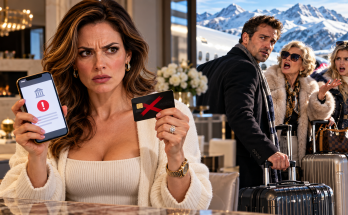
The first thing buried by the blast was a white Mercedes.
The second was a black Range Rover.
The third was the lie Denise Caldwell had been telling two hundred homeowners about who actually owned the mountain.
I stood behind the reinforced glass of my quarry control office and watched a brown wall of dust roll across the eastern bench while car alarms screamed beneath it.
Beside me, County Deputy Aaron Walsh lowered his binoculars.
“Tell me those cars were empty.”
“They were,” I said.
“You’re sure?”
“I cleared the zone myself.”
He looked toward the parking area Denise Caldwell had created that morning by cutting my chain, removing my warning signs, and directing sixty-three luxury vehicles onto an active quarry bench that had been closed to the public for eleven years.
“You knew this was coming?”
“I knew the blast was coming.”
I turned toward him.
“I didn’t know Denise would park a wedding on top of it.”
Three hours earlier, she had smiled at me through the open window of her pearl-white golf cart and said seven words I still remembered perfectly.
“You don’t own the mountain anymore, sweetheart.”
She had been wrong about the mountain.
What worried me was why she had suddenly become so certain.
My name is Claire Mercer.
I’m thirty-eight years old, and until that Saturday, the most dramatic thing I had ever done in public was ask a contractor to leave my property after he ignored a safety briefing twice.
I don’t scream.
I don’t threaten.
I don’t throw coffee.
I keep records.
I take photographs.
I read contracts.
And when someone tells me they own something I know belongs to me, I usually let them finish talking before I show them exactly how expensive that mistake is going to become.
Mercer Ridge Quarry sits outside a small Colorado town called Red Pine, about forty minutes west of Fort Collins.
My grandfather opened it in 1968.
My father ran it for thirty-four years.
I inherited the property when he died.
Four hundred and twelve acres.
Two active extraction areas.
One maintenance yard.
A private haul road.
A spring-fed pond.
And an eastern bench that had been dormant for nearly a decade until a new county infrastructure contract required us to reopen it.
That mattered.
Because beyond the eastern ridge sat Willow Crest Estates.
Willow Crest had arrived much later.
The first homes went up in 2012.
Then came another phase.
Then another.
Then a clubhouse.
Then a pool.
Then stone entrance pillars.
Then newsletters.
Then committees.
Then professionally printed signs reminding everyone that Willow Crest represented “Mountain Living Without Compromise.”
The neighborhood did not own the mountain.
It did not own the quarry.
It did not own my access road.
It did not own the trees between us.
It definitely did not own my blasting bench.
But Denise Caldwell behaved as though county property records were suggestions written by people who had never attended a proper fundraiser.
Denise was fifty-three, blond, polished, and always dressed as if a television crew might surprise her at any moment.
She was president of the Willow Crest HOA.
Not elected originally.
Appointed.
Then reelected twice because nobody else wanted the job.
She had turned a voluntary neighborhood board into something between a country club and a minor monarchy.
She approved mailbox colors.
She sent violation letters over basketball hoops.
She once fined a retired firefighter because his American flag bracket was four inches wider than the architectural guidelines allowed.
But until that summer, her kingdom ended at the subdivision entrance.
Then the wedding happened.
Her daughter Madison was marrying a Denver real estate developer named Blake Harrington.
Three hundred guests.
Imported flowers.
A twelve-piece band.
Valet service.
Outdoor ceremony.
Drone photography.
Fireworks had been proposed until the county rejected them.
The clubhouse parking lot held maybe eighty cars.
The overflow field held another forty.
Denise needed space for at least one hundred more.
She decided my quarry could provide it.
Not metaphorically.
Literally.
She wanted to use the eastern bench as valet parking.
The first email arrived twelve days before the wedding.
“Dear Ms. Mercer,
As part of Willow Crest’s community partnership initiative, we will be temporarily utilizing the flat gravel area east of Ridge Trail for guest overflow parking on September 12.”
Not asking.
Informing.
I replied four minutes later.
“No.
That area is private quarry property and an active industrial exclusion zone. No vehicles or pedestrians are permitted.”
Her response came an hour later.
“I believe you may be mistaken about the boundary.”
I sent her the survey.
She sent me an HOA map.
Her map had a decorative green shape labeled “Community Open Space.”
My survey had coordinates, monuments, county stamps, title references, and the signature of a licensed surveyor.
I wrote:
“The HOA illustration is not a legal boundary document.”
That should have ended it.
It didn’t.
Two days later, one of my foremen found three men measuring the east bench.
They wore polo shirts from Harrington Signature Events.
I drove out.
“Can I help you?”
One of them smiled.
“We’re marking valet lanes.”
“On whose authorization?”
“Willow Crest HOA.”
“You’re on Mercer Ridge Quarry property.”
He checked his tablet.
“No, ma’am. We were told this parcel belongs to the association.”
“It doesn’t.”
He looked uncertain.
I pointed toward a steel sign twenty feet behind him.
PRIVATE INDUSTRIAL PROPERTY.
NO TRESPASSING.
ACTIVE BLASTING AREA.
“Do your event plans usually include those?”
That got their attention.
They packed up.
I photographed their truck, their stakes, the placement marks, and the tire tracks.
Then I called Denise.
She answered on speaker.
I could hear silverware and voices in the background.
“Claire, I’m in a luncheon.”
“Your contractors trespassed into an active quarry.”
A pause.
Then a little laugh.
“Oh, for heaven’s sake. They were measuring gravel.”
“Private gravel.”
“It’s an unused lot.”
“It’s a regulated industrial area.”
“It hasn’t been used in years.”
“It’s being reopened.”
“For what?”
I looked through my windshield toward the drilling rig positioned near the western face.
“Quarrying.”
Silence.
Then she said something strange.
“You can’t do that.”
That was the first moment I knew this was about more than parking.
Not, “Please don’t.”
Not, “Can we negotiate?”
Not even, “That will ruin the wedding.”
She said:
“You can’t do that.”
I asked, “Why?”
Her voice changed.
Not much.
Just enough.
“Because it will affect the community.”
“The quarry predates the community by forty-four years.”
“You know what I mean.”
“No. I don’t.”
She hung up.
The next morning, I found a stop-work notice zip-tied to our main gate.
It looked official.
County logo.
Reference number.
Bold red heading.
TEMPORARY SUSPENSION OF EXTRACTION ACTIVITY.
My operations manager, Miguel Santos, stared at it.
“We have a problem?”
I pulled out my phone.
“We’re about to find out.”
The county planning office had no record of the notice.
Neither did the sheriff’s office.
Neither did the state mine safety inspector.
The reference number belonged to a drainage permit issued to a grocery store two towns away.
The document was fake.
Deputy Walsh came out that afternoon.
He took the notice.
He photographed the gate.
He asked who might benefit from shutting us down.
I gave him Denise’s emails.
He read them twice.
Then he looked toward Willow Crest.
“That woman?”
“That woman.”
He exhaled.
“I’ll speak with her.”
“Please do.”
He returned an hour later looking irritated.
“What did she say?”
“She says she knows nothing about the notice.”
“Do you believe her?”
“I don’t get paid to believe people.”
That was one reason I liked Aaron Walsh.
“What else?”
“She says there’s a property dispute.”
“There isn’t.”
“She says the HOA has documents.”
“Did she show you?”
“No.”
That was reason number two.
I spent the next three days preparing.
Not for Denise.
For the quarry.
The eastern bench had to be cleared as part of a scheduled rock removal operation.
We had survey stakes, engineering plans, contractor certifications, safety boundaries, county notifications, warning signs, physical barriers, and a controlled work schedule.
Nothing unusual.
Nothing secret.
Nothing spontaneous.
The blast was scheduled for 2:00 p.m. Saturday.
Denise’s daughter’s wedding was scheduled for 4:30.
When I realized the dates overlapped, I immediately notified her again.
Certified letter.
Email.
Courier delivery.
And a copy hand-delivered to Willow Crest security.
The message was simple:
ACTIVE QUARRY OPERATIONS SEPTEMBER 12.
EASTERN BENCH CLOSED.
NO PUBLIC ACCESS.
NO PARKING.
NO EVENTS.
I thought that was enough.
Then Friday night, the chain disappeared.
I arrived at 6:10 Saturday morning.
The padlock from the eastern service road had been cut cleanly through.
Our three warning signs had been removed.
Bright wooden arrows had been planted along the road.
WEDDING PARKING.
A valet tent stood near my aggregate stockpile.
Two teenagers in white shirts were unfolding traffic cones.
I parked across the road.
One of them waved.
“Ma’am, vendor entrance is up top.”
“This is my property.”
He froze.
The second kid slowly stopped unfolding a cone.
“Uh…”
“Who told you to set up here?”
A man stepped from behind the tent.
Mid-forties.
Gray suit.
Headset.
Smile sharpened by years of handling wealthy clients.
“Good morning. I’m Travis Cole with Harrington Events.”
“We’ve met by email.”
His smile weakened.
“I understand there’s been some confusion.”
“There’s no confusion.”
I pointed to the cut chain hanging from my fence.
“That’s criminal damage.”
“We didn’t cut anything.”
“Who did?”
“I couldn’t say.”
“Pack up.”
He glanced uphill.
“Mrs. Caldwell specifically authorized this.”
“Mrs. Caldwell doesn’t own this land.”
He lowered his voice.
“She has documentation.”
“Then she can show it to a judge.”
A black SUV pulled in behind me.
Then another.
Then Denise’s pearl-white golf cart rolled between them like a parade float.
She wore an emerald-green dress even though the ceremony was still ten hours away.
Her daughter Madison sat beside her in a silk robe, looking exhausted.
Denise climbed out.
“Claire.”
“Denise.”
She looked at the cut chain.
Then at me.
“Must we do this today?”
“You’re asking me?”
“My daughter is getting married.”
“Congratulations.”
“There are three hundred guests arriving.”
“Not here.”
Her jaw tightened.
“We have a temporary access agreement.”
“With whom?”
“The rightful property authority.”
“That should be interesting.”
She reached into her golf cart and pulled out a blue folder.
Inside was a photocopied plat map.
She tapped the eastern bench.
“There.”
I looked at it.
The map was dated 1994.
The quarry boundary line was real.
The handwriting across it was not.
Someone had written:
FUTURE RECREATIONAL EASEMENT — TRANSFERRED 2009.
No recording number.
No county stamp.
No notarized instrument.
Nothing.
“Where is the recorded easement?”
She folded her arms.
“Our counsel has it.”
“Name?”
“You’ll hear from him.”
“Then your counsel can explain it to the sheriff.”
Madison shifted uneasily.
“Mom…”
Denise ignored her.
“You have bullied this community for years.”
That almost made me laugh.
“How?”
“Truck noise. Dust. Industrial activity. Property-value suppression.”
“You built houses next to a quarry.”
“That quarry was supposed to close.”
“Who told you that?”
She hesitated.
Only for half a second.
But I saw it.
“Everyone understood it.”
“Everyone who?”
“The developers. The county. Homeowners.”
I took one step closer.
“Who told you this quarry was supposed to close?”
She stared at me.
Then smiled.
It was the wrong smile.
The kind people use when they’ve decided they know something you don’t.
“You don’t own the mountain anymore, sweetheart.”
I remember the breeze lifting the edge of her blue folder.
I remember the smell of pine and diesel.
I remember Madison looking down.
I remember Travis Cole suddenly becoming very interested in his phone.
And I remember realizing Denise genuinely believed the sentence she had just spoken.
Not pretended.
Believed.
That made her more dangerous.
Because arrogance is annoying.
Confidence backed by unknown paperwork can cost you land.
I called Deputy Walsh.
Then I called my attorney.
Then I called my blasting contractor and suspended access to the east bench until law enforcement cleared every unauthorized person.
I didn’t cancel the operation.
I didn’t threaten Denise.
I didn’t touch her cones.
I documented everything.
Because anger feels powerful for five minutes.
Paperwork stays powerful in court.
By 8:30, a sheriff’s cruiser arrived.
Aaron stepped out.
Denise walked toward him first.
Of course she did.
“Deputy, thank goodness.”
She pointed at me.
“This woman is interfering with a private community event.”
Aaron looked at the cut chain.
Then the valet tent.
Then the WEDDING PARKING arrows.
“Mrs. Caldwell, we spoke yesterday.”
“Yes, and I told you there is an ownership dispute.”
“An ownership dispute doesn’t authorize you to cut locks.”
“I did no such thing.”
“Who did?”
“I have no idea.”
He looked at Travis.
Travis raised both hands.
“Our crew arrived after six. The entrance was already open.”
Aaron turned to me.
“You have cameras?”
“Three.”
Denise’s face changed.
Only slightly.
But again, I saw it.
I opened the security app.
At 4:47 a.m., headlights appeared.
A dark pickup stopped by the chain.
A man in a baseball cap stepped out.
Bolt cutters.
Thirty seconds.
Chain gone.
He removed the signs.
Then another vehicle arrived.
Pearl-white golf cart on a utility trailer.
The driver unloaded it.
The camera caught the side of his face.
Aaron zoomed in.
Denise said nothing.
Madison whispered, “Oh my God.”
The man was Denise’s husband, Robert Caldwell.
Denise recovered fast.
“He must have misunderstood.”
Aaron looked at her.
“With bolt cutters?”
“He thought we had permission.”
“From whom?”
“Our attorney.”
“Name?”
Again, Denise avoided the question.
Aaron took Robert’s information.
Then he ordered the valet equipment removed from quarry property.
For twenty minutes, I believed the problem was solved.
That was my mistake.
At 10:05, Aaron left to respond to a rollover accident on Route 14.
At 10:40, Denise’s crew returned.
Not through the service road.
Through Willow Crest.
Somewhere behind the clubhouse, contractors had removed forty feet of decorative split-rail fence and laid temporary mats across the drainage swale separating the subdivision from my property.
Cars began entering from the neighborhood side.
I was at the west office reviewing production sheets when Miguel called.
“You need to see this.”
I stepped outside.
Across the ridge, sunlight flashed from windshields.
One row.
Then two.
Then three.
Black SUVs.
Mercedes sedans.
Cadillacs.
A Porsche.
A vintage Mustang.
Rental vans.
By 11:15, more than fifty vehicles sat in neat wedding rows on the eastern bench.
People were walking among them.
Valets were taking keys.
A woman in heels was posing for photographs beside one of my warning berms.
Miguel stared.
“She can’t be serious.”
“She’s very serious.”
“Blast is in less than three hours.”
“Not with civilians in the zone.”
“You cancel?”
“Not yet.”
I called Aaron.
Voicemail.
I called dispatch.
They had units tied up.
I called the event company.
Travis answered.
“Claire, I don’t want a confrontation.”
“Then remove every vehicle.”
“We have been assured the land is legally available.”
“By Denise?”
“By counsel.”
“Name the lawyer.”
Silence.
“Travis.”
“I’m not authorized.”
“Then listen carefully. This is an active quarry. You are placing guests in a restricted industrial area after written notice.”
“The guests aren’t staying. It’s parking only.”
“Cars contain gasoline. Valets are people. Drivers are people.”
“We’ll be finished before the ceremony.”
“The issue isn’t the ceremony.”
I looked toward the east bench.
“It’s the mountain.”
He went quiet.
I ended the call.
At noon, Madison Caldwell came to my office alone.
No mother.
No photographer.
No entourage.
Just a twenty-nine-year-old woman in jeans, sneakers, and a white button-down shirt with her hair pinned halfway up.
She looked nothing like the spoiled bride I expected.
She looked terrified.
“Can I come in?”
I opened the door.
She stepped inside and stared through the glass toward the bench.
“Those cars really can’t be there?”
“No.”
“Is there actually going to be blasting?”
“Yes.”
“Today?”
“Yes.”
She closed her eyes.
“My mother said you were bluffing.”
“I don’t bluff with explosives.”
She swallowed.
“She said the quarry wasn’t operational.”
“It is.”
“She said the county was shutting you down.”
“They aren’t.”
“She said we own that lot.”
“You don’t.”
Madison leaned against a cabinet.
“What is she doing?”
That question sounded painfully sincere.
“I was hoping you could tell me.”
She looked toward the mountain.
Then she said, “The wedding wasn’t supposed to be here.”
“What?”
“We booked a hotel in Estes Park.”
“When?”
“Last year.”
“Then why Willow Crest?”
“My mother changed it three months ago.”
“Why?”
“She said having it at the clubhouse would be more meaningful.”
“Was it?”
“No.”
Her answer came too fast.
“She became obsessed with having it here. She doubled the guest list. Hired drone photographers. Ordered giant lights. She wanted everyone facing the ridge during dinner.”
I studied her.
“The ridge?”
“Yes.”
Not the lake.
Not the flower garden.
Not the mountain sunset.
The ridge.
“What exactly did she say?”
Madison thought.
“She kept saying people needed to ‘see what was about to become possible.’”
A cold little feeling formed behind my ribs.
“When did she start saying that?”
“After she met Blake’s father.”
“Your fiancé’s father?”
“Charles Harrington.”
I knew the name.
Most people in northern Colorado did.
Harrington Development Group had built luxury subdivisions, retail centers, two golf communities, and a resort outside Vail.
They had also purchased hundreds of acres east of Willow Crest in the previous eighteen months.
Land that was beautiful.
Land that had highway access.
Land that would be worth a fortune.
Except for one problem.
My quarry sat between much of it and the best access corridor.
And active quarry operations complicated the image of premium mountain living.
“Madison,” I said slowly, “does Charles Harrington have any interest in this property?”
She looked at me.
“I thought Blake did.”
“What?”
“Blake told me your quarry was becoming part of the next development phase.”
My pulse didn’t change.
But everything else did.
“What development phase?”
She pulled out her phone.
Opened an email.
Scrolled.
Then handed it to me.
The attachment was a glossy investment rendering.
HARRINGTON SUMMIT.
Luxury residences.
Boutique hotel.
Equestrian center.
Retail village.
Private trails.
And directly where my quarry sat, the rendering showed a blue lake surrounded by homes.
My quarry.
My office.
My crushing yard.
My eastern bench.
Gone.
Replaced by water and expensive roofs.
Across the top:
PROPOSED PHASE III — FOR INVESTOR REVIEW ONLY.
I zoomed in.
“Where did you get this?”
“Blake sent it to me by mistake in June.”
“Does your mother have it?”
“Yes.”
“How?”
“I showed her.”
“When?”
“The week she moved the wedding.”
There it was.
Not the whole answer.
But the first twist.
The wedding was never just a wedding.
It was a demonstration.
Three hundred affluent guests.
Investors.
Real estate people.
Bankers.
County donors.
Potential buyers.
All positioned with a perfect view of the land Denise believed Harrington Development was about to absorb.
If she could make the quarry look inactive…
If she could occupy it publicly…
If she could show cars parked where trucks normally ran…
She could create an image.
An image has no legal power.
But images sell stories.
And stories attract money.
Madison whispered, “You look angry.”
“I’m thinking.”
“My mother said you were unreasonable.”
“Your mother parked sixty cars in a blasting zone.”
“That sounded more reasonable when she explained it.”
Despite everything, I almost smiled.
Madison didn’t.
“Claire, is anyone in danger?”
“Not if they leave.”
“Will you cancel?”
“If I have to.”
Her shoulders loosened.
I continued.
“But the quarry cannot operate with people trespassing every time someone wants to prove it’s inactive.”
“So what happens?”
“That depends on what your family does next.”
She looked ashamed.
“Blake’s family.”
“And yours.”
That hurt her.
Good.
Truth sometimes should.
At 12:37, Deputy Walsh returned.
This time he brought another cruiser.
And this time I showed him Harrington Summit.
His expression changed.
“This public?”
“No.”
“Who sent it?”
“Bride’s fiancé.”
Madison nodded.
Aaron rubbed his jaw.
“So the developers want the quarry.”
“Looks that way.”
“Still doesn’t explain fake county paperwork.”
“No.”
“Or the easement.”
“No.”
He turned toward the east bench.
“I’ll clear the cars.”
And he did.
Mostly.
Deputies entered through the neighborhood side and began directing valets to move vehicles.
Guests complained.
Someone filmed.
One man demanded Aaron’s badge number.
Another woman asked if her Bentley could remain because she was wearing expensive shoes.
By 1:15, thirty-nine cars were gone.
By 1:30, fifty-eight were gone.
At 1:38, the last valet drove a silver Lexus out.
Miguel walked the bench.
Two quarry employees checked the access road.
A deputy swept the parking area.
Empty.
No people.
No vehicles.
We locked both entrances.
Aaron stayed.
Denise stood on the Willow Crest side of the temporary fence with at least twenty guests behind her.
“You are destroying my daughter’s wedding!” she shouted.
I was sixty yards away.
I didn’t shout back.
I walked closer.
Stopped behind my property line.
And said, “Your daughter asked you to move the wedding.”
Madison stood behind her mother.
Denise turned.
Madison’s face went pale.
“I told Claire the truth.”
For the first time all day, Denise lost control.
Not completely.
Just enough.
“You had no right.”
Madison stared at her.
“It’s my wedding.”
“That is exactly why I’m doing this!”
“No. You’re doing this for Harrington.”
People nearby became quiet.
Blake Harrington stepped forward.
Tall.
Handsome.
Thirty-two.
Navy suit.
The kind of face developers put in charity-gala photos.
“Madison, this isn’t the place.”
She laughed once.
“You made it the place.”
Denise looked at me.
“This is family business.”
“You brought your family business onto my quarry.”
Blake approached the boundary.
“Ms. Mercer, we can discuss a purchase.”
“There’s nothing to discuss.”
“Every property has a number.”
“Not every owner needs your money.”
His smile disappeared.
Behind him, a silver-haired man stood under the clubhouse portico.
Charles Harrington.
He didn’t speak.
He just watched.
That bothered me more than Blake.
Because powerful people usually talk when they still think persuasion matters.
Charles was watching as if persuasion had already ended.
At 1:52, my contractor confirmed the work area was secure.
At 1:55, warning signals sounded.
At 1:57, another perimeter confirmation came through.
At 1:59, I watched the ridge.
So did everyone else.
Denise stood with her arms folded.
Defiant.
Blake stared at me.
Charles Harrington stared at the bench.
And Madison had tears in her eyes, although I don’t think they were about the wedding anymore.
Then my radio crackled.
“Hold.”
One word.
Everything stopped.
Miguel turned.
“What?”
A quarry employee had spotted movement beyond the aggregate stockpile.
We searched.
Thirty seconds later, one of our workers found a young valet sprinting toward the fence.
He had gone back for a guest’s keys.
Apparently someone had left them in the valet tent.
The tent had been removed.
The key box hadn’t.
The kid was nineteen.
White face.
Shaking hands.
He crossed the boundary and nearly collapsed.
I walked toward him.
“You okay?”
“I didn’t know.”
“You passed three barriers.”
“Mrs. Caldwell said it was safe.”
Denise yelled from across the boundary.
“That is not what I said!”
The kid turned toward her.
“Yes, it is!”
Silence.
Aaron looked at Denise.
She stepped backward.
That was the moment the crowd changed.
Not all at once.
People didn’t suddenly become brave.
They simply became uncertain.
And uncertainty is the beginning of the end for anyone whose power depends on appearing unquestionably right.
At 2:07, the zone was cleared again.
The operation proceeded.
The sound came first.
Deep.
Heavy.
Not like a movie explosion.
More like the mountain itself had slammed a door.
The eastern face moved.
Dust rose.
Rock settled within the controlled area.
For three seconds, everything worked exactly as planned.
Then the old bench gave way.
Not the blasted face.
The bench below it.
A section of weathered material, already fractured from decades of freeze and thaw, slumped into the unauthorized parking rows.
No people were there.
But Denise’s crew had failed to remove every vehicle.
Three had been left behind near the lower edge.
A Mercedes.
A Range Rover.
A Cadillac Escalade.
The Mercedes disappeared first beneath dirt and broken rock.
The Range Rover tipped sideways.
The Escalade vanished to the roofline.
Car alarms began screaming.
Guests gasped.
Somebody dropped a champagne glass.
Dust rolled over the bench.
Deputy Walsh stared at the vehicles.
“Tell me those cars were empty.”
“They were.”
“You’re sure?”
“I cleared the zone myself.”
The dust drifted.
Denise stood frozen.
Her emerald dress looked almost black through the haze.
Then a man behind her shouted, “That’s my Range Rover!”
Another voice yelled, “My Mercedes!”
Denise turned toward them.
“It’s insured!”
That was not the right thing to say.
The owner of the Mercedes pushed through the crowd.
“You told me it was safe!”
“I said the parking area had been approved!”
“By who?”
Blake stepped toward his father.
Charles Harrington finally moved.
Not toward Denise.
Away from her.
He walked toward the clubhouse.
Quietly.
Almost casually.
I watched him go.
And I knew immediately that Denise was no longer useful to him.
By 2:30, the wedding had collapsed into arguments.
The band hadn’t started.
Half the guests were filming the buried cars.
Two local news vans appeared after someone posted video online.
A photographer climbed onto a stone planter until a deputy told him to get down.
Madison changed out of her wedding dress before she ever walked down the aisle.
Blake followed her into the clubhouse.
They came back out separately.
She wasn’t wearing her engagement ring.
That was one mini-payoff I hadn’t expected.
But Denise still wasn’t finished.
At 3:12, she approached me with a lawyer.
Finally.
He introduced himself as Peter Langford.
Denver.
Real estate.
Expensive watch.
Perfect teeth.
His handshake was dry and brief.
“Ms. Mercer, there appears to have been a serious accident involving property invited onto land under a disputed easement.”
“There was no accident involving people.”
“Vehicles were damaged.”
“Vehicles illegally left inside a closed industrial area.”
He smiled.
“That will be litigated.”
“Probably.”
He wasn’t prepared for that answer.
People expect fear when they say “litigated.”
My father taught me something different.
Lawsuits are not magic spells.
Sometimes they are simply expensive ways to discover who kept better records.
Langford opened his briefcase.
“I have documentation establishing an easement.”
“Show me.”
He did.
This one was better.
Much better.
Not handwriting on a plat.
A recorded-looking document.
Legal description.
Signatures.
Notary.
Transfer language.
Dated November 2009.
It purported to grant a permanent recreational and access easement across thirty-eight acres of the eastern quarry.
Grantor:
Thomas Mercer.
My father.
I stared at his signature.
For the first time that day, I felt something cold.
Because it looked real.
Not close.
Real.
Peter saw it in my face.
“So,” he said softly, “perhaps now you understand Mrs. Caldwell’s confidence.”
Denise stood behind him.
Her expression returned.
Not a smile exactly.
Something worse.
Vindication.
I took a photograph.
Then another.
“What recording number?”
Peter pointed.
I copied it.
Aaron looked over my shoulder.
“You’ve seen this before?”
“Never.”
Denise crossed her arms.
“Your father understood this land had a future.”
I ignored her.
I called my attorney, Rachel Kim.
She answered on the second ring.
“Please tell me nobody died.”
“Nobody died.”
“Good start.”
“I’m sending you an easement.”
“Send.”
I did.
Thirty seconds.
Forty.
Then Rachel said, “Where did this come from?”
“Denise’s attorney.”
“Is he standing there?”
“Yes.”
“Ask him for the original.”
I did.
Peter’s expression barely changed.
“This is a certified copy.”
“Certified by whom?”
“The recording office.”
Rachel heard him through speakerphone.
“Bull.”
Peter stiffened.
I almost smiled.
Rachel continued.
“I’m in the county database now. That recording number exists.”
My stomach tightened.
“What is it?”
“A utility easement.”
“For what land?”
“Not yours. Parcel eighteen miles south.”
I looked at Peter.
His face changed.
Not much.
Enough.
Rachel said, “Claire, the document is fabricated.”
Denise’s mouth opened.
Peter snapped his briefcase shut.
Aaron stepped between him and the parking lot.
“Counselor, don’t leave.”
Peter’s professional smile vanished.
“I have not been accused of any crime.”
“No,” Aaron said. “I’m just really interested in where you got that paper.”
Denise turned toward Peter.
“You said it was recorded.”
“It was provided to my office.”
“By who?”
He looked at her.
For the first time, they looked like strangers.
That was twist number two.
Denise had believed the easement.
At least part of it.
She wasn’t the architect.
She was the useful person who needed to feel important.
Someone had handed her exactly what she wanted to believe.
The HOA president who hated the quarry had been given proof that the quarry was already half gone.
The mother desperate to host a spectacular wedding had been given a reason to occupy it publicly.
The developers got their demonstration.
The photographers got their images.
And if the quarry had canceled operations because of community pressure, Harrington could later point to the inactivity.
It was elegant.
Until the mountain buried the cars.
Deputy Walsh asked Peter to remain for questioning.
Peter called another attorney.
Denise began calling Robert.
He didn’t answer.
Madison sat alone on the clubhouse steps.
Blake was gone.
So was Charles Harrington.
By sunset, the wedding was officially canceled.
The guests left.
Tow trucks waited for the quarry to be declared accessible.
News crews gathered along the county road.
The buried Mercedes appeared on three Denver stations.
Someone uploaded a video titled:
HOA WEDDING PARKING VS. ACTIVE QUARRY.
It had 600,000 views before midnight.
That should have felt satisfying.
It didn’t.
Because my father’s signature was still bothering me.
The easement was fake.
The recording number was fake.
But the signature?
I had spent my childhood watching Dad sign payroll checks, equipment leases, tax forms, Christmas cards, school permission slips, birthday notes.
That curve in the T.
That compressed M.
That final upward slash.
It was either an extraordinary forgery…
or copied from something real.
At 11:18 p.m., long after the deputies left and the wedding decorations went dark, I sat in my office with a box of my father’s records.
Miguel came through the door carrying two coffees.
“You staying all night?”
“Maybe.”
He put one beside me.
“What are you looking for?”
“My father’s signature.”
“You have a thousand.”
“Exactly.”
I showed him the fake easement.
Miguel studied it.
“You think Denise made this?”
“No.”
“Harrington?”
“Maybe.”
He frowned.
“Why would a company that big forge a document?”
“Because somebody thinks the real paperwork says something useful.”
That stopped him.
“You think there’s a real easement?”
“I think forgery is usually faster when you start with a document that already exists.”
We searched.
Old lease folders.
Mineral-rights agreements.
County permits.
Environmental reviews.
Equipment loans.
Surface-use records.
Nothing.
At 1:06 a.m., Miguel went home.
At 1:42, I found a manila envelope tucked inside a 2008 property-tax folder.
No label.
Inside were three photocopies.
The first was a survey.
The second was a letter from Harrington Land Holdings.
Not Harrington Development Group.
Harrington Land Holdings.
Dated February 2009.
Dear Mr. Mercer,
We appreciate your willingness to discuss long-term access options affecting the eastern ridge. As noted, the proposed arrangement would not interfere with active mineral extraction and would become effective only upon permanent cessation of quarry operations.
I read that sentence three times.
Would become effective only upon permanent cessation.
The third page was missing.
I searched the envelope.
Nothing.
Then I noticed handwriting on the back.
My father’s.
CHARLES WANTS ACCESS BEFORE CLOSURE.
NO.
MINERAL RIGHTS CONTROL EVERYTHING.
SEE FILE M-17.
File M-17.
I searched every cabinet.
Nothing.
At 2:30, I called Rachel.
She answered sounding half asleep.
“You’re lucky I like you.”
“What does ‘mineral rights control everything’ mean?”
“That depends on the deed.”
“I found a 2009 letter from Harrington Land Holdings.”
She was awake now.
“What?”
I read it.
Silence.
Then keyboard clicks.
“Claire.”
“What?”
“Harrington Land Holdings still exists.”
“Charles?”
“Looks like it.”
“Any filings?”
“Give me a second.”
More clicking.
Then she went quiet.
“Rachel?”
“You need to photograph every document you found and put the originals somewhere secure.”
“Why?”
“Harrington Land Holdings filed an option agreement in 2009 involving multiple parcels around Willow Crest.”
“My parcel?”
“I can’t tell from this summary.”
“What was the option conditioned on?”
“Quarry closure.”
My coffee suddenly tasted metallic.
“So they’ve been waiting seventeen years?”
“Maybe.”
“Why now?”
Rachel didn’t answer immediately.
Then she said, “Because somebody thinks the condition is about to happen.”
I looked through the office window.
The quarry was dark.
Floodlights glowed around the maintenance yard.
Beyond the ridge, Willow Crest was silent.
No music.
No wedding.
Just expensive houses under a moonless sky.
“My quarry isn’t closing.”
“I know.”
“Then what makes them think it is?”
“I don’t know.”
At 3:11 a.m., I drove home.
At 6:20, I was back.
I had slept maybe two hours.
Deputy Walsh arrived at eight.
He looked worse than I did.
“Got something.”
“So do I.”
He held up his phone.
“You first.”
I showed him the 2009 letter.
He read my father’s handwritten note.
“File M-17?”
“Missing.”
He looked toward the quarry.
“My turn.”
He opened a photograph from Robert Caldwell’s truck.
The truck had been impounded after investigators linked him to the cut gate.
Inside, deputies found bolt cutters, removed warning signs, and a folder.
The folder contained talking points.
Not handwritten.
Printed.
Instructions for Denise.
If challenged, characterize quarry as dormant.
Refer to community access rights.
Do not discuss acquisition.
Direct questions regarding east bench ownership to counsel.
Emphasize decades of recreational use.
Aaron swiped to the second page.
Public occupancy prior to operational restart may support abandonment narrative.
I looked at him.
“Abandonment.”
“Yeah.”
“They wanted photos of the land being used like community property.”
“That’s my read.”
“Would it work?”
“Ask your lawyer.”
“I will.”
“There’s more.”
Next page.
Talking points for media after planned event.
Willow Crest welcomes transition from obsolete industrial use to sustainable residential future.
I almost laughed.
“Planned transition?”
Aaron nodded.
“Your quarry apparently died before anyone told you.”
“Who wrote this?”
“No author listed.”
“Metadata?”
“Detectives are working on it.”
“What did Robert say?”
“That Denise gave it to him.”
“What did Denise say?”
“That Peter Langford gave it to her.”
“What did Peter say?”
“Attorney-client privilege.”
“That’s not how privilege works.”
Aaron smiled.
“That’s exactly what our investigator told him.”
A truck rumbled through the main gate.
We both turned.
Federal Express.
The driver handed me a flat envelope.
No return name.
Inside was a single sheet of paper.
Photocopy.
A county map.
My quarry circled in red.
At the bottom:
PHASE III ACQUISITION DEADLINE — OCTOBER 1.
Below that:
MERCER EXTRACTION LICENSE — TERMINATION PENDING.
I stared at the words.
“My license isn’t pending termination.”
Aaron leaned closer.
“Are you sure?”
I looked at him.
“Yes.”
But suddenly I understood the value of fake paperwork.
One fake notice can be dismissed.
Two can be investigated.
Three can create confusion.
If a bank sees one…
an insurer sees another…
a contractor sees another…
a county employee sees another…
eventually someone reacts as if the fiction is real.
Maybe the plan had never been to legally shut me down.
Maybe the plan was to make enough people believe I was already being shut down that normal business became impossible.
A quarry with no contractors, no insurance, no permits, and no bank support closes whether the deed changes hands or not.
Someone wasn’t trying to steal my land with one document.
They were trying to suffocate it with twenty.
That morning, Rachel filed emergency notices with the county.
She contacted my bank.
My insurer.
Our contractors.
The state.
Every relevant agency received the same message:
Any document claiming Mercer Ridge Quarry had ceased operations, transferred ownership, abandoned mineral rights, granted public access, or entered a sale agreement required direct confirmation from me or my attorney.
By lunch, things got worse.
Our fuel supplier called.
They had received a cancellation notice.
Fake.
Then our equipment lessor called.
They had received notice that operations were suspended.
Fake.
Then my insurance broker called.
Someone had submitted an inquiry stating the quarry was being converted to residential development.
Fake.
Rachel said, “This is coordinated.”
Aaron said, “This is bigger than Denise.”
Miguel said nothing.
He just locked every office cabinet.
At 2:00 p.m., exactly twenty-four hours after the blast, crews began uncovering the buried vehicles.
The Mercedes was destroyed.
The Range Rover was crushed along the passenger side.
The Escalade looked like it had been swallowed by the mountain and reconsidered.
Reporters gathered outside the gate.
I gave one statement.
“No member of the public was injured because established quarry safety procedures were followed. The vehicles entered private industrial property without authorization and remained after repeated warnings. The ownership of Mercer Ridge Quarry has not changed.”
A reporter shouted, “Is the quarry being sold to Harrington Development?”
“No.”
“Are you in negotiations?”
“No.”
“Did your father sign an easement?”
“No valid easement has been produced.”
Then a reporter I didn’t recognize asked:
“Did your father sign a mineral reversion agreement in 2009?”
Everything stopped.
I looked at her.
“What agreement?”
She seemed surprised.
“I was told your office had confirmed it.”
“Who told you?”
She checked her phone.
“Harrington Land Holdings.”
I stepped away from the microphones.
Rachel grabbed my elbow.
“Don’t answer another question.”
“Mineral reversion.”
“I heard.”
“You know what that is?”
“Yes.”
“Do I have one?”
“I don’t know.”
That answer frightened me more than anything Denise had done.
Because Rachel always knew.
We went back inside.
She pulled the chain of title remotely.
Then the mineral deed.
Then an old memorandum.
Twenty minutes later, she said, “I found something.”
“Bad?”
“Complicated.”
“Rachel.”
“In 1978, your grandfather purchased the surface estate and certain mineral rights from Red Pine Aggregate Corporation.”
“I know.”
“But part of the mineral estate may have been structured through a production covenant.”
“Meaning?”
“If commercial extraction permanently ceases, some subsurface rights may revert.”
“To who?”
“The successor entity.”
“Harrington?”
“No.”
I exhaled.
Then she continued.
“But Harrington bought options from the successor entity.”
There it was.
The mountain beneath my feet seemed to change shape without moving.
“They don’t need my land.”
“They may need your quarry to stop operating.”
“If operations permanently cease, mineral rights revert.”
“Possibly.”
“And Harrington exercises its option.”
“Possibly.”
“Then they have leverage over everything above it.”
“Potentially.”
I sat down.
Suddenly Denise’s behavior made sense in a different way.
Fake shutdown notices.
Claims the quarry was dormant.
Public occupation of the bench.
Media language calling it obsolete.
Investor renderings showing the quarry gone.
They weren’t just preparing people for a sale.
They were building a narrative that quarry operations had already ceased.
“But we’re operating,” I said.
“Yes.”
“We have production records.”
“Yes.”
“Contracts.”
“Yes.”
“Employees.”
“Yes.”
“Permits.”
“Yes.”
“So they lose.”
Rachel stared at the screen.
“Unless they have evidence your operation legally terminated before you restarted it.”
“It never terminated.”
“Your father shut the eastern bench for years.”
“The quarry stayed open.”
“I know.”
“Then what?”
She scrolled.
Her expression changed.
“What?”
She didn’t answer.
“Rachel.”
“There’s a filing from 2018.”
My father was alive then.
“What filing?”
“A cessation declaration.”
My skin went cold.
“Signed by who?”
She turned the laptop toward me.
The signature read:
Thomas Mercer.
My father.
I stared.
It looked real.
More real than the fake easement.
My phone began ringing.
Miguel.
I answered.
“Claire, you need to come to the north shed.”
“What happened?”
“I found M-17.”
I was already moving.
The north shed had belonged to my father.
Old welding equipment.
Chains.
Parts.
Boxes no one had touched after he died.
Miguel stood beside a steel cabinet bolted to the wall.
The lock had been drilled recently.
Inside were folders.
M-11.
M-12.
M-14.
M-17.
I pulled the file.
The first document was the original 2009 proposal from Charles Harrington.
My father had rejected it.
The second was a letter from Red Pine Mineral Trust.
The third was an attorney memo.
The fourth was a handwritten note.
Claire must never sign continuation waiver without full mineral audit.
Continuation waiver?
I flipped the page.
Then stopped.
There was a photograph.
My father standing beside Charles Harrington.
Between them stood another man.
I recognized him immediately.
County Commissioner Daniel Voss.
The same Daniel Voss who had publicly called the quarry “an important legacy employer.”
The same Daniel Voss who had signed my most recent operating permit.
The same Daniel Voss who had called me after Dad died and said:
“Your father trusted me. If you ever need anything, call.”
On the back of the photograph my father had written:
They think I’ll close voluntarily.
They’re wrong.
Underneath:
If anything happens to me, audit 2018 cessation filing.
My hands went still.
Miguel whispered, “Claire…”
I pulled the 2018 filing Rachel had found online.
Then compared it with a signature in M-17.
Same name.
Same general shape.
Different pressure.
Different T.
Different final stroke.
Forged.
I called Rachel.
“It’s fake.”
“You’re sure?”
“Yes.”
“How sure?”
“My father left a warning about it.”
Silence.
Then:
“I’m coming out there.”
I turned another page.
Bank statements.
Wire references.
A company called Summit Civic Strategies.
Payments to Peter Langford’s firm.
Payments to a consulting company owned by Robert Caldwell.
Payments to a campaign committee associated with Daniel Voss.
Not proof of criminal activity by themselves.
But enough to ask questions.
A lot of questions.
Miguel stared.
“Denise’s husband was getting paid?”
“Looks like it.”
“How long?”
I checked dates.
“Four years.”
That explained Robert.
Maybe not Denise.
Maybe she believed the land story because the story had been built inside her own house for years.
I kept turning pages.
At the bottom was a sealed envelope.
CLAIRE.
My name in my father’s handwriting.
I sat down before opening it.
Inside was one page.
Claire,
If you are reading this, someone is trying again.
Do not focus on the surface deed. That is what they want.
The quarry is not valuable because of the granite.
It is not valuable because of the road.
It is not even valuable because of the land.
They found something below the east bench in 2008.
I refused every offer after that.
Trust no survey commissioned by Harrington.
Trust no county mineral map after March 2018.
Go to marker 47-B.
The original core sample is still there.
Do not tell anyone until you see it yourself.
Dad.
I read it twice.
Miguel stared at me.
“What did they find?”
“I don’t know.”
“Marker 47-B still exist?”
I looked through the shed door toward the eastern bench.
Toward the exact area where Denise had parked sixty-three cars.
Toward the exact slope blasted yesterday.
Toward the exact ground Harrington wanted people to believe we had abandoned.
“Yes.”
Marker 47-B stood near the old exploration line.
Thirty yards beyond the buried Mercedes.
Aaron arrived twenty minutes later.
I showed him the letter.
He read it carefully.
“You’re going out there?”
“Yes.”
“You’re not going alone.”
“Good.”
Rachel arrived before we left.
She tried to argue that the area should be secured first.
She was right.
So we treated it like evidence.
Photographs.
Video.
GPS location.
Witnesses.
No digging beyond what was necessary.
The marker was old.
Steel.
Rusty.
Half buried.
47-B was barely visible.
Miguel brought the original exploration map.
The map showed a vertical core hole drilled in 2008.
Depth: 612 feet.
Status: sealed.
But beside it, my father had drawn a small red X.
Aaron looked at me.
“What are we looking for?”
“My father said the original core sample.”
Miguel pointed toward a rock-storage container twenty feet away.
It hadn’t been opened in years.
Inside were rows of long wooden core boxes.
Most were rotten.
Numbers stenciled on the ends.
39-A.
41-C.
44-B.
Then:
47-B.
My heart began beating harder.
The box was nailed shut.
Aaron photographed it.
Then nodded.
Miguel opened it.
Inside were cylindrical sections of stone.
Gray.
White.
Black bands.
Nothing dramatic.
No diamonds.
No gold.
No glowing mystery rock.
Rachel exhaled.
“It’s stone.”
Miguel didn’t answer.
He lifted one core segment.
Turned it.
Then rubbed dust from a pale metallic streak.
His face changed.
“What?”
“I’m not a geologist.”
“That wasn’t my question.”
He looked at me.
“We need one.”
Rachel crouched.
“Why?”
Miguel pointed.
“That doesn’t look like granite.”
We sealed the box.
Called an independent geologist from Boulder.
Not someone associated with the county.
Not someone Harrington had hired.
Dr. Ethan Hale arrived after sunset.
He expected a routine dispute.
Then he looked at the core.
His tone changed.
“Where was this drilled?”
“Here.”
“How deep?”
“Six hundred twelve feet.”
“Who logged it?”
“My father.”
“Any assay?”
“Missing.”
Ethan examined several sections with a hand lens.
Then he sat back.
“I need a lab.”
“What do you think it is?”
“I don’t guess from field appearance.”
“Give me a reason my father hid it.”
He looked toward the ridge.
Then toward Rachel and Aaron.
Finally back at me.
“There are mineralized zones in this region that developers would care about.”
“Because they’re valuable?”
“Sometimes.”
“How valuable?”
“That depends entirely on concentration, continuity, access, regulation, extraction economics, a dozen other things.”
“So you don’t know.”
“No.”
He hesitated.
“But if your father received certain assay results in 2008 and someone else learned about them…”
He stopped.
“What?”
“They may not have wanted the quarry closed because it was ugly.”
Nobody spoke.
The next morning, Ethan took documented samples to two independent labs.
By then, the sheriff’s office had opened a broader fraud investigation.
Peter Langford stopped answering Denise’s calls.
Robert Caldwell hired a criminal defense attorney.
Daniel Voss issued a statement calling allegations involving his office “politically motivated misinformation.”
Harrington Development Group denied authoring any fraudulent documents.
Charles Harrington said the Phase III rendering was “conceptual only.”
Blake Harrington released no statement.
Madison called me.
“I left.”
“Blake?”
“Yes.”
“You safe?”
“Yes.”
“Where’s your mother?”
“At home.”
“How is she?”
“Furious at everyone except herself.”
I almost said something cruel.
I didn’t.
Madison continued.
“She didn’t know about the payments to Dad.”
“You believe that?”
“I believe she knew she was pushing something she didn’t understand.”
“That can still hurt people.”
“I know.”
There was a long pause.
Then she said, “She keeps asking why Charles won’t call her back.”
That told me everything I needed to know.
Denise had believed she was entering a powerful circle.
Instead, she had been standing outside the entire time.
Useful until inconvenient.
Important until exposed.
Then disposable.
Three days after the blast, she came to see me.
No golf cart.
No emerald dress.
No folder.
She drove an ordinary gray Volvo and stopped outside the main office.
I almost refused to let her in.
Almost.
Then curiosity won.
She sat across from my desk.
Her makeup was perfect.
Her hands weren’t.
They shook slightly.
“I owe you an apology.”
“That’s a small sentence for a large problem.”
“I know.”
“Do you?”
She looked out the window.
“I thought the quarry was going away.”
“You made sure everyone else thought so too.”
“I believed the documents.”
“You ignored the real ones.”
She flinched.
Fair.
“Robert told me Harrington had already acquired the mineral interests.”
“Robert was being paid by Harrington-connected consultants.”
“I didn’t know.”
“You cut my gate.”
“Robert cut it.”
“You sent the valets back after the sheriff cleared them.”
She looked at the floor.
“Yes.”
“You told a nineteen-year-old kid the area was safe.”
Her eyes closed.
“Yes.”
“That part belongs to you.”
“I know.”
For once, I believed her.
She reached into her purse.
Not dramatically.
Carefully.
She placed a small flash drive on my desk.
“What is this?”
“Robert kept a second laptop.”
“Where?”
“Our lake house.”
“Why are you giving it to me instead of the sheriff?”
“I gave them a copy.”
“Then why come here?”
“Because there’s something on it about your father.”
Every muscle in my body tightened.
“What?”
“An audio file.”
I didn’t touch the drive.
“From when?”
“2009.”
“Who recorded it?”
“I don’t know.”
“What’s on it?”
“Your father talking to Charles Harrington.”
“What did they say?”
Her voice dropped.
“Your father told him no amount of money would make him surrender 47-B.”
I stared at her.
“You listened to it?”
“Yes.”
“What did Charles say?”
Denise looked at me.
“He said if your father wouldn’t close the quarry, someone eventually would.”
My office went silent.
Outside, a loader reversed.
Beep.
Beep.
Beep.
I picked up my phone and called Aaron.
I didn’t play the drive myself.
Evidence had already been manipulated too many times.
The sheriff’s digital unit made an image.
Verified the file.
Preserved metadata.
Then we listened.
My father’s voice filled a small interview room.
Older.
Tired.
unmistakable.
“Charles, the answer is no.”
A second voice.
Calm.
Smooth.
Charles Harrington.
“You are protecting rock you can’t develop.”
“I’m protecting what belongs to my family.”
“You don’t understand what you’re sitting on.”
“I understand better than you think.”
“You’re sixty-three, Tom.”
“So?”
“Eventually Claire inherits this.”
My breathing stopped.
Dad answered.
“That’s the plan.”
Charles laughed softly.
“She won’t want a quarry.”
“You’ve never met my daughter.”
“I know enough.”
“No. You know people who need your money.”
A pause.
Then Charles:
“You can take twelve million now.”
Dad:
“No.”
“Fifteen.”
“No.”
“Twenty.”
“No.”
Another pause.
Then the sentence Denise had warned me about.
“If you won’t close it, somebody eventually will.”
Dad answered immediately.
“Try.”
The recording ended.
Aaron sat motionless.
Rachel looked sick.
I stared at the dark screen.
My father had died seven years later.
Heart attack.
At home.
Age seventy.
No mystery.
No suspicious circumstances.
At least none anyone had ever suggested.
I refused to let my mind invent what evidence did not support.
Not yet.
That matters.
Fear can make coincidences look like confessions.
And I had watched Denise destroy herself by believing what she wanted to believe.
I would not become her in the opposite direction.
We waited for the laboratory results.
The first arrived Friday morning.
Ethan called.
“Claire.”
“Yes.”
“Are you sitting down?”
“I’m standing.”
“Sit.”
I sat.
“The sample contains significant concentrations of several commercially interesting elements.”
“How significant?”
“Enough that I want the second lab before I say anything stronger.”
“What elements?”
He named them.
I knew only two.
Lithium.
And a rare-earth element used in high-performance magnets.
My hand tightened around the phone.
“Worth mining?”
“I did not say that.”
“Worth fighting over?”
Silence.
Then:
“If continuity exists at scale, people could certainly care.”
“How much?”
“Claire, don’t turn one core into a billion-dollar headline.”
“I’m not.”
“Good.”
“What did my father find?”
“Potential.”
Sometimes one word weighs more than a truck.
Potential.
Not treasure.
Not certainty.
Potential.
Enough for a developer to want control.
Enough for investors to care.
Enough for a quiet negotiation in 2009.
Enough for someone to preserve options for seventeen years.
The second lab result was due Monday.
It never arrived.
At 7:13 Monday morning, Ethan called again.
His voice was different.
“Did you receive anything from Summit Analytical?”
“No.”
“Neither did I.”
“Late?”
“No.”
“What happened?”
“The lab was broken into last night.”
I stood up.
“What was taken?”
“They’re inventorying.”
“The quarry samples?”
“I don’t know yet.”
Ten minutes later, Aaron called.
“Stay on the property.”
“Why?”
“Summit Analytical reported burglary.”
“I know.”
“There’s more.”
“What?”
“Your sample chain documents were accessed.”
“By who?”
“We don’t know.”
“Do they have security footage?”
“Some.”
“Some?”
“Server was damaged.”
I looked toward the east bench.
A cold September rain had begun.
Water darkened the scar where the blast had cut the rock.
The buried cars were gone now.
The valet cones were gone.
The wedding arrows were gone.
But the conflict felt closer than ever.
At 8:02, Miguel came into my office carrying a padded envelope.
“Found this at the gate.”
“No delivery label?”
“No.”
I didn’t touch it.
Aaron was twenty minutes away.
We waited.
He opened it.
Inside was a photograph.
Recent.
Taken from somewhere above the quarry.
Telephoto lens.
It showed me, Miguel, Rachel, Aaron, and Dr. Hale standing beside the 47-B core box.
Someone had photographed us the night we found it.
On the back, typed:
YOUR FATHER MADE THE SAME MISTAKE.
Rachel went pale.
Aaron immediately called for additional units.
I stared at the picture.
“No.”
“What?” Aaron asked.
“They want me scared.”
“Claire—”
“No. Look.”
I pointed to the angle.
“This wasn’t taken from Willow Crest.”
Miguel studied it.
“North ridge.”
“Yes.”
The north ridge wasn’t owned by Harrington.
It wasn’t owned by the HOA.
It belonged to the county.
And the only building there was an old communications facility used by the public works department.
Daniel Voss’s county.
By noon, deputies had secured the ridge.
The facility logs showed an authorized vehicle entered at 7:48 p.m. the night we opened M-17.
The access credential belonged to a county engineering supervisor.
He swore he hadn’t been there.
His badge had been cloned.
Another fake.
Another layer.
Another piece of a machine built to make every trail lead somewhere uncertain.
That afternoon, I walked the quarry with Aaron.
Rain tapped against our jackets.
We stopped above the east bench.
He looked at the exposed rock.
“You ever think about selling?”
“Today?”
“Ever.”
“Sure.”
“For twenty million?”
“I’d listen.”
“Your dad didn’t.”
“No.”
“Why?”
I looked toward the ridge.
“That’s what I want to know.”
At 4:26, my phone rang.
Unknown number.
I almost ignored it.
Then answered.
“Claire Mercer?”
“Yes.”
A man’s voice.
Older.
Careful.
“My name is Samuel Beck.”
“I don’t know you.”
“You knew my brother.”
“Who was your brother?”
“Dr. Nathan Beck.”
The name meant nothing.
“I’m sorry.”
“He was a geologist.”
I stopped walking.
Aaron noticed.
Samuel continued.
“He worked at your quarry in 2008.”
I looked at Aaron.
“Why are you calling me?”
“Because I saw the news.”
“What news?”
“The wedding. The buried cars. Harrington.”
My mouth went dry.
“Did your brother drill 47-B?”
Silence.
Then Samuel said:
“Yes.”
I gripped the phone.
“What did he find?”
“I’m not discussing this by phone.”
“Then where?”
“There’s a storage facility in Cheyenne.”
“What’s there?”
“My brother’s records.”
“Why didn’t my father have them?”
Another pause.
“Your father did.”
“Then why are they in Wyoming?”
“Because Tom called Nathan three days before he died.”
Everything around me seemed to disappear.
Rain.
Trucks.
Mountain.
Aaron.
All of it.
“What did my father say?”
Samuel exhaled slowly.
“He told my brother someone had accessed the original assay reports.”
“That’s why Nathan moved them?”
“Yes.”
“Who accessed them?”
“I don’t know.”
“What’s in the reports?”
“I’ve never opened the sealed packet.”
“Why not?”
“My brother told me not to.”
“Your brother is dead?”
“Yes.”
“When?”
“2019.”
“How?”
“Car accident.”
I closed my eyes.
Coincidence.
Could be coincidence.
Had to remain coincidence until evidence said otherwise.
Samuel spoke again.
“There’s something else.”
“What?”
“Your father left an envelope with Nathan.”
“For me?”
“Yes.”
“Why didn’t Nathan give it to me?”
“He tried.”
“When?”
“After your father’s funeral.”
“I never met him.”
“I know.”
“What happened?”
“He said someone followed him from Colorado into Wyoming.”
Aaron was watching my face.
I put the call on speaker.
Samuel continued.
“He got scared. Put everything in storage. After he died, I inherited the account.”
“Why call now?”
“Because yesterday someone tried to access the unit.”
Aaron took one step closer.
“Mr. Beck, this is Deputy Aaron Walsh with Larimer County. Do not go to that storage facility. Give me the address.”
Samuel did.
Aaron started making calls.
I asked one last question.
“Samuel, what did my father write on the envelope?”
He was quiet for so long I thought the call had dropped.
Then he said:
“Three words.”
“What words?”
“Not the quarry.”
I frowned.
“What?”
“That’s what it says.”
Not the quarry.
My father’s letter had told me the quarry wasn’t valuable because of the granite.
Not because of the road.
Not even because of the land.
I looked down at the muddy bench.
At marker 47-B.
At the mountain everyone had been fighting to control.
And suddenly I wondered if we had misunderstood everything.
Maybe 47-B wasn’t the treasure.
Maybe it was evidence pointing toward something else.
That night, the sheriff arranged for Wyoming authorities to secure the storage unit.
Rachel and I drove north the next morning.
Aaron followed in an unmarked SUV.
Cheyenne was cold and bright when we arrived.
The storage facility manager unlocked a corridor lined with orange doors.
Unit C-118.
Samuel Beck stood outside.
Sixty-something.
Gray beard.
Nervous eyes.
He handed over the key.
“I haven’t been inside in years.”
Authorities documented the opening.
The metal door rolled upward.
Boxes.
Camping gear.
A desk.
Two filing cabinets.
An old geological field case.
And against the rear wall, a green steel trunk.
Samuel pointed.
“That.”
The trunk had three locks.
Two were ordinary.
The third was a tamper seal with Nathan Beck’s signature across it.
Unbroken.
Inside were field notebooks.
Core photographs.
Assay reports.
A geological map.
And a sealed brown envelope.
CLAIRE MERCER.
My hands trembled for the first time since this started.
Not because of Denise.
Not because of Harrington.
Because my father had written my name fourteen years before I knew any of this existed.
I opened it.
Claire,
If you are reading this, they finally forced you to look beneath the story everyone knows.
The quarry is a distraction.
47-B was drilled because Nathan and I were investigating a formation that does not stop at our property line.
Do not let Harrington convince you this is about mining.
Mining is only how they found it.
The important map is Nathan’s groundwater map.
I stopped.
“Groundwater?”
Samuel pulled a rolled map from the trunk.
We spread it across the desk.
Blue lines crossed the region.
Aquifers.
Recharge zones.
Subsurface channels.
Rachel leaned forward.
Then she whispered:
“Oh my God.”
The mapped formation ran beneath Mercer Ridge.
Then Willow Crest.
Then thousands of acres Harrington Development had purchased east of us.
And beside several test wells were handwritten flow estimates.
Huge numbers.
Samuel stared at the page.
“This isn’t a mineral map.”
“No,” Rachel said.
“It’s water.”
Northern Colorado.
Development land.
Future subdivisions.
Hotels.
Golf courses.
Thousands of homes.
All requiring one thing more valuable than granite.
More essential than lithium.
More politically sensitive than almost anything else in the West.
Water.
My father’s letter continued.
Nathan believes the ridge sits above one of the most productive confined groundwater structures documented in this county in decades.
If correct, ownership and access rights will affect every major development east of Willow Crest.
Charles knows enough to understand what this means.
He does not know the full extent because I refused to give him Nathan’s final map.
Never sell surface rights without understanding the water beneath them.
And Claire—
If anyone tells you I wanted the quarry closed, they are lying.
I kept it open because continuous industrial use was the simplest way to prevent them from controlling access before you were ready.
I read that sentence twice.
Then a third time.
The quarry had never been the prize.
It was the lock.
The blasting.
The trucks.
The ugly fences.
The industrial permits.
Everything Willow Crest complained about.
Everything Harrington wanted declared obsolete.
My father had kept all of it alive because the quarry prevented someone else from quietly controlling the ridge.
Denise thought she was fighting gravel trucks.
Harrington was fighting for water.
Rachel pointed to the map.
“If this is accurate, every proposed Harrington development east of here has a completely different valuation depending on access.”
Samuel nodded.
“And if Mercer Ridge controls key well locations…”
He didn’t finish.
He didn’t have to.
Aaron’s phone rang.
He walked into the hallway.
Thirty seconds later, he returned.
His expression had changed.
“We need to go.”
“What happened?”
“Fire.”
My stomach dropped.
“Where?”
“Mercer Ridge.”
I was already moving.
We drove south hard.
Not dangerously.
Not recklessly.
But fast enough that every minute felt stolen.
Smoke became visible before we reached Red Pine.
Black.
Heavy.
Rising behind the northern ridge.
When we reached the quarry entrance, fire engines lined the road.
Miguel stood beside the gate.
Alive.
Thank God.
“What burned?”
He looked at me.
“North shed.”
M-17.
The original records.
Gone.
“Anyone hurt?”
“No.”
“Cause?”
“Too early.”
Aaron went straight to the fire marshal.
I walked toward the blackened shell.
Rain from the previous night should have made accidental ignition less likely.
But less likely isn’t impossible.
Nothing was proof yet.
I forced myself to remember that.
Facts first.
Always.
Then Miguel touched my arm.
“There’s something you need to see.”
He led me toward the office.
One of our security monitors had survived because its storage system was remote.
At 3:14 a.m., a vehicle approached the north perimeter.
No headlights.
It stopped beyond the camera angle.
A figure walked toward the shed.
Hood up.
Face hidden.
Then another figure appeared.
The second person turned for half a second.
Just enough.
Miguel froze the frame.
My breath stopped.
I knew the face.
Not Charles Harrington.
Not Blake.
Not Denise.
Not Robert.
County Commissioner Daniel Voss.
The man my father had once called a friend.
Aaron stared at the screen.
“Claire, don’t touch anything.”
“I’m not.”
He enlarged the image.
Voss carried something under his arm.
A folder.
Or a laptop.
Then the camera skipped.
Twenty-three seconds missing.
When the image returned, both men were walking away.
Twelve minutes later, smoke appeared.
Aaron called investigators.
The quarry became a crime scene.
By evening, Daniel Voss could not be located.
His county vehicle was found at Denver International Airport.
His phone was off.
His office claimed he was taking “personal leave.”
No flight was booked under his name.
Harrington Development issued another denial.
Denise stopped answering reporters.
Peter Langford’s law firm announced he had been placed on administrative leave.
The whole structure was cracking.
But it still wasn’t collapsing.
Because the biggest secret remained in the green steel trunk.
The groundwater map.
Nathan Beck’s reports.
My father’s final letter.
Documents the fire hadn’t reached because they had been sitting ninety miles away.
That night, Rachel, Aaron, Miguel, Samuel, and I gathered in my office.
The map covered the conference table.
Ethan Hale joined by video.
We traced the underground formation.
The numbers were preliminary.
Old.
Unverified.
No one pretended otherwise.
But one fact stood out.
The deepest projected channel did not run beneath the eastern bench.
It continued north.
Beyond my quarry.
Under county land.
Then curved east beneath Harrington’s largest undeveloped parcel.
Rachel tapped the map.
“So why obsess over your quarry if the aquifer extends beyond it?”
Samuel looked at his brother’s field notebook.
“Because of this.”
He turned the notebook toward us.
Nathan had written:
PRIMARY ACCESS WINDOW — MERCER RIDGE FRACTURE SYSTEM.
Best drilling access.
Best pressure.
Best geological opening.
My land wasn’t the water.
It was the easiest door to the water.
Aaron leaned back.
“So if Harrington controls the ridge…”
“They control the cheapest access,” Rachel said.
“And potentially the development schedule.”
Miguel shook his head.
“All this over wells?”
Rachel looked at him.
“You’ve never watched western developers fight over water.”
My phone vibrated.
Unknown sender.
One image.
No message.
I opened it.
A photograph of the green steel trunk.
Taken that afternoon.
In Wyoming.
Inside the storage facility.
My blood turned cold.
Someone had been there while we were there.
Watching.
A second image arrived.
This one showed us carrying the documents outside.
A third.
My truck entering Mercer Ridge hours later.
Then text:
TOM WAS SMARTER THAN YOU.
I handed the phone to Aaron.
He immediately started tracing procedures with his department.
Another message appeared before he finished.
ASK YOUR MOTHER WHY HE REALLY DIED.
I stared at it.
My mother.
She lived in Arizona.
Seventy-two.
Retired teacher.
She had never spoken about Harrington.
Never spoken about 47-B.
Never spoken about underground water.
Never spoken about my father being threatened.
I called her.
Straight to voicemail.
Again.
Voicemail.
Third time.
Nothing.
Aaron said, “Don’t keep calling.”
“She always answers.”
“Claire.”
“She always answers.”
I opened our family location app.
Her phone hadn’t moved in six hours.
Home.
Scottsdale.
I called her neighbor.
No answer.
Then my mother called back.
I grabbed the phone.
“Mom?”
Silence.
“Mom?”
Breathing.
Then a man spoke.
Not loudly.
Not dramatically.
Almost politely.
“Ms. Mercer.”
Every person in the office froze.
I put the phone on speaker.
“Who is this?”
“You found Nathan’s map.”
Aaron began silently signaling another deputy.
I kept talking.
“Where is my mother?”
“She’s fine.”
“Put her on.”
“You need to understand something your father never did.”
“What?”
“The ridge was never his to protect.”
I looked at Rachel.
She was already writing notes.
“Who are you?”
The man ignored me.
“Your father had one chance to cooperate.”
“My father died seven years ago.”
A pause.
Then the voice said:
“Yes.”
One word.
Nothing else.
But it landed like a blade.
I forced my voice to stay level.
“Put my mother on the phone.”
A rustle.
Then her voice.
“Claire?”
“Mom.”
“I’m okay.”
“Are you alone?”
Another rustle.
The man returned.
“She remains okay as long as the map remains private.”
Aaron shook his head sharply at me.
I knew.
No promises.
No negotiations.
Keep him talking.
“What do you want?”
“The original groundwater map.”
“And then?”
“You forget the ridge.”
“That’s not specific.”
“You stop quarry expansion.”
“Why?”
“You transfer access rights.”
“To Harrington?”
The man laughed softly.
That laugh changed everything.
“No.”
I looked at Rachel.
She looked back.
If not Harrington…
then who?
I said, “Charles Harrington is behind this.”
The man answered:
“Charles thinks he is.”
Silence swallowed the room.
The story changed again.
Not a new twist I wanted.
A larger one.
“He’s been buying land for you?”
“Charles has been useful.”
The same word that had described Denise.
Useful.
Layers.
Denise useful to Robert.
Robert useful to Harrington.
Harrington useful to someone else.
I felt suddenly small beneath the weight of it.
“Who are you?”
“You have until sunrise.”
“To do what?”
“Bring the original map to marker 47-B.”
Aaron mouthed no.
The man continued.
“Come alone.”
“No.”
A pause.
“You really are Tom’s daughter.”
“Put my mother back on.”
Instead, he said:
“Ask yourself why your father kept a quarry running for decades when the stone had stopped making real money.”
“I know why.”
“No.”
His voice became quieter.
“You know what Nathan Beck found in 2008.”
My fingers tightened around the phone.
“You do not know what they found in 1976.”
The call ended.
Nobody moved.
Two years before my grandfather acquired the property.
Twenty-three years before Willow Crest.
Thirty-three years before Harrington’s first offer.
My father had never mentioned 1976.
Neither had Nathan’s map.
Aaron’s team began coordinating with Arizona law enforcement.
Rachel stared at the groundwater documents.
Miguel stared toward marker 47-B through the dark office window.
Then Samuel Beck slowly opened his brother’s field case again.
“What are you doing?” I asked.
“Nathan kept old references separately.”
He pulled out a thin notebook.
Flipped backward.
Stopped.
His face lost color.
“What?”
He turned it toward me.
One line.
Written beside a copied 1976 geological survey reference.
MERCER RIDGE — ORIGINAL DEEP BORE ABANDONED AFTER UNDISCLOSED INCIDENT.
Below it:
ACCESS RECORD SEALED BY COUNTY.
And underneath, in a different handwriting I recognized immediately as my father’s:
47-B WAS NEVER THE FIRST HOLE.
I looked out at the mountain.
At the quarry I thought I inherited.
At the ridge Harrington wanted.
At the ground Denise had claimed for wedding parking.
At the blast that buried three cars and accidentally cracked open a seventeen-year conspiracy.
Somewhere beneath those floodlights was another bore.
Older than my family’s ownership.
Missing from every modern county map.
Connected somehow to the water, the developers, my father’s fear, and a stranger who knew where my mother lived.
Then Miguel whispered from beside me.
“Claire.”
He was staring at the old 1976 survey.
“What?”
He pointed to a faded coordinate mark.
I followed his finger.
The original deep bore wasn’t beneath the east bench.
It wasn’t near marker 47-B.
It wasn’t even inside the active quarry.
It was directly beneath Willow Crest Estates.
Directly beneath the HOA clubhouse.
And according to the handwritten depth notation beside it, whatever they had found in 1976 was only sixty-eight feet below the exact spot where Denise Caldwell had planned to seat three hundred wedding guests.
My phone vibrated one final time.
A photograph appeared.
Fresh.
Taken less than a minute earlier.
The Willow Crest clubhouse.
Empty parking lot.
Dark windows.
Except for one.
The basement.
Light glowing from underneath.
And standing outside the basement entrance was a man holding a set of county keys.
Daniel Voss.
The commissioner who was supposed to have disappeared.
Below the photograph were six words.