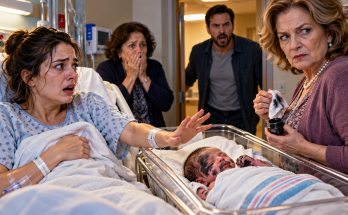
Hope’s surgery was scheduled for 7:30 in the morning, but the hospital wanted us there before six. The city was still dark when we crossed the parking structure, Melissa carrying Hope beneath a pale pink blanket while Ryan walked beside her with the diaper bag and medical folder. I followed a few steps behind, moving carefully because my body was still reminding me that six weeks was not very long after giving birth.
Inside, everything smelled of coffee, disinfectant, and overheated air. A television mounted above the admissions desk played a morning news program without sound. Somewhere behind the double doors, a machine chimed at regular intervals.
Melissa gave Hope’s name.
The receptionist printed a bracelet.
It looked absurdly large around her tiny wrist.
Ryan watched while the nurse checked the spelling twice.
“Hope Mercer,” the nurse read.
Ryan’s mouth tightened slightly at the sound of his daughter’s full name.
Melissa noticed.
She didn’t say anything.
We were taken to a preoperative room where Hope was undressed, weighed, examined, and wrapped in a hospital blanket. She had been fasting and was furious about it. Her cries became hoarse little complaints while Melissa paced the room.
Ryan stood near the wall for less than a minute before catching himself.
Then he stepped forward.
“Can I take her?”
Melissa hesitated.
It was brief, but I saw it.
Then she handed Hope to him.
Ryan held her upright against his shoulder.
“She’s hungry,” he whispered.
“I know.”
“I hate this.”
“So do I.”
He rubbed one hand slowly over Hope’s back, avoiding the place where the surgeons would soon operate.
Melissa watched his hand.
“You still here?”
Ryan looked at her.
“Yes.”
“Good.”
The neurosurgeon entered shortly after seven. Dr. Serrano reviewed the plan again: release the tethering, protect the nerve structures, monitor Hope afterward for movement and bladder function, and keep her admitted until they were comfortable with her recovery.
Melissa asked questions from the list in her folder.
Ryan asked only one.
“If you find something worse than you expect, will somebody come tell us?”
Dr. Serrano nodded.
“Yes.”
Ryan glanced toward the floor.
Then he looked back at the doctor.
“Tell us directly.”
“I will.”
When the anesthesiologist came for Hope, Melissa’s composure finally gave way.
She kissed her daughter’s forehead again and again.
Ryan stood beside her.
Not in front.
Not trying to stop the tears.
Just beside her.
The anesthesiologist reached for Hope.
Melissa’s arms tightened automatically.
For a second, she couldn’t let go.
“I can walk with her a little farther,” she said.
The nurse explained where they had to stop.
Melissa nodded but still held on.
Then Ryan said quietly, “I’ll walk with you.”
She looked at him.
He didn’t touch her.
He simply stood close enough that when she finally released Hope into the nurse’s arms, she had somewhere to put her weight.
We followed until the double doors.
Hope disappeared through them.
Melissa stared after her.
Ryan’s face went gray.
I heard his breathing change.
Short inhale.
Longer exhale.
The same pattern from the delivery room.
He shoved both hands into his pockets.
Melissa heard it too.
Her eyes moved toward him.
Ryan closed his eyes for one second.
Then opened them.
“I’m scared,” he said.
The sentence was almost laughably simple.
Six weeks earlier, he had destroyed part of his family because he could not say it.
Melissa looked at him for a long time.
“So am I.”
Ryan nodded.
Neither tried to solve the other.
We went to the surgical waiting room.
The first hour passed slowly.
Ryan sat forward with his elbows on his knees, staring at the floor tiles. Melissa read the same page of a magazine without turning it. I drank bad coffee and checked on Gabriel, who was spending the morning with a friend’s family.
At 8:43, the electronic board changed Hope’s status from PROCEDURE STARTED to IN SURGERY.
Melissa stood.
“Why did that take so long?”
“Preparation,” I said.
She nodded.
Then sat again.
At 9:17, a hospital volunteer came through offering coffee and tea.
Nobody wanted anything.
At 9:51, Ryan’s phone vibrated.
All three of us looked at it.
He stared at the screen.
“What?” Melissa asked.
“Recruiter.”
“The job?”
He nodded.
The company that had offered him the position wanted an answer by noon.
Months earlier, Ryan would have stepped away, handled it secretly, and returned with whatever version of the story felt safest.
Instead, he held out the phone.
“They want my decision.”
Melissa looked at him.
“What do you want?”
“I want the job.”
“Then take it.”
“I wanted to make sure—”
“No.”
He stopped.
Melissa leaned back.
“You don’t need permission. You need honesty.”
Ryan nodded.
He typed his response where she could see him doing it.
Then he set the phone face down.
At 10:26, the surgery board still had not changed.
Ryan stood.
He walked to the window.
I watched his shoulders rise.
Melissa watched too.
“Ryan.”
He turned.
She pointed to the chair.
“Don’t pace like you’re preparing to escape.”
He almost smiled.
“I’m not.”
“Then sit.”
He sat.
At 10:41, Dr. Serrano entered the waiting room.
All three of us stood at once.
The surgeon’s cap was gone, and there were faint pressure marks across his forehead where it had rested.
Melissa asked the question before he reached us.
“Is she okay?”
“She is stable.”
Nobody breathed properly until he continued.
“The procedure is complete.”
Melissa grabbed the back of a chair.
Ryan stood rigid.
Dr. Serrano explained that the tethering had been more extensive than the imaging suggested, but the surgical team had been able to release it. They had monitored the nerves throughout the procedure and had not observed evidence of new neurological injury.
I felt my knees weaken.
Melissa pressed one hand against her mouth.
Ryan stared at the doctor.
“More extensive how?”
“There was additional attachment around the lower cord. That made the dissection slower.”
“Does that change her prognosis?”
“It means we’ll watch her closely, but the procedure went well.”
“Can she move her legs?”
“She was still under anesthesia when I left the operating room. We’ll assess her as she wakes.”
Ryan nodded.
The surgeon continued speaking.
I watched my brother.
He was frightened.
I knew because I could see the pulse jumping in his neck.
But he asked questions.
He listened to the answers.
He stayed.
When Dr. Serrano left, Melissa sat down abruptly.
Ryan remained standing.
Then she looked up at him.
“You can sit beside me.”
He did.
Their shoulders did not touch.
But the empty chair between them was gone.
Hope reached recovery shortly before noon.
Only one parent could enter initially.
Melissa went.
Ryan did not argue.
He sat with me for nearly forty minutes.
Finally he whispered, “What if she can’t move her legs?”
I looked at him.
“Then you’ll learn what she needs.”
“What if she needs help forever?”
“Then you’ll help her forever.”
He swallowed.
“What if I’m not enough?”
“You keep asking the wrong question.”
He frowned.
“The question isn’t whether you’re enough for every possible future. Nobody is. The question is whether you show up for the future that actually arrives.”
Ryan looked toward the recovery doors.
A nurse came out.
“Dad?”
Ryan stood so quickly the chair legs scraped the floor.
“You can come in now.”
He looked at me.
I nodded.
“Go.”
Hope looked impossibly small in the recovery crib.
A clear line ran into one tiny hand. Monitors surrounded her. A dressing covered the lower part of her back.
Melissa stood at one side.
Ryan approached the other.
Hope’s eyes were half open.
Her face looked swollen and sleepy.
Ryan touched two fingers to her hand.
“Hey.”
Her fingers curled weakly around one of his.
Ryan made a sound that was half laugh, half sob.
Then Hope moved her left leg.
Melissa saw it.
“So did I.
Ryan didn’t.
“Ryan.”
He looked at Melissa.
She pointed.
Hope moved both feet beneath the blanket.
Ryan stared.
Then he lowered his head until his forehead nearly touched the crib rail.
Melissa reached across the bed.
Her hand landed against the back of his neck.
It stayed there for three seconds.
Maybe four.
Then she removed it.
That afternoon was not easy.
Hope cried whenever the medication began wearing off. Nurses checked her constantly. Melissa looked exhausted enough to fall over but refused to leave the room.
Ryan remained.
At one point Hope had difficulty urinating, and a nurse explained that temporary bladder problems were not unusual after the procedure but needed observation.
I saw the fear enter Ryan’s face.
This time, he asked the nurse what it meant.
He did not search the internet.
He did not invent the worst outcome.
He did not leave.
Later, Melissa went to shower at the family facility down the hall.
Before she left, she stood beside Ryan.
“She’ll probably wake up.”
“I know.”
“She’ll cry.”
“I know.”
“Call the nurse if you think anything is wrong.”
“I will.”
Melissa looked at him.
Then at Hope.
“I’ll be ten minutes.”
Ryan nodded.
“I’ll be here.”
After she left, I stood near the door.
Ryan glanced at me.
“You staying?”
“No.”
His eyes widened.
“You’ve got this.”
“Ivy.”
“She’s sleeping. The nurses are twenty feet away.”
“What if—”
I pointed toward the chair.
“Stay.”
He looked at Hope.
Then sat.
I stepped into the hallway.
Through the narrow window in the door, I saw him lean toward his daughter.
He spoke quietly enough that I couldn’t hear.
I didn’t need to.
Ten minutes later, Melissa returned.
Ryan was exactly where she had left him.
So was Hope.
That should have been ordinary.
For our family, it was not.
The next morning, Dr. Serrano examined Hope again.
Her leg movement remained strong.
Her bladder function had improved overnight.
If nothing changed, she could go home the following day.
Melissa cried quietly.
Ryan asked about wound care.
Before leaving, the surgeon said something I saw land deeply in my brother.
“Early treatment gives her a very good chance of growing without significant neurological limitations.”
Ryan looked at Hope.
Then at Melissa.
All the catastrophic futures he had built in his head had been possibilities, not facts.
He had almost sacrificed his family to a future that had never existed.
That evening, Melissa finally agreed to sleep for a few hours.
She lowered herself into the reclining chair beside Hope’s crib.
Ryan sat near the window.
Before closing her eyes, Melissa looked at him.
“You’ll wake me if she needs something?”
“Yes.”
“You won’t decide I need rest more than I need information?”
Ryan understood.
“No.”
“You’ll wake me.”
“I promise.”
Melissa studied his face.
Then she closed her eyes.
At 2:13 in the morning, Hope began crying.
Ryan stood immediately.
He looked at Melissa.
For one second, I watched him hesitate.
Then he touched her shoulder.
“Melissa.”
Her eyes opened.
“Hope’s awake.”
Melissa looked at him.
The relief in her face had nothing to do with the baby crying.
Ryan had told her.
He had not decided for her.
Together, they went to their daughter.
And somewhere between that dark hospital room and the first gray light of morning, trust—damaged, thin, and nowhere near whole—took its first honest breath.
Click here to continue reading: PART 10: After Hope Came Home, the Hardest Repair Was Not Her Spine but the Life Ryan Had Quietly Built on Concealment
The Daughter I Carried for My Brother Arrived Crying, and One Glance at Her Back Made Him Step Away
Part 9 of 12