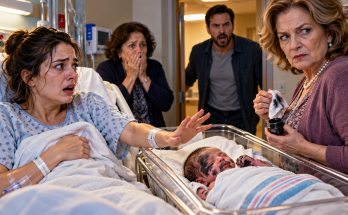
By the time I reached their house, Ryan had already called the pediatrician.
That was the first thing Melissa told me.
Not the temperature.
Not the symptoms.
Not how frightened she was.
“Ryan called.”
I looked past her.
He stood near the kitchen counter with Hope against his chest while speaking to the overnight nurse.
Hope’s cheeks were flushed.
Her eyes looked heavy.
The thermometer on the table read 102.3.
“What did they say?” Melissa asked when Ryan ended the call.
“Because of her age and medical history, they want her evaluated tonight.”
Melissa grabbed the diaper bag.
Ryan reached for the car seat.
Neither hesitated.
Neither argued about whether the other was overreacting.
I followed them to the emergency department.
Hope had a viral infection.
Nothing more dramatic.
No surgical complication.
No neurological crisis.
No hidden catastrophe.
She needed fluids, fever control, monitoring, and time.
That should have made the night forgettable.
Instead, it became the moment I understood how much had changed.
At three in the morning, Hope vomited across Ryan’s shirt.
He froze.
Melissa looked at him.
Ryan looked down at the mess.
Then Hope began crying.
“Oh,” he said softly. “Okay.”
He wiped her mouth first.
Only then did he look at his shirt.
Melissa handed him a towel.
“Still want to be a father?”
Ryan looked at Hope.
“Unfortunately, yes.”
Melissa laughed.
The nurse smiled.
Hope screamed louder.
Nothing about it was beautiful.
That was what made it beautiful to me.
There was no dramatic music, no life-changing diagnosis, no speech about redemption.
There was only a frightened baby, exhausted parents, and a father who stayed when things became unpleasant.
Hope’s fever came down by morning.
They took her home.
Ryan changed his shirt.
Life continued.
Months passed.
The first year of Hope’s life was measured by follow-ups.
Physical therapy.
Pediatric appointments.
Neurological checks.
Vaccinations.
Weight.
Height.
Movement.
She learned to sit.
Then crawl.
She favored neither leg.
Every milestone pleased the doctors.
None came with a guarantee about the next one.
By the time she was ten months old, she could pull herself upright against the sofa.
The first time she did it, Ryan was alone with her.
Melissa was at the grocery store.
He called her immediately.
Not after she came home.
Not after he had processed it.
Immediately.
“She’s standing.”
“What?”
“She pulled up.”
“Are you serious?”
“I have video.”
“Send it.”
He sent the video.
Then he sent it to me.
Then Carol.
Then probably everyone he had ever met.
Hope stood for seven seconds while gripping the sofa cushion with both hands.
Then she sat down hard and looked surprised.
Ryan’s voice on the recording cracked when he laughed.
At one year, Hope took three independent steps.
Melissa cried.
Ryan cried harder.
Gabriel demanded credit because he had been holding a cracker in front of her at the time.
“She walked to me.”
“She walked to the cracker,” I told him.
“Same thing.”
Dr. Serrano remained cautious about long-term predictions.
Tethered-cord conditions required monitoring through growth.
Symptoms could appear later.
Future imaging might be necessary.
Additional treatment could someday become appropriate.
This time, nobody turned uncertainty into disaster.
Melissa wrote down the follow-up schedule.
Ryan added it to the shared calendar.
Then they took Hope home.
Their finances improved slowly.
Ryan kept the new job.
After a year, he earned a modest raise.
They did not use it to pretend the debt was gone.
Half went toward repayment.
The rest went into emergency savings.
Melissa insisted on that.
“We need something that keeps fear from becoming a credit card.”
Ryan agreed.
They paid off the smallest card first.
When the balance reached zero, Melissa printed the statement.
Ryan laughed.
“You going to frame it?”
“No.”
She put it in the same envelope as the cut-up card from her father’s account.
“What is that envelope?”
Melissa thought for a moment.
“Evidence.”
“Of what?”
“That we can survive knowing things.”
Ryan stopped smiling.
Then nodded.
He understood.
By Hope’s first birthday, their marriage still had scars.
Melissa continued checking the accounts.
Ryan continued therapy.
They attended counseling together twice a month.
Some weeks they talked about rebuilding.
Other weeks Melissa admitted she still considered leaving.
Ryan no longer treated that possibility as an emergency he had to manipulate away.
He listened.
One evening, months after Hope’s birthday, Melissa told him she had decided not to file for divorce.
Ryan did not speak immediately.
They were sitting at the dining table after Hope had gone to sleep.
I know what happened because Melissa told me later.
Ryan’s first question was not, “Does that mean you forgive me?”
It was, “Why?”
Melissa answered carefully.
“Because I’m not staying out of fear.”
He waited.
“I’m not staying because of Hope.”
He nodded.
“I’m staying because the marriage we have now is more honest than the one I thought was good before.”
Ryan looked down.
“That’s not exactly romantic.”
“No.”
He smiled faintly.
“I’ll take it.”
Melissa reached across the table.
For the first time since the hospital, she placed her hand fully over his.
“I’m still angry sometimes.”
“I know.”
“I might bring this up years from now.”
“You probably will.”
“I might never trust you as blindly as I did.”
Ryan looked at her.
“I don’t think I want blind trust anymore.”
Melissa’s fingers tightened around his.
“Neither do I.”
There was no second wedding.
No dramatic vow renewal.
No moment when everybody agreed the past no longer mattered.
Instead, they built habits.
Ryan told Melissa when work worried him.
Melissa told Ryan when she checked an account because she felt anxious rather than because anything was wrong.
They argued.
Sometimes badly.
But they stopped treating conflict as proof that something had failed.
I watched them learn what our father had never learned soon enough: peace created by missing information is not peace.
Eventually Ryan told Gabriel what had happened in language a child could understand.
Not the debt details.
Not every marital wound.
Just the important part.
“I got scared when Hope was born,” Ryan said.
Gabriel looked at him seriously.
“And you left?”
“Yes.”
“Why?”
“I made a bad choice.”
Gabriel thought about it.
“Did Aunt Melissa yell at you?”
“Yes.”
“Did Mom?”
“A lot.”
Gabriel nodded approvingly.
Then he looked toward Hope, who was sitting on the floor beating two plastic cups together.
“You came back.”
“I did.”
Gabriel’s expression remained thoughtful.
“Then don’t leave again.”
Ryan swallowed.
“I won’t.”
Children have a way of making complicated truths sound obvious.
Two years after Hope was born, our family returned to the same children’s hospital for another follow-up.
Hope walked through the lobby holding one finger from each parent.
She wore red shoes.
She insisted on stepping on every dark tile and avoiding every light one.
The journey from the entrance to the elevator took nearly ten minutes.
Nobody hurried her.
Dr. Serrano watched her walk across the examination room.
He checked her strength, reflexes, gait, and scar.
Everything looked encouraging.
Monitoring would continue.
That was all.
Melissa asked, “So she’s okay?”
The doctor smiled.
“She’s doing very well.”
Ryan looked at Hope.
Years earlier, he might have demanded a stronger answer.
Will she always be okay?
Will this ever come back?
Can you promise us?
This time he asked, “When do you want to see her again?”
“In a year unless anything changes.”
Ryan nodded.
“Okay.”
Outside the hospital, Hope refused to get into the stroller.
“I walk.”
Melissa laughed.
“You’ve been walking.”
“I walk.”
Ryan crouched.
“You know this stroller cost us a ridiculous amount of money.”
Melissa stared at him.
Ryan realized what he had said.
Then they both started laughing.
Hope looked offended.
“I walk!”
Ryan folded the stroller.
“All right.”
They walked.
I stayed slightly behind them.
It had been more than two years since I had lain in a hospital bed and watched Ryan hand his newborn daughter back to me.
For a long time, I believed that moment would define him forever.
I was wrong.
It defined what he had done.
There was a difference.
Ryan could never erase walking away.
Melissa never asked him to.
Hope would eventually learn about the beginning of her life when she was old enough to understand it, because both her parents had agreed that family history should not survive through omissions.
That included the medical history.
Our grandfather.
Our father.
Ryan’s small sacral dimple.
Hope’s surgery.
No one would have to discover those facts from a forgotten box decades later.
Ryan framed a copy of our father’s letter.
Not the whole thing.
One sentence.
It came from the paragraph where Dad admitted that he had confused silence with protection for so long that he no longer knew how to tell the people he loved he was afraid.
Ryan placed the sentence inside his desk drawer.
Not on a wall.
Not where guests could see it.
He read it when he needed to.
One afternoon, I asked him whether he had forgiven Dad for not telling us about the spinal history.
Ryan considered the question.
“I don’t think there’s much to forgive.”
“He should have told us.”
“Yes.”
“Then?”
He watched Hope running across the backyard.
Her red shoes had been replaced by muddy sneakers.
“Dad probably thought the past was over because he survived it.”
I followed his gaze.
“And now?”
“Now I know surviving something doesn’t mean the people after you won’t need the truth.”
Hope tripped in the grass.
Ryan stood instinctively.
She pushed herself up before he reached her.
“I’m okay!” she shouted.
Ryan stopped.
Melissa was sitting on the patio.
“Let her come to you,” she called.
Ryan waited.
Hope ran back toward him.
He opened his arms.
She crashed into his chest.
I saw his face above her hair.
There was still fear in him.
Parenthood had not cured that.
Marriage had not cured it.
Therapy had not cured it.
Nothing had made uncertainty disappear.
Ryan had simply learned that fear did not have to become secrecy, and shame did not have to become abandonment.
Later that evening, after dinner, Hope climbed onto his lap.
She traced one finger over a faded scar on his hand.
“What’s that?”
Ryan looked down.
“Something that happened a long time ago.”
Hope considered this answer.
“Did it hurt?”
“Yes.”
“Is it better?”
Ryan looked across the table at Melissa.
She met his eyes.
Then he looked at me.
Finally he looked back at his daughter.
“Yes,” he said.
“Better doesn’t mean it never happened.”
Hope frowned because she was two and the distinction meant nothing to her.
Then she demanded dessert.
We laughed.
That was the true ending, if families are allowed to have endings at all.
Hope did not become proof that fear was foolish.
Her medical future still required attention.
Ryan did not become perfect because he returned.
Melissa did not forget because she stayed.
Their debt did not disappear.
Our family history did not become simple.
What changed was smaller and harder.
We stopped treating difficult truth as something love required us to hide.
Ryan lost his job once and told his wife months later.
Years afterward, when his company announced another restructuring, he told her within forty minutes.
That difference looked tiny on paper.
It saved his marriage.
Hope’s first scar faded into a pale line at the base of her back.
She grew.
She ran.
She fell.
She got up.
And every time life frightened my brother, he practiced the lesson his daughter had forced him to learn on the day she was born.
Stay.
Tell the truth.
Then face whatever comes next with the people who have the right to face it beside you.
The End
Read more original stories on Feel Every Story.
The Daughter I Carried for My Brother Arrived Crying, and One Glance at Her Back Made Him Step Away
Part 12 of 12