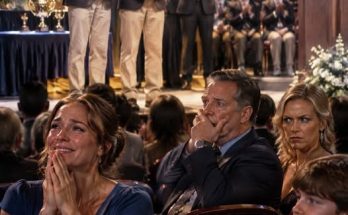
Rachel knew something had happened before Bernard reached the counsel table. She watched him enter with Maria behind him and the children following in a loose line, then leaned close.
“What happened?”
Bernard sat without answering.
“Bernard.”
“Their mother was Emily.”
Rachel waited for the rest.
“My Emily.”
The clerk called the room to order.
Rachel caught his sleeve. “What does that mean?”
“I’ll explain.”
“You need to explain now.”
Judge Lawson entered.
Rachel had no choice but to release him.
The first matter addressed was the home study. The emergency inspector had approved Bernard’s residence provisionally, subject to weekly visits and several follow-up requirements. Normally the finding would have strengthened his petition considerably.
Bernard barely heard it.
Emma sat behind him holding Captain.
He kept seeing a different child holding the same bear.
Emily at five had been small for her age and stubborn enough to compensate for every missing inch. Her hair had escaped every ponytail anyone tried to give her. She hated peas, loud toilets and being called Emmy by anyone except Bernard. On nights when she could not sleep, she would drag a blanket into the hallway and lie outside his bedroom door without admitting she was frightened.
Twenty-two years later, her daughter had inherited the same deep crease between her eyebrows.
“Mr. Vance?”
Bernard looked up.
Judge Lawson had addressed him.
“I’m sorry, Your Honor.”
The judge studied him. “Are you unwell?”
Rachel rose. “Your Honor, we need to request a brief conference regarding information discovered during recess.”
The county attorney objected immediately. “What information?”
Rachel looked at Bernard.
He nodded.
“The deceased mother may have had a prior familial relationship with my client.”
The statement transformed the room.
Judge Lawson leaned forward. “May have?”
Bernard stood.
“She was my foster sister.”
The county attorney flipped through her papers. “The mother’s surname was Carter. Mr. Vance’s childhood file—”
“My name was Dawson then.”
Judge Lawson’s gaze sharpened. “You are saying the children’s mother was one of the children you just described to this court?”
“Yes.”
“Can you prove that?”
Bernard looked at Captain.
“I think I can.”
Judge Lawson followed his gaze.
Emma tightened both arms around the bear.
Bernard explained the repairs. The blue stitches. The red thread. The green button. He explained that he had made them himself when he was seven, badly enough that he could still remember pushing the needle through his thumb.
The county attorney’s skepticism was understandable.
“A toy is not identification.”
“No,” Bernard said. “But her middle name is Grace. Her first name is Emily. She was five when she entered care. And that bear belonged to the Emily I knew.”
Maria requested permission to speak.
Judge Lawson granted it.
“The archived intake information I can access lists Emily Grace Carter as having entered county care at approximately five years old,” Maria said. “Some older records are not digitized. I would need authorization to retrieve the original placement history.”
“Granted.”
The judge looked at the attorneys. “Until that history is reviewed, I am not issuing a final placement order.”
For the first time that day, Bernard felt the children behind him exhale as though they shared one set of lungs.
The county attorney stood. “Your Honor, the emergency placements expire—”
“I am aware.”
“The department cannot leave five children without legal placement.”
Judge Lawson’s voice remained measured. “Then maintain the current emergency arrangement until tomorrow morning. I want the old records.”
The gavel came down.
Bernard should have felt relief.
Instead, he felt cheated by time.
He had found Emily three weeks too late.
Outside the courthouse, Rachel steered him away from reporters who had begun gathering near the front steps after hearing about the unusual guardianship petition. They crossed to a small café on the opposite corner and took a table in the back.
Bernard did not remove his coat.
Rachel ordered two coffees and waited until the server left.
“Start from the beginning.”
“I don’t know the beginning.”
“Then start with what you do know.”
Bernard stared through the window at people entering the courthouse.
“There were four of us.”
“You said that.”
“I’ve spent years searching. Mostly for Emily. I searched Dawson because that was the name in the placement documents I had. I assumed she kept it or that some record would connect it to whatever name she eventually used.”
“But Carter was her original surname?”
“I don’t know.”
“You never knew?”
“We were children.”
Rachel sat back.
Bernard rubbed his forehead. “Do you understand how many Emilys there are? How many sealed adoptions? How many agencies merged or shut down? I had a birth year that might have been wrong by one year, an old school name and a foster file with half the pages redacted.”
“And now she turns out to have lived close enough that her children entered your county system.”
“Two counties away.”
Rachel watched him.
Bernard laughed once, without humor. “Twenty-two years. Two counties.”
The coffee arrived.
Neither touched it.
When Bernard returned home that afternoon, he went directly to the closet in his bedroom.
At the back, behind winter coats and a broken vacuum cleaner, sat a metal cashbox with no cash in it.
He carried it to the kitchen table.
The key was taped under the base.
Inside were the pieces of childhood he had managed to preserve: four photographs, two school certificates, a hospital bracelet with faded printing, a bus pass, three letters returned as undeliverable and a birthday card Marcus had made from folded construction paper. There were also documents Samuel had helped him obtain after he turned eighteen.
Bernard spread everything across the table.
Rachel arrived forty minutes later.
“This is all?”
“All I have.”
She put on reading glasses and began sorting.
Bernard picked up the oldest photograph.
Four children stood in front of a chain-link fence. Bernard was seven and already trying to look older. Marcus squinted into the sun. Tasha had one shoe untied. Emily stood beside Bernard holding Captain against her chest.
The bear had its head then.
The green button was visible on its paw.
Rachel took the photograph.
“That’s the same bear.”
“Yes.”
She turned it over.
Three words and a date had been written in blue ink.
Bernard had seen them countless times.
This time something caught.
“Wait.”
Rachel looked at him.
On the back, above the date, someone had written: Marjorie. Bernard. Emily.
“I always thought Marjorie was another kid,” Bernard said.
“Why?”
“I was seven.”
Rachel reached for the placement papers.
They searched until dusk.
The name appeared once in a photocopied case summary.
M. Lane — assigned social worker.
Rachel found her phone.
“If she was working twenty-two years ago, she could be retired.”
“Or dead.”
“Let’s try retired first.”
Public records gave them a Marjorie Lane, seventy-three, living less than thirty miles away.
Bernard stared at the address.
Another nearby place.
Another person he could have passed in a grocery store without knowing.
Rachel stopped him before he reached for his keys.
“You are not showing up at a seventy-three-year-old woman’s house after dark.”
“She may know what happened to Emily.”
“And tomorrow morning you are due in court.”
“I’ve waited twenty-two years.”
“Then you can survive until eight.”
He hated her for being right.
That night he did not sleep.
At two seventeen, Bernard sat on the floor of the converted children’s room with the photograph in his hands. The new beds smelled faintly of oak and finish. Moonlight made pale rectangles across the floor.
He imagined Emily standing there.
Not at five.
At twenty-seven.
A woman he had never met.
Had she remembered him?
Had she searched too?
Had she kept Captain because it came from those years, or simply because a battered childhood toy had followed her through life?
He had no idea what she looked like before she died.
He opened his phone and searched her name again.
Emily Grace Carter.
This time he had enough information.
A memorial page appeared.
No photograph loaded at first. Then the screen refreshed.
Bernard dropped the phone.
He picked it up with both hands.
Emily was older, of course. Her face was thinner than the child in his memories, her dark hair longer. But the eyes were unmistakable.
Below the photograph were five smaller faces.
Leo. Mia. Caleb. Emma. Noah.
Her children.
His chest tightened so suddenly he had to lean against one of the beds.
The memorial text described a devoted mother, a private person, someone who volunteered at her children’s school and hated having her picture taken.
There was no husband listed.
A surviving relative appeared near the bottom.
Charles Mercer.
The relationship was described in language Bernard read three times.
Father.
Bernard frowned.
Emily’s father.
A memory shifted.
He could hear Emily crying in the back seat of a county car. Not for a father named Charles.
For someone else.
Bernard stood abruptly.
At seven years old, he had known almost nothing about adult custody battles. But he remembered a man coming to the foster home gate once. He remembered Emily trying to run to him.
He remembered a caseworker holding her back.
And he remembered Emily saying, again and again, “That’s my dad.”
Bernard looked at the memorial page.
Charles Mercer’s name meant nothing to him.
But the man at the gate had not been Charles Mercer.
He was certain of it.
By eight the next morning, Bernard and Rachel were knocking on Marjorie Lane’s front door.
An elderly woman opened it wearing a blue cardigan and holding a mug.
Rachel began, “Ms. Lane, I’m sorry to arrive without—”
Marjorie looked past her.
The mug slipped slightly in her hand.
Her eyes fixed on Bernard’s face.
For several seconds she said nothing.
Then, in a voice that made twenty-two years collapse between them, she whispered:
“Bernard Dawson.”
Click here to continue reading: PART 4: The woman who remembered Bernard’s first separation exposed a lie about Emily’s past, just as evidence from the fatal fire began disappearing
Five children were about to be divided among strangers, and Bernard Vance had nine days to prove one man could become their home
Part 3 of 15