The first time Jason Carter looked at me as if I were a burden, I told myself he was tired.
That is what wives do when they are still trying to save a marriage. They collect small cruelties and rename them stress. They hear indifference and call it distraction. They watch love leaving the room one quiet step at a time and convince themselves it will come back before morning.
My name is Colonel Emily Carter, though for most of my marriage, my husband only knew half of that sentence.
To Jason, I was Emily, his pregnant wife who worked somewhere in the Department of Defense. I answered emails at strange hours. I disappeared for briefings I could not explain. I came home with the kind of silence that settles into soldiers who have seen too much and learned not to speak carelessly.
He believed I was an administrative officer.
I let him believe it because my assignment required discretion, and because the parts of my life that mattered most were protected by oath, classification, and the kind of discipline civilians often mistake for secrecy.
At first, Jason admired the mystery.
“My wife works for the government,” he used to say at dinner parties, lifting his glass with a smile. “She could tell us what she does, but then she’d have to kill us.”
Everyone laughed. I laughed too, because back then the joke still felt harmless.
We met when I was thirty-five and he was forty. He owned a small real estate consulting business that looked impressive from the outside and fragile from the inside. Jason was handsome in the polished way some men are when they have practiced appearing confident in every mirror they pass. He knew how to open doors, how to order wine, how to make a woman feel seen in a crowded room.
At least in the beginning.
When we married, I did not need his money, his protection, or his permission. But I wanted a partner. After years of moving between bases, deployments, and rooms where emotional softness was treated like a liability, I wanted a home where I could set down my boots and just be a woman at the end of the day.
For a while, I thought Jason was that home.
Then I became pregnant.
Our daughter, though we did not yet know her face, changed the temperature of the house. I began noticing what I had once ignored. Jason did not ask about my appointments unless he needed to know whether dinner would be late. He watched my body change with a kind of irritated fascination, as if pregnancy were something I had chosen to inconvenience him.
When I reached seven months, my grandfather died.
Samuel Whitaker had raised me after my parents were gone. He had been a quiet man with weathered hands, sharp eyes, and a heart that understood duty better than most generals I had served under. He taught me how to change a tire, how to keep my word, and how to stand still when someone tried to shame me into shrinking.
I learned of his death while I was overseas on temporary duty.
The call came at 0300. I sat on the edge of a narrow bed in a secure facility, one hand on my swollen stomach, the other gripping a phone I could barely feel.
“I’m sorry, Colonel,” the attorney said gently. “Your grandfather left specific instructions. There is a family trust. The estate is substantial.”
“How substantial?” I asked.
There was a pause.
“Twenty million dollars.”
For a moment, I could not breathe.
Not because of the money. Because I could hear my grandfather’s voice in my mind, low and steady, telling me, “Emmy, wealth is not what you have. It’s what you refuse to sell your soul for.”
The military legal office became involved because of my assignment, my security status, and the structure of the trust. I was instructed not to disclose the inheritance until the transfer was complete and all protective measures were in place.
Not even to my husband.
“It is temporary,” the JAG officer told me. “Given your position and the amount involved, confidentiality is not optional.”
So I kept quiet.
I told myself Jason would understand later. I told myself that when everything was settled, I would sit him down, take his hand, and explain why silence had been necessary.
But silence has a strange way of revealing what noise hides.
Jason began coming home later. His phone stayed facedown. He started criticizing small things with the precision of a man building a case against his own marriage.
“You’re always tired.”
“You never tell me anything.”
“You walk around here like you’re carrying the world.”
One night, I stood at the sink washing a mug I had not used, simply because I needed something to do with my hands. Jason leaned against the refrigerator, scrolling through his phone.
“I’m carrying our child,” I said quietly.
He looked up with a faint smile that had no kindness in it.
“Sometimes it feels like I’m carrying both of you.”
That sentence stayed with me.
I did not answer. Soldiers are trained to recognize warning signs. Wives are trained by hope to excuse them.
By the time I was thirty-eight weeks pregnant, I had become very good at breathing through pain, both physical and otherwise.
I did not yet know that the man who called me difficult had been opening my mail. I did not know he had seen one partial notice from the trust office before the legal team moved everything to secure channels. I did not know he had begun searching my grandfather’s name late at night, trying to discover how much money an old man from Virginia could possibly leave behind.
And I certainly did not know that Jason had already decided I was worth more to him discarded than loved.
PART 2: THE NIGHT HE THREW ME AWAY
The contractions began on a Thursday evening while rain tapped against the kitchen windows.
I remember the sound clearly. It was soft at first, almost polite, then harder, as if the sky itself were growing impatient. I stood near the counter with one hand pressed against my lower back, trying to decide whether the pain was real labor or another false alarm.
Then the second contraction came.
It folded me over.
“Jason,” I called.
He was in the living room, dressed in a dark blazer and the expensive shoes he wore when he wanted people to believe business was better than it was.
“What?” he snapped.
I took a careful breath. “I think it’s time. The doctor said if the contractions were this close, we need to go in.”
He appeared in the doorway, phone in hand, annoyance already hardening his face.
“Tonight?”
I stared at him. “I’m sorry. Did the baby fail to check your calendar?”
His jaw tightened. “Don’t start with sarcasm.”
Another pain gripped me, sharp and deep. I clutched the edge of the counter.
“Jason, please. I need the hospital.”
He looked toward the hallway where my hospital bag waited by the closet. For a heartbeat, I saw something in his eyes that I mistook for decision.
Then he walked over, grabbed the bag, and threw it onto the floor.
The sound of it hitting the tile was small, almost ridiculous. A bag falling. A zipper scraping. A water bottle rolling under the bench.
But in my memory, it sounded like a door closing forever.
“I can’t do this anymore,” he said.
I blinked. “Do what?”
“This.” He waved his hand at me, at my stomach, at the house, at the life we had built and neglected in equal measure. “The secrecy. The moods. The pregnancy drama. You’ve turned into dead weight, Emily.”
The words entered me more slowly than they should have.
Dead weight.
I was carrying his child, standing in our kitchen in active labor, and he looked at me as if I were luggage he no longer wished to carry.
“Jason,” I whispered, “listen to yourself.”
“No, you listen.” His voice rose. “I have given enough to this marriage. I have been patient. I have tolerated being shut out of your life, tolerated your little classified excuses, tolerated living with a woman who acts like she’s above everyone.”
I swallowed through the pain. “I never acted above you.”
“You didn’t have to. You breathe like you’re judging me.”
That sentence, absurd as it was, told me something important. Jason had not hated my silence. He had hated my strength. He had mistaken my self-control for contempt because he could not imagine a woman having an inner life that did not revolve around him.
“I need help,” I said. “Whatever you feel about me, the baby needs help.”
For a moment, I thought that might reach him.
Instead, he stepped aside and pointed toward the front door.
“Get out.”
The room became very still.
“Excuse me?”
“Go make someone else deal with your drama.”
“You’re throwing out your wife while she’s in labor?”
“I’m removing chaos from my house.”
His house.
That was another lie I had not yet corrected.
I bent slowly, trying to pick up the hospital bag, but another contraction seized me so fiercely my knees buckled. Jason watched. He did not move.
That was when something inside me went cold.
Not numb. Not broken. Cold.
I reached for my phone and called Mrs. Alvarez.
She lived next door in a blue house with white shutters and a porch full of plants she treated like grandchildren. She was seventy-six, widowed, and sharper than most officers I had commanded. She had brought soup when morning sickness flattened me, and she had once told Jason, with a sweet smile, that men who raised their voices indoors usually lacked courage outdoors.
She answered on the second ring.
“Emily?”
“I need help,” I said, and hated how small my voice sounded.
“I’m coming.”
She arrived in less than three minutes wearing a raincoat over her nightgown, her gray hair pinned crookedly, her eyes blazing.
Jason opened the door before she could knock.
“This is private,” he said.
Mrs. Alvarez looked him up and down. “A man throwing a laboring woman into the rain has surrendered his right to privacy.”
His face flushed.
She pushed past him and came straight to me. “Come, mi hija. Lean on me.”
I did.
Her arm was thin but steady. She smelled faintly of lavender and coffee. As she helped me through the hallway, Jason leaned against the wall with his arms crossed.
“Don’t ever come back,” he said.
Mrs. Alvarez stopped. Slowly, she turned.
“One day,” she said, “you will beg God to let you unsay that.”
Jason laughed. “Get her out of here.”
The rain hit my face like cold needles. Mrs. Alvarez guided me into her old Buick, buckled me in, and placed my bag at my feet. As we pulled away, I looked back once.
Jason stood framed in the doorway, warm light behind him, darkness in front of him. He did not wave. He did not follow. He simply closed the door.
At the military medical center, the nurses moved quickly. Someone recognized my name before they recognized my face. Rank has a way of traveling through military hospitals like electricity.
“Colonel Carter,” one nurse said, startled.
“Please,” I whispered, gripping the bedrail. “Tonight I’m just Emily.”
She softened. “Then we’ll take care of Emily.”
They did.
Doctors came and went. Monitors beeped. My daughter’s heartbeat filled the room, fast and miraculous. Through every contraction, I waited for my phone to ring.
It never did.
By dawn, I had stopped hoping Jason would call.
By noon, I had stopped caring.
Or so I told myself.
The heart is not a switch. It is an old house with too many rooms. Even after someone leaves, their footsteps echo for a long time.
PART 3: THE SALUTE THAT DESTROYED HIM
The following afternoon, the sky cleared.
Sunlight spilled across the hospital room in pale gold sheets, touching the folded blanket at the foot of my bed, the cup of melting ice, the sealed folder my attorney had delivered that morning.
I had not opened it yet.
My labor had slowed, then surged, then slowed again. The doctors said my daughter was safe but stubborn. I smiled weakly and said she came by that honestly.
Mrs. Alvarez sat beside me knitting something yellow and lopsided.
“A blanket?” I asked.
“A warning,” she replied. “If anyone bothers this baby, I strangle them with it.”
I laughed for the first time in twenty-four hours.
Then the door opened.
Jason walked in.
He looked freshly showered, freshly shaved, and entirely unashamed. Behind him stood a woman in a cream-colored dress, elegant and composed, with dark hair swept neatly back. On her left hand was a sparkling ring.
A wedding ring, I thought.
My chest tightened.
Jason glanced at Mrs. Alvarez. “Can we have the room?”
“No,” Mrs. Alvarez said.
He ignored her and turned to me. “Emily, we need to talk like adults.”
The woman beside him gave me a small, unreadable smile.
I looked at Jason. “You found time today?”
His mouth twitched. “Don’t make this ugly.”
“You threw me out while I was in labor.”
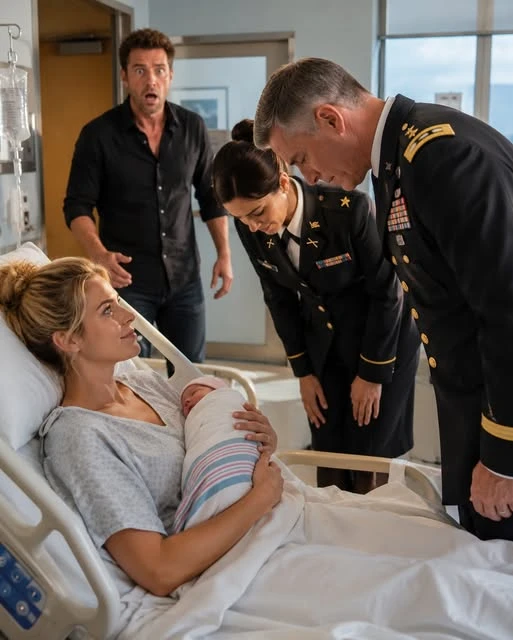
“And yet here you are, being cared for.” He spread his hands as if the universe had proven him reasonable. “Maybe that’s best for everyone.”
I stared at him, stunned by the calmness of his cruelty.
The woman stepped forward. “Emily, my name is Diana.”
Her voice was smooth, controlled, familiar in a way I could not immediately place. There was something military in her posture, though she wore no uniform.
Jason continued, “Diana has helped me see things clearly.”
“How generous of Diana.”
His eyes narrowed. “I’m filing for divorce. I think we both know it’s overdue. I’m prepared to be reasonable, but only if you are.”
“Reasonable,” I repeated.
He pulled documents from inside his jacket.
Mrs. Alvarez stopped knitting.
Jason placed the papers on the rolling table beside my bed. “Temporary separation agreement. Financial disclosure authorization. Medical decision permissions for the baby.”
I looked from the papers to his face.
He had not come to apologize.
He had come to harvest.
“You want me to sign legal documents while I’m in labor?”
“You’re lucid.”
“I’m medicated.”
“Barely.”
Diana watched him carefully.
I lowered my voice. “Jason, what do you think you know?”
For the first time, his confidence flickered.
“I know enough,” he said. “I know your grandfather left money. I know you hid it. I know wives don’t get to keep secrets and then play victim when husbands protect themselves.”
There it was.
Not grief. Not betrayal. Greed.
I almost laughed, but the sound would have broken into something too close to a sob.
“You opened my mail.”
“I opened mail sent to my house.”
“My name was on it.”
“My last name is on you.”
Mrs. Alvarez rose from her chair. “Careful, boy.”
Jason pointed at her. “Stay out of this.”
The door opened again.
This time, no one spoke.
A tall man in dress uniform entered with two officers behind him. Three stars gleamed on his shoulders. Every nurse visible beyond the door straightened as if a current had passed through them.
Lieutenant General Thomas Rourke had commanded soldiers in places most Americans only saw on evening news maps. He was known for his iron memory, his quiet temper, and his habit of appearing exactly when someone hoped he would not.
He walked directly to my bedside.
My throat tightened.
“Colonel Carter,” he said.
I tried to sit straighter.
“Sir.”
He stopped, brought his heels together, and rendered a flawless salute.
The room froze.
I returned it as best I could from a hospital bed.
Jason stared as if the walls had shifted.
General Rourke lowered his hand. “Headquarters directed me to personally deliver your promotion orders and classified assignment authorization.”
He handed me a sealed envelope.
My fingers shook as I accepted it.
“Your command has been briefed,” he continued. “Your estate security concern has also been resolved.”
Jason’s face drained of color. “Estate security?”
The general turned slowly toward him.
“Mr. Carter.”
Jason swallowed. “General, I think there’s been some misunderstanding.”
“I doubt that.”
Diana stepped forward then, no longer smiling.
“Sir,” she said clearly, “Lieutenant Colonel Diana Vale, executive officer to Colonel Carter. Evidence collection complete.”
Jason jerked backward. “What?”
Diana removed the ring from her finger and held it up between two fingers.
“This is not a wedding ring,” she said. “It is a recording device authorized under investigation after you attempted to access Colonel Carter’s trust through fraudulent representation.”
Jason looked at the ring, then at her, then at me.
“You set me up.”
Diana’s eyes hardened. “No, Mr. Carter. I gave you opportunities to tell the truth. You chose to brag.”
My body went cold again, but this time not from pain.
General Rourke opened the folder Jason had placed beside my bed. He glanced at the top page.
“Power of attorney,” he said. “Medical authority. Trust disclosure waiver. You brought these to a woman in active labor?”
Jason began to sweat. “She’s my wife.”
I looked at him then, really looked at him, and saw not the man I had married, not the man I had hoped he could become, but the small, frightened thing underneath all his performance.
“You called me dead weight,” I said.
His lips parted.
“You told me never to come back.”
“Emily—”
“No.” My voice was soft, but every person in that room heard it. “You don’t get to use my name like shelter after you used it like property.”
A contraction struck so hard the monitors jumped.
The nurse rushed in. “Colonel, we need to check you.”
General Rourke stepped back immediately. “We will clear the room.”
Jason moved toward me. “Emily, wait—”
Diana blocked him.
“Mr. Carter,” she said, “you are done moving toward her.”
He stared at her as if she had slapped him.
The general nodded to the officers behind him. “Escort him out.”
Jason’s voice cracked. “You can’t do this. That’s my child.”
I gripped the bedrail through another wave of pain and looked straight at him.
“Then you should have remembered that before you threw her mother into the rain.”
They led him away as he protested, his polished shoes squeaking against the hospital floor.
The door closed.
And at 5:42 that evening, with Mrs. Alvarez holding one hand and a nurse holding the other, my daughter came into the world screaming with the righteous fury of a tiny general.
I named her Hope.
PART 4: THE TRUTH BEHIND THE RING
In the days after Hope was born, the world became both smaller and sharper.
There was the warm weight of her sleeping against my chest. The astonishing curl of her fingers around mine. The soft snuffling sounds she made when she dreamed. There were nurses who came in smiling just to look at her, and doctors who called her strong, healthy, perfect.
Then there were the legal calls.
Jason had been questioned, released, and advised not to contact me except through counsel. That did not stop him from trying.
He sent messages that moved through every stage of desperation.
Emily, we need to talk.
I panicked.
Diana manipulated me.
You lied first.
I can forgive you if you forgive me.
Then, finally:
Don’t think you can keep my daughter from me.
I read that last one at two in the morning while Hope slept beside me in the bassinet. My milk had come in. My body ached. My stitches pulled when I moved too quickly. I was exhausted in the ancient way new mothers are exhausted, as if generations of women were breathing through me.
And still, when I read his threat, my hands did not tremble.
Motherhood did not make me weak.
It clarified the battlefield.
Diana visited on the third day, this time in uniform. Without the cream dress and false softness, she looked exactly like what she was: disciplined, intelligent, and absolutely not a woman any man should underestimate.
She stood beside Hope’s bassinet and smiled.
“She has your glare,” she said.
“Poor child.”
“Lucky child.”
I studied her. “How long?”
Diana did not pretend not to understand. “Six weeks.”
I looked toward the window.
Six weeks.
Long enough for Jason to sit across from her in hotel bars and complain about his pregnant wife. Long enough for him to mention the trust. Long enough for him to say things I was not sure I wanted to hear.
“He approached the trust office first,” Diana said gently. “Claimed you were emotionally unstable. Asked whether a spouse could assist with financial transition if the beneficiary was incapacitated.”
I closed my eyes.
“He knew about the money before he threw me out.”
“Yes.”
“How?”
“A mailed notice. Before the confidentiality hold fully redirected everything.”
I remembered Jason standing by the mailbox one afternoon, startled when I came home early. I remembered him smiling too quickly.
“What else?” I asked.
Diana hesitated.
“Tell me.”
“He said he wanted you out of the house before the baby came because a postpartum mother would be harder to pressure in court. He believed if he established separation first, he could argue abandonment, mental instability, and concealment of assets.”
A laugh escaped me. It was small and bitter.
“He threw me out and planned to accuse me of abandonment?”
“Yes.”
For a long time, I said nothing.
Then Hope stirred, opened her tiny mouth, and sighed in her sleep. That sound brought me back from the edge of a darkness I did not want to enter.
“I loved him,” I said, almost ashamed.
Diana’s expression softened. “Of course you did.”
“I keep wondering if I missed the real man.”
“No,” she said. “You saw him. You just hoped the better parts were the truest ones.”
That sentence gave me permission to grieve without feeling foolish.
When I was discharged, I did not go back to the house. I went to a secure residence arranged by the Army until the legal situation stabilized. Mrs. Alvarez came with me for the first week and pretended she was there because I needed help with the baby.
In truth, I think she came because she knew I needed someone who would not ask me to be brave every minute.
One evening, while Hope slept in a sling against my chest, Mrs. Alvarez made tea and set a worn envelope on the table.
“Your grandfather gave me this,” she said.
I stared at it.
“My grandfather knew you?”
Her eyes shone. “For forty-three years.”
I sat slowly.
“Mrs. Alvarez.”
“Maria,” she corrected. “I suppose it is time.”
She told me then what she had never told me before.
She had served as a civilian legal analyst attached to military intelligence decades earlier. My grandfather, Samuel Whitaker, had been more than the quiet mechanic and widower I had known. During his service, he had helped expose a procurement fraud network that stole from soldiers, widows, and military hospitals. After retirement, he spent years building quiet safeguards for families like ours.
“He trusted very few people,” Maria said. “But he trusted me. When you married Jason, Samuel asked me to keep an eye out. Not interfere. Just be near.”
I sat back, stunned.
“You moved next door because of him?”
“I moved next door because he loved you,” she said. “And because old men who have seen wickedness know it rarely arrives wearing horns. Sometimes it arrives wearing a nice suit and carrying flowers.”
I opened the envelope with unsteady fingers.
Inside was a letter in my grandfather’s handwriting.
My dearest Emmy,
If you are reading this, then I am gone, and someone has mistaken your kindness for weakness. I hope I am wrong. I hope your husband turns out to be the man you wanted him to be. But hope is not a security plan.
The trust is yours, but not only for comfort. I built it so you would never have to stay where you were diminished. I built it so you could leave any room where love had become a leash.
Money will not heal betrayal. But it can buy doors, lawyers, locks, time, and choices. Use it for those first. Later, when your heart steadies, use it for others.
And remember this, child: dead weight is what cowards call the people they are too weak to carry with honor.
I pressed the letter to my mouth and cried until Hope woke and cried with me.
Maria did not tell me to stop.
She only sat beside me, one hand on my shoulder, and let grief pass through the room like weather.
PART 5: THE HOUSE THAT BECAME A WARNING
Three months later, Jason arrived at the courthouse looking like a man auditioning for sympathy.
He wore a navy suit, a pale tie, and the wounded expression of someone who had practiced forgiveness in the mirror. His attorney walked beside him carrying a leather briefcase. Jason’s mother followed close behind, dabbing her eyes though no tears fell.
I stood across the hall with Diana, Maria, and my attorney.
Hope slept against my chest in a soft white blanket. She had grown round-cheeked and solemn, with eyes that seemed to study people before deciding whether they deserved her smile.
Jason saw her and stopped.
For one moment, something like real emotion crossed his face.
Then his gaze shifted to me, and calculation returned.
“Emily,” he said softly. “She’s beautiful.”
“Yes,” I replied. “She is.”
“I’d like to hold my daughter.”
My attorney stepped forward. “Not today.”
Pain flashed into anger. “You can’t erase me.”
“No,” I said. “You did that yourself. I’m just refusing to hand you the eraser again.”
Inside the courtroom, Jason’s attorney argued that I had concealed assets, misrepresented my work, damaged the marriage through secrecy, and denied a father access to his child.
He spoke smoothly. Men like Jason often hire men who can make cruelty sound like paperwork.
Then my attorney stood.
She presented the hospital documents. The messages. The forged forms. The recorded conversations from Diana’s ring. The trust office logs showing Jason’s attempts to gain information. The neighbor’s statement describing the night he threw me out during active labor.
Jason’s face changed with each exhibit.
First offended.
Then pale.
Then afraid.
But the real twist came after lunch.
My attorney called Maria Alvarez.
Jason looked confused. His attorney frowned.
Maria walked to the stand in a dark blue dress, her silver hair pinned neatly, her expression calm. She looked like someone’s grandmother until she raised her right hand and swore to tell the truth. Then she looked like a woman who had waited years for the right room.
She testified about the night of my labor.
Then my attorney asked, “Mrs. Alvarez, do you have any relationship to the Whitaker Family Trust?”
Jason’s head snapped up.
Maria folded her hands.
“Yes,” she said. “I am one of the original trustees.”
A murmur moved through the room.
Jason whispered something to his attorney.
My attorney continued, “And do you know the ownership status of the residence where Mr. Carter and Colonel Carter lived?”
Maria looked directly at Jason.
“Yes. The house is not owned by Mr. Carter. It never was.”
Jason stood halfway. “That’s a lie.”
The judge looked over her glasses. “Sit down, Mr. Carter.”
Maria continued, “The residence was purchased through a protected trust entity before the marriage. Colonel Carter allowed Mr. Carter to believe his contributions gave him authority there because she valued peace over pride. But legally, the home belongs to the trust.”
Jason’s mouth opened.
No sound came out.
My attorney placed one final document before the judge.
“Your Honor, three days after forcing Colonel Carter from that residence, Mr. Carter attempted to list the property through a private sale using forged authorization. The buyer he believed he had secured was another protected entity owned by the Whitaker Trust.”
Jason slowly turned toward me.
Understanding arrived like a storm breaking over his face.
“You bought it back?” he whispered.
I shook my head. “No, Jason. You tried to sell me a house I already owned.”
The courtroom went silent.
Even the judge paused.
That was the moment the last mask fell from him. Not because he had lost me. Not because he had endangered his child. Not because he had been cruel.
Because he had lost the money.
He sank into his chair.
The ruling did not give me everything, because courts rarely give anyone everything. But it gave me enough. Temporary sole custody. Supervised visitation pending evaluation. Protective orders around my residence, command, and financial affairs. Referral of the forged documents for criminal review.
Jason left the courthouse without looking at Hope.
Six months later, the divorce became final.
By then, I had returned to duty in a new role that allowed me to command without disappearing into silence. I had also made the first major decision of my inheritance.
The house where Jason had thrown me out was renovated.
The marble counters he had once leaned against while calling me dead weight were removed. The nursery he had never finished became a child therapy room painted pale yellow. The primary bedroom became temporary housing for mothers leaving unsafe homes. The dining room became a legal clinic twice a month for military spouses who had been told they were powerless.
On the morning we opened it, a small brass plaque was mounted beside the front door.
THE SAMUEL WHITAKER HOUSE
A refuge for those who were told they had nowhere to go.
Maria stood beside me holding Hope, who was chewing happily on the edge of her blanket.
Diana arrived in uniform and saluted the plaque before hugging me.
General Rourke came too, though he insisted he was only there for the coffee. He stood on the porch, looking at the house with quiet approval.
“Your grandfather would have liked this,” he said.
“I hope so.”
“He would have said you turned insult into infrastructure.”
I laughed. “That sounds like him.”
The ceremony was small. A few officers. A few neighbors. A few women with children standing close to them, eyes tired but hopeful. I looked at them and understood my grandfather’s letter in a way I had not before.
Money had bought doors.
Now those doors would open for others.
Just before we cut the ribbon, a car slowed near the curb.
Jason sat behind the wheel.
For a moment, our eyes met through the windshield.
He looked older. Smaller. The shine had gone out of him. His business had collapsed under investigation. The woman he thought he had fooled had testified against him. The wife he thought he had discarded had become untouchable.
Hope reached for my face and patted my cheek.
Jason saw her.
His expression shifted, and for a second I wondered whether regret had finally found him.
Then his eyes moved to the plaque, to the cameras, to the people gathered on the lawn.
No. Not regret.
Recognition.
He understood that the house he had used to humiliate me had become a monument to his failure.
He drove away without stopping.
Maria leaned close. “Are you all right?”
I watched his car disappear at the corner.
“Yes,” I said, and meant it.
The ribbon was placed in my hands. Diana stood on one side of me, Maria on the other, Hope warm against my heart.
I thought of the night rain on my face. The hospital bag on the floor. Jason’s voice saying, dead weight.
Then I thought of my daughter’s first cry.
I cut the ribbon.
The crowd applauded, but above it I heard something deeper: the sound of a life closing behind me and another opening ahead.
Years later, people would ask me when I became strong.
They expected me to say it happened when the general saluted me, or when Jason was exposed, or when the court ruled in my favor.
But that was not true.
I became strong in the passenger seat of Mrs. Alvarez’s Buick, soaked with rain, one hand on my stomach, watching the house disappear behind me.
Because that was the moment I understood that being thrown away by the wrong person can be the beginning of being returned to yourself.
Jason thought he had discarded a helpless wife.
What he had really done was unlock a colonel, a mother, a fortune, a witness, an investigation, and a legacy he never saw coming.
And the woman he called dead weight became the foundation that carried everyone else home.