The first time Victoria Langford stopped my food delivery, she made the driver unload $286 worth of groceries onto the pavement and leave them beside the neighborhood gate in ninety-three-degree heat.
The second time, she had my delivery truck towed.
The third time, she smiled through the open window of her white Mercedes and told me, “Maybe people who can’t follow community standards shouldn’t live in communities like this.”
I didn’t yell.
I didn’t threaten her.
I picked up the carton of eggs melting into the asphalt, photographed everything, and said, “Victoria, are you absolutely sure you want this to become official?”
Her smile widened.
“Oh, honey,” she said. “It already is.”
That was the moment I knew she had no idea who she was dealing with.
My name is Claire Bennett. I was thirty-eight years old, recently divorced, and living alone in a cedar-sided house at the northern edge of Sterling Oaks, an expensive gated development outside Raleigh, North Carolina.
My house was different from the others.
Sterling Oaks had enormous brick homes with decorative columns, circular driveways, perfect lawns, and garages filled with golf carts nobody needed.
Mine sat behind a row of old pecan trees.
It was smaller.
Older.
And unlike nearly every other house in the neighborhood, it had been there before Sterling Oaks existed.
My grandfather bought those six acres in 1978.
The developers eventually surrounded us, but my family never sold.
When Dad died, the property came to me.
That bothered Victoria.
She was fifty-three, wealthy, polished, and president of the Sterling Oaks Homeowners Association.
She wore pearl earrings to morning meetings.
She drove a Mercedes SUV that seemed to receive professional detailing more often than most people visited a dentist.
She lived in a $2.4 million house overlooking the artificial lake.
And she had one obsession.
Control.
Mailbox colors.
Fence heights.
Trash-can placement.
Holiday lights.
She once fined a retired Marine $150 because his American flagpole was supposedly four inches too tall.
Most residents complained privately and paid publicly.
I did neither.
Because there was one little problem Victoria never seemed interested in understanding.
My property wasn’t actually part of the HOA.
My grandfather’s original deed predated Sterling Oaks by nearly twenty years, and when the surrounding farmland was developed, he had refused every attempt to annex his property into the association.
We had access through the neighborhood road because of a recorded easement.
But Sterling Oaks had no authority over my house.
Victoria knew this.
At least, she should have.
Yet she kept sending violations.
$75 for my mailbox.
$100 for leaving my pickup visible.
$250 for refusing approved landscaping.
I returned every notice with the same polite sentence.
“My property is not subject to Sterling Oaks HOA covenants.”
Then something changed.
Food trucks started arriving at my house.
Not restaurant trucks.
Commercial refrigerated vehicles.
Boxes of potatoes.
Rice.
Canned vegetables.
Frozen chicken.
Flour.
Cooking oil.
People noticed.
Victoria definitely noticed.
What she didn’t know was that I had spent twelve years working in logistics for regional grocery distributors.
After my divorce, I left corporate life and began helping a nonprofit called Carolina Table Network.
We recovered safe surplus food from wholesalers and supermarkets and redistributed it through churches, shelters, school programs, and community kitchens.
My property became a temporary transfer point.
Usually twice a week, a refrigerated truck arrived.
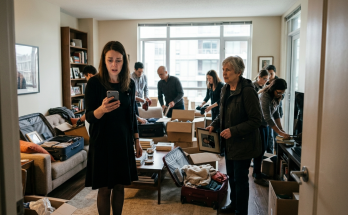
Volunteers sorted sealed products inside my detached barn.
Within hours, smaller vans took everything away.
Nothing was sold.
Nothing spoiled.
Nothing remained overnight.
And nothing violated county regulations.
Victoria saw trucks.
Victoria saw boxes.
Victoria saw volunteers.
Victoria saw something she couldn’t control.
Victoria saw something she couldn’t tax.
Victoria saw something happening without her permission.
And Victoria decided that meant it had to stop.
She began by blocking grocery deliveries meant for me personally.
Then she targeted the nonprofit trucks.
She told security guards that commercial vehicles entering for my address required HOA authorization.
Drivers were turned away.
One truck carrying nearly 1,800 pounds of refrigerated chicken sat outside the gate for forty-two minutes before someone called me.
I drove down.
Victoria was already there.
She stood beside the guardhouse wearing cream slacks, oversized sunglasses, and the expression of someone attending an event organized entirely in her honor.
“You’re creating a commercial operation,” she said.
“No,” I replied.
“You’re receiving commercial trucks.”
“Those aren’t the same thing.”
“This is a residential neighborhood.”
“My property isn’t in your association.”
“The road is.”
“The road is subject to my recorded access easement.”
Her jaw tightened.
She had expected anger.
Anger was useful to people like Victoria.
Anger could be called harassment.
Anger could be recorded.
Anger could be edited into a thirty-second video.
So I stayed calm.
I pulled a folder from my truck.
Inside were copies of the deed, easement, county zoning determination, nonprofit insurance certificate, and correspondence from our attorney.
I handed her the easement.
She barely looked at it.
“HOA counsel has already reviewed this.”
“Wonderful,” I said. “Then your attorney can explain it to mine.”
For half a second, something flickered behind her sunglasses.
Not fear.
Calculation.
Then she handed the paper back.
“No commercial deliveries.”
The truck was turned away.
That evening, 1,800 pounds of chicken had to be rerouted forty-seven miles to another refrigerated facility.
Three church kitchens received their deliveries late.
One after-school meal program had to change its menu.
I sat at my kitchen table that night with a legal pad.
Not crying.
Not raging.
Calculating.
Time.
Mileage.
Fuel.
Storage.
Lost volunteer hours.
Additional refrigeration.
Driver overtime.
Every consequence had a number.
I wrote them all down.
Then I created a folder on my laptop.
STERLING OAKS.
Every email went inside.
Every video.
Every photograph.
Every delivery manifest.
Every timestamp.
Every invoice.
Every gate-camera incident I could legally obtain.
Because bullies expect resistance.
What they rarely expect is accounting.
For the next two weeks, Victoria escalated.
Delivery drivers received notices claiming my address was temporarily restricted.
Security guards were instructed to call her personally before allowing trucks through.
She even had orange cones placed across the section of road leading toward my property one Saturday morning.
I moved nothing.
I photographed everything.
Then I called the county sheriff’s non-emergency line.
Deputy Aaron Wallace arrived twenty-five minutes later.
Victoria arrived seven minutes after him.
She had changed clothes.
That detail almost made me laugh.
She’d apparently gone home and put on a navy blazer before confronting a sheriff’s deputy.
“It’s an HOA matter,” she told him.
Deputy Wallace examined my deed.
Then the recorded easement.
Then the cones.
“Ma’am,” he said to Victoria, “who placed these?”
“Our maintenance contractor.”
“Why?”
“For community safety.”
“What safety issue?”
Victoria paused.
“Unauthorized commercial traffic.”
Deputy Wallace looked toward my barn, then toward the road.
“Mrs. Bennett has recorded access here.”
Victoria corrected him immediately.
“Ms. Bennett.”
The deputy glanced at me.
“Ms. Bennett.”
“Thank you,” I said.
He turned back to Victoria.
“You can’t block access based on paperwork you’re showing me.”
“This is private property.”
“So is hers.”
That sentence landed hard.
Victoria folded her arms.
“I’ll contact our attorney.”
“That’s probably a good idea.”
The cones disappeared within an hour.
That was my first mini-victory.
Victoria responded with something nastier.
Three days later, she circulated a neighborhood email claiming an “unregulated food-distribution facility” was operating near residents’ homes and could potentially attract rodents, increase traffic, and lower property values.
She didn’t name me.
She didn’t have to.
By dinner, strangers were driving slowly past my property.
One man photographed my barn.
A woman posted online that she had “heard” spoiled meat was being stored there.
Another claimed eighteen-wheelers were arriving at midnight.
None of it was true.
I could have fought every rumor.
Instead, I invited the county health inspector.
His name was Raymond Ellis.
He spent nearly two hours examining our operation.
Refrigeration logs.
Storage surfaces.
Pest controls.
Handling procedures.
Documentation.
When he finished, he closed his clipboard.
“I wish half the commercial kitchens I inspect looked this organized.”
“Can you put that in writing?”
He smiled.
“You knew I was going to say that.”
“I hoped.”
Four days later, Carolina Table Network hosted an open volunteer afternoon.
Twenty-seven Sterling Oaks residents came.
Then forty-three.
They saw teachers packing cereal.
They saw retirees sorting canned beans.
They saw high-school students loading boxes into church vans.
They saw food that supermarkets couldn’t sell because packaging had changed or expiration windows were approaching—but which remained perfectly safe.
And they saw where it went.
A domestic-violence shelter.
Two church pantries.
A veterans’ center.
A school weekend-meal program.
People stopped seeing trucks.
They started seeing meals.
Victoria stopped attending neighborhood social events.
But she didn’t stop fighting.
Then, on October 14, she made her biggest mistake.
A refrigerated semi arrived carrying eleven pallets from a regional distributor.
More than 14,000 pounds of food.
The load included frozen meat, produce, milk, bread, canned goods, and prepared meals.
It was our largest donation that year.
The truck reached Sterling Oaks at 7:12 a.m.
Security refused entry.
The driver called me.
I drove to the gate.
Victoria was already there.
Of course she was.
“You cannot bring that vehicle inside,” she said.
I looked at the truck.
Then at her.
“Victoria, this is your final opportunity.”
She laughed.
“My final opportunity for what?”
“To stop interfering with my lawful access.”
Her face hardened.
“You don’t intimidate me, Claire.”
“I’m not trying to.”
I held up my phone.
“I’m documenting you.”
That changed her expression.
Only slightly.
“Document whatever you like.”
So I did.
I recorded her instructing security to deny the truck.
I recorded myself presenting the easement.
I recorded the driver explaining that the load required continuous refrigeration.
I recorded the guard apologizing and saying he had been ordered not to open the gate.
And then I left.
I didn’t argue.
The truck turned around.
Our alternate warehouse accepted the shipment.
Nothing was lost.
But the detour cost money.
A lot of money.
That afternoon, my attorney filed for an emergency injunction.
Three days later, Victoria received it.
She called me at 6:08 p.m.
I remember because I was chopping onions.
“You sued the association?”
“No.”
“You filed against us.”
“I asked a court to enforce my access rights.”
“Do you understand how much legal expense you’re creating for your neighbors?”
I set down the knife.
“Do you understand how much expense your decisions created for a food charity?”
Silence.
Then she said something I never forgot.
“Charity doesn’t give you special rights.”
“No,” I replied. “My deed does.”
I hung up.
The court hearing was short.
Painfully short—for Victoria.
The judge reviewed the easement.
Reviewed the recorded restrictions.
Reviewed the HOA’s correspondence.
Then asked the association’s attorney a simple question.
“On what recorded authority did your client believe she could deny access?”
Their attorney looked toward Victoria.
Then back at the judge.
“Your Honor, the association believed—”
“I didn’t ask what it believed.”
Silence.
“I asked for its authority.”
They didn’t have any.
The temporary injunction became permanent.
The HOA could not interfere with lawful access to my property.
The court also ordered the association to pay part of my legal expenses.
That should have ended everything.
It didn’t.
Because the biggest twist arrived nine days later.
Carolina Table Network received notice that one of our largest grocery partners was temporarily suspending donations.
Not because of us.
A refrigeration failure at its distribution hub had disrupted operations across three counties.
At almost the same time, a tropical storm swept through central North Carolina.
Trees came down.
Power lines snapped.
Roads flooded.
Thousands of homes lost electricity.
Sterling Oaks lost power on Tuesday at 4:17 p.m.
By Wednesday morning, residents discovered something expensive neighborhoods rarely think about.
Money doesn’t keep a refrigerator cold when the electricity stops.
The neighborhood’s backup generator powered the gate, clubhouse emergency lights, and a few pumps.
Not houses.
Stores nearby closed.
Gas stations couldn’t process cards.
Road crews blocked the main highway after trees fell across both lanes.
By Wednesday evening, people were cooking everything thawing in their freezers.
By Thursday morning, refrigerators were warming.
By Thursday afternoon, bottled water was disappearing.
My property still had electricity.
Years earlier, Dad had installed a propane generator after Hurricane Fran stories scared him half to death.
It powered the house, well pump, barn refrigeration, and two chest freezers.
And because our alternate distribution site had lost power, Carolina Table Network had transferred emergency supplies to my barn.
Water.
Bread.
Canned soup.
Peanut butter.
Shelf-stable milk.
Rice.
Baby formula.
Diapers.
Protein bars.
Apples.
Crackers.
Hundreds of emergency meal boxes.
At 3:26 Thursday afternoon, someone knocked on my door.
It was Victoria.
She looked different without the Mercedes.
Without the blazer.
Without the board members.
She wore jeans, muddy sneakers, and a gray sweatshirt.
Her hair was tied back.
For once, she wasn’t carrying a folder.
She was carrying two empty grocery bags.
I opened the screen door.
She stared past me toward the barn.
“I heard you have food.”
“I do.”
Her eyes dropped.
“My generator failed.”
I waited.
“My freezer’s gone. Refrigerator too.”
Another pause.
“My daughter is here with the kids.”
I knew Victoria had grandchildren.
Two boys.
Five and eight.
“There isn’t much left at the clubhouse,” she continued. “And one of the boys has a peanut allergy.”
She looked directly at me.
It must have cost her something enormous.
Not money.
Something harder for people like Victoria to spend.
Pride.
“Claire,” she said quietly, “I need food.”
Thirty days earlier, this woman had stood at the gate and watched my groceries spoil on hot pavement.
Now she stood on my porch holding empty bags.
I could have reminded her.
I could have made her apologize first.
I could have photographed her.
I could have posted it online.
I could have said community standards prohibited unauthorized food distribution.
Instead, I opened the door.
“Come with me.”
She looked surprised.
We walked toward the barn.
Volunteers were assembling emergency boxes.
I checked our allergy-safe inventory.
Rice.
Beans.
Canned chicken.
Applesauce.
Vegetables.
Shelf-stable milk.
Crackers produced in a peanut-free facility.
Bottled water.
I filled two boxes.
Victoria watched.
“How much?”
“Nothing.”
“I can pay.”
“I know.”
Her mouth tightened.
“Then let me.”
“No.”
“Why?”
I placed another case of water beside her.
“Because hunger isn’t a debt collection system.”
She stared at me.
Something in her face changed.
Not dramatically.
No tears.
No speech.
Just silence.
Then she whispered, “Thank you.”
Before she left, she stopped at the barn door.
“Are you feeding other residents?”
“Anyone who needs it.”
“How many?”
“Depends how long the roads stay closed.”
Victoria looked toward the neighborhood.
Then back at the stacked boxes.
“I can help.”
I almost laughed.
Instead, I handed her a roll of packing tape.
“Start with those twelve.”
For the next six hours, Victoria Langford packed food.
Residents came.
Families.
Retirees.
Parents with babies.
A diabetic man whose refrigerated medication was being stored temporarily in our backup unit.
Nobody was asked whether they had supported me.
Nobody was asked whether they had believed the rumors.
Nobody was charged.
By Friday, the clubhouse became a distribution point.
By Saturday, Victoria was driving emergency boxes to elderly residents in her golf cart.
The power returned Sunday morning.
Sterling Oaks celebrated as if civilization itself had been restored.
But something had changed.
At the next HOA meeting, Victoria stood before eighty-two residents.
She didn’t make a dramatic confession.
She didn’t suddenly become a saint.
Real people rarely transform that neatly.
She simply placed a folder on the table.
“I made decisions regarding the Bennett property that exceeded the association’s authority,” she said. “Those decisions cost this community money and created unnecessary conflict.”
Nobody moved.
She continued.
“I have submitted my resignation as president.”
A murmur swept through the room.
Then she looked at me.
“Claire’s organization fed 173 Sterling Oaks residents during the outage.”
Someone began clapping.
Then another.
Soon the room was standing.
I wasn’t.
I stayed seated.
Because applause wasn’t what mattered.
Three weeks later, Sterling Oaks voted to establish a permanent emergency partnership with Carolina Table Network.
The HOA donated the old maintenance building near the clubhouse for disaster storage.
Residents raised $41,000 for refrigeration equipment.
Victoria donated $10,000 anonymously.
At least, she tried to.
I recognized the handwriting on the cashier’s-envelope note.
Six months later, she was volunteering twice a month.
We never became best friends.
That would have been dishonest.
But we became something stranger.
People who had seen the worst side of each other—and decided not to stay there.
One Saturday morning in April, Victoria and I were stacking canned vegetables when she suddenly said, “You know what bothered me most about you?”
I smiled.
“My mailbox?”
She almost smiled back.
“No.”
“My truck?”
“No.”
“Then what?”
“You didn’t need me.”
I stopped stacking.
Victoria looked toward the open barn doors.
“When I became president, people started calling me for everything. Trees. Fences. Contractors. Security. Complaints. Invitations. Problems.”
She rubbed dust from her hands.
“I confused being needed with being important.”
That was probably the most truthful thing she’d ever told me.
I handed her another case.
“Those aren’t the same thing.”
“I know that now.”
For the first time, I believed her.
A year after she blocked my first delivery, Carolina Table Network distributed its millionth meal.
We held the celebration in my barn.
There were folding tables.
Barbecue.
Cornbread.
Kids running between pecan trees.
Deputy Wallace came.
Raymond Ellis came.
Half the neighborhood came.
Victoria stood near the entrance handing plates to families.
Nobody treated her like a queen.
She looked happier.
Late that evening, after everyone left, I walked back into the barn to shut off the lights.
That’s when I noticed an envelope underneath the office door.
No stamp.
No name.
Just my address typed across the front.
Inside were photocopies of HOA financial records.
Invoices.
Transfers.
Contractor payments.
And a bank statement connected to an account I had never seen.
At first, I assumed someone wanted me to expose Victoria.
Then I noticed the dates.
The account existed before she became HOA president.
Millions of dollars had moved through it.
At the bottom of the stack was a copy of an old land survey.
My grandfather’s property was outlined in red.
So were eleven other parcels around Sterling Oaks.
A handwritten note appeared beside them.
ACQUISITION PHASE II.
My stomach tightened.
Then I found the final page.
It was a contract dated seventeen years earlier.
The signature wasn’t Victoria’s.
It belonged to the man who originally developed Sterling Oaks.
And beside my grandfather’s six acres was a number that made absolutely no sense.
$4,800,000.
My phone buzzed.
Unknown number.
One message appeared.
DON’T SHOW THESE DOCUMENTS TO THE HOA.
A second message arrived before I could move.
VICTORIA WAS NEVER TRYING TO TAKE YOUR LAND.
I stared at the screen.
Then came the third message.