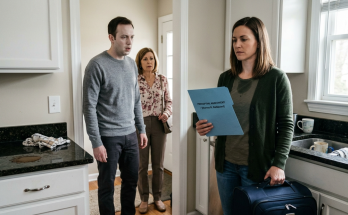
Caleb had always been good at recovering his composure. I had watched him lose clients, contracts and investments without allowing anyone in the room to see panic. After I refused the twenty-eight thousand dollars, he remained silent long enough to make me wonder whether he intended to do the same thing now—take a breath, change his tone, turn the entire morning into a misunderstanding we could discuss later.
Instead, he stepped closer to the island.
“My mother deserves this trip.”
“Then buy it for her.”
His nostrils flared.
“I just explained the company’s situation.”
“You explained that you took forty thousand dollars from our emergency fund while telling me the company wasn’t having problems.”
“That money is coming back.”
“When?”
“When I have liquidity.”
“You mean when I put more money in?”
Vivian made an impatient sound. “Mara, there is no reason to be vicious.”
I turned toward her. “Asking what happened to my money is vicious?”
“You’re humiliating my son.”
“No. I’m asking him a question.”
“He built a business.”
“With one hundred eighty-five thousand dollars from me.”
Caleb struck the counter with his palm.
The impact startled all three of us.
My teacup jumped against its saucer, tipped sideways and shattered against the stone. Hot tea splashed across the front of my blouse, my shoulder and the side of my face.
I gasped and stumbled backward.
For a moment, nobody moved.
The heat on my cheek sharpened into pain. Liquid dripped from my sleeve onto the floor. I grabbed a dish towel and pressed it against my skin.
Caleb stared at the broken cup.
I waited for him to come around the island.
I waited for him to ask whether I was burned.
I waited for the husband I had once believed he was.
He never came.
Instead, he lifted his eyes and pointed toward the front hallway.
“Transfer the money,” he said, “or leave.”
Even Vivian looked at him then.
Not horrified.
Interested.
My breathing slowed.
“Caleb.”
“You heard me.”
The towel against my cheek smelled faintly of laundry detergent and tea.
“You’re telling me to pay twenty-eight thousand dollars for your mother’s vacation or get out of our home?”
“Our home,” he said sharply. “Exactly. A marriage requires partnership.”
I looked down at the broken porcelain.
A pale blue piece of the cup had landed near my shoe. I remembered buying the set shortly after we moved in. Caleb had teased me for spending too long choosing between two patterns. We had been newly married then, still unpacking boxes, still arguing affectionately about where to hang photographs.
How strange that a life could change without its furniture moving.
Vivian folded her arms.
“Maybe some distance would be healthy,” she said. “You’ve become very focused on what belongs to you.”
There was satisfaction under her concern.
Something in me finally stopped struggling.
For years, every family emergency had placed me in the same position: pay now, discuss later. Whenever I hesitated, there was a reason I should feel ashamed. Caleb was my husband. Vivian was my mother-in-law. Families supported one another. Money could be replaced. Relationships mattered more.
And each time I surrendered, the next request grew easier for them to make.
I lowered the towel.
“All right.”
Caleb blinked.
“What?”
“I said all right.”
His expression shifted, almost with relief. He thought I meant I would transfer the money.
I walked past him.
“Mara.”
I kept going.
“Where are you going?”
“To pack.”
His footsteps followed me to the bottom of the stairs.
“Stop being dramatic.”
I climbed without answering.
Our bedroom looked exactly as it had when I left it that morning. Caleb’s watch lay beside the bed. A shirt he had considered wearing was draped over a chair. My book was still open facedown on the nightstand.
I pulled a suitcase from the closet.
Only when I placed it on the bed did my hands begin shaking.
I packed carefully because careful movements gave me something to control.
Jeans.
Two sweaters.
Underwear.
Work clothes.
Medication.
Toiletries.
Chargers.
My laptop.
Then I walked into the small study beside the bedroom and locked the door behind me.
The desk had once belonged to my grandmother.
In its bottom drawer was a narrow blue folder.
Caleb knew the folder existed. He had seen it dozens of times. He had once asked whether it contained old tax documents, and when I told him it held paperwork from my grandmother’s estate and some business records, he lost interest before I finished the sentence.
That indifference had protected me better than any lock.
I removed the folder and held it against my chest.
Estelle Bennett had trusted paper more than promises.
When I was young, I found that irritating. She kept receipts in labeled envelopes, read contracts line by line and insisted that affection was not a substitute for understanding what you signed.
“People don’t become dishonest because a document exists,” she once told me. “The document simply makes dishonesty more expensive.”
At twenty-eight, I had rolled my eyes.
At thirty-six, I carried her folder downstairs.
Caleb was waiting in the foyer.
His gaze went first to the suitcase, then to the blue folder.
“What’s that?”
“Something important.”
“What kind of important?”
“The kind you should have cared about before ordering me out.”
He stepped into my path.
“I didn’t order you out.”
I stared at him.
He hesitated.
“I was angry.”
“You pointed at the door.”
“Because you were being impossible.”
There it was—the revision, already beginning.
Behind him, Vivian stood beside the island while blotting spilled tea with a paper towel. She looked mildly inconvenienced, as though my departure might delay lunch.
Caleb reached toward the suitcase handle.
I pulled it away.
“Don’t.”
“Mara, put the suitcase back upstairs.”
“You told me to leave.”
“Stop twisting my words.”
“I’m following them.”
His voice softened.
That change frightened me more than the shouting.
“Come on. We’ve both had a bad morning. Transfer the money. Mom can finish her booking, and tonight you and I will talk.”
It was so familiar that I nearly obeyed.
Not because I believed him.
Because obedience had become muscle memory.
I pictured myself carrying the suitcase upstairs, opening the banking app and convincing myself afterward that I had prevented a family crisis.
Then I pictured another request six months from now.
And another.
And another.
“No,” I said.
Caleb stared at me.
Behind him, Vivian’s mouth tightened.
That one syllable seemed louder than his hand striking the counter.
I walked around him, opened the front door and rolled the suitcase outside.
He followed me onto the porch.
“Where are you going?”
“I don’t know yet.”
“You’re seriously leaving over money?”
I stopped beside my car.
“No. I’m leaving because when I wouldn’t give you money, you threatened my place in our marriage.”
“You’re making this much bigger than it is.”
“Maybe I’ve been making everything smaller than it is.”
For once he had no immediate answer.
I put the folder on the passenger seat and drove away.
I made it four blocks before I started crying.
The tears came without drama, silently and annoyingly, blurring traffic lights. I pulled into a grocery-store parking lot until I could see clearly again.
My phone began vibrating.
Caleb.
I let it ring.
Then again.
And again.
By the time I checked into a hotel thirty minutes away, I had six missed calls and three messages.
Stop embarrassing yourself and come home.
Mom is extremely upset. You owe her an apology.
Transfer the money before you make this worse.
I read them twice.
Not one asked whether the tea had burned me.
I went into the hotel bathroom and examined my face under the harsh white light. The skin near my cheekbone was red. There was another mark across my shoulder where the liquid had soaked through my blouse.
Following Priya’s instructions, I photographed everything.
Then I took screenshots of the messages.
I opened my laptop, copied the joint-account records and saved them in three places.
At ten forty-eight that evening, I texted Priya.
Are you awake?
Her reply arrived almost immediately.
Yes. What happened?
I sent her the photographs.
Her phone call came before I could type an explanation.
“Mara, where are you?”
“In a hotel.”
“Is Caleb there?”
“No.”
“Does he know which hotel?”
“I don’t think so.”
“Stay where you are. I’m going back to my office.”
“You don’t have to do that tonight.”
“Yes, I do.”
There was no panic in her voice, which helped me control mine.
“Bring the folder,” she added.
I looked toward the blue folder lying on the desk.
At eleven thirty, I entered Priya’s office carrying my suitcase in one hand and Estelle’s folder in the other.
Priya had changed out of the clothes she had worn earlier that day and pulled her hair into a loose knot. Two cups of coffee sat beside her computer.
She studied the redness on my cheek before saying anything.
“He did this?”
“He hit the counter. The cup spilled.”
“Did he apologize?”
I shook my head.
Priya sat back.
“Tell me exactly what happened.”
I did.
When I reached the part where Caleb ordered me to transfer twenty-eight thousand dollars or leave, Priya removed her glasses.
“And you left.”
“Yes.”
“Good.”
The word startled me.
For seven years, every important person around Caleb had rewarded me for staying.
Priya reached toward the folder.
“May I?”
I placed it in front of her.
She opened it.
The first document was our prenuptial agreement.
The next concerned Alder House Holdings, the company I had created before marrying Caleb to manage property and investments inherited from my grandmother.
Then came the deed to our house.
Priya paused.
Her eyes moved carefully across the page.
She looked up.
“Mara.”
“What?”
“Does Caleb understand who owns the house he just told you to leave?”
I glanced at the document.
“I’m not sure he remembers.”
Her eyebrows rose.
During the collapse of Caleb’s first business, we had fallen dangerously behind on the mortgage. Alder House Holdings had eventually paid the debt and purchased the property under an arrangement reviewed by both of our attorneys. Caleb had signed every page acknowledging that he retained no ownership interest after the transfer.
He never discussed it again.
Priya turned to the next documents.
Her expression became even more intent.
The membership-interest transfer agreement.
The amended operating agreement for Rowe Strategy Group.
And beneath them, Caleb’s signature.
Priya read in silence for several minutes.
Then she looked across the desk at me.
“You told me you invested one hundred eighty-five thousand dollars in your husband’s company.”
“I did.”
“You didn’t tell me what you received in exchange.”
I swallowed.
“A majority interest.”
“How much?”
“Sixty percent.”
Priya slowly placed the document flat on the desk.
At that moment I understood that Caleb had not merely ordered me out of a house he did not own.
He had demanded twenty-eight thousand dollars from the woman whose company quietly owned most of the business he had spent years telling everyone was his.
Click here to continue reading: PART 3: The Blue Folder Revealed What Caleb Had Forgotten, but a Search of My Credit Card Exposed Something Even More Immediate
My Mother-in-Law Arrived With a Luxury Itinerary, but the Missing Money in Our Accounts Made Her Demand Feel Different
Part 2 of 15