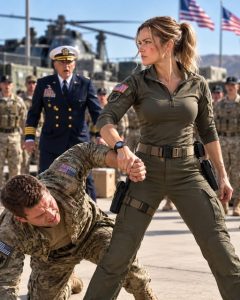
Part 2: The Letter No One Was Meant to Read.
PART 2
“Captain Hayes has operational authority.”
Five words.
The admiral’s voice did not rise. It did not need to.
Commander Brock Sullivan stopped as if someone had removed the ground beneath him.
Around us, more than a thousand service members remained in formation, silent under the bright California sky. A gull crossed somewhere above the reviewing stand. The flag snapped once in the ocean wind.
Brock looked from me to the admiral.
Then back to me.
“Operational authority?” he repeated.
Rear Admiral Nathaniel Mercer reached the edge of the field and stopped several feet away.
He was a compact man in his early sixties, with silver hair cut close and a face that revealed little when he did not want it to. I had known him for eleven years.
That was long enough to recognize anger in the way he held his shoulders.
It was also long enough to know he would not turn this moment into a spectacle.
“Commander Sullivan,” Mercer said, “you will report to the administrative building at fourteen hundred hours.”
Brock opened his mouth.
Mercer raised one hand.
“That is not an invitation to debate.”
The commander’s jaw tightened.
“Yes, sir.”
Mercer turned toward the reviewing stand.
“Sergeant Major Reed.”
“Sir.”
“Dismiss the formation according to schedule.”
Reed stepped forward immediately.
“Yes, Admiral.”
There would be no public explanation.
No announcement of Brock’s punishment.
No dramatic stripping of insignia.
Mercer understood something that had taken me years to learn: accountability and humiliation were not the same thing.
One corrected behavior.
The other often hardened it.
The formations began to move.
Commands traveled down the lines, crisp and professional. Boots shifted against pavement. Officers redirected units toward afternoon training areas.
But hundreds of eyes still found their way toward me.
Some curious.
Some confused.
A few openly stunned.
I hated being watched.
Not because I was shy.
Because attention had once been dangerous.
For much of my career, success had depended on entering a room without being remembered afterward.
Today, nobody on that field would forget my face.
Reed approached as the last formation cleared.
He glanced at my lip.
“You all right?”
“I’ve had worse coffee.”
His mouth almost twitched.
Almost.
Then his expression became serious.
“I knew the second he started walking toward you that something was wrong.”
“You knew before I did.”
“I’ve known Sullivan six years.”
“That long?”
Reed nodded.
“He’s not usually reckless.”
I looked toward the administrative building, where Brock was disappearing through a side entrance.
“People are rarely only one thing.”
Reed studied me for a moment.
“You still do that.”
“Do what?”
“Look for explanations when everybody else is looking for villains.”
I tucked the handkerchief deeper into my pocket.
“Explanations aren’t excuses.”
“No.”
Reed looked toward the reviewing stand.
“But they tell you what needs fixing.”
That was precisely why I trusted him.
Admiral Mercer joined us.
“Medical.”
“I’m fine.”
“That was not a question.”
I sighed.
“Yes, sir.”
His eyes softened by perhaps half a degree.
“And then my office.”
“Yes, sir.”
He glanced at Reed.
“Sergeant Major, come with us.”
Reed looked surprised.
So was I.
Mercer noticed.
“There are things both of you need to hear.”
That sentence stayed with me during the short walk to the base clinic.
It stayed with me while a corpsman cleaned the small cut inside my lip.
It stayed with me when she asked if I felt dizzy, and when I told her no, and when she gave me the professionally skeptical look medical personnel reserved for officers who insisted they were fine.
But mostly, it stayed with me because Mercer was not a man who spoke carelessly.
There are things both of you need to hear.
By the time we entered his office twenty minutes later, the strange certainty I had felt on the parade field was gone.
In its place came something less familiar.
Unease.
Mercer closed the door behind us.
His office overlooked the water.
Beyond the glass, San Diego Bay shone blue beneath the afternoon sun. Sailboats drifted in the distance, tiny and peaceful against the horizon.
On the wall behind Mercer’s desk were photographs from a career spanning more than three decades.
Ships.
Commands.
Graduations.
A younger Mercer standing beside people whose names I could not always remember.
One photograph caught my attention.
Five men stood on the deck of a ship in rough weather, all of them grinning at the camera.
I recognized Mercer.
I recognized Reed.
And then I recognized a third face.
I stepped closer.
“Is that Daniel Sullivan?”
Reed turned.
Mercer said nothing for several seconds.
That was my answer.
Master Chief Daniel Sullivan.
Brock’s father.
I had met him once.
Only once.
And I remembered that meeting better than I wanted to.
Mercer went behind his desk and opened a drawer.
“Sit down, Avery.”
He almost never used my first name at work.
I sat.
Reed took the chair beside me.
Mercer remained standing.
“Commander Sullivan has been removed from today’s exercise pending review.”
I nodded.
“He’ll receive representation, statements will be collected, and the matter will proceed normally.”
“That’s appropriate.”
Mercer watched me.
“You’re not asking what happens to him.”
“That isn’t my decision.”
“You could influence it.”
“That’s exactly why I shouldn’t.”
Reed leaned back slowly.
Mercer’s expression changed again.
Something like approval, though with Mercer one could never be certain.
“He expected you to file a personal complaint immediately.”
“Brock?”
“Yes.”
“How do you know?”
“He told me.”
I frowned.
“He’s already been interviewed?”
“Informally.”
“And?”
Mercer walked to the window.
“He asked whether you wanted his career.”
I stared at his back.
“Why would I want that?”
“That was my question.”
The room became quiet.
Reed looked down at his hands.
There was something being withheld.
I felt it immediately.
“Thomas.”
Reed lifted his eyes.
“What aren’t you saying?”
He glanced toward Mercer.
The admiral nodded.
Reed exhaled.
“Brock knows your name.”
I did not move.
“That isn’t possible.”
“He knew it before today.”
My thoughts rearranged themselves.
The insult.
The deliberate way Brock had approached me.
The certainty in his voice.
You’re standing here because somebody made a paperwork mistake.
I had assumed he saw me as an unfamiliar captain invading his exercise.
Perhaps he had.
But maybe not only that.
“How?”
Mercer returned to his desk.
“That is what we are trying to determine.”
I felt my pulse slow, the way it always did when uncertainty became serious.
“My name appears on open records.”
“Not in connection with him.”
“Then someone talked.”
“Possibly.”
Reed shook his head.
“I don’t think so.”
Mercer looked at him.
“Why?”
“Because of what Sullivan said to me three months ago.”
I turned toward Reed.
“You never mentioned this.”
“I didn’t understand it at the time.”
“What did he say?”
Reed rubbed a thumb along the edge of his chair.
“He asked whether I believed classified reputations should matter more than visible service.”
I waited.
“That was it?”
“He was asking about promotion boards. People getting credit for things nobody else could see. I thought he was frustrated about his own record.”
“That sounds ordinary enough.”
“It did.”
Reed looked toward the photograph on the wall.
“Then he asked if I’d ever served with Captain Avery Hayes.”
The room seemed suddenly smaller.
I stood.
“What did you tell him?”
“The truth. I said yes.”
“What else?”
“Nothing.”
Mercer picked up a folder from his desk.
“He asked me too.”
I looked at him sharply.
“When?”
“Last year.”
“And you didn’t think that was worth mentioning?”
“No.”
His answer was calm.
It irritated me precisely because it was reasonable.
“Why not?”
“Because officers ask about other officers. Your name appears in enough personnel systems to be searchable. He never mentioned classified operations, never suggested he knew anything sensitive, and never asked a question that crossed a security boundary.”
I folded my arms.
“But now?”
“Now he struck you in front of an entire formation after making a remark that suggested he believed your assignment was illegitimate.”
Reed added quietly, “And he knew who you were before you arrived.”
I looked again at Daniel Sullivan’s face in the photograph.
He was younger there.
Laughing.
Alive.
I remembered him differently.
Exhausted.
Covered in dust.
Sitting beneath a dim light while a medic wrapped his forearm.
He had looked at me after thirty-two hours without real sleep and said, You’re younger than I expected.
I had answered, So are you.
He had laughed.
Even then.
Even after everything.
Daniel Sullivan had possessed that rare ability to make tired people remember they were still human.
“He never told Brock about me,” I said.
Mercer was quiet.
“You’re sure?”
“Yes.”
“How can you be?”
“Because he promised.”
Reed looked at me.
“Promised what?”
The memory came back with uncomfortable clarity.
A temporary medical station.
The soft hum of a generator.
Daniel sitting across from me with a cup of terrible coffee.
Thirty-seven Americans had been extracted over a period of days.
The mission would never be acknowledged publicly.
Several of the people involved would return to families who could never know where they had been.
Daniel had been one of them.
He had asked me whether his son would ever know what happened.
I had said probably not.
He had looked disappointed, but not angry.
Then he had smiled.
Maybe that’s all right, he had said. Kids shouldn’t have to carry every weight their parents carried.
Brock had been twenty-three then.
Already in the Navy.
Already trying to become something his father would admire.
“Daniel understood secrecy,” I said.
Mercer opened the folder.
“Yes.”
Something in his tone made me look up.
“What?”
He removed a sealed plastic evidence sleeve.
Inside was an envelope.
Old.
Cream-colored.
My name was written across the front.
CAPTAIN AVERY HAYES.
I did not reach for it.
“Where did you get that?”
Mercer placed it on the desk.
“Daniel Sullivan’s personal effects.”
I stared at him.
“He died four years ago.”
“I know.”
“Then why are you giving this to me now?”
“Because it arrived here this morning.”
Reed leaned forward.
“Arrived from where?”
“Naval Personnel Records Center.”
Mercer tapped the envelope once.
“It was enclosed in a box transferred during a records consolidation. Most of Daniel’s official material was processed years ago. This was misfiled with documents under restricted-access review.”
My throat tightened.
“That doesn’t explain why it came to you.”
“No.”
Mercer sat.
“This does.”
He handed me a photocopy of a routing sheet.
I read the first line.
Then the second.
The third made my stomach drop.
SPECIAL HANDLING REQUEST:DELIVER TO CAPTAIN AVERY HAYES UPON DECLASSIFICATION OR UPON FAMILY INQUIRY REGARDING OPERATIONAL CITATION.
I read it again.
“Family inquiry?”
Mercer nodded.
“Commander Sullivan submitted a request six months ago regarding one of his father’s commendations.”
Now the pieces began fitting together.
Not cleanly.
But enough.
“Daniel received a classified citation.”
“Yes.”
“Brock wanted to know why.”
“Yes.”
“And the request led to this?”
“It appears so.”
I looked at the envelope.
Daniel’s handwriting was unmistakable.
I had seen it only twice, but some details attach themselves permanently to memory.
“Has Brock seen this?”
“No.”
“Does he know it exists?”
“We don’t know.”
I looked at the sealed edge.
“You opened it?”
“No.”
“Security reviewed it?”
“The exterior and routing history. The letter itself was previously cleared for eventual release to you.”
Reed stood and walked toward the window.
“So Sullivan searches his father’s record, finds Captain Hayes attached to some restricted administrative trail, and decides she somehow benefited from what happened?”
Mercer nodded slowly.
“That is one possibility.”
I felt an old pressure building behind my ribs.
Not anger.
Something sadder.
“Brock worshipped his father.”
Reed looked at me.
“You knew that?”
“Daniel talked about him.”
“What did he say?”
I hesitated.
Those conversations had never technically been classified.
But they had been personal.
And personal things deserved their own kind of protection.
“He said Brock always wanted to be first through every door.”
Reed smiled faintly.
“That sounds accurate.”
“He worried his son confused courage with never backing down.”
Mercer’s gaze sharpened.
“Anything else?”
I looked at Daniel’s photograph.
“He said Brock had a good heart.”
Reed lowered his eyes.
The room went still.
It is easy to dislike someone when you know only the worst thing they have done.
It becomes harder when somebody you respected once saw goodness in them.
I picked up the envelope.
My name looked strange in Daniel’s handwriting.
“What happened to him after the operation?” Reed asked.
“He recovered.”
“I know that part.”
I understood his real question.
“What happened between us?”
“Yeah.”
“Nothing.”
Reed raised an eyebrow.
“We went home.”
That was the strange thing about certain missions.
You could share the most intense hours of your life with someone, know the exact sound of their breathing in darkness, know how they took their coffee, know what they said when they thought they might never see home again—
and then never speak again.
“Daniel sent one message through channels about six months later,” I said.
Mercer looked interested.
“What did it say?”
“Three words.”
Reed waited.
I smiled despite myself.
“Still owe coffee.”
Reed laughed softly.
Even Mercer almost smiled.
Then the moment passed.
I looked back at the envelope.
“Do you want me to read it here?”
Mercer shook his head.
“It was addressed to you.”
“And Brock?”
“Has his own decisions to make.”
I stood.
“What happens at fourteen hundred?”
“He answers questions.”
“Can I be there?”
Mercer studied me.
“That would be unusual.”
“I’m aware.”
“Why?”
“Because if he knows something about Daniel’s record, I want to understand what he thinks he knows.”
Reed spoke before Mercer could answer.
“Maybe not today.”
I turned.
“Why?”
“Because he’s embarrassed.”
“That’s not a reason.”
“No. But it matters.”
His voice remained gentle.
“He did something wrong. He knows it. Right now, if you walk into that room, he’ll hear every question as an accusation whether you mean it that way or not.”
I disliked how much sense that made.
Reed continued.
“Give him enough space to tell the truth without performing for you.”
Mercer nodded.
“I agree.”
I looked between them.
“I hate when you two coordinate.”
“We’ve had practice,” Reed said.
Mercer pointed toward the door.
“Read the letter.”
That was an order I did not mind following.
I did not open it immediately.
Instead, I walked.
Coronado was bright and beautiful in the deceptive way military bases near the ocean sometimes were. Palm trees moved gently in the breeze. Somewhere beyond the buildings, training continued as though nothing unusual had occurred.
That helped.
Institutions survive embarrassment because most people keep doing their jobs.
I crossed toward a quieter stretch near the water and sat on a bench facing the bay.
The envelope rested in my lap.
For several minutes, I simply looked at it.
Then my phone vibrated.
The name on the screen surprised me.
CLAIRE.
My younger sister.
I answered.
“Hi.”
“Don’t ‘hi’ me.”
I closed my eyes.
“How did you hear?”
“There is apparently no communications technology more efficient than military spouses and retired chiefs.”
“That sounds accurate.”
“Are you okay?”
“Yes.”
A pause.
“Avery.”
“I’m actually okay.”
“You always say that.”
“I know.”
“That isn’t a compliment.”
I looked across the water.
Claire lived north of San Diego with her husband and their nine-year-old daughter, Emma.
We loved each other.
We were also experts at disappointing each other in small, survivable ways.
My career had created most of the distance.
Not because Claire resented service.
Because for years I had disappeared without explanations.
Missed birthdays.
Missed holidays.
Once missed the birth of my niece because I was somewhere I could not name.
Claire understood intellectually.
Families do not live intellectually.
They live in empty chairs, unanswered messages, postponed dinners, and explanations that arrive years too late.
“I’m sorry you heard from somebody else,” I said.
“That’s not why I called.”
“No?”
“No. Emma heard me talking to Mark and asked whether Aunt Avery got hurt.”
I sat straighter.
“What did you tell her?”
“That you bumped your lip at work.”
Despite everything, I laughed.
“That’s technically true.”
“Good. Because she has enough imagination without knowing the rest.”
“Thank you.”
Claire became quiet.
Then she said, “Come to dinner tonight.”
“I have work.”
“You always have work.”
I stared at Daniel’s envelope.
“That sounded worse than I meant it.”
“It sounded exactly how you meant it.”
Another pause.
Then Claire sighed.
“I’m not trying to start something.”
“I know.”
“Emma misses you.”
“I miss her too.”
“She’s doing a family-history project.”
I smiled.
“That sounds dangerous.”
“She needs to interview a relative about a meaningful life choice.”
“Oh.”
“She picked you.”
That landed harder than I expected.
“Why?”
“Because according to her, you have ‘the most mysterious job in America.’”
I laughed again.
“She’s not completely wrong.”
“She doesn’t need classified operations, Avery.”
“I figured.”
“She wants to know why you joined the Navy.”
My smile faded.
“That’s a harder question.”
“I know.”
The old answer was easy.
Because Dad served.
Because I wanted purpose.
Because I believed discipline could make the world understandable.
But none of those answers were complete.
Our father, Chief Petty Officer Samuel Hayes, had died twelve years earlier from a sudden heart condition, long after retiring from the Navy.
He had been the person who taught me that service was less about courage than reliability.
Show up.
Do the job.
Bring people home.
Call your mother.
The last instruction was the one I had followed least consistently.
“I’ll come,” I said.
Claire was silent.
“Tonight?”
“Tonight.”
“Seven?”
“Seven.”
“Emma is going to pretend she isn’t excited.”
“I’ll pretend to believe her.”
Claire’s voice softened.
“Good.”
Before hanging up, she added, “And Avery?”
“Yeah?”
“You don’t have to tell me what happened today.”
I waited.
“But you are allowed to tell me how you feel about it.”
The line went quiet after we said goodbye.
I held the phone in my hand for several seconds.
Then I put it away.
Daniel’s letter waited.
I opened the envelope.
There were three pages.
The first line stopped me.
Avery,
If this reaches you, either somebody finally decided secrecy has an expiration date, or my son has started asking questions I always suspected he would.
I read it twice.
Then continued.
Daniel wrote the way he spoke—directly, without wasting words.
He thanked me.
Not for the mission.
Not exactly.
He thanked me for something I had forgotten.
On the third night of the extraction, Daniel had received word through secure channels that Brock had passed an important stage of training.
Daniel had wanted to send a message.
Operational rules made that impossible.
Apparently I had told him, “Then remember his face now. You can tell him yourself when you get home.”
I did not remember saying it.
Daniel had.
The next paragraph was harder.
I have spent most of Brock’s life teaching him strength. I’m not sure I did enough to teach him gentleness. Those are different skills, though men in our line of work sometimes pretend otherwise.
I stopped.
The wind lifted the corner of the page.
I held it down with my thumb.
Daniel continued.
If Brock is the reason this letter got released, there is something I hope you understand. He has always measured himself against what he thinks I was. The problem is that sons rarely know their fathers clearly. They remember uniforms, stories, photographs, and whatever we were brave enough to tell them.
I looked toward the water.
A small ferry moved in the distance.
The final page contained something I had not expected.
Daniel had known his classified citation might someday create questions.
He had asked that if Brock ever learned my name, I tell him one thing.
Not what happened.
Not where.
Not how.
Only this:
Tell him I came home because people trusted one another.
I lowered the page.
For several minutes, I could not continue.
Trust.
Such an ordinary word.
Such an expensive thing.
At the bottom of the page, Daniel had written one final paragraph.
There is also something you should know about Brock. If he ever seems angry when he is afraid, that came from me. I spent years teaching him to turn fear into forward motion. It works wonderfully in emergencies and terribly in ordinary life.
I smiled sadly.
That sounded like Daniel.
Then came the last sentence.
Please don’t mistake my son’s armor for the man underneath it.
I folded the pages carefully.
I understood more than I had an hour earlier.
But not enough.
Why had Brock been angry with me?
How much had he discovered?
And what exactly did he believe I had done?
At seven that evening, I stood on Claire’s front porch holding a container of lemon cookies from a bakery Emma liked.
The door opened before I knocked.
Emma stood there wearing purple glasses and a shirt covered in tiny planets.
She tried very hard not to smile.
“Aunt Avery.”
“Citizen Emma.”
“I’m not a citizen.”
“You should investigate that.”
She rolled her eyes.
Then hugged me.
Children have a way of finding the precise fracture lines adults spend years concealing.
I hugged her back longer than usual.
Claire noticed.
She said nothing.
Dinner was spaghetti, garlic bread, and a salad nobody except Claire seemed particularly interested in.
Mark, my brother-in-law, carefully avoided discussing the base.
I appreciated him for it.
After dinner, Emma appeared with a notebook.
“Interview.”
“Should I have a lawyer?”
“You can have Mom.”
“That seems worse.”
Claire threw a napkin at me.
Emma opened her notebook.
“Question one. Why did you join the Navy?”
I considered giving her the easy answer.
Then I thought about Daniel.
About fathers and children.
About uniforms and incomplete stories.
“Because of your grandfather,” I said.
Emma brightened.
“Grandpa Sam?”
“Yes.”
“Was he a hero?”
Claire looked at me.
The question hung there.
I could have said yes.
Children like clean answers.
Adults do too.
Instead I said, “He was dependable.”
Emma frowned.
“That’s not the same.”
“No.”
“Is dependable better?”
I smiled.
“Sometimes.”
She thought about that.
“What did he do?”
“He repaired things. Helped people. Taught younger sailors. Called Grandma every Sunday.”
Emma wrote furiously.
“Did he ever save the world?”
“Not that I know of.”
“Then how was he important?”
Claire became very still.
I looked at my niece.
“Because most of the world is held together by people who keep their promises when nobody is watching.”
Emma stopped writing.
“That’s good.”
“I stole it from Grandpa.”
“Really?”
“No.”
She narrowed her eyes.
“You’re weird.”
“I’ve been told.”
The interview lasted thirty minutes.
Her final question was the one that stayed with me.
“What meaningful choice are you most proud of?”
I did not answer immediately.
Emma waited with her pencil ready.
Finally I said, “Choosing people over being right.”
Claire looked at me.
Emma frowned.
“What does that mean?”
“It means sometimes proving you’re right can cost more than understanding somebody.”
“Were you wrong?”
“Plenty of times.”
“That’s not what I asked.”
I laughed.
Claire smiled into her glass.
“No,” I said. “Sometimes I was right.”
“And you still didn’t prove it?”
“Sometimes.”
Emma considered this deeply.
“That sounds annoying.”
“It is.”
She wrote it down anyway.
Later, after Emma went upstairs to get ready for bed and Mark started loading the dishwasher, Claire and I stepped onto the back patio.
The night air was cool.
String lights glowed along the fence.
For a while we listened to neighborhood sounds—distant traffic, a dog barking, someone closing a garage door.
Normal life.
I had missed it more than I realized.
Claire leaned against the railing.
“So.”
“So.”
“You want to talk?”
I looked through the kitchen window.
Emma was showing Mark something in her notebook.
“There was a man I served with years ago.”
Claire waited.
“He had a son.”
“That’s the commander?”
I looked at her.
“You always were annoyingly observant.”
“Family gift.”
I told her only what I could.
That Daniel Sullivan had been connected to an old operation.
That Brock had begun searching his father’s record.
That something he discovered seemed to have given him the wrong idea about me.
Claire listened without interrupting.
When I finished, she asked, “What do you want?”
“To know why.”
“That’s not what I asked.”
I looked away.
She nudged my arm.
“What do you want to happen?”
I thought about the parade field.
The silence.
Brock’s face after Mercer spoke.
A younger version of myself might have wanted consequences simply because consequences felt like order.
Now the answer was less simple.
“I want him to understand that what he did was wrong.”
“Okay.”
“I want the people around him to know they’re safe from that kind of leadership.”
“Okay.”
“And…”
Claire waited.
“I don’t want one terrible minute to become his entire life.”
She nodded slowly.
“That sounds like you.”
“No, it doesn’t.”
“It does now.”
I looked at her.
“What does that mean?”
She smiled.
“You used to think strength meant never needing anyone.”
“That sounds dramatic.”
“You once drove yourself to the hospital with pneumonia.”
“I had a meeting.”
“You had a fever of one hundred and three.”
“The meeting was important.”
“Avery.”
“Fine.”
She laughed.
Then her expression softened.
“You’ve changed.”
“Getting old.”
“You’re forty-two.”
“Ancient.”
“I’m serious.”
So was she.
I looked at the lights along the fence.
“Maybe I got tired.”
“Of what?”
“Carrying everything like it belonged only to me.”
Claire slipped her arm through mine.
For once, I let her.
The next morning, Mercer called at 0615.
“I need you on base.”
I sat up immediately.
“What happened?”
“Nothing urgent.”
“Then why are you calling at 0615?”
“Because I’m an admiral.”
“That explanation is becoming less charming.”
“Building Four. Seven hundred.”
He hung up.
At 0658, I entered a small conference room where Mercer and Reed were already seated.
A third person sat with them.
Brock Sullivan.
He stood when I entered.
Not dramatically.
Automatically.
The left side of his face carried the exhaustion of someone who had not slept.
“Captain.”
“Commander.”
Mercer gestured to the empty chair.
“This is not a disciplinary hearing.”
I sat.
“It is a clarification meeting,” he continued. “Commander Sullivan requested Captain Hayes be present.”
That surprised me.
I looked at Brock.
He kept his eyes on the table.
Mercer nodded toward him.
“Commander.”
Brock folded his hands.
For several seconds he said nothing.
Then he looked at me.
“I owe you an apology.”
I did not answer immediately.
He continued.
“What happened yesterday was unacceptable. There isn’t an explanation that changes that.”
His voice was controlled, but not rehearsed.
“I allowed assumptions to become certainty. Then I acted on them.”
I watched him carefully.
“What assumptions?”
His throat moved.
“About my father.”
The room seemed to tighten.
Brock reached into a folder and removed a photocopied document.
He slid it across the table.
It was a citation summary.
Most of it was redacted.
But my surname appeared once.
HAYES.
Beside Daniel Sullivan’s.
Brock spoke quietly.
“I found that six months ago.”
“Through your records request.”
“Yes.”
“What did you think it meant?”
He gave a humorless smile.
“What I wanted it to mean.”
That answer interested me.
“Which was?”
“That my father had done something extraordinary, and somebody else had received credit for it.”
I looked at the page.
There was no sentence supporting that conclusion.
Just names.
Dates.
Black bars.
Fragments.
“Why me?”
“Because every time I asked about the citation, doors closed.”
His jaw tightened slightly.
“Then your name started appearing in routing responses. Senior people knew you. Nobody would explain why.”
Reed shifted in his chair.
Brock looked at him.
“You told me she was one of the best officers you ever served with.”
Reed nodded.
“I meant it.”
“That made it worse.”
Reed frowned.
Brock looked embarrassed.
“I thought everyone was protecting a reputation.”
Mine.
I finally understood.
An invisible career.
A famous father.
A son desperate to know which parts of the story belonged to whom.
“You thought I took something from Daniel.”
“Yes.”
The honesty of it made the room quiet.
“And yesterday?”
Brock looked down.
“I saw you on the reviewing platform.”
He swallowed.
“I had just received another denial on my records request that morning. I thought you were there because someone had decided to put you over the exercise without explanation.”
“And you decided that confirmed everything.”
“Yes.”
He did not defend himself.
That mattered.
Not enough.
But it mattered.
I reached into my folder and removed Daniel’s letter.
Brock’s eyes fixed on the handwriting.
His entire expression changed.
Not fear.
Recognition.
“Is that my father’s?”
“Yes.”
He stared at it.
“Where did you get it?”
I explained.
He listened without moving.
When I finished, he asked the question I knew was coming.
“Did you read it?”
“Yes.”
His face tightened for an instant.
Then he nodded.
“It was addressed to you.”
“Yes.”
A long silence followed.
I placed one hand over the envelope.
“There are personal things in here he meant for me.”
Brock nodded again.
“I understand.”
“But there are also things he wanted you to know.”
His eyes lifted.
Mercer and Reed remained quiet.
I took out the pages.
My hands were steadier than I felt.
“Your father believed you might eventually search for answers.”
Brock gave a faint smile.
“He knew me.”
“Yes.”
“What did he say?”
I found the line.
I did not hand him the entire letter.
Not yet.
Some words belonged to Daniel and me.
But this sentence belonged to Daniel and his son.
I read it aloud.
“Tell him I came home because people trusted one another.”
Brock stared at me.
His eyes moved toward the window.
For several seconds, he seemed unable to speak.
Then he said, very quietly, “Came home from where?”
I glanced at Mercer.
He nodded once.
Not permission to reveal everything.
Permission to reveal enough.
I looked back at Brock.
“From an operation where thirty-seven Americans were extracted safely.”
His face changed.
“My father was one of them?”
“Yes.”
“And you?”
“I led the team responsible for bringing them home.”
Brock closed his eyes.
The truth did not arrive dramatically.
It simply settled into the room.
Heavy.
Human.
Unavoidable.
When he opened his eyes again, his voice was different.
“You didn’t take his credit.”
“No.”
“You saved his life.”
I shook my head.
“That isn’t how your father would have described it.”
“How would he?”
“As people doing their jobs together.”
Brock looked at the redacted citation in front of him.
For half a year, he had built a story from fragments.
Now that story had collapsed.
But something still bothered me.
“Commander.”
He looked up.
“There’s a problem.”
He waited.
“This document should never have shown my name.”
Mercer leaned forward.
“That’s why we’re here.”
Brock frowned.
Mercer slid a second paper onto the table.
“A security review finished at 0540.”
I picked it up.
Someone had manually altered the response to Brock’s records request.
Not classified details.
Just enough metadata to expose a connection that should have remained sealed.
A name.
Mine.
Reed read over my shoulder.
“Who accessed it?”
Mercer’s expression was grim.
“That’s the question.”
Brock stared at him.
“You’re saying someone wanted me to see her name?”
“We don’t know what they wanted,” Mercer said.
“But the release was not accidental.”
I looked again at the access history.
There were three authorized entries.
Then a fourth.
A credential code I did not recognize.
Brock did.
His face went pale.
“No.”
I turned toward him.
“You know that code?”
He did not answer at first.
His eyes remained fixed on the page.
Then he whispered a name.
“Eleanor Sullivan.”
Reed frowned.
“Who is Eleanor Sullivan?”
Brock looked at me.
“My mother.”
The room went silent.
Brock shook his head slowly.
“That’s impossible. She left government service years ago.”
Mercer’s eyes narrowed.
“What did she do?”
Brock swallowed.
“Records intelligence.”
I looked at Daniel’s letter.
Then at the altered request.
A dead father.
A sealed operation.
A son searching for answers.
And a mother who, somehow, had placed my name directly in his path.
Brock stared at the document as though it belonged to a family he was only beginning to understand.
Then he said the question none of us could answer.
“Why would my mother want me to find you?”
-END OF PART 2 – CLICK THE “NEXT PART” SECTION AT THE BOTTOM OF THE PAGE TO CONTINUE READING
Part 3: The Letter No One Was Meant to Read.
PART 3
For most of my career, mysteries had arrived in predictable forms.
Missing information.
Contradictory reports.
A name appearing where it should not.
A door somebody claimed had been locked.
A timeline that almost made sense.
Family mysteries were different.
They rarely survived logic intact.
People hid things from the people they loved for reasons that could not be reduced to strategy.
Fear.
Protection.
Pride.
Regret.
Sometimes love itself.
Brock Sullivan sat across from me in Admiral Mercer’s conference room, staring at his mother’s old credential code.
Nobody spoke for nearly a minute.
Finally Mercer asked, “When did you last see her?”
“Sunday.”
Brock’s answer surprised all of us.
“She lives here?”
“Point Loma.”
Reed leaned forward.
“And you’re certain this credential belonged to her?”
“I grew up seeing those numbers written on file boxes.”
His expression tightened.
“She retired fourteen years ago.”
Mercer tapped the access log.
“Then either someone used an archived credential connected to her identity, or she maintained access you didn’t know about.”
Brock looked toward me.
There was a helplessness in his face now that had not been there on the parade field.
Yesterday he had been certain.
Certainty is heavy armor.
Once removed, people often look smaller.
“My mother wouldn’t compromise a classified system.”
“I didn’t say she did,” Mercer replied.
Brock looked back at the page.
“She spent her whole career telling me rules existed for a reason.”
Reed smiled faintly.
“Parents are allowed contradictions.”
“Not this one.”
Brock almost smiled too.
Almost.
Mercer stood.
“I want a formal security review before anybody makes assumptions.”
His eyes moved deliberately from Brock to me.
“That includes both of you.”
Message received.
No theories becoming certainty.
Not again.
Brock seemed to understand the irony.
He nodded.
“Yes, sir.”
Mercer continued.
“Commander Sullivan, your administrative status remains unchanged while yesterday’s conduct is reviewed.”
“Yes, sir.”
“You are not being investigated for requesting your father’s records. That was lawful.”
“Yes, sir.”
Mercer turned to me.
“Captain Hayes, you have no assignment related to this review.”
That annoyed me immediately.
“Sir.”
“That means exactly what it sounds like.”
“I know what it means.”
“Good.”
Reed coughed into his hand, hiding a smile.
Mercer ignored him.
“You will not conduct an unofficial investigation.”
“I wasn’t planning to.”
All three men looked at me.
I sighed.
“I was barely planning to.”
“That is still too much planning.”
The meeting ended ten minutes later.
Brock caught up with me outside.
“Captain.”
I stopped.
Morning fog still hung over parts of the base, softening the buildings and muting the distant sounds of training.
Brock stood several feet away.
His posture was formal.
Uncertain.
“I meant what I said in there.”
“About the apology?”
“Yes.”
I studied him.
“Then don’t spend the next six months apologizing.”
He looked confused.
“Learn from it.”
His gaze dropped.
“I don’t expect forgiveness.”
“I didn’t say anything about forgiveness.”
“No.”
He nodded.
“I suppose you didn’t.”
I started walking.
After several steps, he called my name again.
“Avery.”
That made me turn.
He seemed surprised he had said it.
“So are you,” he said.
“What?”
“Younger than I expected.”
For a second, I could not breathe.
Daniel.
Temporary medical station.
Bad coffee.
You’re younger than I expected.
So are you.
Brock saw my expression.
“What?”
“Nothing.”
But it was not nothing.
“Did your father ever tell you he said that to me?”
Brock frowned.
“No.”
“Then why did you?”
He looked almost embarrassed.
“He used to say it whenever he met somebody impressive.”
Despite myself, I smiled.
“Apparently I wasn’t special.”
“He said it to my high-school principal.”
“That helps.”
“He liked her.”
“Less helpful.”
We both laughed.
Quietly.
Unexpectedly.
It did not erase yesterday.
Nothing should.
But it reminded me that relationships are built from more than single moments.
Even difficult ones.
Especially difficult ones.
I went to Claire’s house that afternoon.
Not because I was avoiding Mercer’s order.
Mostly.
Emma was at school. Mark was working. Claire sat at her kitchen table surrounded by invoices from the design business she ran from home.
She looked up when I entered.
“You have that face.”
“What face?”
“The one that means you discovered something you’re not supposed to investigate.”
“I resent how well you know me.”
“Coffee?”
“Yes.”
She poured two cups.
I told her a simplified version.
Brock’s mother had apparently been connected to the release of my name.
The security office was verifying whether the access was genuine.
Claire listened.
Then asked, “Why does this bother you so much?”
“It’s strange.”
“That’s not what I asked.”
“You’ve become irritatingly philosophical.”
“I have a nine-year-old. Everything becomes philosophical eventually.”
I wrapped both hands around the coffee mug.
“It bothers me because Daniel clearly expected Brock might find me.”
“Okay.”
“But he sent the letter to me.”
“Okay.”
“And Eleanor may have deliberately put my name into Brock’s records request.”
Claire waited.
I stared at the steam rising from the cup.
“They were coordinating.”
“Your dead friend and his wife?”
“He wasn’t exactly my friend.”
“You still remember his handwriting.”
I looked at her.
She shrugged.
“Continue.”
“They may have planned this years ago.”
“To what end?”
“That’s what I don’t understand.”
Claire leaned back.
“Maybe you’re assuming the goal was operational.”
“What else would it be?”
“Avery.”
She smiled.
“Normal people exist.”
“I’ve heard rumors.”
“Maybe this wasn’t about a mission.”
“It involved classified records.”
“That doesn’t mean the motive was classified.”
I hated when civilians made excellent points.
“What would the motive be?”
Claire lifted her cup.
“You said Daniel worried about his son.”
“Yes.”
“You said Brock spent years trying to understand his father.”
“Yes.”
“And you knew something true about Daniel that Brock didn’t.”
I stared at her.
Claire raised an eyebrow.
“There you go.”
“That is not evidence.”
“It isn’t supposed to be.”
“What is it?”
“A sister telling you that not every mystery needs a secure briefing room.”
Before I could answer, the front door opened.
Emma came in with her backpack bouncing against one shoulder.
She saw me and stopped.
“You’re here again.”
“I know. Terrifying.”
She dropped her bag.
“Did you get fired?”
Claire choked on her coffee.
“What?”
Emma looked between us.
“Mom said you had work problems.”
“I said she had a difficult day.”
“That means work problems.”
I considered my answer.
“No. I did not get fired.”
“Good.”
She headed toward the refrigerator.
“Because I need part two.”
“Of what?”
“My project.”
I looked at Claire.
She smiled innocently.
Emma returned with an apple.
“My teacher said my interview was interesting, but I need one family object.”
“A family object?”
“Something that means something.”
Claire pointed toward me.
“She has Grandpa’s watch.”
I instinctively touched my left wrist.
The watch had belonged to our father.
Plain stainless steel.
Scratched crystal.
Nothing valuable about it except everything.
Emma’s eyes widened.
“You do?”
“Yes.”
“Can I take it?”
“No.”
Claire laughed.
“Avery.”
“She’s nine.”
“I’m careful.”
“You put your lunchbox on the roof of the car last week.”
“That was one time.”
“You lost a shoe at school.”
“That wasn’t my fault.”
“How does someone else cause you to lose a shoe?”
Emma considered this.
“I don’t remember.”
“Exactly.”
She folded her arms.
“I only need a picture.”
“Oh.”
I took off the watch.
Emma placed it carefully on the table and photographed it with Claire’s phone.
Then she asked, “Why do you wear it?”
“Because it was Grandpa’s.”
“That’s not enough for the assignment.”
I glanced at Claire.
She was enjoying this far too much.
I looked at the watch.
“Your grandfather gave it to me when I graduated.”
“From college?”
“The Naval Academy.”
“What did he say?”
I remembered.
Perfectly.
“He told me clocks measure time, but people decide what the time means.”
Emma frowned.
“That doesn’t make sense.”
“I told him the same thing.”
“What did he mean?”
“I think he meant that ten minutes can be nothing, or ten minutes can change your whole life. A year can feel long or disappear quickly. What matters is what you do inside it.”
Emma nodded slowly.
“That’s better.”
“Glad I improved Grandpa’s line.”
She wrote it down.
Then she looked at my wrist.
“Why do you still wear it if he died?”
The question was innocent.
Claire watched me carefully.
I ran one finger over the scratches on the crystal.
“Because remembering someone can help you decide who you want to be.”
Emma accepted this without needing it softened.
Children sometimes understand grief more naturally than adults.
They do not expect it to be solved.
They simply want to know where love goes afterward.
Emma returned to her homework.
Claire watched her for a moment.
Then she looked at me.
“Maybe Brock is doing the same thing.”
I knew exactly what she meant.
Remembering someone to decide who you want to be.
The problem was that Brock had remembered an incomplete man.
Perhaps we all did.
Two days passed.
I followed Mercer’s order.
Mostly.
I attended scheduled briefings.
Reviewed joint-training assessments.
Answered seventeen emails that should have been meetings and three meetings that should have been emails.
Brock remained away from command duties during the review.
Rumors spread, as rumors always do.
I refused to feed them.
When officers asked what had happened, I gave the shortest truthful answer.
“An incident occurred. The process is handling it.”
That disappointed people.
Good.
By Thursday afternoon, Mercer summoned me again.
This time, only Reed was with him.
“Security review is complete,” Mercer said.
I sat.
“And?”
“The credential was genuine.”
I leaned back.
“Eleanor?”
“Yes.”
“How?”
“She was retained for limited records consultation after retirement.”
“That wasn’t in the ordinary personnel system.”
“No.”
“Of course it wasn’t.”
Reed slid a report toward me.
“Her access was legal.”
I scanned the first page.
“She released my name deliberately.”
“Yes.”
“Why?”
Mercer folded his hands.
“We asked her.”
I looked up.
“You contacted her?”
“She asked to speak with you.”
“When?”
“Now.”
The adjoining door opened.
Eleanor Sullivan entered.
I had expected someone imposing.
That expectation embarrassed me.
She was seventy-one, slender, with short gray hair and an expression that reminded me immediately of Daniel—not because they looked alike, but because both seemed to observe a room before entering it emotionally.
She wore a navy cardigan and carried a leather folder.
Brock followed her.
He looked uncomfortable.
Eleanor did not.
“Captain Hayes.”
I stood.
“Mrs. Sullivan.”
She smiled.
“Eleanor, please.”
She turned toward Mercer.
“Admiral.”
“Mrs. Sullivan.”
“Still too formal, Nathan.”
That surprised me.
Mercer sighed.
“Eleanor.”
Reed looked delighted.
Clearly there was history here.
We sat.
Eleanor placed the folder on the table.
“I owe several people an explanation.”
Brock spoke quietly.
“Mom, you owe me one.”
She looked at him.
“Yes.”
There was no defensiveness in her voice.
Only sadness.
“That most of all.”
Brock looked away.
Eleanor rested her hands on the folder.
“Daniel and I disagreed about what you should know.”
Brock’s face tightened.
“About the operation?”
“About him.”
That answer caught him off guard.
She continued.
“Your father spent years becoming a story in your mind.”
“He was my father.”
“Yes.”
“And you loved him.”
“Yes.”
“So did I.”
She leaned slightly toward him.
“But love can turn people into statues if we aren’t careful.”
Brock stared at her.
Eleanor looked at me.
“Daniel knew that.”
I thought of the letter.
Sons rarely know their fathers clearly.
“What did he ask you to do?” I said.
She opened the folder.
Inside were copies of old correspondence.
Some handwritten.
Some typed.
None classified.
“After he came home from the operation, he changed.”
Brock’s eyes narrowed.
“How?”
“He became quieter.”
“I remember.”
“He also became more patient.”
Brock gave a small laugh.
“I don’t remember that.”
“You were twenty-three. Patience was not a quality you were actively monitoring.”
Reed covered a smile.
Eleanor continued.
“Daniel had always believed leadership meant moving first. After that deployment, he began saying leadership sometimes meant waiting until everyone could move together.”
I recognized the thought.
People trusted one another.
“He learned that during the extraction,” I said.
Eleanor nodded.
“He attributed much of it to you.”
I shifted uncomfortably.
“I was one person.”
“He knew.”
Her voice softened.
“That was exactly his point.”
Brock looked between us.
“What does this have to do with Mom putting Avery’s name in my file?”
Eleanor closed the folder.
“Everything.”
She faced her son fully.
“When you began requesting your father’s records, I knew what you were looking for.”
“You never asked.”
“I didn’t need to.”
“That sounds like you.”
There was irritation in his voice.
But beneath it, affection.
Old and complicated.
“You wanted proof that he had done something extraordinary,” she said.
“He had.”
“Yes.”
“But you wanted the kind of proof you could put in a frame.”
Brock looked down.
Eleanor’s tone remained gentle.
“Your father worried about that.”
“Why?”
“Because he spent years watching you chase the version of him you had invented.”
“I didn’t invent him.”
“No.”
She reached across the table.
“You inherited pieces.”
That sentence quieted him.
“The uniform,” she continued. “The citations. Stories from shipmates. Photographs where he was always twenty years younger and standing straight.”
Brock’s eyes filled, though his expression barely changed.
“You did not inherit his doubts. Or his mistakes. Or the nights he came home and wondered whether he had been too hard on you.”
Brock looked up sharply.
“He said that?”
“Many times.”
“Never to me.”
“No.”
“Why?”
“Because your father was brave in complicated places and awkward in simple ones.”
Reed looked down.
I thought of my own father.
A man who could repair an engine with almost no tools, yet sometimes took twenty minutes to say he was proud of me.
Families lived inside those contradictions.
Eleanor turned to me.
“Daniel left instructions.”
“The letter.”
“That was part of it.”
She removed another envelope from her folder.
This one was addressed to Brock.
His name.
His father’s handwriting.
Brock stared at it.
His face lost all color.
“You had that?”
“Yes.”
“For how long?”
“Four years.”
His chair moved slightly as he leaned back.
“Four years.”
“I know.”
“You told me there was nothing else.”
“I told you there was nothing else I could give you.”
“That is not the same sentence.”
“No.”
For the first time, Eleanor’s composure cracked.
“I know.”
Brock looked at Mercer.
“Was this classified?”
Mercer shook his head.
“No.”
He looked at his mother again.
“Then why?”
Eleanor’s eyes shone.
“Because Daniel asked me to wait.”
“For what?”
“Until you stopped asking what he had done and started asking who he had become.”
Brock stood.
No one tried to stop him.
He walked to the window.
His shoulders rose and fell once.
Then again.
When he spoke, his voice was quiet.
“So you manipulated the records request.”
“No.”
He turned.
“You put her name where I would see it.”
“Yes.”
“You knew I would search for her.”
“I hoped you would ask about her.”
“You could have told me.”
“I tried.”
“When?”
“Three years ago, at Thanksgiving.”
Brock frowned.
“You said Dad owed his life to people I would never meet.”
“Yes.”
“I thought you meant doctors.”
“I know.”
“Why didn’t you just say her name?”
“Because Daniel believed finding the question mattered.”
Brock shook his head.
“That sounds like something people say when they want secrecy to seem profound.”
Eleanor accepted that.
“Perhaps.”
I watched her carefully.
There was regret in her face.
Not regret about loving Daniel.
Regret about following instructions too literally.
“Did you expect what happened on the parade field?” I asked.
She looked horrified.
“No.”
Brock closed his eyes.
“Of course she didn’t.”
“I thought he would contact you,” Eleanor said. “Or Admiral Mercer. Or Thomas.”
Reed nodded.
“I wish he had.”
“So do I,” Brock said.
His voice held no self-pity.
Only fact.
Eleanor looked at me.
“I am sorry my choice placed you in that position.”
“You didn’t make his choice.”
“No.”
She glanced toward her son.
“But my secrecy helped create the space around it.”
That was not the same as blame.
It was responsibility.
There is a difference.
I respected her for knowing it.
Brock returned to the table.
He sat.
For a long moment, he looked at the sealed letter.
Then he pushed it toward his mother.
“You read it?”
“No.”
“Never?”
“Never.”
He looked at me.
“Did you?”
“No.”
He nodded.
Then broke the seal.
None of us spoke while he read.
The letter was four pages.
Halfway through the second, Brock covered his mouth with one hand.
At the third, he laughed unexpectedly.
Eleanor smiled through tears.
“What?”
Brock wiped at his eyes.
“He’s complaining about your meatloaf.”
She laughed.
“That man ate two servings every time.”
“Apparently under protest.”
“He was a coward.”
Reed chuckled.
Even Mercer smiled.
Brock continued reading.
At the final page, his expression changed.
He read more slowly.
Then stopped.
His fingers tightened around the paper.
Eleanor waited.
“What did he say?” she asked.
Brock looked at me.
“He wrote about Avery.”
I felt suddenly exposed.
“What?”
Brock read silently again.
Then asked, “May I?”
I knew what he meant.
“Go ahead.”
He read aloud.
“A good officer brought me home without ever making me feel like I owed her my life. I hope someday you understand why that mattered.”
The room blurred for a moment.
I looked down.
Brock continued.
“She understood something I learned too late. People follow rank because they have to. They follow character because they choose to.”
No one moved.
Brock swallowed.
Then read the last line.
“Son, if you spend your life trying to become me, you will miss your chance to become yourself.”
He lowered the letter.
Eleanor closed her eyes.
For years, Brock had searched for his father.
The final thing Daniel had left him was permission to stop.
Later, Brock and I walked along the seawall.
The sky was gray.
A cool breeze came off the Pacific.
Neither of us spoke for several minutes.
Finally he said, “I thought being like him meant never hesitating.”
“Daniel hesitated.”
Brock looked at me.
“A lot?”
“Constantly.”
He seemed surprised.
“He never looked uncertain.”
“Most good leaders don’t advertise every uncertainty.”
“Did he ever get scared?”
“Yes.”
“How do you know?”
“He told me.”
Brock looked almost offended.
“He told you?”
“We were both tired.”
“That doesn’t count.”
“It counts more.”
He laughed softly.
Then his expression became serious.
“What was he afraid of?”
I considered the boundaries.
Some details would remain sealed.
But this was not one of them.
“You.”
Brock stopped walking.
“Me?”
“He was afraid he wouldn’t get home to tell you he was proud of you.”
Brock looked toward the ocean.
“He never said that.”
“Parents are astonishingly inefficient communicators.”
That made him smile.
“My mother would agree.”
We continued walking.
After a while he said, “The review board meets tomorrow.”
“I know.”
“I’ll accept whatever they decide.”
“That’s part of accountability.”
He nodded.
“I’ve been thinking about stepping down.”
I looked at him.
“From command?”
“Yes.”
“Why?”
“I failed.”
“That’s not an answer.”
“It feels like one.”
“That’s because shame likes simple conclusions.”
He looked at me.
I continued.
“You made a serious mistake. The question is what that mistake reveals and what you do with it.”
“You think I should stay?”
“I didn’t say that.”
“Would you?”
“That decision has to belong to you and the people responsible for assessing your command.”
He nodded reluctantly.
I added, “But don’t resign just to escape having to change in front of people who saw you fail.”
That landed.
He looked out toward the water.
“I don’t know if they’ll trust me.”
“Maybe not immediately.”
“Would you?”
I took my time.
“Trust isn’t a medal. You don’t receive it once.”
He smiled faintly.
“That sounds like something my father would say.”
“It sounds like something my father would say.”
“Maybe fathers share material.”
“Probably.”
Brock grew quiet.
Then he said, “For what it’s worth, I am sorry.”
“I know.”
“I was wrong about you.”
“Yes.”
He looked at me.
I almost smiled.
“You don’t make this easy.”
“It shouldn’t be easy.”
“No.”
I stopped near the end of the path.
“But it also shouldn’t be endless.”
He waited.
“I accept your apology.”
His shoulders lowered.
Not dramatically.
Just enough.
Forgiveness did not restore trust.
It did not erase consequences.
It was simply a decision not to keep collecting interest on a debt after the debt had been acknowledged.
Brock nodded.
“Thank you.”
“Don’t make me regret it.”
“That sounded vaguely threatening.”
“It was administrative.”
He laughed.
The review board did not end Brock Sullivan’s career.
Nor did it ignore what had happened.
He received formal disciplinary action, temporary removal from command duties, mandatory leadership counseling, and reassignment during a structured evaluation period.
Some people considered that too lenient.
Others considered it too severe.
Institutions attract confident opinions from people who never sit in the rooms where decisions must account for law, precedent, context, safety, history, and the possibility that people can change.
I did not participate in the board.
I was glad.
Three months later, Brock was assigned to a training-development unit where he worked with younger officers on decision-making under pressure.
When I heard about it, I laughed.
Mercer asked why.
“Daniel would appreciate the irony.”
Mercer nodded.
“Possibly why I approved it.”
“You’re becoming sentimental.”
“Careful, Captain.”
“Yes, sir.”
Reed retired the following spring.
At his ceremony, he spoke for eleven minutes despite having insisted he would speak for five.
His wife rolled her eyes from the front row.
I stood beside Claire, Mark, and Emma.
Brock attended quietly near the back.
So did Eleanor.
After the ceremony, Reed found me by the refreshments table.
“You staying in?”
“For now.”
“You still say that?”
“It remains accurate.”
He looked toward Emma, who was explaining something with great seriousness to Brock.
“What are they talking about?”
I listened.
“Her history project.”
“Still?”
“She expanded it.”
“Into what?”
“A family archive.”
Reed raised an eyebrow.
“She’s nine.”
“Ten now.”
“My mistake.”
“She has become very serious about primary sources.”
“Dangerous age.”
Eleanor joined us.
“She requested an interview with me.”
Reed laughed.
“You agreed?”
“I was informed refusal would affect my standing in the historical record.”
“That sounds like Emma.”
Across the room, Brock crouched slightly so he could hear my niece over the crowd.
He had changed.
Not into a different person.
That was never how growth worked.
He was still competitive.
Still direct.
Still occasionally too certain.
But now he caught himself.
Asked questions.
Waited through silences.
His counseling officer later told Mercer that Brock had become unusually good at admitting when he did not know something.
That sounded small.
It was not.
The older I became, the more I believed civilization depended on people being able to say four words.
I might be wrong.
Emma ran over.
“Aunt Avery.”
“What?”
“I need you.”
“That sounds ominous.”
“It’s Grandpa Sam.”
“What about him?”
She held up a photocopy.
“I found this in Grandma’s box.”
My mother had apparently opened the family archives to her.
That was alarming.
I took the page.
It was a letter from my father.
Not to me.
To Claire.
Dated fifteen years earlier.
I glanced at my sister across the room.
She immediately looked guilty.
“You knew about this?”
Claire approached.
“I forgot that was in the box.”
“What is it?”
“You should read it.”
I did.
My father had written it after I left on one of my earliest classified assignments.
He told Claire not to worry when I disappeared.
Then came a paragraph that made my chest tighten.
Avery thinks her job is to carry everyone else. Someday she may need reminding that a bridge is strongest because the weight is shared.
I read it twice.
Emma peered up at me.
“Why are you making that face?”
“What face?”
“The crying-but-not-crying face.”
“I have allergies.”
“It’s February.”
“Seasonal allergies.”
She was unconvinced.
Claire slipped her hand into mine.
“You okay?”
I nodded.
For years I had thought secrecy protected my family.
Sometimes it had.
Other times, secrecy had simply become habit.
A shield I forgot to lower after the danger was gone.
“Dinner Sunday,” Claire said.
I looked at her.
“Is that a question?”
“No.”
“Fine.”
“Mom’s coming.”
“Fine.”
“Seven.”
“Six-thirty.”
She blinked.
“You’re volunteering to arrive early?”
“Don’t ruin it.”
She smiled.
Six months after the parade-field incident, I received orders that would take me back overseas.
Nothing dramatic.
Nothing I could discuss in detail.
The night before I left, Claire hosted dinner.
Emma made place cards.
Mine said:
CAPTAIN AVERY HAYESMYSTERIOUS AUNTKNOWN ALLERGY: FEBRUARY
I stared at it.
Claire laughed so hard she had to sit down.
“You encouraged this.”
“I absolutely did.”
My mother arrived carrying pie.
Mark burned the garlic bread.
Emma interviewed everyone without permission.
For once, I did not check my phone during dinner.
Near dessert, Claire asked how long I would be gone.
“I don’t know.”
Her expression changed.
The old answer.
The old uncertainty.
But this time I did not hide behind it.
“I hate that I can’t give you more.”
Claire nodded.
“I know.”
“I’ll call whenever I can.”
“I know.”
“And if I miss Emma’s school presentation—”
“You’ll watch the recording.”
“I’d rather be there.”
Emma looked up from her pie.
“You can come to the next one.”
I smiled.
“Deal.”
She returned to eating as though she had solved something simple.
Maybe she had.
Adults often mistake absence for abandonment.
Children sometimes understand that love can stretch.
It just needs reassurance at both ends.
After dinner, my mother asked me to walk outside with her.
She was seventy-three and still moved with the brisk purpose of someone who had spent forty years refusing to be late.
We stood beneath the porch light.
“You’re wearing your father’s watch,” she said.
“I always do.”
“I know.”
She touched the metal band.
“He worried about you.”
“I know.”
“No. I mean he worried you would become too much like him.”
I laughed softly.
“That’s new.”
“He thought duty came too easily to both of you.”
“Is that possible?”
“Oh, yes.”
She looked through the window at Claire and Emma.
“Duty tells you where you are needed. Love reminds you where you belong.”
I swallowed.
“That sounds rehearsed.”
“I’m old. We recycle wisdom.”
I hugged her.
She held on tightly.
When we separated, she said, “Come home.”
“I will.”
“Not eventually.”
I understood.
Come home emotionally.
Come home while there was still time to sit around ordinary tables.
Come home without needing a crisis to justify it.
“I will,” I said again.
This time I meant more.
I returned seven months later.
There was no parade.
No ceremony.
No crowd.
Just an ordinary flight into San Diego beneath a pale evening sky.
Claire picked me up.
Emma came too.
She was holding a cardboard sign.
WELCOME HOME AUNT AVERYNO CLASSIFIED EXCUSES FOR MISSING TACOS
I laughed before I even reached them.
Emma ran forward.
I dropped my bag and hugged her.
Claire waited behind her.
When I stood, my sister folded her arms.
“You’re late.”
“By four minutes.”
“History remembers.”
“Emma has corrupted you.”
“The reverse.”
We drove straight to the taco place near Claire’s house.
Halfway through dinner, my phone buzzed.
A message from Brock.
WELCOME HOME. MOM SAYS YOU STILL OWE MY FATHER COFFEE. SHE CLAIMS THE DEBT TRANSFERRED TO HIS ESTATE.
I smiled.
Claire noticed.
“Work?”
“Not exactly.”
“Good news?”
I looked at the message.
Then at my family.
“Yes.”
A week later, I met Brock and Eleanor at a small café overlooking the harbor.
Brock was preparing to return to an operational leadership role.
Not the same command.
Not the same position.
Something rebuilt rather than restored.
He seemed nervous telling me.
“You think I’m ready?”
“I think that’s the wrong question.”
He smiled.
“I should have expected that.”
“The better question is whether you know what you’ll do differently.”
He thought for a moment.
“Ask before assuming.”
“That’s a start.”
“Listen longer.”
“Good.”
“Never hit a captain.”
I stared at him.
Eleanor burst out laughing.
I tried not to.
Failed.
Brock smiled.
“That was a joke.”
“Questionable timing.”
“I’m still developing.”
“Yes.”
Eleanor lifted her coffee.
“To development.”
We raised our cups.
The harbor beyond us glittered in the morning sun.
For a while we talked about Daniel.
Not the classified parts.
Not the citation.
Not the operation.
We talked about his terrible singing.
His habit of repairing things that were not broken.
The way he carried peppermints in every jacket.
How he claimed not to like dogs but somehow every dog liked him.
Those stories mattered more than the secrets.
Perhaps that had been Daniel’s final lesson.
A life could not be measured only by its most extraordinary moments.
Neither could a person.
Not Brock.
Not me.
Not anyone.
Before we left, Eleanor handed me a small photograph.
Daniel stood on a dock in civilian clothes, holding a coffee cup.
He was older than I remembered him.
Happier too.
On the back, in his handwriting, were four words.
Trust people enough to stay.
I read them twice.
Brock looked over my shoulder.
“He wrote that everywhere.”
“Did he?”
“Notes. Books. Birthday cards.”
Eleanor smiled.
“Usually after disappearing into the garage for six hours.”
“So he was a hypocrite.”
“Profoundly.”
We laughed.
I slipped the photograph into my wallet.
Later that afternoon, I drove to Claire’s.
No emergency.
No birthday.
No obligation.
I simply went.
Emma opened the door.
She looked surprised.
“Aunt Avery?”
“Citizen Emma.”
“What are you doing here?”
I considered the question.
For most of my life, I would have needed a reason.
A task.
A scheduled dinner.
A crisis.
Something important enough to justify stopping everything else.
Now I understood what my father had tried to tell me with his watch.
What Daniel had tried to tell Brock.
What Claire had been telling me for years.
The meaningful parts of life were often hidden inside ordinary time.
“I came to see you,” I said.
Emma smiled.
“That’s it?”
“That’s it.”
She opened the door wider.
“Okay.”
I stepped inside.
Claire called from the kitchen.
“Who is it?”
Emma shouted back.
“Aunt Avery!”
A pause.
Then Claire appeared.
She looked at me suspiciously.
“Everything okay?”
I smiled.
“Yes.”
And for once, nothing complicated followed.
No classified explanation.
No unfinished mission.
No hidden truth waiting behind black ink.
Just a house filled with late-afternoon sunlight, my niece’s schoolbooks spread across the dining table, my sister standing barefoot in the hallway, and dinner beginning somewhere in the kitchen.
I took off my jacket.
Set down my phone.
And stayed.
-END OF PART 3 – PLEASE “LIKE” AND SHARE THIS POST ON FACEBOOK TO SUPPORT US IN SHARING EVEN MORE STORIES