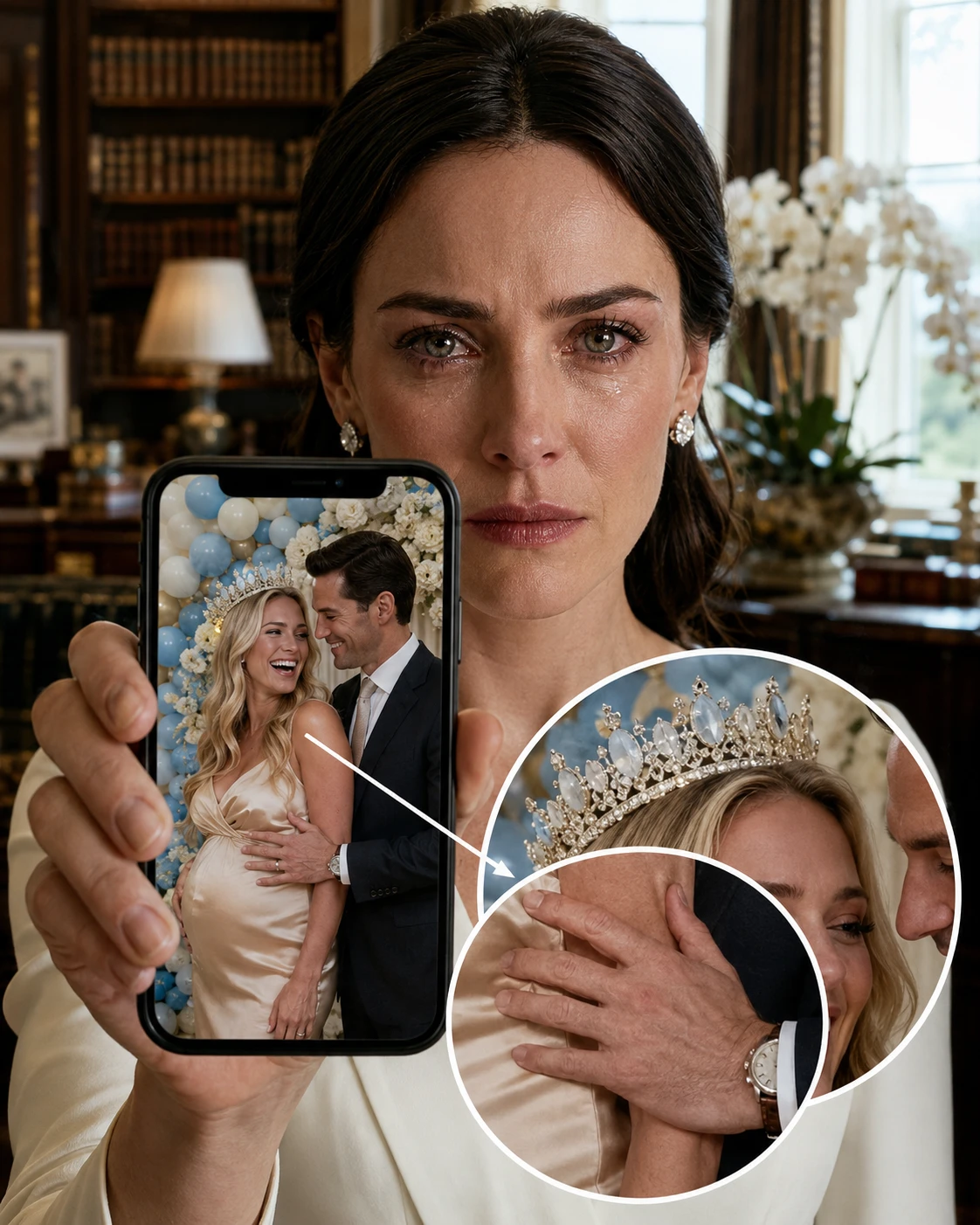
His mistress tried to wear my bridal crown at her baby shower.
Not a tiara. Not a glittering party favor from some boutique on Madison Avenue. My crown.
The one my grandmother had worn when she married into old Newport money in 1958. The one my mother had refused to wear because she said it felt too much like a prophecy. The one I wore at my own wedding to Preston Whitaker beneath eight thousand white roses, a cathedral ceiling, and the kind of silence rich families use when they are pretending not to smell a lie.
The crown was platinum and moonstone, made delicate enough to look angelic and sharp enough to draw blood if you gripped it wrong. It had been photographed by Vogue, appraised by Christie’s, and locked for thirty-two years in a temperature-controlled vault at Harbor House, my grandmother’s estate above the cliffs of Newport, Rhode Island.
It was also listed as a protected heirloom under the Magnolia Sinclair Irrevocable Trust.
Which meant it did not belong to Preston.
It did not belong to his family.
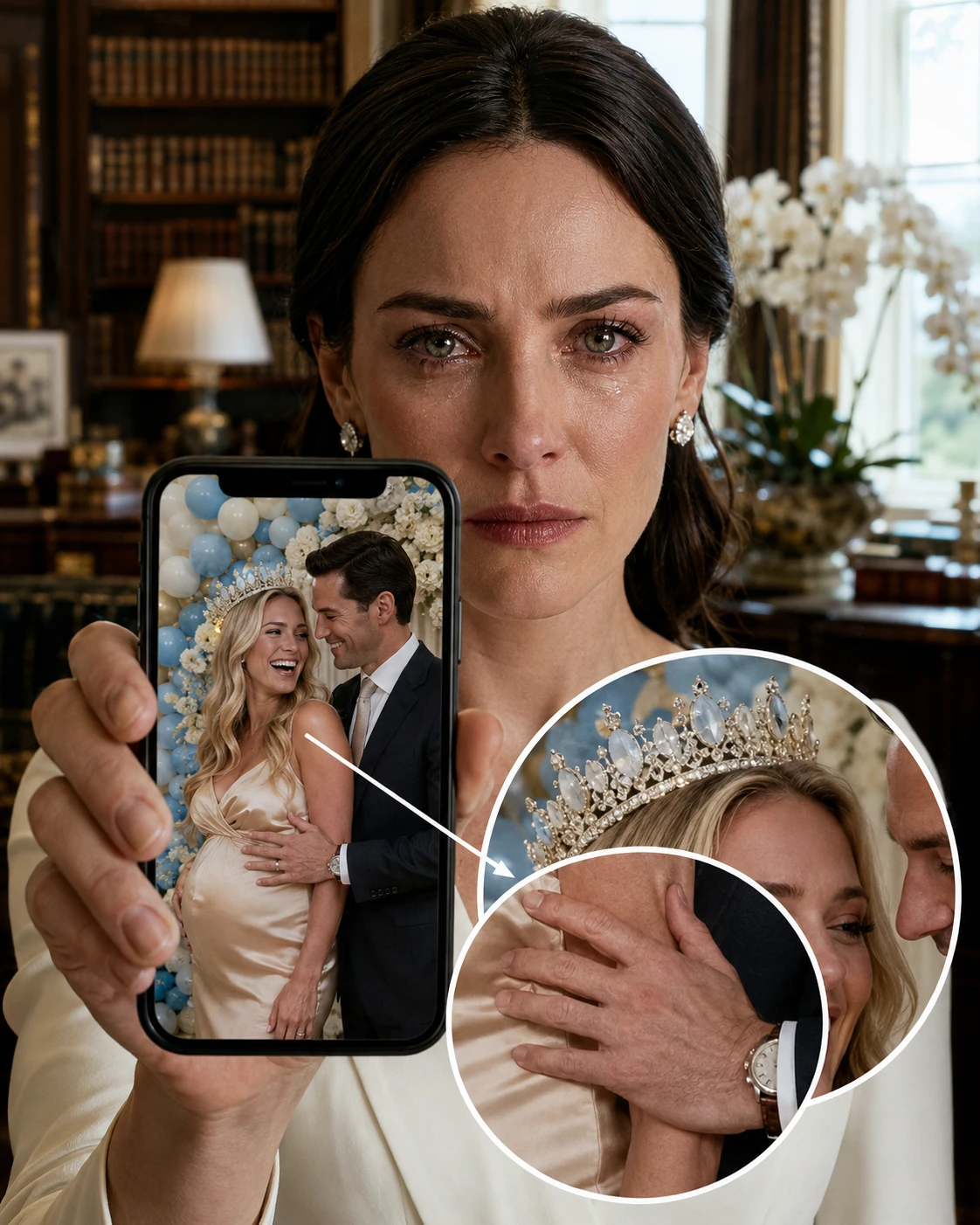
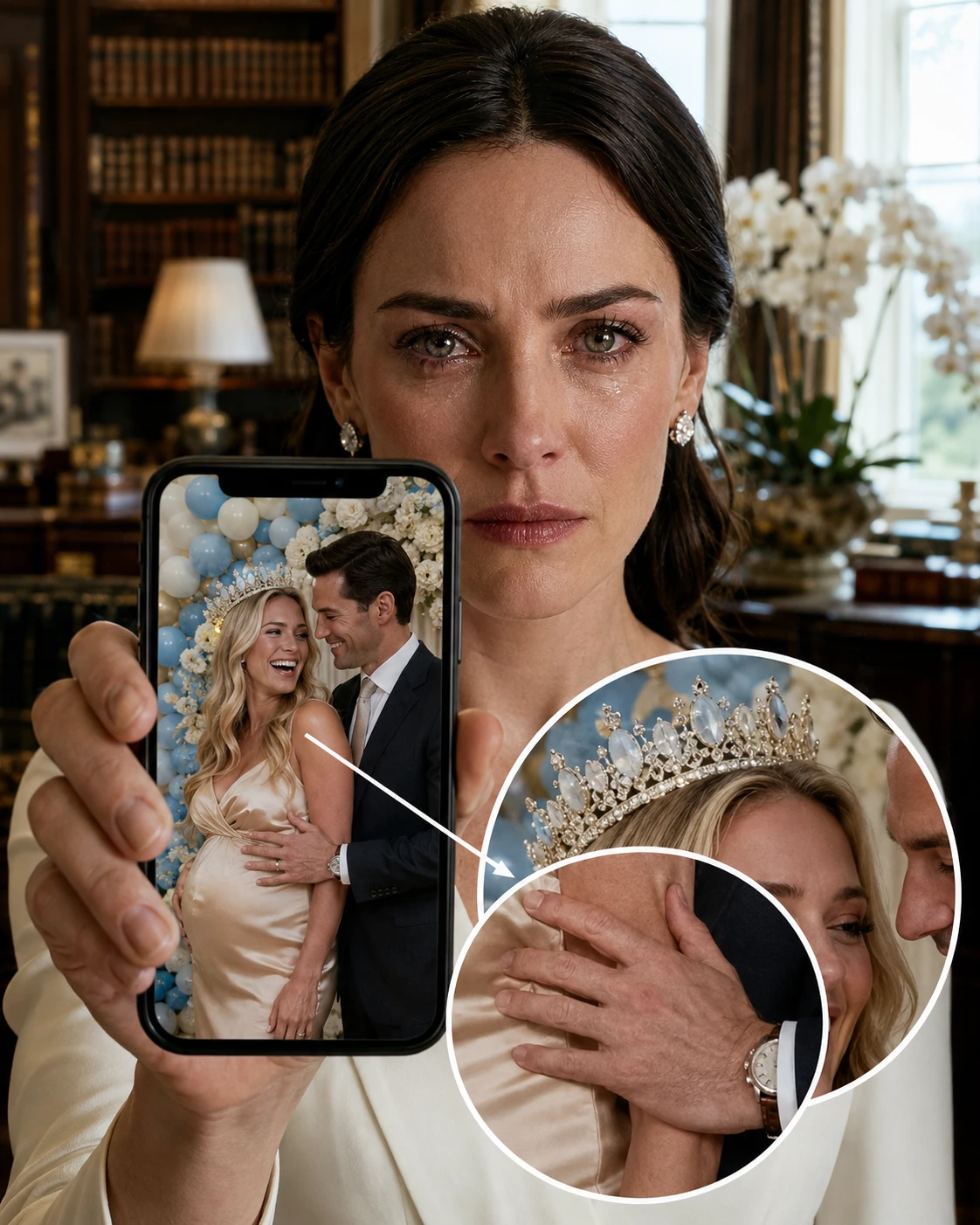
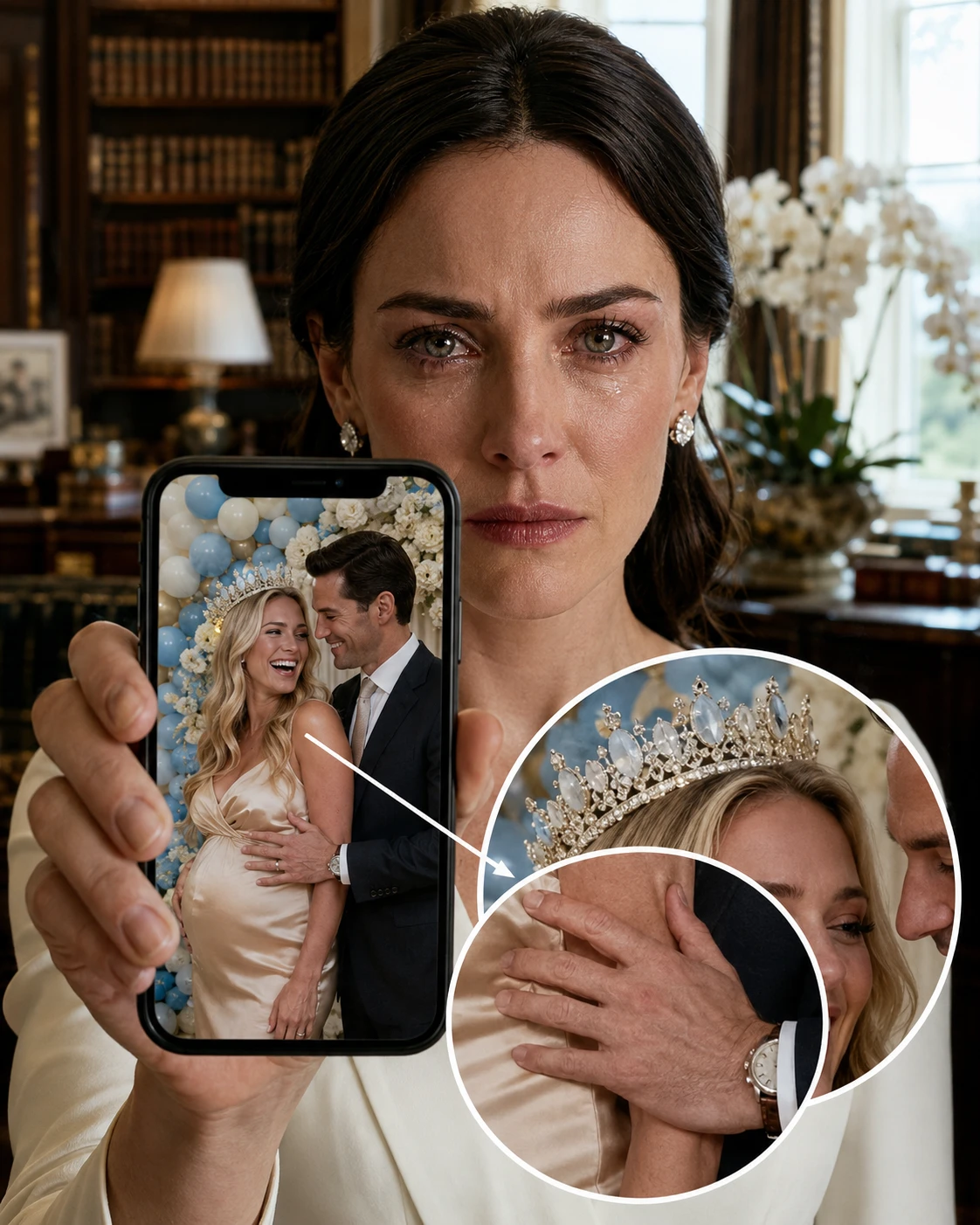
And it certainly did not belong on the head of Sloane Mercer, his pregnant twenty-six-year-old mistress, while she stood beneath a balloon arch that said WELCOME BABY WHITAKER in gold script.
My sister Celeste was the one who saw it first.
She had not meant to go to the shower. Celeste said she was only stopping by the Lenox Club in Boston because one of her friends had whispered that the “other woman” was throwing herself a blue-and-ivory baby shower with Whitaker money and Sinclair flowers.
Then she walked into the ballroom and saw Sloane laughing in my grandmother’s crown.
Celeste texted me one photo.
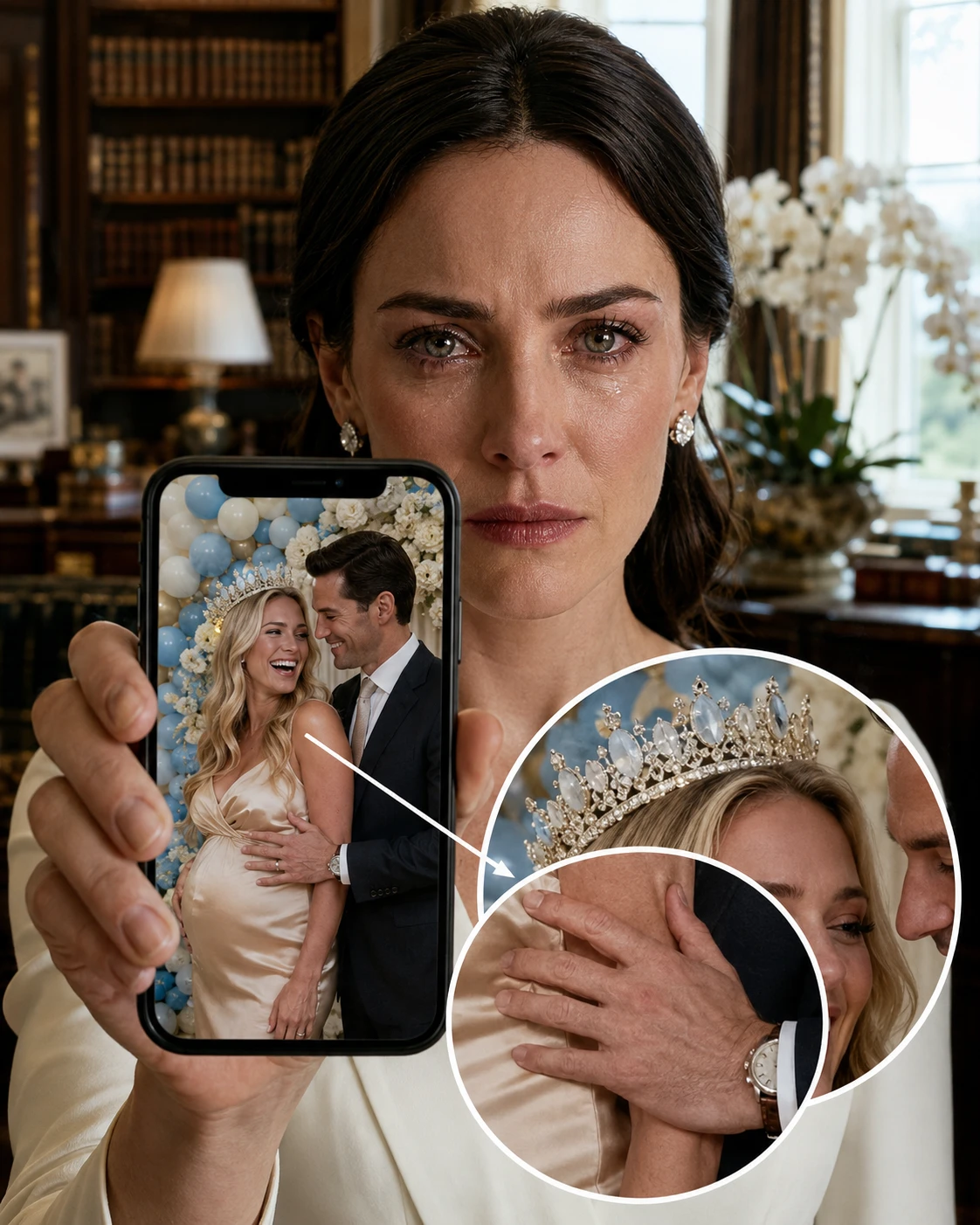
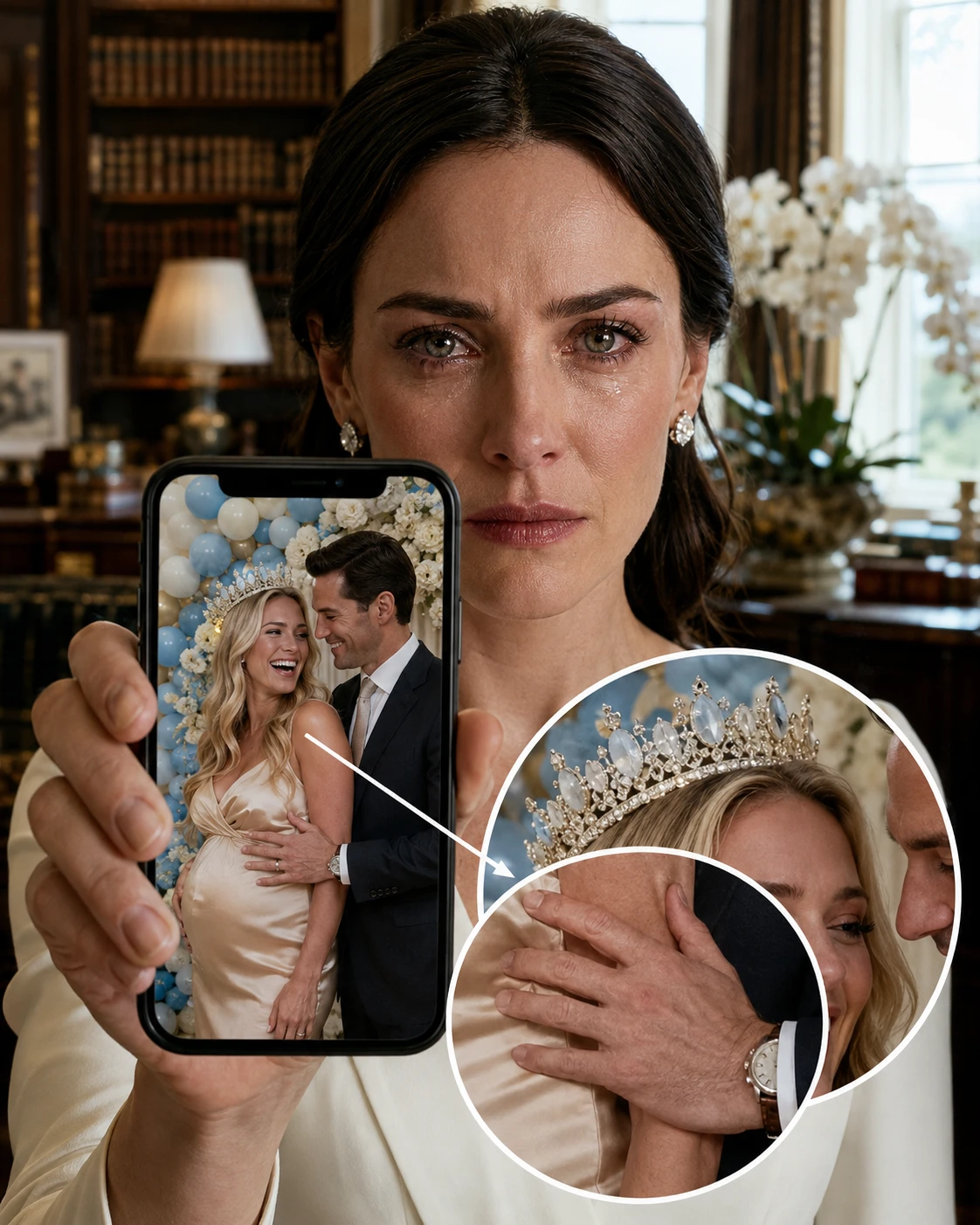
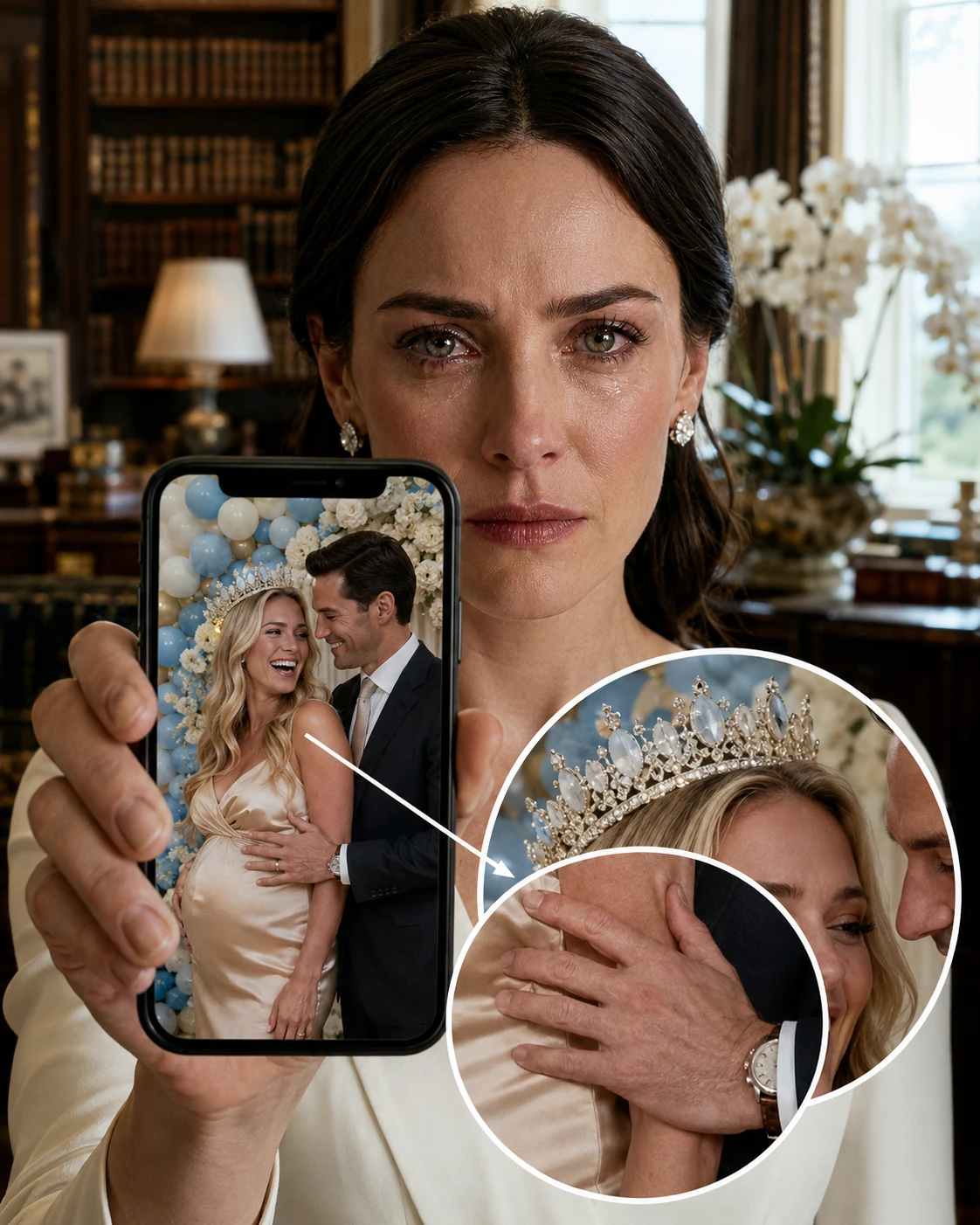
In it, Sloane had both hands lifted to the crown like she was being coronated. Her hair was a pale, expensive blonde, her lips glossy, her belly wrapped in champagne satin. Behind her, women smiled with their teeth and lowered their eyes with their morals.
And beneath the photo, my sister typed:
Viv, breathe before you answer.
I did breathe.
Once.
Then I zoomed in and saw Preston standing beside Sloane, one hand on the small of her back, his wedding ring missing, his face bright with the kind of pride he had never given me in public.
Sloane was speaking when Celeste took the picture. A guest had asked if the crown was real.
According to Celeste, Sloane touched the moonstones and said, “He said I deserve everything she had.”
That was the moment something inside me became very, very quiet.
Not broken.
Not hysterical.
Quiet.
I did not call Preston. I did not scream. I did not drive to Boston in a black dress and make a scene worthy of a hundred million views.
I saved the photo.
I forwarded it to my estate attorney.
At 3:14 p.m., I wrote:
Lydia, the crown has been removed from Harbor House without authorization. Please initiate enforcement of the trust immediately.
At 3:16 p.m., Lydia Chen replied:
Already drafting. Do not engage. Let them keep smiling.
By evening, the baby shower had an unexpected guest.
A legal notice.
CHAPTER 1: THE CROWN AT THE BABY SHOWER
I learned a long time ago that humiliation has a temperature.
At first, it burns. Your skin goes hot, your throat closes, your fingers shake around whatever object is unlucky enough to be near you. A phone. A glass. A pearl-handled letter opener your grandmother kept on her desk because she believed even paper should be opened with dignity.
Then the burn passes.
If you survive the first wave, humiliation turns cold.
That cold is dangerous.
That cold can sit through dinner.
It can answer emails.
It can walk barefoot across marble floors at midnight, past portraits of dead ancestors and vases of white orchids, without making a sound.
I was thirty-four years old when I saw my husband’s mistress wearing my bridal crown at her baby shower, and the cold entered me so completely that even the June air over Newport felt like winter.
Harbor House stood on a private stretch of cliff road, all gray stone and black shutters, with windows tall enough to make sunlight look obedient. My grandmother Magnolia Sinclair had called it “the last honest house in Rhode Island,” which was not true. Nothing about my family had ever been honest. But Harbor House was beautiful, and sometimes beauty is the most convincing lie.
I was in the west library when Celeste sent the photo.
The west library had always smelled like leather, salt, and old money. It was the room where Magnolia taught me never to confuse softness with weakness. “A woman can wear silk,” she once told me, “and still cut a man’s throat with a contract.”
At the time, I thought she was being dramatic.
After eleven years married to Preston Whitaker, I understood she had been giving me instructions.
My husband came from money, but not the old kind. Whitaker money was new enough to still need applause. His grandfather had built an energy logistics company in Texas. His father had turned it into a private equity empire in New York. Preston inherited charm, cheekbones, and the Whitaker belief that rules were only fences built for other people’s cattle.
When we met at a charity auction in Manhattan, he told me he loved that I did not seem impressed by him.
I was impressed. I was twenty-three and trying not to show it.
He had stood under the blue light of the aquarium ballroom in a midnight tuxedo, laughing with senators, art dealers, and men who owned football teams. He had looked at me like I was the only object in the room not for sale.
“I know who you are,” he said.
“I’m sure you do.”
“Vivienne Sinclair. Harbor House. The Magnolia Sinclair Foundation. Princeton. Art history. You outbid my mother on a de Kooning study last spring.”
“I didn’t outbid your mother,” I said. “She stopped bidding.”
He grinned. “That’s what losing people say.”
That was the beginning.
Preston loved winning. He loved beautiful rooms, fast cars, and the public performance of devotion. He sent white peonies to my office every Monday for six months before proposing. He flew my friends to Aspen for my birthday. He learned the names of my favorite books and misquoted them charmingly. When he proposed at the Breakers beneath a chandelier that had outlived three American wars, my mother cried, my grandmother watched without blinking, and I said yes because I mistook being chosen for being known.
Our wedding was written about as if it were a merger between dynasties.
The Whitaker heir and the Sinclair heiress.
A Newport cathedral. A reception at Harbor House. A bridal crown no one had seen in public since Magnolia’s wedding portrait.
Preston cried when I walked down the aisle.
I used to keep that memory carefully, like a candle protected from wind.
Now I know men can cry over things they still intend to ruin.
The first year of marriage was golden. The second was polished. By the fifth, the gold had begun to flake.
Preston traveled constantly. Dallas. Palm Beach. Jackson Hole. London. Wherever there was money pretending to be opportunity. He came home with gifts too expensive to question and kisses too practiced to trust. When I asked where he had been, he answered with details. Men think details sound like truth. Often they are just decorations around a locked door.
Sloane Mercer arrived in his life as a communications consultant for Whitaker Holdings.
She had a face made for soft lighting and a résumé full of names rich people like to see. Vanderbilt. Condé Nast. A political campaign no one wanted to discuss but everyone respected. She was blonde in the way expensive hotels are blonde: all cream, gold, and calculated warmth.
I met her once at a holiday party in Manhattan.
She wore winter white and looked at my left hand before she looked at my face.
“Your ring is famous,” she said.
“My husband is loud,” I replied.
She laughed too quickly.
Preston touched her elbow and said, “Sloane is helping us modernize the foundation’s public image.”
“Our foundation?” I asked.
He smiled. “Figure of speech, darling.”
That was another thing Preston loved: calling women darling when he wanted them to stop asking questions.
By the time the affair became obvious, it had already become old news to everyone who mattered. I noticed the perfume on his scarf. The hotel charges disguised as strategy retreats. The sudden password changes. The way his phone slept face down like it had secrets even from the ceiling.
But wealthy marriages do not collapse dramatically at first. They rot politely.
There are dinners to attend. Boards to chair. Reporters to avoid. Family names to protect. You learn to sit beside betrayal and cut your salmon into elegant pieces. You learn to smile when older women squeeze your hand and say, “Marriage is complicated,” which is the language rich people use for “He is humiliating you, and we are all watching.”
Then Sloane got pregnant.
I found out from a florist.
Not from Preston.
Not from a friend.
From Martin at Fleur de Mer, who called Harbor House to confirm whether Mrs. Whitaker wanted the usual white peonies delivered to the Lenox Club for “the baby celebration.”
“The what?” I asked.
Silence.
Then Martin, poor Martin, realized he had just thrown a match into a room full of gas.
“I apologize, Mrs. Whitaker. There must be some confusion.”
“There usually is,” I said. “Send me the invoice.”
The invoice arrived four minutes later.
Two hundred white peonies.
Ninety ivory roses.
Blue hydrangeas.
Gold-rimmed vases.
Charged to the Whitaker-Sinclair household account.
Delivery address: The Lenox Club, Boston.
Client note: Sloane wants it to feel bridal but maternal. Preston approved.
Bridal but maternal.
There are phrases that should be illegal.
I did not confront him. Not then.
Instead, I called Celeste.
My sister was three years younger, five inches taller, and born with the kind of fury I had been trained to hide. She lived in Boston with her wife, a sculptor named Mara, and a German shepherd that disliked almost everyone but me.
“I need you to check something,” I said.
Celeste listened without interrupting. Then she said, “I’ll go.”
“Don’t do anything.”
“I’m offended you think so little of me.”
“I think exactly enough of you.”
“I’ll only observe,” she promised.
Celeste’s version of observing once involved throwing a glass of Bordeaux at a hedge fund manager who called his assistant “sweetheart” one too many times. But she loved me, and love sometimes requires witnesses.
She arrived at the Lenox Club at 2:47 p.m. wearing black sunglasses, a cream linen suit, and the expression of a woman mentally selecting a weapon.
The baby shower was in the Adelaide Ballroom, which had crystal chandeliers, hand-painted wallpaper, and a balcony where string musicians played covers of pop songs for people who wanted elegance without silence. There were monogrammed napkins. A dessert table shaped like a cloud. A guest book bound in pale blue leather. A champagne tower, which Celeste later described as “optimistic, considering the guest of honor.”
And there, seated in a velvet chair beneath the balloon arch, was Sloane.
Pregnant.
Radiant.
Wearing my grandmother’s crown.
When Celeste called me, she was whispering.
“Viv.”
“I know,” I said, because the photo had already arrived.
“No, you don’t. She’s telling people Preston gave it to her.”
My hand tightened around the phone.
“She said he told her she deserved everything you had.”
Through the line, I could hear women laughing. The soft clink of glass. A violin playing something sentimental and obscene.
Then I heard Sloane’s voice, bright as a knife.
“I know it’s a little dramatic,” she said, “but Preston says every baby deserves a legacy.”
Every baby.
A legacy.
I looked up at the portrait over the fireplace.
Magnolia Sinclair stared back at me from 1962, wrapped in black satin, one hand resting on a marble balustrade, the crown glittering in her dark hair. She had buried two husbands, outlived three brothers, sued a governor, bought back every acre her father had gambled away, and died at ninety-one with red lipstick on and no apologies in her mouth.
I wondered what she would have done.
Then I remembered.
She had already done it.
Three months before my wedding, Magnolia summoned me to her study at Harbor House. She was eighty-six then, bones delicate beneath silk, mind sharp enough to shave with.
“The crown is not yours,” she said.
I blinked. “I thought—”
“It is not mine either. Not really. Beautiful things become dangerous when people think beauty means possession.”
She slid a folder across the desk.
“The crown belongs to the trust. It can be worn by Sinclair women on marriage, displayed for charitable exhibitions with trustee approval, or stored. It cannot be sold, pledged, gifted, loaned, borrowed, altered, transported, photographed for commercial purpose, or placed upon the head of any person outside the bloodline without written consent of the trustees.”
“That seems intense.”
“My dear, everything worth keeping requires intensity.”
I signed where she told me.
Preston signed too, three days before the wedding, barely reading the document. He was too busy choosing a honeymoon yacht.
Now, eleven years later, his mistress had my crown on her head because Preston had made the oldest mistake of entitled men.
He confused access with ownership.
At 3:14 p.m., I sent the photograph to Lydia Chen.
Lydia had been Magnolia’s protégé, a trust and estate attorney with silver-threaded black hair and a voice so calm it made panic feel childish. She had offices in Boston and New York, wore navy suits, and once made a billionaire cry in mediation without raising her volume.
By 4:02 p.m., she had confirmed what I already knew.
The crown had been removed illegally from Harbor House.
The person who removed it had bypassed the vault log.
The security code used belonged to Preston.
By 5:08 p.m., Lydia had obtained an emergency preservation order from a judge who belonged to three of the same clubs as my grandmother and feared none of them more than the dead woman’s paperwork.
At 6:17 p.m., a process server named Denise Cole entered the Adelaide Ballroom in a charcoal dress and low heels.
Celeste filmed it from behind a floral arrangement.
The shower had reached the gift-opening portion. Sloane sat in her velvet chair with tissue paper around her feet, the crown shining in her hair like borrowed moonlight. Preston was beside her, one arm along the back of the chair, smiling as if he had built the entire room from his own charm.
Denise approached with an envelope.
“Ms. Mercer?”
Sloane looked up, still glowing.
“Yes?”
“You have been served.”
The room changed temperature.
It is beautiful, the way rich people go silent when consequences enter wearing sensible shoes.
Preston stood. “Excuse me?”
Denise handed him a second envelope.
“Mr. Whitaker. You as well.”
Sloane’s smile trembled. “What is this?”
Denise looked at the crown.
“Notice of emergency recovery regarding protected trust property, demand for immediate surrender, and preservation of evidence.”
Someone gasped.
Celeste whispered from behind the hydrangeas, “Oh my God, Viv.”
Preston ripped open the envelope. I watched the video later and replayed the exact second his face understood the problem. The color drained from him slowly, like ink pulled from water.
Sloane touched the crown.
“Preston?”
He did not answer.
Denise continued, “The item currently on your head has been identified as the Sinclair moonstone bridal crown, protected under the Magnolia Sinclair Irrevocable Trust. You are required to remove it and surrender it immediately to the custody representative present.”
“I’m sorry,” Sloane said, her voice climbing. “This was a gift.”
“No,” Denise said. “It was evidence.”
A woman near the dessert table dropped her champagne flute.
It shattered.
For the first time that day, Sloane stopped pretending she was a fairytale princess and looked exactly like what she was: a woman wearing another woman’s history without permission.
Preston moved toward Denise. “This is absurd. My wife is emotional. She doesn’t understand—”
That was when Lydia Chen stepped into the ballroom.
Navy suit. Pearl earrings. No expression.
Behind her stood two uniformed security officers from the Lenox Club and a private recovery agent with white gloves and a velvet-lined case.
Lydia said, “Mrs. Whitaker understands perfectly.”
Preston’s jaw tightened. “Lydia.”
“Mr. Whitaker.”
“This is a private event.”
“Then you should not have brought stolen trust property to it.”
The word stolen moved through the room like smoke.
Sloane began crying, which would have worked in a different room, with different stakes, and fewer lawyers.
“I didn’t steal anything,” she said. “Preston gave it to me.”
Lydia turned to her.
“Ms. Mercer, whether you stole it or merely accepted stolen property will be a question for counsel. For now, remove the crown.”
Sloane looked at Preston.
That was the saddest part, I think.
Not for me.
For her.
She really believed he would save her.
But Preston loved admiration more than women, and scandal more than neither. In that room, with phones lifted and whispers sharpening, he made a calculation.
Then he stepped back.
Sloane saw it. Everyone did.
Slowly, with shaking hands, she lifted the crown from her head.
The recovery agent placed it into the velvet case.
The lid closed with a soft click.
A sound small enough to miss.
Final enough to end an empire.
CHAPTER 2: THE WIFE WHO SAID NOTHING
By seven o’clock that evening, half of Boston society had seen the video.
By eight, New York had it.
By nine, an anonymous account posted a twelve-second clip on TikTok with the caption:
Mistress wore wife’s heirloom crown to baby shower. Wife sent lawyer. I fear this level of calm.
By midnight, the internet had become a courtroom.
Some people called me iconic.
Some called me cold.
Some said I should have confronted Sloane myself, slapped Preston, thrown cake, screamed, cried, given them the kind of messy entertainment people demand from women in pain.
But I had learned from Magnolia that public emotion is a currency. Spend it carefully, or people will use it to buy pieces of you.
I stayed at Harbor House that night.
I did not turn on the lights.
The moon was full over the Atlantic, silvering the lawns and the black line of the cliffs. Downstairs, the crown had been returned to the vault after inspection. Lydia had texted me one sentence:
Recovered intact. Minor oil transfer. No structural damage.
No structural damage.
I laughed when I read that, though nothing was funny.
My marriage had been wearing cracks for years. But the crown was fine.
At 12:43 a.m., Preston called.
I let it ring.
At 12:44, he called again.
At 12:46, he texted.
Vivienne, this has gone too far.
Then:
You embarrassed me.
Then:
We need to handle this like adults.
Then:
Sloane is pregnant. Think about the baby.
The baby.
Men always discover innocence when they need a shield.
I poured myself a glass of water from the crystal pitcher beside my bed and read his messages twice.
Then I typed:
All future communication through counsel.
I watched the bubbles appear.
Disappear.
Appear again.
Finally:
You are making a mistake.
No, I thought.
I was correcting one.
The next morning, I woke before dawn and dressed in black silk trousers, a white blouse, and my grandmother’s Cartier watch. Not mourning clothes. Armor.
Lydia arrived at seven with coffee, two associates, and a banker’s box of documents Magnolia had once called “the rainy-day folder.”
“It appears,” Lydia said, sitting across from me in the breakfast room, “that Preston has not only violated the heirloom provisions.”
I looked at her over my coffee.
“He used his vault access code. That gives us unauthorized removal.”
“Yes.”
“He transported the crown across state lines.”
“Yes.”
“He represented it as his to gift.”
“Yes.”
“And he did this while hosting a public event for his pregnant mistress, charged to our household account.”
Lydia’s mouth almost moved. For her, that was a smile.
“Yes.”
Celeste arrived fifteen minutes later wearing sunglasses indoors.
“I brought bagels,” she said. “And rage.”
Mara followed with a paper bag and a calm nod. She kissed my cheek and set the bag on the table.
“Also cream cheese,” she said. “Rage needs protein.”
It should have been unbearable, sitting there while the entire world discussed my husband’s mistress. Instead, for the first time in months, I felt strangely awake.
Pain clarifies.
You notice who comes to the table.
You notice who sends flowers and who sends silence.
My mother called from Palm Beach and said, “Darling, please don’t do anything irreversible.”
I said, “Mother, he got another woman pregnant and put my grandmother’s crown on her head.”
“Yes, but divorce is so public.”
“So was the baby shower.”
She sighed the sigh of a woman who had endured everything except accountability. “Your grandmother would have handled this quietly.”
“No,” I said. “Grandmother would have handled this legally.”
That ended the call.
At ten, Preston’s attorney contacted Lydia.
At ten-thirty, Whitaker Holdings’ general counsel contacted Lydia.
At eleven, Sloane’s attorney called, claiming “emotional distress” caused by the recovery process.
By noon, Lydia had responded to all three with language so elegant and lethal it should have been framed.
Meanwhile, I did something I had not done in eleven years.
I entered my husband’s study.
At Harbor House, Preston’s study had always been more performance than workspace. Leather chairs. Decanters. Framed photographs of him shaking hands with men whose smiles never reached their eyes. A signed football from a quarterback later indicted for tax fraud. Shelves of books he had not read but liked to stand in front of during interviews.
I had avoided that room out of respect.
Or fear.
Sometimes marriage teaches you to call fear respect because it sounds prettier.
Now I opened every drawer.
The top drawers contained pens, cufflinks, receipts, nothing. The locked drawer took ten minutes and a call to the house manager, who reminded me where the emergency key was kept.
Inside were folders.
Not many.
But enough.
A lease agreement for an apartment in Beacon Hill.
A jeweler’s invoice for a diamond bracelet.
Ultrasound photos in a cream envelope.
A handwritten note from Sloane:
P,
She’ll never give you a son.
But I will give you an heir.
S.
I stared at that note for a long time.
Not because it hurt.
Because it explained so much.
Preston had wanted children, but only in the abstract way men want legacy. He wanted a son at boarding school, a Christmas card, a little boy in a navy blazer carrying the Whitaker name into rooms Preston could no longer enter.
I had wanted children too.
For years.
There were doctors. Treatments. Hopeful calendars. Needles. Quiet losses no one posted about. One miscarriage at ten weeks that Preston missed because he was in Dubai closing a deal. Another at twelve weeks, after which he sent yellow roses because he forgot I hated them.
Eventually, my body became a room everyone stopped mentioning.
Then Sloane became pregnant.
And Preston, who had once cried beside my hospital bed and promised that I was enough, threw a baby shower with my flowers, my money, and my crown.
Celeste found me in the study with the note in my hand.
Her face changed when she saw mine.
“Viv.”
I handed it to her.
She read it.
For a second, I thought she might tear the room apart.
Instead, she folded the note carefully and placed it back in the envelope.
“Evidence,” she said.
I nodded.
That was when my phone rang.
Unknown number.
I almost ignored it. Then something made me answer.
“Mrs. Whitaker?”
“Yes.”
“My name is Julian Vale. I apologize for calling directly. I’m the crisis advisor Lydia Chen brought in this morning.”
I closed my eyes.
“Of course she did.”
“She asked me to monitor media exposure and help protect your privacy.”
“I didn’t realize my privacy survived the baby shower.”
A pause.
His voice softened but did not pity me. I appreciated that immediately.
“Privacy is not the same as secrecy. You’ve lost secrecy. You can still control privacy.”
Julian Vale had the kind of voice one imagines coming from a courtroom at dusk. Low. Careful. Educated without being ornamental. He had advised governors, widows, CEOs, and one actress whose divorce had nearly swallowed an entire awards season.
“I don’t want a public war,” I said.
“No,” he replied. “You want a clean one.”
I looked toward the window. The ocean moved below the cliffs, violent and beautiful.
“Yes.”
“Then say nothing today. Not to reporters. Not online. Not to Preston. Silence will make people lean closer. Documentation will make them stay.”
“You sound like my grandmother.”
“Then I’m already afraid of her.”
Against my will, I smiled.
“She would have liked you.”
“I’ll consider that a warning.”
That was my first real conversation with Julian.
Not romantic. Not yet.
At the beginning, he was simply the first man in years who did not ask me to make myself smaller so someone else could feel comfortable.
Over the next seventy-two hours, the scandal grew teeth.
A gossip site identified Sloane by name.
A business magazine asked whether Whitaker Holdings funds had been used for personal expenses.
A mommy influencer made a video titled When the Side Chick Tries on the Crown and Gets Served Instead, which gained four million views before lunch.
Preston issued no statement.
Sloane deleted her Instagram.
I said nothing.
Silence became my signature.
Photographers parked outside the gates of Harbor House. Helicopters circled once, then left after our security team made calls involving airspace restrictions and unhappy federal acronyms. Women I barely knew sent messages full of heart emojis and curiosity disguised as support.
Preston’s mother, Evelyn Whitaker, requested tea.
I agreed because I wanted to see what desperation wore.
She arrived at Harbor House in a dove-gray Chanel suit, pearls, and fury powdered into civility. Evelyn had built her life around the belief that appearances were not superficial; they were structural. To her, scandal was not a moral event. It was a maintenance problem.
“Vivienne,” she said, kissing the air beside my cheek. “You look thin.”
“Betrayal is very slimming.”
Her lips tightened.
We sat in the sunroom, where white curtains moved in the sea wind. A tray of tea appeared. Neither of us drank.
“This situation,” Evelyn began, “has become unnecessarily theatrical.”
“I agree. Baby showers are usually excessive.”
She ignored that.
“Preston made mistakes.”
“Plural is generous.”
“Sloane is young.”
“So is the century. Yet we expect progress.”
Evelyn placed her gloves on the table.
“The child is innocent.”
“I know.”
“And Preston is still your husband.”
“For now.”
Her gaze sharpened. “Divorce would be disastrous for everyone.”
“No,” I said. “It would be disastrous for Preston.”
“For you as well. People adore spectacle, but they do not respect women who destroy families.”
I almost laughed.
“Evelyn, your son created a second family and invited Boston to bring gifts.”
“He was lonely.”
There it was.
The defense of every man who breaks a home: loneliness.
As if loneliness were a gun someone else loaded.
I looked at Preston’s mother and saw not an enemy, exactly, but a woman who had spent decades polishing men until she could see her reflection in their sins.
“I was lonely too,” I said.
She looked away first.
That pleased me more than it should have.
Then she leaned in.
“Name your number.”
The room became very still.
“My number?”
“To resolve this. Quietly. A settlement. A renewed arrangement. You maintain your residence, your title, your foundation role. Preston acknowledges the child privately. Sloane is moved somewhere comfortable. Everyone survives.”
Everyone survives.
Not everyone heals.
Not everyone tells the truth.
Not everyone pays.
Just survives.
I reached for my tea and finally took a sip. It had gone cold.
“Evelyn, do you know why my grandmother put the crown in a trust?”
“Old families love paperwork.”
“No. She did it because men like your son always think women’s treasures are props in their redemption story.”
Her eyes narrowed.
I set down the cup.
“There is no number.”
She stood so quickly the chair legs scratched the floor.
“You are enjoying this.”
I looked at her for a long moment.
“No,” I said. “I am learning from it.”
After she left, Lydia called.
“We received Preston’s preliminary financial disclosure.”
“And?”
“He is lying.”
The cold inside me smiled.
“Good.”
CHAPTER 3: THE TRUST THAT REMEMBERED EVERYTHING
Money tells the truth when people will not.
Not immediately. Money, like sin, hides behind layers. Shell companies. Trusts. Holdings. Family partnerships with names like Cedar Ridge or Bluewater Capital, designed to sound harmless while swallowing entire lives.
But money always leaves fingerprints.
Preston’s first mistake was humiliating me in public.
His second was assuming I had spent eleven years doing nothing inside our marriage except decorating tables and attending galas.
The truth was quieter.
For eleven years, while Preston charmed rooms and chased applause, I had been learning the architecture beneath our life. Not because I expected revenge. Because Magnolia raised me to read documents the way other women read love letters.
Before the wedding, there had been a prenuptial agreement.
Preston’s lawyers drafted the first version, arrogant enough to be insulting. It protected Whitaker family assets, limited spousal support, excluded business appreciation, and assumed I would be too flattered by love to care.
Magnolia read it once, laughed, and invited their legal team to Harbor House.
I was there.
So was Preston, though he spent most of the meeting checking his phone.
Magnolia sat at the head of the table in a black dress and diamonds before noon. Her attorney, Lydia Chen, sat beside her.
The Whitaker lawyers explained their position.
Magnolia listened.
Then she said, “Gentlemen, my granddaughter is not applying for a job. She is entering a marriage. If you wish to make that marriage financially predatory before it begins, do have the courage to say so plainly.”
Preston’s lead attorney turned pink.
By the end of the week, the agreement changed.
My premarital assets remained separate.
So did his.
But any marital funds used to maintain, enhance, promote, or shield separate assets created reimbursement claims. Any personal expenses charged to joint household accounts required disclosure. Any public conduct causing reputational harm to the Magnolia Sinclair Foundation triggered an indemnity clause.
And then there was Magnolia’s favorite provision.
The Legacy Protection Clause.
It stated that if Preston, directly or indirectly, used Sinclair family property, heirlooms, restricted trust assets, foundation resources, or protected intellectual property to confer status, benefit, legitimacy, or public appearance upon a third party with whom he was engaged in an undisclosed intimate relationship, he would be deemed to have committed material marital fraud and reputational conversion.
When Lydia first explained that clause to me, I thought it was absurdly specific.
Now I understood Magnolia had not been paranoid.
She had been experienced.
“She knew,” I said to Lydia, sitting in the conference room of her Boston office while rain pressed silver lines against the windows.
Lydia did not pretend to misunderstand.
“She suspected patterns.”
“With Preston?”
“With men.”
On the table between us lay a map of my life with Preston. Bank statements. Wire transfers. Emails. Invoices. Security logs. Foundation reports. Household accounts. Credit card charges. Hotel records obtained legally and politely, which somehow made them more damning.
Julian Vale sat near the windows with a laptop open, reading social sentiment reports. He wore a charcoal suit and no tie. His dark hair was threaded with a little gray at the temples, though he could not have been more than forty. He looked less like a man hired to manage scandal and more like one who had personally disappointed several empires.
He had been careful with me.
Never familiar.
Never flattering.
He did not tell me I was brave, which would have annoyed me. He told me where reporters were likely to be standing, which exits were safest, which statements sounded defensive, and which silences sounded powerful.
That day, while Lydia walked me through Preston’s financial lies, Julian said very little.
Until Lydia placed one invoice in front of me.
“This is the Beacon Hill apartment.”
I looked at the amount.
Fourteen thousand dollars a month.
Paid from the Whitaker-Sinclair household account.
The lease began eight months before Sloane’s pregnancy.
Another invoice.
Furniture.
Another.
Medical concierge services.
Another.
Jewelry.
Another.
A private security detail for Sloane, billed as “foundation event support.”
I felt something in my chest harden.
“He used foundation resources?”
Lydia nodded.
“Not directly from foundation accounts. But he coded certain reimbursements through event-related vendors. We have enough to trigger an internal review.”
I leaned back.
Outside, Boston moved under rain, all umbrellas and brake lights, a city pretending not to stare.
“Can he go to prison?”
Lydia folded her hands.
“Possibly, depending on what else we find. But prison is not the cleanest outcome.”
“What is?”
“Exposure with documentation. Civil judgments. Asset freezes. Removal from boards. Loss of lender confidence. Personal liability. If prosecutors become interested, we cooperate. But we do not build your strategy around criminal charges we cannot control.”
Julian looked up.
“Your power is not in punishing him loudly. It’s in making every institution around him realize he is a liability.”
That was when I understood what my grandmother meant by a kingdom.
A kingdom is not a castle.
It is not a crown.
It is a network of people who keep saying yes because they believe no one will survive saying no.
Preston’s kingdom was credit lines, board seats, golf invitations, private planes, whispered introductions, family offices, and the assumption that Whitaker men could misbehave without consequence.
To destroy it, I did not need fire.
I needed proof.
For two weeks, we gathered it.
I signed authorizations. Sat for interviews. Reviewed statements until numbers blurred. Slept four hours a night. Ate when Celeste appeared with food and threatened me. Ignored seventeen calls from Preston, nine from Evelyn, and one from a senator’s wife who began with “I love you like a daughter” and ended with “surely this can be handled discreetly.”
The internet kept watching.
Every day brought new theories.
People asked why I had not spoken.
Why I had not filed for divorce publicly.
Why I had not attacked Sloane.
Why I had not “taken my man back,” as if men were misplaced umbrellas.
Sloane reappeared online after six days with a statement.
It was written in Notes app font, which Julian called “the white flag of the guilty and photogenic.”
She wrote about love.
About being judged.
About the cruelty of women toward women.
About how she had been “misled regarding certain family items” and never meant to hurt anyone.
She did not mention my name.
She did not apologize.
She ended with:
My baby and I deserve peace.
I read it twice.
Then I set down my phone.
Celeste, who was sitting at my kitchen island eating grapes, said, “Please let me respond.”
“No.”
“Just a tiny response.”
“No.”
“I’ll be tasteful.”
“You have never been tasteful in your life.”
“I wore beige once.”
“Mara burned that dress.”
“Because it was haunted.”
Julian called ten minutes later.
“Have you seen Sloane’s statement?”
“Yes.”
“Do you want to respond?”
“No.”
“Good.”
A pause.
Then he said, “How are you?”
I almost gave the automatic answer. Fine. Alright. Managing. Words women use when they do not want to inconvenience anyone with the size of their grief.
Instead, maybe because it was raining again, maybe because I was tired, maybe because Julian had not once asked me to soften the truth, I said, “I feel like my life has become evidence.”
He was quiet.
Then, “That happens when someone puts you on trial without your consent.”
“I hate that strangers know.”
“They don’t know you. They know the shape of what happened.”
“That’s almost worse.”
“Yes,” he said. “It is.”
The honesty settled between us.
I looked across the library at the crown, now displayed temporarily in its case on the table because Lydia wanted photographs for insurance and litigation records. Without a woman beneath it, the crown looked almost innocent.
“Do you think I’m cruel?” I asked.
“No.”
“You answered too fast.”
“I work in public scandal, Vivienne. Cruelty is easy to recognize. You are controlled. There’s a difference.”
“What is Preston?”
“Careless.”
“That seems too small.”
“Carelessness in powerful people is never small.”
I carried that sentence with me.
Carelessness in powerful people is never small.
Three days later, we found the first hidden asset.
It was not hidden well. Men like Preston rarely hide things well because they confuse complexity with intelligence. The asset was a waterfront property in Sag Harbor purchased through an LLC named Blue Lark. Sloane’s mother was listed as manager. Funds came from a Whitaker-controlled entity, but closing costs were paid from a marital line of credit secured in part by my distributions.
Lydia’s associate found it at 1:12 a.m. and emailed everyone with the subject line:
Blue Lark sings.
By morning, there were more.
A diamond necklace insured under a false classification.
A Range Rover titled through a consulting company.
A private prenatal medical package paid through executive benefits.
A $500,000 transfer to a Delaware entity created two weeks after Sloane’s first ultrasound.
And, most interestingly, a series of calls between Preston and an appraiser known for discreet high-value collateral arrangements.
The crown had not been just a gesture.
It had been a test.
Lydia confirmed it on a Thursday afternoon.
“We believe Preston intended to use the crown’s appraisal history to support a private collateral representation.”
I stared at her.
“He was going to borrow against it?”
“Not directly. He knew he could not pledge it legally. But he appears to have represented proximity to Sinclair heirlooms and trust assets in negotiations with a private lender. The baby shower may have been designed to signal control.”
“By putting it on Sloane?”
“By showing the world he could.”
For a moment, the room tilted.
Not from heartbreak.
From disgust.
The affair had been ugly. The pregnancy painful. The public humiliation brutal.
But this was something colder.
Preston had not only betrayed me.
He had used Sloane, the baby, the crown, and our marriage as theater for money.
He had placed a pregnant woman beneath a stolen heirloom so lenders, investors, and his family could see him crowned by access to Sinclair wealth.
Sloane thought she was being chosen.
I thought I was being mocked.
Preston thought he was being strategic.
All three of us had been standing in different stories.
Only one of us had read the trust.
That evening, Preston came to Harbor House.
He was not allowed through the gate, so he stood outside in a navy suit, shouting into the intercom while cameras flashed from across the road.
I watched from an upstairs window.
He looked smaller from there.
“Vivienne,” he said through the speaker, voice distorted by static. “Open the gate.”
I pressed the button.
“No.”
“This is insane. We are married.”
“For now.”
“You’re letting lawyers poison you.”
“You did that yourself.”
He looked toward the house, trying to find me behind the dark windows.
“I made mistakes.”
“That word again.”
“I love her,” he said.
It landed differently than I expected.
Not like a knife.
Like a receipt.
I waited for pain. Instead, I felt a clean, almost merciful emptiness.
“Then why are you here?” I asked.
His face shifted.
There was the answer, naked before he spoke.
Because love had not solved his legal problem.
Because Sloane could not protect his assets.
Because babies did not satisfy lenders.
Because mistresses were romantic in secret and expensive in daylight.
“I’m here because we need to be reasonable,” he said.
“No, Preston. You are here because you need me to be reasonable.”
He stepped closer to the gate.
“Do you understand what you’re doing? If you go after me, you go after the Whitaker name.”
I looked down at him through glass and shadow.
“That’s the first accurate thing you’ve said.”
He gripped the bars.
“You won’t win.”
That was when I smiled.
Not because I was happy.
Because I finally understood the game.
“Preston,” I said, “you still think I’m trying to win you.”
The wind moved through the hedges.
His expression changed.
I released the intercom button.
The gate stayed closed.
CHAPTER 4: THE BALL WHERE MEN STOPPED LAUGHING
The Magnolia Sinclair Foundation gala had been scheduled for June 28 long before my marriage became public property.
Every year, it took place at the Metropolitan Museum of Art in New York after hours, beneath ancient stone faces and ceilings high enough to make even billionaires lower their voices. The gala raised money for women’s legal aid, domestic financial abuse prevention, and arts education in rural schools.
Magnolia had started the legal aid program after discovering that one of her closest friends could not leave a violent marriage because her husband controlled every bank account, deed, and attorney in their county.
“A woman with no access to money,” Magnolia said, “is a woman locked in a room without walls.”
That quote was engraved on the foundation’s annual report.
Preston always hated it.
He said it sounded accusatory.
Magnolia said only guilty men objected to accurate sentences.
That year’s gala theme was The Architecture of Freedom.
Before the scandal, Preston had planned to attend as co-chair.
After the scandal, the board asked him to step back pending internal review.
He refused.
Then Lydia sent the board documentation of misallocated expenses connected to Sloane’s baby shower.
He stepped back.
Quietly.
The press noticed anyway.
For days, speculation fed itself. Would I attend? Would Preston? Would Sloane appear? Would there be a statement? A confrontation? A divorce announcement? The internet wanted blood in couture.
Julian advised me not to attend unless I was prepared to become the event.
I said, “It is my foundation.”
He nodded.
“Then become the event on purpose.”
The night of the gala, I wore black.
Not widow’s black. Not revenge-dress black. Something quieter and more dangerous.
A custom silk column gown with a high neck, long sleeves, and an open back that fell like a shadow. No necklace. No tiara. No crown. My hair was swept low. My only jewelry was Magnolia’s watch and my wedding ring, which I wore one final time because evidence should always be presented clearly.
Celeste cried when she saw me.
“I hate that you look this good for such a terrible reason.”
Mara adjusted my sleeve. “Terrible reasons often have excellent tailoring.”
Julian met us at the side entrance of the museum.
For a second, when he saw me, the professional mask slipped.
Not much.
Enough.
“You look,” he said, then stopped.
“Careful,” I said.
“I was going to say prepared.”
“No, you weren’t.”
His mouth curved.
“No, I wasn’t.”
It was the closest thing to flirtation I had felt in years, and it should have felt inappropriate. Instead, it felt like a window opening in a room where I had been suffocating.
He offered his arm, not possessively, not performatively. Simply there.
I took it.
Flashbulbs exploded as we entered.
Reporters shouted questions.
“Mrs. Whitaker, are you filing for divorce?”
“Was the crown recovered?”
“Do you have a message for Sloane Mercer?”
“Did Preston Whitaker misuse foundation funds?”
I stopped.
Julian’s arm tensed slightly beneath my hand.
The cameras leaned closer.
I looked directly at them and said the first public words I had spoken since the baby shower.
“The foundation serves women whose lives have been controlled, hidden, or financially exploited. Tonight is about them.”
Then I walked inside.
Twelve words would have been enough.
I gave them nineteen.
The internet made them eternal.
Inside the Temple of Dendur, the gala shimmered like a dream built by people with tax attorneys. Candlelight moved across reflecting pools. White flowers climbed stone walls. Women in diamonds spoke softly under statues older than their bloodlines. Men laughed too loudly until they saw me, then remembered their volume.
I moved through the room with Celeste on one side and Julian a step behind.
Board members kissed my cheek.
Donors squeezed my hand.
Some people apologized with genuine feeling. Others apologized because they wanted to be photographed doing it.
Halfway through cocktail hour, Evelyn Whitaker appeared.
She wore silver.
Her face was controlled, but not calm.
“Vivienne.”
“Evelyn.”
“You look well.”
“You sound disappointed.”
Her eyes flicked toward Julian.
“And you have new company.”
“Professional company.”
“How modern.”
“How observant.”
Her smile tightened.
“Preston is here.”
I had expected that. Still, something in my stomach went cold.
“Of course he is.”
“He wants to speak with you privately.”
“No.”
“Vivienne, do not make this uglier.”
I leaned closer.
“It became ugly when your son turned a pregnant woman into collateral and a wife into a prop.”
Evelyn’s face went pale beneath the museum lights.
So she had not known.
Good.
Truth should travel through families like a storm.
Before she could answer, the room changed.
That subtle ripple again. Heads turning. Conversations thinning. A social weather system announcing the arrival of disaster in Tom Ford.
Preston entered alone.
No Sloane.
No wedding ring.
He wore a black tuxedo and the expression of a man determined to look wounded enough to be forgiven. It was a brilliant performance. His eyes found mine across the room, and for one ridiculous second I remembered the boyish grin at the aquarium ballroom, the peonies, the proposal, the man I had loved because I did not yet know love could be used as camouflage.
He crossed the room.
People pretended not to watch.
“Vivienne,” he said.
“Preston.”
“You look beautiful.”
“How inconvenient for you.”
A few nearby guests suddenly became fascinated by their champagne.
His jaw tightened.
“Can we speak?”
“We are speaking.”
“Privately.”
“No.”
He lowered his voice.
“You don’t want to do this here.”
I looked around at the donors, the board, the museum walls, the women whose legal aid cases the foundation had funded, the cameras tucked near the step-and-repeat outside.
“You’re mistaken,” I said. “Here is exactly where I want to do this.”
His eyes narrowed.
For the first time, the charm dropped completely.
“You think you’re untouchable because of your grandmother’s trust.”
“No,” I said. “I know the trust is untouchable because of my grandmother.”
He leaned closer.
“I can still make this painful.”
I smiled faintly.
“Preston, you already did. That’s why I stopped being afraid.”
A bell chimed.
Dinner was beginning.
He glanced toward the stage. “Whatever you think you have—”
“I have enough.”
“You always did love drama.”
“And you always mistook restraint for weakness.”
I walked away before he could answer.
The dinner took place beneath a canopy of projected stars. Every table was named after a woman who had changed American law, art, or history. I was seated at the Magnolia table, naturally. Julian sat to my right. Celeste to my left.
Preston had not been given a seat.
That was Lydia’s doing.
He stood near the back with two Whitaker board members and a face like a locked door.
The first speeches were ordinary. Moving, polished, donor-friendly. A judge spoke about access to counsel. A former client of the foundation described escaping a marriage where her husband hid every dollar and told everyone she was unstable. Her voice shook once. The room gave her a standing ovation.
Then it was my turn.
I had not been scheduled to speak.
That made it better.
I walked to the stage carrying one cream folder.
The room quieted in layers.
I looked out over the crowd and saw Preston near the rear exit, Evelyn beside him now, her hand on his arm as if holding him in place.
I began.
“My grandmother believed beautiful rooms should be used for difficult truths.”
A soft murmur. Recognition. They loved Magnolia quotes. They did not yet know this one had teeth.
“She also believed that legacy is not what we inherit. It is what we protect.”
I paused.
“Two weeks ago, a protected Sinclair family heirloom was removed without authorization from Harbor House and displayed at a private event. Many of you know this because the internet enjoys scandal. But scandal is only the smoke. Tonight, I want to speak about the fire.”
No one moved.
Not even Preston.
“For years, the Magnolia Sinclair Foundation has supported women facing financial deception, coercive control, hidden assets, and reputational threats. We have told those women that documentation matters. That the truth matters. That the law can be slow, imperfect, expensive, and still worth using.”
I opened the folder.
“My own household is now subject to legal review for precisely these issues.”
A hiss moved across the room.
I did not look at Preston.
“Because this involves the foundation’s reputation and possible misuse of foundation-related vendors, I have asked independent counsel to conduct a full audit. I have also resigned, effective temporarily, from any committee with a conflict of interest until that review concludes.”
People blinked.
That was not what they expected.
They expected accusation.
They got governance.
That was the first blade.
I continued.
“Additionally, the board has voted this afternoon to remove Preston Whitaker from all advisory roles connected to the foundation, pending the outcome of legal proceedings.”
This time, the room did react.
A collective inhale.
At the back, Preston stepped forward.
Evelyn grabbed his sleeve.
I turned a page.
“Finally, the foundation is establishing the Magnolia Emergency Counsel Fund, dedicated to women whose partners use money, status, or public humiliation to keep them silent.”
Applause began before I finished. It rose slowly, then thundered.
I waited.
When it faded, I said, “The first contribution is a personal donation from me.”
The screen behind me lit up.
$25,000,000
The room erupted.
Not because rich people are impressed by money. They are impressed by timing.
Julian looked at me from the table, and in his eyes I saw something I had not allowed myself to want.
Pride.
Not ownership. Not relief. Pride.
I looked back at the crowd.
“And because this foundation will never ask women to prove pain for public approval, the fund will provide emergency legal retainers within forty-eight hours of application.”
More applause.
Cameras flashed.
Preston was no longer looking angry.
He was looking afraid.
He had reason.
Because the donation did not come from Sinclair money.
It came from the sale of a Whitaker marital asset.
Specifically, my court-approved liquidation of my reimbursement claim against the Sag Harbor property he had bought for Sloane through Blue Lark.
But the room did not know that yet.
Preston did.
His attorney had received the order twenty minutes before I took the stage.
The gala became history before dessert.
By midnight, clips of my speech were everywhere.
By morning, the phrase The smoke is not the fire was printed across social media in fonts Magnolia would have despised.
Donations flooded the foundation.
Women wrote stories in comment sections. Some funny. Some devastating. Some only a sentence long.
He hid the money, but I found the keys.
He told everyone I was crazy until the bank statements came out.
He gave her my ring. I gave his lawyer my screenshots.
Pain recognized pain.
That was the part I had not expected.
Revenge had opened the door.
But truth walked through it carrying other women’s names.
Preston did not sleep that night.
I know because he sent seventeen emails between 1:00 and 4:30 a.m.
The first threatened litigation.
The second suggested mediation.
The third accused me of destroying him.
The fourth said he missed me.
The fifth said Sloane was hysterical.
The sixth asked whether I had “thought about what this would do to the baby.”
By the seventeenth, he wrote:
Please. Call me.
I did not.
At dawn, Julian found me on the terrace of my Manhattan apartment overlooking Central Park. The city below was pale and waking, all glass towers and morning sirens. I had not changed out of the black gown. My feet were bare. My hair had loosened.
He stood in the doorway with two coffees.
“You should sleep,” he said.
“People keep telling me what I should do.”
“Fair.”
He handed me a cup.
We stood together in silence.
The sky lightened.
Finally, I said, “I thought I’d feel satisfied.”
“You don’t?”
“I feel… clean in places. Hollow in others.”
“That sounds honest.”
I looked at him.
“Do you always say the thing that makes people unable to hate you?”
“No. Some people hate me easily.”
“Preston hates you.”
“Preston hates mirrors. I’m only standing near one.”
A laugh escaped me, small but real.
Julian looked at me then, and the air shifted.
Not dramatically. No music. No cinematic rain.
Just two adults standing at the edge of a life that had burned down, careful not to mistake warmth for rescue.
“I’m still married,” I said.
“I know.”
“I’m not ready to be grateful to a man.”
“I wouldn’t recommend it.”
“I’m dangerous right now.”
“Yes.”
“You’re not supposed to agree.”
“You are dangerous to people who need you confused.”
I looked away because suddenly my eyes hurt.
Julian’s voice softened.
“Vivienne, I am not here to be the next chapter before you finish this one.”
That sentence did something worse than flirtation.
It respected me.
And respect, after betrayal, feels almost indecent.
I did not kiss him.
He did not try.
But when he left, the terrace seemed warmer.
CHAPTER 5: THE FINAL TRUSTEE
Three weeks after the gala, Sloane gave birth to a boy.
His name was announced through a publicist.
Bennett James Mercer-Whitaker.
Seven pounds, two ounces.
Mother and baby healthy.
Father overjoyed.
I read the announcement in Lydia’s office while signing divorce filings.
For a moment, I felt the old ache.
Not jealousy.
Not exactly grief.
Something more complicated. The sharp little ghost of every child I had imagined and lost. A boy with Preston’s dark hair. A girl with my grandmother’s eyes. A nursery at Harbor House painted pale green because I hated the idea of assigning colors to hope.
Celeste, who had come with me, saw my face.
“You okay?”
I nodded.
Then shook my head.
Then nodded again.
Lydia gave me space by pretending to read a document she had already memorized.
I placed the birth announcement facedown on the table.
“The baby did nothing wrong,” I said.
“No,” Lydia agreed.
That mattered.
In revenge stories, people like clean lines. Villain. Victim. Punishment. Victory.
Real life is messier.
A child had been born into a room full of adult lies. That did not make him a weapon. It made him the person most deserving of protection from all of us.
So I made one decision that no one expected.
I asked Lydia to create a sealed education trust for Bennett.
Not publicly.
Not through Preston.
Not with the Whitaker name attached.
A modest trust by our world’s standards, excessive by any sane one. Enough for school, healthcare, and a start in life if the adults around him continued making expensive mistakes.
Celeste stared at me when I told her.
“You’re serious?”
“Yes.”
“Viv, his mother wore your crown.”
“His mother did. He didn’t.”
“She called him an heir.”
“Then someone should make sure he is not raised only by people who think inheritance is love.”
Celeste’s eyes filled.
“I hate when you’re better than me.”
“I’m not better. I’m tired.”
But the truth was, that trust was not forgiveness.
It was boundary.
It said: I will not become cruel just because cruelty touched me.
Preston heard about it anyway.
Not the amount. Not the structure. Just enough to know I had done something decent without him.
He called from a blocked number.
This time, I answered.
“Vivienne.”
“Preston.”
His voice was rough.
“You set up something for Bennett.”
“I set up something for a child.”
“Why?”
“Because he may need protection from his parents.”
Silence.
Then, quietly, “You hate me that much?”
“No,” I said. “That is the part you’ll never understand. I don’t hate you enough to organize my life around you.”
He exhaled.
For a second, he sounded like the man I married.
“I did love you,” he said.
I closed my eyes.
Maybe he had.
Maybe men like Preston love the way they do everything else: beautifully, briefly, and with no plan for maintenance.
“I know,” I said.
It was the gentlest lie I had left.
The divorce became public the next morning.
Not through a leak.
Through a filing.
Whitaker v. Whitaker.
Irretrievable breakdown. Marital misconduct. Financial misrepresentation. Breach of fiduciary duties. Reputational damages. Enforcement of prenuptial provisions.
The petition was not emotional.
It did not need to be.
It was 118 pages of cold weather.
Preston’s team responded aggressively. They accused me of weaponizing public sympathy. They claimed the crown incident had been a misunderstanding. They insisted Sloane believed the heirloom had been gifted with appropriate authority. They argued the household expenses were ordinary marital spending. They called my foundation speech defamatory without identifying one false sentence.
Lydia read their response, took off her glasses, and said, “Cute.”
Then we filed exhibits.
The vault logs.
The signed heirloom agreement.
The Legacy Protection Clause.
The baby shower invoice.
The Blue Lark documents.
The Beacon Hill lease.
The vendor reimbursements.
The appraiser calls.
The note from Sloane.
The text from Preston to Sloane two days before the shower:
Wear it. Let them see what’s coming.
That text ended him.
Not legally, not all at once.
But socially, instantly.
Let them see what’s coming.
The phrase spread everywhere.
It sounded like arrogance because it was arrogance. It sounded like conspiracy because it was almost one. It made every denial after it look insulting.
Whitaker Holdings’ lenders began asking questions.
Board members resigned.
A planned acquisition stalled.
An investor pulled out of a Dallas development project.
Evelyn stopped calling me and started calling bankers.
Preston’s father, Hal Whitaker, flew in from Texas and was photographed entering the Manhattan office with the face of a man discovering his son had turned lust into a liquidity crisis.
Meanwhile, Sloane gave one interview.
It was supposed to save her.
It did not.
She sat in a cream sweater in a softly lit room and told a lifestyle journalist she had been “swept into a powerful man’s promises” and “made to believe a future was secure.” She cried. She spoke about postpartum stress. She said she never understood the legal significance of the crown.
For part of the interview, I believed her.
Then the journalist asked about the note.
“She’ll never give you a son. But I will give you an heir.”
Sloane’s face changed.
Not guilt.
Annoyance.
“I was emotional,” she said. “Women say things when they’re in love.”
No, I thought.
Women reveal things when they think they’ve won.
The interview aired on a Thursday.
By Friday, Sloane had lost her consulting clients.
By Monday, she had moved out of the Beacon Hill apartment because the court froze disputed payments.
By Wednesday, Preston’s temporary support arrangement for her became part of a separate dispute with his family, who suddenly discovered morality when invoices arrived.
I took no joy in her fall.
That surprised people.
They wanted me to hate her publicly, but public hatred gives too much importance to the hated. Sloane had hurt me, yes. She had humiliated me, yes. She had tried to wear symbols she did not earn.
But Preston had opened the vault.
Preston had planned the theater.
Preston had placed the crown.
The man who hands a weapon to someone else and smiles at the wound is not less guilty because his fingerprints are clean.
The final hearing on the trust property issue took place in Newport County Superior Court.
It was raining that morning, a hard Atlantic rain that slapped against black umbrellas and turned the courthouse steps glossy. Reporters lined the sidewalk. Not just gossip reporters now. Financial journalists. Legal analysts. A documentary crew from somewhere, already hungry.
I wore navy.
Lydia wore darker navy, which somehow felt threatening.
Preston arrived with three attorneys, his father, and no mother. Evelyn, I heard later, had developed a migraine severe enough to avoid cameras.
Sloane did not attend.
Inside, the courtroom smelled of wood polish, damp wool, and consequences.
The hearing itself was not dramatic in the way television teaches people to expect. No one shouted. No one confessed on the stand. Real legal destruction is mostly paper, dates, signatures, and the patient assembly of facts until denial has nowhere elegant to stand.
Lydia argued that Preston had knowingly violated the trust, misrepresented his authority, exposed protected property to reputational and physical risk, and attempted to use the heirloom’s symbolic value for personal financial and social benefit.
Preston’s attorney argued misunderstanding, marital access, lack of damages, and emotional context due to “a complicated family transition.”
The judge looked over his glasses.
“A complicated family transition?”
The attorney cleared his throat.
“Yes, Your Honor.”
The judge glanced at the exhibit photograph of Sloane wearing the crown beneath the baby shower arch.
“I see.”
That “I see” should be studied in law schools.
Preston was ordered to pay substantial damages to the trust, cover recovery and legal costs, submit to expanded discovery regarding related financial representations, and surrender all access privileges to Harbor House and Sinclair trust property permanently.
Permanently.
The word entered me like oxygen.
After court, Preston found me in the corridor.
His attorneys were speaking to Lydia. His father stood by the elevators, staring at his phone as if bad news might become better if lit from below.
Preston approached slowly.
For once, he looked tired without looking tragic.
“Vivienne.”
I turned.
He looked at my bare left hand.
I had removed the ring that morning.
Something in his face flinched.
“I never thought it would go this far,” he said.
That was the closest he would ever come to honesty.
“I know,” I replied. “That was the problem.”
“I’m losing everything.”
“No,” I said. “You’re losing what was never safely yours.”
His eyes darkened.
“You think you’re different? You think your family money is clean?”
“No. I think my grandmother knew it wasn’t. That’s why she wrote rules.”
He laughed once, bitterly.
“Magnolia. Still controlling everyone from the grave.”
I stepped closer.
“Not everyone. Just the people who touch what she protected.”
For a second, I thought he might say something cruel enough to matter.
Instead, he whispered, “Did you ever love me?”
That question found a soft place I thought had gone extinct.
“Yes,” I said.
His face changed.
“But I loved the man you performed. Not the man who needed an audience to be decent.”
He looked away first.
I left him there.
That should have been the end.
It was not.
Because Magnolia Sinclair had one more secret.
The twist arrived in a cream envelope delivered to Harbor House on the first clear morning after the hearing.
Lydia brought it herself.
That alone told me it mattered.
We sat in Magnolia’s old study, where the ocean threw light onto the ceiling and the crown rested again in its vault below us.
“What is it?” I asked.
Lydia placed the envelope on the desk.
“Your grandmother instructed me to deliver this only under specific conditions.”
“Which conditions?”
“Your marriage ending due to documented misuse of Sinclair trust property by Preston Whitaker.”
I stared at her.
“She wrote that before the wedding?”
“Yes.”
“And you let me marry him?”
Lydia’s face softened.
“Your grandmother did not know he would betray you. She knew power reveals people, and she wanted you protected if it did.”
My hands felt cold as I opened the envelope.
Inside was a letter in Magnolia’s handwriting.
Vivienne,
If you are reading this, then I was right enough to be sorry.
Do not waste time being angry that I prepared for your pain. Preparation is not a curse. It is love with a long memory.
Men like Preston are not always villains when we meet them. Some are merely weak in expensive ways. Weakness, when protected by money, becomes appetite. Appetite, when applauded, becomes entitlement.
You may believe he took your crown because he wanted to wound you. Perhaps he did. But men like that rarely stop at symbols.
So I bought his kingdom before he could use yours.
I stopped reading.
The room lost sound.
Lydia watched me carefully.
“What does that mean?”
She opened her own folder.
“Over a period of twelve years, Magnolia, through several trust-controlled entities, acquired distressed debt, minority positions, and conversion rights connected to Whitaker Holdings and its subsidiaries.”
I blinked.
“She bought into Preston’s family company?”
“Quietly. Legally. Extensively.”
“How extensively?”
Lydia turned a page.
“The Magnolia Sinclair Trust currently controls or has enforceable rights over approximately forty-one percent of the voting leverage in key Whitaker entities, including debt covenants that can be triggered by fraud, reputational misconduct, unauthorized collateral representations, and executive instability.”
I could not speak.
Lydia continued.
“After the evidence filed in court, several covenants are now active. Hal Whitaker has been negotiating with our office since yesterday.”
“Negotiating what?”
“His son’s removal.”
The words sat on the desk between us.
His son’s removal.
I looked back at Magnolia’s letter.
So I bought his kingdom before he could use yours.
The final twist was not that Preston lost me.
It was not that he lost the crown.
It was not even that he lost money.
The final twist was that my grandmother, decades before Sloane Mercer ever touched champagne satin, had seen enough of the Whitaker appetite to make sure that if one of their men tried to swallow Sinclair legacy, he would choke on a contract.
“Why didn’t I know?” I asked.
“Because Magnolia did not want you marrying with a weapon in your hand. She wanted you to choose freely.”
“And if I was happy?”
“The provisions would have remained dormant. The positions profitable. No one needed to know.”
I laughed, but it came out like a sob.
“That woman was terrifying.”
“Yes,” Lydia said. “She loved you very much.”
The vote took place one week later in a glass tower overlooking Manhattan.
I did not attend in person.
I watched remotely from Harbor House with Lydia, Celeste, Mara, and Julian.
Preston was removed from executive authority at Whitaker Holdings pending investigation. Hal Whitaker retained a ceremonial role but surrendered operational control to an interim board approved by major stakeholders.
One of those stakeholders was the Magnolia Sinclair Trust.
Another was me.
Because Magnolia’s letter came with a second document.
Upon activation of the Legacy Protection Clause and dissolution proceedings arising therefrom, voting stewardship of the trust’s Whitaker positions transferred to Vivienne Sinclair Whitaker, individually and as successor trustee.
Successor trustee.
Not widow.
Not discarded wife.
Not humiliated woman in a viral video.
Trustee.
That evening, Preston called from his office.
I answered because the war was over, and sometimes one must witness the surrender.
“You knew,” he said.
“No.”
“Don’t lie.”
“I didn’t know.”
“Your grandmother stole my company.”
“No, Preston. Your family borrowed against its future. My grandmother bought the paper.”
He made a sound between a laugh and a curse.
“You planned this.”
“Give me some credit. I reacted beautifully.”
“You ruined me.”
I looked out at the cliffs, where twilight had turned the water violet.
“No. I became expensive to betray.”
Silence.
Then, bitterly, “Enjoy your kingdom.”
And there it was.
The last gift he would ever give me.
The right word.
I said, “I intend to improve it.”
Then I hung up.
CONCLUSION: THE HOUSE AFTER THE STORM
A year later, Harbor House felt different.
Not smaller.
Not quieter.
Just honest.
I changed very little at first. Grief needs familiar walls. But slowly, I let the house breathe.
I took down three portraits of men who had done nothing memorable except inherit well. I opened the east wing, which Magnolia had kept closed after my grandfather died, and turned it into offices for the foundation’s legal fellows. I replaced Preston’s study with a reading room for women staying temporarily under the foundation’s emergency protection program.
The leather chairs stayed.
The signed football did not.
The crown returned to the vault, where it belonged. Not hidden. Protected.
Once, Vogue asked to photograph me wearing it for a feature titled The Heiress Who Took Back Her Name.
I declined.
Some symbols become stronger when no one gets to consume them.
Sloane moved to Connecticut with Bennett. The education trust remained sealed. I never met the child, though once, through Lydia, I received a small card with a blue handprint on it and no message.
I kept it.
Not because I had forgiven his parents.
Because he had blue paint on his fingers and no guilt in his bones.
Preston remarried no one.
For a while, he tried to rebrand himself as a misunderstood father and fallen executive. Then the investigations grew deeper, and rebranding became difficult. He sold the Sag Harbor house. Lost the Beacon Hill apartment. Moved between Dallas, New York, and whatever private island still welcomed men who called consequences betrayal.
Evelyn sent one handwritten note.
Vivienne,
I underestimated you.
E.W.
I almost threw it away.
Instead, I wrote back:
So did I.
V.S.
The foundation grew beyond anything Magnolia had imagined. The Emergency Counsel Fund became national. Women wrote from Ohio, California, Georgia, Montana. Some needed lawyers. Some needed bank accounts. Some needed someone to say, clearly and without romance, that love is not supposed to require financial captivity.
Every year at the gala, we read Magnolia’s words aloud.
A woman with no access to money is a woman locked in a room without walls.
Then we opened doors.
As for Julian, he remained careful.
For months, he was simply there. At board meetings. In crisis calls. Across dinner tables where Celeste watched him like a hawk and Mara quietly decided he was acceptable because the dog liked him.
He never pushed.
He never asked me to turn healing into a love story before it was ready.
One October afternoon, more than a year after the baby shower, he came to Harbor House to review a media plan for the foundation’s new initiative. We worked in the west library while rain moved over the ocean. At some point, the conversation ended, and silence arrived without awkwardness.
I looked at him across Magnolia’s old desk.
“You know,” I said, “I used to think romance was someone choosing you in front of everyone.”
Julian closed the folder.
“What do you think now?”
I looked toward the window, where the cliffs stood dark and steady beneath the storm.
“I think it is someone respecting what you survived without trying to own the survivor.”
His gaze did not move from mine.
“That sounds harder to photograph.”
“Most real things are.”
He smiled.
Not charmingly.
Warmly.
I stood. Walked around the desk. Stopped in front of him.
“I’m divorced,” I said.
“I know.”
“I’m not fixed.”
“I didn’t think you were broken.”
That was when I kissed him.
No orchestra. No crown. No audience.
Just rain, old books, and a house that had seen enough performance to recognize truth when it entered quietly.
Love, the second time, did not feel like being chosen.
It felt like choosing.
Myself first.
Then, carefully, someone else.
Sometimes people ask whether revenge healed me.
It did not.
Revenge is not medicine.
It is a door with a lock on the other side.
Justice opened that door. Documentation kept it open. The women who walked through after me made the room worth rebuilding.
And healing?
Healing was quieter.
It was sleeping through the night.
Laughing without checking who might use it against me.
Signing my name without his attached to it.
Standing in Harbor House at sunset, watching the Atlantic strike the rocks below, knowing that what tried to shame me had become the story that freed me.
The mistress wanted a fairytale.
The wife sent the trust.
And as for the crown?
She wore the crown. I sent the kingdom.