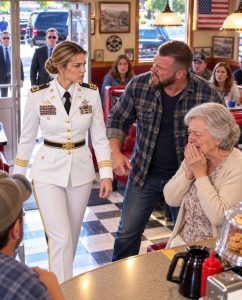
The two black SUVs stopped directly outside Turner’s Family Diner at precisely 8:17 that morning.
Through the front window, I watched four men step onto the sidewalk.
They wore dark suits, polished shoes, and the kind of expressions that made people instinctively straighten their backs.
One of them carried a leather briefcase.
Another held a thick folder marked with a federal seal.
Every conversation inside the diner stopped.
My mother, Evelyn Turner, stood behind the counter with her injured arm resting in a sling.
“Nicole,” she whispered, “what have you done?”
I took another sip of coffee.
“Nothing you need to worry about, Mom.”
The brass bell above the door jingled.
The first man entered, glanced around the room, and walked straight toward my booth.
“Colonel Turner.”
I stood.
“Special Agent Daniel Mercer.”
We shook hands.
Behind him stood Special Agent Rebecca Shaw, an investigator from the state attorney general’s office, and two members of a joint financial crimes task force.
I had known Mercer for eight years. We had worked together on a federal contracting fraud investigation involving stolen military equipment.
But today, he wasn’t here because I commanded soldiers.
He was here because someone had spent years turning an entire county into a private criminal enterprise.
“Everything you sent us checks out,” Mercer said quietly.
“All thirty properties?”
“Thirty-two. We found two more overnight.”
My stomach tightened.
“And my father?”
Mercer hesitated.
“That’s why I wanted to speak to you in person.”
Before I could answer, the diner door opened again.
This time, it was Travis Cain.
He wore an expensive leather jacket, dark sunglasses, and a grin that suggested he had never once been told no.
Two men followed him.
Travis stopped when he noticed the unfamiliar faces.
Then he spotted me.
“Well, well,” he drawled. “The soldier girl came home.”
I remained standing.
“Travis.”
He looked toward my mother.
“Evelyn, I thought we settled our little disagreement.”
My mother went pale.
One of the men behind Travis laughed.
I set my coffee cup down.
“You assaulted a seventy-five-year-old woman.”
Travis shrugged.
“Old people fall.”
Agent Shaw slowly turned toward him.
“Is that your official statement?”
Travis looked her up and down.
“Lady, who are you?”
She opened her credentials.
“State Attorney General’s Office.”
His smile faltered.
Only for a second.
Then he laughed.
“You people don’t understand how things work around here.”
Mercer stepped forward.
“Actually, Mr. Cain, understanding how things work around here is precisely why we’re here.”
Travis glanced toward the window.
Outside, another vehicle had arrived.
A white county sheriff’s cruiser.
Sheriff Don Harper climbed out.
And when he saw the government SUVs, the color drained from his face.
## THE SHERIFF WHO FORGOT HOW TO SPEAK
Harper entered the diner with one hand resting near his belt.
“What’s going on here?”
Mercer displayed his credentials.
“Special Agent Daniel Mercer. We’re conducting an investigation involving allegations of property fraud, official corruption, witness intimidation, and obstruction of justice.”
Harper stared at him.
Then at me.
“You called the federal government because your mother fell?”
“No,” I answered. “I provided evidence of possible crimes. Investigators made their own decisions.”
Travis stepped beside the sheriff.
“Don, tell these people to leave.”
Harper didn’t move.
“Travis, shut up.”
The entire diner went silent.
I had known Don Harper since I was sixteen.
He had once coached my high school softball team.
He had eaten Thanksgiving dinner at my parents’ house.
When my father died, he had stood beside the coffin and promised my mother that our family would never be alone.
Now he couldn’t look either of us in the eyes.
Mercer placed a document on the counter.
“Sheriff Harper, we’re requesting preservation of all records concerning the Turner property, the Cain family’s real estate transactions, and the investigation into Robert Turner’s death.”
Harper swallowed.
“That accident was investigated.”
“Then the records should be easy to produce.”
Travis snorted.
“You think my father is scared of paperwork?”
Mercer looked at him.
“Your father was served with a subpoena this morning.”
For the first time, Travis stopped smiling.
But then he leaned close enough that I could smell expensive cologne.
“You made a mistake coming home, Nicole.”
I met his eyes.
“No, Travis.”
I glanced at my mother.
“My mistake was staying away long enough for you to think she was alone.”
He opened his mouth.
Before he could speak, the diner bell rang again.
Carol Jenkins entered carrying a small cardboard box.
She was seventy-two, walked with a cane, and had lived next door to my parents for thirty-five years.
Her hands shook as she approached Mercer.
“I have something,” she whispered.
Travis stiffened.
“Carol, don’t.”
She stopped.
For a moment, I thought fear would win again.
Then she looked at my mother.
Evelyn had given Carol free meals during her husband’s chemotherapy.
She had driven Carol to appointments when nobody else could.
She had never asked for repayment.
Carol straightened.
“I’ve been afraid of your family for eleven years, Travis. I’m done.”
She placed the box on the counter.
Inside were photographs.
Receipts.
Copies of letters.
And a small digital recorder.
“I used to clean Wade Cain’s office,” Carol said. “He thought an old woman couldn’t understand business.”
Mercer opened the box.
“What are these?”
Carol’s voice cracked.
“Proof that Robert Turner wasn’t the first person who refused to sell.”
Then she said something that made my blood turn cold.
“And he wasn’t the first person who died afterward.”
## THE THIRTY-SECOND PROPERTY
Within an hour, Mercer had arranged private interviews with Carol and Kayla.
I stayed at the diner with Mom.
The customers who had refused to speak the day before now sat in uneasy silence.
Some looked ashamed.
Others kept glancing toward the windows.
Finally, an elderly farmer named Henry Dalton stood.
Henry had been eating breakfast at our diner since before I was born.
He approached my mother.
“Evelyn, I owe you an apology.”
Mom looked up.
“For what?”
“I saw that boy push you.”
Her lips trembled.
Henry removed his cap.
“I saw everything. But my granddaughter works at Cain’s warehouse, and Wade told me she’d lose her job if I caused trouble.”
He looked toward me.
“I was a coward.”
I studied his weathered face.
“Were you afraid?”
“Yes.”
“Then tell the investigators what happened.”
He nodded.
One by one, other customers began speaking.
A truck driver admitted Travis had threatened to revoke his delivery contract.
A school secretary described receiving anonymous warnings after her husband challenged a Cain zoning proposal.
A mechanic revealed that his repair shop had been condemned just weeks after he refused to sell it.
The silence that had protected the Cain family for years was beginning to break.
But the most important discovery came at 11:43 that morning.
Mercer called me from his vehicle.
“Nicole, you need to see this.”
I stepped outside.
He handed me a photograph.
It showed a small white farmhouse surrounded by oak trees.
“Recognize it?”
“No.”
“It belonged to a woman named Margaret Bell.”
The name meant nothing to me.
“Margaret refused to sell her property to Wade Cain in 2015,” Mercer continued. “Six months later, her house burned down.”
“Was anyone hurt?”
Mercer looked at me.
“She died in the fire.”
I stared at the photograph.
“Why wasn’t it investigated?”
“It was. Sheriff Harper ruled it an electrical accident.”
My hands tightened around the picture.
Mercer continued.
“Her property transferred to Cain Realty eight months later through a disputed foreclosure.”
I looked up.
“Who signed the foreclosure documents?”
He handed me another page.
At the bottom was a familiar name.
Mayor Linda Brooks.
But that wasn’t the worst part.
Margaret Bell had a daughter.
A daughter who had spent eleven years trying to prove her mother’s death wasn’t accidental.
And that daughter had disappeared three weeks earlier.
Her name was Sarah Bell.
## THE MAYOR’S PERFECT SMILE
At two that afternoon, Mayor Linda Brooks called an emergency town meeting.
By the time I arrived, nearly two hundred residents had crowded into the municipal building.
Linda stood behind a polished wooden podium.
She was sixty-one, elegant, and famous for smiling in photographs beside children, veterans, and charity volunteers.
She had also served as mayor for eighteen years.
“Friends,” she began, “our community is experiencing an unfortunate misunderstanding.”
I stood near the back wall.
Mom sat beside Carol in the front row.
Linda continued.
“Outside authorities have been invited into our peaceful town by individuals making exaggerated allegations.”
Several people turned toward me.
Linda smiled.
“While we respect military service, no individual should believe that wearing a uniform places them above the law.”
I almost laughed.
I wasn’t wearing a uniform.
I was wearing jeans and a sweatshirt.
But Linda had chosen her target.
She wanted the town to see me as an arrogant outsider.
Then she made her mistake.
“Robert Turner’s tragic accident was thoroughly investigated. Reopening old wounds serves nobody.”
My mother’s head lifted.
I raised my hand.
Linda hesitated.
“Yes, Colonel Turner?”
I walked toward the center aisle.
“Mayor Brooks, who told you investigators were reviewing my father’s death?”
Her smile tightened.
“It’s common knowledge.”
“No public announcement has been made.”
The room grew quiet.
“Perhaps I misunderstood.”
“Perhaps.”
I took another step.
“Can you explain why your signature appears on the foreclosure paperwork for Margaret Bell’s property?”
Linda gripped the podium.
“That matter was handled legally.”
“Margaret Bell died in a fire before the property was transferred.”
“I don’t recall the details.”
“Then perhaps you remember Sarah Bell.”
For one second, Linda’s expression changed.
It was brief.
But I saw it.
Fear.
“Sarah Bell?” she repeated.
“The daughter who’s been missing for three weeks.”
Linda looked toward the side entrance.
Two men in county security uniforms stood there.
“I think this discussion is over.”
Then my mother rose.
Slowly.
Painfully.
Her arm was still in a sling.
“Linda.”
The mayor froze.
My mother had known Linda since they were girls.
They had attended the same church.
Their children had played together.
“Evelyn, please sit down.”
“No.”
Mom’s voice trembled, but she continued.
“Robert trusted you.”
Linda said nothing.
“He came to you before he died. He said he had found something terrible, and you promised to help him.”
My heart slammed against my ribs.
I turned toward Mom.
“You never told me that.”
She looked at me with tears in her eyes.
“Your father made me promise not to.”
Linda stepped away from the microphone.
“Evelyn, you’re confused.”
My mother shook her head.
“No, Linda. I remember exactly what happened. And I remember the envelope he gave you.”
A murmur swept through the room.
Linda’s smile vanished.
Then the rear doors opened.
Wade Cain walked inside.
And the entire room fell silent.
## THE MAN WHO OWNED THE TOWN
Wade Cain was sixty-eight years old.
Tall.
Broad-shouldered.
Silver-haired.
He wore a dark suit and carried himself like a man entering a building he had already purchased.
Which, I suspected, he nearly had.
“Enough,” he said.
Linda immediately stepped aside.
Wade approached the microphone.
“I’ve spent forty years building businesses and creating jobs in this county.”
Nobody interrupted.
“I won’t stand by while a bitter family destroys my reputation.”
His eyes found mine.
“Nicole Turner.”
I remained still.
“Your father was a difficult man.”
My jaw tightened.
“Careful.”
Wade smiled.
“He never understood progress. Neither does your mother.”
He glanced at her sling.
“It’s unfortunate when elderly people become involved in disagreements they can’t handle.”
I stepped forward.
“Your son assaulted her.”
“My son denies that.”
“There are two videos.”
Wade’s smile thinned.
“Videos can be misleading.”
“Not when they’re supported by witnesses.”
Something flickered in his eyes.
Then he leaned toward the microphone.
“Let me explain something to you, Colonel. You may command soldiers somewhere else, but this is my home.”
He spread his hands.
“In this county, nothing happens without my knowledge.”
A voice came from the rear of the room.
“That’s exactly what we’re investigating.”
Agent Mercer stood beside two state investigators.
Wade turned.
For the first time, he looked uncertain.
Mercer continued.
“Mr. Cain, we’d like you to accompany us for a voluntary interview.”
Wade laughed.
“Call my attorney.”
“You’re welcome to.”
Wade stepped away from the podium.
Then he stopped beside me.
“You think you’ve won?”
I said nothing.
He leaned closer.
“Your father thought the same thing.”
My blood went cold.
“What did you say?”
Wade smiled.
“Ask your mother what he found beneath that diner.”
Then he walked away.
I turned toward Mom.
Her face had gone completely white.
And I knew.
She had been keeping something from me for six years.
## THE SECRET BENEATH THE DINER
That evening, I locked the diner’s front door.
The last customer had gone home.
Carol sat near the window while Mom stood beside the old cash register.
“Tell me,” I said.
Mom looked exhausted.
“Nicole, your father wanted to protect you.”
“From what?”
She reached beneath the counter and removed a small brass key.
It was attached to a faded blue ribbon.
“I promised Robert I would never use this unless there was no other choice.”
I stared at it.
“What does it open?”
“The storage room.”
“We’ve used that room my entire life.”
“Not the storage room you know.”
She led me into the kitchen.
Past the walk-in refrigerator.
Past the shelves of flour and canned tomatoes.
At the rear wall stood an enormous antique freezer that hadn’t worked in twenty years.
Mom pointed toward it.
“Help me move that.”
It took both of us several minutes.
When the freezer finally shifted, I saw a narrow wooden panel.
Behind it was a metal door.
I stared.
“Dad built this?”
“He found it when we renovated the diner.”
The brass key turned with a dull click.
The door opened.
Cold, stale air drifted out.
Inside was a narrow stairway descending into darkness.
I switched on my phone flashlight.
“Stay here, Mom.”
“No.”
She took my hand.
“I’ve spent six years being afraid of what’s down there. I’m not letting you face it alone.”
We descended together.
At the bottom was a small concrete room.
A steel cabinet stood against one wall.
Beside it sat an old desk.
On the desk were folders, photographs, and a dusty tape recorder.
My father’s handwriting covered a yellow legal pad.
I recognized it instantly.
The same strong, slanted letters he had used to leave notes in my school lunch.
Be brave, Nikki. Love, Dad.
My throat closed.
I picked up the top page.
It contained names.
Dates.
Property numbers.
Payments.
And a handwritten heading:
PROJECT BLACKWATER — ORIGINAL LAND ACQUISITION RECORDS.
I opened the first folder.
Inside were copies of bank transfers linking Cain Realty to shell companies.
There were photographs of damaged properties.
Statements from families who had been threatened.
And documents suggesting that public officials had helped engineer fraudulent foreclosures.
Then I found a map.
It showed the diner and the strip of land behind it.
But underneath the property was a series of tunnels.
“Mom?”
She nodded.
“Your grandfather used them for storage decades ago. Robert discovered that some had been reopened.”
“By whom?”
She shook her head.
“Your father believed the Cain family was moving something through them.”
I examined the map.
The tunnels connected the diner property to an abandoned freight depot.
And the freight depot belonged to Wade Cain.
I turned another page.
There was a photograph of my father standing beside a younger man.
The younger man wore a sheriff’s deputy uniform.
I recognized him immediately.
Don Harper.
On the back, my father had written:
DON KNOWS. ASK HIM ABOUT THE NIGHT OF OCTOBER 14.
October 14.
The night my father died.
## THE DEPUTY’S CONFESSION
I called Mercer.
Twenty minutes later, he arrived with Agent Shaw.
They photographed the room, documented the materials, and arranged for the records to be secured.
I wanted to drive straight to Sheriff Harper’s house.
Mercer stopped me.
“Nicole, you’re a witness and a victim’s family member. You cannot become the investigator.”
“I know.”
“Then let us do our jobs.”
I looked at my father’s handwriting.
“Just find out what happened.”
Mercer nodded.
“We will.”
At 9:06 that evening, Sheriff Harper called me.
His voice sounded different.
Older.
Broken.
“Nicole, I need to talk.”
“Then talk.”
“Not on the phone.”
I hesitated.
“Where?”
“The old church on Miller Road.”
I told Mercer immediately.
He arranged surveillance and accompanied me.
When we arrived, Harper was sitting in the back pew.
His uniform shirt was wrinkled.
His eyes were red.
He looked like a man who hadn’t slept in years.
“I didn’t kill your father,” he whispered before I sat down.
I felt my chest tighten.
“Then who did?”
Harper covered his face.
“I don’t know.”
I stared at him.
“Don’t lie to me again.”
He lowered his hands.
“Robert came to me three weeks before the crash. He had evidence that Wade was using county enforcement offices to pressure landowners into selling.”
“Why didn’t you help him?”
“Because Wade had something on me.”
Harper swallowed.
“My son had a gambling problem. Wade paid his debts. Then he threatened to expose him and ruin his life unless I cooperated.”
“That doesn’t excuse anything.”
“I know.”
Tears filled his eyes.
“The night Robert died, dispatch received a report about a suspicious truck following him on Route 9.”
My heart pounded.
“What truck?”
“A dark pickup. No plates recorded.”
“Who reported it?”
Harper looked down.
“Robert did.”
I stopped breathing.
“My father called for help?”
Harper nodded.
“He said someone was following him. He sounded frightened.”
“And what did you do?”
Harper’s voice cracked.
“I ordered dispatch not to send a unit.”
For a moment, I couldn’t hear anything.
The church seemed to tilt around me.
My father had been alive.
Afraid.
Calling the people he trusted.
And Harper had abandoned him.
I stood.
“You let him die.”
Harper began sobbing.
“I thought they only wanted to scare him.”
I stepped backward.
My hands were shaking.
For twenty years, I had learned how to remain calm under pressure.
But nothing had prepared me to hear that my father’s final plea had been ignored by someone who had eaten at our family table.
Mercer moved forward.
“Sheriff Harper, you’re going to need an attorney.”
Harper nodded.
Then he reached into his jacket.
Agent Shaw immediately raised her hand.
“Keep your hands visible.”
Harper froze.
Slowly, he removed a folded envelope.
“Robert gave me this the afternoon he died.”
He handed it to Mercer.
Inside was a photograph.
It showed Wade Cain standing beside a black pickup truck.
And next to him stood someone I recognized.
Someone who had been inside the diner the morning my mother was assaulted.
Kayla.
## THE WAITRESS WHO KNEW TOO MUCH
I stared at the photograph.
“That can’t be right.”
Kayla was twenty-four.
The picture appeared to have been taken six years earlier.
She would have been eighteen.
Her hair was darker, and she looked frightened.
Mercer studied it.
“Do you know why she was with Wade?”
Harper shook his head.
“Robert never told me.”
I called Kayla.
No answer.
Again.
Voicemail.
I drove back to the diner with Mercer following.
Mom was sitting behind the counter, reading an old recipe book.
“Where’s Kayla?”
“She left early.”
“When?”
“About an hour ago. She said she needed to see her sister.”
“What sister?”
Mom frowned.
“Nicole, she never talks about her family.”
I looked toward the window.
Across the street, a dark sedan sat beneath a broken streetlight.
Its engine was running.
As I watched, it pulled away.
Mercer stepped beside me.
“Did you get the plate?”
“Partial.”
He called it in.
Then Mom said something that made both of us turn.
“Kayla wasn’t always called Kayla.”
I stared at her.
“What?”
“When she first came here, she introduced herself as Katherine. Then she asked me to call her Kayla.”
“Why?”
“She said she needed a fresh start.”
Mercer opened his phone and began searching through the case files.
A minute later, his expression changed.
“Nicole.”
He turned the screen toward me.
A photograph appeared.
A missing-person report from eleven years earlier.
A teenage girl with dark hair and frightened eyes.
Her name was Katherine Bell.
Margaret Bell’s granddaughter.
Sarah Bell’s daughter.
I looked at the picture.
Then at the photograph from my father’s envelope.
It was the same girl.
Kayla had been connected to the Cain family’s victims long before she started working at our diner.
And she had never told us.
## THE MESSAGE FROM A GHOST
At 11:38 that night, my phone vibrated.
An unknown number.
One message.
Don’t trust the sheriff. Don’t trust the mayor. And don’t let Wade find the blue folder.
I stared at the screen.
A second message arrived.
Your father didn’t die because he discovered the property scheme.
Then a third.
He died because he discovered who was really behind it.
I called the number.
Disconnected.
Mercer examined the messages.
“Whoever sent these knows about your father’s investigation.”
I nodded.
Then my phone vibrated again.
This time, it was a photograph.
An old black-and-white image.
It showed four people standing in front of Turner’s Family Diner thirty years earlier.
My father.
My mother.
Wade Cain.
And a fourth person.
A woman holding a baby.
I zoomed in.
The woman’s face was familiar.
Not because I knew her.
Because I had seen her in the town hall that afternoon.
She had been sitting near the rear exit.
Watching.
The final message arrived.
Ask Evelyn about the baby.
I turned toward Mom.
She was standing in the kitchen doorway.
She had seen the photograph on my screen.
And she was crying.
“Mom?”
She shook her head.
“No.”
“Who is that woman?”
“Nicole, please.”
“Who is the baby?”
She pressed her good hand against her mouth.
For the first time in my life, I saw my mother look truly defeated.
Then she whispered:
“I thought we buried this secret when your father died.”
## THE WOMAN IN THE PHOTOGRAPH
Mom sat at the kitchen table.
I sat opposite her.
Mercer remained outside, giving us privacy.
For a long time, neither of us spoke.
Finally, Mom looked at the photograph.
“Her name was Anna Bell.”
“Margaret Bell’s daughter?”
“Yes.”
“Was she related to Sarah?”
Mom nodded.
“Sarah was Anna’s younger sister.”
I tried to follow.
“And the baby?”
Mom’s tears fell onto the table.
“Anna worked for Wade Cain when she was young. She knew things about his business. Things he wanted hidden.”
“Was the baby hers?”
“Yes.”
“Who was the father?”
Mom looked away.
I felt a terrible certainty forming.
“Wade?”
She shook her head.
“No.”
“Then who?”
Mom gripped my hand.
“Your father helped Anna escape town after Wade threatened her.”
I stared.
“Why would Wade threaten her?”
“Because she had evidence that could destroy him.”
“What happened to Anna?”
“She disappeared.”
“And the baby?”
Mom began trembling.
“Robert and I promised to protect that child.”
The room went silent.
I looked down at the photograph again.
The baby was wrapped in a white blanket.
My father stood beside Anna, his hand resting protectively on her shoulder.
I could barely speak.
“Mom…”
She looked at me.
And I asked the question I suddenly feared more than anything.
“Was that baby me?”
Mom closed her eyes.
For several agonizing seconds, she said nothing.
Then she whispered:
“No, sweetheart.”
I exhaled shakily.
But before relief could settle, she continued.
“That baby was your sister.”
I stared at her.
“My what?”
“Your sister.”
I shook my head.
“I don’t have a sister.”
Mom’s voice broke.
“You do.”
“Where is she?”
She began crying harder.
“We don’t know.”
I stood so quickly that the chair scraped across the floor.
“All these years? You let me believe I was an only child?”
“We were trying to keep her alive.”
“From Wade?”
Mom nodded.
“Robert arranged for Anna and the baby to leave the state. He never told me where they went.”
“Why not?”
“Because he was afraid someone would force the truth out of us.”
I looked at the photograph.
The baby.
My father.
The woman who had disappeared.
And the terrible possibility that my entire childhood had been built around a secret.
Then I noticed something.
The baby wore a tiny silver bracelet.
I zoomed in.
Three letters were engraved on it.
K.B.T.
I stared.
Katherine Bell Turner.
Kayla.
My waitress.
The frightened young woman who had risked everything to record Travis Cain assaulting my mother.
She hadn’t come to the diner by accident.
She had come home.
## THE CALL THAT CHANGED EVERYTHING
I rushed outside.
“Mercer!”
He turned.
“What’s wrong?”
“Kayla is my sister.”
His expression hardened.
“Are you certain?”
“Not completely. But my mother just told me enough to make it possible.”
He immediately called his team.
Within minutes, investigators began checking Kayla’s last known movements.
Her apartment was empty.
Her car was gone.
Her phone was switched off.
At 12:21 A.M., Mercer received a call.
He listened without speaking.
Then his face changed.
“What?” I demanded.
He lowered the phone.
“Wade Cain’s attorney just contacted investigators.”
“And?”
“Wade says he wants to cooperate.”
I stared.
“Why?”
Mercer hesitated.
“Because Travis has disappeared.”
For a moment, neither of us spoke.
Then Mercer continued.
“His father claims Travis took documents from his office before leaving town.”
“What documents?”
“We don’t know.”
My phone vibrated.
Another unknown message.
This one contained a video.
I pressed play.
The footage showed a dimly lit room.
A woman sat in a chair.
Her wrists were bound.
Her face was bruised.
It was Kayla.
She looked directly into the camera.
“Nicole,” she whispered. “If you’re watching this, I’m sorry.”
A man’s voice came from behind the camera.
“Tell her.”
Kayla shook her head.
The man stepped into view.
Travis Cain.
He grabbed the back of her chair.
“Your sister has been keeping secrets, Colonel.”
I felt my entire body go cold.
Travis leaned toward the camera.
“Your father left something behind. Something my father has spent six years trying to find.”
Kayla began crying.
“Nicole, don’t—”
Travis covered her mouth.
Then he smiled.
“Bring me the blue folder, or you’ll lose another member of your family.”
The video ended.
I stood motionless.
Mercer reached for his phone.
“We’ll trace it.”
But before he could dial, another message appeared.
This one contained only six words.
CHECK YOUR FATHER’S DEATH CERTIFICATE AGAIN.
I opened the photograph of the certificate I had taken earlier.
Robert Turner.
Date of death.
October 14.
Cause of death.
Blunt-force injuries sustained in a motor vehicle collision.
Everything looked familiar.
Until I reached the bottom.
There, beneath the medical examiner’s signature, was a notation I had never noticed.
Identification confirmed by surviving spouse.
I stared at it.
My mother had identified his body.
Or at least, that was what the certificate claimed.
I turned toward the diner.
Mom stood behind the glass door.
Watching me.
I walked back inside.
“Mom.”
She looked at my face and seemed to understand immediately.
“What is it?”
“Did you identify Dad’s body?”
Her eyes widened.
“Nicole—”
“Did you?”
She lowered herself into a chair.
“No.”
My heartbeat thundered.
“Then who did?”
Mom covered her mouth.
“I was told the injuries were too severe. Don said the identification had already been handled.”
I felt the floor shift beneath me.
“Who handled it?”
She whispered:
“Linda Brooks.”
I stepped backward.
Six years.
Six years of visiting a grave.
Six years of believing my father was dead.
Six years of mourning a man whose body my mother had never actually seen.
Mercer entered the diner just as my phone rang.
Unknown caller.
I answered.
For several seconds, there was only static.
Then a man’s voice spoke.
Low.
Rough.
Older than I remembered.
But unmistakable.
“Nikki?”
My knees nearly buckled.
Only one person had ever called me that in exactly that way.
“Dad?”
Silence.
Then a trembling breath.
“Baby girl, listen carefully. Don’t give Travis the folder. And whatever you do, don’t let your mother leave that diner.”
I couldn’t speak.
Tears blurred my vision.
“Dad… where are you?”
His next words froze every drop of blood in my body.
“I’m closer than you think. But the man you buried six years ago wasn’t me.”
A loud crash sounded behind him.
Someone shouted.
The connection broke.
I stood staring at my phone.
Then the lights inside Turner’s Family Diner went out.
Outside, headlights swept across the windows.
Three black vehicles pulled into the parking lot.
Their doors opened.
And through the darkness, I saw a familiar figure step onto the sidewalk.
An older man.
Tall.
Silver-haired.
Walking with a slight limp.
He stopped beneath the streetlight and slowly raised his face.
My breath caught.
Because standing outside the diner, looking directly at me through the glass, was the man whose grave I had visited every Memorial Day for six years.
My father. Robert Turner. Alive.
But before I could run toward him, he lifted one hand.
Not to wave.
To warn me.
Then he pointed behind me.
I turned.
My mother was standing beside the kitchen door.
And in her trembling hand was a small black pistol.
She wasn’t aiming it at the strangers outside.
She was aiming it at Special Agent Daniel Mercer.
“Nicole,” my mother whispered, tears streaming down her face, “get away from that man.”
Mercer slowly raised both hands.
“Evelyn, put the gun down.”
But Mom shook her head.
And what she said next shattered everything I thought I knew.
“Your father didn’t disappear to escape Wade Cain, sweetheart. He disappeared because Daniel Mercer was the man who ordered him killed.”
…If you want to know what happened next, please type “YES” and like for more.