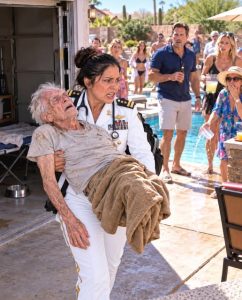
The woman in the sun hat stood perfectly still, staring at my father as though she had just watched a dead man climb out of his grave.
“Ray,” she whispered, “we went to his funeral. You told us your father died five months ago.”
Twenty people turned toward my brother.
The swimming pool suddenly seemed impossibly quiet.
Ray stood barefoot on the wet concrete, his beer forgotten beside his feet. His face had gone from red to a sickly shade of gray.
“Mrs. Delgado,” he said, forcing a laugh, “you’re confused. That was a memorial service for our mother.”
The woman shook her head.
“No.”
Her voice was trembling, but she didn’t look away.
“Your mother died two years ago. I attended that funeral, too. In March, you invited us to Saint Mary’s Chapel. There was a photograph of Arturo beside a wooden urn. You gave a speech about how your father had finally found peace.”
My stomach dropped.
A photograph. An urn. A funeral.
For my father.
Who was lying on a lounge chair in front of me, struggling to breathe.
I pressed another cold towel against his neck.
“Dad,” I whispered. “Stay with me. The ambulance is coming.”
His eyes fluttered.
“Marisol…”
“Don’t talk, Papi.”
But he tightened his fingers around my wrist.
“They buried somebody, mija.”
I stopped moving.
“What?”
His cracked lips barely formed the words.
“But it wasn’t me.”
Before I could ask another question, his eyes rolled backward.
“Dad!”
I checked his breathing, then his pulse.
Still there.
Weak.
Too fast.
I looked up at my brother.
“WHAT DID YOU DO?”
Ray took a step backward.
“Marisol, you’re making a scene.”
“A SCENE?”
My voice echoed across the backyard.
“You locked our eighty-one-year-old father inside a garage in 114-degree heat. You told the neighborhood he was dead. And now you’re worried about a scene?”
Tiffany hurried toward us.
“Everybody, please. This is a family misunderstanding.”
I turned on her.
“Don’t come near him.”
She stopped.
For the first time since I’d arrived, I saw something behind her perfectly arranged smile.
Not embarrassment.
Not guilt.
Fear.
Then the ambulance sirens sounded.
And everything changed.
The paramedics came through the gate carrying their equipment.
I gave them a rapid report.
“Eighty-one-year-old male. Prolonged exposure to extreme heat in an enclosed garage. Altered mental status, severe dehydration, possible heat stroke. History of coronary artery disease and insulin-dependent diabetes. Unknown medication compliance.”
One paramedic immediately began assessing Dad while the other prepared the stretcher.
“Are you family?” he asked.
“His daughter. I’m an ICU nurse.”
He nodded.
“Then you know how serious this is.”
“Yes.”
My voice cracked.
“I know.”
They began active cooling and moved him toward the ambulance.
Ray followed.
“Wait,” he said. “I’m his legal caregiver. You can’t take him without my authorization.”
The older paramedic looked at him.
“Sir, this patient needs emergency medical treatment.”
“But I have paperwork.”
“Then you can show it to the hospital.”
Ray stepped into their path.
“I said I have power of attorney!”
I had spent twelve years watching families make impossible decisions in hospital rooms.
I had watched husbands hold their wives’ hands through final breaths.
I had watched children beg for five more minutes with their parents.
But I had never imagined standing in my childhood backyard, watching my own brother argue against saving our father’s life.
I pulled out my phone.
“Officer,” I said to the deputy who had just entered through the gate, “I need to report suspected elder abuse, unlawful confinement, and financial exploitation.”
Ray’s expression changed.
“Marisol, don’t.”
I stared at him.
“You should have thought about that before you put our father in a cage.”
At the hospital, they took Dad directly into a treatment room.
I knew the procedures.
I understood the monitors, the blood tests, the fluids, the cooling measures.
But knowing what every machine did didn’t make it easier to watch them connected to my father.
His core temperature was dangerously elevated.
His kidneys were under stress.
His blood glucose was abnormal.
And when the attending physician reviewed his medication history, she frowned.
“Ms. Vega, when did your father last receive his insulin?”
“I don’t know.”
“His other prescriptions?”
“I don’t know.”
She looked at me carefully.
“Who has been managing his medications?”
“My brother.”
The physician’s expression became serious.
“We’ll need to investigate that.”
I sat beside Dad’s bed after they stabilized him enough for observation.
His hands were covered in bruises.
His toenails were overgrown.
There was a pressure sore beginning to form near his hip.
I recognized the signs.
Neglect didn’t happen overnight.
This had been happening for months.
And I had been sending $1,200 every month to the people responsible.
I took his hand.
“I’m sorry, Papi.”
His eyelids moved.
“Marisol?”
“I’m here.”
He looked toward the door.
Then toward the window.
Then back at me.
“Did Ray follow us?”
“No.”
His breathing quickened.
“Lock the door.”
“Dad, you’re safe.”
He shook his head weakly.
“You don’t understand.”
I leaned closer.
He swallowed painfully.
“Ray didn’t put me in that garage because he wanted my house.”
I felt something cold settle inside my chest.
“Then why?”
My father stared directly into my eyes.
“Because I found out what happened to your mother.”
My mother, Elena Vega, had died two years earlier.
At least, that was what I’d believed.
She had been seventy-six.
She had diabetes, mild hypertension, and a heart that had never been quite the same after a difficult winter illness.
Ray called me while I was working in Boston.
“Mom had a stroke,” he said. “It was fast. She didn’t suffer.”
By the time I got home, she had already been cremated.
Ray told me it had been her wish.
I had been devastated.
But grief makes you believe things you would normally question.
I trusted my brother.
I trusted the death certificate.
I trusted the doctor whose name appeared on it.
And I trusted that the woman who had spent my entire childhood teaching me how to be strong had simply reached the end of her life.
Now Dad was telling me something different.
“What do you mean, what happened to Mom?”
His eyes filled with tears.
“I heard them.”
“Who?”
“Ray and Tiffany.”
I moved closer.
“Tell me.”
Dad’s fingers trembled around mine.
“Three weeks before your mother died, she discovered Ray was taking money from our accounts.”
I felt my heart begin to pound.
“She confronted him?”
Dad nodded.
“He told her it was a misunderstanding. Said he was borrowing money for a business investment. Your mother didn’t believe him.”
“What happened next?”
“She went to see a lawyer.”
I stared at him.
Mom had never mentioned a lawyer.
Dad swallowed.
“She wanted to change the will. She said Ray couldn’t be trusted with the house anymore.”
A long silence passed between us.
Then Dad whispered something that made my blood run cold.
“The night before she died, your mother told me she was afraid of our son.”
I couldn’t speak.
Dad closed his eyes.
“I should have listened.”
A knock interrupted us.
A woman in a navy blazer stood in the doorway.
“Ms. Vega? I’m Detective Hannah Brooks with Mesa Police.”
She was in her early forties, with dark hair pulled into a tight bun and the tired eyes of someone who had heard too many terrible stories.
“Your brother has made some allegations,” she said.
I almost laughed.
“Of course he has.”
“He claims you entered the property unlawfully, damaged a door, and removed your father against his wishes.”
I stared at her.
“Did he mention the padlock?”
“We’ve documented it.”
“The dog bowl?”
“Yes.”
“The fact that Dad was nearly dead?”
Her expression softened.
“Ms. Vega, I saw the garage.”
That stopped me.
She stepped inside.
“And I spoke to several people at the party. Including Mrs. Delgado.”
I looked at her.
“Then you know about the funeral.”
“Yes.”
She paused.
“And that’s where this case becomes considerably more complicated.”
She opened a folder.
Inside was a photograph of a printed funeral program.
I recognized my father’s face immediately.
He was wearing his favorite navy suit.
The photograph had been taken at my wedding fifteen years earlier.
Above it were the words:
IN LOVING MEMORY OF ARTURO VEGA
Below that was a date in March.
And beneath the date:
Beloved husband, father, grandfather, and friend.
My throat tightened.
“They used his photograph.”
Detective Brooks nodded.
“We’ve confirmed that a memorial service took place. But we haven’t yet established what happened to the remains supposedly associated with it.”
I stared at the photograph.
“Why would someone hold a funeral for a living man?”
She looked at me.
“That’s what we intend to find out.”
Then she turned another page.
“Your brother also claims your father was diagnosed with advanced dementia last year.”
“He wasn’t.”
“He provided medical paperwork.”
“From whom?”
“A physician named Dr. Leonard Price.”
The name meant nothing to me.
But Dad suddenly began pulling at the blanket.
“No.”
I turned.
“Papi?”
His eyes were wide.
“That doctor came to the garage.”
Detective Brooks moved closer.
“When?”
Dad struggled to speak.
“Two weeks ago. He told Ray I was still too strong.”
The room fell silent.
“What do you mean?” she asked.
Dad looked at me.
“He said…”
His voice broke.
“He said they needed me to sign one more paper before I could die.”
That night, I didn’t sleep.
I sat in a chair beside Dad’s hospital bed, watching his oxygen saturation and listening to every breath.
Around midnight, Detective Brooks returned.
She had new information.
“Your father’s house was transferred into a family trust six months ago,” she said.
I frowned.
“What trust?”
“The Vega Legacy Trust.”
“I’ve never heard of it.”
“Your brother is listed as trustee.”
“Dad would never have agreed to that.”
“According to the documents, he did.”
She placed a photocopy in front of me.
At the bottom was my father’s signature.
Arturo Vega.
I knew that signature.
He had written my name on birthday cards for forty-three years.
He had signed every school permission slip.
He had taught me to write my own name by tracing his letters.
And I knew immediately.
“That’s not his signature.”
Detective Brooks studied me.
“You’re certain?”
“Absolutely.”
She nodded slowly.
“We’ll have it examined.”
Then she hesitated.
“There’s something else.”
I looked up.
“Your brother took out a loan against the property shortly after the trust was created.”
“How much?”
“Four hundred and eighty thousand dollars.”
My mouth went dry.
Dad had paid off that house eleven years ago.
Mom used to call it their greatest accomplishment.
No mortgage.
No debt.
Something to leave their children.
“Where did the money go?”
“We’re tracing it.”
I stared at the floor.
Almost half a million dollars.
A fake funeral.
A locked garage.
And a doctor who apparently wanted my father to sign something before he died.
None of it made sense.
Not yet.
The next morning, I went back to the house with Detective Brooks.
Ray and Tiffany weren’t there.
The police had secured the garage while they documented the scene.
I stood in front of the little building where Dad had once taught me to change a tire.
I remembered being twelve years old, standing beside him while he showed me how to use a socket wrench.
“Never depend on somebody else to rescue you, mija,” he’d said.
“Learn how things work.”
Now the garage smelled of urine, stale food, and hot concrete.
The cot was still there.
The dog bowl.
The bucket.
And on a small shelf near the back wall, I noticed something strange.
A yellow toolbox.
Dad’s old machinist’s toolbox.
It had been with him since 1974.
He kept his most valuable tools inside it.
When I touched the handle, something rattled.
I opened it.
There were rusted wrenches, drill bits, and an old measuring tape.
Beneath them was a folded cloth.
Inside the cloth sat a tiny digital voice recorder.
I stared at it.
Dad had always loved recording things.
When I was little, he’d tape my birthday songs.
He’d record Mom singing while she cooked.
After she died, he sometimes listened to those recordings just to hear her voice.
I held the recorder in my palm.
Its battery indicator showed almost nothing.
But when I pressed play, I heard my brother’s voice.
“You should’ve signed the papers when we asked.”
A pause.
Then Dad.
Weak.
Frightened.
“It’s my house.”
Ray laughed.
“Not anymore.”
Another voice spoke.
Tiffany.
“Ray, stop arguing with him. Price said stress might finish the job.”
My knees nearly buckled.
The recording continued.
Dad said, “Marisol will come.”
Tiffany answered.
“Your daughter thinks you’re losing your mind. Nobody is coming, Arturo.”
I stopped the playback.
Detective Brooks was standing beside me.
Her expression had changed completely.
“Don’t touch anything else,” she said quietly.
I handed her the recorder.
She placed it into an evidence bag.
Then she looked at me.
“Ms. Vega, I think your father may have just given us the first direct evidence of what happened here.”
But I couldn’t stop thinking about something else.
Dad had hidden the recorder.
Which meant he had known he needed proof.
Which meant he’d been fighting back.
Alone.
For months.
By Tuesday, the investigation had expanded.
Adult Protective Services became involved.
The hospital documented Dad’s injuries and nutritional condition.
Detectives began reviewing the trust documents, medical records, and financial transactions.
And I learned something that made me physically sick.
Ray had stopped buying Dad’s prescribed medications almost seven months earlier.
The pharmacy records showed long gaps.
Yet every month, I’d sent the money.
Fourteen thousand four hundred dollars a year.
I thought I was paying for my father’s care.
Instead, my brother and his wife had been using my money while denying him treatment.
I sat in the hospital cafeteria with a cup of coffee I couldn’t drink.
My phone rang.
Ray.
I almost ignored it.
Then I answered.
“What?”
“Marisol, please. We need to talk.”
“Talk to your lawyer.”
“You’re destroying this family.”
I closed my eyes.
“No, Ray. You did that.”
“You have no idea what you’re getting involved in.”
“Then enlighten me.”
He was silent for several seconds.
Then he said something unexpected.
“You think this was about money?”
I sat up.
“What?”
“You always thought you were smarter than me. The nurse. The perfect daughter. Mom’s favorite.”
“Ray—”
“Do you know what Mom was planning before she died?”
My grip tightened around the phone.
“Tell me.”
He laughed bitterly.
“You really don’t know.”
“Know what?”
His voice dropped.
“Ask Dad why Mom kept a locked blue suitcase under their bed for thirty years.”
Then he hung up.
That evening, Dad was finally strong enough to sit up.
I brought him chicken soup from a restaurant near the hospital.
He managed a few spoonfuls.
Then I asked about the suitcase.
He stopped eating.
For a long moment, he stared at the wall.
“Ray told you?”
“Yes.”
Dad put down his spoon.
“I hoped you would never hear about that.”
“Papi, what was in it?”
He looked older than I’d ever seen him.
“Your mother kept documents.”
“What kind?”
“Letters. Photographs. Things from before you were born.”
I frowned.
“What does that have to do with Ray?”
Dad’s eyes filled with tears.
“Your brother found it after she died.”
“And?”
“He became obsessed.”
“With what?”
Dad shook his head.
“He thought there was money.”
“Was there?”
“Not the kind he imagined.”
I leaned closer.
“Dad, please. I need to understand.”
He took a trembling breath.
“Your mother was keeping something safe for someone.”
“Who?”
He looked directly at me.
“You.”
My heart seemed to stop.
“Me?”
Dad nodded.
Then he whispered:
“Your mother wanted to tell you herself. But she was afraid it would change everything.”
Before I could respond, a nurse entered to check his vital signs.
Dad immediately fell silent.
I knew that look.
He wasn’t merely tired.
He was frightened of what the truth might do to me.
Two days later, Detective Brooks called.
“We found Dr. Leonard Price.”
I stood up so quickly that my chair scraped across the kitchen floor.
“Where?”
“He was questioned yesterday.”
“What did he say?”
“He claims your father was suffering from severe cognitive impairment and required constant supervision.”
“Then why was he locked in a garage?”
“He says he never authorized that.”
I clenched my jaw.
“Of course.”
“But we found something interesting.”
“What?”
“Dr. Price signed a medical capacity evaluation supporting the trust transfer.”
I closed my eyes.
“And?”
“The evaluation was dated March nineteenth.”
I frowned.
“That’s after Dad’s supposed funeral.”
“Exactly.”
For a moment, I couldn’t process what she’d said.
A doctor had certified my father as mentally incapable.
After the same people requesting the certification had already announced that he was dead.
Detective Brooks continued.
“We’re also examining the death-related paperwork your brother submitted. Some of the documents appear to have been altered.”
“Can you arrest him?”
“We’re building the case carefully. We don’t want to move before we’ve secured the evidence.”
I understood.
As a nurse, I knew how badly a case could be damaged by one careless step.
But as a daughter, I wanted Ray in handcuffs.
Immediately.
Then Detective Brooks said something that made me sit down.
“Marisol, we located the blue suitcase.”
I held my breath.
“Where?”
“Your brother rented a storage unit in Tempe. We recovered several boxes of family documents there.”
“And the suitcase?”
“We have it.”
“What was inside?”
She hesitated.
“I’d rather discuss that in person.”
“Why?”
“Because there are things here that may concern your own history.”
I met her at the police station an hour later.
The suitcase was old.
Blue leather.
Scratched corners.
A brass clasp.
I remembered seeing it once when I was a child.
Mom had pulled it out from beneath the bed while searching for Christmas decorations.
When I asked what was inside, she’d smiled and said:
“Old memories, mi amor.”
Now it sat on a table between me and a detective.
Brooks opened a folder.
“Before we discuss the contents, I need to ask you something.”
“Okay.”
“Were you ever told that you were adopted?”
I stared at her.
The room seemed to tilt.
“What?”
She watched my expression.
“Your parents never mentioned it?”
“No.”
I shook my head.
“No. That’s impossible.”
She slid a faded photograph across the table.
It showed my mother, much younger, standing outside a hospital.
She was holding a newborn baby wrapped in a yellow blanket.
Beside her stood a woman I didn’t recognize.
A beautiful woman with dark curls and frightened eyes.
On the back of the photograph, written in my mother’s handwriting, were four words.
MARISOL. THE DAY WE PROMISED.
I couldn’t breathe.
“What promise?”
Detective Brooks opened another envelope.
Inside was a letter.
The paper was yellowed.
The ink had faded in places.
At the top was a date from forty-three years earlier.
The letter began:
Dear Elena,
If anything happens to me, please keep my daughter safe.
I covered my mouth.
My daughter.
My hands started shaking.
The letter continued.
I know what they’re capable of. I know what they did to my husband. Please don’t let them find her.
I looked up at Detective Brooks.
“Who wrote this?”
She took a slow breath.
“A woman named Isabel Navarro.”
The name meant nothing to me.
Then she said:
“Marisol, we have reason to believe Isabel Navarro may have been your biological mother.”
I don’t remember leaving the police station.
I remember sitting in my rental car.
I remember gripping the steering wheel.
And I remember crying so hard that I couldn’t see through the windshield.
My mother.
The woman who taught me to cook.
Who braided my hair before school.
Who stayed awake while I studied for nursing exams.
Who cried when I graduated.
Had she lied to me?
Or had she saved me?
I drove straight to the hospital.
Dad was watching an old western on television.
When he saw my face, he turned it off.
“You found the suitcase.”
I nodded.
“Is it true?”
He closed his eyes.
“Marisol…”
“Am I adopted?”
Tears slipped down his cheeks.
“Yes, mija.”
The word struck harder than I expected.
I sat down.
“Why didn’t you tell me?”
“Because we promised someone we’d protect you.”
“Isabel?”
Dad nodded.
“Your mother loved Isabel like a sister.”
“What happened to her?”
He stared at the blanket.
“She disappeared.”
“When?”
“Three days after you were born.”
My heart hammered.
“Disappeared?”
“Your mother searched for her. For years.”
“Did the police find her?”
“No.”
“Was she murdered?”
Dad’s eyes filled again.
“We never knew.”
I looked at him.
“Then what does any of this have to do with Ray?”
Dad gripped my hand.
“Your brother found Isabel’s letters. He saw the references to a trust, to property, to money that was supposed to belong to you.”
I shook my head.
“What money?”
“Your mother never told me the full story. She only said that someday, when it was safe, the truth would come out.”
“And Ray wanted it?”
“He thought there was a fortune.”
My stomach turned.
“So he locked you away because you wouldn’t tell him where it was?”
Dad looked at me for a long time.
Then he whispered:
“No, mija. He locked me away because I told him Isabel might still be alive.”
That night, I received a message from an unknown number.
No greeting.
No name.
Just a photograph.
It showed an elderly woman sitting on a bench outside a white house.
Her hair was silver.
Her face was lined.
But her eyes…
I knew those eyes.
They were mine.
Under the photograph was a message.
YOUR MOTHER IS ALIVE.
My breath caught.
A second message arrived.
RAY KNOWS WHERE SHE IS.
I stared at the screen.
Then a third message appeared.
DON’T TRUST THE DETECTIVE.
I stood motionless in the hospital corridor.
For several seconds, all I could hear was the distant sound of medical monitors.
Then my phone rang.
Unknown caller.
I answered.
“Hello?”
There was breathing on the other end.
Then a woman’s voice.
Old.
Unsteady.
Terrified.
“Marisol?”
My knees weakened.
“Yes?”
The woman began crying.
“Oh, my beautiful girl.”
I pressed the phone harder against my ear.
“Who is this?”
She took a trembling breath.
“I’m Isabel.”
I couldn’t speak.
Then she whispered something that turned every thought in my head upside down.
“Your brother didn’t find me by accident, sweetheart. I’ve been trying to reach you for twenty-three years.”
I gripped the wall.
“What?”
“And Marisol…”
Her voice broke.
“Elena didn’t die from a stroke.”
My heart slammed against my ribs.
“What are you saying?”
The woman sobbed.
“Your mother found out who was helping Ray. She was going to tell you everything.”
I felt sick.
“Who was helping him?”
There was a long silence.
Then Isabel whispered:
“The person who signed her death certificate.”
I remembered the name on Mom’s paperwork.
The name I’d barely looked at through my tears.
Dr. Leonard Price.
Before I could say it aloud, Isabel spoke again.
“Listen carefully. I don’t have much time. Ray thinks the only copy of Elena’s evidence was destroyed.”
“What evidence?”
“The recording she made the night before she died.”
My blood ran cold.
“Where is it?”
“Your father knows.”
I looked toward Dad’s hospital room.
“He’s right here. I can ask him.”
“No!”
Her sudden shout made me flinch.
“Don’t ask him where anyone can hear.”
“Why?”
“Because Ray has already tried to get that recording twice.”
My voice trembled.
“Isabel, where are you?”
“I can’t tell you over the phone.”
“Please.”
“There’s something you need to understand first.”
“What?”
She began crying again.
“Ray isn’t your biological brother, Marisol. And the money he’s been searching for isn’t in a bank account.”
I stood frozen.
“What does that mean?”
She inhaled shakily.
“It means your mother left you something much more dangerous than money.”
Then I heard a door slam on her end of the call.
A man’s voice shouted in the background.
“WHO ARE YOU TALKING TO?”
Isabel gasped.
“Marisol, listen to me!”
“Isabel?”
“Find the red envelope!”
“What red envelope?”
“The one Elena hid behind Arturo’s military photograph!”
A crash.
A scream.
Then the call disconnected.
I immediately dialed back.
The number was unavailable.
I ran into Dad’s room.
“Papi!”
He looked up, startled.
“What’s wrong?”
“Where’s your military photograph?”
His face went white.
“The one in the hallway?”
“Yes!”
He gripped the bedrail.
“Why?”
“Isabel called me.”
For a moment, he didn’t move.
Then tears began pouring down his face.
“She’s alive?”
“Yes.”
Dad covered his mouth.
I knelt beside him.
“Papi, she said Mom hid something behind your military photograph.”
He stared at me.
Then he whispered:
“Elena told me never to open that envelope unless someone came looking for you.”
My entire body went cold.
“What is it?”
He shook his head.
“I don’t know.”
“Dad…”
He reached for my hand.
“But I know what your mother said the night she hid it.”
“What?”
He looked toward the dark hospital window.
Then he whispered:
“If Marisol ever learns who her real father was, there will be people willing to kill to keep her quiet.”
I stared at him.
And just as I opened my mouth to ask the question that had been waiting forty-three years to be answered, my phone vibrated.
A new photograph.
This one showed the hallway of my father’s house.
The military photograph had been taken off the wall.
Its glass was shattered on the floor.
And beneath it, someone had written a message in thick black marker.
YOU’RE TOO LATE, MARISOL.
Then another photograph arrived.
It showed a red envelope lying open on a kitchen table.
Beside it was a black-and-white photograph of a young man in a military uniform.
I zoomed in.
My hands began to shake.
Because standing beside that man was my mother, Elena.
And on the back of the photograph, in her unmistakable handwriting, were six words:
MARISOL’S FATHER. HE NEVER DIED.
I looked at Dad.
He was staring at the screen.
His lips parted.
Then he whispered a name I had never heard before.
A name that made him look more terrified than he had in the garage.
“Dear God. He’s come back.”
And before I could ask who he meant, a hospital security officer appeared at the door.
“Ms. Vega?”
I turned.
“Yes?”
“There’s a man downstairs asking to see you.”
My heart raced.
“Who?”
The officer hesitated.
“He says he’s your father.”
I looked at Arturo.
The man who had raised me.
The man who had almost died protecting me.
His face crumpled.
Then he whispered:
“Marisol, whatever happens next, remember one thing. I may not have given you life, but I have always been your father.”
I squeezed his hand.
“Always, Papi.”
But as I stepped toward the door, the security officer added something that made me stop.
“Ma’am, the man downstairs also says he has proof that your brother wasn’t acting alone.”
I turned slowly.
“What proof?”
The officer looked down at his radio.
Then back at me.
“He says the woman who arranged your mother’s death is waiting in the parking lot.”
My blood turned to ice.
Because through the hospital window, beneath the yellow glow of the emergency entrance, I could see a familiar silver sedan.
And standing beside it, speaking into a phone, was a woman wearing a navy blazer.
Detective Hannah Brooks.
…If you want to know what happened next, please type “YES” and like for more.