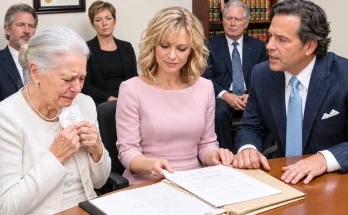
I had never been frightened of a piece of paper before.
That changed when Mr. Halden placed Emma's property records in front of me.
I went to his office the morning after reading her letter.
I carried the pale blue envelope in my handbag.
I had hardly slept.
Every time I closed my eyes, I saw Emma sitting somewhere writing those six pages.
I kept thinking about what she must have felt when she realized her husband might be trying to sell her father's house.
Mr. Halden met me in a small, quiet office.
He had already made tea.
There were two cups on his desk.
The sight of them almost made me cry.
Emma had loved tea in the afternoon.
When she visited me, she always insisted on making it herself.
She said I left the bags in too long.
I pulled out a chair.
Mr. Halden waited until I was seated.
"Were you able to go through Emma's letter?"
I nodded.
"All of it."
He didn't ask me how I felt.
I was grateful for that.
I wouldn't have known how to answer.
Instead, he opened a folder.
Several documents were arranged inside.
He explained what each one was before passing it across the desk.
A record showing the ownership of Willow Lane.
Paperwork associated with a real estate listing.
An early version of a proposed purchase agreement that had never been signed.
And a separate document that supposedly permitted Evan to represent Emma in arranging a sale.
That last document made me sit forward.
Emma's name appeared near the bottom.
There was a signature beside it.
I leaned closer.
For a moment, it looked like hers.
The letters had roughly the same shape.
The name was written with the kind of confidence Emma usually had when signing something important.
But then I noticed the second letter.
It was too short.
Emma had always made that letter stand taller than the rest.
I couldn't remember when she first developed the habit.
Even her birthday cards had it.
I pointed to the signature.
"Emma didn't write that."
Mr. Halden looked at the document.
"What makes you say that?"
I showed him the letter.
I explained the difference.
He nodded.
"Emma identified the same inconsistency."
My throat tightened.
She had noticed.
She had known.
And she had come here looking for help.
I studied the document again.
I wanted it to explain itself.
I wanted to know who had held the pen.
Who had copied my daughter's name.
Who had decided that her permission was something they could simply invent.
But paper doesn't answer questions.
It only shows what somebody was prepared to put into writing.
I looked at Mr. Halden.
"Did they manage to sell the house?"
"No."
I let out a breath I hadn't realized I was holding.
He explained that the process had been stopped before a sale was completed.
Once Emma disputed the authorization, the people involved in the proposed transaction were notified.
The validity of the document had been challenged.
The property had not changed hands through that attempted sale.
I pressed my fingers together.
"That's something, at least."
"It is."
I looked again at the paperwork.
Then I asked the question that had been troubling me since the night before.
"Was Evan responsible for this?"
Mr. Halden didn't answer immediately.
He chose his words carefully.
"We know he wanted the property sold. We know Emma opposed that decision. We also have a document containing a signature she denied making."
He paused.
"That doesn't establish who produced it."
I felt frustrated.
Part of me wanted him to say what I was thinking.
Evan had wanted the money.
Evan had been angry when Emma refused.
Evan was the person named in the authorization.
But wanting something and proving wrongdoing weren't the same.
Mr. Halden had to work with evidence.
I understood that.
I didn't like it.
But I understood.
I asked whether Emma had spoken to Evan about the document.
Mr. Halden said she had intended to discuss the situation after getting advice from a family-law attorney.
I frowned.
"When was she going to do that?"
He looked at me.
"The day before the accident."
The room seemed to become very still.
I remembered the last afternoon Emma had tried to call me.
I had been at the pharmacy.
I missed her call.
At the time, I didn't think anything of it.
We called each other often.
Sometimes she wanted to ask whether I needed groceries.
Sometimes she told me a funny story about one of the children at school.
Sometimes she simply wanted to hear my voice.
There was no reason for me to believe that one missed call would matter.
Later, I listened to her voicemail.
Only once.
After her death, hearing her voice became so painful that I avoided playing it again.
Now, sitting across from Mr. Halden, I reached for my phone.
My fingers felt clumsy.
I opened the saved messages.
I found Emma's name.
I pressed play.
Her voice filled the office.
"Hi, Mom. I missed you."
I closed my eyes.
She sounded tired.
But she still sounded like Emma.
She said she planned to come to my house the next day.
There was something important she wanted to talk about.
She told me she was doing all right.
Then she paused.
I remembered that pause.
It had seemed ordinary when I first heard it.
Now I listened to the silence as though something might be hiding inside it.
Emma ended by telling me she loved me.
The message stopped.
I held the phone in both hands.
I could hear Mr. Halden moving quietly on the other side of the desk.
I didn't look up.
"She was coming to tell me," I said.
My voice broke.
"She was finally going to tell me what was happening."
Mr. Halden didn't disagree.
He didn't try to comfort me with something he couldn't know.
I was grateful for that too.
I stared at the screen.
Emma's name was still there.
For a moment, I wanted to call her back.
It was an absurd thought.
But grief does that.
It lets you forget the truth for half a second.
Then it makes you remember everything.
Emma had died while driving home on a rainy evening.
Her vehicle left County Road 18 and hit a tree.
It happened a little after eight.
The doctors told us both Emma and Oliver had died before emergency help reached them.
I remembered standing at the hospital trying to understand the words.
I remembered asking whether they were absolutely certain about the baby.
As though they might have forgotten to check.
As though there could be another answer.
The medical staff had been gentle.
But there had been no other answer.
Since then, I had tried not to think about the accident itself.
I couldn't bear to imagine Emma frightened behind the wheel.
I couldn't bear to think of her reaching for help.
Now her unfinished voicemail brought those questions back.
Had she been thinking about the meeting she planned to have with me?
Had she been relieved that she was finally preparing to leave?
Had she believed she could make it through the next few days safely?
I didn't know.
And I knew I might never know.
Mr. Halden's office phone rang.
The sound startled me.
He answered.
I heard him speak briefly with his assistant.
Then his expression became serious.
"Please send the detective in."
I looked up.
"Detective?"
He put down the receiver.
"There's someone from the investigation who needs to speak with us."
My stomach tightened.
I didn't have time to ask another question.
The door opened.
A woman entered carrying a slim folder.
She looked to be in her forties.
Her eyes were tired, but she spoke calmly.
She introduced herself as Detective Sarah Whitcomb.
She shook my hand.
Then she offered her condolences.
I thanked her because that was what people did.
But I was watching the folder in her hand.
I wondered why she had come to the lawyer's office.
I wondered why she wanted to speak to me.
And I was beginning to feel afraid of the answers.
Detective Whitcomb took a seat.
She explained that the inquiry into Emma's crash had not been formally closed.
Investigators were reviewing information that had come to their attention.
I held the edge of my chair.
"Did somebody find something wrong with her car?"
The detective didn't answer that question directly.
She said the authorities were still examining the circumstances surrounding the collision.
There were details they wanted to verify before reaching conclusions.
I swallowed.
"Are you saying it might not have been an accident?"
She looked at me carefully.
"We haven't established the full explanation for what happened."
It wasn't a yes.
It wasn't a no.
I wanted her to give me one or the other.
Instead, she explained what was known.
Emma had been traveling along County Road 18.
It was after eight in the evening.
Rain had left the road wet.
Visibility was poor.
The first evidence had suggested that Emma lost control of the vehicle.
But the investigation had developed beyond that initial assessment.
Information had been received indicating that Emma might have felt unsafe during a dispute at home.
I gripped my handbag.
I could feel the outline of the blue envelope through the leather.
"Unsafe because of Evan?"
Detective Whitcomb watched me for a moment.
Then she asked whether Emma had ever discussed marital problems with me.
I looked down.
"Not really."
I hated saying it.
I was her mother.
And I couldn't give the detective the information she needed.
"She told me small things," I continued.
"She didn't tell me how bad it was."
I explained that I had only recently learned about the affair and the questions concerning Willow Lane.
The detective listened without interrupting.
Then she told me someone who lived near Emma and Evan had reported an argument outside their home.
It had happened earlier on the evening Emma died.
I felt a sharp pressure in my chest.
"Was Evan involved?"
"Yes."
I looked at Mr. Halden.
He was sitting very still.
The detective went on.
Investigators were examining communications and available evidence concerning the vehicle.
They were also speaking with people who might know about Emma's situation in the days before her death.
She made one thing clear.
They weren't prepared to say exactly what had caused the crash.
They needed evidence.
They needed the full sequence of events.
And they needed to avoid conclusions that went beyond what they could prove.
I listened.
But my thoughts kept returning to the same few things.
Emma had discovered the suspicious property document.
She had contacted Mr. Halden.
She was considering leaving her husband.
She had tried to call me.
Then she died.
I looked at the photograph of her signature again.
I thought about the letter in my handbag.
For the first time, I wondered whether the last weeks of my daughter's life had been even more frightening than she had admitted.
Detective Whitcomb asked whether Emma had ever told me she feared someone.
I searched my memory.
There were conversations.
Little remarks.
Times when Emma looked tired.
I had accepted her explanations.
Pregnancy.
Work.
Not sleeping well.
Now I was questioning everything.
But I didn't want to invent a memory just because I needed an answer.
"She never directly told me anyone was going to hurt her," I said.
The detective nodded.
She thanked me for being careful about what I remembered.
I looked at Emma's letter again.
There was a difference between suspecting something and knowing it.
I would have to learn to live with that difference.
Even though it hurt.
When the meeting ended, I remained in my chair for a moment.
Mr. Halden gathered the documents.
Detective Whitcomb closed her folder.
I put my phone back into my handbag.
Emma's message was still saved.
I knew I would listen to it again.
Probably many times.
I also knew I would never hear the conversation she had planned to have with me the following day.
That was the part I couldn't accept.
My daughter had finally decided to speak.
And she had run out of time.
Click here to continue reading: PART 4: When I Returned to My Daughter’s Home, Her Unfinished Shopping List Showed Me the Life She Had Been Preparing to Save
My Daughter Was Lying in Her Coffin When Her Husband Challenged the Lawyer and Revealed What Mattered Most to Him
Part 3 of 15