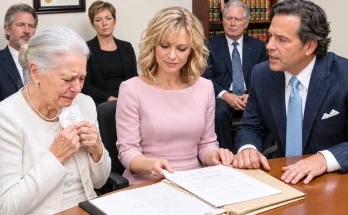
The trial had a way of making time feel strange.
Some days passed slowly.
Other days disappeared before I could remember what had been said.
I measured my life by court sessions.
By breaks in the testimony.
By the moments when Ruth touched my arm and asked whether I needed to step outside.
I had stopped making many plans.
I didn't know when I would feel able to keep them.
The case had become part of every day.
Even when I was home, I kept thinking about the courtroom.
The documents.
The testimony.
The questions asked by the attorneys.
The judge's instructions.
And Evan sitting across the room.
I wanted it to be over.
But I was afraid of what the end would bring.
Because I knew a verdict couldn't change the most important fact.
Emma was gone.
Oliver was gone.
Nothing the court decided would make that different.
One morning, I stood in my bedroom trying to choose what to wear.
I had already worn the same dark clothes too many times.
I looked at my reflection.
My face seemed older than it had before Emma died.
My eyes looked tired.
I didn't recognize the woman staring back at me.
I used to be able to get through a difficult day by making a list.
Finish one thing.
Then another.
Keep moving.
But there was no list that could make this situation manageable.
I couldn't cross off grief.
I couldn't complete the task of missing my daughter.
I could only wake up and face another day.
Ruth arrived to drive me.
She was holding her handbag and looking at me carefully.
"Ready?"
I wanted to say no.
Instead, I nodded.
We went together.
I sat in the passenger seat and watched the road.
There was a light rain that morning.
Not heavy.
Just enough to leave the pavement dark.
I hated rain now.
Emma had loved it.
She used to tell me rainy afternoons made everything feel quieter.
She liked sitting with a book while the weather moved past the windows.
I remembered buying her books when she was little.
She would open them immediately and smell the pages.
Thomas used to laugh.
He said she acted as though every book had been made especially for her.
Now the smell of new books made me cry.
And rain made me think about County Road 18.
I looked away from the windshield.
Ruth noticed.
She didn't ask why.
She knew.
At the courthouse, we took our usual seats.
Evan was already there.
I didn't look at him for long.
I had learned that watching his face didn't help me understand anything.
The evidence mattered more than his expression.
That was something Detective Whitcomb had taught me without saying it directly.
She had always been careful.
She never promised an answer before the investigation supported it.
She didn't tell me Evan was guilty when he was arrested.
She explained what the charges meant.
And she reminded me that the court had to decide.
I respected her for that.
Even when I wanted certainty.
The trial continued with the evidence concerning Emma's final evening.
I had heard portions of it before.
But every time the crash was discussed, I felt the same tightness in my chest.
The wet road.
The limited visibility.
The vehicle leaving the roadway.
The tree.
I could picture the place too easily.
I tried not to.
But the testimony made it difficult.
The court heard technical explanations about the damage to the tire.
The specialists had examined the vehicle.
They had considered what damage could have occurred before the crash.
They had compared it with what would normally be expected from wear or from the collision itself.
I knew the basic findings.
Detective Whitcomb had explained them to me.
The tire damage had not been consistent with ordinary wear.
It had not appeared to be caused only by the final impact.
Those conclusions were important.
They were part of the reason the investigation had moved beyond the original explanation of a loss of control on a wet road.
But hearing the evidence in court made it feel more real.
I kept thinking about Emma's hands on the steering wheel.
I wondered whether she had noticed the car behaving strangely.
I wondered whether she had been frightened.
I hated those thoughts.
They were questions I couldn't answer.
And I was afraid of imagining details that nobody could establish.
I closed my eyes briefly.
Then I opened them.
I wanted to hear what was actually being said.
Not what my fear supplied.
The prosecution argued that the vehicle evidence supported its allegation that the tire had been deliberately damaged before the crash.
The other evidence was discussed alongside it.
Communications.
Financial records.
Witness testimony.
The circumstances of Emma's separation plans.
The conflict over Willow Lane.
I watched the attorneys work through those matters.
Sometimes they returned to something I thought had already been explained.
Sometimes they asked a question in a different way.
At first, that frustrated me.
Then I understood why it mattered.
Serious accusations needed careful examination.
The jury had to consider the evidence.
Not my grief.
Not Evan's behavior at the funeral.
Not how strongly I disliked him.
The evidence.
I repeated that to myself.
It helped me stay focused.
During a break, I went into the corridor with Ruth.
We found a quiet place to sit.
I held a cup of water.
My hands were shaking slightly.
Ruth looked at me.
"Do you want to leave for the afternoon?"
I shook my head.
"I want to hear it."
She nodded.
I stared at the cup.
"I just wish I didn't have to."
Ruth put her hand over mine.
"I know."
I thought about Emma.
She had always been determined when something mattered.
As a child, she could spend an entire afternoon trying to understand a difficult school assignment.
She would ask Thomas to explain it.
Then she would ask me.
Then she would sit with her pencil until she understood.
Sometimes I told her to take a break.
She would smile and say she was almost finished.
I remembered that stubbornness now.
Emma had approached her marriage problems in much the same way.
She had questioned what Evan told her.
She had looked at the financial information.
She had taken the disputed document to a lawyer.
She had begun making arrangements for a different future.
I was proud of that.
Even though it broke my heart.
When the proceedings resumed, the evidence concerning Evan's financial problems came up again.
I understood more than I had at the beginning.
The debts hadn't appeared overnight.
They had involved business loans, credit balances, and obligations connected to a failed venture.
He had hidden the scale of those problems from Emma.
Willow Lane represented a possible source of money.
And Emma had refused to let him sell it.
That dispute was part of the prosecution's account of what had happened before her death.
I looked at Evan.
I remembered him telling me the house was his concern because he had been Emma's husband.
I remembered his anger when I said I wouldn't discuss the estate at the cemetery.
I remembered Celeste kissing him beside the white Mercedes.
Those memories still made me angry.
But I understood that the jury's decision couldn't rest on them.
The trial had to establish responsibility for the offenses charged.
I wanted the jurors to be careful.
I wanted them to listen.
I wanted them to ask themselves what the evidence truly showed.
Because whatever decision they made would matter.
Not only to me.
Not only to Evan.
It would be the legal determination of responsibility for a case involving the deaths of my daughter and grandson.
That thought frightened me.
I had never imagined being part of anything like this.
I had spent my life doing ordinary things.
Raising Emma.
Helping Thomas.
Working around the house.
Visiting my daughter when she became an adult.
Waiting to become a grandmother.
I hadn't expected to sit in a courtroom listening to evidence about a damaged tire.
I hadn't expected to learn that my daughter's husband had concealed debts.
I hadn't expected to discover that Emma had been planning to leave him.
And I certainly hadn't expected to see him facing criminal charges connected to her death.
Sometimes I wondered how Emma would have reacted if she could see everything now.
Would she have been shocked?
Would she have felt betrayed all over again?
Would she have been relieved that people were finally listening to her concerns?
I couldn't know.
I stopped myself from imagining her answers.
She had already left her own words.
Six pages.
Carefully written.
An explanation of what she had discovered.
And a request that I protect Willow Lane.
Those words mattered.
They were the closest thing I had to hearing her explain the final months of her life.
When court ended that day, I was so tired that Ruth had to remind me to collect my handbag.
I looked down at the pale blue envelope inside.
I had brought it again.
It had become a habit.
I knew I didn't need it in court.
The evidence was being presented through the proper procedures.
But the envelope reminded me that Emma had tried to tell someone what was happening.
She hadn't simply remained silent.
She had been gathering information.
She had been preparing to speak.
And she had trusted me enough to leave those pages.
We walked outside.
The rain had stopped.
The pavement was still wet.
Ruth asked whether I wanted something to eat.
I shook my head.
Then I changed my mind.
"Maybe a little."
We went home.
She made a simple meal.
I ate because she sat across from me and waited.
I didn't feel hungry.
But I knew she worried when I stopped taking care of myself.
Afterward, we sat quietly.
I looked at the clock.
I remembered Emma calling me after school.
Sometimes she called while preparing dinner.
Sometimes she wanted to complain about how tired she was.
Sometimes she wanted to tell me something funny a child had said.
I could almost hear the phone ringing.
Then I remembered it wouldn't ring with her name again.
I reached for my own phone.
Her voicemail was still saved.
I opened it.
Ruth watched me.
I pressed play.
Emma's voice filled the kitchen.
She told me she was planning to come over.
There was something important she needed to discuss.
She said she was all right.
Then she told me she loved me.
The recording ended.
I stared at the screen.
Ruth was crying quietly.
I didn't press play again.
I put the phone down.
"She sounded so normal," I said.
Ruth nodded.
"She did."
I looked at the empty chair.
"She was going to tell me."
"Yes."
I swallowed.
"She didn't get the chance."
Ruth reached for my hand.
I wanted to ask her why.
Why Emma had died before she could leave.
Why Oliver had never been born.
Why a husband could become the person accused of harming the woman who trusted him.
But those weren't questions Ruth could answer.
The court was trying to answer what happened.
It couldn't answer why the loss felt so unbearable.
That evening, I went into Emma's bedroom.
I sat beside the little stuffed rabbit.
I remembered how she had carried it everywhere when she was six.
Its worn ear was still soft.
I rubbed it between my fingers.
Then I thought about the way Emma had spoken about Oliver.
She loved saying his name.
She had already imagined holding him.
Teaching him.
Watching him grow.
I wondered whether he would have had her eyes.
Whether he would have liked books.
Whether Thomas's magnolia tree would have been one of the places Emma took him when he was old enough to walk.
Those thoughts hurt.
But I couldn't stop having them.
They were the only memories of Oliver I would ever be able to imagine.
I looked at the blue envelope.
My daughter had wanted to begin again with him.
She had believed she could manage.
I wanted to hold on to that part of her life.
Not only the betrayal.
Not only the crash.
Not only the trial.
She had still been looking toward a future.
That mattered to me.
As the proceedings moved toward their final stages, I became more aware of what the jury would have to decide.
The prosecution had presented its case.
The defense had challenged the evidence.
The court had examined the allegations through the required process.
I knew the result was not mine to choose.
I couldn't make it happen by wanting it badly enough.
I couldn't change the facts by crying.
I couldn't punish Evan with my anger.
And I couldn't save Emma.
I had to accept those limits.
They were painful.
But they were real.
One afternoon, after another court session, Mr. Halden spoke with me briefly.
He reminded me that the estate proceedings were still being handled separately.
I nodded.
Willow Lane was still part of my responsibility.
The ownership history.
Emma's documents.
The disputed authorization.
All of that would still need attention after the criminal case.
I felt tired just thinking about it.
But I didn't regret protecting the house.
It was Thomas's final gift to Emma.
It was something she had fought to preserve.
And it remained standing because the attempted sale had been stopped.
I held on to that.
The next morning, I returned to court.
Ruth was beside me.
Evan sat across the room.
I looked at him only briefly.
Then I turned toward the judge and the attorneys.
I wanted the jury to consider the evidence carefully.
I wanted the truth established through the proper process.
And I wanted my daughter remembered as someone whose life had mattered long before the day she died.
When the court moved closer to a decision, I understood something I hadn't understood at the funeral.
Justice wasn't a moment when someone finally said the perfect words.
It was a difficult process.
A process that required patience.
Evidence.
And the willingness to hear things nobody wanted to hear.
I didn't know whether it would bring me peace.
But I knew I needed to see it through.
Click here to continue reading: PART 11: When the Jury Returned Its Decision, I Finally Heard the Court Hold Evan Responsible, but Nothing Inside Me Felt Like Victory
My Daughter Was Lying in Her Coffin When Her Husband Challenged the Lawyer and Revealed What Mattered Most to Him
Part 10 of 15