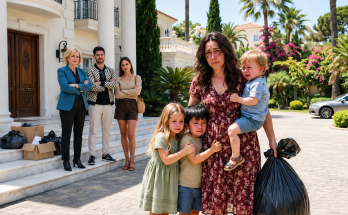
I kept returning to the front porch.
Not because I wanted to.
Because every time I tried to think about something else, I remembered Richard standing there.
Dry.
Calm.
Irritated.
I had been kneeling beside our daughter.
Her skin had been frighteningly cold.
Her lips had a bluish color.
She hadn't answered when I called her name.
And Richard had acted as though I was creating a problem.
I couldn't reconcile those two things.
I had known him for years.
I knew he disliked being questioned.
I knew he could become defensive when someone challenged his decisions.
I knew how quickly he could describe another person's concern as an overreaction.
But this had been different.
Maya wasn't arguing with him.
She wasn't refusing to follow instructions.
She wasn't even conscious.
Whatever disagreement had happened earlier, it was over.
The only thing that mattered was her condition.
Richard hadn't seemed to understand that.
Or perhaps he had understood and refused to acknowledge it.
I couldn't know which.
I had to be careful not to confuse my suspicions with facts.
But I could remember exactly what I saw.
He didn't come down the steps when I called for help.
He didn't kneel beside Maya.
He didn't ask whether she was breathing normally.
He didn't reach for his phone.
He stood beneath the porch roof and dismissed my concern.
I looked at Maya's sleeping face.
The memory made my hands tighten.
I loosened them.
I didn't want anger to become the only thing I felt.
There was fear beneath it.
And sadness.
And a terrible sense that I had been trusting the wrong signs for years.
I remembered the first time Richard spoke after opening the door.
He had told me Maya was grounded.
That had been his explanation.
I had asked what happened because I wanted to know why our daughter was lying on the driveway.
He answered as though I had asked why she wasn't allowed to watch television.
Grounded.
The word seemed painfully inadequate now.
I thought about ordinary consequences.
Taking away a privilege.
Asking a teenager to apologize.
Having a difficult conversation about respect.
None of those things explained locking a child outside in a storm.
None of them explained leaving her without a phone.
And none explained watching her remain unconscious without calling for help.
I looked toward the folded note.
There were earlier punishments on it.
A porch.
A room without dinner.
A confiscated phone.
Patricia's warning.
The same idea seemed to run through all of them.
An adult became dissatisfied with Maya.
Then Maya lost access to something she needed.
The house.
Food.
Communication.
The confidence that her mother would listen.
I stared at the paper.
I didn't want to exaggerate what it said.
I didn't want to give the entries meanings they couldn't support.
But I couldn't ignore the pattern they described.
Each incident had been written plainly.
There was no long explanation.
No attempt to make Richard or Patricia look worse by adding dramatic details.
Maya had recorded the event.
Then moved to the next one.
I wondered whether she had been trying to remind herself that the things happened.
I couldn't know.
But I understood why a person might want a written record when someone else kept dismissing their experience.
I thought about Richard calling Maya a liar without using the word directly.
He had said she was pretending.
He had told me she wanted attention.
He had acted as though her condition was part of a performance.
Patricia had apparently told Maya I wouldn't believe her because she was a liar.
The connection was painful.
Maya had been warned that her words would be dismissed.
Then, when I arrived and found her unconscious, Richard dismissed what I could see with my own eyes.
I looked at my daughter.
How could she have known whether I would believe her?
She had heard adults deny her experience.
She had seen punishment follow small disagreements.
She had been told I would doubt her.
And I had spent years trying not to challenge Richard unless absolutely necessary.
I began to understand why my assurances might not have been enough.
I had always told Maya she could talk to me.
But what did those words mean if she believed I would eventually send her back to the same house?
What did they mean if she worried Richard would become angry after she spoke?
I didn't know whether she had thought about those questions.
She hadn't told me.
But I could see how difficult speaking might have been.
I looked down at my hands.
I remembered the way Maya had held them.
She had been weak.
Her voice sounded rough.
She had needed to know Richard wasn't nearby.
Only then did she describe the evening.
The order of her words mattered to me.
She didn't begin with an accusation.
She began with a simple explanation of what made Patricia angry.
A sigh.
I had heard Maya sigh hundreds of times.
It was such an ordinary sound.
Sometimes she was tired.
Sometimes impatient.
Sometimes she didn't even seem aware she had done it.
I thought about Patricia interpreting that sound as disrespect.
Then both adults confronting her.
Then taking her phone.
Then the locked door.
I could follow the sequence.
But I couldn't accept the response.
I thought about the moment Maya told me she knocked.
That detail had nearly broken me.
She had gone to the door.
She had tried to get back inside.
She hadn't simply sat outside refusing to cooperate.
She had asked, in the most ordinary way possible, to be let in.
The adults didn't open it.
Then she heard the garage door and the car leaving.
I looked toward the hospital doorway.
The image of a closed door seemed to follow me everywhere.
I thought about how many times I had opened our townhouse door for Maya.
Sometimes she forgot her key.
Sometimes her hands were full.
Sometimes she knocked because it was easier than searching through her bag.
I never thought about those moments as something important.
I simply opened the door.
She came inside.
That was home.
Now I understood how much meaning a closed door could carry.
Maya had been told she couldn't come in until she changed her behavior.
The rain had started.
She became cold.
She knocked.
And the door remained locked.
I couldn't stop thinking about that.
I looked at the white blankets.
She was warm now.
The hospital staff had cared for her.
The paramedics had recognized the seriousness of her condition.
Everything that happened after I called 911 had been focused on helping her.
That contrast made Richard's behavior more disturbing.
Strangers had responded with urgency.
Her father had responded with irritation.
I didn't want to keep comparing them.
But the facts were there.
I remembered Mark Davis.
He had checked Maya carefully.
Then he looked toward the porch.
He asked about an earlier emergency call.
I still didn't know why.
That question remained separate from the note.
The paper didn't mention an ambulance.
It didn't explain what Mark remembered.
I couldn't assume his earlier visit involved Maya.
But his reaction had been real.
And Richard's denial had been real.
I had heard both.
I wondered why Mark had asked.
Then I stopped.
Wondering wouldn't give me an answer.
I had no new information.
I couldn't solve it by replaying the conversation.
I looked at Maya.
I didn't want to make her responsible for every unanswered question.
She had been through enough.
When she woke, I wanted her to feel safe speaking at her own pace.
I didn't want to greet her with a list of things she needed to explain.
She was not the person who had failed to respond to an unconscious child.
She was the person who had needed help.
That distinction mattered.
I had spent much of my life believing that careful questioning could make difficult situations clearer.
But this time, I needed to recognize that my fear didn't give me the right to demand more from Maya than she could offer.
She had already told me about the locked door.
She had already described the rain.
She had already begged me not to send her back.
And I had found the note.
I knew enough to believe her.
I leaned back in the chair.
I remembered how exhausted I had been during the drive.
I had wanted dinner and rest.
I had wanted an uneventful evening.
Now those wishes seemed almost distant.
I thought about the lasagna in my refrigerator.
It would still be there when we eventually got home.
That small detail made my eyes sting.
I had planned to heat it for Maya.
I had imagined us sitting at the table.
Perhaps she would tell me about school.
Perhaps she would say very little.
I would have accepted either.
I hadn't known she was outside in the rain while I was still driving.
I hadn't known she was knocking on a locked door.
I hadn't known she had no phone.
I hadn't known how frightened she was.
I looked at the clock in my memory.
Seven ten.
That was when my headlights found her.
I couldn't know how long she had been lying there.
Richard hadn't answered.
Maya could only estimate how long she had been outside.
The uncertainty troubled me.
But it didn't change what I had seen.
My daughter had been unconscious.
She had been exposed to cold rain.
She needed emergency help.
Richard had refused to treat the situation seriously.
Those facts were clear.
I looked at the scrape on my knee.
The torn fabric still reminded me of falling onto the concrete.
I had not felt the impact then.
I had been frightened beyond ordinary awareness.
I thought about how little attention Richard had paid to that fear.
He seemed concerned only with the consequences for himself.
He had warned me about the custody arrangement.
Even after the paramedics arrived.
Even while Maya was being prepared for transport.
I remembered how his hand closed around my shoulder.
I remembered the anger in his voice.
The warning had been directed at me.
Not at the people caring for Maya.
Not at the situation that had placed her outside.
At me.
I had pushed his hand away.
I hadn't done it to make a point.
I had done it because I needed to reach my daughter.
Looking back, I realized how much that moment represented.
I had spent years letting Richard's reactions determine how I spoke.
That night, I couldn't afford to keep doing it.
I needed to act without waiting for his approval.
I needed to believe what was in front of me.
I needed to stop letting his certainty make me question my own judgment.
I looked at the folded paper again.
Maya had needed that same freedom.
She had needed to know that someone would listen without first asking whether Richard agreed.
I thought about Patricia's words.
She had told Maya I wouldn't believe her.
I couldn't change that those words had been spoken.
I couldn't know how many times Maya had remembered them.
But I could make sure my response didn't prove Patricia right.
That mattered more than winning an argument.
I reached toward Maya's hand.
Her fingers were still.
I touched them lightly.
She didn't wake.
I stayed quiet.
I thought about what I would want her to understand when she opened her eyes.
Not that I was angry with Richard.
She already knew the situation had frightened me.
Not that I intended to prove something about the divorce.
She didn't need to carry that.
I wanted her to know that I had heard her.
That I believed she was frightened.
That I understood the punishment had been wrong.
That she didn't have to keep proving it.
I knew those words wouldn't erase the note.
They wouldn't undo the hours outside.
They wouldn't make the experience disappear.
But they might begin to repair something.
I looked toward the window.
The storm had been the setting of the emergency, but the rain wasn't what made the evening so painful.
Rain was weather.
Cold was weather.
The terrible part was that Maya had been kept outside by adults who could have opened the door.
They could have let her in.
They could have checked on her.
They could have called for help.
When I arrived, they could have acknowledged that something was wrong.
Instead, Richard had called her condition an act.
I sat with that thought.
I no longer wanted to understand how he justified it.
Not before acknowledging what happened.
Explanations could come later.
The facts had to come first.
Maya was fifteen.
She had been locked outside.
She had been cold.
She had lost consciousness.
And I had found her.
That was the truth I could not compromise away.
I had spent years trying to make exchanges between our households peaceful.
But I had finally recognized the limit of peace built around one person's refusal to listen.
Richard could be angry.
Patricia could disagree.
They could insist Maya had been disrespectful.
None of that changed her condition when I arrived.
None of it changed the note.
None of it changed the fear in her voice at the hospital.
I looked at her sleeping face.
I couldn't undo what had happened.
But I could stop allowing Richard's confidence to make his version seem more important than hers.
I held her hand gently.
The monitor continued its steady rhythm.
And for the first time since the driveway, I stopped trying to understand how Richard could behave that way.
I didn't need to understand his excuses before recognizing my daughter's suffering.