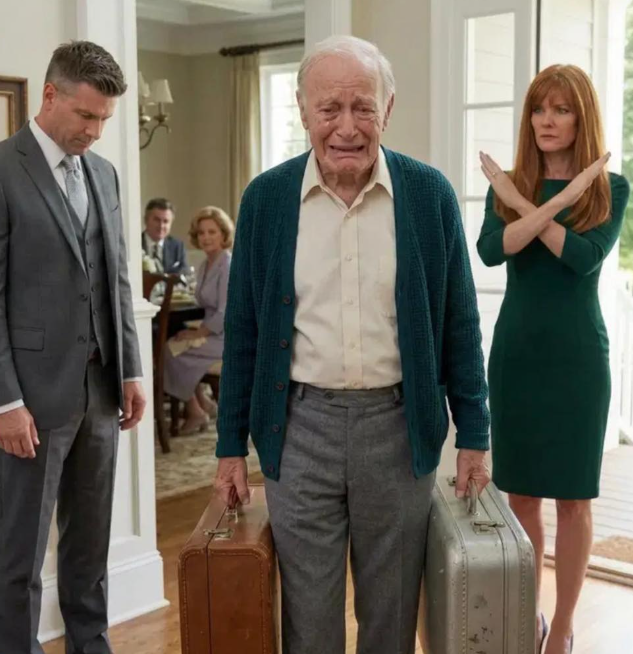
PART 3: “My son had no idea I had quietly built up $800,000 over the years. Then one evening, his wife looked at him and said, “He needs to leave this house.”
“My son had no idea I had quietly built up $800,000 over the years. Then one evening, his wife looked at him and said, “He needs to leave this house.” I had never told Logan about the money I had saved in silence. I lived modestly, kept my finances private, and let everyone assume I was just an old retired man getting by on a small pension. Then one night, my daughter-in-law decided she no longer wanted me in her home. My son said nothing. So I smiled, packed my bags, and left without a single argument. Three weeks later, I removed my name from every account, loan, and agreement I had been quietly supporting behind the scenes. That was when the desperate calls began.
In my son’s house in Dallas, everyone saw me as harmless. Just an elderly man who repaired things, cooked when needed, and tried not to become a burden. But I lived simply by choice, not because I was broke.”My son had no idea I had quietly built up $800,000 over the years. Then one evening, his wife looked at him and said, “He needs to leave this house.”
My name is Albert Higgins. I am sixty-eight years old, retired after thirty-five years as a senior accountant. I have always trusted paperwork, signatures, and timing. People, however, were much harder to read.
I kept my savings private not because I enjoyed secrets, but because discretion gave me freedom. My plan had always been simple: one day, I would quietly leave everything to my son, no strings attached.
Six years earlier, after my wife died, Logan asked me to move in with him and Chelsea. Their house near Thunderbird Road had a spare bedroom, a wide kitchen, and warm desert light that made grief feel a little less heavy. I agreed because my old apartment had become unbearably silent.
At first, Chelsea seemed kind.
Then the little requests began.
“Could you eat in the kitchen tonight? We’re having guests.”
Later, it became,
“Would you mind staying in your room tonight? It’s more of a couples’ dinner.”
One Thanksgiving, they placed me alone at a small side table while everyone else laughed behind closed doors. I ate quietly, listening through the wall, telling myself I was being reasonable.
Months later, Chelsea started treating the house like it had two entrances: one for the family, and one for me.
“We have guests,” she said with a polished smile. “Could you use the back door? It’ll be easier.”
So I walked around the house like a man whose welcome had quietly expired.
The kitchen counters were always covered with bills, furniture invoices, takeout receipts, and documents for their new SUV. I noticed everything automatically. Years in accounting train the eye. I never scolded them. I only observed how recklessly money moved when people believed it would never run out.
Still, I helped.
I cooked. I mowed the lawn. I fixed leaks. I folded towels the way my late wife used to like them—sharp corners, neat stacks, perfect lines.
I stayed quiet because Logan always looked relieved when the house was peaceful. For a while, I told myself that was enough.
Then everything changed during a Monday night dinner party.
Logan’s coworkers filled the living room with loud laughter and clinking glasses. Chelsea moved through the house in an expensive dress, looking untouched by ordinary life. I had spent the afternoon making stuffed mushrooms the way Logan loved them as a child—extra garlic, slow-cooked, careful.
Chelsea came over with a tight smile.
“Albert, could you stop hovering? People are trying to talk.”
So I stepped back.
A few minutes later, she returned. This time, she did not even pretend to be polite.
“Why don’t you stay in your room tonight?” she said quietly. “It’ll be easier for everyone.”
I looked at Logan. He stared into his glass as though the answer might be floating in it.
Then Chelsea raised her voice just enough for the nearby guests to hear.
“Logan, are you going to handle this?”
The room went still.
Everyone looked at us.
My son looked embarrassed, guilty, trapped. Then he made a choice without having the courage to name it.
“Dad,” he said softly, “maybe you could just… give us some space.”
I nodded once because I understood exactly what had happened.
He was not choosing me.
He was letting someone else choose for him.
“I won’t be in the way,” I said calmly.
Later that night, I sat on the edge of my bed while the party continued downstairs without me. What I felt was not rage. It was clarity—the kind that arrives when every number finally adds up.
Before sunrise, I packed two suitcases. I took my documents, a few photographs, my laptop, and the cardigan that still faintly smelled like home. I left my key on the kitchen counter without a note.
There was nothing left worth writing.
I did not leave because I was angry.
I left because I had finally understood.
In the garage, inside storage boxes labeled with my name, were the papers I had always kept for emergencies: co-signing forms, a notarized loan agreement, receipts, and signed documents Logan and Chelsea had never bothered to read carefully.
I had not kept those papers as weapons.
I kept them because accountants document reality.
The next morning, I took the bus downtown and met with a contract attorney named Fiona Cartwright. She did not offer empty sympathy. She simply opened a legal pad and asked,
“What exactly do you want?”
“I want to separate my finances cleanly,” I told her. “And I want to leave with dignity.”
She reviewed every document carefully, checking signatures and dates before tapping her pen against the desk.
“Then we’ll do this properly,” she said. “Three notices. Same week. Same morning.”
Over the next few days, I quietly rebuilt my life. I rented a small room, redirected my mail, and began removing my name from everything that tied them to me.
Three weeks later, peace finally settled inside my chest.
That morning, I parked down the street from their house just after sunrise. The Texas heat was already rising.
At exactly 8:30, a delivery truck stopped in front of their driveway.
The driver placed three plain envelopes at the front door, rang the bell, and left.
A few minutes later, Chelsea came outside in a robe, still holding her coffee.
She opened the first envelope casually.
Then her expression shifted.
She tore open the second one.
Her shoulders went rigid.
And by the time her hand reached for the third envelope…
that was when the real story began.
Logan’s thumb hovered over my contact name.
But before he could press call—
his phone rang first.
He froze.
Chelsea leaned in. “Is it him?”
Logan didn’t answer. Because the caller ID didn’t show my name.
It showed a bank’s legal department.
And the moment he answered, the color drained from his face.
“Mr. Logan Higgins?” a calm voice said. “This is regarding the immediate reversal of multiple secured liabilities and asset withdrawals tied to your household accounts.”
Chelsea snatched the phone. “This is some kind of mistake. We didn’t authorize anything—”
The voice didn’t change tone.
“Authorization was previously granted and legally registered under Albert Higgins. All changes are now active.”
A pause.
Then the sentence that made Chelsea step back.
“Your household is currently operating under temporary financial suspension until outstanding obligations are reviewed.”
The call ended.
Just like that.
No argument. No negotiation. No room left for denial.
Logan stood there holding a dead phone, like it had suddenly become heavier than anything he’d ever owned.
Chelsea’s voice cracked for the first time.
“This is fixable,” she said quickly. “We just talk to him. He’ll reverse it.”
But even as she said it, she already knew something didn’t fit anymore.
Because this wasn’t anger.
It was procedure.
And procedures don’t get emotional.
They get completed.
Across town, I folded the morning newspaper and finally allowed myself a quiet breath.
On the table beside me sat a single folder labeled: FINAL REVIEW.
Not everything I had done was visible yet.
Some parts only activated when the right line was crossed.
And that line… had just been crossed twice.
First by silence.
Then by choice.
My phone lit up again.
Logan calling.
I didn’t answer.
Instead, I opened the folder.
And turned to page two.
Because the real consequence wasn’t the money.
It was what they never bothered to read before signing.
Logan tried again.
This time, he didn’t wait.
He grabbed the keys, heading for the door. “I’m going to his place. Right now.”
Chelsea followed immediately. “You don’t even know where he is.”
“I know enough,” Logan snapped, more out of panic than certainty.
But when he opened the garage—
his car didn’t start.
Just a soft click.
Then silence.
He tried again. Nothing.
Chelsea’s voice dropped. “That’s not normal.”
It wasn’t.
Because outside, the driveway looked the same, the house looked the same—but every system they relied on was beginning to behave like it had been quietly… unlinked.
At that exact moment, across town, I placed a small key card on the table in front of Fiona Cartwright.
She slid a second document toward me.
“This is the last layer,” she said. “If you sign this, everything tied to your name is fully insulated. No informal access. No emergency reversal. No exceptions.”
I looked at the line.
Then at the empty space around it.
For years, I had lived inside their house while being treated like I didn’t fully belong in it.
And yet I had still been the structure holding it up.
Now, I was simply removing myself from the blueprint.
I signed.
Fiona didn’t smile. She never did.
But she did say one thing.
“They’ll realize it in stages. Not all at once.”
I nodded.
“I know.”
Back at the house, Chelsea was on her laptop now, frantically logging into accounts.
One by one, screens loaded… then stalled… then redirected.
Logan stood behind her, silent.
Then Chelsea whispered, almost afraid to say it out loud.
“The accounts… they’re there… but we don’t have full access anymore.”
Logan’s jaw tightened. “What does that mean?”
Chelsea looked up slowly.
“It means…” she hesitated, “…we can see the house.”
“But not the foundation.”
A knock came at the door.
Both of them froze.
Not loud. Not aggressive.
Just one clean, professional knock.
Logan opened it.
A courier stood there holding a sealed envelope stamped with a final seal he hadn’t seen before.
“Personal delivery,” the man said.
Logan took it.
The moment his fingers touched the paper, something in him already knew this wasn’t another warning.
This was the end of the conversation.
Inside the envelope was a single page.
And one sentence at the bottom:
“Effective immediately, you are no longer financially dependent on Albert Higgins because Albert Higgins is no longer financially attached to you.”
Logan’s hands went still.
Chelsea read over his shoulder.
And for the first time since it began—
there was nothing to argue with.
Only something to accept.
Somewhere far away from their house, I closed my folder.
Not because everything was finished.
But because the part where they could misunderstand me…
had already ended.
Logan didn’t speak for a long moment.
Neither did Chelsea.
The house, which used to feel filled with schedules, noise, and certainty, now felt like it was waiting for instructions it no longer recognized.
Then Logan finally said, almost quietly, “He planned all of this.”
Chelsea shook her head. “No… he wouldn’t do that to us.”
But even as she said it, she didn’t sound convinced anymore.
Because everything around them was still working—electricity, water, lights—but anything tied to trust, money, or authority felt like it had been carefully pulled out one thread at a time.
Logan looked down at the paper again.
Then something caught his eye.
A small line at the bottom that he hadn’t noticed before.
A reference code.
And beneath it—an instruction:
“For resolution, contact the assigned trustee in person. Do not attempt remote recovery.”
Chelsea frowned. “Trustee? What trustee?”
Logan didn’t answer immediately.
Because he already understood something uncomfortable.
If there was a trustee…
then this wasn’t just about him and his father anymore.
This was about an entire structure he had never been told existed.
Across town, I stepped out of the small rental room for the first time that morning.
The sun was already sharp, streets already moving.
Fiona walked beside me, holding a thin briefcase.
“They’ll come looking for you today,” she said.
I nodded. “I expect they will.”
She glanced at me. “Are you going to meet them?”
I didn’t answer right away.
Because the truth wasn’t about whether I would meet them.
It was about when.
And whether they would arrive as sons…
or as people finally meeting the version of me they never bothered to understand.
Back at the house, Logan grabbed his jacket.
“I’m going,” he said.
Chelsea stood up quickly. “To where?”
“To the trustee.”
He paused at the door.
Then added, more quietly, “If Dad set this up… I need to hear it from him directly.”
He stepped outside.
The air felt different now.
Not colder.
Just final.
And for the first time, Logan wasn’t walking toward a conversation.
He was walking toward the moment where everything he assumed about his father would either collapse…
or finally make sense.
Logan drove in silence.
Every few minutes, he glanced at the dashboard like it might suddenly change its mind about reality.
Behind him, Chelsea sat rigid, scrolling through the same frozen financial pages over and over, as if repetition could undo what had already been confirmed.
Finally, the GPS spoke:
“Arriving at destination.”
Logan slowed.
But what he saw ahead didn’t look like a corporate office or a bank building.
It was a small, understated legal firm tucked between two older buildings—no signage that screamed importance, no luxury that matched the scale of what had just happened.
Just a calm, deliberate door.
Chelsea frowned. “This can’t be it.”
Logan didn’t answer.
Because something about it made sense in a way he didn’t like.
The most powerful things rarely announce themselves.
Inside, I was already seated.
Fiona stood near the window.
And across from me sat a second chair.
Empty.
She checked her watch once.
“They’re early,” she said.
I nodded slightly. “They’re panicking.”
“That’s usually faster than understanding,” she replied.
A beat of silence passed.
Then footsteps in the hallway.
Not rushed anymore.
Heavier.
Uncertain.
The door opened.
Logan stepped in first.
He stopped the moment he saw me.
Not angry.
Not relieved.
Just… stunned by how ordinary the room looked compared to what it had just done to his life.
Chelsea followed behind him, her confidence gone thin at the edges.
For a few seconds, nobody spoke.
Then Logan finally managed:
“Dad…”
I looked at him.
Not as someone in control.
Not as someone distant.
Just as someone who had already made peace with the fact that this moment was always going to arrive.
“I wasn’t trying to punish you,” I said calmly.
That made Chelsea laugh once—sharp, disbelieving.
“Then what do you call this?”
I turned slightly toward her.
“Clarity.”
Logan swallowed. “We didn’t know any of this was happening.”
I nodded.
“That’s the part I was counting on.”
Silence fell again, heavier this time.
Then I slid a single folder across the table toward him.
Not dramatic.
Not rushed.
Just placed where it needed to be.
Logan stared at it.
“I didn’t come here to fight,” he said quietly.
I replied, just as calm:
“Neither did I.”
A pause.
Then the final line, the one neither of them were ready for yet.
“You came here to understand what you were standing on,” I said. “And whether it was ever yours at all.”
Logan didn’t touch the folder.
Not at first.
His hand hovered over it like it might burn him—or change him—just by contact.
Chelsea, however, couldn’t stay still.
“You’re talking like we took something from you,” she said sharply. “We didn’t force you to do anything.”
I looked at her for a long moment.
“That’s not what I said.”
That stopped her.
Fiona finally stepped in, voice calm but precise.
“What your father is saying,” she explained, “is that every system in your household—loans, co-signs, credit structures, and asset guarantees—was built on his active participation.”
Logan frowned. “We had our own income.”
“Yes,” Fiona replied. “But not your stability.”
That word landed harder than expected.
Stability.
Not money.
Not comfort.
Stability—the thing you only notice when it stops holding you up.
Logan finally opened the folder.
Page one.
Page two.
His eyes moved faster now, searching for something that would contradict what he was reading.
It wasn’t there.
Chelsea leaned in, reading over his shoulder, and for the first time her voice dropped completely.
“…this can’t be legal.”
Fiona didn’t blink.
“It already is.”
A long silence followed.
Then Logan looked up at me again, but something had changed in his expression.
Not anger.
Not denial.
Something closer to realization that felt heavier than both.
“So what happens now?” he asked quietly.
I leaned back slightly in my chair.
“That depends,” I said.
Chelsea let out a short breath. “On what?”
My answer came without hesitation.
“On whether you came here to fix the situation…”
I paused.
“…or to understand it.”
Logan’s jaw tightened. “What’s the difference?”
For the first time that day, I let a faint, tired honesty show.
“One tries to undo consequences,” I said.
“The other learns why they arrived.”
The room went still again.
Even Chelsea didn’t interrupt this time.
Outside the window, traffic moved normally. People went on with their lives. Nothing in the world had changed except the small space inside that room.
But inside it—
everything already had.
Logan closed the folder slowly.
Not shut.
Just… contained.
Like he was afraid of what might happen if he let it sit open any longer.
Then he said something quieter than everything before it:
“Did you ever actually plan to leave us?”
I didn’t answer immediately.
Because that wasn’t the right question.
Not really.
So I chose the truer one.
“I planned to stop being taken for granted,” I said.
A pause.
Then I added:
“I just didn’t know what it would look like until it happened.”
Chelsea exhaled sharply.
“So this is it?” she said. “We just accept everything and what—start over?”
Her voice had emotion now, but not control. That distinction mattered more than she realized.
Logan stayed quiet for a moment longer, then finally spoke.
“Dad… is there anything we can do to reverse it?”
I looked at him steadily.
“Yes,” I said.
Both of them froze slightly at that.
Even Fiona glanced over, as if confirming I intended to say it plainly.
But I didn’t soften it.
“There’s always something you can do,” I continued. “But not everything comes with a reversal.”
Chelsea stepped forward half a pace. “Then what are we supposed to do?”
I closed the folder in front of me.
“Start by understanding what you lost,” I said.
A pause.
“Not the money. Not the accounts.”
I looked directly at Logan now.
“Your structure.”
Silence settled again, deeper this time.
Logan finally sat down—not because he was told to, but because standing suddenly felt unnecessary.
Chelsea remained upright, arms crossed, but her posture had shifted. Less defiance. More instability.
Fiona gently slid a second document across the table.
“This is an option,” she said.
Logan looked at it. “What kind of option?”
“A separation plan,” Fiona replied. “Clean financial independence. New terms. New boundaries. No hidden dependencies on either side.”
Chelsea frowned. “So you’re saying we rebuild everything?”
Fiona nodded once. “Correct.”
Logan looked at me. “And you?”
I didn’t hesitate.
“I already rebuilt.”
That answer hit differently.
Not dramatic. Not emotional.
Just final in a way that didn’t invite debate.
Logan lowered his gaze to the document again.
This time, he didn’t look for loopholes.
He looked for reality.
“I didn’t realize,” he said slowly, “how much of our life was… connected to you.”
I replied quietly, “Most people don’t. Until it’s gone.”
Chelsea’s voice softened slightly, but only slightly.
“You could’ve told us.”
I held her gaze.
“And changed nothing?”
That question hung there longer than anything else.
Because no one answered it.
Not immediately.
Not honestly.
Logan finally pushed the document back a little, not rejecting it—just unable to process it yet.
“So what happens if we don’t sign anything?” he asked.
Fiona answered this time.
“Then nothing stabilizes. Everything continues as-is—but without support, adjustments, or safety nets.”
A pause.
“In other words,” she said calmly, “you would experience the system as it truly is.”
The words weren’t threatening.
They were descriptive.
And that made them worse.
Logan leaned back slightly, staring at the ceiling for a moment like it might provide a different version of events.
Then he looked at me again.
“Is this punishment?”
I shook my head once.
“No.”
A beat.
“This is what remains when someone stops carrying what was never acknowledged.”
The room went quiet again.
But this time, the silence wasn’t empty.
It was decision waiting to happen.
Logan didn’t respond right away.
Instead, he picked up the separation plan again—this time reading it slowly, line by line, as if speed had been part of the misunderstanding.
Chelsea watched him, then looked at me.
Her voice softened, but only slightly.
“So what happens to us… if we sign this?”
I answered honestly.
“You become responsible for everything you already assumed was stable.”
That sentence landed heavier than the others.
Logan finally spoke without looking up.
“And if we don’t sign?”
Fiona answered before I could.
“Then nothing changes immediately,” she said. “But nothing protects you either.”
Chelsea frowned. “That sounds like a threat.”
“It isn’t,” Fiona replied calmly. “It’s a description of exposure.”
Silence returned again, but this time it felt different—less like confrontation, more like calculation.
Logan set the papers down.
Then he did something neither Chelsea nor I expected.
He leaned forward slightly.
“Dad… I need to ask you something directly.”
I nodded once.
“Go ahead.”
His voice lowered.
“When you lived with us… were we ever actually okay? Or were we just okay because of you?”
Because it was the first real one he had asked since he walked into the room.
I thought about it for a moment.
Not emotionally.
Practically.
Then I answered.
“You were okay,” I said. “But not independent.”
A pause.
“That’s not an insult,” I added. “It’s just the structure of it.”
Logan looked down again.
Something in him shifted—not breaking, but reorganizing.
Like a system trying to recompile itself after losing a core dependency.
Chelsea exhaled slowly.
“So you were… holding everything together without telling us?”
I shook my head.
“I was holding it together while hoping you wouldn’t need me to.”
That sentence stayed in the air longer than the rest.
Fiona quietly closed her notebook.
“This is the point,” she said gently, “where most families either redefine the relationship… or repeat the cycle in a different form.”
Logan gave a short, tired laugh—no humor in it.
“So there’s no version where everything goes back to normal?”
I met his eyes.
“No,” I said simply.
Then I added something softer.
“But there is a version where it becomes honest.”
Chelsea looked between us.
For the first time, she didn’t argue.
She just asked, quietly:
“And what does honest look like?”
I paused.
Then answered:
“It looks like no one living in a version of stability they didn’t build—and everyone knowing exactly what they’re responsible for.”
A long silence followed.
This one didn’t feel like tension anymore.
It felt like a threshold.
And on the other side of it—
nothing was decided yet.
But everything was about to be.
Logan stared at the papers for a long time.
Then, slowly, he pushed them back toward the center of the table.
Not rejecting them.
Not accepting them.
Just refusing to decide while his emotions were still ahead of his understanding.
“I need time,” he said quietly.
Chelsea immediately turned toward him. “Logan, we don’t have—”
He cut her off, but not harshly.
“I said I need time.”
That was new.
Not anger. Not obedience. A boundary.
Silence followed again, but it shifted the room.
Fiona glanced at me, then spoke carefully.
“Time is possible,” she said. “But the terms of the current structure will continue operating in the meantime.”
Logan nodded once. “I understand.”
Chelsea looked unsettled now, as if she was realizing something different was happening—not just financially, but in how decisions were being made between them.
For the first time, Logan wasn’t reacting.
He was choosing to pause.
That alone changed the balance in the room.
I stood up slowly.
Both of them looked at me immediately, instinctively.
Not fear.
Not relief.
Expectation.
But I didn’t move toward the door yet.
Instead, I placed a small key on the table.
Logan frowned. “What is that?”
“The house key,” I said.
Chelsea stiffened slightly. “You still have a key?”
I nodded.
“I did.”
A pause.
“I won’t need it anymore.”
Logan’s voice tightened. “Where are you going?”
I looked at him for a moment.
Not like a father leaving.
More like someone stepping out of a role that had quietly lasted longer than it should have.
“I’m not going anywhere far,” I said.
Then I added:
“I’m just not going to be the foundation anymore.”
Chelsea’s expression changed slightly at that word again—foundation.
Because now she understood it wasn’t just a metaphor.
It was literal in every way that mattered to their lives.
Logan stood up halfway. “Dad—wait.”
But I shook my head once.
Not in anger.
In closure.
“You don’t need me to decide this part,” I said.
A beat.
“You just need to decide who you are without leaning on what I built.”
For the first time, Logan didn’t argue.
He just stood there, holding the silence like it weighed something real.
Chelsea looked down at the separation papers again.
But this time, she wasn’t reading them like a threat.
She was reading them like a map.
And maps only matter when you’re ready to move.
I turned toward the door.
Fiona followed a step behind me.
Before I left the room, I paused just once.
Not for drama.
For truth.
“This isn’t the end of your life,” I said quietly.
“It’s the end of me carrying it for you.”
Then I walked out.
And this time—
no one stopped me.
The door closed behind me without a sound that felt important.
Not dramatic.
Just final.
In the hallway, Fiona walked beside me for a few steps before speaking.
“They won’t process this quickly,” she said.
“I know,” I replied.
She glanced at me. “Do you think they’ll make the right choice?”
I considered that carefully.
Not from hope.
From experience.
“I think,” I said, “they’ll make a choice that reveals what they were relying on all along.”
Fiona nodded once, like that was answer enough.
Back in the room, the silence didn’t end after I left.
It stretched.
Logan was the first to sit down again, slowly, like his body had lost interest in urgency.
Chelsea remained standing, but now she looked less like she was in control of a situation and more like she was trying to understand the shape of it.
Finally, she spoke.
“He really meant it.”
Logan didn’t answer immediately.
Then: “Yeah.”
A pause.
Chelsea sat down across from him, not gracefully—more like her certainty had been removed from under her.
“So what now?” she asked again, but softer this time.
Logan looked at the separation plan again.
This time, it didn’t look like a weapon.
It looked like a starting point he didn’t know how to start from.
“I don’t think we get to ‘now’ yet,” he said.
Chelsea frowned. “What does that mean?”
He leaned back, exhaling slowly.
“It means… we’ve been living in the outcome for years without realizing there were decisions underneath it.”
That made her quiet.
Because for the first time, she didn’t have a quick response.
Outside, I stepped into the daylight.
The city was the same as it had been that morning.
Traffic. Heat. People thinking about their own problems.
Nothing about the world acknowledged what had just shifted inside a small office room.
Fiona closed her briefcase.
“So,” she said, “what’s next for you?”
I looked down the street.
Not toward them.
Not away from them either.
Just forward.
“I stop being the invisible system,” I said.
A pause.
“And I start being just a person again.”
Fiona gave a small, rare nod.
“That’s usually harder,” she said.
“I know,” I replied.
And for the first time in a long while—
that difficulty didn’t feel like a burden.
It felt like mine.
Back inside the office, Logan stayed quiet for a long stretch.
Then he finally pushed the separation plan forward again—this time not reading it, just staring at it.
Like he was waiting for it to change on its own.
Chelsea broke the silence first.
“If we do this…” she said carefully, “we lose access to everything tied to him.”
Logan nodded slightly. “Yeah.”
She frowned. “And if we don’t?”
He looked up at her.
“Then we keep pretending we understand something we clearly don’t.”
That hit harder than either of them expected.
Because it wasn’t anger anymore.
It was admission.
Chelsea leaned back in her chair, arms loosening from their defensive position.
“So what do you want to do?” she asked quietly.
Logan didn’t answer immediately.
For the first time, he wasn’t trying to protect an outcome.
He was trying to understand a direction.
Then he said something simple.
“I want to know what’s actually mine.”
Chelsea looked at him. “And if the answer is… not much?”
He didn’t flinch this time.
“Then I deal with that.”
A pause.
That sentence changed something subtle between them—not harmony, not resolution, but alignment.
For the first time, they were looking at the same problem instead of fighting over its interpretation.
Meanwhile, a few blocks away, I sat alone on a bench outside a quiet café.
No folders.
No documents.
No systems running in the background that needed my attention.
Just a cup of coffee and the sound of the city continuing without me.
Fiona had already left after a final handshake.
She’d said one last thing before going.
“Most people try to stay essential,” she said. “You chose to become optional.”
I hadn’t replied right away.
Because I was still learning what that actually felt like.
Now, sitting there, I realized something simple but heavy:
Being optional didn’t mean being unnecessary.
It meant being free.
My phone buzzed once.
A message preview from Logan:
“We need to talk. Not about money.”
I didn’t open it immediately.
Instead, I looked at the street ahead.
And for the first time in years, I didn’t feel like I was standing behind anyone’s life.
I was standing in my own.
And whatever came next—
was no longer something I was carrying for them.
Logan waited.
The message showed as “delivered,” but not read.
Chelsea noticed him staring at the phone.
“He didn’t answer?” she asked.
Logan shook his head once. “Not yet.”
Chelsea exhaled slowly, then surprised even herself by saying, “That’s fair.”
Logan glanced at her.
That wasn’t the version of Chelsea he was used to hearing.
Not resistance.
Not urgency.
Something closer to acceptance.
A long pause followed before she spoke again.
“I think we’ve been treating him like part of the system,” she said quietly. “Not like a person.”
Logan didn’t respond immediately, because the sentence landed too accurately to dismiss.
Instead, he looked down at the separation plan again.
Then he did something different.
He took out his pen.
Chelsea’s eyes widened slightly. “Logan…”
He didn’t sign yet.
He just placed the pen on the paper.
Like he was acknowledging that the decision was now real, not theoretical.
“I don’t want to lose him,” he said.
Chelsea answered honestly this time.
“Neither do I.”
Silence.
Then Logan said something more grounded than anything he had said all day.
“Then we stop reacting like we’re entitled to what he built.”
Chelsea nodded slowly.
For the first time, she didn’t argue.
Across town, I finally opened the message.
Read it once.
Then again.
We need to talk. Not about money.
I stared at that line longer than I expected.
Because it was the first thing Logan had said since this began that wasn’t transactional.
No defense.
No negotiation.
Just intent.
I took a sip of coffee.
Then typed a reply.
Not long.
Not emotional.
Just clear.
“Then come without expectations.”
I sent it.
And for the first time since the envelopes arrived at their door—
the conversation was no longer about what had been taken.