**Lena Whitaker lost her job seven minutes before she saved the man who owned everything.**
At first, nobody understood that.
Not the truckers hunched over cold eggs inside Miller’s Roadside Kitchen.
Not the tourists staring through the dusty windows along Route 66.
And certainly not Grant Mercer, the diner manager who stood with his arms folded, watching Lena’s entire life collapse with the same bored expression a man might wear while throwing away spoiled milk.
“Take off the apron,” he said.
The words were quiet.
That made them worse.
Lena’s fingers tightened around the black apron tied at her waist. **For one terrible second, the whole diner seemed to tilt sideways.** The coffee pots hissed behind her. Forks scraped plates. Somewhere in the kitchen, bacon popped on the grill.
“You’re firing me?” she whispered.
Grant’s mouth barely moved. “You did it to yourself.”
Lena stared at him, trying to breathe.
Rent was due in six days.
Her savings were almost gone.
Her blue sedan needed a new battery.
This job was not a dream. It was not a future. It was not even kindness.
But it was survival.
“I was helping booth seven,” Lena said, forcing her voice not to shake. “Angela asked me to cover her table.”
“I told you,” Grant snapped, stepping closer, “I don’t pay you to wander.”
Lena looked past him toward the dining room. A few customers quickly dropped their eyes. They had heard everything. Of course they had. But no one wanted trouble with Grant Mercer.
He liked it that way.
Grant was the kind of man who turned fear into furniture. It lived in the walls, in the kitchen, in the employees’ nervous smiles. Everyone knew he could cut hours, ruin references, or fire someone just because his coffee was too cold.
Lena had promised herself when she came to Arizona that she would never again beg to be treated like a person.
But standing there, with her paycheck disappearing in front of her, she nearly did.
Then came the scream of tires.
It tore through the morning like metal ripping apart.
Every head turned toward the windows.
Outside, beyond the cracked parking lot and shimmering highway heat, a motorcycle skidded across the gravel shoulder. The bike slammed sideways. A black saddlebag burst open. The rider hit the ground and rolled hard near the roadside ditch.
For a moment, no one moved.
A tourist woman covered her mouth.
A trucker stood halfway, then stopped.
Someone muttered, “Somebody should call 911.”
Grant cursed under his breath. “Nobody leave. I don’t need people getting involved.”
But Lena was already running.
“Lena!” Grant barked.
She ignored him.
She shoved through the front door, sunlight blasting her face, and sprinted across the hot pavement. Horns blared as she crossed the road. Gravel cut through the soles of her cheap work shoes.
The biker lay on his side, breathing roughly.
He was older, maybe in his sixties, with a gray beard, weathered skin, and a black leather vest dusty from the fall. Blood darkened one sleeve of his denim shirt.
“Sir?” Lena dropped to her knees. “Can you hear me?”
His eyes opened slightly.
“Don’t move,” she said, trying to sound braver than she felt. “Help is coming.”
The man tried to push himself up and groaned.
“No,” Lena said sharply. “Stay down.”
He looked at her then, really looked.
His eyes were startlingly clear.
“Bossy,” he rasped.
Lena almost laughed from nerves. “Alive people can complain later.”
She grabbed a clean towel from her apron pocket and pressed it against his bleeding arm. Cars slowed. Faces watched. Nobody joined her.
Behind her, through the diner windows, Grant stood frozen.
The biker noticed him.
A strange expression passed over the old man’s face.
Not pain.
Recognition.
The ambulance arrived minutes later, sirens wailing across the desert. Paramedics rushed out and took over. Lena stayed close until they lifted the biker onto the stretcher.
As they rolled him toward the ambulance, his hand suddenly caught her wrist.
His grip was weak but deliberate.
“You work at that diner?” he asked.
Lena hesitated. “I did.”
His eyes narrowed.
“Did?”
She swallowed. “I was fired a few minutes ago.”
The old man turned his head toward Miller’s Roadside Kitchen.
Grant was still watching.
The biker smiled.
It was small.
Cold.
Knowing.
“What’s your name?” he asked.
“Lena Whitaker.”
His smile faded.
For the first time, something emotional cracked through his rugged face.
“Whitaker?” he repeated.
“Yes.”
He stared at her as if the desert itself had just spoken.
Then he whispered, **“Your mother was Anna Whitaker.”**
Lena went still.
The sirens, traffic, voices—all of it vanished.
“How do you know my mother?”
The paramedic tried to step in. “Sir, we need to move.”
But the biker held Lena’s wrist tighter.
His voice dropped.
“Because I spent twenty-six years looking for her daughter.”
Lena’s blood turned cold.
Before she could ask another question, the ambulance doors closed.
And through the glass, the old biker lifted one trembling hand and pointed directly at Grant Mercer.
Grant backed away from the window.
That was when Lena knew.
**This was not over.**
By noon, the ambulance had taken the biker away, and Lena stood outside the diner with her apron in her hands and her heart hammering so hard she felt sick.
She should have gone home.
Instead, she walked back inside.
The diner went quiet.
Grant appeared from the office hallway, his face pale and slick with sweat.
“You need to leave,” he said.
Lena stared at him. “Who was he?”
“I don’t know.”
“You’re lying.”
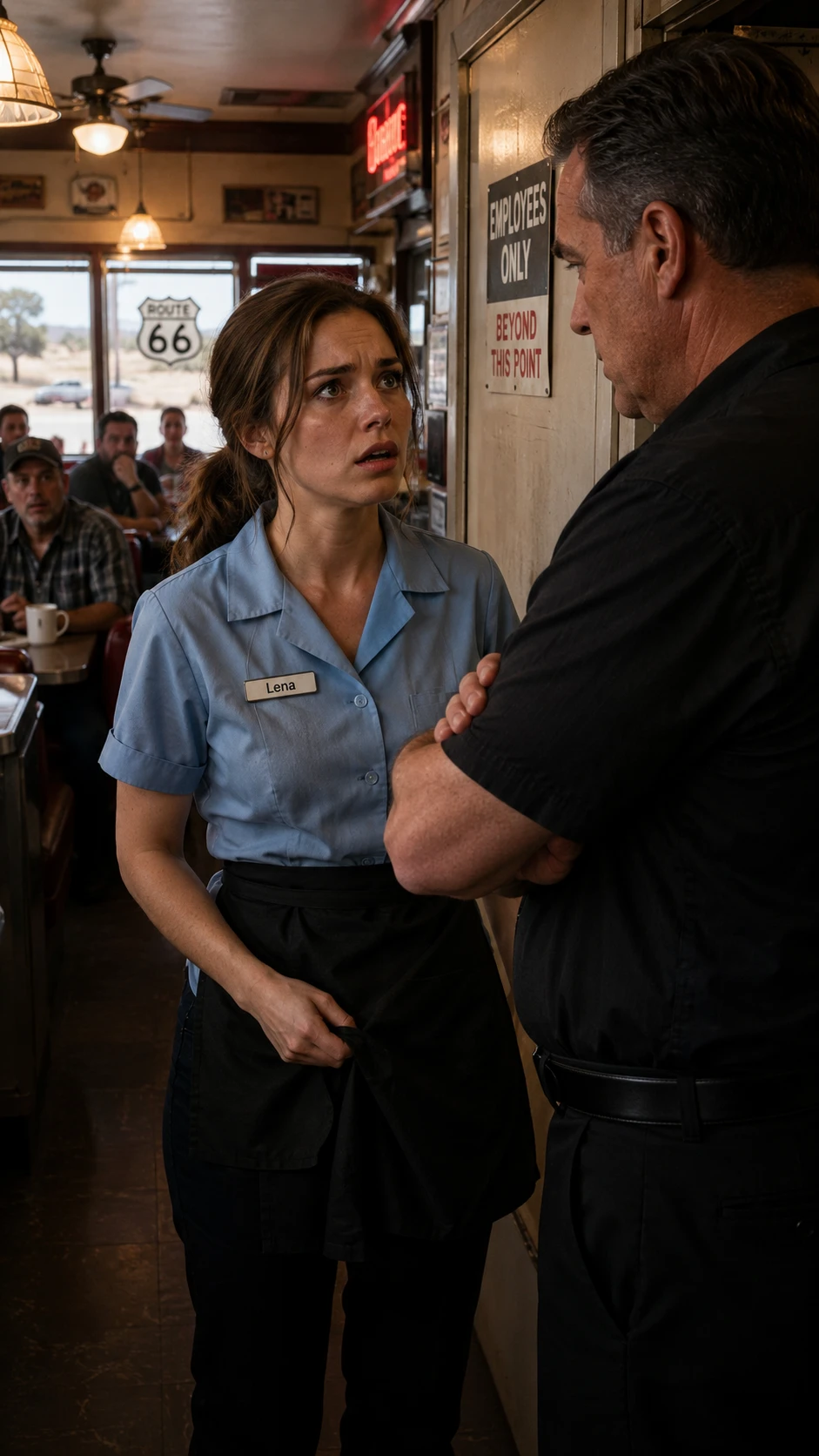
Grant’s jaw tightened. “Get out before I call the sheriff.”
“Call him.”
The words surprised even Lena.
Grant’s eyes flickered.
Then the bell above the diner door rang.
Three motorcycles pulled into the lot.
Then six more.
Then twelve.
Engines thundered until the windows trembled.
Customers turned toward the parking lot as men and women in black leather dismounted, one after another. They were not rowdy. They were not smiling. They moved with the heavy silence of people who had come for a reckoning.
At the center of them walked a tall woman with silver hair braided down her back. She wore a leather vest with a patch that read: ROAD SAINTS.
She entered the diner, removed her sunglasses, and looked directly at Lena.
“You’re Anna’s girl,” she said softly.
Lena’s throat tightened. “Who are you?”
“My name is Mae Calder. The man you helped is Elias Boone.”
Grant made a strangled sound from behind the counter.
Mae looked at him.
And smiled without warmth.
“Hello, Grant.”
The diner seemed to hold its breath.
Lena turned slowly. “You know him?”
Mae stepped closer.
“We all do.”
Grant shook his head. “This is private property.”
Mae laughed once. “Not anymore.”
She reached into her vest and placed a folded document on the counter.
Grant did not touch it.
Lena saw the name printed across the top.
**BOONE FAMILY HOLDINGS.**
Mae looked at Lena. “Elias owns this diner, the land under it, and half the businesses on this strip.”
A gasp moved through the room.
Lena stared at Grant.
His face had gone gray.
Mae continued. “Grant was hired to manage it. Not steal from it. Not threaten employees. And certainly not fire the one person Elias had been trying to find.”
Lena could barely speak. “Find me? Why?”
Mae’s expression softened.
“Your mother, Anna, saved Elias’s life years ago. Before you were born. He loved her. But she disappeared after a man threatened her.”
Lena’s eyes moved slowly to Grant.
Grant stepped back.
“No,” Lena whispered.
Mae nodded. “Your mother worked here. So did Grant.”
Lena’s hands began to shake.
Mae’s voice dropped. “Anna found out Grant was stealing money from Elias’s accounts. She was going to report him. Then she vanished with her baby.”
“That’s not true,” Grant snapped.
But his voice cracked.
Mae laid another photograph on the counter.
It showed a younger Anna Whitaker standing outside the same diner, holding a baby wrapped in a yellow blanket.
Beside her stood Elias Boone.
On the back, written in faded ink, were the words:
**For Lena, when she is old enough to know the truth.**
Lena covered her mouth.
All her life, her mother had said very little about Arizona. Only that some places looked peaceful until you learned where the bones were buried.
Anna had died when Lena was nineteen, taking her secrets with her.
Or so Lena had believed.
The diner door opened again.
A sheriff entered.
Grant immediately pointed at Mae. “Remove these people.”
The sheriff looked at Grant, then at Mae, then at Lena.
“I’m not here for them,” he said.
Grant froze.
The sheriff pulled out a set of papers.
“Grant Mercer, you’re being investigated for fraud, intimidation, wage theft, and obstruction related to the disappearance of Anna Whitaker.”
Lena’s knees nearly gave out.
“Disappearance?” she said. “My mother wasn’t missing. She raised me.”
Mae turned to her.
“That’s the twist, sweetheart,” she whispered. “Anna survived because she ran. But she left evidence behind.”
Grant’s lips parted. “You can’t prove anything.”
A voice answered from the doorway.
“Yes, we can.”
Everyone turned.
Elias Boone stood there.
His arm was bandaged. His face was pale. A paramedic hovered behind him, clearly annoyed that he had left the hospital.
But Elias stood tall.
And his eyes were burning.
“You should be in the hospital,” Lena said.
Elias gave her a tired smile. “I’ve waited twenty-six years. I’m not waiting another hour.”
Grant looked like he might collapse.
Elias walked slowly toward him.
“You told me Anna stole from me,” Elias said. “You told me she ran because she was guilty. You showed me forged papers. You made me believe she betrayed me.”
Grant said nothing.
Elias’s voice trembled now.
“But Anna sent me letters. You intercepted them. She sent proof. You buried it. And when she came back one last time…”
He stopped.
The room went silent.
Lena’s breathing became shallow.
“What happened?” she asked.
Elias looked at her with tears in his eyes.
“She came to tell me about you.”
Lena felt the floor disappear beneath her.
Elias reached into his jacket and pulled out a small silver locket.
Inside was a photo of Anna holding a newborn baby.
On the other side was a picture of Elias.
Lena stared at it.
“No,” she whispered.
Elias’s face broke.
“Lena,” he said, voice barely audible, “I’m your father.”
The diner erupted in shocked whispers.
Grant lunged suddenly, grabbing for the locket.
Mae moved first.
So did the sheriff.
Grant was forced against the counter, shouting, red-faced and desperate.
“She was supposed to stay gone!” he screamed.
The room froze.
There it was.
The confession.
Lena stared at him, horror and fury rising together.
“What did you do to my mother?”
Grant’s face twisted.
“I did what I had to do! She was going to ruin everything!”
The sheriff tightened the cuffs around his wrists.
Elias stepped toward Lena, but stopped just short, as if afraid she might vanish.
“I didn’t know,” he said. “I swear to you, I didn’t know.”
Lena looked at this injured biker, this stranger, this man who had unknowingly been tied to every unanswered question in her life.
Then she remembered her mother’s last words.
**“One day, kindness will lead you back to where truth is waiting.”**
Lena had thought it was just something dying people said to make the world feel less cruel.
But now, standing in the diner where her mother’s story had been stolen, she realized Anna had known.
Maybe not when.
Maybe not how.
But she had known the truth would find her daughter.
Grant was dragged toward the door.
As he passed Lena, he hissed, “You still have nothing.”
Lena turned to him.
For the first time all day, she smiled.
Elias placed the keys to Miller’s Roadside Kitchen in her hand.
“No,” he said quietly. “She has everything Anna wanted her to have.”
Lena looked down.
The keys were warm from his palm.
Outside, the motorcycles waited beneath the Arizona sun.
Inside, the customers stared in stunned silence.
And behind the counter, the old coffee still burned at the bottom of the pot.
Lena laughed through her tears.
Then she untied the apron Grant had ordered her to remove and laid it gently on the counter.
“I quit,” she said.
Elias smiled.
Mae folded her arms. “Good. Now hire yourself back as owner.”
One week later, the sign outside the diner changed.
Miller’s Roadside Kitchen was gone.
In its place, painted in bright blue letters, was a new name.
**Anna’s Roadside Table.**
And every morning after that, when travelers passed through Kingman, Arizona, they heard the story of the waitress who was fired for helping an injured biker.
But locals knew the real story.
**Lena Whitaker had not lost her job that day.**
**She had found her father, exposed her mother’s enemy, inherited the diner, and discovered that one act of kindness could resurrect a truth buried for twenty-six years.**