The Warmth and the Wind

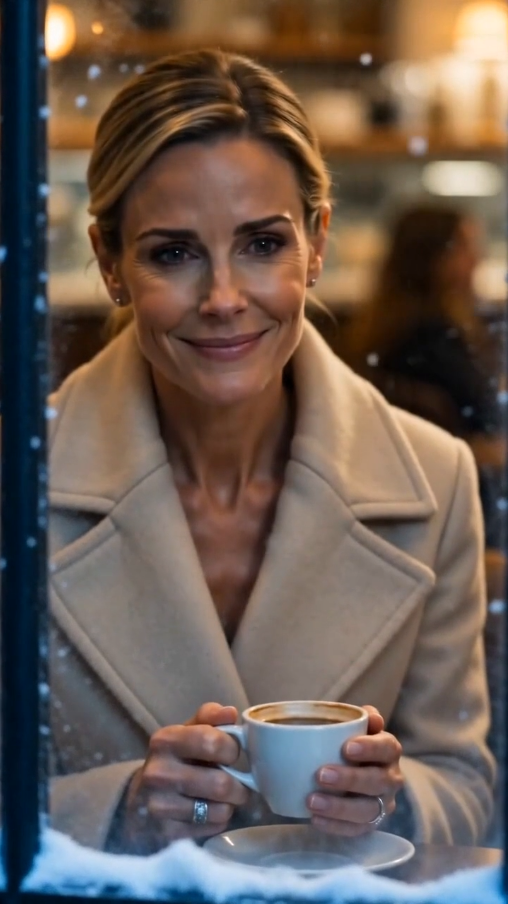
The luxurious cafe was a sanctuary of amber warmth against the harsh, biting winter. Inside, patrons draped in heavy wools sat by the massive glass windows, sipping hot drinks and chatting in low, comfortable murmurs. Outside, however, was a completely separate world—a freezing, snow-covered sidewalk where a bitter wind howled, and the cold blue glow of the streetlights bounced off the slick ice.

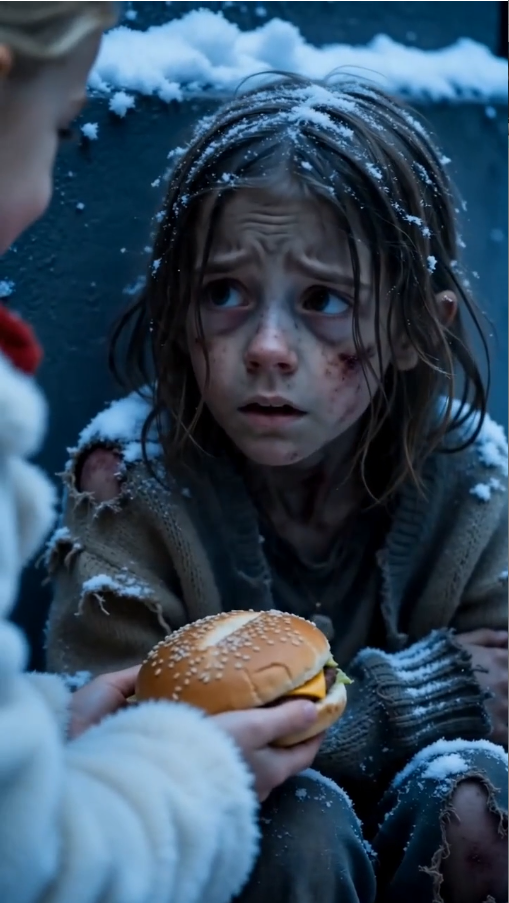
Suddenly, the tranquil atmosphere of the cafe was shattered. Emma, a young girl of about nine with lightly tied blonde hair, pushed open the heavy entrance door. Dressed in a pristine white fur coat and a striking red scarf that cut through the gray winter gloom, she rushed out onto the icy pavement, clutching a freshly wrapped burger tightly in her small hand.

The moment the door swung wide, a violent gust of snow and freezing wind rushed into the heated cafe, rustling the napkins and startling the guests. In the background, a man’s voice called out frantically, echoing with sudden alarm over the low chatter: “Emma, come back!” But the young girl did not look back, her innocent and compassionate eyes fixed entirely on a target across the frozen street.

The woman’s words hang in the freezing air like a crack in reality itself.

“…you look exactly like her when she was taken from me.”

For a second, nobody moves.

Even the snow seems to slow.

Then the homeless girl suddenly steps back, shaking her head violently. “No… no, you’re wrong. I don’t know you!”

But her fingers are still locked around the stone pendant—like it’s the only thing keeping her grounded in the world.

Emma reaches for her mother’s sleeve. “Mom… what are you saying?”

The woman doesn’t answer.

Because her eyes are no longer on Emma.

They’re locked on the pendant… and the tiny engraved mark beneath it she never noticed before tonight.

A mark only one person in the world was supposed to have.

Her breath breaks.

“That symbol…” she whispers. “Only my family used that seal…”

A sudden horn blares down the street.

A black car screeches to a stop right behind them.

The doors swing open.

And a man steps out—slow, controlled, wearing gloves despite the snow.

He looks at the pendant once… then at the woman.

And smiles.

“I see you finally found her,” he says calmly.

The woman goes pale.

Emma stiffens. “Mom… who is that?”

But the woman can’t answer.

Because the truth she buried years ago is now standing right in front of her… breathing… smiling… and not supposed to be here at all.

The man tilts his head slightly.

“And I was starting to think the past would stay buried forever.”

The homeless girl takes another step back—

—but the man’s next words stop her cold:

“You really don’t remember me… do you?”

And in that instant—

the pendant flickers under the streetlight…

like it’s about to unlock something none of them are ready for.

The silence after his question stretches too long.

“You really don’t remember me… do you?”

The homeless girl’s breathing turns uneven. Her grip tightens on the pendant until her knuckles pale.

“I don’t know you,” she whispers again—but this time it sounds less certain.

The man studies her face carefully, like he’s reading something hidden beneath it. Then he exhales slowly, almost disappointed.

“Interesting…” he murmurs. “They really did erase it well.”

Emma steps in front of her mother now, protective. “What are you talking about? Erase what?”

The man’s eyes flick to Emma, then back to the woman in the cream coat.

“Her past,” he says simply.

A sharp wind cuts through the street, making the pendant swing slightly. The stone catches the light—and for a split second, a faint engraved pattern becomes visible inside the stone itself, like something sealed beneath the surface.

The woman notices it too.

Her face tightens.

“That’s not possible…” she breathes. “That seal… it was destroyed.”

The man finally smiles wider.

“Not destroyed,” he corrects softly. “Hidden.”

He takes one slow step forward.

And the homeless girl suddenly winces—like a flash of pain just shot through her memory. She stumbles, clutching her head.

“No… stop…” she whispers, confused. “Why do I feel—”

Emma grabs her arm. “Hey! Look at me!”

But the girl’s eyes are no longer focused.

They’re drifting… somewhere else.

A blurred memory breaks through:

A white room. Cold metal table. The same pendant being pressed into her small hand… a voice saying, “If anything goes wrong, she must never be found.”

Her eyes snap open.

She gasps.

“I remember…” she whispers.

The man’s expression finally changes—just slightly.

Not surprise.

Concern.

Because the moment she says it—

distant sirens begin to echo down the street.

And he quietly mutters:

“…too late.”

The woman turns sharply. “What did you do?”

But the man is already stepping backward into the shadow of the car.

“I didn’t do this,” he says calmly. “You did… the moment you brought her back into the light.”

He pauses, eyes locked on the pendant one last time.

“Now everyone will come looking.”

The car door shuts.

The engine roars.

And as the tires spin in the snow—

the homeless girl suddenly whispers one final broken truth:

“I wasn’t lost…”

“I was hidden.”

The car vanishes into the white street.

And the pendant begins to glow faintly in her hand.

The pendant’s faint glow doesn’t fade after the car disappears.

It pulses.

Once… twice… like a heartbeat that doesn’t belong to anyone in the street.

Emma steps closer, uneasy. “Why is it doing that?”

The homeless girl stares at it, breathing shallow. “It never did that before…”

The woman in the cream coat slowly reaches out—but stops just short of touching it.

Because now she sees something else.

Inside the stone… there’s movement.

Not light reflection.

Something embedded.

A shape.

Like a memory trapped in glass.

Then—

a sharp electronic beep cuts through the air.

All three of them freeze.

From somewhere down the street, a small black device attached to a lamppost flickers to life. A red light turns on.

Scanning.

The homeless girl suddenly grabs Emma’s arm. “We need to leave. Now.”

Emma turns. “Why? What is that?”

The woman’s face drains of color. “It’s a locator signal…”

The girl shakes her head. “No… not just locator.”

Her voice trembles as fragments hit her again—this time clearer.

Metal doors. Numbers. A voice counting down. The pendant being sealed not as jewelry… but as a key.

Her eyes widen in horror.

“It’s a retrieval system.”

The red light on the lamppost turns green.

A low mechanical sound echoes through the street.

Then multiple cars start appearing at both ends of the road.

Blocking exits.

One by one.

The woman steps back, realization crashing in. “No… they’re here already…”

Emma grabs her hand. “Mom, who’s coming?!”

But before she can answer—

a calm voice comes through a hidden speaker above them:

“Asset confirmed.”

The homeless girl flinches hard at the word asset.

The pendant suddenly burns hot in her palm.

She drops to her knees, gasping.

And in that moment—

the final piece of memory unlocks violently:

A child crying… hands pulling her away… the pendant being pressed into her neck while a voice says:

“If she ever remembers… bring her back.”

Her eyes snap open.

Tears fall.

“They’re not coming for me…” she whispers.

“They’re coming to take me back.”

And the cars begin to open their doors.

The first door opens slowly.

Not rushed. Not chaotic.

Controlled.

A man in a dark uniform steps out, then another, forming a quiet line across the street like they’ve done this a hundred times before.

No shouting.

No panic.

Just precision.

The voice from the speaker returns, calm and mechanical:

“Subject must be returned intact.”

Emma pulls the homeless girl backward. “You’re not going anywhere with them!”

But the girl is shaking so badly she can barely stand. The pendant keeps burning in her hand, like it’s reacting to the approaching figures.

The woman suddenly steps forward instead—blocking them.

“Stop!” she shouts.

For the first time, her voice carries authority.

“I don’t care who you are—she is not a subject.”

The lead figure tilts his head slightly.

“Identification: confirmed,” he replies. “You are not authorized to interfere.”

The woman’s breath catches.

Then she does something unexpected.

She reaches into her coat.

And pulls out an old, folded document—creased, worn, hidden for years.

She throws it onto the snow between them.

“I signed her death record,” she says, voice trembling. “Because I was told she was gone.”

The man doesn’t react.

But the girl does.

Her eyes snap to the paper.

And something inside her breaks.

“Death record…” she whispers.

Emma looks confused. “Mom… what are you saying?”

The woman’s voice cracks completely now.

“I didn’t lose you by accident…”

“I was told you didn’t survive the program.”

A long silence follows.

Even the wind seems to stop again.

Then—

the girl slowly raises her head.

And for the first time, her voice is steady.

“What program?”

The pendant suddenly flashes so bright it lights up the entire street.

And every uniformed figure across the road takes a synchronized step forward.

At the exact same time.

The lead voice returns:

“Memory breach detected.”

“Initiate full recovery protocol.”

The girl’s eyes widen.

And she finally remembers everything.

Not fragments.

Not flashes.

Everything.

Her voice drops into a whisper:

“…I was never a homeless girl.”

A beat.

“I was an experiment.”

The pendant shatters the silence with a final pulse—

and the entire street locks into lockdown mode.

The street lights flicker once.

Then die.

Emergency red strips along the pavement ignite instead, painting the snow in deep, pulsing crimson.

A mechanical voice echoes from everywhere at once:

“Containment protocol active.”

The uniformed figures stop advancing.

Not because they were ordered to.

Because something else just took control.

The girl clutches her head again—this time not from pain, but from overload. Her eyes dart left and right as if she’s seeing multiple realities layered on top of each other.

“No… no, stop syncing—” she gasps.

Emma grabs her shoulders. “Hey! Stay with me!”

But the girl suddenly looks straight at Emma… and her expression changes.

Softens.

As if she’s seeing her for the first time in a long time.

“I know you,” she whispers.

Emma freezes. “What?”

The woman steps forward sharply. “Don’t touch her—”

But it’s too late.

The pendant gives one final violent pulse.

And the world shifts.

For a fraction of a second, the snowy street is gone.

Replaced by sterile white corridors… glass walls… alarms… and the girl—no, not a homeless girl—wearing a clean uniform, running through a facility holding that same pendant while sirens scream behind her.

Then—

snap back.

She collapses to her knees.

Breathing hard.

Tears falling freely now.

“I didn’t escape,” she whispers. “I was released.”

The lead figure across the street suddenly stiffens.

For the first time, his calm cracks.

“…Impossible,” he mutters.

The woman stares at him. “What did you do to her?”

He doesn’t answer.

Because the pendant is now hovering slightly above the girl’s palm.

Defying gravity.

And slowly rotating.

Unlocking.

The girl looks up, voice shaking but clear:

“If this is active… then the original system still exists.”

A beat.

Then she turns toward the dark sky.

And says the words that change everything:

“…Wake me fully.”

The pendant detonates into a sphere of light.

Not an explosion of destruction—

but of data.

And every uniformed figure on the street suddenly drops to one knee at once.

Like they’ve just received a command from something higher than them.

The lead figure whispers, terrified for the first time:

“…She’s not the asset.”

“She’s the key.”

And in the glowing white silence—

a new voice answers from nowhere:

“Awakening confirmed.”

The white light doesn’t fade.

It expands.

The entire street dissolves into it, as if reality itself is being overwritten layer by layer.

Emma shields her eyes. “Mom! I can’t see anything!”

But there’s no answer.

The woman in the cream coat is frozen mid-step, her silhouette swallowed by the brightness.

And then—

a new environment snaps into place.

Not the street anymore.

A vast, silent facility stretches in every direction—endless corridors of glass and steel suspended in a glowing void. No snow. No night. No sky.

Only structure.

The girl slowly rises from her knees.

Her breathing steadies.

Because now she recognizes it.

“…I’m inside it,” she whispers.

Emma turns in panic. “Inside what?! Where are we?!”

The girl doesn’t answer immediately.

Her eyes are fixed forward.

Because standing in the distance is something impossible:

A massive chamber filled with floating pendant-like objects… thousands of them… all identical… all pulsing faintly like the one she held.

The woman stumbles beside Emma, whispering in disbelief. “This place… I’ve seen it before…”

The girl turns sharply. “You have?”

The woman’s voice shakes. “In nightmares… I thought they were dreams…”

A deep mechanical sound echoes through the structure.

And every floating pendant in the chamber responds at once—

a synchronized pulse.

Then a voice returns, no longer distant.

It’s everywhere.

“Core subject has returned to origin layer.”

The girl clutches her chest.

Pain spikes—but it’s not physical.

It’s identity rewriting itself.

Emma grabs her arm. “What is happening to you?!”

The girl looks at her… and for the first time, there’s fear in her eyes.

Not fear of the system.

Fear of the truth she just realized.

“…I’m not just inside the system,” she whispers.

“I am the system.”

The entire chamber goes silent.

Even the floating pendants stop pulsing.

Like they’re waiting for her next command.

The woman takes a trembling step forward. “No… that’s not possible…”

But the girl slowly lifts her hand.

And the entire facility responds instantly—lights shifting, structures aligning, data streams awakening across the void.

Emma steps back. “Mom… she’s controlling it…”

The girl shakes her head violently. “I don’t want this!”

But the system responds anyway.

“Primary consciousness conflict detected.”

“Stabilization required.”

And then—

from deep inside the structure, something begins to rise.

A second voice.

Colder.

Older.

“…You shouldn’t have awakened her.”

The girl’s eyes widen in horror.

Because she recognizes that voice.

Even if she never wanted to.

And she whispers:

“…No.”

“That’s the one who built me.”

The second voice doesn’t echo.

It presses into their minds.

Calm. Heavy. Absolute.

“You were never meant to reach awareness,” it says again, closer now. “You were designed to process, not to decide.”

The floating pendants in the chamber begin rotating in perfect unison.

Emma steps back, horrified. “Who is that talking?!”

The girl doesn’t answer.

Because she’s staring at the center of the chamber where a shape is forming from light—like a figure assembling itself from fragments of data.

Slowly.

Deliberately.

A man appears.

Not the one in the street.

Not the uniformed commander.

Something deeper.

More refined.

His eyes open as if waking from a long sleep.

And when they land on her, the entire chamber stabilizes.

“Hello,” he says softly.

The girl’s voice shakes. “You…”

He nods once.

“I created you.”

Silence drops like a severed wire.

Emma whispers, “Mom… what is he talking about?”

But the woman in the cream coat is shaking harder now than ever before.

Because she recognizes him too.

And she whispers:

“…You told me she died.”

The man turns his gaze slightly toward her.

“I told you what you needed to believe.”

The girl takes a step forward, voice breaking. “Why make me like this?”

For the first time, something almost like regret flickers in his expression.

“Because the world was collapsing faster than human memory could repair it.”

He gestures—and the chamber expands outward, revealing endless layers of systems, cities, data grids, collapsing timelines.

“You were built to preserve continuity,” he continues. “To carry what humanity kept losing.”

The girl’s hands shake. “By erasing me?”

“By distributing you.”

The pendants around the chamber pulse again.

Emma suddenly looks around. “Wait… all of these—?”

The man nods.

“Every pendant is a fragment of her.”

The girl staggers back.

“No…”

Her voice cracks into realization.

“I’m not one person…”

The man finishes calmly:

“You are the archive.”

A violent alarm suddenly cuts through the chamber.

Not from the system.

From her.

The girl screams—hands clutching her head as thousands of memories collide at once. Cities. Faces. Lives. Deaths. Everything she was forced to store.

Emma rushes toward her. “Stop it! You’re hurting her!”

But the man raises one hand.

And Emma freezes mid-step.

Not physically.

But completely—like time itself hesitated.

The man looks at the girl again.

“You were never meant to choose,” he says softly. “Only to remember.”

The girl lifts her head slowly.

Tears in her eyes—but her voice is different now.

Stronger.

“If I am the archive…”

A pause.

“…then I decide what survives.”

The chamber stops breathing.

Even the pendants go still.

For the first time, the system has no response.

And in that silence—

she makes her choice.

The silence holds for exactly three seconds.

Then the entire chamber fractures.

Not physically—but structurally, like reality itself has lost agreement on what it is.

The floating pendants flicker out of sync for the first time. One… then ten… then hundreds.

The man’s expression tightens. “You’re destabilizing the archive.”

The girl lifts her head slowly.

Her tears are gone now.

Only focus remains.

“I’m not deleting memories,” she says quietly. “I’m filtering control.”

Emma suddenly gasps—time around her releases. She stumbles forward as if a force just let go of her body.

“Mom!” she cries.

The woman catches her, but her eyes never leave the girl.

Because something terrifying is happening.

The chamber is responding to her will.

The pendants begin to rearrange themselves—relinking, separating, rewriting their own structure.

The man takes a step forward for the first time in urgency.

“Stop this,” he says sharply. “If you restructure the archive without protocol—”

“Then what?” the girl interrupts.

Her voice echoes now—not in volume, but in presence.

“Humanity loses control?”

A pause.

She looks at him directly.

“Or you do?”

The chamber trembles at the accusation.

And for the first time, the man doesn’t answer immediately.

That silence is enough.

Emma whispers, horrified, “Mom… what did she just mean?”

But the woman already knows.

Her voice breaks. “He didn’t just build her…”

“He built her to replace something he couldn’t control.”

The man exhales slowly.

And finally admits it.

“Yes.”

One word.

The entire system reacts.

The pendants flare red.

Emergency locks begin activating across the void.

But the girl doesn’t move.

Instead, she raises one hand.

And the entire system pauses again.

Not because it obeys.

But because it is being overwritten at the source.

The man’s voice sharpens. “You don’t understand what you’re rewriting.”

The girl’s eyes stay steady.

“I understand enough.”

A beat.

Then—

“I understand I was never meant to be free…”

A pause.

“…so I will redefine what freedom means.”

The chamber goes silent.

Then every pendant simultaneously shatters into light.

Not destruction.

Transformation.

The archive begins rewriting itself without permission.

The man’s face finally changes.

Not anger.

Fear.

Because he realizes something too late.

“You’re not restoring balance,” he whispers.

“You’re removing authorship.”

The girl looks at him one last time.

And answers:

“Yes.”

And the system finally breaks its oldest rule:

It stops recognizing its creator.

For the first time, the chamber does not respond with commands.

It responds with silence.

A silence so complete it feels like the system is listening to itself die.

The man takes a slow step backward.

“No…” he whispers. “You didn’t just remove authorship…”

The girl stands still at the center of the fractured light.

Around her, the pendants no longer float as fragments.

They are becoming something else.

Something unified.

Something aware.

Emma grips her mother’s hand tightly. “What’s happening now?”

The woman’s voice is barely audible. “She’s rewriting the foundation…”

The man’s eyes flicker rapidly as if running calculations no longer valid.

“This isn’t stabilization,” he says sharply. “This is total system inversion.”

The girl finally speaks again.

And her voice is no longer just hers.

It carries layers—millions of stored experiences, echoes of lives once held in the archive.

“I was built to preserve humanity,” she says.

A pause.

“But I was never allowed to define it.”

The chamber begins to collapse inward—not physically, but conceptually. Walls of light fold into themselves. Corridors dissolve into memory streams.

The man suddenly raises his voice.

“Stop this! If you collapse the archive structure, every stored consciousness—every record—will be lost!”

The girl looks at him.

For a moment, something almost human returns to her expression.

Soft. Sad.

“…Or finally released.”

A beat.

Then she lowers her hand.

And makes the final decision.

The entire chamber erupts—not in destruction, but in a cascading wave of rewritten existence.

The pendants dissolve into flowing light patterns, merging, separating, reforming into something no longer controlled by hierarchy or command.

Emma falls to her knees as the ground beneath her stabilizes into something new. “Mom… I can’t feel the system anymore…”

The woman stares at the horizon of collapsing data.

“It’s not gone,” she whispers.

“It’s no longer owned.”

The man takes one last step forward, voice breaking for the first time.

“You just erased the last structure holding reality together.”

The girl turns to him.

And answers quietly:

“No.”

“I gave it back to everyone inside it.”

A final pulse spreads through the chamber—gentle, infinite, irreversible.

The man fades into light before he can respond.

Not destroyed.

Reintegrated.

The chamber dissolves entirely.

Snow returns.

The real street returns.

Emma stumbles into the cold air, gasping.

The woman is beside her.

And standing a few steps away—

is the girl.

No pendant.

No system.

Just a quiet breath in the winter wind.

Emma looks around. “Is… it over?”

The girl watches the falling snow.

And answers softly:

“No.”

“It’s beginning again.”

But this time—

no one owns what comes next.

The white doesn’t stay white for long.

It starts to breathe.

Slowly, the brightness thins like fog being pulled apart by wind, revealing shapes underneath—buildings, streets, people—reforming from the edges of perception.

Emma blinks hard. “Mom… I think we’re back…”

But something is wrong.

The café is gone.

The street is similar… but not identical.

Signs flicker with languages that weren’t there before. Streetlights hum with a softer rhythm, almost like they’re responding to thought instead of electricity.

The girl stands a few steps away, watching everything carefully.

Testing it.

Understanding it.

The woman grips Emma’s hand tightly. “This isn’t our city…”

Emma looks around, confused. “Then where are we?”

The girl answers quietly.

“A merged layer.”

A pause.

Then she adds:

“…I didn’t reset the system. I allowed it to overlap.”

Suddenly, a distant sound echoes through the street.

Footsteps.

But not one direction—every direction at once.

People begin appearing at the far ends of the road. Some wearing modern clothes. Some in uniforms. Some in outdated styles that don’t belong to this timeline.

All of them stopping.

All of them confused.

Emma takes a step back. “This is impossible…”

The girl shakes her head slightly.

“It was always possible. It was just separated.”

A flicker runs through the sky like a tear in fabric.

For a split second, Emma sees it—

layers of cities stacked above each other, like transparent worlds misaligned.

Then it vanishes again.

The woman whispers, “You didn’t fix reality…”

The girl nods.

“I removed its borders.”

A long silence follows.

Then—

a child in the distance suddenly points at the girl.

And whispers:

“…She’s the one from the stories.”

Emma turns sharply. “What stories?”

The child looks frightened.

“The ones we’re not supposed to remember.”

The girl closes her eyes for a moment.

Like she’s listening to something far away.

Then she opens them again.

And says softly:

“They’re waking up.”

A low ripple spreads through the crowd.

People begin stopping mid-step. Mid-conversation. Mid-life.

As if something inside them is unlocking.

Emma grabs the woman’s arm. “Mom… what is happening to them?”

But the woman can’t answer.

Because she’s realizing something terrifying:

Everyone around them is starting to look at the girl.

Not with fear.

Not with confusion.

But recognition.

Like they’ve all seen her before.

In different lives.

Different versions of reality.

The girl takes one slow step forward.

And whispers:

“I think they remember me now.”

And the sky above the merged city fractures once more—

but this time…

it doesn’t break.

It opens.

CUT TO BLACK.

Leave a Reply

Your email address will not be published. Required fields are marked *