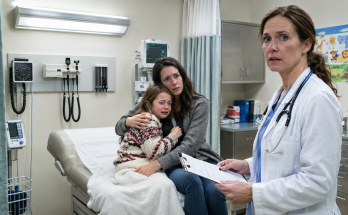
Margaret came into my hospital room a few minutes after Ellie told me she wanted to speak.
I saw the handbag before I noticed anything else.
The expensive one.
The birthday present I had chosen for her.
She was carrying it as though she hadn't known what else to do with her hands.
I remembered picking it out.
I remembered wanting to make her birthday special.
I remembered being tired before dinner and still making sure everything was ready.
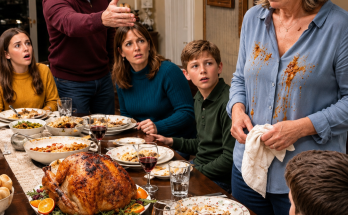
And I remembered that the evening had ended with me on the floor.
The handbag looked completely different to me now.
It was no longer simply a gift.
It reminded me how much effort I had put into pleasing someone who hadn't even checked whether I was conscious after I fell.
Margaret stopped near my bed.
She looked uncomfortable.
I hadn't often seen her that way.
She was usually certain of herself.
Certain of what other people should do.
Certain of how a family gathering ought to be handled.
But she didn't seem certain of anything that afternoon.
She glanced at Grant.
Then at Ellie.
Then back at me.
"Claire, are you feeling any stronger?"
I was resting against the pillows.
My head still hurt.
I still became tired easily.
And I didn't have the strength for a long argument.
But I could speak.
That was enough.
"A little," I answered.
Margaret nodded.
She placed the handbag on the chair.
For a moment, she didn't say anything.
I watched her.
I wasn't going to help her find the right words.
Not this time.
I had spent too many years making uncomfortable situations easier for other people.
If Margaret wanted to apologize, she needed to do it herself.
Finally, she began.
"I suppose I should say I'm sorry."
I looked at her.
That word bothered me.
Suppose.
As though she were still deciding whether an apology was necessary.
As though the problem was that I expected one.
Not that she had ignored me while I lay unconscious on her floor.
I didn't interrupt.
I wanted to hear what came next.
Margaret continued.
She said she shouldn't have allowed the dinner to carry on.
She admitted that she hadn't understood how badly I was hurt.
She explained that she had believed I was refusing to stand.
I listened.
Then I asked her something.
"Did you ever come over and check?"
She looked at me.
I already knew the answer.
But I needed her to say it.
She lowered her eyes.
"No."
I let that word sit between us.
It was small.
But it explained almost everything.
She hadn't checked.
She hadn't bent down.
She hadn't tried to wake me.
She hadn't listened when Ellie said something was wrong.
And because she hadn't looked closely, she had decided I was causing a problem.
"You didn't know I was seriously hurt because you didn't try to find out."
Margaret's face tightened.
She looked at Grant.
I could see her wanting him to step in.
Perhaps to explain.
Perhaps to tell me she had already apologized.
But he remained quiet.
I was grateful for that.
This wasn't his conversation to control.
Margaret turned back to me.
She said she understood.
I shook my head slightly.
The movement hurt.
But I needed to make my point.
"I don't think you do."
Her eyes filled.
I had seen Margaret become emotional before.
Usually when she was upset about something that hadn't gone her way.
But I didn't want to dismiss her tears simply because I was angry.
I wanted her to understand the difference between regretting an outcome and accepting responsibility for a choice.
So I told her what she had done.
I didn't raise my voice.
I couldn't have, even if I wanted to.
I spoke slowly.
I reminded her that I had fallen in her dining room.
That I had lost consciousness.
That Ellie had cried and asked for someone to help.
And that Margaret had told the guests to keep eating.
She stared at me.
I continued.
"You heard my daughter asking for help."
Margaret wiped her face.
"I thought you were making a scene."
I felt something cold settle inside me.
There it was.
The belief underneath everything.
Even when I hadn't moved.
Even when I hadn't answered.
Even when our daughter was frightened.
Margaret had assumed that I was deliberately causing trouble.
"That's what you chose to believe."
She looked down.
I waited.
Then I said what I had needed to say since waking up.
"You didn't have to know exactly what was wrong with me. You only had to care enough to check."
The room became quiet.
Grant was sitting nearby.
Ellie was playing with the pink flower she had brought me.
And Margaret stood beside the chair, holding herself very still.
For the first time, nobody was telling me to be less upset.
Nobody was asking me to move on.
Nobody was explaining why I should understand the person who had hurt me.
I was finally allowed to describe what had happened without being interrupted.
That mattered more than Margaret probably realized.
I had spent years feeling that speaking about hurt was somehow worse than causing it.
If someone made an unkind joke, the problem became my reaction.
If I said something was unfair, I was making the family uncomfortable.
If I wanted Grant to defend me, I was expecting too much.
I had learned to swallow those feelings.
Not because they disappeared.
But because I was tired of arguing.
Now I was lying in a hospital bed recovering from a serious head injury.
I wasn't going to swallow anything else.
Margaret began crying.
She said she had made a terrible mistake.
I looked at her.
"Yes. You did."
I didn't try to comfort her.
That was difficult for me.
I was used to smoothing things over.
I was used to telling people everything was fine even when it wasn't.
But I had nothing left to give her in that moment.
My body needed rest.
My daughter needed reassurance.
And my husband needed to understand that an apology wasn't permission to forget the past.
I turned toward Grant.
He was watching me.
I could see that he knew what was coming.
"You're responsible too."
He nodded.
"I know."
There was no argument.
No explanation about how Lacey hadn't meant it.
No complaint that I was being unfair.
He simply accepted what I said.
I couldn't deny that it was a change.
But I also knew how much had happened before he reached that point.
I had asked him to defend me for years.
I had wanted him to notice when people treated me badly.
And when I finally suffered a serious injury, he hadn't acted until hours had passed.
I wasn't going to pretend his acknowledgment erased that.
I looked at both of them.
"I survived. That doesn't mean everything is fine."
Neither answered.
I continued.
"I don't want us acting as if this was just an awkward dinner."
Margaret nodded.
Grant kept his eyes on me.
I could feel myself becoming tired.
But there was something more important than my exhaustion.
Ellie.
She was sitting close enough to hear us.
I didn't want her to think she had to fix the adults' feelings.
I didn't want her worrying because Grandma was crying.
And I didn't want her believing that loving her father meant she couldn't love her mother.
I looked toward my daughter.
She was examining the small flower beside my pillow.
Her fingers were careful.
She had no idea how much courage she had shown at Margaret's house.
She didn't know that she had done more for me that night than anyone else.
She only knew she wanted me to get better.
I turned back to Margaret.
"Ellie needs to know that people who love each other don't treat them that way."
Margaret listened.
I spoke again.
"I don't want her growing up thinking that being embarrassed or hurt is something she has to accept because the person doing it is family."
Grant looked at Ellie.
I could see the words reaching him.
He had already heard what she told the babysitter.
He knew she blamed herself.
He knew she had interpreted his laughter as proof that he didn't care about me.
But knowing those things wasn't enough.
He needed to understand what kind of example he had set.
"She watched all of you," I said.
Neither of them interrupted.
"She saw me fall. She heard the laughter. She asked for help. And nobody listened."
Margaret covered her mouth.
I continued.
"She's three years old. She should never have been the person trying to convince the adults to help."
Grant lowered his head.
I looked at him.
"She didn't fail me. You did."
The words were difficult to say.
But they were true.
Ellie wasn't responsible for recognizing a head injury.
She wasn't responsible for calling an ambulance.
She wasn't responsible for making adults behave decently.
She had done everything a child could do.
And more.
I wanted both Grant and Margaret to understand that.
I wanted them to stop treating her fear as something they could erase by saying they were sorry.
Children remember what makes them feel unsafe.
And they notice whether adults change afterward.
Margaret asked what I wanted from her.
She sounded uncertain.
Perhaps she expected me to demand another apology.
Perhaps she thought I wanted to punish her.
But I didn't have the energy for punishment.
I wanted boundaries.
I wanted respect.
I wanted my daughter protected from the behavior I had tolerated for too long.
So I told her.
"You need to respect the limits I set."
Margaret looked at me.
"And don't ever make Ellie feel like she has to choose between her parents."
That mattered deeply to me.
I wasn't trying to take Ellie away from Grant.
I wasn't trying to make her hate her grandmother.
I wanted her to understand that loving someone didn't mean excusing everything they did.
I wanted her to know she could love her father and still say he was wrong.
She could love her grandmother and still expect kindness.
And she could love me without feeling responsible for my happiness.
Grant sat down.
He looked at me for a while.
Then he said he wanted to repair what he had damaged.
I listened.
I wanted to believe him.
Part of me still loved the man I had married.
Part of me remembered all the reasons I had chosen him.
But those feelings didn't make the incident disappear.
I needed him to understand something simple.
Being married wasn't just sharing a home.
It wasn't just making plans.
It wasn't bringing flowers after something terrible happened.
It meant standing beside the person you claimed to love.
Especially when other people treated that person badly.
I told him that.
I told him I had needed his support long before the accident.
That I had wanted him to defend me when someone crossed a line.
That I shouldn't have had to suffer a serious injury before he understood.
Grant nodded.
He said he understood.
I watched his face.
I believed he was listening.
But I didn't know whether he could turn that understanding into lasting behavior.
And I wasn't prepared to promise him that everything would go back to the way it had been.
Not yet.
There was still another issue.
One I couldn't ignore.
Lacey.
The woman who had pulled my chair away.
The woman whose actions had caused the fall.
The woman who had been more concerned about explaining her intentions than acknowledging the full consequences.
I didn't want her near me.
I didn't want to see her at another family dinner.
And I certainly didn't want her near Ellie.
I looked directly at Grant.
"Lacey cannot come to our house anymore."
He didn't speak.
I continued.
"I don't want her contacting me. And I don't want her around Ellie."
This wasn't an invitation to discuss the matter.
It wasn't a request for him to talk me out of being upset.
It was a boundary.
One I had decided was necessary.
Grant answered without hesitation.
He agreed.
He didn't defend Lacey.
He didn't say I was overreacting.
He didn't tell me their friendship had lasted too long to end over one incident.
He simply accepted what I had said.
That was the first time in a long while I felt he was listening to me without trying to change my mind.
But Margaret wasn't finished.
She looked surprised.
She asked whether Grant was really prepared to give up a friendship because of what she still seemed to consider a single mistake.
I stared at her.
After everything I had said, she was still calling it that.
One mistake.
As though removing my chair were the entire story.
As though the hours that followed didn't matter.
As though Ellie hadn't been begging for help.
Before I could answer, Grant turned toward his mother.
And this time, he spoke for himself.
Click here to continue reading: PART 8: My Husband Finally Defended Me Against His Mother, but Two Weeks Later the Woman Who Hurt Me Appeared at Our Front Door
I Lay Motionless on the Dining Room Floor While My Husband Finally Noticed What Our Three-Year-Old Daughter Had Been Trying to Tell Him
Part 7 of 15