I used to think I knew the man I married.
That was my first mistake.
My second mistake was believing that a little girl would always know how to explain when something was wrong.
Chloe was six.
She still carried a stuffed bunny around the house.
She needed help tying her shoes.
And when something frightened her, she usually came looking for me.
Except there were things she had been trying to tell me without saying them plainly.
I understood that much too late.
My name is Emily Bennett.
For six years, I had built my life around my daughter and my husband, Nathan.
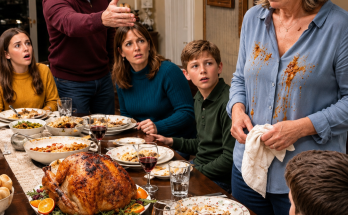
From the outside, we looked like the kind of family people admired.
Nathan had a successful executive career.
We lived in a comfortable house in Colorado.
Our daughter attended a good elementary school.
There were family photographs, birthday parties, and holidays that looked wonderful when I posted the pictures.
People liked Nathan.
They liked him a lot.
He was the father who remembered the little details.
He never forgot Chloe's birthday.
He supported neighborhood charities.
When he had time between business commitments, he helped with activities at her school.
Other parents complimented me.
They said I was fortunate to have a husband who cared so much about his child.
I believed them.
Why wouldn't I?
Three years earlier, I had stopped working so I could spend more time raising Chloe.
Nathan had encouraged that decision.
He told me we had enough money.
He said there was no reason for me to struggle with a job when he could support our household.
I liked being home with my daughter.
I liked walking her to school and hearing about her day.
I liked making dinner before Nathan returned.
It seemed like a simple life.
A good one.
But looking back, I can see how easily I had allowed Nathan to become the person who made nearly every important decision.
He managed our finances.
He dealt with the insurance.
He kept track of the household accounts.
I rarely questioned any of it.
Whenever I asked about money, he told me not to worry.
He had everything under control.
Those words used to comfort me.
Now I cannot think about them without remembering how little I knew.
The first signs that something was changing with Chloe were small.
So small that I explained them away.
She became quieter whenever Nathan announced that he would be taking her somewhere without me.
Sometimes she complained that she was tired.
Sometimes she asked whether I could come.
Other times she stood beside me without saying anything, holding the sleeve of my shirt.
I thought she was becoming more attached to me.
Children went through phases.
That was what I told myself.
Nathan had been spending more time alone with her recently.
He offered to look after her while I went shopping.
He volunteered to take her outside when I needed to finish the housework.
He suggested that I visit my mother without worrying about childcare.
I thanked him.
Every single time.
I remember that part clearly.
I actually felt grateful that he wanted to give me a few hours to myself.
It never occurred to me that Chloe might feel differently.
One Sunday, about two weeks before everything changed, Nathan said he wanted to take Chloe to the mall.
I was folding laundry in our bedroom.
Chloe came running in.
She stopped beside the bed and watched me for a moment.
Then she asked whether I would go with them.
I told her I had things to finish at home.
She moved closer.
"Could you come anyway, Mommy?"
I put down a towel.
"Wouldn't you rather have a fun afternoon with Dad?"
She looked toward the doorway.
Then she spoke quietly.
"I like going when you're there too."
I smiled at her.
I wish I hadn't smiled so easily.
I told her that her father loved her and wanted to spend time with her.
She didn't argue.
She just asked whether she could stay home instead.
I assumed she was tired.
That was the explanation I chose.
And for the next two weeks, I kept finding explanations that made everything seem ordinary.
There was the afternoon Chloe slept much longer than usual.
Nathan had been looking after her while I took my mother to a medical appointment.
When I got back, he said Chloe had needed some rest.
She stayed asleep until around seven that evening.
I remember standing outside her bedroom, wondering why she was still in bed.
Nathan told me she had played hard earlier.
He said I was worrying over nothing.
I accepted it.
There were other moments.
A bedroom door that made me pause.
A change in her behavior at the dinner table.
The way she pulled herself away when Nathan tried to hold her.
At the time, I did not arrange those moments into one picture.
I saw them separately.
A tired child.
A bad mood.
An uncomfortable hug.
Nothing that seemed to demand an explanation.
One evening, Nathan reached for Chloe while we were together at the dinner table.
She moved away from him.
He looked annoyed.
I remember watching her expression.
There was no laughter.
No teasing.
She looked as though she wanted more space between them.
I should have asked myself why.
Instead, I continued with dinner.
That memory stayed with me later.
So did the afternoon when she asked me to remain with her rather than let Nathan take her out.
I kept remembering the way she checked the hallway before speaking.
A six-year-old should not have to measure her words so carefully around a parent.
But I didn't understand that then.
I told myself that our family was normal.
I had no reason, I thought, to believe otherwise.
The evening everything changed began with Chloe complaining of pain.
I was helping her in the bathroom.
At first, I thought she might have a minor irritation or some ordinary childhood problem.
I reached for a washcloth.
Then I noticed how uncomfortable she seemed.
I stopped what I was doing.
Her expression changed when I tried to help.
She looked frightened.
Not just uncomfortable.
Frightened.
I asked her gently whether something hurt.
She nodded.
I asked whether she wanted me to stop.
She nodded again.
So I stopped.
I remember the washcloth slipping from my fingers.
It landed beside the bathtub.
I did not pick it up.
I sat closer to Chloe and tried to keep my voice steady.
I told her she didn't have to do anything that made her uncomfortable.
She looked at me for a long moment.
Then she began asking about her father.
She wanted to know whether she had to go with him.
I told her we could talk about it.
But she became more upset.
"Please don't make me go with Daddy."
The words were quiet.
There was nothing dramatic about the way she said them.
That made them worse.
She wasn't throwing a tantrum.
She wasn't complaining because she wanted another toy or didn't feel like leaving the house.
She was asking me for something she seemed to need.
I looked at her face.
I realized that the fear I had seen over the previous weeks had not gone away.
It had been growing.
I told her she could stay with me.
She held onto my arm.
I wanted to ask a hundred questions.
What had happened?
Why was she afraid?
Had someone hurt her?
But she was already distressed, and I didn't want to frighten her further.
I told her I believed that she was hurting.
Then I helped her get comfortable.
My first thought was that she needed a doctor.
My second thought was that Nathan would want to know where we were going.
That thought made me hesitate.
Only for a moment.
But I still remember it.
I had become so accustomed to telling Nathan everything that even taking our daughter for medical attention felt like something I should explain to him first.
Then Chloe looked at me again.
I knew I could not wait for his opinion.
I gathered what she needed and took her to the emergency department.
During the drive, she sat quietly.
I kept checking on her.
Every time I looked toward her, I felt another question forming in my mind.
Had she been trying to tell me something for weeks?
Had I mistaken fear for ordinary childhood behavior?
I didn't know.
I only knew that she was in pain.
And that she had begged me not to send her away with her father.
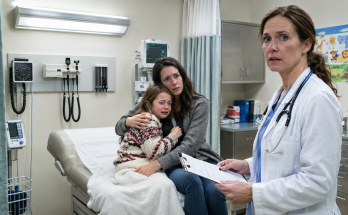
At the hospital, I explained her symptoms to the medical staff.
I tried to keep my voice calm.
I answered the questions I could answer.
Chloe stayed close to me.
Her little hand kept reaching for mine.
The staff treated her gently.
They explained what they were doing.
They made sure she felt as comfortable as possible.
Eventually, Dr. Brooks became involved in her care.
I watched the doctor's expression while she considered Chloe's condition.
Something about her manner changed.
She was still kind.
Still careful.
But I could tell she was taking the situation very seriously.
I began to feel a kind of fear I had never experienced before.
I had brought my child to the hospital hoping someone would tell me she had a treatable medical problem.
Now I was beginning to understand that the questions might be much more difficult.
Dr. Brooks explained that Chloe needed a careful evaluation.
She said the findings and Chloe's words had to be treated seriously.
She also explained that the medical team would follow the appropriate child-protection procedures.
I stared at her.
I wanted her to say there had been a mistake.
I wanted her to tell me that six-year-old children sometimes became frightened over ordinary things.
But she did not say that.
Instead, she spoke about specialists.
Documentation.
Safety.
And the need to involve the proper authorities.
My chest tightened.
I had entered that hospital worried about my daughter's pain.
Now I was afraid that the pain might be connected to something that had happened when I was not there.
I looked toward Chloe.
She was still holding her bunny.
Her face was tired.
She looked so little in that hospital room.
For one terrible moment, I saw every afternoon Nathan had offered to look after her.
Every shopping trip.
Every time I had left them together.
And every time I had thanked him.
I wanted to go backward.
I wanted to return to that Sunday when Chloe had asked me to accompany them to the mall.
I wanted to tell her she could stay home.
But I couldn't change those afternoons.
I could only decide what to do now.
Dr. Brooks told me that the police needed to be involved.
I nodded.
My hands were shaking.
I was frightened of what the doctors might discover.
I was frightened of what the police might ask.
But when I looked at Chloe, one thing finally became clear.
I had spent weeks treating her fear as something she would outgrow.
I was not going to make that mistake again.
Click here to continue reading: PART 2: While My Daughter Waited for a Specialist, My Husband Started Sending Messages That Made Me Afraid to Tell Him Where We Were
I Thought My Daughter Was Just Afraid of Being Apart From Me Until One Evening Made Me Question Everything I Believed
Part 1 of 15