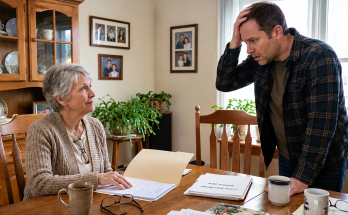
The Thursday after Daniel came to dinner, Brooke sent me a message.
I was making coffee when my phone vibrated.
I glanced at the screen.
Her name appeared.
For a moment, I wondered whether she was finally going to apologize.
I opened the message.
She wanted to know why I'd changed my will.
More specifically, she wanted me to understand how much pain my decision was supposedly causing Daniel.
I read it twice.
Then I placed my phone beside the coffee pot.
I wasn't surprised that she knew I'd been reviewing my estate plans.
Daniel had asked about my will before.
He had probably discussed it with his wife.
That was his choice.
But I hadn't given Brooke permission to turn my legal decisions into another argument.
I poured my coffee.
I took a sip.
Then I looked at the message again.
She hadn't asked what I'd changed.
She hadn't asked why I felt it was necessary.
She had gone straight to Daniel's feelings.
I knew Daniel had been upset.
I'd watched him cry at my kitchen table.
I'd held his hand.
I'd told him I still loved him.
But that conversation had been between us.
Brooke was trying to make me feel responsible for pain caused by decisions that she and Daniel had helped create.
I didn't answer.
There was nothing useful to say.
An hour later, another message arrived.
This time, Brooke described the situation at her house.
Her parents were staying with her and Daniel.
The rooms were crowded.
Everyone was tense.
They had little privacy.
There wasn't enough space.
She reminded me that the entire problem could have been avoided if I'd allowed Gary and Denise to move into my cabin.
I sat down at the kitchen table.
I could picture the crowded house.
Gary trying to find somewhere comfortable to sit with his sore knee.
Denise worrying about money.
Brooke growing frustrated.
Daniel trying to keep everybody calm.
I knew it couldn't be pleasant.
But there was something I couldn't ignore.
They were crowded because Brooke had promised her parents a home she didn't own.
That was the beginning of the problem.
Not my refusal.
I looked at the empty chair across from me.
For years, I would have responded immediately.
I would have apologized for their discomfort.
I would have offered to help find a solution.
Perhaps I would even have reconsidered letting them stay temporarily.
But now I understood where that path led.
I could help someone without handing over my home.
I could feel compassion without accepting responsibility for their choices.
I put down the phone.
I opened my book.
I managed several pages before it vibrated again.
Another message.
This one asked whether I truly intended to leave my own relatives struggling while I remained by myself beside the lake.
I looked up from the screen.
The morning sunlight was coming through the kitchen window.
The coffee was warm.
My table was clear.
For once, I had nothing urgent to do.
And Brooke was describing that peace as something shameful.
As though enjoying my home were a selfish act.
As though every quiet hour I spent here was an hour stolen from someone else.
I felt the old guilt rise.
I knew that feeling.
It arrived before I had time to think.
Someone needed something.
I had more than they did.
Therefore, I was supposed to give.
That was how I'd lived for years.
I had given extra time at school.
I had taken food to neighbors.
I had helped Daniel and Brooke whenever I could.
I had stayed late.
I had shown up.
I had made excuses for people who didn't return the favor.
Most of those choices had come from love.
But somewhere along the way, I'd stopped asking whether I was allowed to have something left for myself.
I looked toward the lake.
I had not bought the cabin to hurt anybody.
I had bought it because I wanted to live here.
I deserved to enjoy it.
That thought still felt strange.
I picked up the phone.
I wrote a short reply.
I told Brooke I hoped her parents would find a stable place to live.
Then I explained that the cabin wasn't available for them to occupy.
I asked her not to arrange anything else involving my property.
I read the message before sending it.
No insults.
No accusations.
No explanation about the rings.
No long defense of how hard I'd worked.
Just a clear boundary.
I pressed send.
Brooke answered almost immediately.
One word.
She couldn't believe me.
I stared at the screen.
Then I put the phone down.
There was nothing more to discuss.
I wasn't going to spend the afternoon proving that I had the right to live in the house I owned.
I washed my mug.
I went outside.
The lake was calm.
The porch boards were warm beneath my feet.
I stood beside the railing and looked toward the dock.
For the first time in days, I didn't feel the need to check my phone.
I went back inside and left it on the kitchen counter.
Brooke didn't contact me again that day.
She didn't contact me the next day either.
Or the day after that.
Eventually, eleven days passed without another message from her.
I expected those days to feel tense.
I thought I would spend them wondering when she would call again.
Instead, something unexpected happened.
I began enjoying the cabin.
Not as a place I needed to defend.
As a place where I could live.
The first thing I did was work on the flowers beside the porch.
I had been thinking about planting something there since I moved in.
I'd kept postponing it.
There was always another errand.
Another family obligation.
Another reason to wait.
Now I had time.
I went outside and worked slowly.
The soil was uneven in places.
I stopped when my back grew tired.
I didn't rush.
I didn't try to finish everything before somebody needed me.
I simply worked until I was ready to stop.
When I stepped back, the flowers looked cheerful beside the wooden steps.
Nothing fancy.
But they made the entrance feel more like mine.
I stood there longer than necessary.
Then I smiled.
I hadn't done something wrong by spending an afternoon making my own home pleasant.
It was such a small realization.
But it mattered.
A few days later, I bought a secondhand kayak from a man in town.
I had never considered myself particularly adventurous.
Robert had been the one who liked trying new things outdoors.
I preferred a comfortable chair and a book.
But every morning, I watched the water.
And every morning, I wondered what it would feel like to paddle across it.
The kayak wasn't new.
That didn't bother me.
Most of the furniture Robert and I bought had been secondhand.
We'd never believed something had to be expensive to be useful.
I brought it home.
I looked at it beside the lake.
Then I laughed at myself.
I had spent more than half my life telling other people to try things they were afraid of.
Now I was nervous about a little boat.
I took my time getting used to it.
I didn't need to prove anything.
I simply wanted to enjoy the water.
That felt like a reasonable thing for a woman my age to want.
I also began walking the path around the lake.
Every morning at seven.
The first day, I left the house while the air was still cool.
I walked slowly.
I listened to the birds.
I noticed which places along the path were shaded.
I came home feeling better than I expected.
The next morning, I went again.
Soon it became something I looked forward to.
A simple routine.
Coffee afterward.
A shower.
Then whatever I wanted to do with the day.
There were no demands.
No complaints.
No messages telling me I was disappointing somebody.
Just the small pleasure of deciding how to spend my own time.
During one of those walks, I met Susan.
She lived two houses down.
She had a dog named Walter.
Walter seemed convinced that every squirrel in Wisconsin was involved in some personal disagreement with him.
The first time I saw him, he was pulling toward a tree.
Susan tried to get his attention.
He ignored her.
I laughed.
She looked embarrassed.
“He's usually better than this.”
Walter immediately proved otherwise.
He lunged toward another squirrel.
Susan sighed.
I laughed again.
We began talking.
It was an easy conversation.
Nothing important.
Just neighbors getting acquainted.
I didn't feel the need to explain my family problems.
I didn't need to tell her about the moving truck.
For a few minutes, I was simply a woman taking a walk beside the lake.
That felt wonderful.
We saw each other again.
And again.
Walter continued his argument with the squirrels.
I began looking forward to seeing them.
Back at the cabin, I started reading more.
I'd always loved books.
As a teacher, I'd spent years encouraging children to discover stories.
But somewhere between Robert's illness and the responsibilities that followed, I'd stopped reading for pleasure as often as I wanted.
Now I had time.
I finished one book.
Then another.
Then a third.
Sometimes I read on the porch.
Sometimes I sat in the chair beside the window.
I could hear the water from there.
I liked that.
I liked being able to close a book when I wanted.
Or keep reading late because nobody needed anything from me.
I began cooking smaller meals.
That was another change.
For years, I'd cooked as though someone might arrive unexpectedly.
I made extra.
I saved portions.
I worried about whether there would be enough.
Now I prepared what I wanted for one evening.
Sometimes it was soup.
Sometimes a sandwich.
Sometimes something simple with vegetables.
I ate when I was hungry.
I washed my plate.
Then I was finished.
It was ordinary.
And it felt like freedom.
I took naps too.
That surprised me.
I'd always believed sleeping during the afternoon was something people did when they had nothing useful to accomplish.
Robert used to tell me I worked too hard.
I'd tell him there were things to do.
Now I sometimes lay down for a while simply because I felt tired.
When I woke up, the world hadn't fallen apart.
Nobody was waiting to accuse me of wasting time.
I began to understand how much pressure I'd been carrying.
Not because anyone had ordered me to work every minute.
Because I'd spent years believing I was valuable only when I was useful.
That belief had followed me through marriage.
Through motherhood.
Through teaching.
Through widowhood.
I had been proud of how much I could do for people.
I still wanted to be generous.
But I was starting to enjoy being a person who didn't always have to give something away.
Every evening, I sat on the porch.
The lake changed color as the sun went down.
Some nights it looked silver.
Other evenings it looked darker.
I watched the reflections near the dock.
I listened to the trees.
Sometimes I thought about Robert.
I missed him.
I always would.
But the grief felt different here.
At the apartment, his absence had made every room feel empty.
At the cabin, I could look at the lake and remember something we'd wanted together.
I felt closer to him in a way I hadn't expected.
I kept his notebooks in the drawer.
Occasionally, I opened one.
I liked seeing his handwriting.
I liked remembering how carefully he'd planned things.
The cabin had been one of those plans.
He hadn't lived long enough to make it happen.
But I had.
That mattered.
One Saturday, Marilyn came over.
She was carrying a bowl of tomatoes.
I opened the door and smiled.
“Those look wonderful.”
She made a face.
“They're not as good as they look.”
I laughed.
She insisted they had very little flavor.
I told her I would take them anyway.
She came onto the porch.
I brought out coffee.
We sat beside the railing.
For a while, we talked about ordinary things.
The weather.
The lake.
Her garden.
Then Marilyn looked toward the driveway.
“I've been thinking about that morning.”
I knew which morning she meant.
The truck.
The furniture.
Brooke standing on my porch.
Daniel looking everywhere except at me.
I rested my mug against my knee.
“So have I.”
Marilyn shook her head.
“I don't think I would have stayed as calm as you did.”
I gave a small laugh.
“I wasn't calm afterward.”
She looked at me.
“No?”
“I cried more than once.”
Marilyn nodded.
“That doesn't surprise me.”
I looked down.
For some reason, I felt embarrassed admitting it.
I'd wanted to seem strong.
Marilyn took another sip of coffee.
“Crying afterward doesn't change what you did.”
I considered that.
She was right.
I had been frightened.
I had been hurt.
I'd doubted myself.
But I hadn't given in.
For most of my life, I'd treated confidence as the absence of fear.
Now I was learning that sometimes you could be frightened and still make the right decision.
Marilyn looked across the lake.
“People get used to older women making everything easy.”
I smiled faintly.
“I've noticed.”
She turned toward me.
“After a while, they stop asking what you want.”
I thought about Brooke.
She hadn't even tried to ask.
She'd skipped straight to arranging the move.
Marilyn continued.
“Sometimes they think being tired means you've agreed.”
I looked at her.
That was exactly what had happened.
Brooke had expected me to become exhausted by the argument.
Then she expected me to surrender.
She hadn't imagined that I might stay uncomfortable long enough to protect myself.
I told Marilyn that.
She nodded.
“Well, you didn't.”
We sat quietly for a moment.
I looked at the bowl of tomatoes.
Then I started laughing.
Marilyn glanced at me.
“What?”
“Nothing. I was just thinking that we're having a very serious conversation over tomatoes you don't even like.”
She laughed too.
I laughed harder.
It felt good.
A real laugh.
Not the polite kind I'd used at family gatherings when someone made a joke I didn't enjoy.
The kind that arrived without warning.
Marilyn shook her head.
“Take the tomatoes anyway.”
“I will.”
When she left, I carried the bowl inside.
I wrote down what she'd said about people confusing exhaustion with agreement.
I didn't want to forget it.
That sentence explained something I'd struggled to understand for years.
Being tired didn't mean I had accepted someone else's decision.
Being quiet didn't mean I had given permission.
And being kind didn't mean I had no limits.
I placed the note in the kitchen drawer.
Then I went back outside.
The afternoon was warm.
I sat on the dock with a fishing rod.
I had no idea what I was doing.
Robert would have laughed at me.
I imagined him standing nearby, offering instructions I would probably ignore.
I smiled at the thought.
The line sat in the water.
Nothing happened.
I waited.
Still nothing.
I began to suspect the fish were more sensible than I was.
Then my phone vibrated.
I reached into my pocket.
Brooke.
I stared at her name.
Eleven days had passed.
No apology.
No conversation.
No attempt to understand why I'd refused her parents.
Now she was calling.
I considered letting it ring.
But I didn't want to spend my days avoiding her either.
I wanted to be able to speak to my daughter-in-law without surrendering my peace.
I answered.
“Hello, Brooke.”
Her voice was unusually careful.
“Quinn, do you have a minute?”
I looked at the fishing line.
“I do.”
She paused.
“I think we should talk about everything.”
I waited.
She sighed.
“I don't like how things have been between us.”
“Neither do I.”
“I want us to get past what happened.”
I reeled in the line.
There was nothing on the hook.
I wasn't surprised.
I set the rod beside me.
“I'm listening.”
Brooke took a breath.
“I know that Saturday became a mess.”
I looked toward the cabin.
It was such a careful way to describe what she'd done.
A mess.
As though the moving truck had arrived by accident.
As though the boxes had carried themselves inside.
As though nobody had deliberately avoided asking me.
I kept my voice steady.
“You made arrangements for your parents without my approval.”
She hesitated.
“I know you were upset.”
I closed my eyes briefly.
She was describing my reaction again.
Not her decision.
I wanted to hear her acknowledge what she had done.
Not explain how I'd felt about it.
“Brooke, I don't want to argue about whether I had a reason to refuse.”
She sighed.
“I'm trying to make things better.”
“Then tell me what you're sorry for.”
The line went quiet.
I could hear her breathing.
Finally, she began talking about Gary and Denise.
They were still struggling.
Their living situation was difficult.
Gary's income hadn't recovered.
Denise was worried about her expenses.
Brooke and Daniel didn't have enough room for everyone.
I listened.
I knew their problems were real.
I had never doubted that.
But I also knew those problems hadn't given Brooke permission to make promises about my home.
She continued.
“I thought the cabin would solve a lot of problems.”
“For whom?”
She hesitated.
“For all of us.”
I looked at the water.
“Did you think about whether it would create problems for me?”
She was quiet.
Then she said, “I didn't expect you to be so against it.”
I considered that answer.
It wasn't entirely true.
She had expected resistance.
She'd told her parents that much.
What she hadn't expected was for my refusal to remain a refusal.
I asked her directly.
“Did you really believe I'd be happy about the move?”
There was a long pause.
Then Brooke gave an answer I hadn't expected her to admit.
“Not at first.”
I waited.
She continued.
“I thought you'd be annoyed for a while.”
“And then?”
She sighed.
“I thought you'd understand why we needed to do it.”
I looked toward the porch.
The flowers were growing beside the steps.
The house looked peaceful.
I'd spent eleven days learning how to enjoy that peace.
Now Brooke was admitting that she'd expected to take it away and wait for me to stop objecting.
I didn't feel angry in the same way I had before.
I felt clearer.
She hadn't misunderstood my wishes.
She had planned around them.
I took a breath.
“Brooke, you don't get to decide that someone will eventually accept something.”
“I know.”
I waited for more.
She didn't offer it.
Instead, she said she didn't want bitterness between us.
I understood that.
I didn't want bitterness either.
Brooke was married to my only child.
I wanted family gatherings to be pleasant.
I wanted Daniel to feel comfortable visiting me.
I wanted to be able to see Brooke without remembering the moving truck every time.
But I couldn't repair the relationship by pretending nothing had happened.
“I don't want us fighting,” I said.
She sounded relieved.
“Good. Neither do I.”
I could hear something changing in her voice.
A little confidence returning.
She seemed to believe the difficult part was over.
Then she spoke again.
“Maybe there's still something you could do to make things easier for us.”
I looked at my fishing rod.
Then at the lake.
I had been hoping to hear an apology.
Instead, Brooke had arrived at another request.
I didn't answer immediately.
For eleven days, I'd lived without trying to solve her problems.
I'd planted flowers.
I'd walked by the lake.
I'd met Susan and Walter.
I'd laughed with Marilyn.
I'd remembered what it felt like to choose things for myself.
Now my daughter-in-law wanted me to help again.
I wasn't opposed to helping people.
I never had been.
But I needed to understand what she was asking before I agreed to anything.
I rested the phone against my ear.
“What kind of help are you talking about, Brooke?”
And this time, I was prepared to listen without promising a thing.
Click here to continue reading: PART 9: When Brooke Asked Me for One More Favor, I Finally Understood Why Our Family Conversations Always Ended With Me Giving Something Up
I Stood Outside My Own Lake Cabin While My Daughter-in-Law Explained Why Her Parents Had More Right to Stay Than I Did
Part 8 of 15