PART 2
“Judge Thorne,” I said quietly, “this is Assistant Attorney General Elena Vance. I need an emergency protective order tonight.”
There was a brief silence on the other end.
Then his voice sharpened.
“Who is the victim?”
I looked down at my mother.
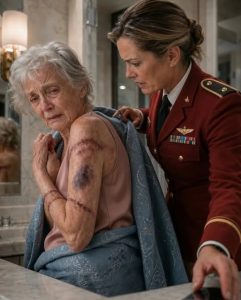
She sat on the closed toilet seat with a towel wrapped around her shoulders, her white hair damp at the temples, her hands shaking in her lap. She had survived nearly eight decades of life, poverty, widowhood, grief, and illness. But what my brother and his wife had done had reduced her voice to a whisper.
“My mother,” I said.
Judge Thorne did not waste time with sympathy.
“Is she in immediate danger?”
“Yes.”
“Evidence?”
“Photographs. Recorded statement. Visible injuries. Financial coercion. Forced isolation. Possible forgery and unlawful restraint.”
His chair creaked through the phone.
“Are the abusers in the home now?”
“Yes.”
“Can you remove her safely?”
I glanced toward the locked bathroom door. Downstairs, I could hear Chloe laughing too loudly at something on television. Julian’s footsteps crossed the kitchen floor, slow and heavy, as if he owned every inch of the house.
“No,” I said. “Not without help.”
“I’ll wake the clerk. Send me the documentation now. I’ll contact the duty magistrate and the sheriff’s office.”
“Thank you.”
“Elena,” he added, his voice lower. “Do not confront them alone.”
I looked at the bruises blooming across my mother’s skin.
“I won’t.”
But the truth was, some confrontations had already begun long before anyone raised their voice.
I sent the files with steady fingers. Every photograph. Every recorded answer. Every trembling sentence my mother had managed to speak while the shower water roared against the tile.
When I finished, I knelt in front of her.
“Mom,” I whispered, “listen to me. I need you to be brave for a little while longer.”
Her eyes filled again.
“They’ll be angry.”
“They will.”
“They’ll say I’m confused.”
“They can say whatever they want.”
“They’ll say you’re lying because you want my money.”
A cold smile touched my lips.
“Then they picked the wrong daughter.”
She reached for my hand with fingers so thin they felt like paper folded over bone.
“I thought you forgot me.”
The words broke something in me.
Not loudly. Not dramatically. Something deeper than anger cracked open in a place I had kept carefully sealed for years.
I had always been the one who left.
That was what Julian loved to say.
Elena left for law school. Elena left for the city. Elena left Mom with responsibilities. Elena sent checks but never stayed. Elena knew how to prosecute strangers but not how to sit at a kitchen table and listen to an old woman repeat the same story twice.
Some of it had been true.
Work was easier than family. Cases had facts. Trials had rules. Evidence spoke more clearly than resentment. My brother, on the other hand, had learned long ago how to turn every family conversation into a courtroom where he was the grieving son and I was the absent daughter.
But absence was not the same as abandonment.
And now I understood why his voice had grown so soft, so concerned, whenever he told me Mom was “getting worse.”
He had been building a cage with words.
A knock struck the bathroom door.
Three hard raps.
“Elena?” Julian called. “Everything all right in there?”
My mother’s nails dug into my hand.
I rose and forced my face into calmness.
“She’s fine,” I called back. “She just needs a few minutes.”
“She doesn’t like locked doors.”
His voice was closer now.
I looked at the small brass lock. Fragile. Cheap. Useless if he put his shoulder into it.
“She asked for privacy,” I said.
A pause.
Then Chloe’s voice floated from the hallway, sugary and sharp.
“That’s new.”
My mother began to tremble again.
I stepped close to the door.
“I said she needs a few minutes.”
Julian laughed once.
It was not a pleasant sound.
“You come here for one afternoon and suddenly you know what she needs?”
Behind me, Mom shook her head, silently pleading.
Not yet, her face said.
Please, not yet.
I unlocked the door and opened it only wide enough to slip through. Julian stood inches away, his broad shoulders blocking the hall. He had our father’s dark eyes but none of his warmth. Chloe leaned against the wall beside him, arms crossed, diamonds glittering at her throat.
“You’re being dramatic,” Julian said.
“Am I?”
“You always are when it comes to Mom.”
Chloe tilted her head and studied my face. She was better at reading people than Julian. That made her more dangerous.
“Where’s her coat?” she asked.
“In the bathroom.”
“She gets cold.”
“The house is seventy-six degrees.”
“She feels cold,” Chloe corrected. “Elderly people do.”
Julian tried to look past me.
I shifted, blocking his view.
His expression changed then. Not much. Just enough.
A flicker.
Suspicion.
“What did she say to you?” he asked.
I gave him the same expression I used with hostile witnesses who mistook my silence for uncertainty.
“She said she’s tired.”
“That’s all?”
“For now.”
Chloe uncrossed her arms.
“Elena, I know you’re used to intimidating people in court, but this is our home.”
“No,” I said. “It’s Mom’s home.”
The hallway went quiet.
Julian’s jaw tightened.
“Legally, I manage the property.”
“Managing something doesn’t make it yours.”
His face darkened, but Chloe placed a hand on his arm.
“Let’s not fight,” she said sweetly. “It’s her birthday.”
Her smile widened.
“We bought a cake.”
The next twenty minutes stretched like wire.
I helped Mom dress in a soft blouse and loose pants, careful not to touch the worst bruises. She flinched anyway, apologizing each time as if pain were a personal failure.
Downstairs, the dining room had been staged like a photograph.
A white cake sat in the center of the table. Candles waited unlit. Three wrapped boxes stood beside it, all decorated with silver ribbon. Chloe had even placed fresh flowers in a vase.
Anyone walking in would have seen devotion.
The dutiful son.
The patient daughter-in-law.
The confused elderly mother.
The visiting daughter who had arrived with suspicion and city clothes.
Chloe had crafted the scene beautifully.
I almost admired her.
Almost.
“Sit here, Mom,” Julian said, pulling out the chair at the head of the table.
My mother froze.
Not from confusion.
Recognition.
Fear.
I noticed what I had missed earlier: faint scratches on the chair arms, tiny grooves along the underside where rope might have rubbed against polished wood.
“No,” I said. “She’ll sit beside me.”
Julian stared at me.
“She always sits there.”
“Not tonight.”
Chloe’s smile finally slipped.
“You know, Elena, this sudden protectiveness is insulting.”
I helped Mom into the chair beside mine.
“Is it?”
“We’ve been here every day,” Chloe said. “Every meal. Every appointment. Every tantrum. Every accident. Do you know what it’s like when she screams at midnight because she thinks your father is alive? Do you know what it’s like to clean up after her? To have no life because someone else won’t put her in a home where she belongs?”
Mom lowered her head.
I looked at Chloe.
There it was.
Not exhaustion.
Not caregiver burnout.
Resentment sharpened into entitlement.
Julian lit the candles.
“Enough,” he said. “Let’s just have cake.”
He sang first. Chloe joined in. Their voices filled the dining room with a cheerfulness so false it seemed obscene.
My mother did not sing.
Neither did I.
When the song ended, Julian leaned toward her.
“Make a wish, Mom.”
She stared at the flames.
For one terrible second, I thought she would crumble. That she would retreat into the frightened silence they had trained into her.
Then she inhaled.
It was small. Uneven. Barely audible.
But she blew out every candle.
The doorbell rang.
Chloe’s head snapped toward the foyer.
Julian frowned.
“Who the hell is that?”
I folded my hands on the table.
“Maybe someone bringing birthday wishes.”
He stood.
I stood too.
“No,” he said. “Stay with Mom.”
“I think I’ll come.”
He turned slowly.
“Elena.”
There was warning in my name.
Then the doorbell rang again.
Longer this time.
Julian marched to the foyer. Chloe followed, suddenly pale beneath her makeup. I stayed where I was, one hand resting on Mom’s shoulder.
The front door opened.
A man’s voice said, “Julian Vance?”
“Yes?”
“I’m Sheriff Daniel Price. We have an emergency protective order for Margaret Vance.”
Silence.
Then Chloe laughed.
Not convincingly.
“I’m sorry, what?”
Two deputies stepped inside behind Sheriff Price. Judge Thorne had moved faster than I expected.
Julian’s voice rose.
“There must be some mistake.”
“No mistake,” Sheriff Price said. “Mrs. Vance is to be removed from this residence immediately and placed under temporary protective care pending investigation.”
Chloe appeared in the dining room doorway first. Her face had transformed completely. The impatient smile was gone. In its place was something raw and hard.
“You did this,” she said.
I helped my mother stand.
“Yes.”
Julian came in behind her, holding the papers as if they burned his fingers.
“You have no idea what you’ve done.”
“I have some idea.”
“She’s incompetent,” he snapped. “She doesn’t know what she’s saying half the time.”
Sheriff Price looked at me.
“Mrs. Vance?”
My mother’s knees wavered, but she lifted her chin.
“Yes?”
“Do you wish to leave this house tonight?”
Her eyes moved to Julian.
His face changed instantly.
The anger vanished. His mouth softened. He looked almost wounded.
“Mom,” he said, stepping toward her. “Don’t do this. You know how much we’ve sacrificed. You know Elena doesn’t understand. She’s twisting things.”
Chloe began to cry.
It happened so quickly, so skillfully, I wondered how many times she had practiced it in mirrors.
“We love you,” she whispered. “We only wanted to protect you.”
My mother’s breathing grew shallow.
Julian held out a hand.
“Tell them you’re confused.”
The old command was still there, hidden beneath tenderness.
Tell them.
Obey.
Disappear.
My mother gripped my arm.
Then she looked at Sheriff Price.
“I want to leave,” she said.
The room changed.
Not visibly. The furniture remained. The cake still sat with thin trails of smoke rising from extinguished candles. The flowers still leaned prettily in their vase.
But the house no longer belonged to Julian’s lies.
A deputy escorted Mom upstairs to gather clothes and medication. I followed, refusing to let Chloe near her. Sheriff Price remained with Julian in the dining room, explaining the terms of the order.
Julian was not allowed to contact Mom. Not directly. Not through third parties. Not by phone, email, message, letter, or whispered threat sent through some sympathetic neighbor.
He was also required to surrender any keys to her property.
That was when Chloe lost control.
“This is insane!” she shouted from the foot of the stairs. “We are her caregivers!”
I came down carrying Mom’s small overnight bag.
“No,” I said. “You were her captors.”
Her eyes flashed.
“You smug little prosecutor. You think you can walk in here and steal everything?”
I paused on the staircase.
“Everything?”
She realized the mistake as soon as she said it.
Sheriff Price noticed too.
Julian closed his eyes briefly.
Chloe’s face went white.
I continued down the stairs.
“Interesting word.”
She lunged toward me then, not dramatically enough to look guilty, but quickly enough that one deputy stepped between us.
“I want her out of my house,” Chloe said.
Sheriff Price said, “Ma’am, lower your voice.”
“This is my house!”
“No,” Mom said from behind me.
We all turned.
She stood at the top of the stairs, one hand on the banister, looking smaller than anyone should look in her own home.
“This is my house,” she said.
Chloe stared at her with pure hatred.
For the first time, Mom stared back.
The deputies escorted us outside beneath a violet evening sky.
Neighbors had begun to peek from behind curtains. Of course they had. People always sensed scandal before they sensed suffering.
As Sheriff Price helped Mom into the back of his cruiser, Julian came to the porch.
“Elena,” he called.
I turned.
He stood under the porch light, handsome and furious.
“You really want to destroy this family?”
I looked at him for a long moment.
“No,” I said. “You already did.”
He smiled then.
It was small.
Private.
Ugly.
“You think you know everything?”
Something in his tone made my stomach tighten.
“I know enough.”
“No,” he said. “You know what she told you.”
I walked back toward the porch until only the steps separated us.
“What does that mean?”
Julian leaned down slightly.
“It means you should be careful where you point that righteous little flashlight. Sometimes it shows things you don’t want to see.”
“Is that a threat?”
“It’s advice.”
Sheriff Price called my name.
I stepped back.
Julian’s smile remained.
Behind him, Chloe stood in the doorway, crying again for the benefit of the watching street.
But her eyes were dry.
The hospital examination took three hours.
Three hours of photographs, measurements, questions, signatures, and soft-voiced nurses who had seen too much and still managed tenderness.
Mom answered what she could. When she grew tired, I answered for the record. The doctor documented contusions in different stages of healing, ligature marks consistent with restraint, malnutrition, dehydration, and delayed treatment for a fractured finger that had healed badly.
“She needs rest,” the doctor told me afterward in the hallway. “And she needs to be somewhere they can’t reach her.”
“She will be.”
I meant it.
By midnight, Mom was asleep in a private room with a deputy posted outside.
I stood by the window, looking down at the parking lot lights, when my phone buzzed.
A message from an unknown number.
No words.
Just a photograph.
I opened it.
For a moment, I did not understand what I was seeing.
Then the room seemed to tilt beneath my feet.
It was a copy of a document.
A trust amendment.
Signed six weeks earlier.
Not just by my mother.
By me.
My name was printed beneath a signature that looked almost exactly like mine.
Almost.
The amendment transferred several remaining assets into a private family trust with Julian as controlling trustee—and listed me as having witnessed and consented to the transfer.
I had never seen the document before.
My phone buzzed again.
This time, text appeared.
Careful, sister. You’re already part of it.
I stared at the screen until the words blurred.
Julian had not just stolen from my mother.
He had built a paper trail leading toward me.
Behind me, my mother stirred in her sleep.
“Elena?” she murmured.
I locked the phone and turned.
“I’m here.”
Her eyes opened halfway.
“Don’t let him take the blue box.”
I moved closer.
“What blue box?”
Her gaze drifted, unfocused but urgent.
“Your father’s box,” she whispered. “Behind the wall.”
A chill moved through me.
“What wall, Mom?”
But she was already slipping back into sleep.
“Not Julian,” she breathed. “He must never find it.”
The next morning, I returned to the house with Sheriff Price, two deputies, and a warrant.
Julian and Chloe were gone.
Not hiding upstairs. Not waiting with lawyers. Gone.
Their cars were missing from the driveway. Their closet had been stripped of clothes. Chloe’s jewelry box sat open and empty on the dresser. Julian’s office had been cleared of computers, files, and the locked cabinet he had once claimed contained Mom’s medical records.
But they had left the birthday cake on the dining room table.
Beside it sat a single envelope.
My name was written across the front.
In Julian’s handwriting.
Sheriff Price photographed it before letting me touch it. I opened it with gloved hands.
Inside was one sheet of paper.
On it, Julian had written only seven words.
Ask Mom what happened to Dad.
For several seconds, I could not move.
My father had died nineteen years earlier from a heart attack while repairing the dock at the lake cabin.
That was the story.
That had always been the story.
I turned toward the wall of family photographs lining the hallway.
There we were through the years: Dad holding a fish. Mom in her garden. Julian at graduation. Me in a law school robe. All of us smiling inside frames that had preserved the image of a family better than the family itself ever had.
Sheriff Price watched my face.
“Elena?”
I looked again at Julian’s note.
Then at the house.
Then at the narrow hallway leading toward my parents’ old bedroom.
“What did your mother mean by the blue box?” the sheriff asked.
I did not answer immediately.
Because I had just remembered something.
When I was twelve, I woke one night to voices through the wall.
My father’s voice.
My mother crying.
Julian shouting, though he had only been seventeen.
Then a crash.
The next morning, Dad told me a shelf had fallen.
A week later, he installed new paneling in the bedroom.
Behind the wall.
My pulse slowed.
All these years, I had thought Julian resented me because I left.
Now I wondered if he hated me because I had almost remembered.
I walked to the bedroom.
The deputies followed.
The wallpaper was faded, patterned with pale roses. The room smelled faintly of cedar, dust, and the lavender sachets Mom used to tuck into drawers.
I stood before the wall behind the old wardrobe.
There was no visible seam.
But when I pressed my palm against the paneling, one section gave the slightest hollow sound.
Sheriff Price brought a crowbar from his vehicle.
The first board came loose with a groan.
Then another.
Then the wall opened.
Inside, tucked between studs and wrapped in a yellowed pillowcase, was a small blue metal box.
My father’s initials were scratched into the lid.
R.V.
My hands felt strangely numb as Sheriff Price set it on the bed and opened it.
Inside were photographs.
Documents.
Cassette tapes.
And a sealed letter addressed to me.
My name, written in my father’s hand, reached across nineteen years like a voice from under dark water.
Elena.
I sat on the edge of the bed.
The sheriff said something, but I barely heard him.
I opened the letter.
The paper trembled in my hands.
My dearest Elena,
If you are reading this, then your mother finally found the courage to show you what we hid. I am sorry. I thought I was protecting you. I thought silence would keep this family alive.
I was wrong.
Julian has always known more than he should. And your mother has always feared what he might do with it.
There are things about the night your brother left home that you were too young to understand. There are things about the money, the cabin, and your mother’s injuries that began long before my death.
Most of all, there is something you must know before you trust anyone investigating this.
Your brother did not act alone.
I stopped reading.
A sound escaped me, but it did not feel like my voice.
Sheriff Price stepped closer.
“Elena?”
I looked down at the final line on the page.
It was underlined twice.
Judge Thorne knows everything.
The room went utterly still.
My phone rang.
The name on the screen made my blood turn cold.
Judge Thorne.
For a moment, I simply stared at it while the sound filled my mother’s old bedroom.
Then I answered.
“Elena,” he said warmly. “I heard you went back to the house.”
I looked at the blue box. At my father’s letter. At the sheriff watching me.
Judge Thorne’s voice lowered.
“You found it, didn’t you?”
Outside, a car door slammed.
Then another.
Through the bedroom window, I saw three black SUVs pull up in front of the house.
Men in suits stepped out.
Not deputies.
Not local police.
Judge Thorne sighed softly into my ear.
“You always were too much like your father.”
Down the hall, one of the deputies shouted.
Then the front door burst open.
I folded the letter and slipped it into my jacket pocket.
Sheriff Price drew his weapon.
And for the first time since I had walked into my mother’s house, I understood the truth.
Julian and Chloe were only the surface.
The real cage had been built long before my mother’s bruises.
And the people who built it had judges, signatures, badges, and graves to hide behind.
…If you want to know what happened next, please type “YES” and like for more.
“## PART 3 — **THE JUDGE WHO OPENED THE CAGE**
The moment the front door exploded inward, **everything I thought I knew about justice shattered like glass across my mother’s bedroom floor**.
Sheriff Price raised his weapon, his jaw locked tight. I stood behind him with my father’s letter burning inside my jacket pocket and Judge Thorne’s voice still whispering from my phone.
“Elena,” Thorne said calmly, “put the letter down. You don’t understand what you found.”
I looked out the window at the black SUVs lining the curb. Men in dark suits moved across the lawn with the confidence of people who had never once feared consequences.
“I understand enough,” I said.
A crash echoed downstairs.
One deputy shouted, “Sheriff! They’re coming up!”
My heartbeat slowed in a strange, frightening way. In court, danger was paperwork, testimony, and calculated lies. Here, danger had boots on the stairs.
Sheriff Price glanced at me. “Bathroom window. Now.”
“There’s no fire escape.”
“Then climb.”
I stared at him.
“Elena, your mother is alive because you didn’t hesitate last night. Don’t start now.”
Another crash. A grunt. A body hitting a wall.
I ran.
The bathroom window was painted nearly shut, but desperation made me stronger than patience. I shoved it open with my shoulder, tearing my sleeve on the latch. Cold morning air rushed in. Below, a narrow roof sloped toward the back of the house.
“Elena!” Sheriff Price shouted.
I turned back.
He stood at the bedroom doorway, weapon raised. Behind him, the blue box sat open on the bed, filled with secrets my family had bled to protect.
“Take it,” he said.
I grabbed the box.
Then the hallway erupted.
Two men appeared at the bedroom door. Sheriff Price fired once into the ceiling, not to kill, but to stop them. The sound cracked through the house like thunder.
I climbed through the window with the blue box pressed to my chest.
For one terrible second, my shoe slipped on the shingles. My knees slammed into the roof, pain shooting through my legs. I bit back a scream and slid toward the gutter.
Below me, the backyard spread out in pale winter grass. The old garden shed stood near the fence. Beyond it was the narrow alley Julian and I had used as children when we wanted to sneak out for ice cream.
A face appeared in the bathroom window.
Not Sheriff Price.
One of Thorne’s men.
“Elena!” he barked. “Stop!”
I jumped.
The fall knocked the breath from my lungs. The blue box flew from my arms and landed in the grass with a metallic thud. For a few seconds, I lay there staring at the sky, unable to breathe, unable to move, while memories flashed wildly through my mind: Mom trembling in a towel, Julian smiling on the porch, my father’s handwriting.
Then I heard footsteps pounding inside the house.
I crawled toward the box, grabbed it, and ran.
By the time I reached the alley, sirens began screaming in the distance.
Real sirens.
Not Thorne’s silent black SUVs.
Police.
Maybe Sheriff Price had called backup. Maybe one of the neighbors had finally done something more useful than peek through curtains. I didn’t know. I didn’t stop to find out.
I ran until my lungs burned.
Three blocks away, I ducked behind a closed bakery and opened the blue box with shaking hands.
Inside were cassette tapes, old photographs, bank ledgers, and my father’s letter. Beneath them, tucked in a plastic sleeve, was something I had not noticed before.
A small silver key.
Taped to it was a note in my mother’s handwriting.
**Not the bank. The church.**
I almost laughed from pure shock.
My mother, frail and frightened, had hidden one secret inside another.
My phone buzzed.
Unknown number.
I almost ignored it. Then the screen lit with a message.
**Mom is safe. Do not go to the hospital. They know. — Price**
My knees weakened.
Mom was safe.
For the first time since this nightmare began, I let myself cry.
Only for ten seconds.
Then I wiped my face, stood up, and started walking toward St. Brigid’s Church.
## PART 4 — **THE CONFESSION BENEATH THE ALTAR**
St. Brigid’s looked exactly as it had when I was a child: red brick walls, stained-glass saints, a bell tower that leaned slightly to the left, and heavy wooden doors that smelled of rain and candle smoke.
I had not stepped inside in fifteen years.
The church was empty except for an elderly priest arranging white lilies near the altar. Father Matteo turned when he heard my footsteps. His face changed the moment he saw me.
“Elena Vance,” he whispered. “You found the box.”
I stopped halfway down the aisle.
“You knew?”
His eyes lowered.
“I knew enough to be afraid.”
Anger rose in me, hot and bitter. “Everyone knew enough to be afraid. No one knew enough to help her?”
The priest flinched as if I had struck him.
Then he nodded.
“You are right.”
He led me behind the altar to a small sacristy lined with cabinets and fading robes. In the corner stood an old donation chest with an iron lock. The silver key fit perfectly.
Inside was another bundle.
This one was wrapped in my father’s old navy jacket.
When I unfolded it, I found a videotape, two envelopes, and a stack of photographs that made my blood go cold.
Julian as a teenager, standing beside Judge Thorne.
Chloe, much younger, leaving a courthouse office.
My father arguing with men outside the lake cabin.
And my mother—my beautiful, gentle mother—sitting in a hospital bed with bruises on her face almost twenty years earlier.
Father Matteo crossed himself.
“Your father brought these to me two weeks before he died,” he said. “He said if anything happened to him, I was to keep them until your mother asked for them.”
“Why didn’t you give them to the police?”
“Because the police chief then was Thorne’s cousin. The prosecutor owed Thorne his career. Your father tried once. The evidence disappeared, and the next day Julian came home with blood on his shirt.”
My mouth went dry.
“What happened that night?”
Father Matteo looked toward the crucifix on the wall, not for forgiveness, but perhaps for courage.
“Julian was nineteen when he started gambling. Not cards with friends. Serious debts. Dangerous men. Your father paid once. Then twice. Then he refused. Julian stole from your mother’s accounts. Your father found out.”
He paused.
“The fight at the lake cabin was not between your parents. It was between your father and Julian.”
I gripped the edge of the donation chest.
“Julian killed him?”
“No.”
The answer stunned me.
Father Matteo opened one of the envelopes and handed me a brittle sheet of paper. It was a coroner’s preliminary report. Cause of death: blunt force trauma before drowning.
Not heart attack.
“Then who?”
Father Matteo’s voice dropped to a whisper.
“Chloe.”
The room tilted.
“Chloe wasn’t family then.”
“No. She was Thorne’s assistant. And Julian’s lover.”
My hand tightened around the report.
Father Matteo continued, each word heavier than the last.
“Your father discovered that Judge Thorne was laundering money through guardianships and family trusts. Elderly people declared incompetent. Assets transferred. Cabins, houses, investments sold quietly. Julian became useful to him because he had access to your mother’s finances. Chloe was sent to keep him loyal.”
I thought of Chloe’s diamonds, her polished cruelty, her perfect tears.
“She killed my father?”
“She struck him with an oar during the fight. Julian helped cover it up. Thorne changed the death certificate. Your mother saw enough to know the truth, but she was threatened. She had two children. One dead husband. No allies.”
My throat closed.
“She stayed silent to protect me.”
“And because Thorne told her Julian would go to prison forever if she spoke. A mother’s love can become a lock when evil men learn how to turn it.”
I opened the second envelope.
Inside was a letter from my mother.
Not recent. The handwriting was stronger, steadier.
**Elena, if you are reading this, forgive me. I thought silence would spare you. Instead, it gave them years to sharpen their knives.**
I folded the letter with trembling hands.
Father Matteo placed the videotape on the table.
“This is your father’s last insurance. He recorded Thorne at the cabin two days before he died.”
“How do I play it?”
The priest gave the faintest smile.
“I may be old, but I am not useless.”
He opened a cabinet and pulled out a dusty television with a built-in VCR.
The tape hissed. Static filled the screen.
Then my father appeared.
Younger. Alive. Fierce.
He stood inside the lake cabin, secretly filming through a cracked closet door. Judge Thorne’s voice filled the room.
“Ronald, take the settlement. Walk away. Your son is already ours.”
My father answered, “Julian is weak, not evil.”
Thorne laughed.
“There’s no difference when a weak man wants money.”
Then Chloe stepped into frame.
Young. Beautiful. Cold.
“If Elena learns what Julian did, she’ll destroy him,” she said. “She’s already too smart.”
My father’s voice shook with rage.
“You stay away from my daughter.”
Thorne leaned closer.
“Then keep your wife quiet. Keep your daughter away. And pray your son remains useful.”
The tape cut to static.
I stood motionless.
Father Matteo looked at me.
“Elena, there is more.”
The tape resumed.
This time, my mother was on screen. Younger, crying, hidden somewhere dark.
“If anything happens to Ronald,” she whispered, “Judge Thorne did it. Chloe helped. Julian knows. And my daughter Elena must never come home until she is strong enough to fight them.”
The video ended.
I pressed my hand over my mouth.
All these years, I had thought my mother let distance grow between us because she was lonely, disappointed, perhaps even resentful.
But **she had pushed me away to keep me alive**.
Outside the church, tires screeched.
Father Matteo turned pale.
I grabbed the tape, the letters, and the photographs.
“Is there another exit?”
He nodded toward a narrow staircase.
“The crypt.”
Of course.
In my family, every truth seemed buried beneath something sacred.
## PART 5 — **THE WOMAN WHO PRETENDED TO FORGET**
The crypt tunnel beneath St. Brigid’s led to the old parish school, abandoned since the roof collapsed years ago. Father Matteo walked faster than I expected for a man his age.
At the end of the tunnel, he opened a rusted metal door, and we emerged into a classroom filled with broken desks and dust-covered maps.
A woman was waiting there.
For one wild second, I thought exhaustion had finally broken my mind.
“Mom?”
My mother sat in a wheelchair beside Sheriff Price. She wore a hospital sweater over her thin shoulders, her bruised wrists wrapped in bandages. But her eyes were clear.
Painfully clear.
“Elena,” she said. “I’m sorry.”
I stared at Sheriff Price. “You said she was safe.”
“She is,” he replied. “Safer here than at the hospital. Thorne had two men waiting outside her room dressed as orderlies.”
I looked back at my mother.
“You knew about the church.”
She nodded.
“Not all of it. Enough.”
The room seemed too small for all the secrets crowding it.
“Mom,” I whispered, “did you fake the confusion?”
Her eyes filled with tears.
“Some days I was confused. Fear does that. Hunger does that. Pain does that. But other days…” She swallowed. “Other days I let them think I was worse than I was.”
Sheriff Price placed a folder on an old desk.
“Your mother has been collecting evidence for six months.”
I stared at her.
The fragile woman who had begged me not to remove her coat. The trembling victim. The mother I thought had been completely helpless.
She had been wounded, yes.
Terrified, yes.
But not defeated.
Mom lifted her bandaged hands.
“I couldn’t fight them the way you could. So I listened. Chloe talked on the phone when she thought I was asleep. Julian kept passwords under the drawer. I memorized what I could. I hid notes in books. I moved one document at a time.”
Sheriff Price opened the folder.
Inside were account numbers, names, dates, property transfers, and a list of elderly victims connected to Thorne’s guardianship network.
There were thirteen names.
Thirteen families.
Thirteen stolen lives.
My anger became something colder.
“You built a case.”
Mom gave a small, tired smile.
“I raised a prosecutor.”
I knelt in front of her and took her hands, careful around the bandages.
“You should have told me.”
“I tried. Twice. Julian broke my phone the second time. After that, Chloe slept outside my door.”
The thought of it made my stomach twist.
“I’m so sorry.”
“No,” she said fiercely, with a strength that startled me. “Do not waste grief where action belongs.”
For a moment, she sounded like the mother of my childhood—the woman who once marched into a principal’s office because a teacher mocked my stutter, the woman who taught me to read contracts before birthday cards, the woman who had never been weak until men with power decided weakness was useful to them.
Father Matteo locked the door behind us.
“They followed me to the church,” I said.
Sheriff Price nodded. “Then we move now.”
“Where?”
He hesitated.
Mom answered before he could.
“To your father’s cabin.”
I frowned. “Julian sold it.”
“No,” Mom said. “Julian sold what he thought was the cabin.”
I blinked.
She looked almost pleased.
“Your father placed the land in a separate conservation trust thirty years ago. Julian sold the structure rights to a shell buyer, but not the mineral strip, not the dock access, and not the old boathouse. The boathouse still belongs to me.”
Despite everything, a laugh escaped me.
My mother had been tied to a bed by people who thought she was too confused to understand money, while she had quietly preserved the one place they wanted most.
Sheriff Price smiled. “Mrs. Vance insisted.”
“Mom,” I said, half crying, half laughing, “who are you?”
Her smile faded into something deeper.
“A woman who survived long enough to stop apologizing.”
We left through the back of the school in Father Matteo’s old van.
As we drove out of town, my phone rang again.
This time it was Julian.
I put it on speaker.
“Elena,” he said softly. “You’re making this worse.”
Mom’s hand tightened around mine.
“Where are you, Julian?” I asked.
“Close.”
Chloe’s voice murmured in the background, angry and afraid.
Julian continued, “Thorne is finished if that tape gets out. You know what desperate men do.”
“Do you?”
A pause.
Then he laughed bitterly.
“You still think I’m the monster.”
“You tied Mom to a bed.”
His voice cracked. For the first time, I heard something beneath the arrogance.
“I tied her because Chloe told me Thorne would send people if she kept digging. I hit the wall. Chloe hit her. I signed papers. Chloe forged. I stole, yes. I lied, yes. But you don’t know what they have on me.”
Mom closed her eyes.
“What do they have?” I asked.
Julian’s breathing grew ragged.
“The truth about Dad.”
“We know Chloe killed him.”
Silence.
Then Julian whispered, “No. Chloe struck him. But he was still alive when I left.”
The van seemed to lurch though the road was smooth.
“What?”
“I ran,” Julian said. “I was a coward. Dad was alive. I swear he was alive.”
Chloe shouted something in the background.
Julian’s voice rose. “Shut up! I’m done!”
Then the line crackled.
He spoke quickly.
“Elena, the tape isn’t enough. Thorne has survived worse. You need the ledger. The real one. Chloe kept it because she never trusted him. She’s bringing it to the lake tonight to trade for immunity.”
“Trade with whom?”
Julian’s laugh broke apart.
“With me.”
A sound erupted through the phone.
A gunshot.
Mom screamed.
The call disconnected.
Sheriff Price slammed the accelerator.
The road ahead stretched toward the lake, black and shining under the coming storm.
## PART 6 — **THE LAKE WHERE THE DEAD WAITED**
By dusk, the lake was the color of steel.
Rain moved across the water in silver sheets, and the old boathouse crouched at the shore like something that had been waiting nineteen years to speak.
Sheriff Price parked behind a line of pine trees. Father Matteo stayed with Mom in the van, though she protested until the sheriff gave her a look that even she obeyed.
“Elena,” Mom said before I stepped out.
I turned.
Her face was pale, but her eyes were steady.
“Your brother was many things,” she said. “Greedy. Weak. Cruel when cornered. But he loved your father once.”
I did not know what to do with that.
Love had not stopped Julian from hurting her.
But hatred had become too simple a word for what this family contained.
Sheriff Price and I approached the boathouse through wet grass. The closer we got, the more the past pressed around me.
I remembered being nine years old, running barefoot down this slope.
I remembered Dad teaching me to skip stones.
I remembered Julian laughing as he pushed me into the lake, then diving in after me when I pretended to drown.
I remembered a family before secrets made strangers of us.
The boathouse door was open.
Inside, a lantern burned on a table.
Chloe stood beside it.
Her perfect hair was soaked flat against her face. Her expensive coat was muddy at the hem. In one hand she held a leather ledger. In the other, a gun.
Julian sat slumped against the wall, blood darkening his shoulder.
He was alive.
Barely.
Chloe smiled when she saw me.
“There she is,” she said. “The golden daughter.”
Sheriff Price raised his weapon.
“Drop the gun.”
Chloe laughed. “Sheriff, you have always had such a small-town understanding of power.”
Julian coughed. “Elena… don’t give her the tape.”
I stared at him.
“Why should I believe you?”
His eyes met mine.
For once, there was no performance in them.
“Because I’m dying and I’m tired.”
Chloe rolled her eyes. “He’s not dying. He’s dramatic.”
“You shot him,” I said.
“In the shoulder. Unfortunately.”
Rain hammered the roof.
Chloe lifted the ledger.
“This is what everyone wants. Names. Payments. Judges. Doctors. Bankers. Care homes. Fake competency reports. Your precious Thorne is only one branch on a very old tree.”
“Then give it to me,” I said.
She smiled. “No. You give me the tape. I give you enough to destroy Thorne. Then I disappear.”
“And Julian?”
She glanced at him with mild disgust.
“Julian has been disappearing his whole life.”
He looked away.
Something shifted in me then. Not forgiveness. Not even pity exactly. But recognition. Chloe had used his weakness like Thorne used the law. Julian had chosen badly, again and again, but he had also been chosen by predators who saw the rot before anyone else did.
I stepped forward.
“You killed my father.”
Her smile faded.
“No. Your father killed himself by refusing to be practical.”
Julian whispered, “Chloe.”
She turned on him. “Don’t start confessing now. It’s unattractive.”
He laughed weakly. “You always cared about appearances.”
Chloe pointed the gun at him. “And you always cared about being loved. That made you easy.”
Those words struck harder than the rain.
Julian looked at me.
“I’m sorry,” he said.
I hated that my eyes burned.
“Sorry doesn’t fix Mom’s wrists.”
“No,” he whispered. “But maybe this can.”
His hand moved.
Chloe saw it too late.
Julian kicked the lantern from the table. It crashed to the floor, plunging the boathouse into darkness except for flashes of lightning through the windows.
Sheriff Price lunged.
Chloe fired.
The shot exploded beside my ear.
I dropped to the floor as Julian threw himself at Chloe. They hit the wall together. The ledger flew from her hand and slid across the wet boards toward the open dock.
I crawled after it.
Chloe screamed.
Sheriff Price shouted her name.
Julian groaned.
The ledger tipped over the edge.
I lunged and caught it with both hands as half my body slid onto the rain-slick dock. Below, black water slapped against the pilings.
A hand seized my ankle.
Chloe.
Her face appeared above me, twisted with fury.
“You don’t get to win,” she hissed.
She pulled.
My fingers slipped on the ledger.
Then another hand grabbed my wrist.
Julian.
Bleeding, shaking, teeth clenched, he held me with the last of his strength.
For one impossible second, brother and sister clung to each other above the lake where our father died.
“Elena,” he gasped, “don’t let go.”
“I’m trying.”
“No,” he said, eyes wet with rain or tears. “I mean don’t let go of Mom.”
Chloe raised the gun again.
A shot rang out.
Not hers.
Sheriff Price stood behind her, weapon smoking.
Chloe collapsed onto the dock, the gun skidding into the water.
Silence fell, broken only by rain.
I pulled myself back into the boathouse with the ledger clutched to my chest.
Julian lay on his side, blood spreading beneath him.
I crawled to him.
“You idiot,” I whispered.
He smiled faintly.
“Still bossy.”
“Stay awake.”
“Tell Mom…” His breath hitched. “Tell her I remembered the birthday cake.”
“What?”
His eyes drifted toward the lake.
“She always made lemon cake. Chloe bought vanilla. Mom hated vanilla.”
A sob tore from me unexpectedly.
Julian’s hand twitched toward mine.
I took it.
“I was awful,” he whispered.
“Yes.”
His mouth curved.
“Prosecutor.”
“Julian.”
He looked at me one last time.
“Dad was alive when I left. Thorne came after. Check the dock post.”
Then his eyes closed.
This time, he did not answer when I called his name.
## PART 7 — **THE DOCK POST SECRET**
Julian died before the ambulance reached the lake.
My mother did not cry at first.
When we told her, she sat very still in the van, both bandaged hands folded in her lap. Rain streaked down the windows behind her like the world itself was mourning.
Then she whispered, “My poor boy.”
I wanted to say he didn’t deserve that tenderness.
But I had no right.
A mother can grieve the child she lost long before the man he became.
Sheriff Price secured Chloe in custody. She survived the shot, though she would later claim she had been the victim of a conspiracy led by a corrupt prosecutor, a confused old woman, and a priest with “dramatic tendencies.”
No one believed her for long.
Because the ledger was real.
And it was worse than we imagined.
**Seventeen years of stolen estates. Thirty-one elderly victims. Eight forced competency declarations. Four suspicious deaths. Dozens of forged signatures.**
Doctors had been paid. Bank managers bribed. Lawyers rewarded. Judges promoted.
Judge Thorne’s name appeared everywhere.
But Julian’s final words haunted me.
**Check the dock post.**
The next morning, with crime scene lights still glowing around the boathouse, Sheriff Price pried open the old dock post nearest the water.
Inside was a rusted metal tube.
Inside the tube was a roll of film, a flash drive sealed in plastic, and a small recorder wrapped in oilcloth.
The recorder still worked.
My father’s voice emerged through static.
Breathless. Weak.
“If this is found, I did not drown by accident. Chloe struck me. Julian ran. I don’t blame him. Thorne came after. He offered me one last chance to sign over the evidence. I refused.”
A pause.
Then my father coughed painfully.
“I can hear him outside. Margaret, my love, take Elena away from all of this. Let her hate you if she must. Better hated and alive than loved and buried.”
My mother covered her mouth.
The recording continued.
“And Julian… son, if you ever hear this, you are not beyond saving unless you choose to be.”
The tape clicked.
Then another voice appeared.
Judge Thorne.
“Ronald, you stubborn fool.”
My father said, “It’s over.”
Thorne answered, “No. It’s inherited.”
There was a struggle. A splash. Then silence.
That was the true sound of my father’s death.
Not a heart attack.
Not an accident.
A murder hidden beneath a signature.
Mom broke then.
Not loudly.
She folded forward, and a sound came out of her so old and wounded that Father Matteo wept openly beside her.
I held her as she cried for my father, for Julian, for nineteen stolen years, and perhaps for the woman she had been before fear taught her to whisper.
The arrests began before sunset.
Judge Thorne was taken from his chambers in front of a courtroom full of attorneys who had once bowed their heads when he entered. He did not look frightened. Men like Thorne rarely believe the ground can open beneath them until they are already falling.
But when he saw me standing beside federal agents, holding my father’s recorder, his face changed.
Only slightly.
Enough.
“Elena,” he said, “you have no idea what forces you’re provoking.”
I stepped close.
“No, Judge. You have no idea what daughter you failed to bury.”
The trial lasted nine months.
My mother testified for three days.
Sometimes her voice shook. Sometimes she forgot a date. Once, she cried so hard the judge called recess. But every time Thorne’s attorney suggested she was confused, Mom lifted her chin and corrected him with devastating precision.
“No,” she said once, staring directly at the jury. “I was not confused when my son tied my wrists. I was afraid. Men often mistake women’s fear for weakness because it comforts them.”
That line ran in every newspaper the next morning.
Chloe testified too, but only after accepting a deal that collapsed the moment prosecutors proved she had lied about three separate deaths. She tried to blame Julian for everything. Then the dock recording played.
For the first time, Chloe stopped smiling.
Thorne’s conviction came on a gray Thursday afternoon.
Guilty.
Guilty.
Guilty.
The words landed one by one until the empire he built out of silence lay in ruins.
I looked at Mom.
She was crying.
But she was also smiling.
For a moment, I thought that was the happy ending.
I was wrong.
The real surprise came two weeks later, when my mother invited me to the lake.
## PART 8 — **THE HOUSE THAT LOVE BUILT AGAIN**
Spring arrived slowly that year, as if even the earth needed time to trust warmth again.
The lake cabin was gone. Julian’s fraudulent sale had transferred the structure to a shell company, and after the investigation, it was condemned and torn down. Only the old boathouse remained, repaired and painted white, standing beside the water like a survivor with fresh scars.
Mom waited for me on the dock in a blue cardigan.
She had gained weight. Not much, but enough that her cheeks looked softer. Her wrists were still marked faintly, and perhaps always would be. But she no longer hid them.
When I reached her, she took my hand.
“I have something to show you.”
“Please tell me it isn’t another secret box.”
She smiled. “No. I am done hiding things in boxes.”
She led me up the hill.
Where the old cabin had stood, a construction crew was raising the frame of a new building.
Large windows faced the lake. A wide porch wrapped around the front. The foundation had already been poured, and wooden beams reached upward into the bright sky.
I stared.
“Mom… what is this?”
Her smile trembled.
“A home.”
“For you?”
“For us, sometimes.” She squeezed my hand. “But mostly for women like me.”
I turned to her.
She looked at the half-built house with quiet pride.
“I sold the remaining assets Thorne didn’t touch. The recovered money will take years to untangle, but I had enough. Father Matteo helped. Sheriff Price bullied three contractors into donating labor. The families from the case contributed what they could.”
I could barely speak.
“What kind of home?”
“A temporary refuge,” she said. “For elderly people trapped by relatives, guardians, caregivers, anyone who thinks age makes a person easy to erase.”
The wind moved through the wooden frame, carrying the smell of pine and fresh sawdust.
Mom’s eyes shone.
“I want to call it Ronald House.”
My father’s name moved through me like light through stained glass.
“He would love that.”
“I hope so.”
We stood in silence for a while.
Then she said, “There is one more thing.”
I groaned softly. “Mom.”
“This one is good.”
She led me to the edge of the porch foundation, where a small table had been set beneath a tarp. On it sat a lemon cake.
Not vanilla.
Lemon.
Beside it was a photograph of Julian as a boy, grinning with frosting on his nose.
I froze.
Mom touched the frame gently.
“I am not excusing what he did,” she said. “I never will. But I cannot build a house for healing while pretending grief is tidy.”
My eyes filled.
“He hurt you.”
“Yes.”
“You still love him.”
“Yes.”
Both truths stood between us, neither canceling the other.
“I hated him,” I whispered.
“I know.”
“I still do sometimes.”
“I know that too.”
She cut two slices of cake with careful hands.
“Your brother saved you at the lake.”
“He also helped destroy us.”
“Yes,” she said. “People can be more than the worst thing they did, and still be responsible for it.”
I looked at Julian’s photograph.
The boy in it had not yet become the man who frightened our mother. The man at the end had not become innocent. But he had used his final breath to point us toward the truth.
That did not redeem everything.
But it changed the shape of the ending.
A car drove up the hill.
Sheriff Price stepped out, carrying a folder and looking deeply uncomfortable in a suit.
Mom’s expression became suspiciously innocent.
“What’s this?” I asked.
Sheriff Price cleared his throat.
“Mrs. Vance asked me to deliver paperwork.”
“Paperwork,” I repeated.
Mom handed me the folder.
Inside was a deed.
Not to the refuge.
To the old boathouse.
Transferred to me.
My throat tightened.
“Mom, I don’t need—”
“Yes,” she said firmly. “You do. Not because of money. Because you need a place to come back to that isn’t made of guilt.”
I stared at the water.
For years, I had thought home was something I escaped. Then something I failed. Then something broken beyond repair.
Now my mother was giving me a piece of it back.
Sheriff Price stepped away to give us privacy, but Mom called after him.
“Daniel, don’t pretend you’re not part of this.”
He stopped.
I looked between them.
Mom suddenly became very interested in the cake.
“Mom.”
“What?”
“Why is Sheriff Price blushing?”
“I am not,” he said immediately.
He absolutely was.
For the first time in months, I laughed so hard I had to sit down on the porch frame.
Mom smiled like a woman who had survived hell and still found mischief waiting on the other side.
“Your father told me once that love after sorrow is not betrayal,” she said softly. “It is proof sorrow did not win.”
Sheriff Price looked at the lake, then at her.
“I asked your mother to have dinner with me,” he said.
“And I said yes,” Mom added. “Before you start prosecuting either of us.”
I raised both hands.
“No objection.”
The three of us ate lemon cake beneath the skeleton of a house that had not yet learned its own strength.
Months later, Ronald House opened its doors.
The first resident was a retired schoolteacher whose nephew had stolen her pension. The second was a widower whose caregiver had been drugging him. The third was a woman who cried when Mom placed a warm blanket around her shoulders and said, “You are believed here.”
Those words became the motto above the entrance.
**YOU ARE BELIEVED HERE.**
My mother became the heart of the place.
Not because she was unbroken.
Because she was broken in places where light now entered.
I visited every weekend at first. Then more often. Eventually, I moved my office closer to the county courthouse and accepted a new role leading a statewide elder justice task force.
One afternoon, nearly a year after the night I found the bruises beneath Mom’s coat, I stood on the dock outside my boathouse and watched her teach a group of residents how to plant lavender.
Sheriff Price carried soil bags badly.
Father Matteo supervised as if gardening were a holy sacrament.
Mom laughed when the wind stole her hat.
And for the first time in nineteen years, the lake did not feel haunted.
It felt alive.
That evening, Mom and I sat together on the porch of Ronald House while sunset turned the water gold.
“I used to think survival meant making it to the next morning,” she said.
“What does it mean now?”
She leaned her head against my shoulder.
“It means choosing what the morning is for.”
I held her hand.
The bruises were gone.
The scars remained.
But her hand was warm, steady, and very much alive.
Behind us, Ronald House glowed with lamplight. Inside, people who had been silenced were telling stories over dinner. Some cried. Some laughed. Some simply sat in peace, relearning safety one breath at a time.
My phone buzzed.
For a moment, fear returned by instinct.
Then I saw the message.
It was from the state attorney general.
**Thorne’s appeals denied. Chloe sentenced. Final restitution approved. Call me Monday. We have funding for five more houses.**
I showed Mom.
She read it once.
Then again.
Then she covered her mouth, and her eyes filled with tears.
“Five more?” she whispered.
“Five more.”
She looked toward the lake, where the last light of day shimmered like a path across the water.
My mother, who had once begged me not to remove her coat, stood slowly.
Her shoulders were still narrow. Her body still bore history. But she lifted her face to the evening sky with such quiet power that I knew Julian, Chloe, Thorne, and every person who had tried to erase her had failed completely.
She was not a victim in the final chapter.
She was the author of what came next.
“Elena,” she said, smiling through tears, “we’re going to need more lemon cake.”
And as laughter rose from the house behind us, warm and bright and impossible to steal, I finally understood the truth my father had died trying to protect:
**A family can be ruined by secrets, but it can also be rebuilt by courage.**
Not perfectly.
Not painlessly.
But beautifully.
The end.