My key slid into the lock.
It would not turn.
For three full seconds, I stood motionless in the second-floor corridor of my apartment building, still wearing steel-toed boots and the navy work shirt from the manufacturing plant.
Then I heard laughter behind the door.
Not television laughter.
Not neighbors.
My sister.
“Put those in the bigger bedroom,” Emily called from inside. “Daniel barely owns anything.”
Something cold moved through my stomach.
Unit 214 was mine.
My first home.
The place I had worked double shifts, weekends, holidays, and fourteen-hour days to afford.
I pushed against the door.
It opened several inches.
A rubber stopper had been jammed underneath it.
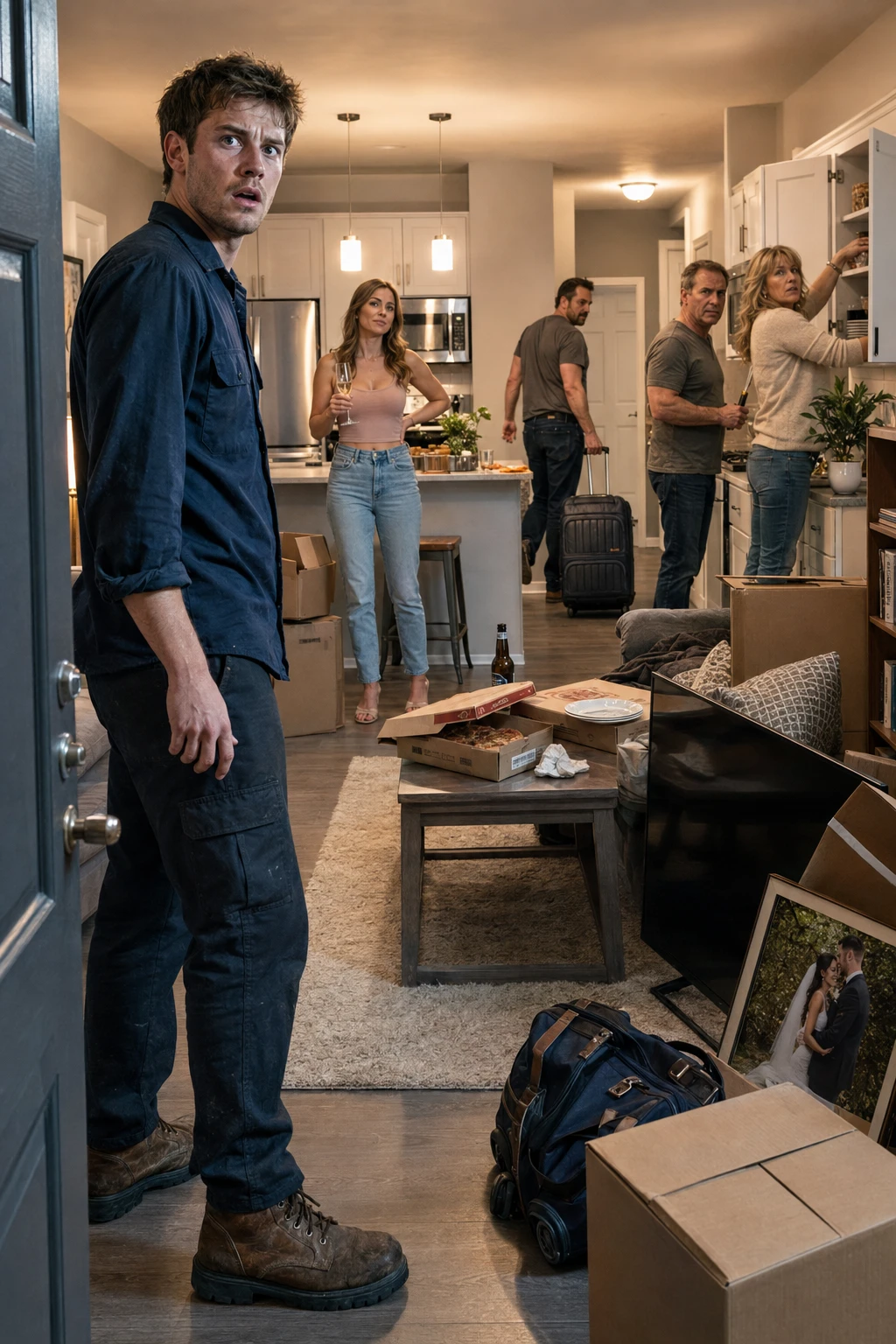
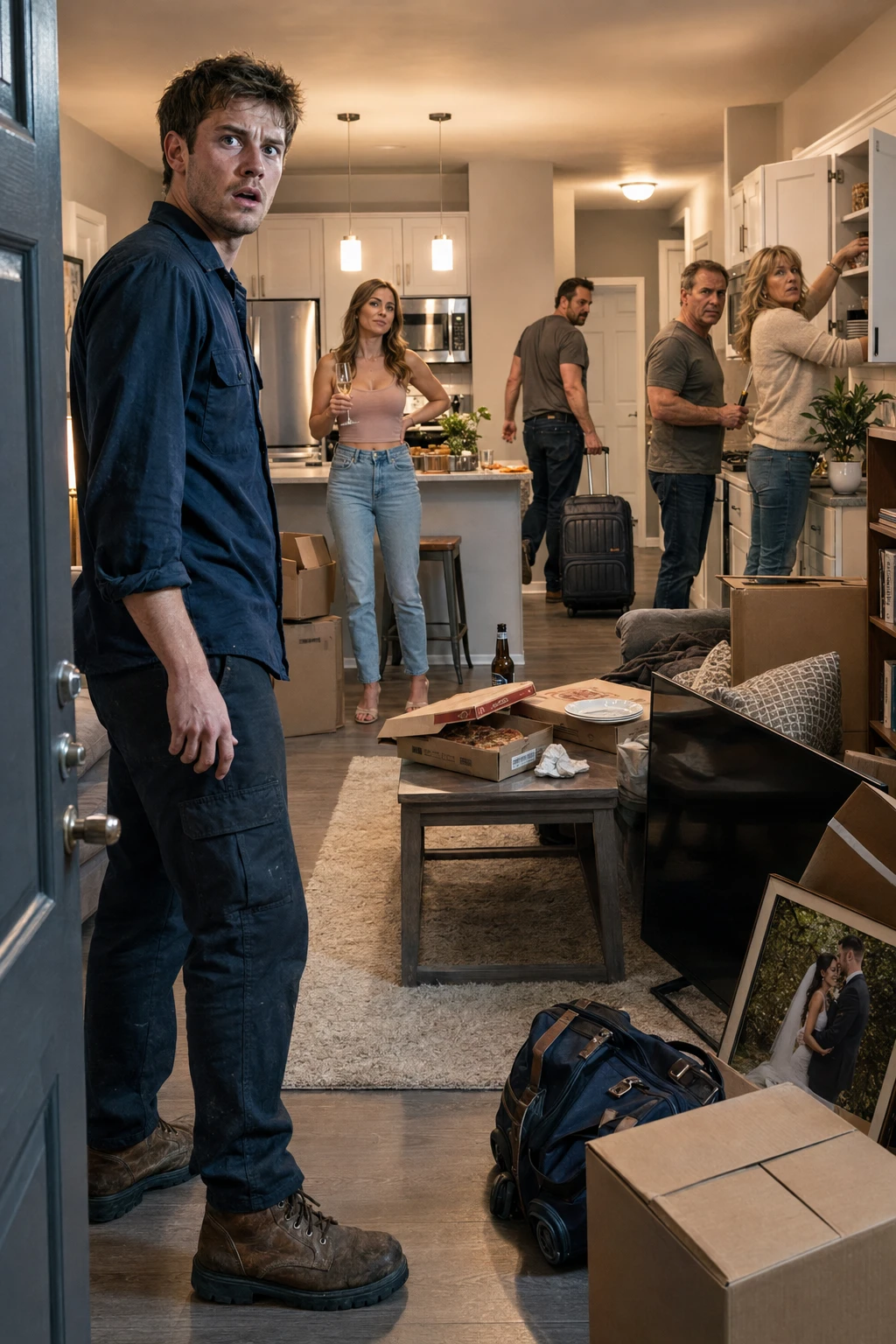
And the apartment beyond looked as if someone had invaded it during a garage sale.
Boxes were stacked beside the couch.
Pizza cartons covered my coffee table.
A second television sat beside mine.
A framed wedding photograph of Emily and her husband, Luke, leaned casually against my bookshelf.
Emily stood at my kitchen island holding sparkling wine.
Luke dragged a suitcase toward the hallway.
Mom was rearranging my dishes.
Dad stood beside the counter with a screwdriver.
Emily saw me first.
“There he is.”
I stared at them.
“What are you doing?”
She smiled.
“We wanted it to be a surprise.”
“A surprise for what?”
“Our move.”
Luke shut off the music.
Emily gestured toward the second bedroom.
“You have two bedrooms. You only use one. We need more privacy.”
I looked at Dad.
“How did you get inside?”
His jaw tightened.
“Don’t start with accusations.”
“My key doesn’t work.”
Silence.
Then he said, “We changed the lock.”
I saw the original deadbolt sitting on top of a box.
Deep metal scratches covered it.
“You changed the lock on my home?”
“There was no other way to enter.”
“That was the point of the lock.”
Mom rolled her eyes.
“Daniel, don’t turn this into some huge drama.”
I stared at her.
“You entered my home while I was at work.”
“Your sister needs space.”
“She has a bedroom at your house.”
“She’s married now.”
Emily crossed her arms.
“We’ll pay rent.”
“How much?”
“Three hundred dollars.”
My monthly housing costs were nearly seven times that.
“No.”
She blinked.
“No?”
“You’re not living here.”
Her expression changed from surprise to offense.
“You haven’t even thought about it.”
“I thought about how I wanted to use this apartment before I bought it.”
Emily laughed sharply.
“You lived in a camper for over a year. Don’t pretend you suddenly care about luxury.”
The room disappeared for a moment.
I could smell rain.
Diesel.
Cold asphalt.
The inside of that camper.
During the shutdown year, I lost two jobs within three weeks.
I had asked my parents for one thing.
Not money.
Not food.
Not a room.
I asked if I could park my camper in their driveway until I got back on my feet.
Dad said the driveway was not a charity lot.
Mom said the camper would embarrass them in front of neighbors.
Emily laughed while Luke photographed it.
For months, I slept behind grocery stores, warehouses, and industrial parks.
Then the owner of a manufacturing company named Raymond Walsh found me sleeping behind his facility.
He knocked on the camper door at six one morning.
“You looking for work?”
“Yes.”
“Can you run a press?”
“I can learn.”
He studied me.
“Can you show up tomorrow at five?”
“I can show up today.”
He laughed.
I started that morning.
I took every shift they gave me.
I became line leader.
Then supervisor.
I saved until my fingers hurt from signing overtime sheets.
Not one member of my family helped me buy Unit 214.
So I looked at Emily and said, “I lived in that camper because I had nowhere else.”
“And now you do,” she replied. “So help us.”
Luke appeared from the hallway.
“We already carried everything upstairs.”
“That was your decision.”
Dad finally stepped forward.
“You have always been more capable than your sister.”
“That doesn’t make me responsible for providing her a home.”
“Families share.”
I looked directly at him.
“Did you share your driveway?”
The room went silent.
Mom looked away.
“That was different.”
“Everything is different when Emily wants something.”
Tears immediately appeared in Emily’s eyes.
“I told everyone how proud I was when you bought this place.”
“You told everyone you helped me buy it.”
“I did help you.”
“You made a Facebook post after somebody else gave you my address.”
Mom snapped, “Stop keeping score.”
I pulled out my phone.
Emily’s tears vanished.
“What are you doing?”
“Keeping a record.”
The building app gave residents access to hallway camera logs.
At 1:12 p.m., my family arrived.
Fourteen minutes later, a locksmith joined them.
In another recording, Dad stood beside the door showing the locksmith something on his phone.
I downloaded everything.
Then I opened my cloud storage.
Deed.
Closing statement.
Mortgage paperwork.
Building rules.
My name appeared everywhere.
Theirs appeared nowhere.
Dad pointed at my phone.
“Put that away before you do something this family can’t recover from.”
I stared at him.
“You removed my lock.”
“I was solving a housing problem.”
“With property you don’t own.”
Mom lowered her voice.
“Your father knows local service providers through his accounting office. He told the locksmith this was a family emergency.”
“What emergency?”
Nobody answered.
So I called Marla, the property manager.
“Daniel?”
“Someone entered my unit and changed my lock.”
Her tone became sharp.
“Who?”
“My parents, sister, and brother-in-law.”
“Did you authorize the lock change?”
“No.”
“I’m coming upstairs.”
Emily grabbed her purse.
“You’re reporting your own family?”
“I’m reporting an unauthorized entry.”
Luke quietly began closing boxes.
Dad did not move.
“You’re humiliating everyone over one empty bedroom.”
“You valued that bedroom more than my permission.”
The elevator chimed.
Mom whispered, “Tell them this was a misunderstanding.”
“A misunderstanding doesn’t arrive with furniture.”
Marla entered with two security officers.
Behind them stood the locksmith.
He looked uncomfortable.
Then he looked at Dad.
Then at me.
“Are you Daniel?”
“Yes.”
He held up his phone.
“I think you need to see what your father showed me.”
Dad went white.
The image on the screen was a typed document.
My address appeared at the top.
Dad’s signature appeared at the bottom.
It claimed he owned the apartment and that I was “occupying it temporarily due to financial instability.”
My hands went numb.
“You forged ownership paperwork?”
Dad scoffed.
“It wasn’t forged. It was just a letter.”
Marla’s voice turned icy.
“It represented him as the owner.”
The locksmith nodded.
“He told me Daniel was his son and refused to surrender access because of a family dispute.”
Emily looked at Dad.
“You said Daniel agreed to this.”
Dad said nothing.
Luke stared at her.
“You told me your parents had permission.”
Emily snapped, “Dad said Daniel would complain but eventually accept it.”
That sentence hurt more than I expected.
Not because it was cruel.
Because it sounded practiced.
Like my consent had always been viewed as temporary resistance.
Marla told security, “Everyone except Daniel needs to leave.”
Mom grabbed my arm.
“Please.”
I pulled away.
“You already made your choice.”
Then Emily’s phone rang.
She answered.
Her face changed.
“What?”
She listened.
“No. That can’t be right.”
Luke stepped closer.
“What happened?”
Emily slowly lowered the phone.
“The moving company says the rest of our furniture was delivered to Mom and Dad’s house.”
Dad looked irritated.
“So?”
Emily swallowed.
“They said the new owners refused delivery.”
Silence.
Mom turned toward Dad.
“What new owners?”
Dad’s mouth opened.
Nothing came out.
Emily whispered, “Dad… did you sell the house?”
Mom stared at him.
“What is she talking about?”
Dad suddenly looked very old.
“I was going to explain.”
Mom’s voice rose.
“Explain what?”
Luke moved away from the boxes.
Dad finally said, “The closing was this morning.”
Emily’s glass slipped from her hand.
It shattered across my kitchen floor.
“You sold the house?”
“We needed liquidity.”
Mom looked as if she had been slapped.
“You sold my home?”
“Our home.”
“Without telling me?”
Dad rubbed his forehead.
“We were behind.”
“Behind on what?”
He looked at the floor.
“Everything.”
The apartment became perfectly still.
Dad’s accounting office had always been treated like a monument.
He drove a leased luxury SUV.
Mom hosted holiday parties.
Emily told everyone our father was “financially brilliant.”
Now he admitted there were tax liens.
Business loans.
Credit lines.
Personal guarantees.
And worse—
he had borrowed against the house.
Twice.
Mom sat down.
Emily whispered, “Where are we supposed to live?”
Dad looked at my hallway.
That was when I understood.
This was never only about Emily needing privacy.
They had already planned where everyone would go.
My apartment.
Dad had decided that because I had one extra bedroom, my home could become the emergency shelter for a disaster he had hidden from all of them.
I laughed once.
Not because it was funny.
Because the arrogance was unbelievable.
“You didn’t move Emily in because she needed space.”
Dad said nothing.
“You moved her in first because you were preparing to bring yourselves next.”
Mom looked up sharply.
“What?”
Dad snapped, “Daniel—”
“You were going to move everyone here.”
Emily stared at him.
“Were you?”
His silence answered.
Luke muttered, “Jesus Christ.”
Marla told the officers, “Escort them out.”
Dad suddenly turned toward me.
“You think you’re better than us now?”
“No.”
“You think because you have a deed, you’re some kind of success?”
“No.”
“I gave you everything.”
I laughed.
“You wouldn’t give me six feet of driveway.”
His face hardened.
“You always exaggerate what happened.”
“I slept in parking lots.”
“You survived.”
“Yes.”
I stepped closer.
“That’s exactly why I’m not letting you turn my survival into your backup plan.”
Security escorted them out.
For the first time since entering, I was alone.
Almost.
The locksmith remained.
“I’m sorry,” he said.
Marla replied, “You should be.”
He nodded.
“I’ll replace the lock properly. No charge.”
After everyone left, I sat on my couch among Emily’s boxes.
My apartment smelled like pizza, perfume, and strangers.
I should have felt triumphant.
Instead, I felt exhausted.
Then my phone rang.
It was Raymond Walsh.
My boss.
“Daniel, you still coming to the meeting tonight?”
I had forgotten.
“I’m dealing with something.”
“Family?”
“How’d you know?”
“You only sound that tired when it’s family.”
I smiled despite myself.
“I’ll be there.”
“Good. Lawyers are waiting.”
That single sentence would change everything.
Six months earlier, Raymond had announced he wanted to retire.
He had no children.
No spouse.
And over the previous five years, I had helped turn his struggling manufacturing shop into a major regional supplier.
I thought he planned to sell.
Instead, he offered me something I still barely believed.
A structured buyout.
I had secretly saved enough to make the first investment.
Raymond financed the rest.
That night, at 8:42 p.m., I signed the final documents.
I became the controlling owner of Walsh Industrial Manufacturing.
Not a supervisor.
Not an employee.
Owner.
I told almost nobody.
At 9:10, my lawyer received a call.
It was Dad.
He wanted to know if he could “temporarily stay” with me.
I said no.
At 9:43, Emily texted me.
You destroyed this family.
At 10:02, Mom wrote:
Your father made mistakes, but he is still your father.
I didn’t respond.
Then at 10:36, Raymond’s attorney leaned into the conference room.
“There’s one more item.”
He placed a folder in front of me.
Inside was a list of Walsh Industrial’s accounts receivable.
I scanned the names.
Then froze.
Carter Financial Services.
My father’s accounting office.
Outstanding balance: $184,000.
I looked up.
“What is this?”
Raymond sighed.
“Your father has been handling payroll tax filings for several small companies we work with. Three months ago, we discovered missing transfers.”
My pulse slowed.
“Missing?”
“Money collected for tax payments that never reached the government.”
I felt sick.
“How much?”
“Across several clients? We estimate over seven hundred thousand dollars.”
The room seemed to tilt.
“Why didn’t you tell me?”
“Because until today, you were his employee’s son.”
Raymond tapped the ownership documents.
“Now you own the largest company affected.”
I stared at him.
Then the impossible pieces aligned.
The house sale.
The desperation.
The forged ownership letter.
The urgency to get access to my apartment.
It wasn’t simply debt.
Dad was running.
The next morning, federal investigators arrived at Carter Financial Services.
By noon, Dad’s office was sealed.
By evening, news spread through town.
Emily called twenty-three times.
Mom called eleven.
I answered neither.
Three days later, someone knocked at Unit 214.
When I opened the door, Mom stood there alone.
No makeup.
No jewelry.
No expensive coat.
She looked smaller than I remembered.
“I need to tell you something,” she said.
I almost closed the door.
Then she added, “Your father didn’t choose your apartment randomly.”
I stopped.
“What does that mean?”
She stepped inside.
For a long time, she said nothing.
Then she pulled an old envelope from her handbag.
Inside was a photocopy of the cashier’s check I had used for my down payment.
I recognized the number immediately.
“What is this?”
“Look at the originating account.”
I did.
The account belonged to a trust.
Walsh Family Trust.
I stared at her.
“Raymond?”
Mom shook her head.
“Not Raymond.”
My chest tightened.
“Then who?”
She began crying.
“His sister.”
I had never heard of Raymond having a sister.
Mom looked directly at me.
“Her name was Caroline Walsh.”
The air left my lungs.
“That was your biological mother.”
Everything inside me stopped.
Mom was not my mother.
Dad was not my biological father.
They had adopted me as an infant after Caroline died in a car accident.
Raymond had spent years quietly watching me from a distance because my parents had insisted on no contact.
When he found me sleeping behind his factory, he recognized me immediately.
The job had never been coincidence.
The camper space had never been charity.
The promotions had still been mine.
The work had still been mine.
But Raymond had known exactly who I was.
Mom whispered, “Caroline left money for you.”
“How much?”
“Enough to buy several apartments.”
My head spun.
“But I saved my down payment.”
“You did.”
She nodded.
“The money you saved came from your wages. But Raymond matched part of it through an employee housing program without telling you.”
I sat down.
Then another realization hit me.
“Dad knew.”
Mom closed her eyes.
“Yes.”
That was why Dad had acted as though the apartment ultimately belonged to the family.
Not because he had paid for it.
Because he believed money connected to my birth family had entered my life.
He thought anything I received somehow belonged to him.
But Mom had one final truth.
“Your father didn’t sell the house because of the debt.”
I stared at her.
“What?”
“He transferred the proceeds before closing.”
“To where?”
She swallowed.
“To an account in Emily’s name.”
My blood turned cold.
Emily knew?
Mom shook her head quickly.
“She didn’t.”
Then who—
The answer arrived that afternoon.
Federal investigators froze the account.
The transfer had been made into Emily’s name without her knowledge, intended to make it appear that she had received the missing client funds.
Dad was preparing to blame his own daughter.
The apartment invasion had served another purpose.
If Emily was living with me when investigators came, Dad planned to claim she had been unstable, financially dependent, and secretly managing accounts from my address.
He wasn’t saving her.
He was positioning her as his scapegoat.
When Emily learned the truth, she came to my apartment and cried on the same floor where her champagne glass had shattered.
“I thought he loved me more than you,” she whispered.
I looked at her.
“He didn’t love you more.”
She wiped her eyes.
“He just found you harder to control.”
For once, neither of us had anything cruel left to say.
Dad eventually pleaded guilty to fraud, falsifying financial records, and misappropriating client funds.
The house was gone.
His office was gone.
His reputation vanished almost overnight.
Luke and Emily rented a small one-bedroom apartment.
They paid full market rent.
Mom moved into a modest condo and found bookkeeping work for a medical clinic.
And me?
I stayed in Unit 214.
People kept asking why.
By then, I owned a manufacturing company.
Raymond had also helped me establish legal control over the remaining trust Caroline left behind.
I could have bought a penthouse.
A house.
Ten houses.
But every evening, I came home to that same second-floor apartment.
Because wealth wasn’t what made it valuable.
I had earned the right to close the door.
I had earned the right to decide who entered.
Months later, Raymond came over for dinner.
We sat at the kitchen island.
The same spot where Emily once drank sparkling wine while pretending my home was hers.
He looked around.
“You ever think about moving somewhere bigger?”
“Sometimes.”
“Why don’t you?”
I smiled.
“Because this place taught me something.”
“What?”
I looked toward the front door.
The new lock reflected the kitchen light.
Then I said the one thing my family had never understood.
“An empty room is still mine.”
Raymond smiled.
And outside, somewhere far below, the city kept moving.
But inside Unit 214, for the first time in my life, everything was exactly where I had chosen to put it.