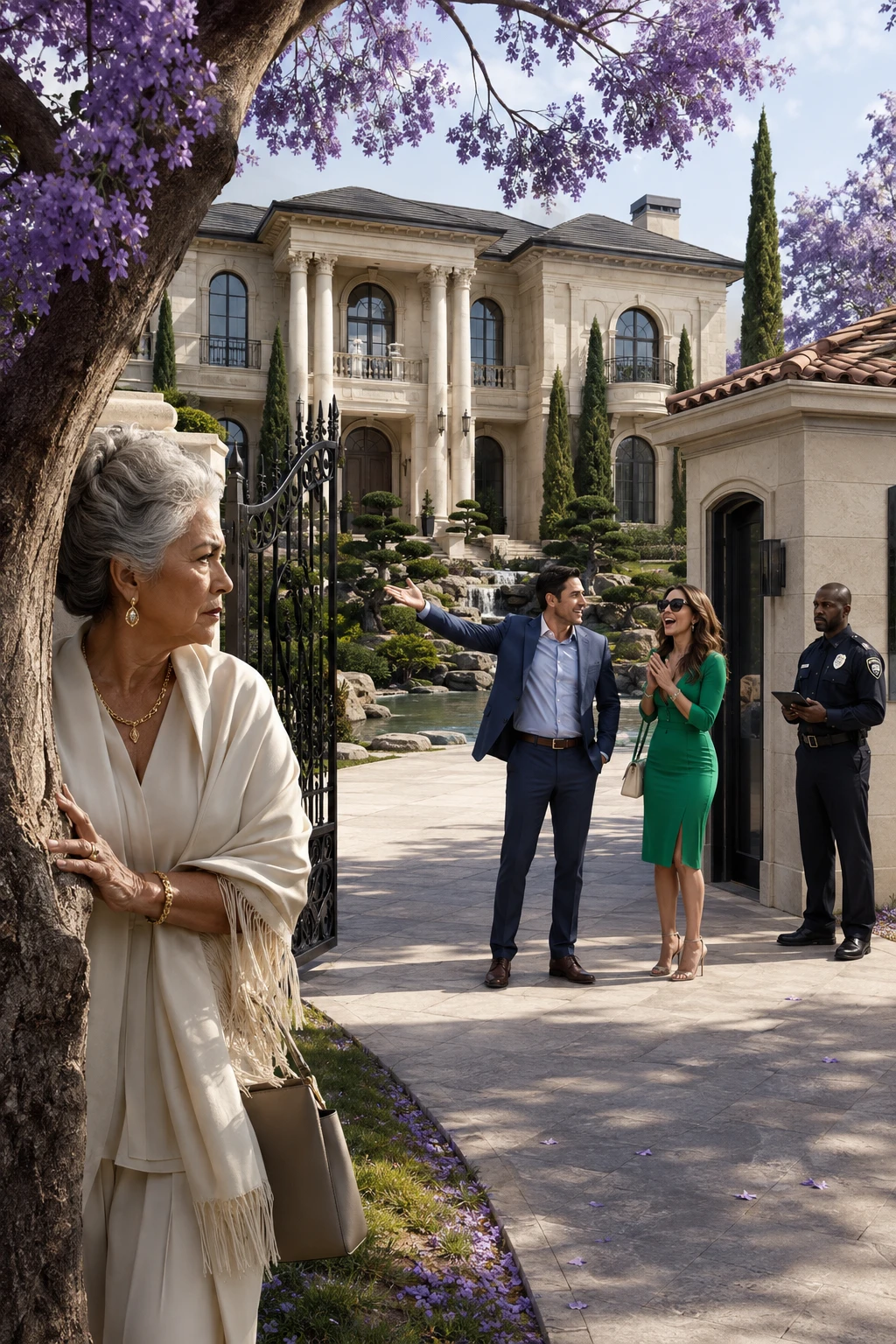
The first time I heard my son give away my house, I was standing behind a jacaranda tree.
Not metaphorically.
Not after the fact.
I was physically hidden behind the thick purple-flowered trunk, listening while Maxwell pointed toward the mansion I had spent half my life earning and told his wife:
“There it is. Your new home, love.”
Samantha pressed both hands to her chest.
“Oh my God, Maxwell.”
She stared through the wrought-iron gates at the cream stone facade, the six arched bedroom windows, the fountain courtyard, the Japanese garden beyond the eastern wall, and the waterfall spilling into the pool.
Then she smiled.
“It’s perfect.”
My fingers tightened against the bark.
Perfect.
She was talking about my bedroom.
My kitchen.
My garden.
My life.
I am Lillian Morales.
I was seventy-two years old that morning.
And every square foot of that two-million-dollar property belonged to me.
Not to Maxwell.
Not to Samantha.
Not to some forgotten family trust.
To me.
I had bought it after selling the real-estate company I built from nothing.
And when I say nothing, I mean nothing.
After my divorce, Maxwell was eight and Julian was five.
Their father left with a suitcase, a younger woman, and an absurd speech about how he needed freedom.
Freedom, apparently, meant leaving me with two children, a mortgage, overdue electric bills, and a Buick that shook whenever I drove faster than fifty.
So I became the parent who remembered everything.
Dentist appointments.
School fees.
Science projects.
Broken faucets.
Birthday cakes.
College applications.
I built my company out of that Buick.
I sat in parking lots making sales calls while Maxwell and Julian slept in the back seat.
I smiled through meetings where men called me “sweetheart.”
I kept my voice polite while bankers asked whether my husband needed to approve the paperwork.
At night, I cooked dinner, helped with homework, folded laundry, and sometimes cried in the laundry room with the dryer running so my sons would not hear me.
Years later, my company sold for more money than anyone in my childhood neighborhood could mention without whispering.
The mansion came afterward.
It was never a trophy.
It was proof that I had survived.
But somewhere along the way, Maxwell stopped seeing my love as love.
He saw it as access.
Private school because he “didn’t fit in.”
I paid.
A car because everyone else had one.
I paid.
College.
Rent.
A failed business.
A lawsuit.
One “temporary” loan after another.
I paid.
I even helped him purchase Samantha’s engagement ring.
Julian was different.
My younger son lived in Madrid. He built his own life, called me every Sunday, asked about my knees, remembered my birthday without reminders, and once spent twenty minutes apologizing because he had ruined my tortilla soup recipe.
He never asked me for money.
Which was why, three nights before the incident at the gate, when he called me after midnight, I knew something was wrong.
“Mom,” he said quietly, “I need to tell you something about Maxwell.”
I sat on the edge of my bed.
Moonlight spilled across the floor.
“What happened?”
Julian hesitated.
“He’s telling people you’re too old to live alone.”
I went still.
“He says you’re going to give him the house.”
My chest tightened.
Then came the sentence that changed something inside me.
“He asked me if I wanted my half now, or if I’d let him take the whole thing because he has a wife.”
For several seconds, I said nothing.
Across the room sat an old photograph of my sons.
Maxwell had chocolate around his mouth.
Julian was missing two front teeth.
I remembered carrying Maxwell through a fever.
I remembered his first day of school, how he wrapped his arms around my neck and begged me not to leave.
And now he was discussing my house as if I were already dead.
As if I were an obstacle with an expiration date.
“Thank you for telling me,” I said.
Afterward, I walked through my home in darkness.
The grand piano stood silent.
The staircase curved toward the second floor.
The cream curtains moved softly in the air-conditioning.
Everything looked unchanged.
Yet for the first time, my home felt different.
Not loved.
Evaluated.
The next morning, I called Marcus, the head security guard at our gated community.
“If Maxwell comes here with Samantha,” I said, “do not let them through.”
Marcus paused.
Then said, “Understood, Mrs. Morales.”
Two days later, I saw Maxwell’s Mercedes approaching while I was parked near the country club.
The same Mercedes I had helped him buy.
Samantha sat beside him in a fitted green dress and oversized sunglasses.
She was smiling before they reached the gate.
Not politely.
Possessively.
I almost stepped out.
Almost confronted them.
Then something inside me whispered:
Watch.
So I walked beneath the jacaranda trees and hid near the guardhouse.
That was when Maxwell made his grand presentation.
“There it is,” he told Samantha.
“Your new home, love.”
Marcus stepped from the booth holding his tablet.
“Good morning, sir.”
“We’re here for my mother’s house,” Maxwell said.
“I know Mrs. Morales.”
“My wife and I are moving in.”
Marcus blinked.
“Moving in?”
“My mother owns the place, but we’ll be living there now.”
Samantha laughed lightly.
“He promised me something beautiful. This is much better than I expected.”
Marcus glanced toward the tree where I stood.
Then he said, “Your mother asked me to call if you arrived.”
Maxwell’s smile disappeared.
“Why?”
Marcus called me.
My phone rang.
I answered.
“Mrs. Morales,” Marcus said, “your son says he and his wife are moving into your home. Do you authorize entry?”
“No.”
One word.
Calm.
Final.
“No move-in has been authorized.”
Marcus repeated it.
Maxwell’s face darkened.
“She’s confused,” he snapped. “She’s seventy-two.”
That hurt.
Not because I believed it.
Because he wanted others to.
Samantha removed her sunglasses.
“Maxwell, you said this was handled.”
“It is.”
“My furniture is arriving this afternoon.”
Marcus shook his head.
“No truck enters without Mrs. Morales’s approval.”
Maxwell pulled out his phone.
“I’m calling her.”
I stepped from behind the tree.
“No need.”
He turned so sharply he nearly dropped the phone.
“Mom?”
Samantha stared at me.
I walked toward them slowly.
“You told your wife my home belonged to her?”
Maxwell recovered quickly.
“Mom, stop making this dramatic.”
“Dramatic?”
“You don’t need six bedrooms.”
I stared at him.
“Samantha and I are starting a family.”
“And that gives you my property?”
He exhaled impatiently.
“Be reasonable.”
I smiled.
That smile unnerved him.
“I am.”
Then I opened my handbag and removed a white envelope.
Maxwell looked at it.
“What’s that?”
“Something I prepared after Julian called me.”
The color left his face.
“What did Julian tell you?”
“Enough.”
Samantha looked between us.
“What is going on?”
Maxwell reached for the envelope.
I pulled it back.
“No.”
“Mom.”
“No.”
For the first time that morning, I raised my voice.
“You will not take another thing from my hand simply because you decided it belongs to you.”
Silence.
Even Marcus looked away.
Maxwell’s face hardened.
“You’re embarrassing me.”
“That is interesting.”
“What?”
“You standing outside my house telling strangers I’m incompetent was acceptable. But me saying no embarrasses you?”
Samantha frowned.
“Maxwell, you said she wanted us here.”
He turned to her.
“She does. She’s just emotional.”
I laughed.
Actually laughed.
“Emotional?”
Then I handed Samantha the envelope.
Maxwell lunged toward it.
“Don’t.”
She stepped back.
“What is this?”
“Open it.”
Inside was a copy of the deed.
My name.
Only my name.
Below it were banking records showing every payment connected to Maxwell for the previous fifteen years.
Tuition.
Cars.
Loans.
Rent.
Legal fees.
Business debt.
The engagement ring.
Samantha’s eyes widened.
“You told me you paid for this ring yourself.”
Maxwell’s jaw tightened.
“It doesn’t matter.”
“It mattered when you bragged about it.”
Then she unfolded another page.
“What is this?”
I answered.
“A statement from my attorney confirming Maxwell has no ownership interest in the house.”
Samantha looked at him.
“You said your father left it to you.”
My heart stopped.
I turned slowly.
“What?”
Maxwell said nothing.
Samantha’s face changed.
“You told me your father bought this house before he died and your mother stayed here afterward.”
I stared at my son.
“That’s what you told her?”
“Mom—”
“My ex-husband never owned this house.”
Samantha’s mouth opened.
Maxwell stepped toward me.
“You always make everything about money.”
That sentence hit something deep.
I thought of the years.
The sacrifices.
The checks.
The rescue calls.
“You’re right,” I said quietly.
He looked surprised.
“I did make one mistake with money.”
“What?”
“I used it every time you needed consequences.”
His expression stiffened.
“I fixed every problem.”
“You helped your son.”
“No.”
I shook my head.
“I prevented my son from becoming a man.”
Samantha folded the papers.
“Maxwell, we’re leaving.”
He stared at her.
“What?”
“You lied.”
“It’s complicated.”
“You told me this house was yours.”
“It will be.”
I went cold.
Will be.
Not might be.
Will be.
“What does that mean?”
Maxwell’s eyes flicked toward me.
“Nothing.”
I watched him carefully.
“What did you mean?”
He stepped away.
“This conversation is over.”
He grabbed Samantha’s elbow.
She pulled free.
“Don’t touch me.”
Then Marcus’s phone rang.
He answered.
“Yes?”
His face changed.
He looked at me.
“Mrs. Morales?”
“Yes?”
“There’s a moving truck at the secondary entrance.”
Maxwell closed his eyes.
My stomach dropped.
“You already sent movers?”
Samantha looked stunned.
“I didn’t.”
Maxwell said nothing.
Marcus spoke again.
“They say they have instructions to remove existing furniture.”
That was when I understood.
He had not planned to move in beside me.
He planned to move me out.
I walked directly toward Maxwell.
“Where were you sending my things?”
“Mom—”
“Where?”
His silence answered.
Samantha whispered, “Oh my God.”
I felt dizzy.
Then angry.
Not loud anger.
The colder kind.
“I want you gone.”
“Fine.”
“Not just today.”
He looked at me.
“I’m done paying your bills.”
His face shifted.
“Mom.”
“Your car payment. Done.”
“Don’t be ridiculous.”
“Your business credit line. Done.”
“You can’t.”
“Your rent subsidy. Done.”
Samantha turned toward him.
“Rent subsidy?”
I almost felt sorry for her.
Almost.
Maxwell stepped closer.
“You’re my mother.”
“And you’re forty-six.”
He lowered his voice.
“You’ll regret this.”
“No.”
I shook my head.
“I regret not doing it ten years ago.”
He left furious.
Samantha followed separately.
But the real shock came that evening.
My attorney, Eleanor Price, arrived at the house.
She had represented me for twenty-three years.
She walked into the library carrying a folder.
“You were right to call.”
I poured coffee.
“About what?”
“The moving company.”
My stomach tightened.
“They had paperwork.”
“What paperwork?”
She placed a document on the table.
At first, I did not understand what I was looking at.
Then I saw my name.
My signature.
Except I had never signed it.
It was a power-of-attorney document giving Maxwell control over my property and financial affairs.
My blood ran cold.
“He forged this.”
Eleanor nodded.
“It appears so.”
I sat down.
“He was going to use this to remove me?”
“Possibly more than that.”
She slid another paper forward.
It was an appointment request from a private geriatric facility.
My name was at the top.
Admission date: Friday.
Three days away.
My mouth went dry.
“He was putting me in a nursing home?”
“He had started the process.”
For several seconds, I could not breathe.
My own son had not merely planned to occupy my home.
He had built a story.
An elderly mother.
Confused.
Unsafe alone.
Needing care.
And once I was removed, he could step into the life I had built.
Eleanor touched my hand.
“There’s more.”
I looked at her.
“What more?”
She hesitated.
Then opened a second folder.
“I found this while reviewing old title records.”
She slid a yellowed envelope toward me.
My name was written across it.
I recognized the handwriting immediately.
My ex-husband’s.
Thomas.
Dead for six years.
My hands began to tremble.
“Where did you get this?”
“It was stored with documents from your original company acquisition. Apparently it was misfiled.”
I opened it.
Inside was a letter.
Lillian,
If you ever read this, then I failed to say it while I was alive.
I read on.
Thomas wrote about leaving me.
About his shame.
About Maxwell.
Then came the line that made my entire world tilt.
Maxwell is not your biological son.
I stopped reading.
“What?”
Eleanor was silent.
I read again.
Years before our divorce, Thomas confessed, a former girlfriend had arrived with an eight-month-old baby.
She was dying of ovarian cancer.
The baby was Thomas’s.
She had no family.
No one else.
Thomas had brought the child home and told me a story about a distant relative who could not care for him.
I had been twenty-six.
Naive.
Already pregnant with Julian.
I had agreed to raise the baby temporarily.
Temporary became forever.
I had loved Maxwell instantly.
Thomas had never told me the truth.
My chest hurt.
“But…”
I could barely speak.
“I raised him from eight months old.”
Eleanor nodded.
I looked again at the letter.
Thomas wrote:
You became his mother in every way that mattered. I was a coward for hiding the truth.
Tears blurred the page.
Then I found one final paragraph.
There was another document.
A trust.
Thomas had inherited land from his biological father.
He had placed it in a trust for Maxwell before his death.
It was worth nearly nine million dollars.
I stared at Eleanor.
“He has money?”
“Potentially.”
“He’s been asking me for money for fifteen years.”
“Yes.”
“He knows?”
Eleanor nodded slowly.
“He has known for at least seven.”
I felt something inside me break.
Not because he was not biologically mine.
That meant nothing.
I had changed his diapers.
Held him through nightmares.
Bandaged his knees.
I was his mother.
But he had inherited enough money to live comfortably forever.
And still he took from me.
Again and again.
Then I understood something else.
“Why didn’t he use the trust?”
Eleanor’s expression changed.
“Because there’s a condition.”
“What condition?”
“He receives full control only if you certify that he maintained a genuine familial relationship with you until your death.”
I stared at her.
The room went silent.
Then the twist became horrifyingly clear.
Maxwell needed me.
But only legally.
He needed me alive long enough to qualify.
Then gone.
My hands went cold.
Eleanor said quietly, “If you certify estrangement or coercion, the trust passes elsewhere.”
“To whom?”
She looked directly at me.
“To Julian.”
I laughed once.
A broken little sound.
Of course.
For two days I said nothing.
Then I invited both sons home.
Julian flew in from Madrid.
Maxwell arrived assuming I had reconsidered.
He walked into the library confidently.
“I knew you’d calm down.”
Samantha did not come.
She had left him.
I placed the trust documents on the table.
His face changed instantly.
“So,” I said.
“You knew.”
He sat down.
“Mom—”
“Did you ever love me?”
His face twisted.
“Of course.”
“Then why the nursing home?”
Silence.
Julian looked horrified.
“You did what?”
Maxwell stood.
“You don’t understand.”
I did.
For the first time, I understood everything.
The gifts.
The lies.
The sudden interest in my “health.”
The questions about the house.
The quiet comments about whether I was becoming forgetful.
It had all been preparation.
“You needed to look devoted,” I whispered.
Maxwell began crying.
Real tears.
“I was desperate.”
“For nine million dollars?”
“I made bad investments.”
Julian stood.
“You were going to institutionalize her.”
“I wasn’t going to hurt her.”
That sentence destroyed the last thing I felt for him.
Because he meant it.
He genuinely believed stealing my freedom did not count as hurting me.
I opened the final document.
“What is that?” Maxwell asked.
“A certification.”
His face went pale.
I signed it.
He lunged toward the table.
“Mom, don’t.”
Too late.
I had certified coercion.
Estrangement.
Financial abuse.
The nine-million-dollar trust would never belong to Maxwell.
Julian stared at me.
“I don’t want it.”
“I know.”
He looked confused.
I smiled through tears.
“That’s why you’re getting it.”
But that was not the final surprise.
Because Julian pushed the papers back.
“No.”
Maxwell stared.
“What?”
Julian looked at Eleanor.
“Can the trust be redirected?”
She nodded.
“With your consent after distribution.”
Julian turned to me.
Then he smiled.
“I already know where it should go.”
Months later, the mansion looked almost exactly the same.
Except for the plaque near the eastern garden.
Maxwell never saw it.
After the forgery investigation, he pleaded guilty to fraud-related charges and received supervised probation, restitution obligations, and court-ordered financial restrictions.
I did not visit him.
Samantha divorced him.
She sent me one letter.
It contained only three lines:
I’m sorry.
I believed him.
You deserved better from both of us.
I kept it.
Not because I forgave everything.
Because truth deserves somewhere to live.
Julian returned to Madrid.
But before leaving, he transferred the entire trust into a charitable foundation.
The foundation funded housing for women rebuilding their lives after divorce, abandonment, and financial abuse.
Women like the younger version of me.
Women sitting in old cars with overdue bills in glove compartments.
Women crying beside dryers so their children would not hear them.
The organization was headquartered in my mansion.
I kept my bedroom.
My kitchen.
My garden.
But the other rooms became offices, counseling spaces, and temporary suites for women starting over.
And the plaque near the jacaranda tree read:
THE LILLIAN MORALES HOUSE
Built by a woman no one believed in. Opened for women who need someone to believe in them.
Sometimes, late in the afternoon, I sit beneath that same jacaranda tree.
The one I hid behind while my son tried to give away my home.
I think about motherhood.
About biology.
About love.
About how sometimes the child who shares none of your blood can still become yours completely.
And how sometimes loving someone does not mean saving them from the consequences of who they chose to become.
I lost a son that year.
At least, I lost the version of him I had believed existed.
But I gained something else.
My own boundaries.
My own voice.
My own life back.
And perhaps the strangest part was this:
For years, Maxwell believed he was waiting for me to die so he could inherit everything.
In the end, he lost everything because I finally decided to start living.