PART 3
I smiled.
“Of course, Mr. Prashad.”
Bernadette was staring at me.
Her mouth had fallen open.
“Mrs. Delacroix?”
She said it like she had never heard the name before.
Mr. Prashad looked at her.
“Yes.”
Then he looked around the room.
“Mrs. Wilma Delacroix is the principal owner of Delacroix Linen Services, our contracted linen supplier and the sponsor of tonight’s event.”
Nobody moved.
I took the folder.
“Thank you, Mr. Prashad.”
He smiled.
“And I wanted to personally thank you. Your company has been one of our most reliable partners for twenty-two years.”
“Twenty-two?”
Bernadette finally found her voice.
“You mean—”
Mr. Prashad nodded.
“Mrs. Delacroix has supplied this hotel since 2004.”
Someone at the back whispered:
“Oh my God.”
Another voice said:
“That’s Wilma?”
I turned.
It was Denny Fowler.
I hadn’t seen him in forty years.
He had gained weight.
Lost most of his hair.
But I recognized his eyes.
He was staring at me with the same expression he had worn at the junior prom when Bernadette had asked him about my dress.
Except this time, there was no laughter in his face.
Only shame.
He stood slowly.
“Wilma?”
I smiled.
“Hello, Denny.”
He looked at the apron.
Then at Mr. Prashad.
Then back at me.
“I didn’t know.”
“I know.”
He swallowed.
“I’ve wanted to apologize.”
I nodded.
“Then you should.”
He looked down.
“I was seventeen.”
“So was I.”
That was all I said.
Denny’s eyes filled.
“I was afraid of Bernadette.”
I almost smiled.
“You weren’t afraid of her, Denny.”
He looked at me.
“You were afraid she’d laugh at you.”
He nodded.
“And I was afraid of being laughed at.”
He looked toward the floor.
“I was a coward.”
“Yes.”
I didn’t soften it.
Not because I wanted to hurt him.
Because at seventy-three, I had finally learned that honesty did not require cruelty.
Sometimes the kindest thing you can do is call something what it was.
Mr. Prashad cleared his throat.
“Mrs. Delacroix, if you approve the final course, we’ll proceed.”
I looked at the folder.
Then I closed it.
“Actually, there’s been a change.”
He smiled.
“Of course.”
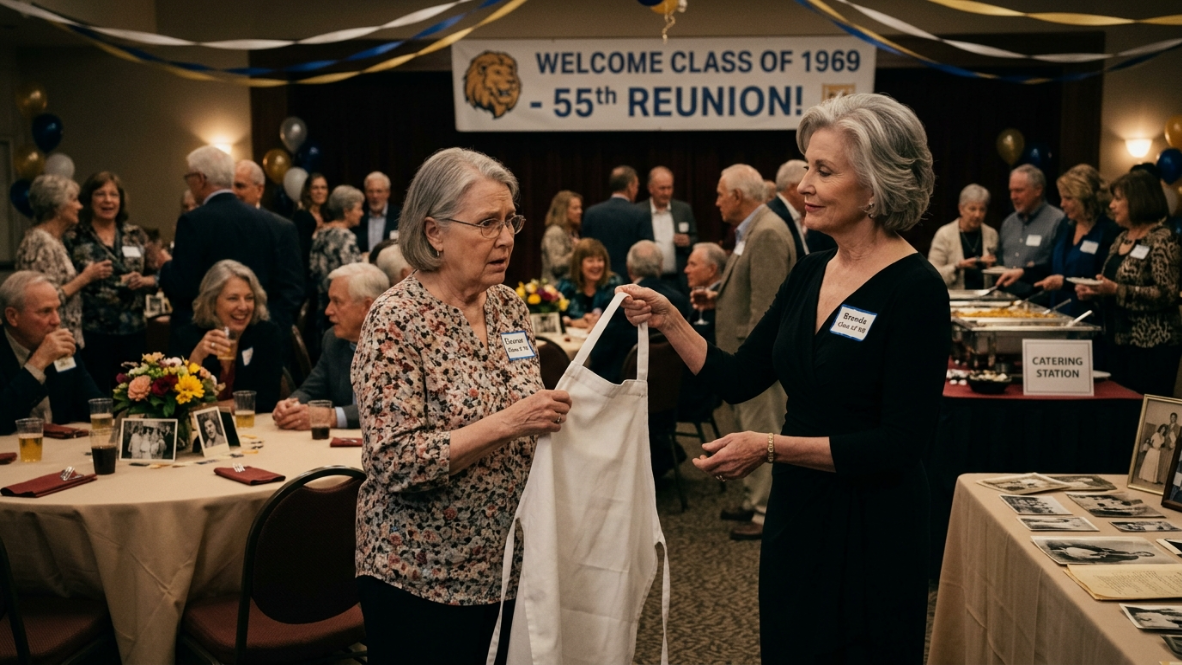
I looked at the catering staff.
“Are the two missing servers here yet?”
Mr. Prashad shook his head.
“No.”
I looked at Bernadette.
She was still frozen.
Then I untied the apron.
Slowly.
I folded it once.
Then again.
And placed it on the empty chair beside me.
“I think we’ve had enough of that.”
Mr. Prashad understood immediately.
He nodded toward one of his staff.
“Please relieve Mrs. Delacroix.”
The young server hurried over.
I stepped away from the table.
Bernadette finally stood.
“Wilma.”
I looked at her.
She walked toward me.
Her face had changed.
The confident expression was gone.
But something remained.
Pride.
Even now.
“You knew?”
I smiled.
“Knew what?”
“That the hotel was yours.”
“It isn’t mine.”
“You know what I mean.”
“No.”
She stared at me.
“You arranged all this.”
“Yes.”
“You paid for tonight?”
“Yes.”
“Why?”
That question surprised me.
Not because I didn’t know the answer.
Because she genuinely didn’t.
I looked around the ballroom.
The white tablecloths.
The polished silverware.
The flowers.
The warm lights.
The old classmates.
People who had spent more than half a century becoming strangers to one another.
“I paid because I wanted everyone to have a nice evening.”
Bernadette’s eyes narrowed.
“You wanted revenge.”
“No.”
She laughed bitterly.
“Don’t lie to me.”
“I didn’t say I was here because of you.”
That silenced her.
I continued.
“I came because I wanted to know whether I could walk back into that school year without becoming seventeen again.”
Bernadette didn’t speak.
“I wanted to see whether I would still feel small.”
“And?”
I looked around.
“I don’t.”
Someone behind us quietly clapped.
Then another person.
Then another.
Within seconds, applause filled the ballroom.
I hadn’t expected it.
I raised a hand.
“Please.”
The applause faded.
I wasn’t interested in being celebrated.
I had spent enough of my life being watched.
I wanted to sit.
So I did.
At a different table.
Alone at first.
Then Doris came over.
She leaned close and said:
“You know, I always hated what Bernadette did to you.”
I looked at her.
“Then why didn’t you say anything?”
She looked ashamed.
“Because I was scared.”
I nodded.
“I understand.”
She sat down.
Then Denny joined us.
Then two other classmates.
Then another.
Within twenty minutes, my table was full.
People began telling stories.
Not about Bernadette.
About themselves.
A man named Arthur admitted he had spent forty years pretending to be successful when he had actually struggled with alcoholism.
A woman named Linda confessed that she had never married because she had spent her twenties caring for her disabled mother.
Another classmate said he had lost his son.
Another said she had lost a daughter.
The room slowly changed.
It stopped being a reunion.
It became something else.
A room full of seventy-year-olds admitting that life had not turned out the way high school had promised.
I listened.
And I realized something.
Bernadette had spent her whole life believing the world was divided into winners and losers.
Popular and invisible.
Beautiful and ordinary.
Important and unimportant.
But age had ruined that scoreboard.
At seventy-three, everybody had scars.
Some were visible.
Some weren’t.
And no amount of money, beauty, status, or popularity could keep time from collecting its debt.
At 10:15, Mr. Prashad returned.
“Mrs. Delacroix?”
“Yes?”
“There is something you should know.”
“What?”
He leaned closer.
“Your company isn’t just supplying the hotel.”
I frowned.
“What do you mean?”
He smiled.
“The board approved your proposal.”
“What proposal?”
“The scholarship.”
I stared at him.
“What scholarship?”
He looked confused.
“You don’t know?”
“No.”
He pulled another document from his folder.
“Your son submitted it three weeks ago.”
My heart stopped.
“My son?”
“Yes. He proposed creating an annual hospitality scholarship for students from Kettering High who cannot afford culinary school.”
I looked toward my son, Michael.
He was standing near the entrance.
I hadn’t known.
He smiled.
I shook my head.
“You did this?”
He walked over.
“Dad and I talked about it years ago.”
I smiled.
“Your father would have loved it.”
“He would.”
Mr. Prashad continued.
“The Grand Regency agreed to match your contribution.”
I looked around.
Suddenly the white tablecloths looked different.
They weren’t symbols of the dress I had made from blue check fabric.
They were symbols of what came after.
The years of work.
The trucks.
The laundromats.
The contracts.
The early mornings.
The mistakes.
The risks.
The life Russell and I had built together.
I looked at Michael.
“You didn’t tell me.”
“You would have said no.”
I laughed.
“That sounds like me.”
“Yes.”
He kissed my forehead.
Then Bernadette appeared beside us.
“Wilma.”
Michael looked at me.
“Should I stay?”
I shook my head.
“No.”
He walked away.
Bernadette stood there.
For several seconds, neither of us spoke.
Then she said:
“I need to apologize.”
I waited.
She took a breath.
“I was cruel to you.”
“Yes.”
“I thought you were beneath me.”
“Yes.”
“I was wrong.”
“Yes.”
She looked irritated.
“Could you at least make this easier?”
I smiled.
“No.”
She almost laughed.
Then she did.
A tiny laugh.
The first genuine one I had ever heard from her.
“I suppose I deserve that.”
“You do.”
She pulled out the chair.
“Can I sit?”
I nodded.
She sat.
For the first time in fifty-five years, we were sitting across from each other without an audience.
“I don’t know why I hated you,” she said.
“I do.”
She looked at me.
“You do?”
“You were terrified.”
“Of you?”
“No.”
I paused.
“Of becoming ordinary.”
She stared at me.
I continued.
“You thought being admired would protect you.”
Her eyes lowered.
“It didn’t.”
“No.”
She looked at her hands.
“I lost my husband twelve years ago.”
“I know.”
“I lost my daughter two years ago.”
I hadn’t known that.
She swallowed.
“She wouldn’t speak to me before she died.”
I said nothing.
“I spent my whole life thinking if I was important enough, people wouldn’t leave.”
She looked at me.
“And they still left.”
There was nothing satisfying about hearing it.
No victory.
No triumph.
Only sadness.
I reached across the table.
Not to hug her.
Just to touch her hand.
She looked at me.
“Why are you doing that?”
“Because I’m not seventeen anymore.”
Her eyes filled with tears.
Neither of us spoke.
Then she whispered:
“Do you forgive me?”
I thought about it.
Forgiveness had always sounded simple when other people talked about it.
It wasn’t.
“You want the truth?”
“Yes.”
“I don’t know.”
She nodded slowly.
“But I don’t hate you.”
That seemed to be enough.
She wiped her eyes.
“Thank you.”
She stood.
Then stopped.
“There is one more thing.”
“What?”
“I kept something.”
She reached into her purse.
She pulled out a small photograph.
I recognized it immediately.
Junior prom.
Me in the blue-check dress.
Denny beside me.
Bernadette standing behind us.
I hadn’t seen the photograph in fifty-five years.
“Why do you have that?”
She looked down.
“Because I took it.”
I stared at her.
“You took it?”
“Yes.”
“Why?”
She hesitated.
“Because you looked beautiful.”
I couldn’t speak.
She continued.
“I never told you.”
“Why not?”
“Because I was afraid that if I admitted you looked beautiful, people would like you.”
My eyes filled with tears.
“And you couldn’t have that?”
“No.”
She handed me the photograph.
“I’ve carried it for fifty-five years.”
I took it.
The girl in the photograph looked so young.
So uncertain.
She didn’t know she would become seventy-three.
She didn’t know she would bury her husband.
She didn’t know she would build businesses.
She didn’t know she would become someone who could walk into a ballroom and have the general manager stop the evening to speak to her.
She only knew that someone had laughed at her dress.
I looked at the photograph again.
Then I tore it in half.
Bernadette gasped.
“What are you doing?”
I tore it again.
And again.
I didn’t need it.
I had spent too many years carrying that night.
I dropped the pieces into the trash.
Bernadette watched me.
“You really don’t need it anymore?”
“No.”
“Why?”
I looked at her.
“Because I remember her.”
I touched my chest.
“She was me.”
Then I stood.
The reunion continued until midnight.
People danced.
Some cried.
Some laughed.
Some exchanged numbers.
Some promised to stay in touch.
Most wouldn’t.
That’s life.
At 12:07, I walked through the empty ballroom.
The staff had already begun clearing the tables.
I stopped beside table four.
The same table where Bernadette had laughed.
The same table where she had handed me the apron.
There was a single white napkin left behind.
I picked it up.
Folded it.
Placed it in my purse.
Not as a reminder of humiliation.
As a reminder of what had happened afterward.
Outside, the night air was cool.
Michael was waiting beside the car.
“You ready, Mom?”
I nodded.
Then I looked back at the hotel.
The Grand Regency glowed behind me.
For twenty-two years, I had supplied linens to that building.
But tonight, I realized I had supplied something else.
Proof.
Proof that a person could begin with almost nothing.
That a borrowed dress did not determine a woman’s future.
That being laughed at did not make you a loser.
That being ignored did not make you invisible.
And that sometimes the best revenge was not making the person who hurt you suffer.
Sometimes it was simply living so fully that their opinion became too small to matter.
Michael opened the car door.
I got in.
As he started the engine, he looked at me.
“Mom?”
“Yes?”
“Did you enjoy yourself?”
I thought about Bernadette.
The apron.
The photograph.
The contract.
The applause.
The apology.
Then I smiled.
“Yes.”
“Really?”
“Yes.”
He laughed.
“Why?”
I looked out the window as the hotel disappeared behind us.
“Because for the first time in fifty-five years, I went back.”
I paused.
“And I didn’t feel like the girl in the blue-check dress.”
Michael smiled.
“Who did you feel like?”
I looked at my hands.
The same hands that had once stitched fabric together at a kitchen table.
The same hands that had washed hotel linens.
Signed contracts.
Paid employees.
Held my husband’s hand when he was dying.
Held my son’s when he was a child.
And held an apron that night without shame.
“I felt like Wilma.”
And that was enough.
The next Monday, I went to work.
At 9:00, my son walked into my office carrying a stack of papers.
“You have a meeting.”
“With who?”
“Kettering High.”
I looked up.
“What do they want?”
“They want to name the scholarship after you.”
I laughed.
“Absolutely not.”
He smiled.
“I knew you’d say that.”
“Why?”
“Because you don’t like attention.”
“I don’t.”
“What if they name it after Dad?”
I stopped.
Russell.
The quiet man who had fixed heating systems.
The man who had believed in me before I believed in myself.
The man who had never once asked what I wore.
The man who had never cared where I came from.
The man who had simply said, when I showed him my first laundromat numbers:
“Wilma, I think you can do this.”
My eyes filled.
“After Russell?”
“Yes.”
I smiled.
“Then tell them yes.”
Three months later, the first scholarship was awarded.
The recipient was a seventeen-year-old girl from Kettering High.
Her mother worked two jobs.
She wanted to become a chef.
At the ceremony, she wore a simple blue dress.
Not expensive.
Not designer.
Just blue.
When she stepped onto the stage, she looked terrified.
I walked over.
I held out my hand.
She took it.
“What’s your name?”
“Emily.”
“Well, Emily, you’re going to be just fine.”
She smiled nervously.
Then she whispered:
“Mrs. Delacroix?”
“Yes?”
“Did you really make a dress out of a tablecloth?”
I laughed.
“Who told you that?”
She pointed toward the back.
Bernadette was standing there.
Older.
Quieter.
Smiling.
I looked at Bernadette.
Then back at Emily.
“Yes.”
Emily’s eyes widened.
“Really?”
“Yes.”
“Was it pretty?”
I smiled.
“It was beautiful.”
And this time, I didn’t need anyone else to agree.
Because I finally understood something I wish I had understood at seventeen:
The dress was never the embarrassing part.
The embarrassing part was believing that someone else’s cruelty could define you.
I spent four years at Kettering High believing Bernadette Voss had won.
She hadn’t.
She had simply been loud.
I had been busy becoming.
And fifty-five years later, when she handed me that apron and told me I’d be more comfortable in the back, she thought she was putting me in my place.
She didn’t realize I had spent a lifetime building a place of my own.
And it was much bigger than any ballroom.
Much bigger than any reunion.
Much bigger than anything she could have imagined.
It was mine.
It had Russell’s fingerprints on it.
My son’s.
My workers’.
And the little girl in the blue-check dress who kept sewing even after someone laughed.
I think about her sometimes.
I wish I could go back and tell her something.
I wish I could kneel beside that frightened seventeen-year-old girl and whisper:
“Don’t worry.”
“They don’t know you yet.”
“You’re going to lose people.”
“You’re going to lose your husband.”
“You’re going to work until your hands hurt.”
“You’re going to fail sometimes.”
“You’re going to cry.”
“But one day, you’re going to walk into a ballroom wearing an apron someone gave you to embarrass you.”
“And when they discover who you are, you won’t even need to say a word.”
“Because the life you’ve built will speak for you.”
And maybe that’s the part of the story that matters most.
Not that I became wealthy.
Not that Bernadette apologized.
Not that the hotel manager knew my name.
The important thing is this:
I stopped measuring my worth by the people who once laughed at me.
At seventeen, I thought being humiliated meant I had lost.
At seventy-three, I finally understood.
I hadn’t lost.
I had simply been sent out of the room early.
And while everyone else was still laughing inside…
I went home.
I went to work.
I built a life.
And when I finally came back fifty-five years later—
I didn’t need revenge.
I only needed to take off the apron.
PART 4
Six months after the reunion, I received a letter.
It arrived on a Tuesday morning, tucked between an electric bill and a stack of invoices from one of our restaurant accounts.
I almost threw it away.
There was no return address.
Only my name.
Mrs. Wilma Delacroix
The handwriting was familiar.
I sat at my kitchen table and opened it.
It was from Bernadette.
There were only two pages.
The first page was an apology.
The second was something I never expected.
A photograph.
Not the old photograph from junior prom.
A new one.
It showed Bernadette standing outside Kettering High with a group of teenagers.
At the bottom she had written:
I finally told them about you.
I read the letter twice.
Then I called my son.
“Michael?”
“What’s wrong?”
“Nothing.”
“You sound strange.”
“Bernadette wrote to me.”
There was silence.
“Are you okay?”
“Yes.”
“What did she say?”
I looked at the photograph again.
“She started a program at the high school.”
“What kind?”
“A mentorship program.”
“For girls?”
“For anyone who feels like they don’t belong.”
Michael was quiet.
Then he said:
“That’s good.”
“Yes.”
“Do you forgive her?”
I looked at the letter.
“I think forgiveness is something you give yourself.”
He sighed.
“Mom, that’s a very complicated answer.”
“I’m seventy-three. I’m allowed complicated answers.”
He laughed.
“So what are you going to do?”
I looked at the photograph.
“I’m going to visit her.”
Kettering High looked smaller than I remembered.
Much smaller.
The hallways that had once seemed endless were narrow now.
The lockers looked like children’s furniture.
The staircase where I had once stood crying after Bernadette poured milk over my books seemed almost ridiculous.
I walked slowly.
Not because I was afraid.
Because I wanted to remember.
There was my old classroom.
There was the auditorium.
And at the end of the hallway was the gymnasium.
The same gymnasium where I had worn the blue-check dress.
I stopped outside the doors.
For a moment, I was seventeen again.
I could almost hear the music.
Almost hear the laughter.
Almost hear Bernadette’s voice.
“Denny, you know she made that dress out of a tablecloth.”
I closed my eyes.
Then I opened the doors.
The gym was empty.
Except for one teenage girl sitting on the bleachers.
She was crying.
I walked toward her.
“Are you all right?”
She looked up.
“I’m fine.”
I smiled.
“I was terrible at being fine when I was your age.”
She wiped her face.
“People are making fun of me.”
“For what?”
“My clothes.”
I sat beside her.
“What are you wearing?”
She looked down.
“A dress my grandmother made.”
I smiled.
“Then your grandmother loves you.”
The girl laughed through her tears.
“Everyone says it’s ugly.”
“People said the same thing about one of my dresses.”
She looked at me.
“Really?”
“Yes.”
“Did you make it?”
“My mother and I did.”
“Was it ugly?”
I thought about that blue-check dress.
“No.”
I smiled.
“It was beautiful.”
She looked at me for a long moment.
“Then why did you stop wearing things you liked?”
The question surprised me.
“Because I was young.”
She nodded.
“Does it get better?”
I looked around the gym.
“Yes.”
“How?”
“You stop asking people who don’t love you whether you’re worth loving.”
She stared at me.
I continued.
“You learn that some people will laugh because they’re unhappy.”
“Does that make it okay?”
“No.”
“Then why forgive them?”
“I didn’t say you had to.”
She smiled.
I stood.
“Come on.”
“Where?”
“I want to show you something.”
We walked to the auditorium.
On the stage was a table covered with a white cloth.
I lifted it.
Underneath was a sewing machine.
The school had started an after-school program teaching students how to sew, repair clothes, and make costumes.
Bernadette had donated the equipment.
I looked at the machine.
Then I laughed.
The girl smiled.
“What?”
“Nothing.”
“What?”
“I just realized something.”
“What?”
“Bernadette finally learned what a tablecloth is worth.”
A year passed.
Then another.
My company continued.
I slowly handed more responsibilities to Michael.
Not because I wanted to retire.
Because he had earned the right to lead.
One morning, he came into my office with a folder.
“Mom.”
“Yes?”
“I think you should sell.”
I stared at him.
“Excuse me?”
“The company.”
“No.”
“You haven’t even heard the offer.”
“I don’t need to.”
“It’s a very good offer.”
“No.”
“Mom.”
“No.”
He sighed.
“You promised you’d think about retirement.”
“I did think about it.”
“And?”
“I decided I don’t like it.”
He laughed.
“You’re impossible.”
I smiled.
“Your father used to say that.”
“You miss him.”
Every time he said it, I pretended I didn’t.
That morning, I didn’t.
“Yes.”
Michael sat down.
“I miss him too.”
We sat quietly.
Then he asked:
“Do you ever wish you’d done something differently?”
I thought about it.
“Yes.”
“What?”
“I wish I’d believed in myself sooner.”
He looked at me.
“Why?”
“Because I spent too many years trying to prove people wrong.”
“And now?”
“Now I don’t care.”
He smiled.
“That sounds like freedom.”
“It is.”
On my seventy-fifth birthday, Michael surprised me.
He took me to the Grand Regency.
The same ballroom.
The same chandeliers.
The same polished floor.
But this time, there were no classmates.
No reunion.
No Bernadette.
Just family.
My son.
My grandchildren.
A few old friends.
And on the center table was a small blue-check tablecloth.
I stopped walking.
Michael smiled.
“You recognize it?”
I touched the fabric.
“Yes.”
“It isn’t the original.”
“I know.”
“We had it recreated.”
I laughed.
“You’re ridiculous.”
“Probably.”
Then my granddaughter walked over.
She was seventeen.
Exactly the age I had been.
She hugged me.
“Grandma?”
“Yes?”
“Mom told me about the dress.”
I looked at Michael.
He shrugged.
“I didn’t tell her everything.”
My granddaughter smiled.
“She said someone made fun of you.”
“They did.”
“What did you do?”
“I went home.”
“And then?”
I looked at the table.
“Then I lived.”
She smiled.
“That sounds simple.”
“It wasn’t.”
She took my hand.
“I’m glad you did.”
Then she handed me a small envelope.
“What is this?”
“Open it.”
Inside was a photograph.
Me.
At seventy-three.
Wearing the apron.
Standing beside Mr. Prashad.
Behind me were dozens of classmates.
On the back, my granddaughter had written:
You were never the girl in the back.
I started crying.
Not the quiet kind.
The kind that comes when you realize someone understands something you spent decades trying to explain.
My granddaughter hugged me.
“Happy birthday, Grandma.”
Years later, when I finally retired, I gave the company to Michael.
He kept my name on the building.
Not because he had to.
Because he wanted to.
The laundromats became restaurants.
The linen company became a regional business.
The scholarship grew.
Hundreds of young people received help.
Some became chefs.
Some became hotel managers.
Some opened restaurants.
One became a nurse.
Another became a teacher.
I never told them they owed me anything.
I only asked one thing.
“When someone makes you feel small, don’t become small to match them.”
Bernadette died at eighty-one.
I received the call from her daughter.
She asked if I would attend the funeral.
I almost said no.
Then I remembered the girl on the bleachers.
The girl who had asked me whether things got better.
So I went.
The funeral was small.
There were fewer people than I expected.
Bernadette had spent her youth surrounded by people.
At the end, there were only a handful.
After the service, her daughter approached me.
“Are you Wilma?”
“Yes.”
“My mother talked about you.”
I wasn’t sure whether I wanted to hear the rest.
“She said you were the strongest person she ever knew.”
I looked down.
“I don’t know about that.”
“She did.”
Her daughter handed me a small box.
“My mother wanted you to have this.”
I opened it.
Inside was a piece of blue-check fabric.
My breath caught.
It was from the original dress.
I looked at Bernadette’s daughter.
“How did she get this?”
“She kept it.”
“For fifty-five years?”
“Yes.”
I touched the fabric.
Then I understood.
Bernadette hadn’t kept it because she hated me.
She had kept it because somewhere along the way, she realized she had been wrong.
Maybe she couldn’t undo what she had done.
None of us can.
But she could remember.
I closed the box.
“Thank you.”
That evening, I went home.
I placed the box on my desk.
I opened it one final time.
Then I took the piece of fabric out.
I didn’t frame it.
I didn’t hide it.
I took it to my sewing room.
And I stitched it into something new.
A small square.
A pocket.
Something useful.
Something ordinary.
Something that didn’t belong to the past anymore.
I finished it just before midnight.
I held it in my hands.
And I smiled.
Because that was the real ending.
Not the reunion.
Not the applause.
Not the contract.
Not Bernadette’s apology.
The real ending was this:
I had taken the thing that once represented humiliation…
and made something new from it.
Something useful.
Something beautiful.
Something mine.
I was seventeen when someone laughed at my tablecloth dress.
I was seventy-three when I wore an apron in front of the same kind of people.
And I was seventy-nine when I finally understood the difference.
The apron had never made me small.
The dress had never made me small.
Other people’s opinions had never made me small.
I had only been small because I believed them.
And once I stopped believing them, there was nothing left to prove.
My name is Wilma Delacroix.
I am seventy-nine years old.
I still own a piece of the company my husband and I built together.
I still visit Kettering High every spring to meet the scholarship students.
I still have the blue-check fabric.
And sometimes, when someone asks me what the best revenge is, I smile.
I tell them:
“Don’t spend your life trying to make the people who hurt you regret it.”
“Build a life they could never have imagined for you.”
“Then live it.”
Because the girl who once wore her cousin’s dresses didn’t need to become someone else.
She only needed time to discover who she already was.
And that girl?
She was never meant for the back of the room.