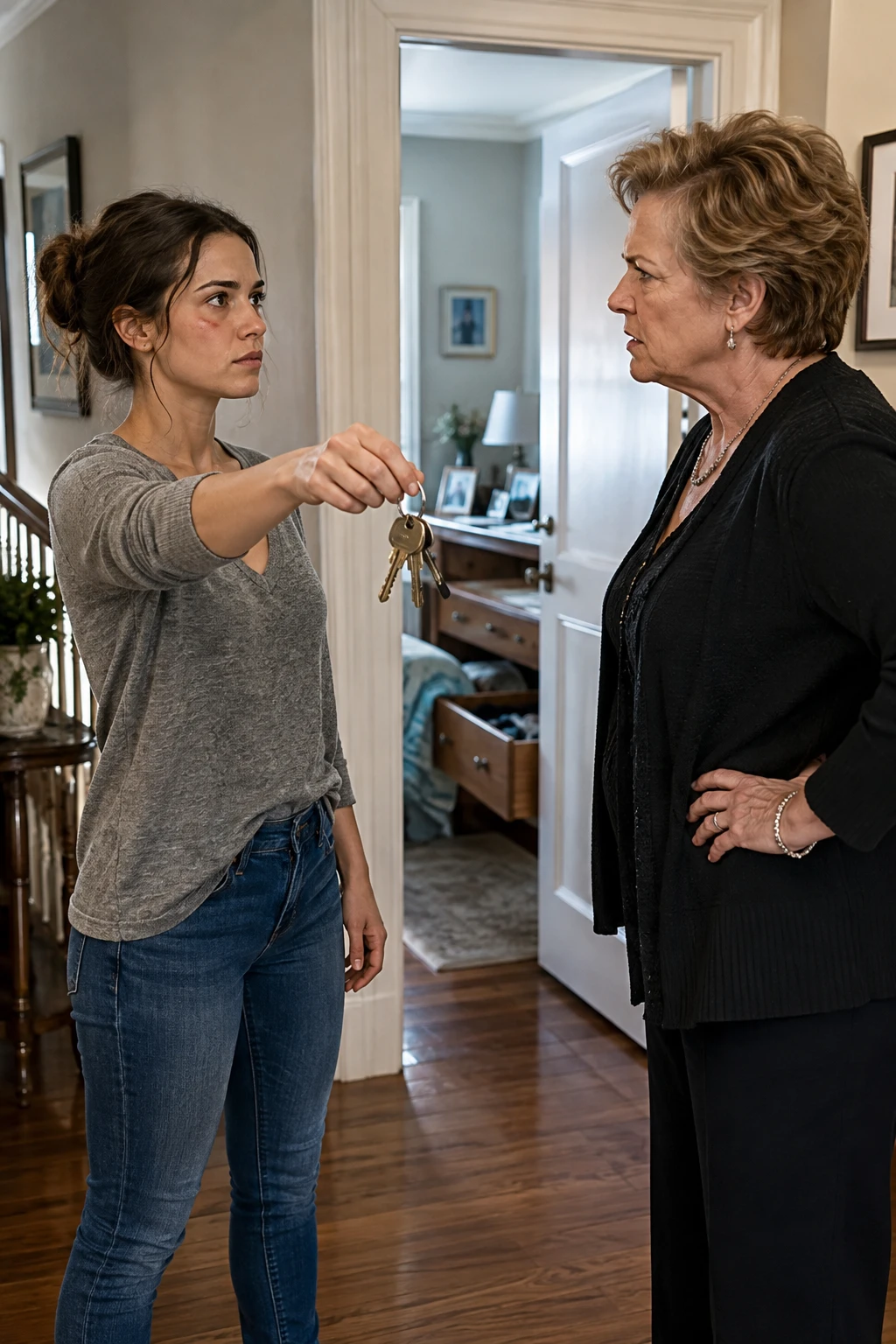
The keys hit my face before I fully understood that my mother-in-law had actually thrown them.
A heavy brass ring clipped the bone beneath my left eye, bounced off my cheek, and struck the hardwood floor with a sharp metallic crack.
For one stunned second, nobody moved.
Gertrude stood six feet away from me in the upstairs hallway, her chest rising and falling, her mouth pinched into a thin line.
Behind her, the door to my bedroom was open.
More importantly, the second drawer of my desk was open too.
I had closed it before leaving for work that morning.
I knew because that drawer contained my grandmother’s documents—insurance records, old bank papers, the original closing documents for the house, and several personal letters I could never bring myself to throw away.
Gertrude lifted her chin.
“This is my son’s house,” she snapped.
I touched my cheek.
My fingers came away clean, but the skin was already burning.
“What were you doing in my desk?”
She didn’t even blink.
“I don’t have to explain myself to you.”
“You absolutely do.”
Her face twisted.
“This house belongs to Brandon too. You’re married. Stop acting like you’re some landlord letting us stay here out of charity.”
That word—us—settled strangely in my stomach.
Six months ago, Gertrude had arrived with three suitcases and a promise.
“Two weeks,” she had said.
Her condo had suffered major water damage after a pipe burst in the unit above hers. I had felt terrible for her.
Two weeks became six.
Six became twelve.
By month four, she had started receiving mail at our address.
By month five, she had rearranged my kitchen.
By month six, she had stopped knocking before entering our bedroom.
And now she was standing outside my desk with my private papers disturbed, telling me I had no authority in my own home.
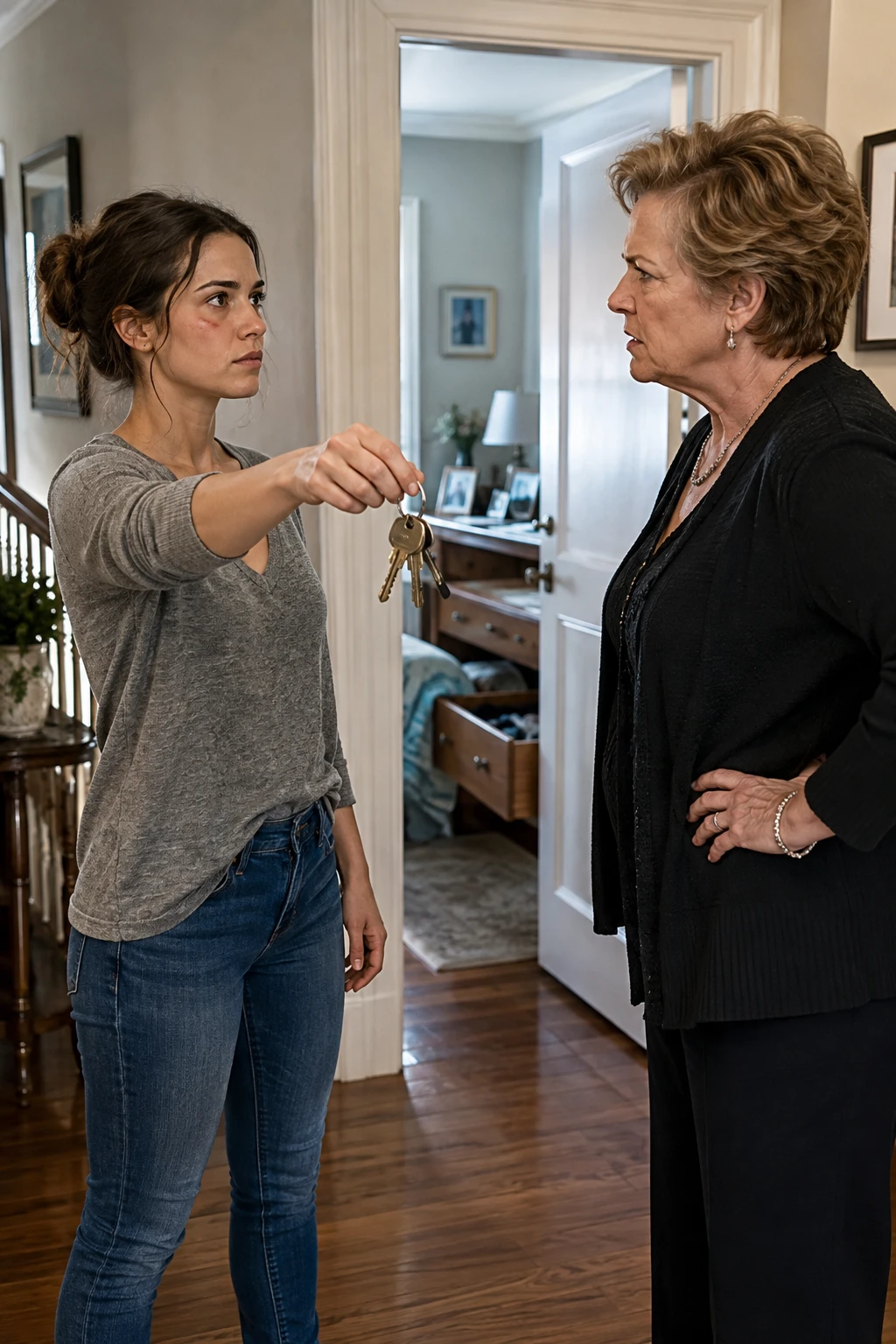
I looked down at the keys she had thrown.
Then I bent, picked them up, and held out my hand.
“Then I guess you won’t be needing these anymore.”
Gertrude stared at me.
Then she laughed.
Not nervously.
Not apologetically.
She laughed like I had just threatened to arrest the President.
“You think you can lock me out?”
“I know I can.”
“Brandon will give me another key.”
I closed my fingers around the ring.
“Then Brandon will be making a choice.”
Her smile faltered.
Only slightly.
But I noticed.
And for reasons I couldn’t explain yet, that tiny flicker of fear frightened me more than her anger had.
I bought the house three years before I married Brandon.
My grandmother, Evelyn, raised me after my parents died in a car accident when I was nine. She was practical, stubborn, disciplined, and almost impossible to fool.
She also loved me with the kind of love that made you feel protected even when she wasn’t in the room.
When she died, she left me an inheritance.
I used part of it as the down payment on the house.
The deed was in my name. The mortgage was in my name. The insurance was in my name.
Brandon knew all of that before our wedding.
He had never contributed to the down payment.
We split ordinary household expenses after we married, but legally, the property remained mine.
At our reception, he had even raised a glass and joked, “I married Claire, not her house.”
Everyone laughed.
I laughed too.
For years, the comment meant nothing.
Lately, I had started remembering it differently.
Especially after Gertrude moved in.
So that afternoon, I called a locksmith.
He arrived at three-thirty.
I showed him my identification and property documents.
He changed the front lock.
Then the back.
Then the side door.
Then he reset the electronic keypad.
Gertrude stood in the driveway with her arms crossed.
When the locksmith asked how many keys I wanted, I said, “Two.”
One for me.
One for Brandon.
None for her.
Gertrude gave me a smug smile.
“That doesn’t matter. My son will give me his.”
I looked directly at her.
“Then my husband will be choosing whether he respects me.”
For the first time, she looked away.
Brandon came home just before seven.
His eyes immediately went to the red mark beneath mine.
“What happened?”
Before I could answer, Gertrude said, “Your wife has lost her mind.”
I waited.
Brandon looked between us.
“She threw a ring of keys at my face,” I said.
His jaw tightened.
“Mom?”
“She was being disrespectful.”
“That wasn’t my question.”
Gertrude folded her arms.
“Oh, please. They slipped.”
“They did not slip,” I said.
Brandon exhaled through his nose.
“She shouldn’t have thrown anything at you.”
Relief rushed through me so suddenly I almost smiled.
Then he continued.
“But changing every lock seems extreme, Claire.”
The relief vanished.
I stared at him.
“Extreme?”
“You could have talked to me first.”
“I tried talking for six months.”
“That’s not fair.”
“Your mother was in our bedroom. My desk drawer was open.”
Gertrude scoffed.
“I was looking for a pen.”
“In a drawer containing financial documents?”
“Do you hear yourself?” Brandon asked. “You sound paranoid.”
There it was.
The same word dressed in different clothing.
Paranoid.
Overreacting.
Imagining things.
I reached into my pocket and removed his new key.
I placed it in his palm.
“This lets you into your home,” I said quietly. “It does not give your mother permission to enter our bedroom. It does not give her permission to search my things.”
I paused.
“And it absolutely does not give her permission to make a copy.”
Gertrude’s eyes moved to Brandon’s hand.
His fingers slowly closed around the key.
He said nothing.
That silence told me more than I wanted to know.
At 11:47 that night, one of my hallway cameras recorded Brandon slipping downstairs.
I didn’t see the footage until the following afternoon.
At the time, I was asleep.
The camera showed him walking through the kitchen, opening the side door, and stepping into the driveway.
Gertrude’s car was parked near the curb.
She rolled down her window.
Brandon looked back toward the house.
Then he handed her something small.
Metal flashed beneath the porch light.
My new key.
The following morning, Brandon left early for work.
Gertrude was gone too.
At 12:16 p.m., my phone buzzed.
Motion detected.
I opened the app.
Gertrude walked through my front door.
She carried a shiny copied key.
My first emotion wasn’t anger.
It was grief.
There is a particular kind of pain that comes from watching someone prove you were right about them.
I replayed the previous night’s footage.
Once.
Twice.
Three times.
Then I saved copies to my phone, laptop, and cloud storage.
After that, I called an attorney.
Her name was Marissa Cole, and my grandmother had used her firm years earlier for estate planning.
I had expected a fifteen-minute consultation.
Instead, when I mentioned Evelyn’s name, Marissa became quiet.
“Claire,” she said, “can you come in today?”
Something in her voice made my stomach tighten.
“Yes.”
“Bring every document Gertrude may have accessed.”
Marissa’s office smelled like coffee and old paper.
She watched the camera footage twice without interrupting.
Then she asked me something unexpected.
“Has Brandon ever asked you to refinance?”
I froze.
“Last year.”
“What did you say?”
“No.”
“Why?”
“He wanted to invest in a friend’s fitness franchise. I thought it was too risky.”
“Did he ask to be added to the deed?”
“Once. Maybe twice.”
“And?”
“I said we could discuss it later.”
Marissa leaned back.
“Has anyone contacted you recently about a home equity loan?”
“No.”
She turned her monitor toward me.
“Then we have a problem.”
On the screen was a scanned application.
My address.
My property information.
My estimated equity.
And at the bottom—
my signature.
Except I had never signed it.
My mouth went dry.
“What is that?”
“A preliminary HELOC application submitted three weeks ago.”
I stared at her.
“That isn’t my signature.”
“I know.”
“How?”
“Because your grandmother made you sign several estate documents in front of this firm. We have verified samples.”
The room seemed to tilt.
“Who submitted it?”
“That’s what we’re going to find out.”
Then Marissa opened another file.
A scanned copy of my deed.
Several handwritten notes had been made along the margin.
One sentence was underlined twice.
SOLE AND SEPARATE PROPERTY.
I felt cold.
“This is why she was in my desk.”
“Possibly.”
“Brandon wants the house.”
Marissa didn’t answer immediately.
“Maybe.”
Her hesitation scared me.
“What aren’t you telling me?”
She folded her hands.
“Your grandmother left instructions concerning this property.”
I frowned.
“What instructions?”
“There is a sealed supplemental file in our archives. Evelyn requested that it remain unopened unless someone attempted to transfer, encumber, or falsely claim an interest in the property.”
I stared at her.
“That’s incredibly specific.”
“Yes.”
“Why would she do that?”
Marissa’s expression changed.
“I’ve wondered that for seven years.”
That evening, Brandon came home to find an envelope on the kitchen table.
Inside was a formal notice from Marissa’s firm informing him that I was aware of an unauthorized loan application connected to my property.
His face drained of color.
Gertrude walked in ten minutes later.
With her copied key.
When she saw the envelope, she stopped.
Brandon turned toward her.
“What did you do?”
Her reaction was immediate.
“What did I do?”
“You said she’d never find out.”
My entire body went still.
Gertrude’s eyes sharpened.
“Shut your mouth.”
Brandon stared at her.
And in that instant, six years of marriage cracked open.
“You knew?” I whispered.
He looked at me.
“Claire—”
“You knew.”
“It wasn’t supposed to hurt you.”
I laughed once.
It sounded broken.
“A forged loan application wasn’t supposed to hurt me?”
“I was going to pay it back.”
“You were going to borrow against my house using my forged signature.”
Gertrude stepped forward.
“It would have benefited both of you.”
“Get out.”
“This is my son’s—”
“GET OUT!”
The shout tore through the kitchen.
Gertrude actually flinched.
I pointed toward the door.
“Both of you.”
Brandon looked stunned.
“Claire, this is my home.”
“No. It’s the place where you lived while pretending to be my husband.”
His face crumpled.
“Please.”
“You copied a key for the woman who assaulted me.”
“I was trying to keep the peace.”
“You forged my signature.”
His silence was enough.
I picked up my phone.
“Leave voluntarily, or I call the police and show them everything.”
Gertrude’s expression changed.
Not fear.
Calculation.
“You don’t understand what you’re doing.”
“No,” I said. “For the first time, I understand exactly what I’m doing.”
They left.
But Gertrude turned at the door.
“You should ask your grandmother why she really bought this house.”
Then she walked away.
I barely slept.
The next morning, I met Marissa at her office.
The sealed file sat between us.
My grandmother’s handwriting covered the envelope.
FOR CLAIRE—ONLY IF SOMEONE COMES FOR THE HOUSE.
My hands shook.
Marissa broke the seal.
Inside were legal documents, photographs, and a handwritten letter.
The first photograph showed my grandmother standing beside a younger woman.
I recognized her instantly.
Gertrude.
Thirty years younger.
But unmistakably Gertrude.
My heartbeat stopped.
“What the hell?”
Marissa handed me another photograph.
Gertrude was standing outside the same house I now owned.
Only the date printed on the back was 1994.
I looked up.
“She knew my grandmother?”
Marissa nodded slowly.
“Read the letter.”
I unfolded it.
Claire,
If you are reading this, then someone has tried to convince you that what belongs to you belongs to them.
I hoped I was wrong.
But I learned a long time ago that greed often waits patiently.
The next paragraph made my hands go numb.
Gertrude had once worked for my grandmother.
Not as an employee.
As a business partner.
My grandmother and Gertrude had jointly purchased a small apartment building decades earlier.
Gertrude secretly took loans against the property and forged signatures.
When everything collapsed, my grandmother bought her out, covered debts she did not owe, and avoided criminal charges only because Gertrude begged her to protect Brandon, who was still a child.
I stared at the letter.
“Brandon knew?”
Marissa pointed toward another page.
I kept reading.
Gertrude blamed me for losing what she believed should have been hers. She said one day her son would have everything my family had taken from her.
I felt sick.
The house wasn’t random.
My marriage suddenly didn’t feel random either.
“Did Brandon marry me because of this house?”
Marissa looked grim.
“We need evidence.”
We found it sooner than expected.
Police investigating the forged application obtained emails connected to the loan submission.
One was from Brandon to Gertrude.
Dated two months before he proposed to me.
Claire inherited more than we thought.
Another:
If we marry, eventually she’ll add me to the deed. Stop pushing.
Another, four years later:
She still won’t refinance.
And finally, three weeks before the keys hit my face:
Find the original deed and Evelyn’s trust papers. There has to be something we can use.
I read them sitting inside Marissa’s conference room.
My hands were completely still.
That frightened me.
Six years.
Birthdays.
Anniversaries.
Sunday mornings.
Hospital visits.
Inside jokes.
His hand reaching for mine beneath restaurant tables.
Every memory became evidence at a crime scene.
Marissa touched my arm.
“Claire?”
“I married a strategy.”
She didn’t tell me I was wrong.
Brandon was charged in connection with the fraudulent loan application.
Gertrude denied everything.
Then she made one final move.
She filed a civil claim asserting that the house had originally been purchased using money wrongfully taken from her during the dissolution of her partnership with my grandmother.
It was desperate.
But it explained her obsession with the old records.
She believed she could turn a decades-old business dispute into ownership of my home.
For weeks, lawyers exchanged documents.
Gertrude gave interviews to relatives.
She told anyone who would listen that I had stolen her son, stolen her property, and manipulated the legal system.
Brandon sent letters.
I never answered.
Then came the deposition.
Gertrude arrived wearing navy blue and pearls, looking like somebody’s elegant grandmother.
She answered questions calmly until Marissa placed my grandmother’s old ledger on the table.
Gertrude’s face changed.
Marissa opened it.
“There is a final accounting from your partnership.”
Gertrude leaned forward.
“I’ve never seen that.”
“Yes, you have.”
“No.”
Marissa produced a receipt.
Gertrude’s signature appeared beneath a settlement acknowledging full payment.
The claim was dead.
I should have felt relieved.
Instead, Marissa looked unsettled.
During a break, I asked why.
“There’s something else.”
“What?”
“When investigators examined the original documents, they found another name connected to the old partnership.”
“Who?”
She hesitated.
Then said, “Your father.”
I stopped breathing.
“My father died when I was nine.”
“I know.”
“He had nothing to do with Grandma’s business.”
“That’s what you were told.”
The final truth came from a safe-deposit box nobody knew existed.
Inside was one cassette tape, several letters, and a sealed birth certificate.
Marissa offered to sit with me while I listened.
I almost said no.
Then I pressed play.
My grandmother’s voice filled the room.
Older.
Tired.
unmistakably hers.
“Claire, there is one thing I could never bring myself to tell you.”
I closed my eyes.
“You were told your parents died together in a car accident. Your mother did. The man you believed was your father did as well.”
I frowned.
Then came the sentence that split my life in half.
“But he was not your biological father.”
I stopped the tape.
Marissa said nothing.
I pressed play again.
My grandmother continued.
“Your biological father was a man named Thomas Whitaker.”
Gertrude’s former husband.
Brandon’s father.
I couldn’t understand the words.
Not at first.
Then my mind rearranged them.
Thomas Whitaker.
Gertrude’s husband.
Brandon’s father.
My stomach turned.
“No.”
Marissa grabbed my hand.
“No, no, no.”
I stood so fast the chair fell backward.
“Brandon is my brother?”
“Claire—”
“I married my brother?”
“Listen to the rest.”
“I’m going to be sick.”
“Claire, listen.”
I hit play.
My grandmother’s voice continued.
“Thomas believed you were his child. He was wrong.”
I froze.
The room went silent except for the tape.
“Your mother had allowed him to believe it because she feared the truth would destroy several families. Years later, DNA testing proved Thomas was not your biological father.”
I nearly collapsed from relief.
Marissa steadied me.
The recording continued.
“The test was done after Thomas attempted to claim custody. The biological father was never identified.”
I stared at the machine.
“So why hide this?”
The answer came seconds later.
“Because Gertrude never knew the DNA test existed.”
My skin prickled.
“She believed you were Thomas’s daughter.”
Suddenly, every impossible piece snapped together.
Gertrude had spent years believing something that wasn’t true.
She believed I was her late husband’s secret child.
She believed my grandmother had protected the affair.
She believed I had inherited money that somehow represented what had been stolen from her.
And worst of all—
she knew exactly who she believed I was when she encouraged Brandon to marry me.
I looked at Marissa in horror.
“She thought Brandon and I were related.”
Marissa’s face was pale.
“Yes.”
The betrayal became something darker than greed.
Gertrude had not merely wanted my house.
She had been willing to let her own son marry a woman she believed was his half-sister if it meant getting access to my inheritance.
I thought nothing could shock me more.
I was wrong.
Because the final letter in the box was written by Brandon.
Not recently.
Twelve years earlier.
He had been nineteen.
The handwriting was messy.
The first line read:
Mom, I know Claire isn’t Dad’s daughter. I found the DNA report.
I stopped.
Read it again.
Then again.
Brandon had known.
Long before we met.
Long before he proposed.
Long before he stood before our families and promised to love me.
The next lines changed everything.
But Mom still believes she is. Don’t tell her. As long as she believes Claire is connected to Dad, she’ll never stop watching that family. Maybe someday that helps us.
I stared at the paper.
Brandon had not been manipulated by his mother.
He had manipulated her.
For years.
He had allowed Gertrude to believe the darkest possible lie because her obsession gave him access to information about my grandmother, my inheritance, and eventually me.
His mother thought she was using her son.
In reality, her son had been using everyone.
Even her.
Especially me.
Months later, the criminal case ended with Brandon pleading guilty to fraud-related charges.
Gertrude’s civil claim collapsed completely.
She never apologized.
Brandon tried.
His final letter arrived on a rainy Thursday.
Claire, I loved you eventually.
Eventually.
That single word hurt more than the keys ever had.
I burned the letter in the fireplace.
Then I sold the house.
People were surprised.
After everything I had done to protect it, they expected me to stay forever.
But they misunderstood.
My grandmother had never protected the house because houses matter more than people.
She protected it so I would always have a choice.
So nobody could trap me.
So nobody could tell me that safety depended on staying somewhere that had become poisonous.
I used part of the sale money to buy a smaller place near the coast.
The rest went into an account nobody else could touch.
On the day I moved, I stood in the empty hallway where Gertrude had thrown those keys at my face.
The red mark was long gone.
The woman who had stood there that morning was gone too.
She had believed keeping the house meant winning.
I knew better now.
Before leaving, I placed the old brass key ring on the kitchen counter.
Not because Gertrude had been right.
Not because Brandon had won.
But because I no longer needed a key to a life I had outgrown.
I stepped outside.
The locksmith—the same one who had changed every lock months earlier—was waiting by his van because the buyers wanted the property rekeyed before closing.
He recognized me.
“Moving on?” he asked.
I smiled.
“Finally.”
He glanced at the house.
“Want to keep one key as a souvenir?”
For a moment, I thought about my grandmother.
About the inheritance.
About Brandon.
About Gertrude standing in my driveway insisting that my husband would simply give her another copy.
Then I shook my head.
“No.”
I looked back at the house one last time.
“Some doors are better closed for good.”
And for the first time in six years, I walked away without wondering who might be following me.
Because the most valuable thing my grandmother had left me had never been the house.
It had never been the money.
It had never even been the truth.
It was the ability to leave the moment someone mistook my love for permission to own me.