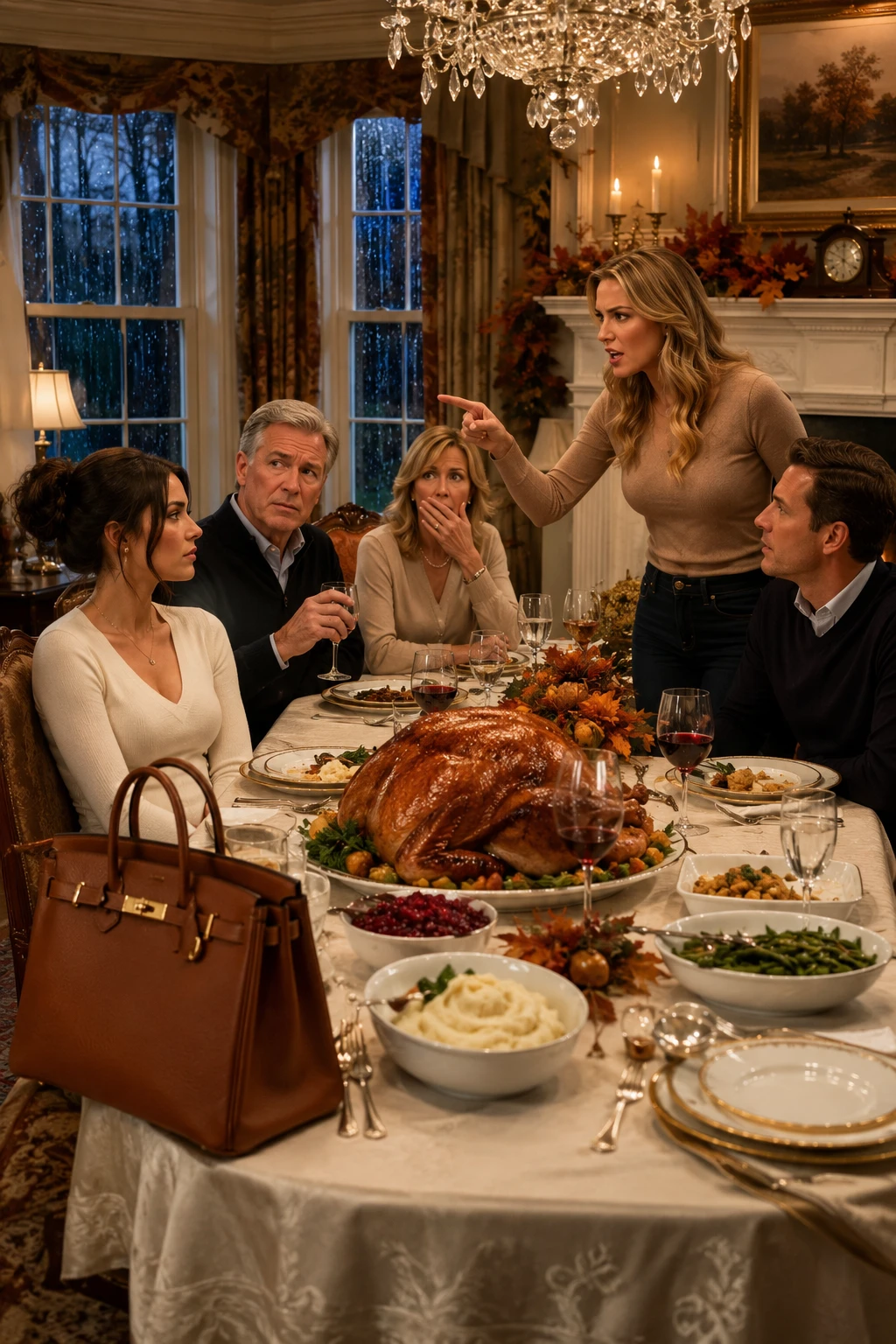
The handbag beside my chair cost more than the first car my father ever bought.
That should have been irrelevant.
Instead, it became the reason my family finally discovered that the daughter they had spent years pitying was the only reason they still had a company to inherit.
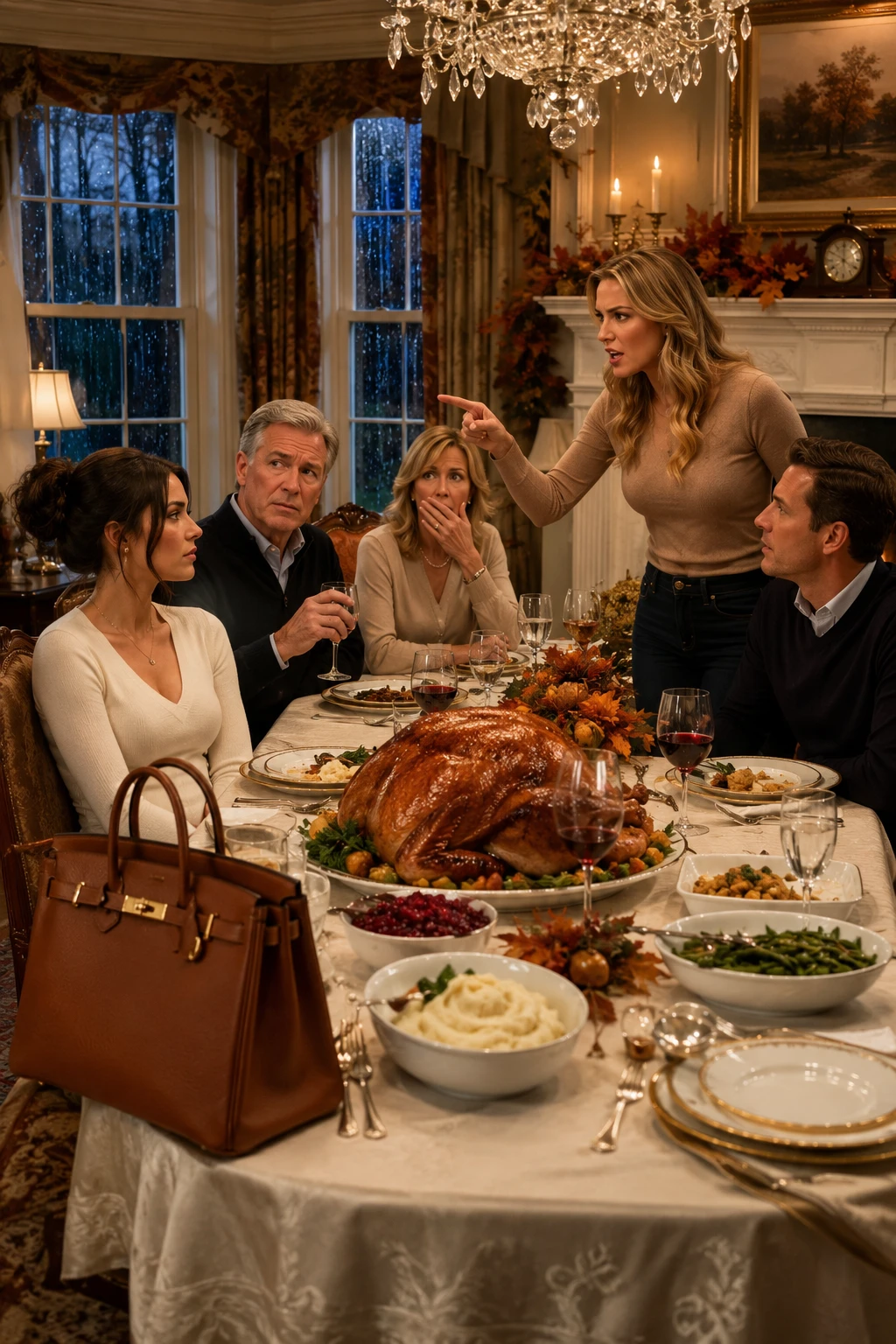
Thanksgiving dinner had barely started when my older sister, Paige, noticed the bag.
It was cognac leather, understated except for the brushed gold clasp. No oversized logo. No glittering monogram. The sort of handbag people recognized only if they already knew what they were looking at.
Paige leaned across the table with the cranberry sauce in one hand.
“Cute bag,” she said. “Canal Street special?”
Dad nearly spit out his wine.
Mom covered her mouth.
Even Paige’s husband, Travis, gave an uncomfortable laugh.
I kept slicing turkey.
Rain traced silver lines down the tall windows behind my father. My mother’s expensive cedar candles burned on the sideboard, filling the room with the same carefully manufactured warmth that had defined every family holiday since childhood.
Everything looked perfect.
Everything always looked perfect.
“Paige,” Mom said, smiling despite herself. “Be nice.”
Then she turned to me.
“But, sweetheart, you really should be careful with counterfeit designer things. People can tell.”
I placed my knife beside my plate.
“It isn’t counterfeit.”
Paige laughed harder.
And just like that, dinner became an intervention.
“This whole thing you’ve been doing lately is embarrassing,” she said.
“What thing?”
“The clothes. Paris. Napa. Those hotels in Manhattan. The restaurants.” She waved vaguely at me. “You post like you’re some kind of millionaire.”
Dad leaned back.
His expression shifted.
I knew that expression.
Richard Bennett had spent thirty-five years as a corporate attorney before taking over as chairman of Bennett Healthcare Holdings, the family company his father had founded.
He had a particular tone when he wanted to make someone feel irrational.
Calm.
Measured.
Almost compassionate.
“You earn roughly sixty-five thousand dollars a year at your nonprofit,” he said. “Correct?”
“Yes.”
“So naturally, we’re concerned.”
“About?”
“Debt.”
“I don’t have any.”
Paige snorted.
“Then where is the money coming from?”
She tilted her head.
“Unless you secretly married a billionaire.”
A beat.
“Oh, right.”
Her smile sharpened.
“You’re still single.”
The table laughed again.
My phone vibrated beside my water glass.
I glanced down.
Daniel Cho — Chief Legal Counsel, Wren Medical Systems.
The message was brief.
Confirming your instruction to proceed tomorrow with the sale of your 51% controlling interest unless authorization is withdrawn before 8:00 a.m.
I read it twice.
Fifty-one percent.
A controlling stake in Wren Medical Systems.
Current valuation: approximately two hundred million dollars.
I locked the screen.
Paige noticed.
“See?” she said. “Probably another fake luxury notification.”
“Paige,” Travis murmured.
“No. Someone has to say it.”
She looked directly at me.
“You’re catfishing your own life.”
Something inside me became very quiet.
Not angry.
Not embarrassed.
Quiet.
Because the strangest thing about being underestimated for years is that eventually, you stop wanting to correct people.
You start wondering how far they’ll go when they think you’re powerless.
I turned my phone over.
Dad sighed.
“Elise, whatever you’re about to show us, you don’t need to keep pretending.”
For the first time that evening, I smiled.
“Pretending?”
Paige folded her arms.
“Just admit you can’t afford this lifestyle.”
I unlocked my phone.
“You’re right.”
Everyone stared.
“Maybe it’s time we talk about money.”
I slid the phone across the table.
Dad picked it up.
The smugness vanished from his face before he reached the second line.
He read the message once.
Then again.
“What is this?”
Paige leaned over his shoulder.
Her face changed when she saw the words 51% controlling interest.
“That’s impossible.”
Dad looked at me.
“Elise, why would Wren Medical Systems’ chief legal counsel be contacting you?”
I lifted my wineglass.
“Because the shares belong to me.”
No one moved.
The antique clock clicked on the mantel.
Once.
Twice.
Three times.
Then Dad laughed.
It was too loud.
Too quick.
“You own fifty-one percent of Wren?”
“Yes.”
“That’s absurd.”
“It’s documented.”
Paige shook her head.
“No. No, this is some scam.”
“Daniel Cho isn’t a scam.”
Dad’s phone began ringing.
He looked down.
Whatever name appeared on the screen drained the color from his face.
He stood so abruptly his chair scraped against the floor.
“I have to take this.”
He walked into the study.
The door shut.
Nobody spoke.
Mom looked at me like I had transformed into someone else.
“How?” she whispered.
I took a bite of turkey.
“Investment.”
Paige barked a laugh.
“You invested two dollars and somehow became majority owner of a two-hundred-million-dollar company?”
“No.”
“How much?”
“Initially?”
“Yes.”
“About three hundred thousand.”
Her mouth fell open.
“Where did you get three hundred thousand dollars?”
Before I answered, Dad returned.
His face was gray.
He didn’t sit.
“That was Mark Feldman.”
The name meant something to Paige.
Her posture changed.
Mark Feldman was Bennett Healthcare’s chief financial officer.
Dad looked at me.
“Wren called an emergency board meeting for tomorrow morning.”
“I know.”
“Why?”
“Because of the sale.”
“What sale?”
“My shares.”
His voice tightened.
“To whom?”
“I haven’t signed the final buyer authorization yet.”
Dad stared.
Then something clicked in his expression.
Something I had been waiting years to see.
Fear.
“Elise,” he said slowly, “do you understand what Wren represents to Bennett Healthcare?”
“Yes.”
“No, I don’t think you do.”
I almost laughed.
“I understand exactly.”
Wren Medical Systems manufactured specialized diagnostic equipment.
Bennett Healthcare distributed it.
For the last six years, Wren products had quietly become almost forty percent of Bennett Healthcare’s annual revenue.
The public story was that Dad had built a brilliant strategic partnership.
The private truth was considerably more complicated.
I knew because I had created the partnership.
Dad gripped the back of his chair.
“If those shares go to the wrong buyer, they could renegotiate our distribution agreement.”
“Yes.”
“They could terminate exclusivity.”
“Yes.”
Paige looked between us.
“What are you talking about?”
Dad ignored her.
“You cannot sell without consulting this family.”
I tilted my head.
“Why?”
His voice rose.
“Because it affects all of us.”
I felt something almost like amusement.
“Interesting.”
Dad froze.
I continued.
“Five minutes ago, my finances were embarrassing and none of your business.”
“Elise—”
“But now my property affects the family?”
Mom whispered my name.
I turned toward her.
She looked genuinely frightened.
That almost hurt worse than Paige’s laughter.
Because Mom had known pieces.
Not everything.
But enough.
She had simply never asked.
Dad sat slowly.
“Start from the beginning.”
So I did.
Not because they deserved it.
Because I had spent fourteen years waiting for this conversation.
When I was twenty-two, I had been the disappointing Bennett daughter.
Paige had graduated from Wharton.
I had studied biomedical engineering.
Dad called it impractical.
Paige joined Bennett Healthcare straight out of business school.
I joined a nonprofit that funded low-cost medical technology for rural hospitals.
Dad called that “charity work.”
What he never knew was that during my first year there, I met Dr. Adrian Wren.
At the time, his company consisted of six people working in a converted warehouse outside Boston.
He had developed a portable diagnostic platform that could reduce testing costs dramatically, but nobody wanted to finance manufacturing.
I did.
Not personally at first.
I helped him secure grants.
Introduced him to donors.
Found hospital partners.
And when the company nearly collapsed during its second year, Adrian offered me equity in exchange for money he desperately needed.
I had inherited $310,000 from my maternal grandmother.
Dad believed Mom had placed it in conservative investments.
She hadn’t.
Grandma had left the money directly to me with one handwritten note.
Build something no one can take credit for.
I invested $300,000 in Wren.
The company survived.
Three years later, it was profitable.
Five years later, venture capital arrived.
Eight years later, Wren was worth more than one hundred million dollars.
Through dilution protection, option purchases, and one early shareholder’s exit, my stake had eventually reached fifty-one percent.
Paige stared at me.
“You’ve been rich for years?”
“I’ve had equity for years.”
“That’s the same thing.”
“No. It isn’t.”
Dad looked furious.
“You concealed this.”
“I kept it private.”
“From your family.”
“Yes.”
“Why?”
I looked at him.
“Do you want the polite answer?”
His jaw tightened.
“No.”
“Because you taught me to.”
The room became still again.
I remembered being seventeen and showing Dad a science competition certificate.
Second place statewide.
He had glanced at it and said, “That’s nice. Paige was elected student body president.”
I remembered being twenty-four and telling him our nonprofit had installed diagnostic units in twelve underserved hospitals.
He responded by asking if I had considered applying for “a serious position” at Bennett.
I remembered bringing Adrian Wren to a charity gala.
Dad had spent twenty minutes talking over him before dismissing his technology as “interesting but commercially premature.”
Six months later, I introduced Wren to Bennett Healthcare through an intermediary.
Dad never knew I was behind it.
He thought one of his executives had found the deal.
And I let him.
Because success was the only thing my father respected—and I wanted to know whether he could respect something without knowing it belonged to me.
He could.
He praised the Wren partnership constantly.
He just never praised me.
Mom looked down at the table.
“Elise, why didn’t you tell me?”
“You remember Grandma’s funeral?”
Her face tightened.
“Yes.”
“Dad said she left me money because she felt sorry for me.”
Dad looked away.
I continued.
“You said nothing.”
Mom’s eyes filled with tears.
That was answer enough.
Paige pushed back from the table.
“This is insane.”
She paced toward the window.
“So what? You’re selling because we made fun of your handbag?”
“No.”
“Then why?”
I looked at Dad.
“Ask him.”
Dad’s head snapped toward me.
Paige stopped.
“What does that mean?”
Dad said nothing.
I reached into my bag and removed a thin envelope.
That finally got everyone’s attention.
I placed it on the table.
“I was hoping tonight might be normal.”
Paige laughed bitterly.
“You brought legal documents to Thanksgiving.”
“I brought them because I knew Dad was going to announce something.”
Dad’s face tightened.
Mom looked at him.
“Richard?”
I slid the envelope toward Paige.
She opened it.
Her eyes moved across the first page.
Then widened.
“What the hell is this?”
Travis stood behind her and read over her shoulder.
His expression changed too.
Mom whispered, “What?”
Paige looked at Dad.
“Bennett Healthcare is being sold?”
Silence.
Then Mom’s face went blank.
“What?”
Dad closed his eyes.
“Not sold.”
Paige slammed the paper onto the table.
“It says preliminary acquisition agreement.”
“It’s a merger.”
“It says Harrow Capital would acquire seventy percent.”
Mom stared at him.
“You told me you were restructuring.”
“I was going to explain tonight.”
Paige looked furious.
“I work there. I’m senior vice president. You didn’t tell me?”
“I was protecting the transaction.”
I almost smiled.
There it was.
The Bennett family motto.
Secrets were betrayal when I kept them.
Strategy when Dad did.
Paige flipped pages.
Then she stopped.
Her expression became confused.
“Why is Wren mentioned?”
Dad looked at me.
Because the sale depended on Bennett retaining its Wren distribution agreement for at least five years.
Without that agreement, Harrow Capital’s valuation of Bennett collapsed.
And Dad knew it.
The acquisition would make him enormously wealthy.
It would secure Paige’s executive position.
It would also trigger a clause allowing Dad to cash out preferred shares worth nearly forty million dollars.
My controlling stake in Wren had become the invisible hinge on which his entire deal turned.
Paige finally understood.
“You’re selling Wren to stop Dad’s acquisition?”
“No.”
Dad looked at me sharply.
“No?”
“No.”
“Then why are you selling?”
I leaned back.
“Because Adrian wants to retire.”
That was true.
“And because the buyer offered a premium.”
Also true.
“And because Bennett Healthcare has been violating the distribution agreement for eleven months.”
Dad went completely still.
Mark Feldman had discovered it first.
Bennett had been quietly bundling cheaper third-party equipment with Wren service contracts while reporting the bundles as Wren-compatible packages.
Profitable.
Clever.
And explicitly prohibited.
Paige looked horrified.
“Dad?”
“It was a temporary sales strategy.”
“It was fraud,” I said.
“It was not fraud.”
“Your lawyers disagree.”
His eyes flashed.
“You spoke to my lawyers?”
“No.”
I paused.
“Wren’s.”
Dad stared at me.
That was when Travis spoke for the first time.
“Elise.”
His voice was low.
“There’s something else, isn’t there?”
Everyone turned toward him.
Travis had always been the quiet one.
A pediatric surgeon.
Polite.
Observant.
The only person at the table who had never mocked my job.
I met his eyes.
“Yes.”
Paige looked between us.
“What?”
I took a breath.
“The buyer.”
Dad’s face hardened.
“Who is it?”
I reached for my phone.
Before I could answer, Paige’s phone buzzed.
Then Dad’s.
Then Travis’s.
Three notifications almost simultaneously.
Dad looked down first.
His lips parted.
“No.”
Paige grabbed her phone.
“What?”
Her face went white.
Mom whispered, “What happened?”
Paige read aloud.
“Bennett Healthcare board schedules emergency session following receipt of notice from Wren Medical Systems…”
Her voice faltered.
Dad looked at me with something beyond anger.
“Who is the buyer?”
I answered.
“Harrow Capital.”
Nobody moved.
Then Paige laughed once.
A shocked, broken sound.
“That makes no sense.”
“It makes perfect sense.”
Harrow wanted Bennett.
But they had discovered Bennett’s value depended too heavily on Wren.
So instead of buying Bennett first, they approached me.
Acquire Wren.
Control the supplier.
Then renegotiate Bennett’s valuation from a position of strength.
Dad looked sick.
“You’re helping them destroy our sale.”
“No.”
I leaned forward.
“I’m helping them determine what Bennett is actually worth.”
“That could cut our valuation in half.”
“Yes.”
Paige stared at me.
“You knew Dad was selling.”
“For three months.”
“You knew?”
“Harrow contacted Wren during due diligence.”
Dad slammed his hand onto the table.
“You could have come to me!”
“Would you have told me the truth?”
“Yes.”
I held his gaze.
He lasted two seconds.
Then looked away.
But the night was not finished.
Not even close.
My phone rang.
Daniel.
I answered.
“Hi.”
“Elise,” he said, “we have a development.”
Everyone watched me.
“What?”
“Harrow has modified the offer.”
My stomach tightened.
“How?”
“They no longer want only your Wren position.”
I stood slowly.
“What do they want?”
Daniel paused.
“They want Bennett Healthcare too.”
Dad heard that.
His face changed.
“What?”
Daniel continued.
“They believe the compliance exposure makes the current acquisition structure untenable. They’re withdrawing the prior term sheet.”
Dad grabbed the edge of the table.
“And?”
“They want to acquire the distressed voting block directly.”
I frowned.
“What voting block?”
Daniel went silent for half a second.
Then said something that changed everything.
“The shares held by the Bennett Family Trust.”
I looked at Dad.
He wasn’t breathing.
Paige whispered, “What trust?”
Mom suddenly stood.
Her chair fell backward.
That was the moment I knew.
The real secret at the table wasn’t mine.
It was hers.
“Mom?”
She stared at Dad.
“You said you fixed it.”
Dad said nothing.
My heart began pounding.
“Fixed what?”
Mom’s hands shook.
“The trust.”
Paige looked furious.
“What trust?”
Mom sat again.
Then she looked at us.
“Your grandfather didn’t leave Bennett Healthcare to your father.”
Dad closed his eyes.
The room seemed to tilt.
Mom continued.
“He left it to both of you.”
Paige went still.
I forgot how to breathe.
“What?”
“Your grandfather created a generation-skipping trust. Richard was given management control while you were minors. But the beneficial ownership…” She swallowed. “It was always meant to transfer equally to Paige and Elise.”
I stared at Dad.
Every sound disappeared.
The rain.
The clock.
The candles.
Everything.
“You told us Grandpa left the company to you.”
Dad’s voice was barely audible.
“It was more complicated than that.”
Mom started crying.
“No. It wasn’t.”
Dad turned on her.
“Laura.”
“No.”
She wiped her face.
“I’m done protecting this.”
Paige looked like she might be sick.
Mom continued.
“When Elise turned thirty, the trust should have distributed voting shares equally between both girls.”
I was thirty-four.
Four years.
Four years during which Dad had acted as owner.
Four years during which Paige believed she was inheriting the company through him.
Four years during which I thought I owned none of it.
“What happened?” I whispered.
Mom looked at Dad.
“He delayed the transfer.”
Dad snapped, “For legitimate corporate reasons.”
“Then he amended documents.”
My stomach turned cold.
Daniel was still on speaker.
He said quietly, “Elise, that aligns with what Harrow’s diligence team found.”
Dad stared at the phone.
I looked at him.
“You forged trust amendments?”
“I preserved the company.”
“You stole our shares.”
“I built Bennett!”
“Grandpa built Bennett.”
“I made it what it is.”
“And that made it yours?”
His face twisted.
“You weren’t interested in the business!”
A laugh escaped me.
“You never asked.”
“You chose nonprofit work.”
“I chose work you didn’t respect.”
Paige suddenly spoke.
“What about me?”
Everyone turned.
Her eyes were wet.
She looked at Dad.
“I gave you fourteen years.”
Dad softened.
“Paige—”
“No.”
Her voice cracked.
“I worked weekends. I missed anniversaries. I postponed having children because you said the company needed me.”
Travis looked at her.
That detail clearly surprised him.
Paige pointed at me.
“You made me believe she was irresponsible.”
Dad said nothing.
“You compared us constantly.”
Silence.
“You told me I was the one carrying the family legacy.”
Her mouth trembled.
“Was any of that true?”
Dad looked at the floor.
And there it was.
The cruelest revelation of the night.
He hadn’t merely underestimated me.
He had built our rivalry deliberately.
Paige and I had spent our lives competing for a prize that legally belonged to both of us.
I looked at my sister.
For the first time in years, I didn’t see arrogance.
I saw exhaustion.
I saw the little girl who used to hold my hand crossing the street before Dad taught us that one of us always had to be winning.
Daniel spoke again.
“Elise, there’s more.”
I almost laughed.
“Of course there is.”
“The original Bennett trust includes a misconduct removal clause.”
Dad’s head lifted.
Mom whispered, “Richard…”
Daniel continued.
“If a trustee attempts unauthorized transfer, concealment, or self-dealing involving trust assets, trustee control terminates automatically upon verified notice.”
Paige stared at Dad.
“You tried to sell seventy percent of a company you didn’t own.”
Dad’s face collapsed.
Daniel said, “Harrow has formally notified the trust administrator.”
I knew the answer before asking.
“When?”
“Six minutes ago.”
Dad sank into his chair.
And then came the twist none of us saw coming.
Not even me.
Daniel said, “The trustee removal has been accepted.”
I closed my eyes.
“So Paige and I control Bennett now?”
“No.”
I opened them.
“What?”
“There is one additional provision.”
Mom covered her mouth.
Dad looked terrified.
Daniel continued.
“Your grandfather included a survivorship condition in the trust.”
My pulse quickened.
“What condition?”
“If either beneficiary independently acquired a controlling interest in a qualifying healthcare technology company before final trust vesting…”
He paused.
“…that beneficiary would receive the founder’s controlling voting block.”
Nobody spoke.
I stared at the phone.
“I don’t understand.”
Daniel’s voice softened.
“Your grandfather anticipated that Richard might favor one child.”
Dad looked as though he had been struck.
“He wanted control of Bennett to go to whichever granddaughter proved she could build or identify value independently.”
My skin went cold.
“And Wren qualifies?”
“Yes.”
Paige sat down hard.
I couldn’t speak.
Daniel delivered the final sentence quietly.
“Because you acquired controlling ownership of Wren before the trust vested, you became the controlling beneficiary of Bennett Healthcare four years ago.”
The room disappeared.
The handbag.
The candles.
The turkey.
The insults.
All of it became absurdly small.
Dad whispered, “No.”
Daniel continued.
“Based on the original trust terms, Elise holds fifty-one percent of Bennett’s voting control. Paige holds the remaining beneficiary interest.”
I looked at Dad.
For years, he had treated my career like a failure.
My choices like mistakes.
My independence like embarrassment.
And the entire time, the very investment he mocked without knowing about it had triggered the clause that made me the legal controlling owner of his company.
Paige started laughing.
Not cruelly.
Helplessly.
Tears ran down her face.
Dad stared at me.
“Elise.”
I had imagined this moment in a hundred different ways.
I thought I would want revenge.
I thought I would want him humiliated.
Instead, I felt strangely calm.
He looked old.
Not defeated.
Just small.
“What are you going to do?” he asked.
I looked at Paige.
She looked back at me.
For once, there was no competition between us.
I turned to the phone.
“Daniel.”
“Yes?”
“Withdraw authorization to sell Wren.”
Dad inhaled sharply.
Then I said, “Tell Harrow the deal is off.”
His eyes widened.
Paige stared at me.
“Elise?”
I continued.
“And call an emergency joint board meeting for Bennett and Wren tomorrow.”
Daniel paused.
“What agenda?”
I looked at Dad.
“First, remove Richard Bennett from every management and board position pending investigation.”
Dad flinched.
“Second, disclose the distribution violations.”
He closed his eyes.
“Third, restructure the Wren agreement on fair terms.”
Paige sat straighter.
“And fourth?”
I looked at her.
For the first time that night, I smiled without bitterness.
“Appoint Paige interim chief operating officer.”
Her mouth fell open.
“What?”
“You know Bennett better than anyone.”
She stared at me.
“You’d trust me?”
“I trust the woman who gave fourteen years to a company she thought she was protecting.”
Her eyes filled again.
“And you?”
I looked toward the rain-streaked window.
“I’ll chair the combined strategic committee.”
Dad gave a hollow laugh.
“So that’s it.”
I turned.
“What?”
“You take everything.”
I shook my head.
“No.”
He looked confused.
“I’m taking nothing that wasn’t already mine.”
Then Mom bent down, picked up the handbag that had started the entire disaster, and placed it gently beside me.
She ran one finger over the leather.
“I suppose this isn’t fake.”
Paige let out a laugh through her tears.
I looked at the bag.
Forty-seven thousand dollars.
Earlier that evening, they had believed it was the most unbelievable thing about me.
Now it seemed almost comically ordinary.
Dad stood.
No one stopped him as he walked toward the doorway.
Before leaving, he turned back.
“Elise.”
I met his eyes.
He struggled for words.
Maybe an apology.
Maybe an excuse.
Maybe one final command.
In the end, he said only, “Your grandfather would have been proud of you.”
I thought that would heal something.
It didn’t.
So I answered with the truth.
“I know.”
He left.
The rain continued tapping against the windows.
Travis poured Paige another glass of wine.
Mom sat quietly, wiping tears from her cheeks.
And for the first time in my life, my sister looked at me without measuring herself against me.
“You really paid forty-seven thousand dollars for that bag?”
I laughed.
“Yes.”
She shook her head.
“That is completely insane.”
“Probably.”
“Can I see it?”
I pushed it toward her.
She examined the stitching.
Then looked up.
“Okay.”
A reluctant smile appeared.
“It is gorgeous.”
We both started laughing.
Not because anything was funny.
Because sometimes laughter is what comes out when an entire family mythology collapses between the turkey and cranberry sauce.
By midnight, Harrow’s acquisition was dead.
By Monday, Dad had formally resigned.
Within three months, Bennett Healthcare disclosed the violations, paid penalties, and renegotiated its Wren contract.
Paige became permanent COO.
And for the first time since we were children, we became sisters instead of competitors.
As for me?
I never quit the nonprofit.
That surprised everyone.
But wealth had never been the part of my life I cared most about.
I still traveled.
Still stayed in beautiful hotels.
Still carried ridiculous handbags when I felt like it.
I simply stopped explaining any of it.
Six months later, Bennett and Wren launched a joint initiative supplying diagnostic systems at cost to rural hospitals—the same kind of hospitals I had spent my entire career trying to help.
At the launch ceremony, Paige stood beside me.
Mom sat in the front row.
Dad was not invited.
Afterward, Daniel handed me a small envelope.
“What’s this?”
“Something we found in the original trust archive.”
Inside was a letter.
My grandfather’s handwriting covered a single page.
Most of it concerned legal details.
But the last paragraph was personal.
I read it twice.
Then once more.
Richard believes inheritance creates leadership. He is wrong. Leadership reveals itself when no inheritance is promised. If either of my granddaughters builds something valuable without knowing what she stands to receive, I want her to understand this: she did not inherit her power. She proved she already had it.
My vision blurred.
Paige read over my shoulder.
Then she squeezed my hand.
That was the real inheritance.
Not Bennett.
Not Wren.
Not the money.
The truth.
All those years, I thought my father had excluded me from the family legacy.
In reality, the legacy had been waiting for me to stop asking permission to belong to it.
And the strangest part?
If Paige had never mocked my handbag that Thanksgiving night, I might have let the Wren sale proceed quietly.
Harrow might have acquired the shares.
Dad might have completed his deal before the trust investigation finished.
The truth might have surfaced months later, buried inside litigation.
Instead, one cruel joke about a “fake designer bag” made me turn my phone over.
One insult forced one question.
One question unraveled one lie.
And that lie exposed everything.
Years later, Paige still brings it up every Thanksgiving.
She raises her wineglass, looks at whatever handbag I happen to be carrying, and says:
“Real?”
And every year, I give her the same answer.
“More real than Dad’s ownership ever was.”
Then we laugh.
Because some families pass down jewelry.
Some pass down businesses.
Ours passed down secrets.
And in the end, the daughter everyone thought was pretending to be wealthy turned out to be the only person at the table who had never needed to pretend at all.