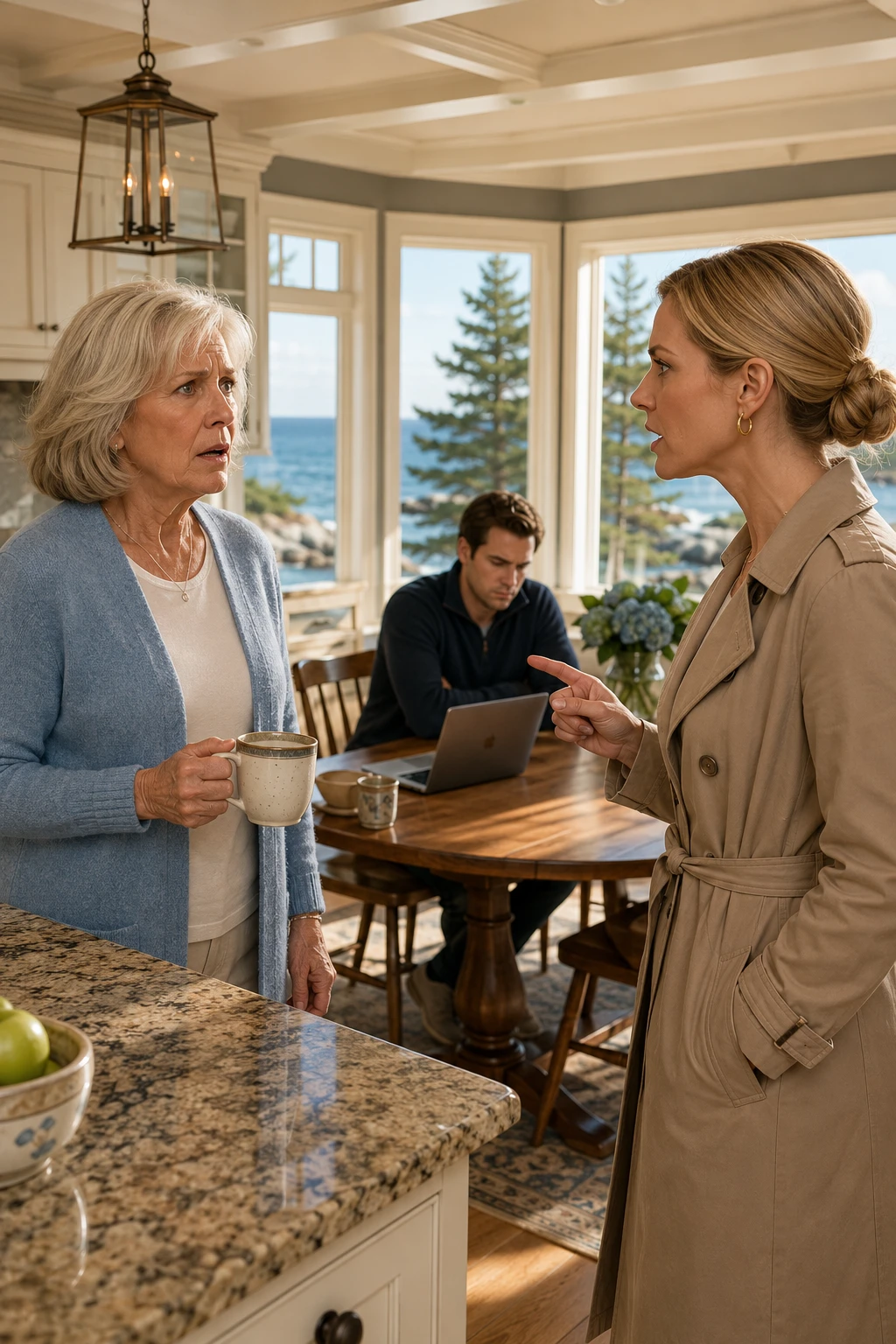
The moment my daughter-in-law told me to leave my own house, my son stared at his laptop and pretended he hadn’t heard her.
That hurt more than anything she said.
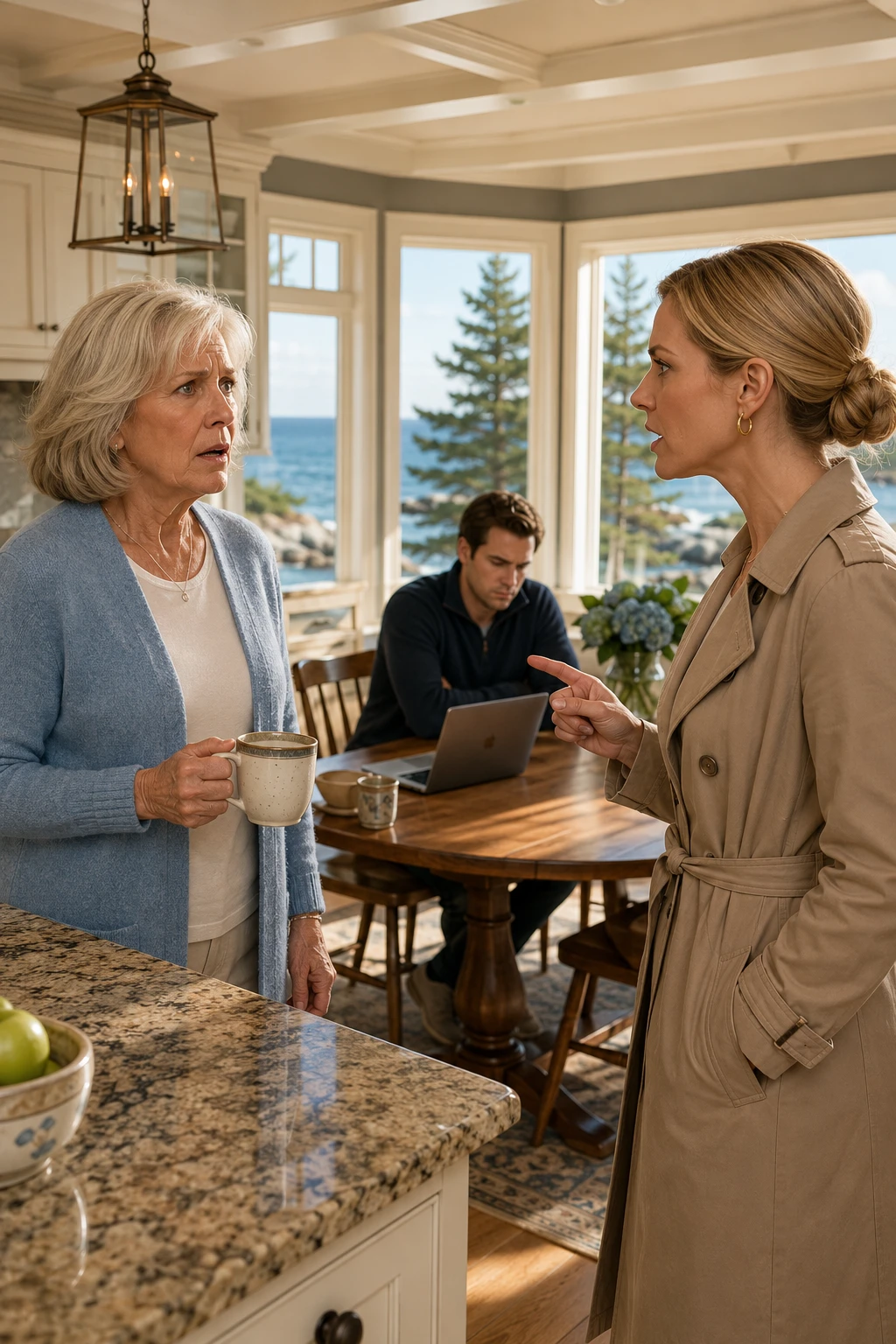
“My parents arrive Friday,” Brooke announced, standing in my kitchen like she was giving instructions to hotel staff. “They’ll need the main-floor suite, so you should pack enough for the summer.”
I stopped with my coffee halfway to my mouth.
“Pack?”
Brooke adjusted the belt of her expensive beige trench coat.
“There’s that seasonal RV park near the bay. Evan and I looked it up. It’s actually pretty nice.”
Actually pretty nice.
She was talking about sending me to an RV park so her parents could sleep in my bedroom, in my house, overlooking my ocean.
Behind her, morning light spilled across the granite island I had saved almost four years to install. Beyond the windows, pine trees swayed along the rocky Maine coastline, and the Atlantic flashed silver beneath the sun.
I had lived in that house for thirty-two years.
My husband, Robert, and I bought it when Evan was seven. After Robert died suddenly from a heart attack, everyone told me I should sell.
Too big, they said.
Too expensive.
Too many memories.
But I worked as a high school librarian for three decades, took extra summer jobs, learned to fix leaking faucets, stained decks myself, and counted every dollar.
That house was not just where I lived. It was the evidence that grief had not defeated me.
And for six months, I had allowed Evan and Brooke to live there completely rent-free.
Their new home was supposedly being built outside town. Construction delays had pushed their move-in date back repeatedly.
I had been the one to offer them a room.
“Stay here,” I told Evan. “Save your money. Start your marriage without unnecessary debt.”
That generosity had somehow transformed into Brooke believing she could evict me for the summer.
I looked past her at my son.
“Evan?”
He shifted in his chair.
“Mom, maybe we can just—”
Brooke cut him off.
“We already discussed it.”
I looked at him.
“You discussed where I would live without discussing it with me?”
His face reddened.
“It’s temporary.”
That phrase again.
Everything had been temporary.
Brooke reorganizing my kitchen was temporary.
Her moving my favorite reading chair onto the porch because it “ruined the room” was temporary.
Her taking over my formal living room and calling it her office was temporary.
Her referring to the guest wing as “our side of the house” was temporary.
Every time I objected, Evan lowered his voice and said, “She’s under pressure, Mom. Just keep the peace.”
For six months, I kept the peace.
That Monday morning, something inside me finally asked:
Peace for whom?
I finished my coffee.
Then I placed the mug gently on the counter.
“All right,” I said.
Brooke’s face relaxed immediately.
She mistook my calmness for surrender.
I grabbed my jacket and walked outside.
The gravel crunched beneath my shoes as I crossed toward the garden shed. Inside, the smell of cedar, soil, and old tools wrapped around me.
I sat on Robert’s old workbench.
For perhaps five minutes, I did nothing.
Then I took out my phone.
My first call was to Mason Reed, the locksmith.
“I want every exterior lock replaced.”
“Everything okay, Claire?”
I looked toward the house.
“Everything is becoming very clear.”
My second call was to Lydia Mercer, the attorney who had handled Robert’s estate.
My third call was to the county registry office.
By lunchtime, I knew enough to realize that Brooke trying to take my bedroom was not the real problem.
Not even close.
Mason arrived Wednesday at nine.
Brooke noticed his van immediately.
“Why is there a locksmith outside?”
“Maintenance.”
“He’s carrying electronic locks.”
“Very observant.”
Her mouth tightened.
Evan looked up from his laptop.
“Mom, what are you doing?”
I poured coffee.
“Something overdue.”
Twenty minutes later, the doorbell rang again.
Lydia Mercer stood outside in a navy suit carrying a leather folder.
Evan went pale.
He remembered her from Robert’s funeral.
“Mom,” he whispered, “why is your attorney here?”
Before I answered, Lydia stepped into the kitchen.
“Good morning.”
Brooke folded her arms.
“This is getting ridiculous.”
Lydia looked at me.
“Would you like everyone present?”
“Yes.”
She placed the folder on my granite island.
I had spent the previous two days wondering if perhaps I had overreacted.
One demand from an entitled daughter-in-law did not necessarily mean there was some grand conspiracy.
Then Lydia opened that folder.
And every doubt disappeared.
She slid a photocopy toward me.
“Claire, do you recognize this signature?”
My name appeared at the bottom.
Claire Margaret Bennett.
It looked convincing.
Very convincing.
But it wasn’t mine.
“No.”
Evan leaned closer.
“What is that?”
“A durable power of attorney,” Lydia said.
Brooke’s face changed.
Only slightly.
But I saw it.
Lydia continued.
“This document supposedly gives Brooke authority to manage Claire’s property and execute real-estate transactions on her behalf.”
Evan stared at his wife.
“What?”
Brooke laughed.
“That’s obviously some mistake.”
Lydia removed another document.
“Then perhaps you can explain this.”
It was a purchase agreement.
My address appeared at the top.
I felt my knees weaken.
My house had been placed under contract for $540,000.
Its market value was closer to $1.4 million.
And the proposed buyers?
Daniel and Patricia Walsh.
Brooke’s parents.
Closing date:
Friday. Noon.
The same Friday Brooke had said her parents were “arriving for the summer.”
I looked at her.
“You’re not bringing your parents here to visit.”
She said nothing.
Lydia answered for her.
“They appear to be purchasing the property.”
Evan stood so quickly his chair scraped backward.
“Brooke?”
“You don’t understand.”
“Then explain it!”
She pointed at me.
“Your mother lives alone in a huge house! We need money to finish construction, my parents want to move closer, and eventually this house would be yours anyway.”
I could barely breathe.
“Eventually?”
Brooke lifted her chin.
“You’re sixty-seven, Claire.”
The room went silent.
I had heard cruelty before.
Teenagers say terrible things when they are angry. Adults do too.
But Brooke’s words were different.
There was calculation behind them.
She had already mentally divided my life into assets she expected to inherit.
Evan looked sick.
“How did you get Mom’s signature?”
“I didn’t.”
Lydia glanced at him.
“There’s another signature you may recognize.”
She turned the power-of-attorney document around.
At the bottom, beneath the witness declaration, was Evan’s name.
He stared at it.
Then closed his eyes.
“Oh, God.”
My heart sank.
“Evan?”
He rubbed both hands over his face.
“Brooke gave me papers two weeks ago. She said they were temporary occupancy documents for the construction lender.”
“You signed something without reading it?”
“She had the signature page open. I didn’t see the rest.”
Brooke scoffed.
“Oh, please. Don’t suddenly pretend you’re innocent.”
Evan turned toward her.
“What did you do?”
She stared back.
And something passed between them.
Something I didn’t understand yet.
Lydia touched my arm.
“There’s more.”
Those three words frightened me more than everything else.
The notary whose seal appeared on the document had been contacted.
She had never notarized it.
Her seal number had been copied from another public filing.
The signature was forged.
And two days earlier, a title company had requested verification of the property ahead of the Friday closing.
If I had gone quietly to the RV park, Brooke would have been able to tell everyone involved that I had voluntarily vacated the property.
The forged power of attorney would have allowed her to sign closing documents in my name.
Whether the fraudulent transaction would eventually have been overturned was almost irrelevant.
By then, money could have moved.
Liens could have been created.
Lawyers could have spent years untangling everything.
I looked at my daughter-in-law.
“You needed me out of the house so I wouldn’t be here when you sold it.”
For the first time since I had known Brooke, she had no clever response.
I told both of them to leave that afternoon.
Brooke exploded.
“You can’t throw us out!”
Mason, standing near the front door with a screwdriver in one hand, looked over.
I almost laughed.
“Brooke, you told me Monday that I should leave before Friday.”
“That’s different.”
“Why?”
“My parents—”
“Are apparently buying a house I never agreed to sell.”
She stopped.
I looked at Evan.
He appeared devastated.
Part of me wanted to hug him.
That instinct shocked me.
Even at sixty-seven, even after betrayal, motherhood can be humiliatingly automatic.
But I resisted.
“Did you know?” I asked.
“No.”
“Did you suspect?”
He hesitated.
That hesitation was the answer.
“Mom…”
“Did you suspect?”
His eyes filled.
“I knew she was doing something with financing.”
“Did you ask?”
“No.”
“Why?”
He looked toward the floor.
“Because we needed the money.”
There it was.
Not innocence.
Not exactly guilt.
Something uglier.
Convenient blindness.
My son had not forged my signature.
But somewhere along the way, he had decided that not knowing was easier than knowing.
I swallowed hard.
“You need to leave too.”
“Mom—”
“Today.”
He nodded.
And that hurt almost as much as Monday morning.
Because for once, he didn’t argue.
Friday arrived under gray skies.
Rain blew sideways against the windows.
At 11:23, a black SUV entered my driveway.
Daniel and Patricia Walsh climbed out.
They had luggage.
A lot of luggage.
Patricia hurried toward me when I opened the door.
“Claire!”
She hugged me before I could stop her.
“This is overwhelming. I still can’t believe you’re doing this for us.”
I looked over her shoulder.
Daniel was unloading suitcases.
“Doing what?”
She pulled away.
“The house.”
My stomach tightened.
Behind them, another vehicle arrived.
Brooke stepped out.
Evan was not with her.
Brooke froze when she saw me standing in the doorway.
“You’re supposed to be—”
“At the RV park?”
Her parents exchanged confused looks.
Patricia frowned.
“What RV park?”
I stepped aside.
“Come in.”
Brooke rushed forward.
“Mom, Dad, we should probably go get lunch first.”
“No,” I said. “I think we should talk.”
Five minutes later, we were gathered around my dining table.
The same table where Evan had sat silently two mornings earlier.
Lydia was in my formal living room.
So was a representative from the title company.
And outside, parked far enough down the road not to attract attention, was Detective Hannah Cole from the county sheriff’s office.
Brooke didn’t know that yet.
Patricia clasped her hands.
“Claire, if the closing date changed, that’s fine.”
“What exactly did Brooke tell you?”
Patricia glanced at her daughter.
“That you wanted to downsize.”
I said nothing.
“She said maintaining the house had become difficult.”
Daniel added, “And that you planned to move to Arizona.”
I stared at Brooke.
“Arizona?”
Patricia looked increasingly uncomfortable.
“She said you wanted warmth.”
“I hate Arizona.”
Nobody spoke.
Then Daniel pulled papers from his bag.
“Brooke said you wanted to keep things simple between families.”
Lydia entered from the other room.
“May I see those?”
Brooke shot to her feet.
“This is a private family conversation!”
Lydia took the pages Daniel offered.
Her eyebrows rose.
“How much money have you transferred?”
Daniel answered.
“Three hundred and twenty thousand dollars.”
Even Lydia looked surprised.
“To whom?”
Daniel pointed at Brooke.
“Brooke gave us the escrow instructions.”
Patricia turned toward her daughter.
“Why are they asking us this?”
Brooke’s lips had gone white.
Lydia studied the document.
“This account does not belong to a licensed escrow company.”
Daniel stood.
“What?”
“It appears to be a personal business account.”
Brooke backed away from the table.
“Okay, everyone is overreacting.”
Patricia looked at her.
“Where is our money?”
“It’s safe.”
“Where?”
Brooke’s eyes darted toward the door.
And suddenly I understood.
Her parents weren’t her partners.
They were victims too.
Patricia’s voice cracked.
“Brooke?”
Her daughter said nothing.
Daniel slowly lowered himself into his chair.
“We sold our condo.”
I looked at him.
“What?”
“We sold it last month. Brooke said if we didn’t transfer the deposit immediately, you might accept another offer.”
Patricia began crying.
“We thought this was our retirement home.”
I felt my anger shift.
Not disappear.
But change shape.
Brooke had not simply tried to steal my home.
She had convinced her own parents to liquidate theirs.
Then the front door opened.
Evan entered.
Brooke spun around.
“What are you doing here?”
He looked terrible.
Unshaven. Hollow-eyed.
But in his hand was another folder.
“I found something.”
Brooke moved toward him.
“Evan, don’t.”
He stepped away.
“I went to the construction site yesterday.”
I stared at him.
“What happened?”
He laughed once.
There was no humor in it.
“There is no construction site anymore.”
Brooke’s mother stopped crying.
Evan looked at me.
“The contractor stopped work four months ago.”
“That’s impossible,” I said. “You showed me pictures.”
“Old pictures.”
He looked at Brooke.
“She kept sending me old progress photos.”
Brooke shook her head.
“We had cash-flow problems.”
Evan opened the folder.
“No. You canceled the contract.”
Daniel whispered, “Why would she do that?”
Evan pulled out a bank statement.
“Because the builder refunded $184,000.”
Brooke ran toward the door.
She got three steps.
Then Detective Cole entered.
“Brooke Bennett?”
Brooke stopped cold.
No one moved.
Detective Cole continued.
“I need you to stay here.”
Brooke looked at me with pure hatred.
“You called the police?”
I stood.
“No.”
That was true.
Lydia had.
But I wasn’t finished.
“Brooke,” I asked, “where is the money?”
She laughed.
It was a broken, strange sound.
“You people act like money just disappears.”
Evan stared at her.
Then his expression changed.
“What?”
She looked at him.
“You wanted the big house. You wanted the lifestyle. You wanted everything.”
“I wanted our house.”
“No. You wanted to prove something to everyone you grew up with.”
He shook his head.
“You stole from my mother.”
Brooke looked directly at me.
And smiled.
“You still don’t understand.”
Detective Cole stepped closer.
“Understand what?”
Brooke said nothing.
Evan suddenly opened the folder again.
“There was one more account.”
He slid a page toward Lydia.
She read it.
Then looked at me.
“Claire…”
Something in her voice chilled me.
“What?”
“This money wasn’t transferred overseas.”
Brooke’s smile vanished.
Lydia pointed at the statement.
“It was transferred into an account connected to Bennett Coastal Holdings LLC.”
I blinked.
“Bennett?”
Evan looked equally confused.
“I thought she created it using our name.”
Lydia shook her head.
“The LLC existed before Brooke married you.”
Brooke closed her eyes.
Detective Cole asked, “Who owns it?”
Lydia turned the page.
Then she stared at Evan.
Not Brooke.
Evan.
My son went completely still.
“What?”
Lydia pushed the filing toward him.
The company had been established seven years earlier.
The registered organizer was Robert Bennett.
My dead husband.
The room disappeared around me.
“Robert?”
My knees nearly gave way.
Lydia caught my arm.
“Claire, did Robert ever mention this company?”
“No.”
Not once.
Brooke laughed again.
But now there was panic beneath it.
“You want your shocking truth?” she said. “Ask your perfect dead husband.”
My blood ran cold.
Twenty years earlier, Robert had purchased a small undeveloped parcel along the coast through Bennett Coastal Holdings.
I knew nothing about it.
Neither did Evan.
After Robert died, paperwork involving the dormant company had been stored separately from his personal estate records and never included in the probate inventory because the company—not Robert personally—held title to the land.
For years, the parcel sat unnoticed.
Then land values exploded.
A developer approached Brooke eighteen months earlier after discovering she was married to Robert Bennett’s son.
Brooke investigated.
She found the company.
She also found something extraordinary.
Robert had made Evan the successor member of the LLC when Evan turned thirty-five.
The land now had an estimated value of nearly $2.8 million.
Brooke had discovered that her husband was unknowingly sitting on a small fortune.
She never told him.
Instead, she revived the company using documents she convinced Evan to sign among stacks of “construction paperwork.”
She sold an option on the land.
She used part of that money to create the illusion that their dream house was being built.
Then she canceled construction, took the refund, and began arranging the fraudulent sale of my house to her own parents.
Why?
Because she wasn’t building a future with Evan.
She was building an exit.
Detective Cole found the final piece on Brooke’s phone after obtaining a warrant.
A Saturday flight from Boston to Lisbon.
One passenger.
Booked under her maiden name.
By Friday afternoon, nearly $700,000 had been gathered across the accounts she controlled.
Her plan had been brutally simple.
Get me out.
Complete the fraudulent closing.
Collect the remaining money.
Leave her parents believing they owned my house.
Leave Evan believing their construction project had collapsed.
And disappear before anyone understood what had happened.
But she made one mistake.
She became too comfortable.
She stood in my kitchen and ordered me out three days too early.
Brooke left my house in the back seat of a sheriff’s vehicle.
Patricia sat at my table afterward, staring at nothing.
“I raised her,” she whispered. “How did I not know?”
I had no answer.
Daniel stood at the windows overlooking the ocean.
Evan sat where he had been sitting Monday morning.
Only now the laptop was gone.
There was nowhere for him to hide his eyes.
Eventually he said, “Mom, I’m sorry.”
I looked at him.
I loved my son.
That was the terrible part.
Love does not disappear when someone disappoints you.
Sometimes it simply becomes painful.
“You didn’t plan this,” I said.
He started to speak.
I raised my hand.
“But you let things happen because asking questions might have cost you something you wanted.”
His eyes filled.
“I know.”
“You watched your wife disrespect me for six months.”
“I know.”
“You watched her tell me to leave my house.”
“I know.”
“And you said nothing.”
He looked down.
I walked to the window.
The storm was breaking apart over the water.
For most of Evan’s life, I had rushed in whenever he hurt.
When he was ten and broke his wrist, I slept beside his bed.
When his first girlfriend left him, I stayed awake until two in the morning listening.
When his business failed at twenty-nine, Robert and I helped him recover.
Somewhere along the way, perhaps I had confused loving my child with protecting him from consequences.
Not anymore.
“You can’t move back in.”
He nodded slowly.
“I understand.”
“You need your own apartment.”
“I understand.”
“And if you want a relationship with me, you rebuild it. You don’t inherit forgiveness because you’re my son.”
His face crumpled.
But he nodded again.
That was the first genuinely adult thing I had seen him do in months.
The fraudulent sale never closed.
The title company froze the transaction.
Daniel and Patricia recovered most of their money after the accounts were seized, though the process took months.
Evan recovered control of Bennett Coastal Holdings.
He sold Robert’s old parcel the following spring.
And then he did something I didn’t expect.
He refused to use the money to build the enormous house Brooke had designed.
Instead, he bought a modest two-bedroom cottage several miles inland.
He paid back every dollar I had spent helping him over the years.
I tried to refuse it.
He said, “Mom, please. I need to know I finally carried something myself.”
So I accepted.
Not because I needed the money.
Because he needed the responsibility.
Brooke eventually pleaded guilty to multiple fraud-related charges.
Her parents moved into a rental near Portland.
They never blamed me.
In fact, Patricia still sends me a Christmas card every December.
But the biggest change happened inside my own home.
The formal living room became a reading room again.
My chair returned to the front window.
The guest wing stopped being “their side.”
And every morning, I sat with my coffee watching sunlight move across the granite island.
One Saturday the following summer, Evan came over to repair a section of porch railing.
Before entering, he knocked.
He had a key again by then.
But he still knocked.
“Why do you keep doing that?” I finally asked.
He looked embarrassed.
“Because I want to remember this is your home.”
I smiled.
“Come in.”
That evening, after he left, I walked down toward the shoreline.
The tide was low, exposing dark rocks polished smooth by generations of waves.
For months, people had asked me whether I regretted letting Evan and Brooke stay with me.
I always gave the same answer.
No.
Because if they had never moved in, I might never have learned what silence can hide.
I might never have discovered Robert’s forgotten land.
Evan might have remained married to a woman who had been quietly dismantling his future.
And I might have spent the rest of my life believing that keeping the peace was the same thing as being kind.
It isn’t.
Sometimes kindness means opening your door.
Sometimes love means giving someone another chance.
But sometimes the most important thing you can do is stand in the home you fought your whole life to keep, look someone you love directly in the eyes, and finally say:
No.
I watched the last orange light disappear across the Atlantic and thought about that Monday morning.
Brooke had believed she was sending an old woman to an RV park.
Instead, she had accidentally exposed a seven-year-old secret, a multimillion-dollar inheritance, a fraudulent sale, a stolen retirement fund, a fake construction project, and her own escape plan.
All because she couldn’t wait three more days to give me an order.
I laughed quietly.
Robert used to tell me that people reveal themselves when they become convinced there will be no consequences.
He was right.
And in the end, Brooke lost everything because she believed the house already belonged to her.
She never understood the one thing I finally did.
The locks Mason installed were never what protected my home.