By the time Jacob Hayes reached the end of Whitaker Lane, the snow was coming down so hard it seemed the whole world had been erased except for the light burning in the upstairs window of his own house.
He had crossed deserts under enemy fire. He had slept in holes in the ground with his rifle across his chest. He had learned the sounds that came before danger and the silences that came after it. But nothing he had seen overseas prepared him for the sight waiting on his front porch in Charlotte, North Carolina.
Two suitcases sat half-buried in snow beside the steps.
At first, his mind refused to understand them. Suitcases belonged in hallways, trunks, airport carts. They did not belong outside during a December blizzard, under a porch light, with ice collecting on the handles.
Then he saw the shape beside the column.
A woman.
His wife.
Emily.
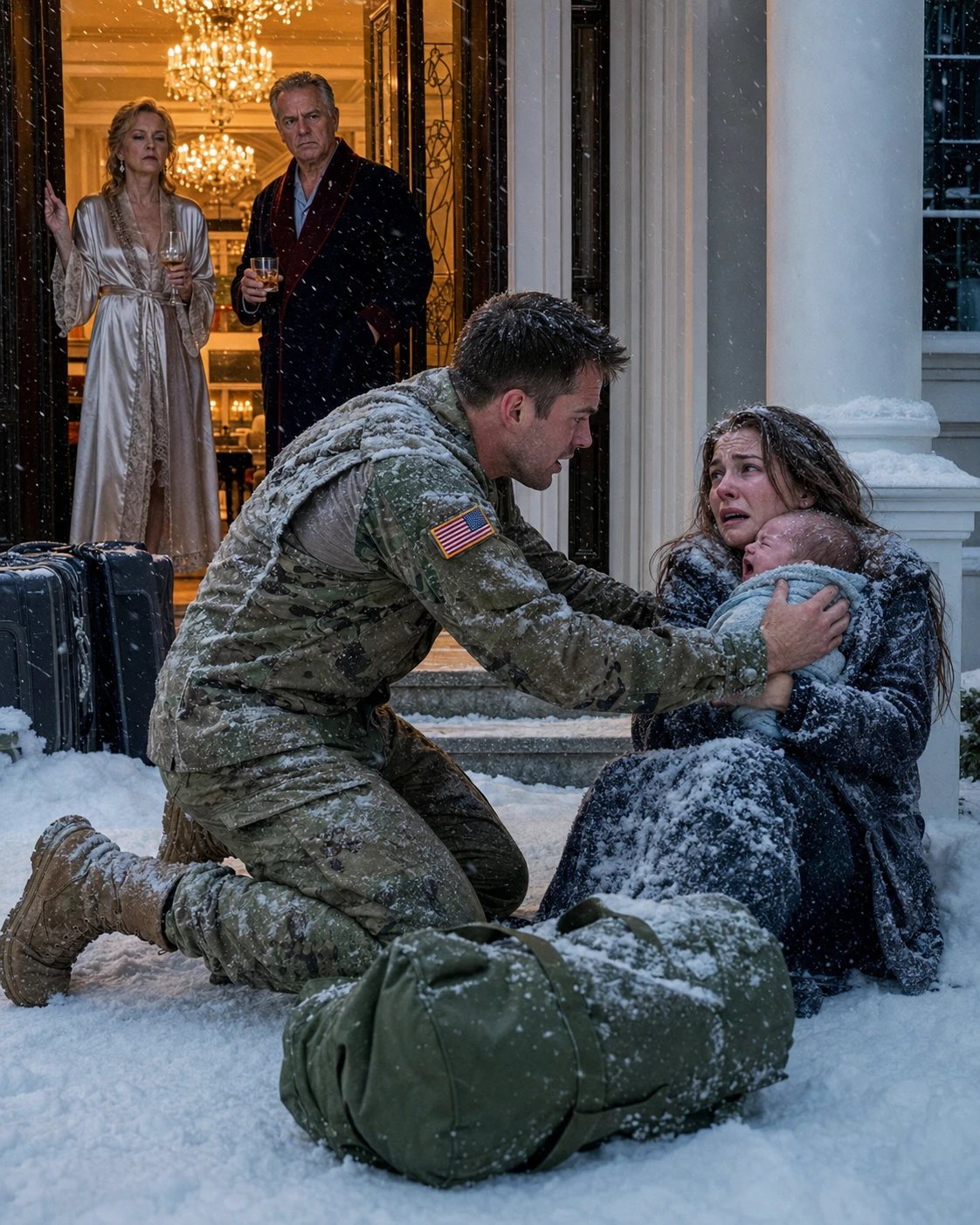
She was curled around their four-month-old daughter as if her own body could become a wall against winter. Her brown hair had frozen in stiff strands against her cheek. Her lips were pale blue. Her coat was too thin for the storm, and Sophie, their baby, was wrapped beneath it with only the smallest whimper left in her little lungs.
For eighteen months, Jacob had survived deployment by imagining one thing: Emily opening the door when he came home, Sophie in her arms, both of them warm, safe, and waiting.
He had not imagined finding them abandoned outside the very house he had paid for.
“Emily!”
His duffel bag dropped into the snow. He ran up the steps and fell to his knees so hard pain shot through both legs. He tore off his gloves and touched her face.
Cold.
Too cold.
“Emily, look at me. It’s Jacob. I’m home.”
Her lashes fluttered. For a second, her eyes did not focus. Then something in her face broke with recognition.
“Jacob,” she whispered.
He pulled off his military jacket and wrapped it around Sophie first. The baby gave a weak cry, thin as paper tearing.
“What happened?” he asked.
Emily’s fingers trembled against his wrist.
“Your parents,” she breathed. “They threw us out.”
The words were so terrible that he did not answer at first. He simply stared at her, waiting for his mind to reject them, correct them, turn them into something else.
But Emily kept talking.
“They changed the locks. They said we weren’t family anymore. They said the house belongs to your father now.”
Jacob turned his head toward the front windows.
Behind the glass, a chandelier glowed over polished marble. A Christmas tree stood near the staircase, fully decorated, gold ornaments shining like little coins. From the living room window, his mother watched him with a glass of wine in her hand.
Rebecca Hayes did not look surprised.
She looked inconvenienced.
The front door opened a moment later, letting warmth spill out onto the porch like an insult.
“Well,” his father said, standing in the doorway with a whiskey glass. “The soldier finally made it home.”
Richard Hayes wore a cashmere sweater, pressed trousers, and the bored expression of a man whose evening had been interrupted by something distasteful. Behind him, Rebecca stood in a silk robe, one hand at her throat, as if she were the wounded party.
Jacob rose slowly, lifting Emily into his arms. Sophie was tucked against his chest beneath his jacket.
“Move,” he said.
Rebecca’s mouth tightened. “Jacob, don’t be dramatic. That woman has been poisoning you against us since the day she got here.”
“That woman is my wife.”
“And she spent your money,” Richard said. “Broke every rule in this house. Tried to steal company documents. I warned you about marrying beneath you.”
Emily stirred weakly in Jacob’s arms. “You emptied the accounts.”
Richard laughed. “What accounts? Everything you have came from this family.”
Jacob looked down at his wife, then at his baby’s tiny face pressed into his jacket. The anger inside him rose like fire under ice, but his training held him still.
The first person to lose control loses the fight.
He stepped forward.
Richard shifted as if to block him.
Jacob said nothing. He only looked at him.
His father moved aside.
Jacob carried Emily over the threshold. Snow melted from her shoes and dripped across the Italian marble floors Rebecca loved showing off to guests. The foyer smelled of pine, cinnamon, and expensive candles. It smelled like Christmas in a house where no mercy lived.
“You threw my entire world into the snow,” Jacob said quietly.
Rebecca lifted her chin. “We protected this family.”
“No,” Jacob said. “You exposed it.”
He carried Emily into the sitting room and laid her gently on the sofa. Then he called 911.
Richard scoffed. “For heaven’s sake. She was outside ten minutes.”
Emily’s eyes opened.
“Three hours,” she whispered.
Jacob turned slowly.
Rebecca looked away.
Sophie began to cry again, stronger now, and that sound went through Jacob like a blade. He held his daughter close while the emergency operator asked questions, while Emily tried to speak, while his parents stood near the fireplace like actors who had forgotten their lines.
When the ambulance lights finally flashed against the snow-covered windows, Jacob followed the paramedics outside. But before he climbed in, Richard caught his arm.
“You need to think carefully,” his father said. “You’ve been gone a long time. You don’t know what she’s done.”
Jacob looked at the hand on his sleeve until Richard removed it.
“I know what you did,” Jacob said. “And when I come back, I’m going to know everything.”
PART 2
The emergency room at Mercy South was crowded with storm injuries, slipping falls, and worried families wrapped in blankets, but Jacob saw only Emily and Sophie.
A nurse took Sophie first, checking her temperature, her breathing, her tiny fingers. Another nurse wrapped Emily in heated blankets while a doctor asked questions with careful urgency. How long outside? Any dizziness? Any pain? Had she fallen? Was the baby feeding?
Jacob answered what he could. Emily answered the rest.
Three hours.
That number lodged in his mind and would not leave.
Three hours in freezing weather, with a baby in her arms, while his parents sat inside drinking wine beside a Christmas tree.
The doctor eventually told him they were lucky. Sophie was chilled and dehydrated, but stable. Emily had mild hypothermia, bruising on one wrist, exhaustion, and signs of long-term stress that made the doctor pause before saying more.
When they were finally moved into a quiet observation room, Jacob sat beside Emily’s bed with Sophie asleep against his chest.
For a long while, neither of them spoke.
Emily looked smaller than he remembered. Not weaker, never weaker, but worn down in a way that deployment had not shown him through video calls. The woman who used to laugh with her whole face now studied the doorway before every sentence.
“I should have known,” Jacob said.
She turned her head. “No.”
“I called every week. You smiled.”
“You were in a war zone.”
“So were you.”
Her eyes filled.
He reached for her hand, careful around the bruise.
“Tell me.”
Emily swallowed. “It started after Sophie was born. Your mother said I was overwhelmed. At first, she helped. She cooked. She folded baby clothes. She told me to rest.”
Jacob remembered those early calls. His mother had praised herself for being generous. Emily had seemed tired but grateful.
“Then she started answering your calls before I could,” Emily continued. “She’d say I was sleeping, or nursing, or emotional. If I did talk to you, she sat nearby. Always nearby.”
Jacob felt his jaw tighten.
“My father?”
“He handled the finances, he said. Since you were deployed and the baby was expensive, he said it would be easier if he made sure bills were paid. He told me you had agreed.”
“I never agreed.”
“I know that now.”
Emily looked toward Sophie. “The first account went empty in September. Your deployment pay stopped depositing where it had always gone. Then my card declined at the pharmacy. When I asked Richard, he said I was spending too much. Rebecca told me good wives don’t interrogate family.”
Jacob closed his eyes.
Emily’s voice steadied, as if she had rehearsed the truth in silence for months.
“They moved into the house in October. Said it was temporary. Then your mother started telling neighbors I had postpartum depression. She told Dr. Bellamy I was confused. She told the church ladies I wasn’t bonding with Sophie. She told everyone little things, Jacob. Not enough to look cruel. Just enough to make me look unreliable.”
He understood then how carefully it had been done. Not one blow hard enough to leave a clear mark. A thousand small cuts no one else noticed.
“What company documents?” he asked.
Emily’s hand tightened around his.
“I found a folder in Richard’s office. I wasn’t snooping. I was looking for Sophie’s insurance card. It had bank statements, a power of attorney with your signature, and a deed transfer for the house.”
Jacob stared at her.
“My signature?”
She nodded. “Dated six months ago.”
“I was outside Kandahar six months ago.”
“I know.”
“What else?”
Emily hesitated.
The room seemed to grow quieter.
“There was also a letter from an attorney named Grace Bell. It said the Hayes family trust couldn’t be altered without your consent, my consent, and Sophie’s birth certificate.”
Jacob frowned. “What trust?”
Emily’s face changed.
“You don’t know?”
“My father always said the company belonged to him. That I had shares because I was his son.”
Emily shook her head slowly. “Jacob, I don’t think your father owns what he says he owns.”
Before he could answer, his phone began vibrating.
Mother.
Then Father.
Then Mother again.
Jacob silenced it.
Emily watched him. “They’re going to say I lied.”
“I know.”
“They’re going to say I’m unstable.”
“I know.”
“They’re going to make you choose.”
Jacob leaned forward and touched his forehead to hers.
“They already did.”
PART 3
By morning, the storm had turned Charlotte into a city of white roofs and bent trees. Roads were still dangerous, but Jacob had learned long ago that danger and necessity often traveled together.
He left Emily and Sophie at the hospital under the care of a nurse who had three grown sons in the military and a way of looking at Jacob that said she understood more than he had explained.
Then he borrowed a coat from a social worker, took a cab as far as the roads allowed, and walked the remaining blocks to the office of Bell & Whitley Law.
Grace Bell was in her sixties, silver-haired, sharp-eyed, and dressed in a navy suit that looked older than fashion and stronger than weather. She opened the door herself.
“You must be Sergeant Hayes,” she said.
“You know me?”
“I’ve been waiting for you to come home.”
That sentence chilled him more than the snow.
Her office smelled of coffee, old paper, and lemon polish. Framed degrees hung beside photographs of children and grandchildren. On her desk sat a thick folder labeled HAYES-CARTER TRUST.
Jacob remained standing.
“Mrs. Bell, my wife and daughter were locked outside in a blizzard last night. My parents claim the house belongs to my father. My accounts are empty, and there is apparently a power of attorney with my signature on it.”
Grace Bell’s expression did not change, but her hand stilled on the folder.
“Sit down, Sergeant.”
“I’d rather stand.”
“I understand. But what I’m about to tell you is easier heard sitting down.”
He sat.
Grace opened the folder.
“Your grandfather, Elias Hayes, founded Hayes Residential Development. But the company did not survive because of Richard. In fact, by 1992, Richard had nearly bankrupted it.”
Jacob stared at her. “That’s not what I was told.”
“I’m sure it isn’t. The rescue money came from your maternal grandmother, Ruth Carter.”
“My grandmother Carter?”
“Yes. Your mother’s mother. She invested everything she had after selling Carter Timberland outside Asheville. The agreement gave her controlling interest if Richard defaulted. He did. Quietly.”
Jacob felt the room tilt.
Grace continued. “Ruth did not trust your parents. Before she died, she placed her interest in trust for you, and after your marriage, for your spouse and children. Richard was allowed to manage operations, but he was never allowed to transfer ownership, sell major assets, or remove beneficiaries without written consent from you and, after Sophie’s birth, Emily.”
Jacob sat very still.
“My father has told me my entire life that everything came from him.”
Grace’s mouth softened. “Men who live on borrowed money often speak as though they invented wealth.”
She turned a document toward him.
“This is the trust summary. The house on Whitaker Lane is not Richard’s. It was purchased by the trust. The deployment account, investment account, and Sophie’s education fund were protected assets. Your wife had every right to ask questions.”
Jacob saw Emily’s name printed beside his own. Sophie’s name beneath theirs.
Then he saw the signatures.
His.
Emily’s.
Both forged.
His pulse became a slow, hard drumbeat.
“The power of attorney?” he asked.
Grace pulled another page.
“Fraudulent. It was notarized here in Mecklenburg County on a date when your military records place you overseas.”
“Who notarized it?”
Grace hesitated.
“Your mother’s cousin.”
Jacob gave a humorless laugh.
“Of course.”
Grace closed the folder. “Emily came here three weeks ago.”
Jacob looked up.
“She was frightened,” Grace said. “Not frantic. Not confused. Frightened. There is a difference. She brought copies of the documents she found and asked me whether Richard could take the house. I told her no. I also told her not to confront him alone.”
“But she did.”
“She had no choice. Yesterday morning, I sent formal notice freezing trust assets pending review. By evening, they threw her out.”
Jacob pressed both hands together.
Grace studied him. “There is one more thing.”
He looked at her.
“Emily brought me a recording.”
“What kind of recording?”
“A conversation between your parents. She used the baby monitor in Sophie’s nursery after she heard them arguing in the hall. I have not released it yet.”
“Why?”
“Because Emily asked me to wait until you were home.”
Jacob’s throat tightened.
Even terrified, even cornered, she had still waited for him.
“What’s on it?”
Grace reached for a small digital recorder.
“Enough,” she said, “to end the lie.”
PART 4
Jacob did not go back to Whitaker Lane shouting.
That was what Richard would have expected. A soldier home from war, furious, emotional, easy to paint as unstable. A son who could be provoked into breaking a door, raising his voice, making the neighbors whisper that maybe Rebecca had been right about stress and combat changing a man.
Instead, Jacob waited.
He took Emily and Sophie to a small extended-stay hotel near the hospital. The room had beige walls, a kitchenette, and a view of a parking lot, but Emily cried when she saw the clean crib the hospital social worker had arranged.
“No one can lock us out of here,” she said.
Jacob stood behind her and wrapped his arms around her shoulders.
“No one will ever lock you out of anywhere again.”
Over the next forty-eight hours, the world Richard Hayes had built began to crack.
Grace Bell filed emergency motions. The trust accounts were frozen. The deed transfer was challenged. The notary was contacted. The bank flagged several wire transfers. A sheriff’s deputy took Emily’s statement. A pediatrician documented Sophie’s condition. The hospital photographed Emily’s wrist.
Richard responded exactly as Jacob expected.
He called first with fury.
“You ungrateful little fool,” he barked over the phone. “Do you have any idea what you’re doing to this family?”
Jacob stood near the hotel window while Emily rocked Sophie to sleep.
“I’m learning what you did to mine.”
“You think that girl loves you? She found out about the trust and made her move.”
“Emily told me about the trust after you threw her into a blizzard.”
Rebecca called next, weeping.
“Jacob, darling, your father is angry, but I’m your mother. I only wanted to protect you. Emily has changed you. She has made you cruel.”
Jacob closed his eyes. Once, that voice could have pulled guilt from him like a thread from cloth.
Not anymore.
“Mom,” he said, “how long was Sophie outside?”
Silence.
“Answer me.”
“I don’t know. I was upstairs.”
“You were at the window.”
“She shouldn’t have refused to leave.”
“She is my wife.”
“She is trouble.”
“She is family.”
Rebecca’s voice hardened. “Family obeys.”
That was the sentence that finally freed him.
For years, Jacob had mistaken obedience for love. He had watched his father humiliate employees and call it leadership. He had watched his mother wound people politely and call it standards. He had been raised to believe that comfort was proof of virtue, that money was proof of wisdom, and that loyalty meant silence.
But in a hospital room, Emily had told the truth with frost still in her hair.
That was love.
Three days after the storm, Grace Bell arranged a meeting at her office. Richard arrived with his own attorney, a younger man in a charcoal suit who looked confident until he saw Grace’s folder. Rebecca came in pearls, black wool, and a wounded expression suitable for church luncheons.
Jacob came with Emily.
His wife wore a plain blue sweater and no makeup. There were shadows beneath her eyes, but she walked beside him with Sophie sleeping against her chest.
Richard looked at the baby and sneered faintly.
“That child has caused more trouble than she’s worth.”
Jacob’s hand curled.
Emily placed her fingers over his.
No.
Not yet.
Grace began calmly. “We are here to discuss the fraudulent transfer of trust assets, the forged power of attorney, and the unlawful eviction of Emily Carter-Hayes and her infant daughter.”
Richard’s attorney cleared his throat. “My client disputes that characterization.”
Grace smiled. “I assumed he would. That is why I invited Mr. Donnelly from First Carolina Bank and Deputy Marsh from the sheriff’s office.”
Richard’s expression changed.
The door opened again. Two men entered. One carried a laptop bag. The other wore a sheriff’s department jacket.
Rebecca stood. “This is intimidation.”
“No,” Emily said quietly. “This is documentation.”
Everyone looked at her.
For the first time since Jacob had come home, Emily’s voice did not tremble.
“I spent months being told I was confused,” she said. “Months being told I was greedy, emotional, ungrateful, unstable. I started writing things down because I thought maybe I was losing my mind. Then I realized the only people who wanted me to doubt my memory were the people stealing from us.”
Rebecca’s face flushed. “How dare you.”
Emily met her eyes. “You left a baby in the snow.”
The room went still.
Richard leaned back. “This sentimental performance is ridiculous.”
Grace connected the recorder to the laptop.
“Then perhaps we should hear something less sentimental.”
The recording began with static, then Rebecca’s voice.
“She found the folder.”
Richard answered, “Then we force her out before Jacob gets back.”
Rebecca said, “What about the baby?”
Richard laughed softly. “If he has any sense, he’ll question whether the child is even his.”
Emily’s face went white.
Jacob turned toward his father.
Richard’s attorney whispered, “Richard.”
The recording continued.
Rebecca said, “And if Jacob asks about the money?”
Richard answered, “He’ll believe me. He always does. I built that boy out of guilt and discipline. He doesn’t know how to disobey.”
Jacob felt something old and heavy inside him split open.
Then came Rebecca’s voice again, lower.
“You should have told him years ago that Ruth Carter owned everything. This is what happens when lies get old.”
The room froze.
Richard lunged forward. “Turn that off.”
Grace did not.
Rebecca’s recorded voice continued. “And what about the other lie?”
There was a long pause.
Richard said, “We don’t speak of that.”
Rebecca whispered, “If Jacob ever finds out you are not his father, the trust becomes untouchable.”
Jacob stopped breathing.
PART 5
No one moved.
Not Grace. Not the deputy. Not Richard’s attorney. Not Emily.
Only Sophie made a small sound in her sleep, a soft sigh against her mother’s chest, as if the truth had disturbed even her dreams.
Jacob stared at Richard Hayes, the man whose name he had carried, whose approval he had chased, whose disappointment had shaped half his life.
“What did she say?” Jacob asked.
Richard’s face had gone gray beneath his expensive tan.
“Jacob,” Rebecca said quickly. “That recording is taken out of context.”
He turned to her.
“My father,” he said slowly. “Who is my father?”
Rebecca’s lips parted. For once, no polished answer came out.
Grace Bell reached into the folder and removed a sealed envelope.
“Your grandmother Ruth left this with me,” she said. “I was instructed to give it to you only if Richard attempted to seize the trust, or if the question of your parentage became relevant to your legal standing.”
Jacob did not take it at first.
Some truths are not doors. They are cliffs.
Emily moved closer. “Jacob.”
He looked at her. In her eyes, he saw no demand, no fear of what the answer might do to them. Only steadiness. Only love that did not require him to be anyone but himself.
He took the envelope.
Inside was a letter written in careful, old-fashioned handwriting.
My dear Jacob,
If you are reading this, then the people who raised you have finally mistaken silence for weakness.
Richard Hayes is not your father.
Your father was Thomas Carter, my son. He was a carpenter, a quiet man, and the best person I ever knew. He loved your mother, Rebecca, when she was young and frightened and already promised to Richard by families who cared more about appearances than happiness.
Thomas died before you were born.
Richard married Rebecca afterward and agreed to raise you as his own because my money saved his company. He demanded the Hayes name in exchange. Your mother accepted because she feared poverty more than truth.
I allowed the lie because I believed a child needed peace more than pride. That was my mistake.
But I protected what I could.
The company interest, the house, and the trust belong to you because they were bought with Carter money and Carter sacrifice. They pass after you to your wife and children, not to Richard, not to Rebecca, and not to anyone who uses family as a weapon.
If they have hurt the woman you love or the child you hold, do not spend your life asking why.
Some people do not betray you because you failed them.
They betray you because you stopped being useful.
Live free, my boy.
And choose the family that chooses you.
Ruth Carter
Jacob read the letter once.
Then again.
The room blurred around the edges.
He had expected anger. He had expected grief. What came first was something stranger: relief. A lifetime of feeling like a disappointment to Richard Hayes suddenly made sense. The coldness, the tests, the impossible standards, the way Richard’s praise always felt like a loan with interest.
He had not failed to be Richard’s son.
He had never been Richard’s son at all.
Rebecca began crying softly. “I was going to tell you.”
Jacob looked at her.
“When?”
She folded her hands together. “It was complicated. Richard gave you a name. He gave you a life.”
Emily spoke before Jacob could.
“No. Ruth Carter gave him a life. Richard gave him a bill.”
Richard slammed his palm on the table. “Enough! You think blood makes a family? I fed you. I clothed you. I made you disciplined. Without me, you would have been nothing.”
Jacob stood.
For the first time in his life, he looked down at Richard Hayes without wanting anything from him.
“No,” he said. “Without you, I might have known sooner that love doesn’t sound like fear.”
The legal consequences came swiftly after that.
Not dramatically, not like in the movies, but with the steady force of paperwork, sworn statements, bank records, and patient truth. The fraudulent deed was reversed. The trust accounts were restored. Richard’s access was revoked. The forged documents triggered investigations that reached beyond the family and into the company books.
The notary cooperated first. Richard’s attorney withdrew second. The bank produced wire records third.
Rebecca tried to save herself by claiming Richard had controlled everything. Richard tried to save himself by claiming Rebecca had known from the beginning. Each pointed at the other until the elegant marriage they had displayed for thirty-five years became exactly what it had always been: a partnership of convenience held together by money, fear, and secrets.
Jacob did not enjoy watching it collapse.
That surprised him.
He had imagined revenge would taste hot and satisfying. Instead, it felt heavy. Necessary, but heavy. He understood then what older soldiers had meant when they told him coming home was not the end of war. Sometimes the battlefield simply changed its address.
Weeks passed.
The snow melted.
Emily’s wrist healed.
Sophie gained weight, learned to laugh, and developed a habit of gripping Jacob’s finger as though making sure he would not disappear again.
They returned to the house on Whitaker Lane in January, not because it was grand, not because it had marble floors or chandeliers, but because Emily wanted to walk through the front door without fear.
Jacob carried Sophie. Emily unlocked the door herself.
Inside, the house felt different. Smaller somehow. Less powerful. Rebecca’s Christmas decorations had been removed. Richard’s whiskey glasses were gone. The air smelled faintly of dust and lemon cleaner.
Emily stood in the foyer, looking at the floor where melted snow had once trailed from her clothes.
“Are you sure?” Jacob asked.
She nodded.
“I don’t want them to own this place in my memory.”
So they changed it.
They turned Richard’s office into a nursery with pale yellow curtains. They gave the marble foyer a rug that Sophie could crawl on. They donated the formal dining table Rebecca had prized and replaced it with a worn oak one from a small furniture store outside town, the kind of table where elbows were allowed and coffee rings were not a moral failure.
Jacob left the company under professional management while the investigation continued. He kept his Army commitments, but when his leave ended, he requested a stateside assignment. He had served his country. Now he wanted to serve bedtime, pediatric appointments, leaky faucets, and quiet mornings with his wife.
One evening in early spring, Grace Bell came by with the final documents. She sat at the oak table, accepted coffee from Emily, and watched Sophie slap both hands happily against a spoon.
“There is one more item,” Grace said.
Jacob smiled faintly. “There always is with you.”
“This one is good.”
She handed him a small box.
Inside was an old brass key and a photograph.
The photograph showed a young man standing beside a half-built porch, hammer in hand, smiling shyly at whoever held the camera. He had Jacob’s eyes.
“Thomas Carter,” Grace said.
Jacob touched the edge of the picture.
Emily leaned close.
“He looks kind,” she whispered.
Grace nodded. “He was.”
“What’s the key?” Jacob asked.
“Ruth kept Thomas’s cabin near Asheville. Richard never knew it remained in the Carter trust. It’s yours.”
That weekend, Jacob drove Emily and Sophie into the mountains.
The cabin stood at the edge of a quiet ridge, weathered but solid, with a stone chimney and a porch facing miles of blue hills. Inside, dust lay thick on the furniture. A stack of old books leaned beside the fireplace. In the bedroom closet hung a flannel shirt that had belonged to Thomas Carter.
Jacob held it for a long time.
Emily did not speak. She only stood beside him, Sophie asleep against her shoulder, giving him the silence he needed.
Later, they found a box beneath the bed.
Inside were letters Thomas had written to Rebecca before Jacob was born. Most were simple. Hopeful. Gentle. He wrote about building a crib. About saving for a little house. About wanting his child to grow up knowing the smell of sawdust, rain, and Sunday biscuits.
At the bottom of the box was one final note, never sent.
If I have a son, I hope he is brave. But more than that, I hope he is loved well enough that he never has to prove he deserves it.
Jacob sat on the cabin floor and wept.
Not loudly. Not dramatically. Just with the quiet grief of a man mourning someone he had never been allowed to know.
Emily knelt beside him and placed Sophie in his arms.
The baby opened her eyes, studied his face, and smiled.
That was when Jacob understood the ending of the story was not Richard in disgrace, or Rebecca exposed, or the house returned, or the money restored.
Those things mattered.
But they were not the miracle.
The miracle was this: the people who had tried to steal his family had accidentally revealed it.
They had locked Emily and Sophie outside because they believed love could be frozen, erased, disowned, and replaced by signatures on paper.
But love had survived the porch.
It had survived the lies.
It had survived eighteen months overseas, three hours in a blizzard, and thirty-four years of buried truth.
That night, Jacob built a fire in Thomas Carter’s cabin. Emily slept on the old sofa with Sophie against her chest, both of them warm beneath a quilt Ruth had sewn decades earlier. Snow began falling again outside, soft and harmless this time, silvering the porch rails and pine branches.
Jacob stood at the window and watched it come down.
For most of his life, he had thought home was a house with a famous name on the mailbox.
Now he knew better.
Home was a woman who told the truth when lying would have been easier.
Home was a baby’s hand curled around his thumb.
Home was an old letter from a dead grandmother, a photograph of a father he had never met, and the knowledge that blood mattered far less than courage, but truth mattered most of all.
Behind him, Emily stirred.
“Jacob?” she murmured.
He turned.
“I’m here.”
She smiled sleepily. “Are we safe?”
He looked at the fire, at his daughter, at the snow beyond the glass, and at the woman who had waited for him in the cold without surrendering the truth.
Then he answered with the first peace he had felt in years.
“Yes,” he said. “We’re finally home.”