The security guard laughed when I told him I had driven three hours to surprise my husband.
Not a cruel laugh, exactly. Cruelty would have been easier to meet. This was worse. It was casual, polished, almost sympathetic, the kind of laugh a young man gives an older woman when he thinks she has wandered into the wrong building with the wrong memory in her hand.
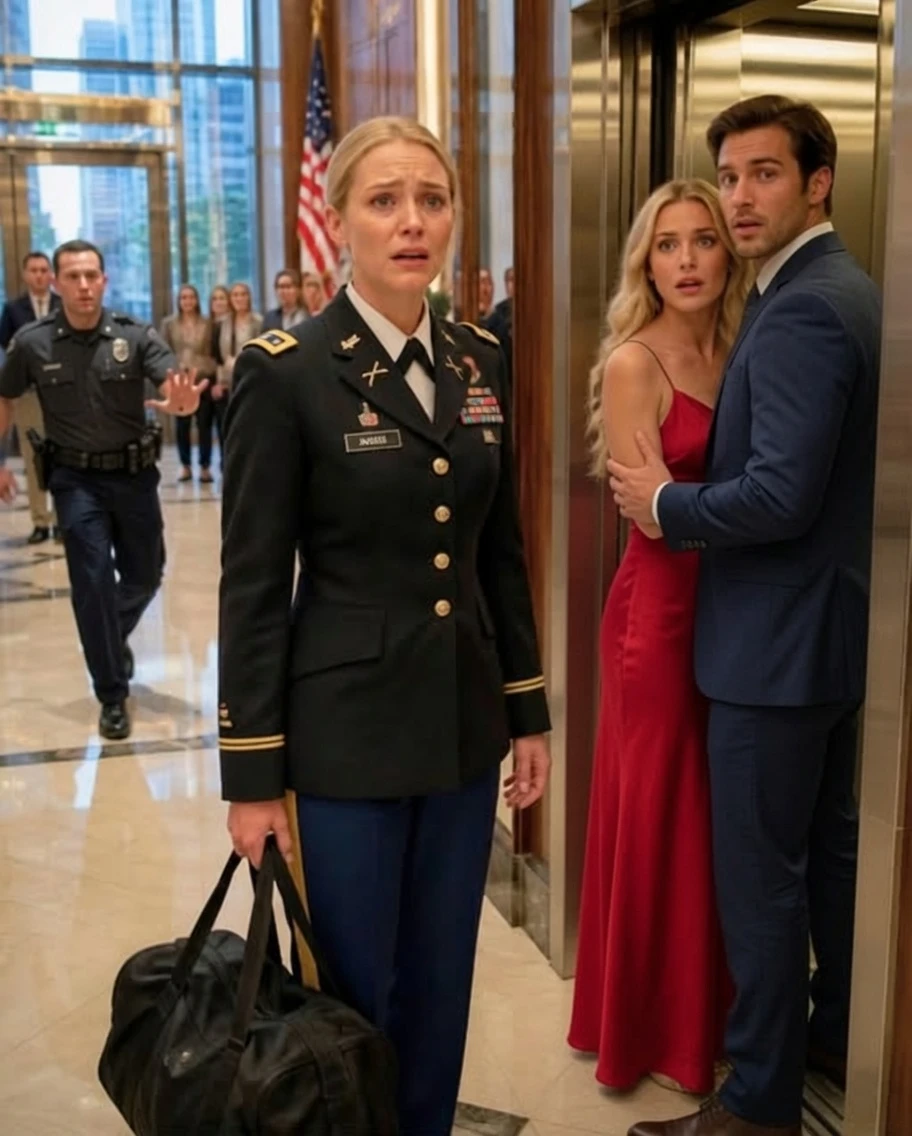
I stood in the marble lobby of Vance Meridian Logistics wearing my U.S. Army dress uniform, my silver hair pinned at the nape of my neck, my overnight bag resting against my boot. Outside, Nashville shimmered beneath a bright spring sky. Inside, the air smelled of lemon polish, expensive flowers, and the cold confidence of people who believed every door opened for them.
“I’m sorry,” I said, keeping my voice level. “What did you just say?”
The guard shifted in his leather chair. His badge read DYLAN. His smile softened, but only slightly.
“I said Mr. Vance’s wife is already upstairs, ma’am.”
For one breath, I could not move.
Thirty-one years of marriage stood behind me like a long hallway filled with photographs: Trevor in his Navy suit at our wedding, Trevor holding our daughter Grace in the hospital, Trevor kissing my forehead before my first deployment after forty, Trevor waving at a screen while I celebrated Christmas in a tent half a world away.
“My husband,” I said slowly, “is Trevor Vance.”
Dylan blinked. “Yes, ma’am. I know.”
“And you’re telling me his wife is upstairs?”
His eyes flicked toward the executive elevators. “She comes in most days.”
The lobby tilted around me. I had received unexpected weekend leave from Fort Campbell that morning and decided not to call. I had imagined Trevor’s face when I walked into his office. I imagined his arms around me. I imagined him whispering, “Eleanor, you’re home.”
Instead, a stranger half my age was looking at me as though I had arrived too late to my own marriage.
Before I could speak, Dylan’s expression changed.
“There she is now.”
The executive elevator opened.
A blonde woman stepped out in a cream designer dress and nude heels. She was younger than me by at least fifteen years, graceful in a way that looked practiced, not natural. Around her throat rested a diamond pendant.
No.
Not diamond.
My breath caught.
It was a small silver military pendant, shaped like a shield, with a tiny cross etched on one side and initials on the back. I knew that pendant because Trevor had given it to me before my second deployment. I had worn it through sandstorms, grief, mortar alarms, and the lonely birthdays no one remembered except the women in my unit.
I had thought I lost it two years earlier.
Two employees walked by her and smiled.
“Morning, Mrs. Vance.”
Mrs. Vance.
The woman nodded, then looked directly at me.
Something passed over her face.
Not surprise.
Recognition.
She knew me.
Then she smoothed her dress and walked past me like I was a ghost.
PART 2: THE WOMAN WITH MY NAME
I followed her.
Not loudly. Not dramatically. The Army teaches you many things, but above all, it teaches you that panic wastes breath. I picked up my overnight bag and walked toward the elevators while Dylan rose halfway from his chair.
“Ma’am,” he said. “You can’t just—”
I turned and looked at him.
He sat back down.
The blonde woman pressed a button for the private elevator. She heard me behind her. I knew she did because one shoulder tightened beneath the cream fabric. Still, she did not turn.
“What is your name?” I asked.
The elevator doors opened.
She stepped inside. “You should ask Trevor.”
I put one hand against the elevator door before it could close.
“I’m asking you.”
Her eyes traveled over my uniform, lingering on the medals, then dropping to the pendant at her throat.
“My name is Celeste,” she said. “Celeste Monroe.”
“Not Vance?”
Her mouth curved faintly. “That depends who’s asking.”
I stepped into the elevator with her.
For several floors, neither of us spoke. The numbers glowed upward in silence. I could hear my own heartbeat, steady but heavy. My wedding ring felt suddenly tight on my finger.
Finally, I said, “That pendant belongs to me.”
Celeste touched it lightly. “Trevor gave it to me.”
“No,” I said. “Trevor may have handed it to you. But he did not give it to you.”
Her face changed then. The polished mask slipped, and beneath it I saw something I had not expected.
Fear.
The elevator stopped on the twenty-third floor. The doors opened into a reception area with glass walls and a view of the Cumberland River. A young assistant at the desk looked up.
“Mrs. Vance,” she said brightly to Celeste.
Then she saw me.
Her smile died.
Celeste whispered, “Don’t do this here.”
I almost laughed. “Here? Honey, I have slept in barracks with no roof. I have had incoming fire land close enough to shake my teeth. I have stood beside mothers who received folded flags. You do not get to tell me where I may stand.”
The assistant picked up the phone with trembling fingers.
A door opened at the end of the hall.
Trevor stepped out.
He was sixty-one, though he still carried himself like the charming young man who had once asked me to dance at a county fair in Kentucky. His hair had gone silver at the sides. His suit was charcoal, tailored, expensive. When he saw me, the color drained from his face so completely that I knew, in that instant, he had rehearsed many disasters.
But not this one.
“Eleanor,” he said.
The sound of my name in his mouth nearly broke me.
Nearly.
Celeste moved toward him, but he did not look at her. He looked only at me, and for one wild, foolish second, I saw the man I had loved.
Then I saw the fear behind his eyes.
“What is this?” I asked.
Trevor swallowed. “Come into my office.”
“No.”
“Eleanor, please.”
“No,” I repeated. “Your employees call her Mrs. Vance. She is wearing my pendant. Your security guard says your wife is upstairs. So we are going to speak where everyone can hear plainly.”
The receptionist lowered the phone.
Celeste’s lips parted. “Trevor, tell her.”
That was the first moment I understood Celeste was not simply another woman.
She was another victim.
PART 3: THE LIES THAT BUILT A PALACE
Trevor closed his eyes.
“Eleanor,” he said softly, “this isn’t what it looks like.”
At fifty-eight years old, I had heard enough lies to recognize the weak ones. The strongest lies come dressed in details. The weakest begin with that sentence.
“Then explain it.”
His jaw tightened. He looked at the assistant, then down the hall, where several employees had gathered without pretending not to listen.
“In my office,” he said.
I stepped closer. “You have ten seconds.”
Celeste took the pendant from her neck. Her fingers shook as she held it out to me. “He told me you were dead.”
The words struck harder than any insult could have.
I did not reach for the pendant.
Trevor’s voice sharpened. “Celeste.”
She turned on him. “No. I’m done.”
The hallway went silent.
Celeste looked at me with wet eyes. “He told me his first wife died during a deployment. He said he couldn’t speak about it because the grief nearly destroyed him. He showed me photographs of you in uniform. He told me your name was Eleanor and that you were the love of his life.”
My hands went cold.
“And then he married you?” I asked.
She shook her head. “Not legally. He said paperwork was complicated because of military survivor benefits and trust issues from the past. We had a ceremony in Charleston. Private. Beautiful. Fake, apparently.”
A sound came from somewhere behind me. The receptionist had covered her mouth.
Trevor stepped forward. “I can explain.”
I looked at him then, really looked.
Thirty-one years.
I had sent this man money from hazard pay. I had signed over decision-making authority during deployments. I had trusted him with our home, our accounts, our daughter’s inheritance from my father, and my mother’s old farmhouse outside Clarksville.
“How long?” I asked.
Trevor said nothing.
Celeste answered. “Six years.”
The number settled between us like a body.
Six years.
For six years, while I was managing logistics, training younger soldiers, attending funerals, and counting the days until retirement, my husband had built a second life in Nashville.
“You brought her into your company under my name,” I said.
Trevor’s eyes flickered. “It was for appearances.”
“For appearances,” I repeated.
He exhaled. “Investors like stability. Family image matters.”
Celeste let out a broken laugh. “Family image? You told me you wanted to honor your dead wife by keeping her name connected to the company.”
I stared at him. “What did you do, Trevor?”
That question, for the first time, frightened him.
He glanced toward his office.
I knew that look. It was the look of a man checking whether the safe was locked.
So I walked past him.
“Eleanor!” he snapped.
I entered his office.
It was larger than our first house. Floor-to-ceiling windows. A walnut desk. Framed awards. Photographs on the shelves.
No photograph of me.
No photograph of Grace.
But there were photographs of Celeste at charity galas, Celeste at company events, Celeste beside Trevor beneath banners reading VANCE MERIDIAN FAMILY FOUNDATION.
Then I saw it.
A framed certificate on the wall.
My signature.
Only it was not my signature.
It was close. Very close. But the E looped wrong, and the final R in Eleanor dragged too low.
I stepped toward it.
Power of Attorney Authorization.
My stomach turned.
Behind me, Trevor said, “I had to keep things running while you were deployed.”
I did not turn around.
“You forged my name.”
“I protected what we built.”
“What you built,” I said, pointing to the wall, “was fraud.”
PART 4: THE DAUGHTER HE FORGOT TO FEAR
Trevor made one mistake in that moment.
He reached for my arm.
I did not hit him. I did not shout. I simply looked down at his hand until he removed it.
Men like Trevor mistake quiet for surrender because it has worked for them before. For years, I had chosen peace because Grace was young, because deployments were hard, because my mother was ill, because marriage after fifty becomes less about romance and more about history. I had forgiven small humiliations until they became architecture.
But there are moments when a woman does not become stronger.
She remembers she always was.
I took out my phone.
Trevor’s face tightened. “Who are you calling?”
“Our daughter.”
His mouth opened. “Eleanor, don’t involve Grace.”
“She was involved the moment you stole from her.”
Celeste whispered, “Stole?”
Trevor closed his eyes again.
Grace answered on the second ring.
“Mom? Aren’t you surprising Dad?”
“I found him,” I said.
Something in my voice must have told her everything. “Where are you?”
“His office.”
“I’m ten minutes away.”
I froze. “What do you mean?”
Grace’s voice went cold. “I mean I’ve been investigating Dad for eight months.”
Trevor staggered back as if Grace had struck him through the phone.
Celeste stared at me.
I put the call on speaker.
Grace continued. “Mom, listen carefully. Don’t sign anything. Don’t let him leave. I already contacted Agent Morales.”
“Agent?” Trevor said hoarsely.
Grace heard him and laughed once. It was not a kind laugh. “Hi, Dad.”
“Grace,” he said, suddenly soft. “Sweetheart, this is a misunderstanding.”
“No,” she said. “A misunderstanding is forgetting to buy milk. You created shell vendors, forged Mom’s signature, used her military status to secure federal logistics contracts, and transferred family assets into companies you control.”
The room seemed to shrink around Trevor.
Celeste sank into a chair.
I looked at my husband, and all the scattered pieces finally formed a picture. This was not only adultery. Not only humiliation. Not only a fake second wife wearing my stolen pendant.
Trevor had used me.
My service. My name. My security clearance history. My reputation.
Grace said, “Mom, the pendant has a tracker.”
I looked at Celeste’s shaking hand.
Trevor whispered, “What?”
Grace’s voice softened for me. “After Grandma died, you told me your pendant was missing. I thought maybe Dad pawned it. Then, months later, photos of Celeste appeared online wearing it at company events. I had the original jeweler confirm it was yours. I had a private investigator follow the company charity trail.”
I could barely breathe.
“You knew about her?”
“I knew there was a woman,” Grace said. “I didn’t know what he had told her. I’m sorry, Mom.”
Celeste looked up, tears slipping down her face. “I didn’t know she was alive.”
“I believe you,” Grace said through the phone.
Trevor turned toward the door.
Two men in dark suits appeared in the hallway.
Behind them stood a woman in a federal badge.
“Trevor Vance?” she said. “I’m Special Agent Morales.”
Trevor’s polished world cracked open in perfect silence.
PART 5: THE REAL WIFE
The arrest did not look dramatic.
That surprised me.
There was no shouting, no chase, no grand confession. Trevor simply stood in his expensive office while Agent Morales read words that seemed too small for the life they were ending. Wire fraud. Identity theft. Forgery. Federal procurement violations.
He looked at me once while they cuffed him.
“Eleanor,” he said, “please.”
For thirty-one years, that word had been a key. Please had opened my forgiveness, my patience, my excuses. Please had convinced me to delay retirement, to send more money, to overlook missed calls, to stop asking why bank statements looked strange, to believe tiredness was the same as love.
This time, please opened nothing.
I stepped aside.
As they led him away, employees filled the hallway. Some looked shocked. Some ashamed. Some looked at Celeste as though she had been the lie, rather than one of its casualties.
I walked to her.
She stood rigid, holding my pendant in both hands.
“I am so sorry,” she whispered.
I took the pendant from her gently. “So am I.”
Her eyes searched mine. “Do you hate me?”
I looked at this younger woman with her perfect hair and ruined face. Six years ago, I might have hated her. Six hours ago, perhaps. But grief sharpens into strange shapes, and mine had already found its rightful target.
“No,” I said. “He made ghosts of both of us.”
Grace arrived while the agents were still boxing files from Trevor’s office. My daughter was thirty-two, tall and steady, with my mother’s eyes and her father’s stubborn chin. When she saw me, she stopped being the lawyer, the investigator, the woman who had outmaneuvered a criminal.
She became my child.
“Mom,” she said, and ran into my arms.
I held her so tightly she laughed and cried at once.
“You should have told me,” I whispered.
“You would have protected him.”
I wanted to deny it.
I could not.
That truth hurt, but it also freed me.
In the weeks that followed, the story became public. Nashville newspapers called it a scandal. Cable panels called it a betrayal. Online strangers called me brave, foolish, blind, dignified, pitiful, and strong, depending on which headline they had read.
But the real story did not happen on television.
It happened in small rooms.
It happened when Celeste came to my kitchen wearing jeans and no makeup, bringing a folder of documents Trevor had hidden in a storage unit. It happened when Grace sat between us with legal pads and coffee, building the case piece by piece. It happened when I learned that Celeste had sold her condo after Trevor convinced her to invest in one of his shell companies. It happened when I learned he had used my forged signature to mortgage my mother’s farmhouse.
That one nearly broke me.
My mother had planted roses along the porch rail after my father died. She used to say, “A woman needs one place in this world where nobody can order her out.”
Trevor had tried to take that place.
But Grace had reached the county office before the transfer cleared. She froze the filing, challenged the signature, and saved the farmhouse.
The trial took eleven months.
Trevor aged ten years before sentencing. He wore gray suits that hung from his shoulders. He tried to look remorseful, but remorse requires seeing another person’s pain as real. Trevor only understood consequences.
On the final day, the judge allowed victim statements.
Celeste spoke first.
She described the fake wedding, the false grief, the years spent living inside a story designed by a man who needed her beauty and my legitimacy. Her voice trembled, but it did not break.
Then Grace spoke.
She did not cry. That was worse. She listed account numbers, forged documents, stolen opportunities, and birthdays her father had missed while pretending to be a devoted husband to a dead woman.
Finally, I stood.
Trevor looked up at me.
For the first time in more than three decades, I felt no urge to rescue him from the discomfort of my honesty.
“I used to think betrayal was a single act,” I said. “A kiss. A lie. A door closing after midnight. But I have learned betrayal can be a house built brick by brick while the person who trusts you is busy surviving.”
The courtroom was silent.
“I served my country for most of my adult life. I believed service meant sacrifice. I believed marriage meant endurance. I believed love meant giving someone the benefit of the doubt until there was no benefit left.”
My voice steadied.
“Trevor did not just betray me. He studied my loyalty and turned it into a weapon. He used my name, my work, my absence, and my devotion. He made another woman wear my life like jewelry. But he forgot something important.”
Trevor’s eyes lifted.
“I was never just his wife.”
Grace smiled through tears.
“I was a soldier. I was a mother. I was my mother’s daughter. And I was the woman who came home.”
Trevor was sentenced that afternoon.
The company collapsed, then was rebuilt under federal supervision. Assets were recovered. The farmhouse remained mine. Celeste moved into the guest room for three months while she found her footing, and somewhere between shared coffee and shared fury, she stopped being the woman upstairs.
She became my friend.
The twist came the following spring.
A letter arrived from Trevor’s attorney.
Inside was a confession.
Not to the fraud. Not to Celeste. Not even to the forged signatures.
To something older.
Trevor admitted that he had not lost my pendant two years earlier.
He had taken it the night my mother died.
Because tucked inside the pendant’s hidden back plate was a tiny folded note my mother had placed there before my deployment. I had never known. Trevor found it when the clasp broke and read it before I could.
Grace repaired the pendant for me after the trial. When she opened the back plate, the brittle paper was still there.
In my mother’s handwriting, faded but clear, were the words:
Eleanor, never forget—your father left the farmhouse only to you. The second deed is in the Bible box.
We found the box under loose floorboards in my mother’s bedroom.
Inside was a deed Trevor had never known about, a bank certificate, and a letter proving my mother had quietly placed nearly two million dollars in trust for me and Grace long before Trevor’s schemes began.
He had spent years trying to steal a house that was never reachable.
A fortune he never found.
A future he never owned.
That summer, Grace, Celeste, and I sat on the farmhouse porch beneath my mother’s roses. The sun dropped low over the fields, turning everything gold. I wore my pendant again, not as proof of marriage, not as proof of suffering, but as proof that some things survive being stolen.
Celeste lifted her glass of sweet tea.
“To coming home,” she said.
Grace leaned her head against my shoulder.
I looked across the land my mother had saved for me, at the two women Trevor had tried to deceive and divide, and smiled.
“To staying home,” I said.
And for the first time in thirty-one years, nobody else’s lie was louder than my own life.