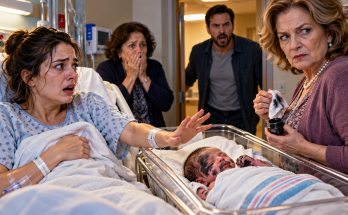
The pediatric specialist introduced herself as Dr. Patel and examined Hope with the calm focus of someone who understood that every movement of her hands was being watched by frightened adults. She checked Hope’s legs, feet, reflexes, and the raised area near the base of her spine, then ordered imaging before she would give us anything more definite.
Melissa sat beside my bed with both arms wrapped around herself.
“Tell me the worst,” she said.
Dr. Patel pulled a chair closer rather than answering from the doorway.
“There are several conditions that can produce an abnormality like this. One possibility is a form of spina bifida. But possibility is not diagnosis. We need imaging, and we need to understand exactly what structures are involved.”
“Will she walk?”
“We don’t know enough yet to answer that responsibly.”
“Will she need surgery?”
“Possibly.”
Melissa looked toward the closed door through which Ryan had disappeared.
I could almost see another piece of her composure break.
Hope was taken for tests while I remained in bed recovering from delivery. I hated being separated from her, though logically I knew she was surrounded by people whose entire purpose was to care for her. My body had spent nine months reacting to every movement she made. Suddenly there was only emptiness beneath my ribs and the question of whether she was all right somewhere down the hall.
Melissa paced.
She called Ryan.
No answer.
She called again.
Nothing.
On the third attempt, she didn’t leave a message.
She lowered the phone and stared at me.
“Did he say something to you?”
“No.”
“Before today?”
“No.”
“You’re sure?”
I thought about the ultrasound.
“That’s not the same question.”
Melissa stopped pacing.
“What does that mean?”
I told her about the technician pausing at the final scan, though she had been standing in the room herself. I told her what I had noticed in Ryan’s face afterward.
She remembered.
I saw it happen.
“He was quiet in the car.”
“Yes.”
“He barely touched dinner that night.”
“I didn’t know that.”
Melissa pressed the heel of her hand to her forehead. “You think he knew.”
“I think he was worried about something. That’s all I can say.”
Her laugh was small and bitter. “Apparently that’s more than he told his wife.”
The first hour after Hope left for imaging felt longer than labor.
When the nurse finally returned her, I cried.
I hadn’t intended to. She was simply wheeled into the room in a clear hospital bassinet, swaddled tightly, her face scrunched as if the entire medical establishment had inconvenienced her personally. Something in me came loose.
“There you are,” I whispered.
Melissa stood beside the bassinet but didn’t pick her up.
Her hands hovered.
I understood what she was afraid of. She had already lost one baby. She had trained herself for years not to believe anything belonged to her until it was safe.
But children are never safe in the absolute sense frightened adults want them to be.
I touched her arm. “Pick up your daughter.”
Melissa looked at me.
“She needs you more than she needs you to be fearless.”
Her mouth trembled.
Then she reached down.
It was the first time Melissa truly held Hope.
She brought the baby against her chest with both hands and bent over her as if shielding her from weather. Hope made one soft sound and settled.
Melissa closed her eyes.
“Hi,” she whispered. “I’m your mom.”
I turned my face toward the window to give them something resembling privacy.
Ryan still had not come back.
He did not return that afternoon.
He did not return that evening.
At 9:17 p.m., my phone lit up.
A message from him.
How is she doing?
I read it twice.
My first impulse was to throw the phone.
Instead, I typed a response, erased it, typed another, erased that too.
Finally I wrote: She has doctors here. Your wife and daughter need you here.
The message showed as delivered.
No reply came.
I placed the phone facedown.
Melissa had seen enough of my expression to understand.
“That was him?”
“Yes.”
“What did he say?”
“He asked how Hope was.”
Her face hardened.
“He knows her name.”
“Of course he does.”
“He knows it, but he can’t come say it to her.”
I had no defense for him.
The next day, Dr. Patel returned with more information. The abnormality appeared to be a mild, skin-covered form affecting Hope’s lower spine. There would be more evaluations and specialists. Surgery was likely during the first months of her life, and physical therapy would be part of the plan.
I gripped the edge of the blanket. “What kind of life are we talking about?”
Dr. Patel looked at me, then Melissa.
“A child’s future is never something I promise in one conversation. But based on what we see now, there are very good reasons to be optimistic. Her leg movement is strong. Her neurological responses are encouraging.”
Melissa leaned forward. “Could she walk?”
“Yes. That is very possible.”
“Run?”
Dr. Patel smiled slightly. “You may eventually find yourself asking her to stop.”
Melissa began crying again.
This time, the tears looked different.
Not relief exactly. Relief was too simple. It was the first breath after believing for hours that every future she had imagined had been erased.
I should have felt only gratitude.
Instead, anger began to settle inside me with extraordinary clarity.
Ryan had walked away before knowing any of this.
He had heard the possibility of difficulty and made a decision while his daughter was less than half an hour old.
That fact did not change because the prognosis improved.
Melissa came and went over the next day. She spent hours holding Hope, then disappeared for stretches when the pressure of the hospital became too much. I didn’t judge her for that. She always returned.
Ryan did not.
When nurses asked about Hope’s parents, I watched Melissa’s face tighten.
When forms appeared, she handled what she could.
When someone asked whether the father would be present for a consultation, she said, “No,” without explanation.
Late that night, she sat beside me while Hope slept between us.
“I keep replaying it,” she said.
“Me too.”
“If he was frightened, why didn’t he tell me?”
I had no answer.
“I would have been frightened with him.”
“I know.”
“That’s what marriage is supposed to be, isn’t it? You get scared in the same room.”
I turned toward her.
“Ryan has always been terrible at failing.”
“So have I.”
“He thinks his job is to fix things.”
“Then why didn’t he fix this?”
The question hung between us.
I looked at Hope.
“I don’t think we understand what he thinks the problem is.”
Melissa went very still.
“What does that mean?”
“I don’t know yet.”
She studied my face, searching for something I didn’t have.
Then she said, “Find out.”
By discharge day, my body felt as if it belonged to someone who had been in an accident. Standing hurt. Sitting hurt. Sleeping happened in scraps. Yet the practical question waiting for us was larger than my exhaustion: where would Hope go while Ryan remained absent and Melissa tried to absorb what had happened?
Melissa asked me if Hope could stay with me temporarily.
The shame on her face made me reach across the table.
“You don’t have to explain.”
“I’m not leaving her.”
“I know.”
“I need you to know that.”
“I do.”
She looked toward the bassinet. “I just need a couple of days to understand what my husband has done.”
So arrangements were made for Hope to come home with me while Melissa remained fully involved in her care and appointments. It was not anyone’s imagined ending to the pregnancy. I had spent nine months preparing to leave the hospital without a baby.
Instead, I buckled my niece into a car seat beside me.
Gabriel waited at home with my neighbor.
The moment I carried Hope inside, he approached on tiptoe as if the living room had become a library.
“Is that her?”
“That’s her.”
He peered into the carrier.
“She’s really small.”
“They usually start that way.”
He frowned at me. “I know that.”
Then he asked the question I had dreaded.
“Why is she coming here if she’s Uncle Ryan’s baby?”
I set the carrier down carefully.
“Because the grown-ups are figuring some things out.”
“Is she sick?”
“She has something in her back that doctors are going to help with.”
“Does it hurt?”
“Not right now.”
Gabriel crouched beside the carrier.
“Does she have a name?”
“Hope.”
He considered it and nodded solemnly.
“That’s a good name.”
That first night, Hope slept in short stretches while I moved through the house in a fog of pain medication, bottles, diapers, alarm clocks, and worry. Around three in the morning I stood beside the window with her against my shoulder, watching the dark street.
I thought about Ryan sleeping somewhere.
If he was sleeping.
I thought about our parents’ funeral and his hand against my back.
Always, he had said.
We will always be a family.
Hope shifted against me.
I realized how easy it was to make promises before they cost you anything.
The following afternoon Melissa called to tell me she still had not been able to get a real conversation out of Ryan. He had answered once, said he needed time, and ended the call after less than a minute.
“I told him he doesn’t have time,” she said.
“What did he say?”
“Nothing useful.”
After we hung up, I sat at the kitchen table with cold coffee and stared at my brother’s name in my phone.
I nearly called him.
Then someone knocked.
Three slow knocks.
I knew before I stood up.
When I opened the door, Ryan was there.
His face looked gray with exhaustion. His shirt was wrinkled, his jaw rough with stubble. I had never seen him look so much like a stranger wearing my brother’s features.
“Can I come in?” he asked.
I stepped aside without answering.
He walked into the kitchen.
Hope was sleeping in the bassinet by the window.
Ryan saw her.
His whole face changed.
For one second he moved toward her.
Then he stopped himself.
I folded my arms.
“You have about ten seconds to start telling me the truth.”
Ryan lowered his eyes.
“Ivy, what happened at the hospital wasn’t because I don’t love her.”
“Eight.”
“I know what it looked like.”
“Seven.”
He gripped the back of a kitchen chair.
“Please.”
“Then talk.”
His shoulders sagged.
“There’s something Melissa doesn’t know.”
I had expected an explanation.
I had not expected another secret.
“What?”
Ryan looked past me toward the sleeping baby.
Then he said, “I’ve been lying to both of you for four months.”
Click here to continue reading: PART 4: Three Days After Abandoning His Daughter, My Brother Came to My Kitchen and Finally Named the Fear He Had Hidden
The Daughter I Carried for My Brother Arrived Crying, and One Glance at Her Back Made Him Step Away
Part 3 of 12