The document followed us home in Melissa’s folder, but it seemed to occupy far more space than a single sheet of paper should.
Our father had undergone surgery as an infant.
Neither Ryan nor I had known.
That fact unsettled me in a way I could not immediately explain. Dad had spent our whole childhood warning us to tell him the truth no matter how uncomfortable it was. Yet he had carried something significant about his own body without ever giving it a name.
Maybe he had not understood it himself.
Maybe his parents had buried the details.
Maybe he had simply decided it did not matter.
But now it mattered.
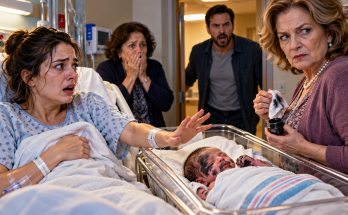
It mattered because Hope lay sleeping in a bassinet with a spinal condition that appeared to echo through three generations.
Two days later, Ryan and I met with a genetic counselor while Melissa joined by video because Hope had finally fallen asleep after a miserable night.
The counselor, Dr. Bell, corrected our assumptions almost immediately.
A family pattern did not mean anyone had “given” Hope her condition in the simple way Ryan feared. Neural tube and spinal-development disorders could involve multiple genetic and environmental factors. Family history could increase risk without offering a single responsible person to blame.
Ryan sat with his hands clasped tightly in his lap.
“So there may never be one explanation.”
“That’s correct,” Dr. Bell said.
“And nothing I did caused this?”
Dr. Bell regarded him carefully.
“If by ‘caused’ you mean an action you knowingly took that produced your daughter’s condition, no evidence we have supports that conclusion.”
Ryan looked down.
Melissa’s voice came through the tablet speaker.
“Did you hear her?”
He looked toward the screen.
“Yes.”
“Good.”
Dr. Bell asked about our father, grandfather, extended family, pregnancies, medications, and health histories. For nearly an hour, we reconstructed relatives from photographs, half-remembered stories, and old remarks made at holiday tables.
At one point Dr. Bell asked whether either twin had ever undergone spinal imaging.
Ryan shook his head.
I did too.
She suggested that, given the family history, Ryan could discuss imaging with his physician if he had symptoms, though the tiny sacral dimple he had lived with for thirty-six years did not by itself prove anything serious.
On the drive home, Ryan was quiet.
This time I did not automatically interpret silence as concealment.
“What are you thinking?”
He looked out the window.
“That I spent weeks believing I had poisoned my daughter with something in my blood.”
I winced.
“Don’t say it like that.”
“That’s what it felt like.”
“It wasn’t true.”
“I know.”
He looked at me.
“But I made decisions as if it were.”
That sentence mattered.
For the first time, Ryan was distinguishing between what he felt and what the facts supported.
I nodded.
“Yes.”
He looked down at his hands.
“I hurt Melissa because I treated fear like evidence.”
“Yes.”
“And I hurt Hope before I even knew what her future would look like.”
“Yes.”
He breathed out slowly.
“I don’t know how people come back from that.”
“They stop asking how to erase it.”
Ryan frowned.
“You can’t undo the hospital,” I said. “You can only become someone who would not make that choice again.”
He stared through the windshield for the rest of the drive.
Melissa spent the next week doing something Ryan had avoided for years.
She opened everything.
Every bank statement.
Every loan.
Every card.
Every recurring payment.
Every medical bill.
Every hidden transfer.
The process turned their dining room into an archaeological site of small financial decisions.
Some of Ryan’s lies were dramatic.
Most were not.
That was what disturbed Melissa most.
A $312 balance moved from one card to another.
A subscription he had canceled, then quietly restarted.
A late fee paid from the dead business account.
A grocery purchase placed on credit because checking was too low.
A minimum payment made from savings.
Each item looked manageable in isolation.
Together they formed a system built entirely on avoiding one difficult conversation at a time.
I helped because Melissa asked me to.
Ryan sat with us whenever she allowed it.
He was not permitted to organize the paperwork.
That had been one of his hiding places.
Melissa did the organizing herself.
One evening, she held up a statement.
“What is this?”
Ryan leaned closer.
“A cash advance.”
“For six thousand dollars.”
“Yes.”
“When?”
“July.”
“Why?”
His jaw tightened.
“The nursery furniture.”
Melissa stared at him.
“The nursery furniture cost forty-two hundred.”
“The rest covered the mortgage.”
She placed the statement on the table.
“I remember that week.”
Ryan said nothing.
“You came home with takeout because you said we should celebrate finishing the nursery.”
His eyes closed.
“I remember.”
“You bought dinner on a card too, didn’t you?”
“Yes.”
Melissa stood and walked into the kitchen.
Ryan started to follow.
I shook my head.
He stayed seated.
A few minutes later, Melissa returned carrying a glass of water.
Her face was calmer.
“I’m not angry about being broke.”
Ryan looked up.
“I’m angry that you made being broke into something shameful enough to lie about.”
He swallowed.
“I know.”
“Do you?”
“Yes.”
She sat.
“If you had come home in May and told me you lost your job, I would have been scared.”
“I know.”
“I would have cried.”
“I know.”
“I might have said something unfair because I was pregnant and terrified.”
Ryan’s face tightened.
“But we would have made decisions together.”
He nodded.
“We might not have bought the expensive stroller. We might have postponed the nursery chair. We might have refinanced. I might have worked extra hours before Hope came. We could have called my mother.”
Ryan looked down.
“You took all of those choices from me.”
“I know.”
Melissa studied him.
“And then when Hope was born, you took another choice from yourself.”
He looked at her.
“You decided you were already a failure, so you behaved like one.”
Ryan closed his eyes.
The words were cruel only if they were untrue.
They were not.
Their financial counselor helped build a plan.
The business account would be closed after consultation with the estate attorney and bank. Ryan disclosed the post-death activity voluntarily. Because he had remained an authorized user under the account structure and had not forged Thomas’s identity, the situation was complicated but not what Melissa had feared in her worst moments. There were still documentation issues to correct.
Ryan handled them openly.
He made the calls on speaker when Melissa requested it.
He handed her every letter before opening it himself.
He applied for jobs from their dining table.
There were no mysterious coffee-shop workdays anymore.
The first interview he received was for a position paying less than his old salary.
Months earlier, he would have rejected it privately.
This time, he told Melissa.
“What do you think?” he asked.
She almost laughed.
Not because the question was funny.
Because he had finally asked it.
“I think we look at the benefits, commute, schedule, and whether you actually want the work.”
Ryan nodded.
“And then?”
“Then you decide whether to interview.”
“You mean we decide?”
Melissa shook her head.
“No. You decide whether to take the job. But we discuss what it means for the family.”
Ryan absorbed the distinction.
The interview went well.
He was invited back.
Nothing was solved yet, but for once uncertainty existed in the open.
Meanwhile, Hope’s surgery was scheduled.
Six weeks old.
The number frightened all of us.
Melissa created a folder with every appointment, scan, insurance letter, and question.
Ryan created nothing.
He simply asked, “What do you need me to do?”
Sometimes Melissa gave him tasks.
Sometimes she said, “Nothing.”
He learned that both answers had to be respected.
I watched their marriage move into a strange middle territory.
Ryan still slept on my couch.
He returned home during the day for appointments, paperwork, or time with Hope when Melissa invited him.
He changed diapers.
He warmed bottles.
He sat through consultations.
He learned how to fasten Hope’s carrier straps correctly after Melissa made him redo them three times.
But he did not assume he had earned his way back into their bedroom.
One afternoon, I found him sitting on my front steps after a job interview.
“How did it go?”
“Good.”
“That sounds disappointing.”
He smiled faintly.
“They offered me the position.”
I sat beside him.
“That is good.”
“It is.”
“What’s wrong?”
He looked toward the street.
“Six months ago, I would have thought this fixed everything.”
“And now?”
“Now I know employment was never the whole problem.”
I waited.
“I thought providing money was the same as providing security.”
He rubbed his palms together.
“But Melissa felt less safe with me than she would have if I had just been unemployed.”
“Yes.”
Ryan leaned back against the railing.
“I keep remembering the hospital.”
I said nothing.
“I remember handing Hope to you.”
His voice became quieter.
“I remember how light she felt.”
I looked at him.
“You don’t need to keep punishing yourself to prove you regret it.”
“I’m not trying to.”
“Then what are you doing?”
He thought about that.
“Remembering the person I can become when I’m scared.”
That answer concerned me less.
“Good.”
Ryan looked at me.
“Good?”
“Remembering is useful. Worshipping your worst moment isn’t.”
He nodded slowly.
A week later, Melissa allowed Ryan to stay overnight at the house for the first time since Hope’s birth.
Not in their bedroom.
On the sofa.
Hope had been unusually fussy, and Melissa had slept less than three hours the night before.
At midnight, she woke to silence.
For one terrible second, she panicked.
Then she found Ryan in the nursery.
He sat in the rocking chair with Hope asleep against his chest.
The night-light cast a pale circle across them.
Melissa stood in the doorway without speaking.
Ryan saw her.
“She finally went down.”
Melissa nodded.
He looked at the sleeping baby.
“I can put her in the crib.”
“In a minute.”
Ryan waited.
Melissa stepped into the room.
Her gaze went to the wooden sign above the crib.
HOPE.
The same sign Ryan had ordered months before everything broke.
“You know what I hate?” Melissa whispered.
Ryan shook his head.
“I still love you.”
He looked at her.
Tears filled her eyes.
“I wish I didn’t right now. It would be easier.”
Ryan’s face tightened.
“I’m sorry.”
Melissa gave him a look.
He stopped.
“No punctuation,” he said.
For the first time in weeks, Melissa almost smiled.
Then Hope stirred.
Ryan adjusted her carefully.
Melissa watched him.
“I don’t know if I can trust you again.”
“I know.”
“I don’t know if I want this marriage.”
“I know.”
“But I want you to be her father.”
Ryan looked down at Hope.
“I want that too.”
“Then don’t make me supervise your courage.”
His eyes returned to hers.
Melissa stood straighter.
“When the surgery happens, you stay. If the doctor says something terrifying, you stay. If there is bad news, you stay. If she cries, you stay. If I fall apart, you don’t decide you have to fix me.”
Ryan nodded.
“You stay.”
“Yes.”
Melissa looked at him for several long seconds.
Then she reached down and touched one finger lightly against Hope’s cheek.
“Surgery is in twelve days.”
Ryan looked at their daughter.
“I’ll be there.”
Melissa’s expression remained guarded.
“Don’t promise me.”
He looked up.
“Show me.”
Twelve days later, before sunrise, the three of us walked through the children’s hospital doors with Hope bundled against Melissa’s chest.
And for the first time since the delivery room, none of us knew what would happen next—but Ryan was still beside us when the doors closed.
Click here to continue reading: PART 9: On the Morning of Hope’s Surgery, Ryan Finally Faced the Kind of Fear He Had Once Chosen to Run From
The Daughter I Carried for My Brother Arrived Crying, and One Glance at Her Back Made Him Step Away
Part 8 of 12