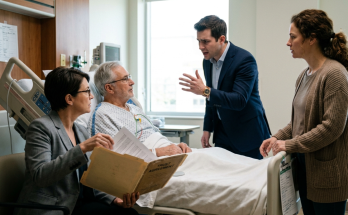
My husband was the first to understand that hospital staff were not going to tell them where I had been moved. He stopped checking the room and turned his attention to the nurse outside. I recognized the posture even through the security monitor: shoulders lowered, expression controlled, voice carefully reasonable.
It was the version of him people trusted.
My mother remained furious.
That contrast had helped them for years.
She created chaos. He entered afterward sounding calm. By comparison, his demands seemed sensible.
He asked whether there had been some misunderstanding.
He explained that he was my husband.
The nurse told him my information was restricted.
He tried again.
My mother did not bother with politeness.
“She’s my daughter.”
The nurse gave the same answer.
From my protected room, I watched something neither of them had experienced with me before.
A boundary they could not argue into disappearing.
My husband’s hands went into his pockets.
My mother paced toward the empty bed again.
She pressed her palm against the sheet as if the remaining warmth offended her personally.
“She was here,” she said.
My husband glanced toward the hallway.
“Obviously.”
“No. She was here a minute ago.”
They spoke quietly after that. The monitor had no useful audio from inside the room, so I could only watch their movements.
My mother pointed toward the hallway.
My husband shook his head.
She stepped closer to him.
He said something that made her recoil.
The nurse beside me adjusted my IV line.
“You don’t have to watch.”
“I know.”
I kept watching.
Part of me needed to see what happened when I was no longer physically present to absorb their frustration.
For years, conflict in my family required me in the middle. My mother accused. My husband judged. I defended, apologized, clarified, negotiated, and finally surrendered enough to restore temporary peace.
Now I had been removed from the system.
Almost immediately, their attention shifted toward each other.
My mother said something sharp.
My husband answered.
She jabbed one finger toward his chest.
He caught her wrist and lowered her hand.
Even through the monitor, I could see her surprise.
My phone lay beside me in a clear hospital bag.
I wondered whether he had tried calling.
I had not checked.
For once, I did not need to know.
A security supervisor entered the old ICU room and spoke to both of them.
My husband’s expression changed first.
He pulled out his phone.
My mother looked suddenly uncertain.
A moment later they were moving down the corridor at nearly the same speed they had arrived.
“What happened?” I asked.
The nurse checked the station message.
“Someone needs them at your residence.”
“Who?”
She read again.
“A deputy.”
My stomach tightened.
I had spoken with the officer about the house during the night.
Because I was the sole recorded owner and because the assault had occurred there, emergency steps were being considered to prevent either of them from entering while everything was investigated.
I had been too exhausted to understand how quickly some of those steps could happen.
Apparently, not slowly.
My husband and mother disappeared from the hospital camera.
For the first time all morning, the screen showed only staff moving through the corridor.
I should have relaxed.
Instead, their reaction bothered me.
Neither had asked the security supervisor why a deputy wanted them at the house.
They had not looked confused.
They looked alarmed.
The nurse lowered the monitor brightness.
“Try to rest.”
I closed my eyes.
The moment I did, I saw the refinance packet again.
Sticky tabs.
Signature lines.
My husband’s pen.
My mother’s hand taking my phone.
The locked front door.
All of it revolved around the same thing.
My name on paper.
Across town, they reached the house before I learned what had been arranged there.
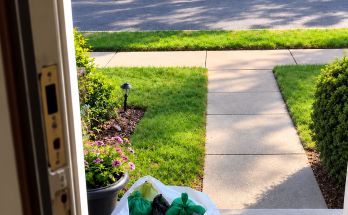
A deputy was waiting on the porch.
So was a locksmith.
The lock had already been changed.
My husband’s duffel bag sat near the front steps.
Beside it stood my mother’s small rolling suitcase and a second bag she often kept at our house because she stayed overnight occasionally.
Between the luggage was a sealed envelope.
My husband saw the bags before he saw the deputy.
According to the statement I later received, he laughed.
Not because he found anything funny.
It was the dismissive laugh he used when someone acted as if rules applied to him.
He walked toward the door.
The deputy stopped him.
My husband said he was going inside.
The deputy told him he was not.
“This is my home.”
The deputy checked the document in his hand.
“Your name isn’t on the property.”
My husband apparently repeated himself, louder this time.
He had lived there for years.
He received mail there.
He contributed to household expenses.
He was my spouse.
Every statement may have been true.
None placed his name on the deed.
The envelope on the porch contained a copy of the property record.
One owner.
Me.
I had spent years allowing the phrase our house because I believed generosity made a marriage stronger.
Now the legal difference between our and mine was the only reason the person who had pressured me to risk the property could not simply walk inside and remove whatever he wanted.
The deputy explained the temporary restrictions.
Neither my husband nor my mother was to enter without authorization while the investigation continued.
Personal property could be retrieved later under controlled conditions.
My husband argued.
My mother stared at the new lock.
Then her attention moved to the sealed envelope.
Something in her expression changed.
The deputy noticed.
So did my husband.
My mother asked whether I had arranged all of this.
The deputy did not discuss where I was or what I had personally requested.
He repeated the conditions.
My mother looked toward the windows.
I could imagine what she was seeing.
The kitchen beyond them.
The table.
The place where the refinance packet had fallen after she hit me.
Then she said something she should not have said.
“She can’t do this yet.”
My husband turned toward her.
“What?”
My mother pointed toward the house.
“She can’t lock us out yet. She hasn’t signed the papers.”
My husband crossed the space between them so quickly the deputy stepped forward.
“Stop talking.”
My mother frowned.
The deputy looked from one to the other.
“What papers?”
That question changed the porch.
Until then, the deputy was dealing with a property dispute connected to an assault.
Now my mother had introduced documents into the conversation without being asked.
My husband understood the problem immediately.
He moved close enough to lower his voice.
“Not here.”
The deputy heard him anyway.
“What papers are you referring to?”
My mother looked at my husband.
He stared back with a warning so familiar I could picture it without having been there.
Do not make this worse.
Do not say the wrong thing.
Follow my lead.
It was the look he had given me across dinner tables, in parking lots after family gatherings, and during arguments when another person entered the room.
For once, it was directed at her.
My mother fell silent.
The deputy asked again.
She glanced toward the changed lock.
Then down at her suitcase.
I later learned that was when she first seemed to realize she was standing beside the man whose interests she had been defending without any guarantee he would defend hers.
The previous night, she had believed they were allies.
My husband had called because I would not cooperate.
She had come because he told her I was standing in the way of something important.
She had taken my phone.
She had locked the door.
She had hit me when I still refused.
And he had left.
At the hospital, they had arrived together again.
But now a deputy was asking questions neither expected, and my husband’s first instinct was not to protect her.
It was to silence her.
My mother’s gaze moved from his face to the deputy.
My husband said she was upset and confused.
He said the assault had nothing to do with financial documents.
My mother looked at him sharply.
That claim must have sounded different to her than it did to the deputy.
She knew why she had been called to the house.
She knew what he wanted me to sign.
She knew how strongly he had pushed her to convince me.
Yet now, standing where another person could record his words, he was separating himself from the reason she had been there.
My mother asked, “What do you mean it had nothing to do with it?”
My husband’s face hardened.
“I mean exactly what I said.”
For perhaps the first time in her life, my mother experienced the version of him I had spent years trying to explain.
The calm voice.
The careful distance.
The sudden suggestion that another person had misunderstood an event he had helped create.
He was preparing a story in which she had lost control by herself.
She saw it happening.
The deputy asked whether my husband had requested that she come over the previous evening.
He hesitated.
My mother answered first.
“Yes.”
My husband looked at her.
The deputy asked why.
My mother’s mouth opened.
My husband interrupted.
“We were having a marital disagreement. I asked her to talk some sense into her daughter. I never asked anyone to hurt anybody.”
There it was.
The separation.
The sentence that left my mother standing alone with every physical injury photographed at the hospital.
Her face changed.
She had done something terrible to me, and no later betrayal could erase that responsibility.
But until that moment, she had apparently believed she was doing it in service of a plan shared with my husband.
Now she understood the arrangement differently.
If the situation remained private, he would benefit from what she had done.
If the situation became criminal, she would become the entire explanation.
My husband shifted toward the driveway as though the conversation were finished.
My mother blocked him.
“You said you would handle this.”
The deputy raised one hand.
“Handle what?”
My husband’s jaw tightened.
My mother kept staring at him.
I would later think about the terrible symmetry of that moment.
The night before, I had stood in my kitchen learning that my mother would choose his demand over my safety.
Now she stood on my porch learning that he would choose his safety over her.
The difference was that I had never agreed to their bargain.
She had.
My husband told her again to stop talking.
This time, she did not.
“What about the refinance?”
The deputy looked at him.
My husband’s composure cracked just enough to show.
My mother saw it too.
She stepped away from him.
The porch suddenly contained more than an assault, more than a marriage dispute, more than a changed lock.
It contained a financial transaction that had been urgent enough for my husband to summon my mother to pressure me, urgent enough for her to take my phone, and important enough that my refusal had ended with me unconscious on a kitchen floor.
The deputy asked whether I had signed the refinance application.
My mother looked toward the house.
“No,” she said.
My husband immediately answered, “She was going to.”
The deputy turned toward him.
“That wasn’t the question.”
My mother’s breathing changed.
My husband told the deputy he wanted a lawyer before discussing finances.
That was his right.
But to my mother, his sudden caution apparently sounded like something else.
Abandonment.
She looked again at the suitcase he had packed or allowed to be placed beside hers.
Then she looked at the house neither of them could enter.
When she spoke again, the anger had drained out of her voice.
“What happens to me?”
My husband did not answer.
She asked him a second time.
He looked toward his car.
That was enough.
My mother had beaten me because she believed my refusal threatened something both of them expected to gain.
Now she was discovering that whatever understanding existed between them had never included equal risk.
If someone had to carry the worst consequences alone, my husband had already chosen who it would be.
The deputy asked whether she wanted to make a statement separately.
My husband finally looked at her.
“Don’t.”
One word.
Not reassurance.
Not loyalty.
A command.
My mother stared at him for several long seconds.
Then she looked toward the deputy, and something in her face settled.
The fury I had seen in my kitchen was gone.
So was the certainty with which she had followed my husband into the hospital that morning.
What remained was recognition.
She had finally understood that he intended to let her take the blame for everything.
And judging by the way she turned away from him, she had just decided she was no longer willing to stay quiet for him.
Click here to continue reading: PART 5: My Mother Finally Told the Deputy Why My Husband Needed My Signature Before the Lender Could Ask More Questions
The Message on My Cracked Phone Forced Me to Answer One Question I Had Avoided for Six Years
Part 4 of 12