The lunch rush in Prescott Valley had almost faded, leaving behind half-empty coffee cups, cooling plates of fries, and the low hum of an old country song crackling from the speaker above the counter. Sunlight poured through the windows, bright and harmless, but the boy standing in the doorway looked as if he had run straight out of a nightmare.
He was ten years old, small, dusty, trembling, wearing a faded blue hoodie and sneakers coated in Arizona dirt.
“Please,” he whispered. **“I need help.”**
Nobody moved.
Nobody except the bikers.
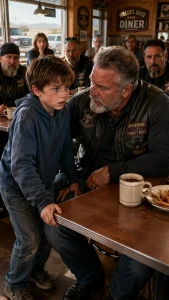
At the corner table, Daryl Boone slowly pushed back his chair. He was a giant of a man in a black leather vest, with a gray beard, weathered hands, and kind blue eyes that had seen enough pain to recognize it instantly in someone else.
“Hey, son,” Daryl said gently. “Come here.”
Miles crossed the diner so fast he nearly stumbled. He grabbed the edge of Daryl’s table with both hands, gasping for breath.
“What’s your name?” Daryl asked.
“Miles.”
“Okay, Miles. You’re safe now. Tell me what happened.”
Miles looked toward the windows. Then the door. Then the floor.
“My grandma,” he said, voice shaking. “He’s about to take her house.”
Daryl’s expression hardened, but his voice stayed soft. “Who is?”
Miles swallowed. **“Mr. Vale.”**
The name made the waitress behind the counter stiffen.
Victor Vale was known in town as a clean-suited investor with perfect hair, polished shoes, and a smile that never reached his eyes. He had spent months buying old properties around Prescott Valley, promising progress, new businesses, and money. But everyone knew his offers came with pressure.
Miles’s grandmother, Ruth Harper, owned one of the oldest houses on the edge of town. It sat crooked on a dry patch of land, with peeling paint, creaking floors, and a porch that groaned in the wind. To most people, it looked worthless.
To Ruth, it was everything.
“My grandpa built that house,” Miles said. “Grandma says every board knows our name.”
Daryl leaned closer. “What did Vale do?”
“He keeps coming over. Telling Grandma the house is unsafe. Saying if she doesn’t sell, the county will force her out.” Miles’s lips trembled. “She cries after he leaves.”
One biker at the table, Ronan Pike, quietly shifted his chair so his broad shoulders blocked Miles from the front door.
Daryl noticed.
So did Miles.
The boy leaned in. “Last night Grandma heard noises under the floor. She thought it was raccoons. But I heard voices.”
Daryl’s eyes narrowed. “Voices?”
Miles nodded. **“Under the house.”**
The diner seemed to shrink around them.
“I crawled underneath this morning,” Miles whispered. “Through the broken panel behind the porch.”
Daryl’s jaw tightened. “Alone?”
“I had to know.”
“What did you see?”
Miles looked down, as though the memory was crawling back up through the tiles beneath his feet.
“There was a man under there. Mr. Vale. He had a flashlight. And a little metal box. He pried up some boards from underneath.”
“What was inside the box?”
“I don’t know. Papers. Old papers. And something wrapped in cloth.” Miles’s breath hitched. “But that’s not all.”
Daryl said nothing.
Miles raised his terrified eyes.
“He said, ‘Once the old woman signs, nobody will ever know this place belonged to Boone.’”
Daryl went completely still.
The bikers looked at him.
Ronan’s voice dropped. “Daryl?”
But Daryl did not answer. His gaze was locked on the boy.
“What did you say?” he asked.
Miles blinked. “He said the house belonged to Boone.”
A strange silence fell over Daryl’s face. Not fear. Not surprise.
Grief.
Long-buried, sudden, unbearable grief.
“My father’s name was Samuel Boone,” Daryl said quietly. “He disappeared before I was born.”
Miles frowned. “But Grandma’s house belonged to my family.”
Daryl slowly shook his head. “Maybe not always.”
Before anyone could speak, the bell above the diner door jingled.
Miles turned.
And all the blood drained from his face.
A man in a tan suit stepped inside, smiling politely at the room.
Victor Vale.
Miles grabbed Daryl’s arm with both hands.
**“That’s him.”**
Vale’s eyes swept across the diner and landed on the boy. For one brief second, his perfect smile cracked.
Then it returned.
“Well,” Vale said smoothly, walking closer. “There you are, Miles. Your grandmother is worried sick.”
“No, she isn’t,” Miles whispered. “You told her I ran away.”
Vale’s smile tightened.
Daryl rose slowly to his full height.
The room changed when he stood.
Even the sunlight seemed to hold back.
“This boy says you were under his grandmother’s house,” Daryl said.
Vale laughed lightly. “Children imagine things.”
“He says you were hiding something beneath the floorboards.”
Vale’s eyes flickered.
Just once.
But Daryl saw it.
Ronan stood too. Then the other bikers. Not threatening. Not violent. Just present. Solid as a wall.
Vale lifted both hands. “Gentlemen, let’s not be dramatic. Mrs. Harper’s property is dangerous. I’m trying to help her.”
“You’re trying to scare her,” Miles snapped.
The diner gasped softly at the boy’s courage.
Vale looked at him with cold eyes. “You should learn when to stay quiet.”
Daryl stepped between them.
“Careful,” he said.
Vale’s smile vanished. “You have no idea what you’re involved in.”
Daryl leaned closer. **“Then explain it.”**
For a moment, Vale said nothing.
Then he reached into his jacket.
Every person in the diner froze.
But he pulled out only an envelope.
He placed it on the table.
“Mrs. Harper signed the sale agreement this morning,” Vale said. “The house is mine by sunset.”
Miles shook his head desperately. “No. She wouldn’t.”
“She did,” Vale said. “Because she understands what happens when old secrets stay buried too long.”
Daryl picked up the envelope and opened it. Inside was a contract bearing Ruth Harper’s shaky signature.
Miles began to cry. “He forced her.”
Vale smirked. “Prove it.”
That was when the diner door opened again.
An elderly woman stood there, leaning on a cane, her silver hair pinned beneath a faded blue scarf.
Ruth Harper.
Miles ran to her. “Grandma!”
She wrapped one shaking arm around him but kept her eyes on Vale.
“You told me he was gone,” Ruth said.
Vale’s face darkened. “Mrs. Harper, you shouldn’t be here.”
“No,” she replied. **“You shouldn’t.”**
Daryl stared at her.
Ruth stared back.
Her face changed.
The cane slipped slightly in her hand.
“Samuel?” she whispered.
Daryl’s chest tightened. “No, ma’am. Daryl Boone.”
Ruth covered her mouth.
“Oh my God,” she breathed. “You’re his son.”
The diner went silent again, but this time the silence was alive.
Daryl’s voice cracked. “You knew my father?”
Ruth’s eyes filled with tears. “I loved your father.”
Daryl staggered as if the words had struck him.
Vale snapped, “Enough.”
But Ruth lifted her cane and pointed at him.
“No. You wanted the house because of what was hidden there. But you never understood what it was.”
Vale’s face twisted. “Give me the deed, Ruth.”
Daryl looked at her. “What deed?”
Ruth reached into her coat with trembling fingers and pulled out a small oilskin packet.
“I found this years ago,” she said. “Samuel hid it before he vanished. I was too afraid to open it after what happened.”
“What happened?” Daryl asked.
Ruth’s tears spilled over.
“Samuel discovered that Prescott Valley’s land records had been forged. Entire families were robbed. Homes stolen. His own family’s land was taken first.” She looked at Vale. “By your grandfather.”
Vale’s polite mask disappeared completely.
Ruth continued. “Samuel gathered proof. He hid copies beneath my floorboards. The night he was going to expose them, he disappeared.”
Daryl’s hands curled into fists, not with rage, but with heartbreak.
“My mother waited for him,” he whispered.
Ruth bowed her head. “He was trying to come back to her. To both of you.”
Miles looked between them, confused and trembling.
“But why Grandma’s house?” he asked.
Ruth touched his hair.
“Because, sweetheart,” she said softly, **“this house was never mine.”**
Daryl froze.
Ruth turned to him.
“Samuel put it in my name to protect it. But the original deed says it belongs to his bloodline.” Her voice broke. “Daryl, that house is yours.”
The words hit the room like thunder.
Vale lunged for the packet.
Ronan moved first, knocking the papers safely from his reach while the waitress screamed and the cook rushed from the kitchen holding a phone.
“I already called the sheriff,” the waitress shouted.
Vale backed away, breathing hard.
“You think this matters?” he hissed. “Those papers are seventy years old.”
Ruth smiled through her tears.
“That’s what I thought too.”
Then she turned to Miles.
“Show him.”
Miles reached inside his hoodie pocket and pulled out a small black object.
A phone.
“I recorded him,” Miles said, voice trembling but clear. “Under the house. He said everything. He said his family buried Samuel Boone in the dry well.”
Daryl stopped breathing.
Ruth sobbed.
Vale’s face turned gray.
Miles pressed play.
Vale’s own voice crackled from the speaker.
“Once the old woman signs, the Boone land is gone for good. My grandfather should’ve burned these papers with Samuel’s body.”
No one moved.
No one spoke.
Then outside, sirens wailed.
Vale looked toward the door, trapped at last by the secret he had spent his life protecting.
Daryl sank to one knee, not from weakness, but because the truth was too heavy to hold standing.
Miles stepped toward him.
“I’m sorry,” the boy whispered.
Daryl looked at the child who had run into a diner terrified, dusty, and alone—and had somehow carried seventy years of truth in his pocket.
Then Daryl pulled him gently into his arms.
“No, son,” he said, voice breaking. **“You brought my father home.”**
Three weeks later, the dry well behind Ruth Harper’s house was opened.
Samuel Boone was found with his old wedding ring still in his pocket.
Beside him was a rusted tin box containing the final original land deeds, letters to his wife, and one note addressed to the child he never got to meet.
Daryl read it on the porch at sunset, Miles beside him, Ruth holding his hand.
**“If my son ever finds this,”** the letter said, **“tell him I did not leave him. Tell him I was trying to give him a home.”**
Daryl wept then.
Not like a biker.
Not like a man trying to be strong.
But like a son who had spent fifty-eight years believing he had been abandoned, only to learn he had been loved enough to be protected by a dead man’s final breath.
Victor Vale was arrested. The forged land scheme collapsed. Families across the county reclaimed what had been stolen.
And Ruth’s house?
It became Boone House.
Not because Daryl took it from her.
Because he refused to let her leave.
He restored it board by board, room by room, with Miles helping every weekend. The broken porch was rebuilt. The floorboards were repaired. The dry well was sealed and covered with desert flowers.
Above the front door, Daryl hung a wooden sign carved by hand.
**THE HOUSE THAT REMEMBERED.**
And sometimes, when the Arizona wind moved through the old walls at night, Miles swore he could hear the house creaking softly.
Not like fear.
Not like warning.
But like a grandfather finally whispering home.
Miles’ grip tightened on Daryl’s vest so hard his knuckles turned pale.
“Something’s happening,” Miles whispered. “Under the house… it wasn’t just him. I heard voices. Like they were talking through the floor.”
Daryl’s jaw tightened.
Ronan’s hand slowly slid under the table.
Outside, the engine across the street didn’t shut off.
It just idled.
Watching.
Waiting.
Then—
The diner lights flickered once.
A soft buzz ran through the old wiring overhead, like the building itself had been disturbed.
The waitress frowned. “Power grid’s acting weird again—”
But Daryl wasn’t listening.
His eyes were locked on the diner floor.
On the exact spot beneath Miles’ feet.
Because for a split second…
He heard it too.
Not from outside.
Not from the door.
From below.
A faint metallic scrape.
Like something shifting under the foundation.
Miles went rigid.
“That’s it,” he breathed. “That sound. That’s what I heard under Grandma’s house.”
Daryl slowly raised a hand.
Not to calm the room.
To signal the bikers.
Ronan nodded once.
The others shifted—quiet, controlled, practiced.
The kind of movement that didn’t come from troublemakers…
…but from men who had already survived it.
Then—
The diner floor gave a soft, almost polite click.
Like a lock disengaging.
And from the corner booth, the largest biker whispered:
“Daryl… that ain’t a basement sound.”
A pause.
“It’s a hatch.”
Before anyone could react—
The booth table tilted slightly.
As if the ground beneath it had just become hollow.
Miles stared at Daryl, terror flooding his face.
“They’re under us,” he said.
And then—
The floor answered back.
The diner floor didn’t collapse.
That would’ve been easier.
Instead, it shifted.
A low mechanical groan rolled through the foundation as if the entire building had started to breathe in the wrong direction. Plates rattled. Coffee rippled in cups. The old wooden floorboards near the corner booth lifted by a few millimeters—then settled again, like something underneath had tested the weight above and decided to wait.
Daryl stepped forward slowly, pulling Miles behind him.
“Everybody stay calm,” Daryl said, voice steady but lower now. “Nobody move toward the exits yet.”
That got everyone’s attention.
Ronan frowned. “Why?”
Daryl didn’t take his eyes off the floor.
“Because if they wanted us trapped, they’d already have locked the doors.”
As if on cue—
click.
The diner’s front lock turned on its own.
The waitress let out a small gasp. Someone dropped a fork.
Outside, the idling engine across the street finally stopped pretending to be casual.
Now there was no hiding it.
Something was coordinated.
Miles tugged on Daryl’s vest again. “Under Grandma’s house… I saw wires. Cameras. Like it wasn’t just a hiding place—it was a system.”
Daryl’s expression hardened.
“Like surveillance?”
Miles shook his head quickly.
“Like they were watching the whole town.”
A long silence fell.
Then—
From under the corner booth, the metallic scrape returned.
But this time it wasn’t random.
It was rhythmic.
Like someone typing a code in metal.
clink… clink… clink.
Ronan crouched slightly, eyes narrowing. “That’s not digging.”
One of the other bikers whispered, “That’s communication.”
The floorboard near Daryl’s boot suddenly clicked open—just a fraction.
A thin seam appeared where there hadn’t been one before.
And from inside that seam—
A soft blue light leaked out.
Not natural.
Not electrical.
Something colder.
More precise.
Miles froze.
“That’s the same light,” he whispered. “Under the house…”
Daryl exhaled slowly.
Then made a decision.
“Ronan,” he said. “Get the door. No panic. No running.”
Ronan nodded.
“And the kid?”
Daryl looked down at Miles.
For the first time, his voice softened.
“Stay right behind me.”
The floor gave another click.
This time, louder.
Closer.
Like whatever was underneath…
had just unlocked the next step.
The blue light didn’t just leak anymore.
It spread.
Thin lines crawled along the seams of the wooden floor like glowing veins, mapping the diner in real time. The customers finally reacted—chairs scraped back, a chair fell over, someone shouted—but it was already too late for confusion to last.
Because the system beneath them was waking up.
Daryl’s voice cut through the rising panic.
“NOW—move to the back wall. No running!”
The bikers shifted instantly, forming a loose barrier between the civilians and the glowing floor. Ronan reached the front door—but stopped.
The handle wouldn’t turn.
Not locked.
Just… unresponsive. Like the mechanism had been removed from reality.
Ronan’s eyes narrowed. “It’s sealed.”
Miles shook violently. “It’s doing the same thing it did at my grandma’s house! The doors just—stop working!”
Daryl looked down at the glowing lines.
And realized something worse.
They weren’t random.
They were forming a shape.
A circle.
Centered directly under the corner booth.
The largest biker stepped back. “Daryl… that’s a containment ring.”
The word hit heavier than it should have.
Containment didn’t mean hiding.
It meant keeping something in.
Or keeping something out.
A sound came from below.
Not scraping this time.
A voice.
Faint. Distorted. Coming through the floor like it was speaking through miles of broken wire.
“…asset located…”
Miles went pale. “That’s them. That’s the voice I heard under the house.”
Daryl’s eyes hardened. “Who’s ‘them’?”
Before Miles could answer—
The floor dropped.
Not collapsing outward.
Dropping inward like a plug being pulled from reality itself.
The corner booth sank a few inches.
Then a foot.
Then deeper—
And the blue circle snapped fully open.
A hatch revealed itself where there had never been one.
Perfectly engineered.
Perfectly hidden.
And inside—
Not darkness.
But a descending corridor lined with soft blue lights.
Like an invitation.
Or a trap that had finally finished opening its mouth.
Ronan whispered, “That wasn’t under the diner…”
Daryl stared into the opening.
“…that was always part of it.”
Miles grabbed his arm. “They’re coming up or going down?”
A pause.
Then from the corridor below—
Footsteps.
Slow.
Measured.
Ascending.
The footsteps didn’t rush.
They didn’t need to.
Each step echoed up the glowing corridor with calm precision, like whoever was coming already knew exactly how this moment would end.
Daryl shifted slightly, placing himself between Miles and the opening.
Ronan moved to the side, giving him a wider angle—covering both the hatch and the front door that refused to open.
The diner had become a sealed box.
And the lid was lifting from underneath.
A shape appeared in the blue-lit corridor.
At first, just a silhouette.
Then details sharpened.
Not a monster.
Not a thug.
A man in a clean, dark tactical coat with no insignia. No expression either—just eyes that looked like they were used to cataloging people instead of seeing them.
He stepped up onto the diner floor without hesitation.
Like he had been here before.
Like he owned the space.
His gaze immediately landed on Miles.
“Subject retrieved faster than expected,” the man said calmly.
Miles recoiled. “That’s him—he was under the house too!”
Daryl didn’t move. “What are you doing in my diner?”
The man tilted his head slightly, as if the question was irrelevant.
“This location is not a diner,” he said. “It is a surface mask.”
Ronan’s voice sharpened. “For what?”
The man finally looked at him.
“For containment infrastructure.”
The lights above flickered again—responding to his presence more than the system beneath.
Miles whispered, “He’s not alone… there were more of them under Grandma’s house…”
The man nodded once.
“Yes.”
A beat.
“They’ve already been relocated.”
Daryl’s eyes narrowed. “To where?”
The man looked down into the open hatch.
Then back up.
“Downstream.”
Silence dropped hard.
Even the panicked customers stopped moving, like the word itself had pressed them still.
Miles shook his head. “No… I saw bodies down there. I saw—”
The man interrupted, voice still flat.
“Misinterpretation.”
That was worse than anger.
Because it wasn’t denial.
It was classification.
Daryl stepped forward half a pace.
“You came here for the boy,” he said.
“Yes.”
“Why?”
The man finally showed something close to interest.
“Because he observed an active transfer site without authorization.”
Ronan’s hand tightened. “He’s ten.”
The man looked at Ronan like that detail was irrelevant.
“Age is not a variable in exposure.”
A low hum began building from the corridor below.
Not louder.
More synchronized.
Like something beneath them had heard the conversation and agreed with it.
Miles grabbed Daryl’s vest again, voice breaking.
“I wasn’t supposed to see it… I wasn’t supposed to crawl under there…”
Daryl looked down at him.
Then at the man.
And made a decision that didn’t require thinking anymore.
“You’re not taking him.”
The man didn’t react immediately.
Then, softly:
“That is not within your operational authority.”
Ronan exhaled once.
“Yeah?” he said.
Then smiled slightly.
“Neither is what’s about to happen next.”
The moment Ronan finished speaking, the diner’s remaining normal lights died.
Not flickered.
Not dimmed.
They shut off all at once, like a switch had been pulled somewhere deep under the building.
Only the blue system-light remained.
It painted everyone in cold outlines—faces stripped of warmth, edges sharpened into something almost unreal.
The man in the tactical coat didn’t even blink.
But the hum from the corridor below changed pitch.
Higher.
Alerted.
Like Ronan’s words had triggered a response protocol.
Daryl didn’t look away from the man.
“Ronan,” he said quietly, “whatever you’re about to do—do it clean.”
Ronan cracked his neck once.
“Already planned it that way.”
Miles backed up instinctively, but Daryl kept him anchored with one hand.
The man finally lifted his hand slightly.
Not threatening.
Just… signaling.
And behind him, in the glowing corridor—
More footsteps answered.
Not one set.
Several.
Measured, synchronized, approaching the surface like a tide rising through engineered stone.
Ronan muttered, “Yeah… that’s a lot more than one guy.”
Daryl’s eyes narrowed. “We hold the line.”
The man spoke again, calm as ever.
“Containment breach probability increasing. Initiating stabilization protocol.”
Miles whispered, “What does that mean?”
Daryl answered without looking at him.
“It means they stop asking nicely.”
The corridor behind the man brightened.
Shapes began to form inside it—figures moving in formation, not rushing, not panicked.
Organized.
Controlled.
Then—
A second hatch clicked open near the diner entrance.
Then another under the bar.
Then another beneath a table where an elderly couple had been sitting.
The system wasn’t coming from one point anymore.
It was everywhere.
The diner hadn’t been chosen.
It had been built into.
Ronan’s voice dropped. “Daryl… we’re standing inside their network.”
The man in the coat nodded slightly, as if approving the conclusion.
“Yes.”
A pause.
“This is node seven.”
Miles’ eyes widened. “Seven…? There are more?”
The man looked directly at him.
“Many more.”
Daryl tightened his grip slightly on Miles.
“Then we burn this one down,” he said.
For the first time, something changed in the man’s expression.
Not fear.
Not anger.
Just recognition that the situation had shifted outside expected parameters.
A faint pause.
Then he spoke into his sleeve.
“Escalation confirmed.”
The corridor lights surged brighter.
And from behind him—
The first of the others stepped up into the diner.
The first operative didn’t rush out of the corridor.
He arrived.
Like stepping through a threshold that treated movement as optional.
Behind him came two more.
Then four.
Then more than the diner could comfortably hold without admitting something was fundamentally wrong with its size.
They spread out without chaos. No shouting. No hesitation. Just positioning—angles, coverage, control points—like they were fitting pieces into a diagram that already existed in their heads.
The blue light sharpened around them, outlining their forms like they were being rendered by the system itself.
Daryl shifted his stance.
Ronan did too.
Not panic.
Adjustment.
Miles pressed closer to Daryl’s side, his breathing uneven now, eyes locked on the descending flow of people.
The man in the coat remained still at the top of the hatch, watching everything like a supervisor observing a procedure.
“Final warning,” he said calmly. “Release the subject.”
Daryl answered immediately.
“No.”
A pause.
The man tilted his head slightly, as if acknowledging a completed data point.
“Then you become obstruction.”
Ronan let out a short breath. “Funny. That’s what people usually call us right before they regret it.”
One of the operatives shifted a fraction—just enough for Daryl to notice.
Not aggressive yet.
But ready.
Then—
Miles spoke, voice small but urgent.
“I saw symbols under the house… carved into the wood. They weren’t random. They were like… instructions.”
That got a reaction.
One of the operatives paused mid-step.
Just for a second.
The man in the coat looked down toward Miles again.
“Confirm exposure level,” he said.
Another operative replied instantly.
“Confirmed. Full visual contact with substrate layer.”
Daryl caught the phrase.
Substrate layer.
Not a basement.
Not infrastructure.
A layer beneath what people were supposed to know existed.
The man’s tone shifted slightly.
“Then containment is no longer optional.”
The lights across the diner flickered in perfect synchronization.
And every open hatch—under tables, behind booths, near the entrance—clicked one step wider.
Not opening.
Aligning.
Like something underneath was preparing to connect all points at once.
Ronan muttered, “Daryl… I don’t think we’re dealing with a rescue op anymore.”
Daryl didn’t look away from the operatives.
“Yeah,” he said quietly.
“We’re inside the system’s cleanup cycle.”
Miles trembled.
“They’re going to take me back under there…”
Daryl tightened his stance.
“Not while I’m standing.”
The man in the coat finally raised his hand.
And the operatives moved.
Not forward.
Not yet.
Just enough to complete the circle around the room.
Closing it.
The circle didn’t close all the way.
It almost did.
That small gap—barely two steps wide between two operatives near the bar—was the only reason Daryl didn’t move yet.
He noticed it instantly.
Ronan noticed it too.
So did the man in the coat.
And for the first time, something like hesitation flickered through the system—not fear, but recalculation.
Miles whispered, “That gap… why is there a gap?”
Daryl didn’t answer. He was already reading it.
Not an accident.
A constraint.
Something about the diner’s physical layout—or whatever was controlling these people—didn’t allow a perfect seal at that angle.
Ronan leaned slightly toward Daryl. “That’s our exit.”
Daryl gave the smallest nod.
But didn’t move.
Not yet.
Because the moment they did, everyone in the room would know.
The man in the coat lowered his hand slightly.
“Adjust perimeter,” he said.
The operatives shifted.
Slowly.
Carefully.
Fixing the gap.
Miles felt it before it fully happened. His breathing sped up.
“They’re closing it…”
Daryl crouched slightly, bringing his voice close to Miles without breaking eye contact with the room.
“When I say move,” he said quietly, “you don’t think. You don’t stop. You go straight for that opening.”
Miles shook his head. “I can’t—”
“Yes, you can,” Daryl cut in, calm but firm. “Because you’re not going back under that floor.”
Ronan exhaled once. “And what about you?”
Daryl didn’t look at him.
“I’ll make sure they don’t follow.”
Ronan gave a short, humorless laugh. “That sounds familiar.”
The gap narrowed.
One step left.
Maybe less.
The man in the coat watched Daryl now more closely than before.
He was no longer just managing containment.
He was anticipating behavior.
“Subject protection behavior detected,” he said quietly.
Daryl straightened slightly.
“Yeah,” he replied. “That’s kind of the point.”
A pause.
Then—
Daryl moved.
Not toward the exit.
Toward the table.
Hard.
He kicked it sideways—not at anyone, not violently, but enough to slam wood into metal shelving behind it.
A sharp CRACK echoed through the diner.
For half a second, every operative turned.
That was the opening.
Ronan grabbed Miles instantly.
“GO!”
They bolted toward the narrowing gap.
The operatives reacted a split second late—not out of confusion, but because the system had prioritized Daryl.
And that delay was everything.
Miles ran.
Ronan right behind him.
The gap tightened—
Daryl stepped into the middle of the room alone, eyes locked on the man in the coat.
And for the first time, Daryl spoke something different.
Not defiance.
Not warning.
A question.
“What exactly are you trying so hard to keep under here?”
The man paused.
Just long enough for the system to hesitate with him.
And from beneath the diner—
The blue light pulsed once.
Like something below had heard the question too.