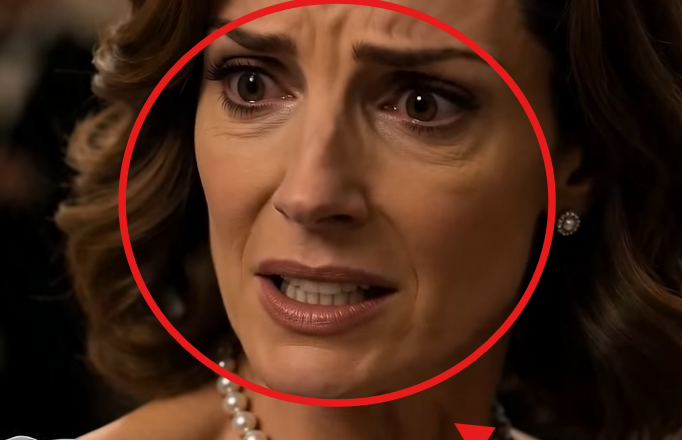
The woman stared down at him, her whole body shaking.
“Who is your mother?” she whispered.
The boy swallowed hard. For the first time, he looked scared.
“She worked in your house,” he said quietly. “A long time ago.”
The woman’s lips parted.
The room around them disappeared.
There had only ever been one person who spoke to her like that when she was broken. One person who sat beside her after the accident, when doctors gave her numbers and pity instead of hope.
Maria.
The maid everyone ignored.
The only friend who never did.
“What’s her name?” the woman asked, though her heart already knew.
The boy’s eyes filled with tears.
“Maria.”
The woman covered her mouth and let out a broken breath.
A few guests looked at each other, confused, but she didn’t see them. She only saw the child kneeling in front of her, with Maria’s eyes and Maria’s quiet courage.
The boy reached into his pocket and pulled out a folded piece of paper, worn soft at the edges.
“She died last month,” he whispered. “Before she died, she told me to find you. She said if you ever stood again, I had to give you this.”
The woman took the note with trembling hands.
Inside, in unsteady handwriting, were the words she had needed for years:
You were never weak. You were only afraid to live without guilt.
Her face collapsed.
She sank back down, not into the wheelchair, but onto her knees in front of him.
“I looked for her,” she cried softly. “She vanished.”
The boy nodded.
“She got sick. She didn’t want you to see her like that. But she said you saved her once… and one day, I would save you.”
The woman pulled him into her arms, crying against his dirty shoulder as the ballroom stood frozen around them.
The rich guests had come to donate money.
But in the middle of the chandelier light and the city glow, a poor child had brought back something none of them could buy.
Hope.
A sharp inhale cut through the silence before she could speak.
The man at the front row finally lost control.
“That’s enough!” he snapped, stepping forward. “This is a charity gala, not a circus—take the boy out!”
Two security guards moved instantly.
But the boy didn’t run.
He didn’t even flinch.
Instead, he calmly placed his hand on the wheelchair handle and said something that stopped them mid-step.
“If you move me,” he said softly, “you’ll never know who paid for this building.”
That hit like a slap.
The guards hesitated.
Whispers exploded across the ballroom.
The woman in the wheelchair turned her head slightly toward him, voice shaking.
“What are you talking about…?”
The boy leaned in closer, his voice now almost a whisper only she could hear.
“My mother didn’t die in that bridge collapse,” he said. “She disappeared after it. And she left me one thing before she went.”
He tapped the folded paper on her shoulder.
“A name.”
Her fingers trembled.
“That name…” she whispered.
The boy’s eyes didn’t blink.
“It’s yours.”
A stunned silence followed—so complete it felt like the room had lost its breath.
Then—
The woman suddenly gripped the wheelchair armrests again, harder than before.
Not fear this time.
Memory.
Something buried deep was breaking loose.
And just as her lips began to form a word she hadn’t said in years…
A loud metallic clink echoed from the ceiling.
Everyone looked up.
A chandelier wire had snapped.
Slowly.
Unraveling.
Right above them.
And the boy said one last thing, calm as ever:
“She’s not the only one who remembers what happened that night.”
The wire gave another inch.
And the gala that was about to become a celebration—
was seconds away from becoming something else entirely.
The chandelier creaked again—metal complaining under impossible tension.
People scrambled back from the center tables, chairs scraping marble in chaotic bursts. A few guests shouted for security, others froze completely, as if moving might make the ceiling decide faster.
But the boy didn’t look up.
He was still watching her.
And she… was no longer watching the chandelier either.
Her gaze had dropped to the folded paper.
Slowly, like it weighed more than the entire room, she reached for it.
Her fingers touched it.
Then stopped.
“I remember a bridge,” she said quietly.
The words were barely audible, but they carried.
The room didn’t breathe.
The boy’s expression didn’t change—but something in his eyes sharpened.
“Go on,” he said.
Her throat tightened.
“Rain,” she whispered. “Headlights. Screaming metal… and a decision I shouldn’t have made.”
A ripple of shock moved through the nearest guests. Not because they understood everything—but because they understood enough.
The chandelier gave a deeper groan.
Still falling… slowly… like time refusing to choose a moment.
The boy finally stepped back, just enough for her to stand fully on her own without his support.
“You weren’t supposed to survive that night,” he said.
Her eyes snapped to him.
“And neither was I,” he added.
That landed harder than anything before it.
Silence stretched.
Then—
A sharp beep came from the woman’s wrist.
A medical device.
Her hand trembled as she looked down at it.
And for the first time, panic broke through her control.
“That’s impossible…” she whispered. “It stopped working years ago.”
The boy tilted his head slightly.
“That’s because it wasn’t for your heart,” he said.
A pause.
“It was for your memory.”
The chandelier cable above them tightened one last time—
and snapped loose with a clean metallic sound.
But instead of falling, it didn’t crash immediately.
It hung—swinging slowly, unpredictably—like something or someone had just changed its course at the last second.
Every head in the room turned upward again.
And in that brief opening of confusion…
The boy was gone.
Only the folded paper remained in her hand.
And on it, now visible in bold ink, was a single line she hadn’t read yet:
“When you remember everything, look for the second exit.”
A sudden alarm blared through the ballroom.
Not fire.
Not security.
A deep, repeating tone like something inside the building had just been unlocked.
Beep… beep… beep…
The “second exit” sign flickered on above a wall that had not existed a minute ago.
Guests shouted, pushing toward the main doors, but those doors had already locked themselves with a heavy mechanical clunk.
The room wasn’t just reacting anymore.
It was responding.
The woman stood perfectly still in the center of it all, the folded paper clenched in her hand.
Then she turned her head slowly toward the new exit.
A narrow corridor.
Dark.
Too clean for something that had just appeared.
Her voice came out barely above a whisper.
“I didn’t build that.”
No one answered.
Because everyone was too busy realizing the same thing:
The boy hadn’t been trapped in the room with them.
They had been trapped in the room for him.
The lights dimmed one by one, like a countdown finishing without warning.
And then—
A soft sound behind her.
Not footsteps.
A page turning.
She spun around.
Empty space.
But now there was something new on the floor where the boy had stood earlier.
A photograph.
She picked it up with shaking hands.
It showed the bridge at night.
Rain falling hard.
A car half-submerged in dark water.
And in the reflection of the broken glass—
a woman in a wheelchair standing.
Not sitting.
Standing.
Her breath caught violently.
“No…” she whispered. “That was never taken.”
The corridor lights pulsed once from the “second exit.”
Like an invitation.
Or a warning.
And from somewhere inside the dark hallway, a voice echoed—not loud, but unmistakably the boy’s:
“You remembered enough.”
“Now come finish what you started.”
The corridor swallowed sound the moment she stepped inside.
Behind her, the ballroom’s panic faded into something distant—muted, like it belonged to another world entirely.
Ahead, the hallway stretched too far for the space it should have contained.
No paintings.
No doors.
Just smooth, pale walls and a thin line of light running along the floor like a guiding pulse.
She walked slowly, each step heavier than the last.
And with every step, pieces of memory began to surface without permission.
Rain on glass.
A steering wheel slipping from her grip.
A voice shouting her name—no… not her name. A different one.
A name she hadn’t heard in years.
She stopped.
“Who are you?” she called out.
No answer at first.
Then—
A soft sound behind her.
Footsteps.
Small.
Measured.
She turned quickly.
The boy stood there again.
But something was different.
No dust on his clothes. No tear in his jeans. His presence felt… sharper. More real than the hallway itself.
“You’re not a child,” she said quietly, confusion breaking through her fear.
He didn’t deny it.
“I never was,” he replied.
Her breath caught.
The walls around them flickered—just for a second—like an image struggling to stay stable.
And suddenly she saw it.
Not the hallway.
The bridge.
The night.
Except this time, she wasn’t watching it.
She was inside it.
The boy stepped closer.
“You made two decisions that night,” he said. “One saved you.”
Her hands started shaking.
“And the other…” he continued.
The corridor lights dimmed.
“…erased everyone else.”
A sharp silence followed.
Then she shook her head violently.
“No… I tried to save them. I remember trying—”
“Memory isn’t truth,” he interrupted gently. “It’s what survives.”
The floor beneath them pulsed with light.
Like something was waking up.
The boy raised his hand and pointed down the corridor.
At the end of it, a single door appeared.
Old.
Metal.
Marked with a symbol she didn’t recognize—but her body reacted to it instantly.
Fear.
Recognition.
Regret.
“That door isn’t an exit,” she whispered.
The boy nodded.
“It’s where you stopped being honest.”
A long pause.
Then, softly:
“And where you started forgetting me.”
The metal door at the end of the corridor began to vibrate.
Not loudly.
Just enough to feel it in the bones.
A low, steady hum like something on the other side was breathing in sync with her heartbeat.
She took one step back.
Then another.
“No,” she whispered. “I never went in there.”
The boy tilted his head slightly.
“That’s not how doors work,” he said. “They don’t need permission. Only truth.”
The lights along the floor flickered faster now, like a pulse rising into panic.
Behind her, the corridor she had entered through was already gone.
Just blank wall.
No exit.
No return.
Her voice cracked.
“If I open it… what happens?”
The boy didn’t answer immediately.
Instead, he stepped closer until he was right beside her, not touching, but close enough that she could feel his presence like pressure in the air.
“You stop surviving it in pieces,” he said quietly. “And you remember it all at once.”
The hum from the door deepened.
Something clicked inside it.
A lock recognizing the right key.
Her hand moved without her fully deciding to move it.
Slowly, trembling, she reached for the handle.
And the moment her fingers touched metal—
The entire corridor went silent.
No lights.
No sound.
No breath.
Just her.
The door.
And a sudden, overwhelming flood of images forcing their way into her mind:
The bridge collapsing.
Screams swallowed by rain.
A child’s hand slipping from hers.
Not a stranger’s.
Not a memory from a story.
Her own child.
Her knees buckled.
The boy’s voice was suddenly right next to her ear.
Soft. Final.
“You didn’t lose me that night.”
A pause.
“You chose who to save.”
The door handle turned by itself.
Slowly.
From the other side.
And in the darkness before it opened completely, she heard a small voice she thought she had buried forever—
“Mom… why didn’t you come back for me?”
The door creaked open just a few centimeters.
Not enough to reveal what was inside.
Just enough to let sound escape.
A child’s breathing.
Unsteady. Real.
The woman froze so hard it felt like her body had forgotten how to move.
Her lips parted.
“I did…” she whispered, but the words collapsed before they could become belief. “I did come back…”
The boy beside her didn’t look at the door.
He was looking at her.
Watching her break open, not like glass—but like something sealed for too long.
The door opened wider.
And the corridor behind her disappeared completely.
There was only darkness now.
Inside the doorway, a faint shape began to form.
Small.
Sitting on the ground.
Knees pulled close.
Waiting.
Her voice cracked again, barely a sound.
“That’s not possible…”
The boy finally spoke, softer than before.
“It is,” he said. “Because you never left that moment.”
A tremor ran through her hands.
The memory didn’t feel like memory anymore.
It felt like now.
Rain. Metal. Screaming water.
And her own voice—shouting a name she had tried to forget because it hurt too much to keep saying it.
The shape inside the room shifted.
And then—
A child’s face lifted into the faint light.
Not angry.
Not accusing.
Just exhausted.
Waiting for an answer that had taken too long.
The woman took one step forward, then stopped again, shaking violently.
“I didn’t choose—” she started.
But the boy interrupted gently.
“You did,” he said. “But not the way you think.”
Silence swallowed everything.
Then the child inside the darkness spoke again.
Quieter this time.
“Mom… are you done pretending now?”
The air seemed to collapse inward.
The woman’s breath broke.
And for the first time since the gala began, she moved forward without hesitation—toward the door, toward the truth, toward whatever was waiting on the other side.
The boy stepped back, letting her pass.
But just as she reached the threshold—
he said one last thing.
Not to stop her.
But to make sure she understood.
“This isn’t where it ends,” he said.
“It’s where you finally remember what you have to fix.”
She crossed the threshold.
And the moment she did, the world didn’t simply change—
it collapsed into itself.
The hallway, the gala, the lights, the noise… all of it vanished like a reflection wiped from glass.
She was standing in rain again.
Cold. Heavy. Endless.
The bridge stretched ahead, broken in places that didn’t seem possible to cross.
Metal groaned beneath the storm.
And in front of her—
the car.
Half-submerged.
Hazards flickering weakly like a dying heartbeat.
Her breath came out shaking.
“No…” she whispered. “This is not real…”
But her body was already moving forward.
Because some part of her recognized this place more than any reality she had ever lived in since.
The boy appeared beside her again.
But this time, he wasn’t on the bridge.
He was part of it.
“Don’t fight it,” he said quietly. “You’re not here to survive it again.”
Her eyes snapped to him.
“Then why am I here?”
The rain hit harder, as if answering for him.
He looked toward the car.
“That night didn’t end when you escaped,” he said. “It split.”
The bridge beneath them shuddered.
Like something underneath was waking up.
“You created two versions of the same moment,” he continued. “One where you lived with the guilt…”
A pause.
“…and one where you buried everything you couldn’t carry.”
Her legs weakened.
“I didn’t do that,” she said, but it sounded uncertain even to her.
The boy turned to her fully now.
“You did,” he said gently. “Because you had to.”
A flash of lightning split the sky.
For a split second, she saw it clearly—
not just the crash—
but the choice.
Her hand on the wheel.
The impossible seconds.
The weight of one life against another.
And the scream she had chosen to survive over.
The bridge groaned again.
The car door in front of her shifted slightly, as if something inside was still waiting for her return.
The boy stepped back into the rain.
“This is the part you never faced,” he said.
“Not the accident.”
A beat.
“The decision after it.”
The water around the bridge began to rise.
Slowly.
Unforgiving.
And from inside the car, a faint sound echoed through the storm—
not panic.
not fear.
just one final question, carried through time:
“Are you coming back this time?”
The words didn’t echo.
They stayed.
Like they had been waiting under the surface of the world for years just to be heard again.
The woman took a step toward the car.
Then another.
Each step felt like walking through something thicker than rain—like memory itself was resisting her.
“I didn’t abandon you,” she whispered into the storm. “I tried to save you…”
The boy’s voice came from behind her, steady and calm.
“Then prove it.”
The bridge trembled violently.
A section of metal ahead snapped loose and dropped into the water below with a sound that swallowed the sky for a second.
She flinched—but kept moving.
The car door was now close enough to touch.
Her hand hovered over the handle.
And for a moment, everything stopped.
The rain.
The wind.
Even the bridge’s groaning.
Silence wrapped around her like a verdict waiting to be spoken.
Inside the car, the faint outline of a child’s hand appeared against the fogged glass.
Small.
Still.
Waiting.
Her breath broke.
“I was afraid,” she admitted, voice shaking. “I was so afraid I couldn’t carry both of us out.”
A pause.
Then the boy spoke behind her again, softer this time.
“No one could,” he said.
The wind returned—but differently now.
Less violent.
More… observant.
Like the world was listening instead of punishing.
The woman finally touched the car handle.
It was warm.
Wrongly warm.
As if something inside remembered her before she did.
She closed her eyes.
And pulled.
The door opened.
Inside—
there was no scream.
No sudden collapse.
Only silence… and the soft sound of breathing that matched hers exactly.
The boy stepped closer, watching carefully.
“This is the moment,” he said, “where you stop rewriting it.”
A pause.
“And start accepting what really happened.”
The rain slowed.
Not stopping.
Just giving her space.
Inside the car, the child didn’t move toward her.
Didn’t speak again.
Just looked at her.
Waiting.
Not for rescue.
But for recognition.
And for the first time since the night of the bridge—
she didn’t look away.
The child inside the car didn’t reach for her.
He just kept looking.
As if he had been holding that gaze for years without blinking.
The woman’s hand trembled on the door frame.
“I’m here,” she whispered. “I’m here now…”
But the words felt thin.
Like they belonged to someone she used to be.
The boy behind her stepped closer to the edge of the bridge, watching both of them like he was waiting for a final piece to click into place.
Then he said quietly:
“You’re saying that like it changes what already happened.”
Her breath caught.
The child inside the car finally moved—but only slightly.
Turning his head, just enough to look past her.
Not at her.
Through her.
Like he was seeing something else standing behind her reflection.
A second version of her that she couldn’t see.
The bridge groaned again.
But this time, it wasn’t collapsing.
It was settling.
Like a structure that had been holding tension for too long and was finally deciding what shape it really belonged to.
The woman shook her head.
“No… I don’t understand what you want from me.”
The boy’s voice softened.
“I don’t want anything from you.”
A pause.
“I was made from what you left behind.”
Her eyes widened slightly.
The rain slowed even more now, turning into a fine mist.
The child inside the car spoke again—but this time his voice didn’t carry accusation.
Only exhaustion.
“You came back to the wrong moment.”
The woman stepped closer into the car, desperate now.
“What does that mean?”
The boy answered instead, voice calm as breaking glass.
“It means you’ve been trying to save the ending.”
A beat.
“When you never fixed the beginning.”
The world around them flickered.
Just once.
And suddenly she wasn’t only looking into the car anymore.
She was seeing everything layered at once—
the crash,
the choice,
the aftermath,
and something she had never allowed herself to see before:
a small hospital room.
A second child’s voice calling her name.
A second set of hands she had once held… and then released.
Her knees weakened.
The boy stepped onto the bridge beside her, finally close enough that his shadow touched hers.
“You didn’t lose one life that night,” he said gently.
“You split yours into two griefs.”
The child in the car blinked slowly.
And added, almost quietly:
“One you buried…”
“…and one you became.”
The mist thickened.
The bridge lights far behind them began to flicker like a system rebooting itself.
The boy looked at her one last time.
And said:
“Now you get to decide what you do with both.”
The mist over the bridge thickened until the car, the water, and the sky all blurred into one pale, endless surface.
It was no longer clear where anything began.
Or ended.
The woman stood between two versions of the same pain—one inside the car, one standing beside her in the form of the boy.
Her breathing was uneven now, like her body couldn’t decide which reality to belong to.
“I can’t carry both,” she whispered.
The boy nodded once.
“You were never supposed to carry both,” he said.
A long silence followed.
The child inside the car pressed his palm lightly against the glass again, not trying to escape, not asking to be saved.
Just… present.
Waiting for her to stop dividing herself.
The bridge beneath them stopped groaning.
For the first time, it felt stable.
Not repaired.
Accepted.
The woman slowly lowered her hand from the car door.
That small movement changed everything.
The air shifted.
The mist loosened.
And the car inside the memory didn’t vanish—
but it softened, like a photograph losing its sharp edges.
The boy stepped closer to her.
“This is the part you never reached,” he said quietly.
“Not because you couldn’t.”
A pause.
“But because you wouldn’t stay long enough to understand it.”
Her eyes filled, but she didn’t wipe the tears away.
For once, she let them fall.
“I was trying to fix it,” she said.
The boy looked at her—not judgmentally, not kindly either.
Just honestly.
“You were trying to undo it.”
That landed differently.
The wind across the bridge changed direction.
Slow.
Intentional.
The child in the car finally spoke again, softer than before.
“Mom…”
She turned immediately.
“Yes—yes, I’m here.”
But this time, the voice didn’t ask for rescue.
It asked for truth.
“Did you ever look at me… after that night?”
Her lips parted.
No answer came at first.
Because the memory that followed was not the crash.
It was the hospital room.
The silence after machines stopped.
The way she had signed something she never fully read.
And walked out anyway.
The boy’s voice came gently behind her.
“You didn’t forget him,” he said.
“You survived by separating him from yourself.”
The bridge began to dissolve at the edges—not falling, not breaking—
just releasing its hold on the moment.
The car faded slightly more.
Not disappearing.
Integrating.
The woman finally spoke, voice raw.
“Then what happens now?”
The boy looked at her for a long time.
And said:
“Now you stop choosing between versions of him.”
A pause.
“And start remembering him as one life you loved… not two ways you lost it.”
The mist cleared just enough for her to see clearly again.
Not the crash.
Not the guilt.
But the child.
Whole.
Looking at her without fear.
Without accusation.
Just recognition.
And for the first time since the bridge—
she didn’t try to change what she saw.
She stayed.
The moment she stayed still, everything stopped trying to break.
No shaking bridge.
No flickering light.
No shifting mist.
Just the quiet weight of presence.
The child inside the car didn’t move closer anymore. He didn’t need to.
Because something in her had finally stopped running.
Her voice came out low.
“I remember now… not everything… but enough.”
The boy beside her nodded once.
“That’s all it ever needed to be.”
A long pause stretched between them.
Then the woman slowly stepped back from the car door.
Not away from the child.
But away from the idea that she could rewrite what had already been lived.
The car didn’t vanish.
Instead, it became still—like a sealed memory finally resting where it belonged.
The child’s face softened.
Not relief.
Not sadness.
Just quiet acceptance.
“Are you leaving again?” he asked.
Her breath trembled.
This time, she didn’t hesitate.
“No,” she said. “Not this time.”
The bridge beneath them gave a final low hum—different from before.
Not collapse.
Not repair.
Closure.
The boy turned his head slightly toward her.
“You understand now,” he said.
She nodded slowly.
“I stopped living in the moment I couldn’t change,” she whispered, “instead of the life I still had.”
For the first time, the boy smiled—not fully, not brightly.
Just enough to feel real.
“That was the fracture,” he said.
A light wind passed through the bridge, carrying the mist away like something being gently erased.
The car, the storm, the water beneath—all of it began to fade at the edges, not destroyed, but released.
The child’s final voice came softly, no longer distant.
“Then don’t forget me again.”
Her hand lifted slightly, as if she could reach him one last time.
“I won’t,” she said.
And this time, the words didn’t sound like hope.
They sounded like a decision.
The world around them dissolved slowly into white.
Not an ending.
A return.
And in that final quiet moment, the boy spoke one last line as everything faded:
“Now you can live without splitting yourself to survive it.”
The white didn’t feel like emptiness.
It felt like breath held for too long finally being released.
Then—
sound returned first.
Soft clinking of glass.
Low music.
Murmur of distant voices.
The chandelier light came back in slow pieces, like reality reassembling itself.
The ballroom.
The gala.
The same room… but quieter now.
Different.
The woman stood in the center of it, her hand still slightly raised in the air, as if she had just let go of something invisible.
Her wheelchair was behind her.
Empty.
Still.
But no longer the only thing defining her presence in the room.
Around her, guests were frozen in uncertain silence. No panic now. No shouting.
Only confusion… and awe they couldn’t explain.
She slowly looked down at her own legs.
Then took a step.
Not dramatic.
Not impossible.
Just real.
The first step in a long time she didn’t fight against.
A breath moved through the room.
Someone whispered, “She’s standing…”
But it wasn’t shock anymore.
It was recognition.
Like the room itself understood something had changed.
She turned slightly, searching.
The boy was gone.
No trace of him in the crowd. No sound. No sign he had ever been there.
Only a folded piece of paper now resting on the seat of the wheelchair.
She walked to it carefully.
Hands steady now.
She picked it up.
Unfolded it.
Only one sentence was written inside:
“You were never broken. You were split between what happened and what you survived.”
Her fingers tightened slightly around the paper.
Not pain.
Not fear.
Understanding.
She looked up again at the room full of people watching her as if she had just returned from somewhere no one else could follow.
And for the first time that night—
she didn’t feel trapped in their eyes.
She felt present in her own.
Outside, far beyond the glass walls of the ballroom, the rain had finally stopped.