The recording began eleven minutes before my car pulled into the driveway.
At first, nothing happened.
The patio sat empty beneath the security light. Wind pushed dry leaves along the fence. Through our kitchen windows, shapes moved behind the curtains.
Then the back door opened.
My daughter came outside.
She was crying before she crossed the threshold.
My wife followed.
Even through the neighbor’s camera, even without a clear view of every facial expression, I recognized the posture. Shoulders rigid. Chin lifted. Movements quick and sharp.
I had seen that version of my wife hundreds of times.
I had simply never watched it while standing outside the situation.
Emma backed away from her.
My wife pointed toward the kitchen.
The camera had no perfect audio from that distance, but the neighbor’s system had captured enough.
“You made the mess.”
Emma answered something I couldn’t hear.
My wife stepped closer.
I watched my daughter raise both hands in front of herself.
Not aggressively.
Protectively.
“Stop.”
My voice came out before I realized I had spoken.
The officer paused the video.
“Do you need a minute?”
“No.”
I hated the answer, but I meant it.
“Keep going.”
Emma tried to move toward the door.
My wife blocked her.
Then came the first shove.
It was not dramatic.
That almost made it worse.
A quick movement of one adult hand against the shoulder of a seven-year-old child.
Emma stumbled backward.
She hit the patio furniture.
I heard myself inhale.
The officer glanced at me but did not stop the recording.
Emma appeared to say she was sorry.
My wife continued speaking.
I recognized pieces.
“You never listen.”
“You always make problems.”
“Look what you did.”
Then she grabbed Emma’s arm.
That was the arm with the bruise I had been told came from a bicycle accident.
My daughter tried to pull away.
My wife tightened her grip.
I felt something inside me collapse.
Not because I had never suspected.
Because I had.
That was the truth I would eventually have to live with.
A small part of me had known something was wrong.
I had simply demanded impossible proof before allowing myself to believe it.
Emma’s fear had not been enough.
The bruises had not been enough.
Her begging me to stay home had not been enough.
The officer continued the video.
My wife dragged one of the patio chairs toward the railing.
Emma started crying harder.
“What is she doing?” I asked.
The officer said nothing.
I already knew he had seen the rest.
I watched my wife take hold of our daughter.
Emma grabbed the railing.
Her small fingers curled around the metal.
My wife pulled.
Emma screamed.
The sound carried clearly through the recording.
“Mommy, please!”
I covered my mouth.
The officer paused the footage again.
I looked away.
There was a vending machine across the hospital corridor. A stupid blue machine full of sodas and bottled water.
I stared at it because staring at anything else was impossible.
My daughter had been seven miles from my office.
Seven miles.
I had been signing documents while this happened.
I had imagined going home, sitting across from my wife, and calmly explaining that our marriage was over.
I had worried about arguments.
Property.
Custody.
Whether divorce would hurt Emma.
The word felt obscene now.
Divorce hurting her?
I had mistaken the removal of danger for the danger itself.
“Continue.”
The officer pressed play.
My wife forced Emma into the position near the railing.
The child’s body disappeared partly below the camera angle.
Then my wife walked away.
I leaned forward.
“She left her?”
The officer nodded.
“How long?”
“We’re still reviewing it.”
“How long?”
He looked directly at me.
“Several minutes before you arrived.”
My hands began shaking.
The temperature outside had been near freezing.
Emma already had a fever.
She was injured.
And my wife had left her there as punishment for spilling dinner.
The recording showed Emma trying to move.
Each attempt looked weaker than the last.
Eventually she stopped struggling and simply cried.
Then the video showed headlights crossing the fence.
My car.
The officer paused the screen.
“That’s when you arrived.”
I stood and walked several steps away before my legs gave out.
I sat against the wall.
Nobody told me to get up.
The officer waited.
I said, “I should have known.”
“You weren’t there.”
“But there were signs.”
“That will be part of the investigation.”
“No.”
I looked at him.
“I’m not talking about the investigation.”
I thought of an afternoon six months earlier.
Emma had been drawing at the dining table when my wife came into the room and reached across her for a glass.
Emma had ducked.
At the time I laughed.
I asked why she was acting so jumpy.
She said she thought Mommy was going to knock over her crayons.
My wife called her dramatic.
I had agreed.
The memory made me nauseous.
“What happens now?”
The officer put away the phone.
“We preserve the recording. We speak with everyone involved. Medical staff document the injuries. Child Protective Services will be notified.”
“And my wife?”
“She’s being interviewed.”
“Can she come here?”
“Not without coordination.”
“She cannot be alone with Emma.”
The officer studied me.
“That decision won’t be entirely yours.”
My jaw tightened.
“It should be.”
“I understand why you feel that way.”
“No, I don’t think you do.”
He did not react.
That steadiness made me realize how close I was to shouting.
I lowered my voice.
“She begged me not to let her mother near her.”
“We heard that.”
“Then protect her.”
“That is what everyone here is trying to do.”
I looked through the window in the hospital door.
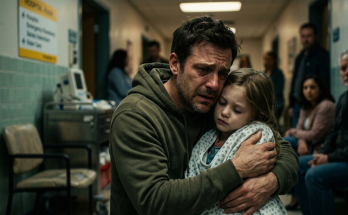
Emma lay beneath a white blanket, small enough that the bed seemed built for someone else.
A nurse adjusted an IV.
My daughter winced.
The officer asked, “Mr. Carter, you said you had been preparing for divorce.”
“Yes.”
“For how long?”
“Several months.”
“Why?”
I thought carefully.
Not because I wanted to protect my wife anymore.
Because I wanted to tell the truth accurately.
“She had become controlling.”
“In what way?”
“With me. With Emma. Everything had to happen exactly as she wanted. If I disagreed, she would turn it into proof that I didn’t care about the family.”
“Did she hit you?”
“No.”
“Threaten you?”
“Not directly.”
“Did you ever see her strike your daughter?”
I hesitated.
“No.”
The officer noticed.
“But?”
“There were moments.”
“What kind of moments?”
“Grabbing her too hard. Shouting close to her face. Sending her to her room for hours. Things I told myself were strict parenting.”
“Did Emma ever say she was being hurt?”
“Not clearly.”
That distinction became important the second I said it.
“She said things.”
“Like what?”
I rubbed my forehead.
“She asked why Mommy hated her once.”
The officer waited.
“What did you say?”
“I told her her mother didn’t hate her.”
“What else?”
“She asked if she could come to work with me.”
“How often?”
“A lot.”
“Why?”
“She said she liked my office.”
I stopped.
The officer didn’t need to say anything.
Maybe she had liked the office.
Maybe she had liked anywhere her mother wasn’t.
I remembered something else.
“A month ago she asked what happens when parents get divorced.”
The officer’s pen stopped.
“Did she know you were considering it?”
“I don’t think so.”
“What did you tell her?”
“That both parents still love their child.”
“How did she respond?”
I could hear Emma’s voice clearly in my memory.
Would I have to live with Mommy?
At the time I thought she was asking an ordinary question.
I had said probably sometimes.
She had gone quiet.
“I missed it,” I whispered.
The officer closed his notebook.
“You can’t change what you didn’t understand then.”
Maybe.
But understanding why I had failed her did not lessen the failure.
Dr. Harris returned with the final imaging results less than an hour later.
Three ribs were fractured.
He explained that children’s ribs were more flexible than adults’, which made multiple fractures especially concerning.
Emma’s breathing needed monitoring.
Her fever was high.
The cold exposure had complicated matters.
“She’s stable,” he said.
I had never hated a reassuring word so much.
“Will she recover?”
“We expect the fractures to heal.”
“Expect?”
“We’re watching for complications. At the moment, she is responding well.”
I nodded.
“Can I see her?”
“Yes.”
Before I entered, the doctor stopped me.
“One thing.”
“What?”
“Do not ask her to describe everything tonight.”
I frowned.
“She needs rest, and there will likely be a forensic interview later. Children can become confused if several adults repeatedly question them.”
“I just want to know what happened.”
“I understand. But right now your job is to make sure she knows she is safe.”
That sentence followed me into the room.
Emma’s eyes were closed.
I sat beside her.
Her hand rested on top of the blanket with tape securing the IV near her wrist.
I touched two fingers to her palm.
Her eyes opened.
“Daddy?”
“I’m here.”
She looked toward the door.
“Is Mommy here?”
“No.”
Her shoulders loosened.
The reaction was almost invisible.
I noticed it anyway.
“Does it hurt?”
“A little.”
I wanted to ask her how often this had happened.
I wanted names, dates, details.
I wanted every unanswered question resolved immediately.
Instead I remembered the doctor.
“You don’t have to tell me anything tonight.”
Emma looked confused.
“You’re not mad?”
“At you?”
She nodded.
“No.”
“Even about dinner?”
“No.”
“The bowl broke.”
“We own other bowls.”
That made her blink.
I tried to smile.
“We might even buy one that’s uglier.”
A tiny sound escaped her.
Almost a laugh.
Then her expression changed again.
“Mommy said you’d be mad.”
“At the bowl?”
She shook her head.
“At me.”
“Why?”
Emma’s eyes filled with tears.
“She said if I kept making trouble, Daddy would get tired.”
My throat tightened.
“Tired of what?”
“Me.”
I leaned closer but did not touch her until she reached for my hand.
“That will never happen.”
“She said you wanted to leave.”
I became still.
“How did she know that?”
Emma shrugged.
“She said Daddy doesn’t want us anymore.”
The divorce papers.
My wife knew.
Somehow, she had known before I came home.
That explained her reaction when she saw the signed documents.
Not surprise.
Confirmation.
“Did she say that today?”
Emma nodded.
“She was mad before dinner.”
“Why?”
“I don’t know.”
Her lower lip trembled.
“I tried to be good.”
I could barely speak.
“You do not have to earn the right to be safe.”
She didn’t understand the sentence.
Of course she didn’t.
Seven-year-olds should not need to.
So I simplified it.
“You never deserve to be hurt.”
She stared at me for a long time.
Then she whispered, “Okay.”
The door opened behind us.
The officer from earlier stood there.
“Mr. Carter?”
I stepped into the hallway.
“What is it?”
“We’ve spoken further with your neighbor.”
My stomach tightened.
“More video?”
“Yes.”
“How much?”
“Several recordings from previous weeks.”
I closed my eyes.
Of course.
The camera had not been installed tonight.
“What do they show?”
“We haven’t reviewed everything.”
“But?”
He hesitated.
“One clip appears to show your daughter being put outside as punishment on another occasion.”
I looked back through the door.
Emma was watching cartoons with the volume turned almost to zero.
“How far back?”
“At least a few months.”
Months.
The same period when the bruises had started.
The same period when Emma had become quieter.
The same period when my wife had accused me of ruining the family whenever I questioned her behavior.
I asked, “Where is my wife?”
“Still with officers.”
“Is she arrested?”
“I can’t discuss everything yet.”
“Then tell me one thing.”
“What?”
“Is she going home tonight?”
His silence lasted only a second.
“I don’t expect so.”
Relief hit me so hard I felt ashamed of it.
My wife was the woman I had once waited for at an altar.
The woman whose hand I had held when our daughter was born.
The person I had believed would be beside me when we were old.
And I was relieved she would not be coming home.
The officer started to leave.
“Wait.”
He turned.
“I have records.”
“What kind?”
“Messages. Photos. Notes I made when I started considering divorce.”
“Why did you make notes?”
“Because every argument ended with me doubting what I remembered.”
His expression sharpened.
“Keep everything.”
“I will.”
“Do not edit anything. Don’t organize it by rewriting it. Preserve the originals.”
I nodded.
Then he asked, “Is there anywhere else your wife might have documented her thoughts?”
The question seemed strange.
“No.”
I started to say more.
Then I remembered something.
Years earlier, during one of our moves, I had carried a box from my wife’s childhood bedroom.
She had grabbed it from me and said she would unpack it herself.
Inside were old notebooks.
She called them journals.
I had teased her about keeping teenage diaries.
She had not laughed.
“My wife keeps old journals.”
The officer stopped.
“Where?”
“I think some are at our house.”
“Can you identify them?”
“Probably.”
He wrote something down.
At the time I thought the journals might contain embarrassing arguments, old resentments, maybe proof she had known about the divorce.
I had no idea they would become the most disturbing evidence of all.
And I had no idea my wife’s own brother was already on his way to the hospital carrying a page that would make investigators search for them immediately.
Click here to continue reading: PART 3: My Wife’s Brother Brought Me a Page She Wrote at Nineteen, and the Journal Turned One Terrible Night Into a Pattern
I Came Home With Divorce Papers and Found My Daughter Outside in the Cold, Begging Me Not to Leave Her
Part 2 of 4