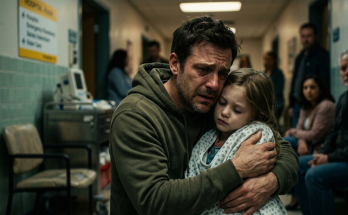
The first thing I heard when I opened the front door was my daughter screaming.
Not crying. Not the frustrated yell of a child who had dropped a toy or scraped a knee. This sound came from somewhere deeper, a thin, terrified scream that seemed to tear straight through the quiet house.
I dropped my briefcase beside the entry table. The folder inside it—the folder containing the divorce papers I had signed that afternoon—slid halfway out and landed against the hardwood floor. I barely noticed.
“Emma?”
No answer came from upstairs.
Then I heard my wife’s voice through the glass doors at the back of the kitchen.
“Stop making that noise.”
I ran.
The kitchen looked as if someone had abandoned dinner halfway through preparing it. A bowl lay broken near the island. Rice and pieces of chicken were scattered across the tile. A dish towel had been thrown beside the mess but never used.
Beyond the doors, the patio lights were on.
It was bitterly cold outside.
And my daughter was there.
For several seconds my mind refused to understand what I was seeing. She was seven years old, barefoot except for one sock, wearing thin pajama bottoms and a long-sleeved shirt. Her face was red from crying. Her hair hung toward the ground because her body was positioned upside down near the patio railing.
My wife stood a few feet away with her arms folded.
“What the hell are you doing?”
She turned.
The expression on her face changed immediately.
Not guilt.
Annoyance.
“You’re home early.”
I shoved the door open so hard it struck the stopper.
Emma saw me.
“Daddy!”
Her voice cracked.
I reached her in seconds. One of her legs had been caught in the position my wife had forced her into near the railing. I supported her weight with both arms and freed her as carefully as I could.
The moment I turned her upright, she screamed again.
“Don’t touch my side!”
I froze.
“What happened?”
My wife stepped toward us.
“She threw a tantrum.”
Emma immediately buried her face against my chest.
Her entire body was trembling.
I pulled my coat around her and felt the heat coming through her shirt.
She wasn’t merely cold.
She had a fever.
“How long has she been outside?”
My wife rolled her eyes.
“Oh, come on.”
“How long?”
“She needed time to calm down.”
I looked at Emma’s face. Her lips had a bluish tint. Tears had dried in streaks across her cheeks, leaving clean lines through the damp hair stuck to her skin.
“Emma, sweetheart, can you stand?”
She shook her head.
“My chest hurts.”
I picked her up.
She cried out so sharply that I nearly dropped her.
“Daddy!”
“I’ve got you. I’ve got you.”
My wife reached for her.
Emma recoiled so violently that her elbow struck my shoulder.
“No!”
The word echoed across the patio.
My wife stopped.
Emma clutched the front of my shirt with both fists.
“Don’t let Mommy take me.”
Something inside me went cold.
For months I had been telling myself that our family was going through a difficult period. My wife was stressed. Emma was sensitive. Arguments happened. Children bruised themselves. Parents lost patience.
I had built an explanation for every warning sign because every explanation was easier than admitting what all of them might mean together.
That ended on the patio.
I carried Emma into the kitchen and set her carefully on a chair while I called emergency services.
My wife followed me inside.
“You’re seriously calling an ambulance?”
“She can barely breathe.”
“She’s being dramatic.”
Emma flinched at the sound of her mother’s voice.
I looked at my wife.
“Go upstairs.”
Her eyebrows lifted.
“Excuse me?”
“Stay away from her.”
“You don’t get to order me around in my own house.”
I knelt beside Emma instead of answering.
Her breathing was shallow. Every inhale seemed to stop halfway.
“Where does it hurt?”
She pointed to the left side of her rib cage.
“Here.”
“Did you fall?”
Her eyes moved toward her mother.
That single glance told me more than an answer would have.
My wife saw it too.
“She slipped.”
I stood.
“You just said she threw a tantrum.”
“She did. Then she slipped.”
“Outside?”
“Yes.”
“From where?”
My wife’s jaw tightened.
“Why are you interrogating me?”
Because I had asked versions of those questions before.
Where did that bruise come from?
Why did Emma suddenly stop wanting you to help her bathe?
Why does she ask whether I’m coming home before bedtime?
Why did she cry when I said I had a business dinner?
Every question had been met with outrage until I eventually apologized for asking it.
Not tonight.
The ambulance arrived within minutes.
Two paramedics came through the front door carrying equipment. One crouched beside Emma while the other began asking me questions.
Age. Seven.
Fever. I didn’t know how high.
Pain. Chest and abdomen.
Possible fall. According to my wife.
The first paramedic gently lifted the hem of Emma’s shirt.
I saw the bruising.
Purple marks spread across her side and lower chest.
Some looked fresh.
Others did not.
The paramedic’s face changed.
“When did these happen?”
My wife answered before Emma could.
“She’s always bruising herself.”
The paramedic looked at Emma.
“Sweetheart, can you tell me what happened tonight?”
Emma pressed herself against me.
“I spilled dinner.”
The room became very quiet.
The paramedic waited.
“And then?”
Emma’s fingers tightened around mine.
“Mommy got mad.”
My wife stepped forward.
“That is not what happened.”
The second paramedic raised a hand.
“Ma’am, please let her answer.”
My wife’s face flushed.
Emma whispered, “She said I had to learn.”
My stomach twisted.
“Learn what?”
Emma looked down.
“Not to make messes.”
The paramedics exchanged a glance.
That was when I realized one of them had already called for police assistance.
My wife realized it a moment later.
“You called the police?”
The paramedic remained calm.
“Given the injuries and the circumstances, we’re required to report this.”
“This is ridiculous.”
She turned toward me.
“Tell them.”
I stared at her.
“Tell them what?”
“That I would never hurt our daughter.”
I looked at Emma curled against me, shivering in my coat.
For years I had answered questions for my wife.
Tonight I let the silence answer instead.
The police arrived as the paramedics prepared Emma for transport.
I intended to ride with her, but an officer asked me to wait several minutes so they could understand what had happened.
My wife was furious.
She kept insisting there had been an accident. Emma had spilled food. Emma had panicked. Emma had run outside. Emma had slipped.
The story changed slightly every time she repeated it.
Then one of the officers walked through the kitchen.
He stopped near the broken bowl.
“Sir?”
“Yes?”
“Did you see what happened?”
“No. I came home afterward.”
“What time?”
I told him.
“Why were you home early?”
My eyes moved toward the folder still lying near the entrance.
For the first time that night I remembered what was inside.
“I had something to discuss with my wife.”
“What?”
I crossed the room and picked up the papers.
My wife’s face changed.
She knew immediately.
I had been considering divorce for months. I had met privately with an attorney. I had documented arguments, photographs, messages—anything that might matter if custody became difficult.
But I had not told her I had signed the paperwork.
Until then.
I removed the documents from the folder.
“I was coming home to tell her I’m filing for divorce.”
My wife stared at me.
“You signed them?”
“Yes.”
Her voice became strangely quiet.
“When?”
“This afternoon.”
She laughed once, but there was no humor in it.
“So this is what this is about.”
I looked at her.
“What are you talking about?”
She pointed toward the police.
“You brought them here because you want Emma.”
“I didn’t bring anyone. The paramedics called them.”
“You planned this.”
The officer stepped between us.
“Ma’am, nobody has accused you of anything yet. We’re trying to establish what happened.”
She ignored him.
“You’ve wanted to take her from me.”
Emma’s stretcher was being wheeled toward the front door.
At the sound of her mother raising her voice, my daughter began crying again.
“Daddy!”
I turned immediately.
“I’m coming.”
My wife tried to follow.
Emma panicked.
“No! No, no, no!”
Everyone stopped.
My daughter struggled against the blanket covering her.
“Please, Daddy.”
I took her hand.
“I’m right here.”
“Don’t let her come.”
My wife’s expression hardened.
“Emma.”
The child squeezed her eyes shut.
The officer gently blocked my wife from approaching.
“Ma’am, you need to stay here.”
“She is my daughter.”
“And right now we need to clarify what occurred.”
I climbed into the ambulance beside Emma.
As the doors were about to close, another officer approached.
“Mr. Carter?”
“Yes?”
“There may be a witness.”
I stared at him.
“A witness?”
“One of your neighbors has a security camera pointed toward part of your backyard.”
My heart began pounding.
“Did it record tonight?”
“We don’t know yet.”
The ambulance doors closed.
During the drive, I held Emma’s hand while a paramedic checked her oxygen level and temperature. She barely spoke.
Once, when the ambulance turned sharply, she grimaced.
I apologized instinctively.
She whispered, “It’s okay.”
Something about hearing her reassure me nearly broke me.
At the hospital, doctors moved faster than I could process. X-rays. Blood work. Questions. A nurse asked Emma to describe her pain using faces printed on a card.
She pointed to the second-worst face.
I sat in a plastic chair outside the examination room while police officers spoke quietly at the nurses’ station.
My phone kept vibrating.
My wife.
Her mother.
My wife again.
I switched it off.
Twenty minutes later, Dr. Harris came through the doors.
“Mr. Carter?”
I stood so quickly the chair scraped backward.
“How is she?”
“We’re still evaluating her.”
“What does that mean?”
He chose his words carefully.
“We have confirmed rib fractures.”
The hallway seemed to narrow around me.
“How many?”
“We’re reviewing the imaging.”
I put my palm against the wall.
“Can broken ribs happen from falling?”
“They can.”
My heart seized onto the answer.
Then he continued.
“But the pattern of injury matters. So does the history.”
I stared at him.
“What history?”
He looked toward the examination room.
“The bruises on your daughter are in different stages of healing.”
I stopped breathing.
Different stages.
Not tonight.
Not one accident.
Not one horrible loss of control.
He asked, “Have you noticed injuries before?”
Images rushed through my mind.
A bruise on Emma’s upper arm three months earlier.
My wife saying she had fallen from her bicycle.
A mark near her shoulder.
A collision at school, supposedly.
A dark patch on her thigh.
Children play rough, my wife had told me.
I had accepted every explanation because rejecting one would have required asking what kind of person I had married.
“Yes,” I said.
The doctor’s expression did not change.
“How many times?”
“I don’t know.”
That answer sounded unforgivable.
A police officer approached us before the doctor could continue.
“Mr. Carter?”
I recognized him from the house.
“We heard from your neighbor.”
I felt my stomach drop.
“And?”
“He has video.”
I looked toward Emma’s room.
The officer lowered his voice.
“It shows your patio.”
I swallowed.
“Does it show what happened?”
“Yes.”
The answer came without hesitation.
I wanted to ask whether my wife had hurt Emma.
But suddenly I was terrified of hearing it confirmed.
The officer took out his phone.
“Before we show you anything, I need you to understand that this may be difficult to watch.”
I stared at the dark screen in his hand.
Behind the hospital door, my daughter whimpered when a nurse asked her to move.
I remembered every bruise I had accepted.
Every excuse.
Every night I had worked late.
Every time Emma had asked, “Daddy, are you staying home tonight?”
I had thought she missed me.
Maybe she had been asking for rescue.
“Show me,” I said.
The officer unlocked the phone.
And for the first time, I watched what happened in my home when I wasn’t there.
Click here to continue reading: PART 2: The Neighbor’s Camera Showed What Happened Before I Arrived, and Every Excuse I Had Believed Began Falling Apart
I Came Home With Divorce Papers and Found My Daughter Outside in the Cold, Begging Me Not to Leave Her
Part 1 of 4