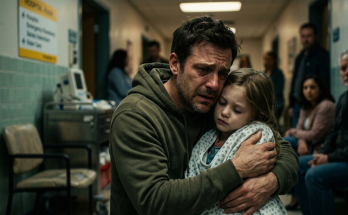
Emma stayed in the hospital two more days.
Her fever finally began to fall. The doctors remained concerned about her ribs, but her breathing improved enough that Dr. Harris approved her discharge with strict instructions.
No running.
No rough play.
Medication on schedule.
Follow-up appointments.
And no contact with my wife while the protective restrictions remained in effect.
When I carried Emma toward the hospital exit, she kept one arm around my neck and the other pressed carefully against her side.
“Daddy?”
“Yeah?”
“Are we going home?”
“Yes.”
She looked toward the parking lot.
“The old house?”
“No.”
She became quiet.
I had already arranged for us to stay with my brother.
Emma rested her cheek against my shoulder.
“Are you sad?”
“A little.”
“Because of Mommy?”
I considered lying.
Then decided she had experienced enough distorted truths.
“I’m sad about what happened to our family.”
She was silent for several seconds.
“Was it because I spilled dinner?”
I stopped walking.
People moved around us with coffee cups, wheelchairs, balloons, overnight bags.
The world continued normally while my daughter waited for an answer that might shape the rest of her childhood.
“No.”
“But if I didn’t spill—”
“Emma.”
She looked at me.
“Accidents happen. People drop things. People spill things. People make messes.”
She watched my face carefully.
“Hurting somebody because they made a mistake is different.”
“Different how?”
“Because spilling something is an accident.”
I adjusted my grip around her.
“Hurting someone is a decision.”
She absorbed that.
“So I’m not in trouble?”
“No.”
“Can we get pancakes?”
The ordinary request made me laugh for the first time in days.
“Yes.”
“With strawberries?”
“Absolutely.”
“And whipped cream?”
“You’re negotiating aggressively.”
She smiled.
That smile became one of the first things I remembered whenever the legal process threatened to consume us.
We stayed with my brother for several weeks.
The criminal investigation continued.
My wife was charged.
Her attorney argued first that Emma’s injuries had been accidental.
Then they challenged the interpretation of the video.
Then they suggested that the divorce had given me an incentive to portray my wife in the worst possible way.
But evidence kept accumulating.
Medical reports documented old and new bruising.
The neighbor provided additional footage from previous months.
In one recording my wife shouted at Emma in the backyard until the child backed into a corner.
Another showed Emma being forced to remain outside while crying.
None was as severe as the patio incident.
Together, however, they revealed repetition.
Then Emma’s teacher spoke with investigators.
That testimony hurt almost as much as the videos.
Months before the hospital, Emma had stopped participating in class.
She startled when adults raised their voices.
She lingered after dismissal.
Several times she invented reasons not to go home immediately.
One afternoon she had asked whether mothers could be arrested for not loving their children.
The teacher reported the concern.
My wife explained it away.
Emma was imaginative.
Emma was adjusting badly to school.
Emma had been watching something inappropriate on television.
Another explanation had been accepted.
I could not blame the teacher without blaming myself first.
Three months later, we attended the custody hearing.
Emma carried a stuffed rabbit I had bought after she left the hospital.
She named it Snowball.
Its fur had already become flattened around the ears because she slept with it every night.
We sat outside the courtroom together.
“Do I have to talk?”
“No.”
“Do I have to see Mommy?”
“You might see her.”
Emma pressed Snowball closer.
“Do I have to go with her?”
“No.”
The courthouse doors opened.
My wife entered with her attorney.
I had spent months wondering how I would feel when I saw her again.
Anger, I assumed.
Maybe grief.
Instead I felt something stranger.
Distance.
She looked familiar in the way a house from childhood can look familiar after strangers move into it.
My wife saw me.
Then Emma.
My daughter immediately shifted closer until her shoulder pressed against my arm.
No one instructed her to do it.
No one needed to.
During the hearing, my wife’s attorney argued that she had not intended to cause serious injury.
They described an overwhelmed parent who had exercised terrible judgment.
They emphasized that parents sometimes lose control.
They spoke about rehabilitation.
They spoke about family preservation.
Then the video played.
The courtroom went silent.
Watching it again was different.
The first time, I had been a father learning what happened.
Now I watched while strangers learned.
My wife stared downward.
The footage ended.
Medical records came next.
Then photographs.
Then testimony from Emma’s teacher.
Then excerpts from the journal.
The handwriting mattered.
No one had interpreted my wife’s private thoughts for her.
She had written them herself.
Entries described resentment whenever Emma sought comfort from me.
Other pages described my daughter as weak because she cried.
Several revealed my wife’s fear that I would leave and take Emma.
One of the final entries had been written only days before the patio incident.
My wife knew about the divorce papers.
She knew our marriage was ending.
And her writing showed that she viewed Emma not simply as a child, but as something she might lose to me.
The judge granted me temporary sole custody.
My wife was denied unsupervised contact.
The divorce moved forward.
Outside the courtroom, my attorney touched my shoulder.
“You got what we asked for.”
I knew what he meant.
But the word victory never entered my mind.
Emma had not won anything.
She had lost the assumption that her mother would never hurt her.
She had lost months of childhood to fear.
She had lost the simple certainty that home automatically meant safety.
Survival was not victory.
It was where recovery had to begin.
Therapy started soon afterward.
During the first sessions, Emma barely spoke.
Her therapist never forced her.
They drew.
Played games.
Built small houses out of wooden blocks.
Sometimes Emma arranged toy people into families.
Sometimes one figure stood far away from the others.
At home, nightmares continued.
She would appear beside my bed at two in the morning holding Snowball.
“Can I stay?”
I always moved over.
I never told her she was too old.
Never told her she needed to be brave.
Never asked why she was afraid.
She already knew why.
Slowly, ordinary things returned.
She talked about cartoons.
School.
Friends.
Pancakes.
A girl in class who chewed pencils.
A boy who claimed his uncle had met an astronaut.
Small stories filled our evenings.
I learned not to underestimate them.
Normal childhood conversation had once vanished from our home without me noticing.
Now every ridiculous detail sounded precious.
One afternoon Emma ran through the door carrying a drawing.
“Dad!”
I looked up from the kitchen.
“What happened?”
“Nothing happened. Look.”
She held out the paper.
A house filled most of the page.
Two people stood in front.
One tall.
One small.
“Who’s this?”
“You.”
“And this?”
“Me.”
There was a yellow sun above us.
I noticed a gray shape near the edge.
“What’s that?”
She hesitated.
“Mommy’s place.”
I nodded.
Emma watched my reaction.
“Is that mean?”
“No.”
“She’s far away.”
“That’s okay.”
“Why?”
I crouched beside her.
“Sometimes distance helps people stay safe.”
She thought about it.
Then pointed toward the bright house.
“That’s our place.”
“Yes.”
A year after the hospital, we moved into a small house of our own.
Three bedrooms.
A modest backyard.
A kitchen that needed work.
When I let Emma choose the paint, she selected yellow for the cabinets.
Very yellow.
Painfully yellow.
I considered objecting.
Then decided I had survived worse things than cheerful cabinetry.
The first evening, boxes covered half the living room.
Emma ran from one room to another.
“Dad!”
“What?”
“There’s no patio like the old one!”
“No.”
She disappeared into the kitchen.
“And if I spill something?”
“We get a towel.”
She reappeared.
“That’s all?”
“That’s all.”
“What if it’s a huge spill?”
“A huge towel.”
She laughed.
I caught her carefully when she ran toward me.
Her ribs had healed long ago, but for months I still remembered exactly where they had been broken whenever I hugged her.
“Is this really ours?” she asked.
“It is.”
She looked around at the unpacked boxes, mismatched furniture, bare walls, and aggressively yellow cabinet doors.
“I like it.”
“So do I.”
The criminal case continued beyond the move.
Eventually my wife accepted legal responsibility.
The court imposed counseling requirements and strict conditions regarding contact with Emma.
Nothing about the outcome felt cinematic.
There was no speech that repaired the past.
No apology that restored trust.
No punishment that erased the patio.
There were legal bills.
Therapy appointments.
Custody discussions.
Sleepless nights.
There were also school concerts.
Soccer practices.
Birthday cakes.
Movie nights.
Lost shoes.
Homework forgotten until bedtime.
Over time, Emma stopped flinching at loud noises.
She stopped watching doors whenever an adult became irritated.
Eventually she stopped asking whether I might leave.
Years passed.
One evening she sat at the kitchen table doing homework while I chopped vegetables for dinner.
She was older now.
Snowball lived on a shelf in her bedroom.
Her hair fell past her shoulders.
“Dad?”
“Yeah?”
“Can I ask something?”
“Always.”
She tapped her pencil against the notebook.
“Why didn’t you leave Mom earlier?”
The knife stopped against the cutting board.
I had expected the question for years.
That did not make answering easier.
“I kept thinking things would improve.”
“Why?”
“Because I thought trying harder fixed most problems.”
She looked at me.
“Doesn’t it?”
“Some.”
I pulled out the chair beside her.
“But not all.”
She waited.
“I also believed keeping our family together was automatically better than separating it.”
“But you separated it.”
“Yes.”
“Was that wrong?”
“No.”
“Why?”
I searched for an answer that respected both her age and the truth.
“Because keeping something together isn’t good if being inside it is hurting someone.”
She considered that.
“You should’ve left earlier.”
“Yes.”
The answer came easily.
“I should have.”
She looked surprised.
I continued.
“I missed things I wish I hadn’t missed. I believed explanations I shouldn’t have believed.”
“You came eventually.”
“I did.”
“And you believed me.”
I looked at her.
“Once I finally understood, yes.”
She leaned against my shoulder.
For several moments neither of us spoke.
Then she said, “You protected me.”
My chest tightened.
“I wish I had protected you sooner.”
She shrugged slightly.
“But you stayed after.”
That distinction mattered to her.
So I let it matter.
The old divorce papers turned up years later while I was clearing a storage box.
The folder had bent corners.
My signature still appeared near the bottom of the final page.
For a while I stood holding it.
Those papers had once represented failure to me.
Failure of a marriage.
Failure of promises.
Failure of the family I thought I was supposed to maintain.
Now I understood them differently.
They were evidence of the moment I stopped protecting appearances.
I kept the folder.
Not as a souvenir of my marriage.
As a reminder.
Downstairs, Emma sat at the kitchen table with friends.
Music played from someone’s phone.
A half-empty pizza box rested beside schoolbooks.
Someone had left a glass dangerously close to the edge of the table.
Then an elbow hit it.
The glass tipped.
Juice spread across the table and dripped onto the floor.
For half a second everyone froze.
I saw Emma’s eyes move toward me.
An old reflex.
Much weaker now.
Almost gone.
I opened the drawer beneath the sink.
“Towels are there.”
Her friend grabbed one.
“Sorry, Mr. Carter.”
“It’s juice.”
I shrugged.
“We’ll survive.”
They laughed.
Emma looked at me.
Then smiled.
And returned to arguing with her friends about which movie they were going to watch.
I remained in the doorway for a moment.
The house was noisy.
Untidy.
Warm.
Safe.
Nothing extraordinary happened after the spill.
No one screamed.
No one threatened.
No one was sent into the cold.
A mistake remained exactly what it was.
A mistake.
That ordinary moment told me more about Emma’s recovery than any court order ever could.
She no longer lived in a house where love depended on obedience.
She lived in a home where she could make noise, disagree, spill things, ask difficult questions, and still know that nobody was going anywhere.
That was the promise I had made beside her hospital bed.
I could never undo the night I arrived too late to prevent her injuries.
I could only make sure I was never too late again.
And years after she had once whispered for me not to let her mother take her, Emma finally stopped checking whether someone was coming to hurt her.
Home had become what it should have been from the beginning.
Not the place where she learned fear.
The place where she knew she was safe.
The End
Read more original stories on Feel Every Story.
I Came Home With Divorce Papers and Found My Daughter Outside in the Cold, Begging Me Not to Leave Her
Part 4 of 4