Three days later, Arthur brought me my grandmother’s letter.
He carried it inside a clear evidence sleeve.
The envelope had yellowed slightly at the corners.
My name was written across the front in my grandmother’s unmistakable hand.
Eleanor.
No last name.
No date.
Just me.
I stared at it until Arthur asked, “Do you want me to leave?”
“Yes.”
He placed the envelope on the table.
“It has been photographed and processed. You can open it.”
Then he stepped outside.
For several minutes, I did nothing.
I had faced police interviews.
Surgery.
A highway crash.
My husband’s betrayal.
Vivian’s arrest.
Yet this envelope frightened me differently.
The dead cannot explain why they chose certain words.
Whatever my grandmother had written would arrive without context, apology, or revision.
I opened it carefully.
Inside were four handwritten pages.
The first line nearly broke me.
Nell, if you are reading this, it means I was right to worry or wrong to trust that the problem would disappear.
I stopped.
My grandmother had called me Nell only in private.
I could hear her voice.
Dry.
Precise.
Never sentimental unless she had earned the right.
I continued.
She wrote that shortly before my wedding, Vivian had approached her repeatedly about the house.
At first politely.
Then indirectly.
Vivian suggested joint ownership after marriage.
A refinancing opportunity.
A family investment structure.
My grandmother rejected all of it.
Then something happened I had never known.
Vivian offered to buy the house.
Not from me.
From my grandmother.
Before it was transferred to me.
The offer was far below market value.
My grandmother refused.
Vivian returned with a second proposal.
This one involved transferring the property to a company that could “protect it from taxes.”
Bennett Family Holdings.
The same company that later controlled Vale Freight.
I lowered the pages.
Vivian’s interest had not been created by Harrison’s recent business problems.
It existed before my marriage.
I kept reading.
My grandmother had investigated Bennett Family Holdings after becoming suspicious.
She discovered that Vivian and her late husband had once been involved in aggressive property acquisitions.
Older homeowners.
Distressed properties.
Complicated title transfers.
Nothing she could prove was illegal.
Enough to make her cautious.
Then came the paragraph that changed my understanding completely.
Years earlier, Vivian had tried to purchase several houses on our street through intermediaries.
Most owners sold.
My grandmother did not.
The neighborhood was later rezoned.
Property values exploded.
My house became the last large privately owned parcel on a block eventually surrounded by commercial development.
I knew the property had appreciated.
I had never understood why.
The land itself mattered more than the house.
My grandmother wrote that developers had contacted her repeatedly.
One group was connected to people she believed Vivian knew.
She refused because she loved the property and wanted me to have it.
Then she wrote:
I suspect Vivian does not want your house because it is beautiful. She wants the ground beneath it.
I put the letter down.
For years, I thought Vivian resented the house because it represented money she could not control.
That was true.
But incomplete.
The property was strategically valuable.
Potentially very valuable.
Maybe worth far more than Harrison ever told me.
I turned to the third page.
My grandmother had discovered that if several adjoining parcels were combined, the block could support a larger redevelopment.
All but hers were already controlled through companies connected to one investment consortium.
She had refused the final sale.
Without her parcel, the project stalled.
I knew nothing about it.
After her death, ownership transferred to me.
Then I married Harrison Bennett.
My grandmother’s next words were underlined.
Do not confuse coincidence with innocence when money has been waiting longer than love.
I closed my eyes.
The sentence hurt.
I wanted to reject it.
Not because it was wrong.
Because I remembered Harrison before everything became ugly.
Our first date.
His ridiculous attempt to cook pasta in my tiny apartment.
The way he once drove four hours because I had the flu and was too stubborn to ask for help.
Were those moments false?
I still did not know.
Perhaps greed came later.
Perhaps Vivian saw the marriage as opportunity while Harrison initially saw me.
Human motives do not always begin corrupted.
Sometimes they rot.
My grandmother did not claim Harrison married me for the property.
She wrote something more careful.
I do not know whether Harrison understands his mother’s interest. I do know he avoids seeing what inconveniences him. That weakness may matter more than malice.
I read that line again.
She had seen him.
Years before I did.
Avoids seeing what inconveniences him.
That described Harrison exactly.
Until eventually avoidance became participation.
On the final page, my grandmother explained why she never told me.
She feared that warning me too strongly would make me defend Harrison more fiercely.
She had watched me do that already.
So she protected the title instead.
The house would pass solely to me.
No marital ownership.
No automatic corporate access.
No Bennett control.
Then she ended with something that finally made me cry.
A house is wood, stone, taxes, repairs, memories, and trouble. Do not ruin your life protecting a building merely because I loved it. Protect your ability to choose what happens to it. That is the inheritance that matters.
I folded over the page.
For days, everyone had spoken about the house as an object.
Asset.
Collateral.
Parcel.
Property.
My grandmother had understood the difference.
The true thing Vivian wanted was not the house.
It was my decision.
She wanted to replace it with hers.
I cried quietly until the tears stopped on their own.
Then I called Arthur back inside.
He looked at the pages.
“Anything relevant to the investigation?”
“Yes.”
I told him about the development interest.
The neighboring parcels.
Bennett Family Holdings.
His expression sharpened.
“This may explain motive beyond Sterling’s debt.”
“Can you trace who owns the adjacent properties?”
“Already starting.”
“I want Rachel involved.”
“Good.”
“And Melissa.”
“For municipal records?”
“Yes.”
My mind was working again.
Not emotionally.
Professionally.
If developers had been assembling the block for years, ownership records would exist.
Shell companies left fingerprints.
Registered agents.
Tax mailing addresses.
Financing liens.
People could hide names.
They could not erase every pattern.
By evening, Melissa had preliminary results.
Four adjoining parcels were controlled by entities linked through a private investment group called Arcwell Development Partners.
I knew the name.
“They approached me two years ago.”
Melissa paused.
“To buy?”
“Yes.”
“They offered almost twice assessed value.”
“What did you say?”
“No.”
“Did Harrison know?”
“Yes.”
“What did he say?”
I remembered the argument.
Harrison told me I was foolish.
Said the house required constant maintenance.
Said we could buy something newer.
When I refused, he sulked for a week.
At the time, I thought he simply wanted cash.
Now I wondered what else he knew.
“Find Arcwell’s investors.”
“Working on it.”
Rachel called thirty minutes later.
She had found old correspondence from Arcwell.
One letter included a familiar law office copied on the transaction.
Marsh Legal Services.
Lydia.
I felt the pieces drawing closer.
“Does Lydia work for Arcwell?”
“Not formally.”
“But she handled documents.”
“Yes.”
“Any Bennett connection?”
“Still looking.”
At nine that night, Arthur called.
His voice carried that particular tension I had learned to recognize.
“You were right about the land.”
“How right?”
“Very.”
“Explain.”
“Arcwell has options on three surrounding parcels that become significantly more valuable if your property is added.”
“How significantly?”
“We don’t have an exact figure.”
“Estimate.”
“Potential redevelopment value could be eight figures.”
I stared at the dark window.
My house was comfortable.
Large.
Old.
I had never thought of it as a piece of a multimillion-dollar development puzzle.
“Who benefits?”
“Arcwell investors.”
“Names.”
“Some are shielded.”
“Some?”
“One investment trust traces back to Bennett Family Holdings.”
There it was.
Vivian again.
“How much?”
“Minority interest on paper.”
“On paper.”
“Yes.”
“And Harrison?”
“No direct ownership found.”
Yet.
“What was supposed to happen after they got my house?”
“Likely sale or contribution into the development project.”
“They would make millions.”
“Potentially.”
The motive became older and larger.
Sterling’s fraud crisis had probably accelerated the plan, but Vivian had wanted the land for years.
Harrison’s financial desperation gave her the moment.
My legal revocation threatened control.
The accident created incapacity.
The forged documents provided authority.
The garage provided coercion.
Every piece served the same objective.
Take choice away.
“Where is Lydia Marsh?”
Arthur exhaled.
“We found her car.”
My stomach tightened.
“Where?”
“Airport parking.”
“She flew?”
“No record under her name.”
“Fake identity?”
“Possible.”
“Cameras?”
“Reviewing.”
“Anything in the car?”
“A suitcase.”
“That makes no sense.”
“Unless she switched vehicles.”
Or wanted people to think she had left.
“What about Vivian?”
“She’s maintaining through counsel that she never intended serious injury.”
I laughed without humor.
“She arranged surveillance.”
“Yes.”
“She discussed steering failure.”
“Yes.”
“She marked the camera gap.”
“Evidence points that way.”
“She benefited from the property.”
“Yes.”
“What is she denying?”
“Intent regarding the collision’s severity and broader allegations.”
Of course.
Nobody intended harm.
They only created circumstances where harm became useful.
The next morning, Harrison formally entered a cooperation agreement with prosecutors.
Not immunity.
Arthur emphasized that.
He would still face serious charges.
But he began giving details.
Names.
Accounts.
Documents.
And the history of Vivian’s obsession with the property.
According to Harrison, she first told him about the development value two years into our marriage.
Not before.
That mattered to me.
“Did he know when he married me?”
“His statement says no.”
“Do you believe him?”
Arthur did not answer.
I did not ask again.
Some questions would never have documentary proof.
Harrison claimed Vivian repeatedly encouraged him to persuade me to sell.
When I refused, she suggested refinancing.
When I refused that, she began looking for legal authority.
The early forged deed in the safe-deposit box had been one of her first experiments.
Not filed.
Not used.
A template for later.
“Why didn’t Harrison stop her?”
Arthur read from his interview notes.
“He says he thought she was bluffing.”
I laughed bitterly.
My grandmother’s sentence returned.
He avoids seeing what inconveniences him.
Then later came greed.
Sterling began losing legitimate revenue.
Harrison covered losses with fraudulent transactions.
Vivian used her entities to move money.
Daniel discovered irregularities.
Harrison pushed him out.
Then I found the fake vendors.
The walls began closing.
That was when the old property plan became urgent.
“What was their deadline?” I asked.
“Arcwell had a financing window.”
“When?”
“End of this month.”
“So they needed my property before then.”
“Yes.”
That explained the week.
Harrison expecting control before the end of it.
Vivian’s urgency.
The forged paperwork.
The planned facility.
Everything had been timed to a development transaction.
Then Arthur gave me the most disturbing detail from Harrison’s cooperation.
“Vivian believed if you remained competent and free, you would eventually discover the land connection.”
“She was right.”
“She also believed you might report Sterling.”
“She was right again.”
“So she wanted both problems solved simultaneously.”
My house.
My evidence.
My independence.
I looked at my brace.
“And Harrison agreed.”
“Yes.”
No softening.
Good.
I needed truth without protection.
That afternoon, police found Lydia Marsh.
She had not left the city.
She had been hiding in an apartment owned by one of Arcwell’s shell entities.
When officers entered, she surrendered.
No chase.
No drama.
Just a tired woman with two phones, six thousand dollars in cash, and copies of documents bearing my forged signature.
Arthur told me she asked for counsel immediately.
By evening, though, her attorney had contacted prosecutors.
She wanted to negotiate.
Everyone wanted to cooperate once the structure began collapsing.
Marcus blamed Harrison.
Harrison blamed Vivian.
Rourke blamed Marcus.
Lydia would probably blame all of them.
Truth emerged not because conscience suddenly appeared, but because loyalty became expensive.
Two days later, Arthur visited with the first part of Lydia’s statement.
She admitted notarizing documents I never signed.
“She knew?”
“Yes.”
“Who asked her?”
“Vivian.”
“Harrison involved?”
“She says yes.”
“Payment?”
“Through Arcwell-related consulting fees.”
“How long?”
“More than a year.”
I looked at him.
“So the forged power of attorney wasn’t the first.”
“No.”
“What else?”
Arthur placed a photocopy in front of me.
A deed.
My name.
My house.
A transfer into Bennett Family Holdings.
The signature looked frighteningly close to mine.
“Was this filed?”
“No.”
“Why not?”
“Lydia says Vivian was waiting for the right moment.”
“What moment?”
“When a challenge from you could be portrayed as confusion or incapacity.”
The crash.
There it was again.
Not simply an attempt to obtain a bag.
Not merely intimidation.
The accident created the condition required to activate fraud already prepared.
I stared at the fake signature.
For the first time, the investigation no longer felt like a maze.
It felt like a line.
Long.
Complicated.
But clear.
Vivian had spent years trying to gain control of the property.
Harrison joined her when his own crimes placed him under pressure.
They forged authority.
Planned incapacity.
Sabotaged my car.
Used a truck to trigger the crisis.
Then, when I survived and came home, they tried to finish the job through confinement and coercion.
Everything connected.
Almost everything.
One question remained.
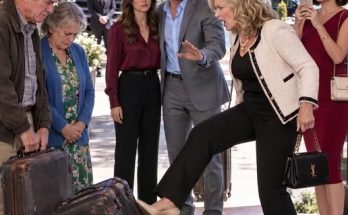
Why had Vivian kicked my crutch?
That act had been reckless.
Unnecessary.
It risked damaging the very person whose signature they supposedly needed.
I asked Arthur.
He looked at me for a long moment.
“We asked Harrison.”
“What did he say?”
“He says the plan changed before you came home.”
My stomach tightened.
“Changed how?”
Arthur closed the folder.
“According to him, Vivian had stopped caring whether the deed was genuinely signed.”
I understood.
The forged version.
The authority documents.
The facility.
My signature had become optional.
“What did she need instead?”
Arthur’s answer came quietly.
“She needed you to appear incapable of contradicting whatever paperwork they filed next.”
I stared at him.
The garage had never only been punishment.
The fall.
The medication withheld.
The isolation.
The threat of rehabilitation.
They were building a picture.
Confused.
Unstable.
Injured.
Unreliable.
If the police had not come, by morning Vivian intended to transform my resistance into evidence against my own competence.
My survival had not ruined their plan.
My ability to speak had.
Click here to continue reading: PART 13: Vivian’s Final Plan Required Everyone to Believe I Was Confused, but One Hospital Record Destroyed the Story She Had Built
Eleven Minutes After Coming Home From Surgery, I Learned Exactly What My Husband Had Been Waiting For
Part 12 of 15