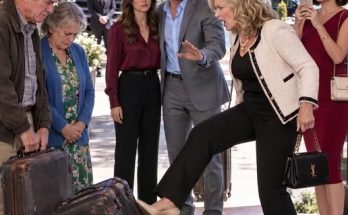
Nine months after Vivian kicked the crutch from beneath me, I walked into my house without one.
The front door still stuck slightly in damp weather.
The entry table still had the small gouge where my shoulder struck it the night I came home from surgery.
The Persian runner had been replaced because police took the original as evidence.
Everything else looked almost offensively familiar.
Sunlight entered through the same narrow windows.
The old clock in the living room ticked.
My grandmother’s ceramic bowl sat on the console exactly where I had left it before the crash.
For months, I had imagined returning.
In some versions, the house felt contaminated.
In others, triumphant.
Reality was quieter.
It was a building.
Wood.
Stone.
Repairs.
Memories.
Trouble.
My grandmother had been right.
I walked slowly through the foyer.
My leg had healed well enough that Dr. Malik no longer required assistive support for normal distances.
There would always be stiffness.
Cold mornings still produced a deep ache.
A thin surgical scar ran along my thigh.
But I could walk.
That fact remained miraculous in ways I no longer needed to announce.
The legal cases had moved more slowly.
Marcus accepted a plea agreement involving conspiracy, financial offenses, and his role in the vehicle tampering.
Owen Pike pleaded guilty to charges arising from sabotaging the steering mechanism.
Caleb Rourke accepted responsibility for his part in forcing my vehicle from its lane and for surveillance-related conduct.
Lydia Marsh admitted the document fraud and conspiracy surrounding the forged authorizations.
Each agreement required cooperation.
Each revealed more.
Sterling Custom Holdings collapsed before summer.
Creditors descended.
Records were seized.
Contracts evaporated.
The company Harrison once treated as proof of his success became a warehouse of evidence.
The municipal investigation eventually confirmed that he and associates had diverted millions through related entities over several years.
Daniel Cross was formally cleared of the central allegations Harrison had blamed on him.
He sent me one short email afterward.
I’m glad you survived. I’m sorry I didn’t warn you sooner.
I replied with two sentences.
You tried to expose what was happening. I wasn’t ready to see it.
That was enough.
My own professional review ended less cleanly.
Melissa called me into a conference room three months after the hearing.
Two ethics officers sat across from me.
They reviewed my delay in reporting Sterling-related records.
I answered every question.
No excuses.
I told them I had preserved evidence but had allowed my marriage to affect my judgment.
They suspended me for thirty days and removed me temporarily from cases involving procurement fraud.
It hurt.
It was fair.
When I returned, Melissa put a stack of routine compliance work on my desk.
“No dramatic corruption cases for you.”
“Punishment?”
“Rehabilitation.”
I laughed.
The word had finally become harmless again.
Harrison’s case took longer.
His cooperation reduced some exposure but did not erase what he had done.
He pleaded guilty to multiple fraud and conspiracy counts, unlawful access to my workplace, and offenses arising from the plan involving my vehicle and confinement.
The assault-related conduct was incorporated into the final agreement and sentencing record.
At his hearing, he read a statement.
I attended.
Not because I needed closure.
Because I wanted the legal record to have a witness who had survived it.
He apologized.
To me.
To my office.
To investors.
To employees.
To Daniel.
He said he had allowed greed and fear to distort his judgment.
Perhaps that was true.
Then he looked toward me and said, “I loved Eleanor, even when I became someone capable of doing this to her.”
For months, I thought about how I might answer if he ever said those words.
When the moment came, I felt nothing urgent enough to say.
Love does not become meaningless because someone uses the word dishonestly.
But neither does the word erase behavior.
Whatever Harrison once felt, he chose money when my autonomy became inconvenient.
He chose the plan.
He chose the garage door.
A judge later sentenced him to years in prison.
The exact number mattered less to me than I expected.
There was no sentence capable of returning the marriage I thought I had.
No sentence could uncrash the car.
No sentence could make my grandmother alive long enough to tell me she had been right.
The court could impose consequence.
It could not manufacture restoration.
Vivian went to trial.
Of course she did.
Pleading guilty would have required admitting that the world had correctly understood her.
Vivian preferred defeat to confession.
Her attorneys attacked everyone.
Harrison was a desperate liar.
Marcus an embezzler.
Rourke a convicted reckless driver.
Lydia a fraudulent notary.
Owen a mechanic willing to commit crimes for cash.
Arthur biased.
Rachel negligent.
Me vindictive.
The defense theory required the jury to believe nearly every other person involved had independently constructed the same false story around an innocent woman.
Then prosecutors played the recordings.
Vale.
Ridgeway.
The emails.
The Capacity Strategy drafts.
The surveillance records.
The payments.
The map.
Best place. No cameras.
The jurors saw photographs of my damaged car.
They saw the loosened steering component.
They saw the forged deeds.
They saw the letter Vivian had sent my grandmother years earlier.
They heard my grandmother’s response read into the record through admissible estate correspondence.
My granddaughter’s property is not a test of marital loyalty.
Sitting in the courtroom, I closed my eyes when I heard the sentence.
Her voice was gone.
Her boundaries remained.
I testified for nearly two days.
Vivian’s lawyer asked why I had kept evidence of Harrison’s financial crimes without reporting him.
“Because I was conflicted and afraid of destroying my marriage.”
“So you admit you concealed evidence?”
“I delayed reporting it.”
“You lied to your husband about destroying a flash drive.”
“Yes.”
“You secretly recorded him.”
“Yes.”
“You had considered leaving him.”
“Yes.”
The lawyer seemed almost pleased.
“You wanted leverage.”
“I wanted protection.”
“From your husband?”
“Eventually, yes.”
The attorney walked closer.
“So this marriage had already become hostile.”
“Not hostile enough to justify sabotaging my car.”
A few jurors looked toward me.
The attorney changed direction.
“Mrs. Bennett, you cannot personally testify that my client intended you to crash.”
“No.”
“You cannot testify that she personally loosened the steering.”
“No.”
“You cannot testify that she drove the truck.”
“No.”
“So much of what you believe depends on other people.”
I looked at Vivian.
She sat perfectly still.
“Most criminal conspiracies do.”
The prosecutor objected to the argumentative exchange.
The judge sustained.
But the point remained.
Vivian had designed distance between herself and every dirty act.
That distance was supposed to protect her.
Instead, the pattern exposed organization.
The jury deliberated for two days.
I spent most of that time at work.
When the call came, I returned to court.
The foreperson stood.
One verdict after another.
Guilty on the central conspiracy charges.
Guilty on fraud and forgery-related counts.
Guilty on charges tied to the plan that compromised my vehicle and placed me in danger.
Guilty on unlawful surveillance and coercive conduct.
Not every count.
Enough.
Vivian showed almost no reaction.
Then the clerk asked her to stand.
For the first time since I had known her, another person gave Vivian an instruction she could not override.
She stood.
At sentencing weeks later, I gave a victim-impact statement.
I did not speak about revenge.
I did not call her evil.
That word would have made her too simple.
Instead, I described choices.
She chose to surveil me.
She chose to forge authority.
She chose to arrange a situation where injury would make fraud easier.
She chose to describe my resistance as illness.
She chose to kick away the crutch of a woman who had just undergone surgery.
She chose to take medication.
She chose to plan confinement.
The law could decide what labels belonged to those choices.
I only needed them named.
Vivian finally looked at me while I spoke.
Her expression was almost curious.
As though she still could not understand why I had refused the role she wrote for me.
At the end, I said one thing directly to her.
“You kept trying to make my decisions for me. You failed.”
Then I sat.
The judge imposed a lengthy prison sentence reflecting the combined financial and conspiracy offenses.
Vivian’s attorney announced plans to appeal.
I expected nothing less.
Outside court, reporters again asked about the house.
By then I finally had an answer.
Arcwell no longer controlled the development project.
Its financing collapsed when the criminal investigation exposed hidden ownership interests.
Several neighboring parcels went into restructuring.
My property remained mine.
Developers still wanted it.
One offered more money than I had ever imagined seeing attached to a piece of land.
I declined.
Not because I planned to live there forever.
Because I had another idea.
My grandmother’s block had changed dramatically.
Small houses had disappeared.
Commercial buildings crowded the edges.
The neighborhood needed something other than another private development.
So I approached the city through an independent attorney and recused myself completely from any professional involvement.
I offered to sell part of the land at below-market value to a nonprofit partnership developing transitional housing and legal-support offices for people leaving coercive domestic situations.
The rest of the parcel would remain with me temporarily while zoning and subdivision were completed.
Rachel thought I was making the decision emotionally.
She asked me twice.
“Are you sure this isn’t about what happened?”
“Of course it’s about what happened.”
“That isn’t always a good basis for property decisions.”
“I know.”
“Then why?”
I looked at the old kitchen where my grandmother once made tea while warning me never to confuse ownership with security.
“Because I’m not giving the house away to punish Vivian.”
Rachel waited.
“I’m choosing what the land becomes.”
That was different.
The nonprofit did not know the full symbolic importance at first.
I preferred it that way.
I did not want a plaque with my name.
I did not want a newspaper photograph standing in front of construction equipment.
I wanted locked doors that belonged to the people behind them.
Legal clinics.
Temporary apartments.
Rooms where someone recovering from an injury could keep their medication beside the bed without another person deciding whether they deserved it.
That felt useful.
The agreement took months.
Real decisions should sometimes take time.
Not because hesitation is noble.
Because choice deserves room.
One autumn afternoon, I stood in the garage while contractors measured the property.
The workbench was still there.
So was the old black rubber mat.
I had avoided that corner since moving back.
Now I walked toward it.
The concealed floor safe remained beneath the concrete panel.
Police had returned its contents after the case allowed.
Emergency cash.
Old documents.
The dead prepaid phone.
The silver flash drive remained in evidence and probably would for years.
I crouched carefully.
My leg protested.
I opened the safe.
Inside was one new object.
My grandmother’s letter.
I had placed it there after the trial.
Not because it needed hiding.
Because that was where the night had changed.
Harrison and Vivian locked me in the garage because they believed isolation meant power.
Instead, the room contained the one phone they did not know about and the evidence they thought I destroyed.
That irony used to feel satisfying.
Now it felt smaller.
The larger truth was that no hidden phone should have been necessary.
I should never have needed proof strong enough to earn the right to be believed about my own fear.
I folded the letter and returned it to the envelope.
On the way out, I noticed the old scuff on the floor where Harrison dragged my brace across the threshold.
For months, I had considered repairing it.
I left it.
Not as a shrine.
Just a mark.
Houses collect marks.
So do people.
Healing does not require pretending the surface was never damaged.
That evening, Melissa came over with takeout.
We ate on the back steps because most of the furniture had been moved in preparation for renovation.
“What will you do when the nonprofit takes over the west section?” she asked.
“Move.”
“Where?”
“I don’t know.”
She laughed.
“You? Without a plan?”
“I’m experimenting.”
“Dangerous.”
“I’ve survived worse.”
We ate quietly.
The sunset turned the neighboring windows gold.
For the first time, I could look across the property without seeing Arcwell diagrams or Vivian’s ownership structures.
Just land.
My phone buzzed.
An email from Rachel.
Final divorce decree entered.
I read it once.
Then locked the screen.
Melissa watched me.
“That it?”
“That’s it.”
“How do you feel?”
I considered the question.
“Finished.”
Not happy.
Not sad.
Finished.
Harrison would remain part of my history.
Vivian too.
There was no clean version of the future where none of it happened.
But there was a future in which their choices stopped controlling the next thing I did.
A month later, demolition crews removed the garage.
I watched from the sidewalk.
The roof came first.
Then the walls.
Then the interior frame.
Eventually the door Harrison had locked disappeared into a pile of timber and metal.
I expected to feel something dramatic.
Instead, I drank coffee and discussed drainage plans with the project manager.
That pleased me.
Vivian had believed the garage would teach me helplessness.
In the end, it became construction debris.
The front portion of the original house remained.
My grandmother’s kitchen would become part of the nonprofit’s legal-support center.
Rachel suggested preserving one of the old built-in cabinets.
I agreed.
Not everything needed to be erased.
On the last day before I moved out, I walked through the empty master bedroom.
The room Vivian had demanded.
The room Harrison had decided mattered more than his injured wife.
Without furniture, it looked smaller.
Ordinary.
I stood in the center and laughed softly.
So much cruelty over rooms, signatures, parcels, and control.
Objects people mistook for power.
I locked the front door one final time.
Then I handed the property manager one set of keys.
I kept another until the transfer process was complete.
That detail mattered to me.
The last key left my hand because I chose the moment.
Outside, my car waited.
Not the old one.
That vehicle had been destroyed after the trial and forensic release.
The new car had adaptive safety systems I researched obsessively before buying.
For the first few months, every large truck made my hands tighten around the wheel.
That response faded.
Slowly.
Not completely.
Healing was not the absence of memory.
It was memory losing authority.
I drove away from the house without checking the rearview mirror more than once.
At the first intersection, the light turned red.
I stopped.
A truck pulled into the lane beside me.
My pulse jumped.
I breathed.
The light changed.
The truck went straight.
I turned left.
The wheel responded exactly as it should.
And for the first time since Route 18, I noticed something before fear could name it.
I was choosing the direction.
The End
Read more original stories on Feel Every Story.
Eleven Minutes After Coming Home From Surgery, I Learned Exactly What My Husband Had Been Waiting For
Part 15 of 15