The drive to Chicago Memorial took nineteen minutes.
I remember because I counted almost everything that night. Red lights. Turns. The number of times Sarah shifted carefully against the passenger seat. The number of times my phone vibrated in the cup holder before I finally switched it to silent.
Eleanor called six times before we reached the hospital.
I did not answer once.
Sarah kept one hand across the lower curve of her stomach and the other wrapped around the door handle. Every few minutes I glanced at her, afraid I would see blood through her clothes even though the bleeding had been a lie.
“Any pain?” I asked.
“Only the usual.”
The phrase made my jaw tighten.
“What does usual mean now?”
She stared through the rain-speckled window.
“Depends on the day.”
I almost asked another question, then stopped. We had hours ahead of us for explanations. At that moment the only important thing was getting her somewhere Eleanor could not control the room.
Chicago Memorial’s emergency entrance glowed beneath fluorescent lights. I pulled to the curb, put the car in park, and started toward Sarah’s side.
“I can walk,” she said.
“I know.”
“I need to.”
So I stayed beside her instead of carrying her.
Inside, the waiting area smelled of disinfectant and burned coffee. A television mounted above the reception desk played silently while three people sat under blankets in plastic chairs. Somewhere behind the security doors, a child was crying.
The triage nurse looked at Sarah’s pregnancy before she looked at either of our faces.
“How far along?”
“Twenty-nine weeks,” Sarah answered.
“Reason for visit?”
Sarah hesitated.
I felt her body tighten beside mine.
The nurse waited.
Sarah swallowed. “Assault.”
The word changed the room.
Not dramatically. No one gasped. No alarm sounded. But the nurse’s posture sharpened instantly.
“Are you currently safe from the person who assaulted you?”
Sarah looked at me.
“Yes.”
“Is the person here?”
“No.”
“Relationship?”
Sarah took a breath.
“My mother-in-law.”
The nurse’s eyes moved briefly toward me, then back to Sarah.
“Do you want your husband present while we talk?”
Another pause.
“Yes.”
I was grateful she had chosen it herself.
We were taken through the security doors within minutes.
A second nurse brought Sarah to a curtained examination room and asked me to remain outside briefly while they checked her privately.
For the first time since leaving the apartment, I was alone.
I leaned against the wall.
My phone vibrated again.
This time I looked.
Nine missed calls.
Four text messages.
The first was gentle.
Ethan, sweetheart, please call me. I’m worried.
The second came twelve minutes later.
Do NOT let Sarah speak to doctors alone. She twists things when she’s frightened.
The third abandoned concern.
You need to tell them she has been injuring herself.
The fourth was shorter.
Call me NOW.
I took screenshots.
Then I forwarded every message to my work email and an encrypted folder Sarah and I shared for tax documents.
I had no idea yet what would matter as evidence.
I had learned enough that evening to save everything.
A nurse opened the curtain.
“You can come in now.”
Sarah was sitting upright on the examination bed wearing a hospital gown. Her coat had been folded onto a chair.
A fetal monitor was strapped around her abdomen.
The steady rhythm of our child’s heartbeat filled the small room.
I stopped walking.
For weeks I had heard recordings at appointments, cheerful little bursts through an ultrasound machine.
This sound was different.
It felt like proof that something inside our life remained untouched.
Sarah watched my face.
“Baby’s okay so far.”
I sat beside the bed.
The nurse adjusted a sensor.
“The obstetrics team will evaluate her. We’ve also requested a social worker and one of our forensic nurses.”
“Forensic?” I asked.
Sarah’s hand tightened around mine.
The nurse answered without judgment. “Because of the reported assault and injuries.”
I nodded.
Of course.
An actual record.
Not Eleanor’s version.
Not Dr. Vance’s paperwork.
Something created after someone looked at Sarah rather than speaking about her.
A physician entered twenty minutes later. Dr. Priya Shah introduced herself, spoke first to Sarah rather than me, and asked permission before every step of the examination.
That detail mattered more than she could have known.
Sarah had spent months having choices removed from her.
Dr. Shah returned each one deliberately.
“May I examine your abdomen?”
“Yes.”
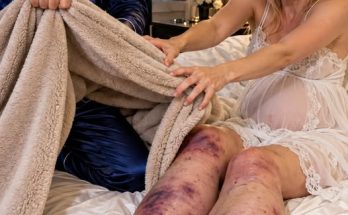
“May I look at the injuries on your legs?”
Sarah’s eyes dropped.
Then she nodded.
When the gown lifted, Dr. Shah became very quiet.
She documented bruises on both shins, one thigh, and Sarah’s left forearm. The burn near her ankle was photographed with a measurement guide beside it.
Then she found another mark.
“Sarah, what happened here?”
A fading bruise curved around the back of her upper arm.
Sarah did not answer immediately.
I had never seen it.
“She grabbed me.”
“Who?”
“My mother-in-law.”
“When?”
“Four days ago.”
“For what reason?”
“I was trying to reach the apartment door.”
I looked away.
Dr. Shah continued calmly.
“Did she prevent you from leaving?”
“Yes.”
“With force?”
“Yes.”
Sarah’s voice had become almost mechanical.
I realized this was the first time she had been required to put the pattern into chronological words.
Each answer turned what Eleanor had disguised as isolated accidents into something structured.
Control.
Confinement.
Threats.
Violence.
The forensic nurse arrived next.
Her name was Louise Brennan. She had gray hair cut close around her face and spoke with the unhurried tone of someone accustomed to frightened people.
She asked me to step outside during part of Sarah’s interview.
This time Sarah did not look at me for permission.
“Okay,” she told Louise.
I left.
That small choice felt important.
A police officer appeared in the corridor forty minutes later.
Officer Alvarez introduced himself and explained that hospital staff had made a report after Sarah disclosed ongoing assault.
“I’m going to need to speak with your wife,” he said.
“Of course.”
“And you separately.”
I nodded.
“Before we do that, is there an immediate threat at your residence?”
“Yes.”
That answer came easily.
“What’s there?”
“The person who assaulted her.”
“Your mother?”
“Yes.”
I watched his face for disbelief.
There was none.
“She’s at our apartment right now.”
“Does she live there?”
“No.”
“Does she have a key?”
“Yes.”
“Any weapons?”
I thought of the iron.
“An antique brass iron that she heated before threatening Sarah tonight.”
Officer Alvarez stared at me.
“Heated how?”
“I don’t know. Probably on the stove.”
“You witnessed this?”
“I saw her holding it in the bedroom. I heard her threaten my wife. I touched near the iron after she set it down. It was extremely hot.”
“Did she strike Mrs. Reed with it tonight?”
“No.”
“Has she used it before?”
I looked toward the curtain separating us from Sarah.
“Yes.”
“How do you know?”
“My wife showed me a burn.”
His expression changed.
“You need to tell me everything from the beginning.”
I did.
Not the beginning of my marriage.
The beginning of that evening.
The call from Eleanor.
Coming home early.
The crying.
The voice through the bedroom door.
The sentence about the baby.
The heated iron.
The psychiatric document.
Dr. Vance.
The forged loan Sarah claimed to have discovered.
I told him about the micro-SD card.
Officer Alvarez wrote continuously.
“Do you have it?”
“Yes.”
“Don’t give it to me yet. We’ll make a formal evidence record if your wife wants to provide it.”
“I also have the psychiatric paperwork.”
“That I’d like to see.”
I removed the folded document from inside my jacket.
He read the first page.
His eyebrows lowered.
“This is dated for tomorrow morning.”
“Yes.”
“And your wife says she was never examined by this doctor?”
“Never.”
“Do you know Dr. Harold Vance personally?”
“No. I’ve heard my mother mention him socially.”
Alvarez photographed the document without taking it from me.
Then he asked, “Does your mother know you removed this?”
“Probably by now.”
As if summoned by the sentence, my phone vibrated.
A new message appeared.
Where is the paper from my purse?
Officer Alvarez saw my expression.
“What?”
I showed him.
He read it.
“Don’t answer yet.”
Another message arrived.
Ethan. This is serious.
Then:
Sarah took confidential medical documents. That proves exactly what I’ve been warning you about.
I laughed once.
Not because anything was funny.
Because I finally saw how quickly Eleanor could manufacture a new version of reality.
“The paper was in my mother’s purse,” I said. “I took it.”
“Good to establish that now,” Alvarez replied.
He asked me to screenshot the exchange.
Then Sarah called my name from behind the curtain.
I stepped inside.
Her face looked exhausted.
Louise was holding a sealed evidence envelope.
Sarah opened her palm.
The micro-SD card rested there.
“I want them to have a copy.”
I moved toward her.
“It’s your decision.”
“I know.”
She looked at Louise.
“But I want the original back once they duplicate it.”
Louise nodded. “We can document the contents and return the card depending on what law enforcement needs tonight.”
A hospital computer was brought into the room.
Sarah inserted the card through an adapter.
Folders appeared on the screen.
There were more files than she had told me about.
I stared.
“Sarah.”
“I had time.”
She opened the first folder.
Photographs of the commercial loan demand letter.
My name.
My signature.
My firm’s information.
The signature looked close enough to mine that I felt physically violated looking at it.
“Did you sign this?” Alvarez asked.
“No.”
“Absolutely certain?”
“Yes.”
Sarah opened another image.
My credit report.
A new business obligation I had never seen.
Another folder contained photographs of injuries.
My stomach dropped.
“You documented them?”
“When I could.”
There were dates.
A bruise.
A burn.
A cut near her wrist.
Another bruise on her shoulder.
Each photograph had apparently been taken in our bathroom mirror when Eleanor stepped away.
Then Sarah opened an audio file.
The room became silent.
My mother’s voice emerged through the speakers.
Faint.
Close.
Unmistakable.
“You think Ethan is going to ruin his mother because his nervous little wife waved a photograph at him?”
Sarah’s recorded voice answered, “I just want you to leave.”
“You don’t decide when I leave.”
I closed my eyes.
The recording continued.
“If you tell him about the loan, I’ll tell him what I’ve seen here. The crying. The obsession. The way you scratch yourself when you’re anxious.”
“That’s not true.”
“Truth is what people can be persuaded to believe.”
Nobody in the room moved.
The recording ended.
Officer Alvarez looked at Sarah.
“When was this?”
“Three weeks ago.”
“You have more?”
Sarah looked at the list of audio files.
“Eleven.”
I stared at her.
She had been building a case from inside her own prison.
Not because she expected rescue.
Because she expected Eleanor to deny everything.
Louise touched Sarah’s shoulder gently.
“You did very well preserving this.”
Sarah’s face crumpled.
It was the first praise she had received for surviving instead of being blamed for how she survived.
My phone began ringing again.
Eleanor.
Officer Alvarez looked at the screen.
“Would she talk freely if you answer?”
I thought about it.
“Yes.”
“Can you keep the conversation normal?”
I remembered Sarah’s warning.
My mother expected anger.
What she feared was evidence.
“I can.”
Alvarez activated the recorder on his body camera.
“Don’t prompt her into confessing. Don’t threaten. Just talk.”
I answered.
“Mom.”
“Oh, thank God.” Eleanor sounded breathless. “Where are you?”
“At the hospital.”
“Which one?”
I hesitated deliberately.
“Ethan?”
“Chicago Memorial.”
Sarah closed her eyes.
My mother’s voice sharpened.
“Why would you take her there?”
“She said she was bleeding.”
“Is she?”
“The doctors are checking.”
“You need to leave before she tells them something ridiculous.”
“What would she tell them?”
Silence.
Very brief.
But real.
“She’s confused.”
“About what?”
“Everything.”
I stared at the hospital floor.
“Mom, where’s the iron?”
Sarah looked at me.
Officer Alvarez raised one hand slightly, warning me not to push too hard.
Eleanor’s breathing changed.
“What iron?”
“The brass one.”
“I don’t know what you mean.”
“The one that was in our bedroom.”
“I was trying to stop her from hurting herself with it.”
The lie came instantly.
“You said she tried to use it?”
“Yes.”
“Was it hot?”
Another pause.
“No.”
Behind me, Louise glanced at Alvarez.
I kept my voice tired.
“Okay.”
“Listen to me. That hospital doesn’t know her history.”
“What history?”
“Her self-harm. The delusions. Her aggression.”
“You’ve seen her hurt herself?”
“Yes.”
“When?”
“Many times.”
Sarah stared at the phone.
I felt her fingers close around the blanket.
“Mom, why didn’t you tell me she was hurting herself?”
“I did.”
“You told me she was emotionally unstable. You never told me she was physically injuring herself.”
“I was trying to protect you.”
“From what?”
“From having to choose.”
The words sat between us.
I let the silence continue.
Then Eleanor said quietly, “Come home, Ethan. Alone.”
I looked at Sarah.
“No.”
My mother stopped breathing.
“I’m staying with my wife.”
Her tone changed.
The softness disappeared.
“You have no idea what she has done.”
“Then you can explain it tomorrow.”
“Tomorrow?”
“I have to go.”
“Ethan.”
I disconnected.
Nobody spoke for several seconds.
Then Officer Alvarez said, “She just gave us several statements worth preserving.”
I put the phone face down.
Sarah whispered, “She knows.”
“Yes.”
“What will she do?”
I thought of Eleanor alone in our apartment.
Cleaning.
Searching.
Destroying.
“Whatever she can before we get back.”
Officer Alvarez shook his head.
“You’re not going back alone.”
I looked at him.
“We need the iron.”
“And anything else she hasn’t destroyed.”
He closed his notebook.
“I’m contacting officers now.”
For the first time that night, Eleanor would hear someone knock on our door whom she could not manipulate by calling him sweetheart.
Click here to continue reading: PART 6: Police Reached Our Apartment Before My Mother Could Finish Cleaning, but the Evidence She Left Behind Raised a Worse Question
I Came Home Two Hours Early and Heard My Mother Use a Voice I Had Never Heard Before
Part 5 of 15