The tablet was recovered from Eleanor’s house at 6:42 that evening.
I learned the exact time because Detective Brooks called immediately after officers secured it.
They also collected two external drives, a stack of financial paperwork, an old laptop, and several handwritten notebooks.
Eleanor’s attorney objected to parts of the search.
The officers preserved what the warrant allowed.
Nothing more.
Nothing less.
I appreciated that restraint.
If this case ever reached a courtroom, I wanted every piece of evidence gathered carefully enough to survive attack.
Sarah slept badly again.
We stayed at Monica’s.
At two in the morning I found Sarah sitting on the stairs in the dark.
She wore a blanket around her shoulders.
I stopped several feet away.
“Can I sit?”
She nodded.
I sat two steps below her.
For a while neither of us spoke.
Then she said, “I know the emails aren’t real.”
I looked at the floor.
“But?”
“I hate that part of me wondered.”
“That makes sense.”
“I don’t want it to.”
“You spent months being told I was choosing her.”
Sarah pulled the blanket tighter.
“She said you were going to take the baby.”
My chest tightened.
“When?”
“More than once.”
“You never told me that.”
“She said you had already spoken to a lawyer.”
I turned.
“Pike?”
“She didn’t give a name.”
I understood now.
Eleanor could say almost anything because Sarah had no independent access to information.
“Did you believe her?”
“Some days.”
The answer hurt.
I stayed where I was.
“She would say you were working late because you didn’t want to come home. Then you actually worked late.”
I swallowed.
“She would say you found me exhausting. Then you’d walk in looking exhausted.”
Every ordinary fact became material for Eleanor.
She didn’t need complete inventions.
She needed interpretations.
“You asked why I flinched when you touched me.”
“Yes.”
“I thought maybe she was right.”
“About what?”
“That you were angry with me.”
I wanted to apologize immediately.
Instead I remembered what Sarah said.
Do not make me carry your guilt.
So I answered only the part that mattered.
“I wasn’t.”
“I know now.”
The words hurt and healed at the same time.
Sarah looked toward the dark kitchen.
“What if the tablet has convincing fake messages?”
“Then we wait for forensics.”
“What if people believe them anyway?”
“Some people might.”
She looked at me.
That answer surprised her.
“I can’t promise everyone will understand immediately.”
“No.”
“But we don’t need everyone.”
Sarah’s expression softened slightly.
“We need the people making decisions to look at evidence.”
“Yes.”
“And we need ourselves not to let Eleanor decide reality for us.”
Sarah leaned against the railing.
“That sounds harder.”
“It probably is.”
A tiny smile appeared.
“Very inspiring.”
“I’m an architect. We mostly complain about budgets.”
She laughed quietly.
I had learned not to treat her laughter as proof she was suddenly okay.
It was simply laughter.
Enough for one moment.
The forensic results started arriving the next afternoon.
Not a complete examination.
Preliminary findings.
Brooks came to Monica’s house with Ellis.
Sarah asked Monica to stay.
We gathered around the dining table.
Brooks began with the supposed emails proving I planned to leave Sarah.
“They exist.”
Sarah’s face tightened.
“What do they say?”
Brooks slid printed copies across the table.
The sender appeared to be my personal email address.
The recipient was Eleanor.
One message read:
After the baby comes, I think Sarah needs distance. If she keeps acting like this, I may need you to take the child for a while.
Another:
Don’t tell her I said this. She’s too fragile.
A third:
If she tries to make trouble over the finances, remind her that she has no idea what she’s talking about.
I felt physically ill.
The language sounded close enough to me that a stranger might believe it.
Sarah read each page silently.
Then she pushed them away.
“Not him.”
Monica asked, “How can you tell?”
Sarah looked at me.
“He doesn’t write ‘take the child.’”
The observation surprised me.
“What do I write?”
“You say ‘the baby.’ Or ‘our baby.’”
I stared at the pages.
She was right.
A small linguistic fingerprint.
Not proof.
But intimate recognition.
Brooks said, “Digital evidence is stronger than style.”
“Good.”
She opened her folder.
“The messages were not sent through Ethan’s email provider.”
I leaned forward.
“What does that mean?”
“They were created as drafts on the tablet.”
Sarah stared.
“Never sent?”
“Correct.”
“Then how do they have timestamps?”
“The timestamps were manually altered through local system changes.”
I felt a slow exhale leave my body.
Eleanor had created fake emails offline.
Then apparently printed or exported them to look authentic.
“Can you prove who created them?”
Brooks answered carefully.
“The tablet was in Eleanor’s possession. Device logs show the files were created under a local profile named Eleanor.”
Monica let out a sharp breath.
Sarah closed her eyes.
Brooks continued.
“More importantly, the tablet’s date and time were manually changed before several documents were generated.”
“To make them look older.”
“Yes.”
“So she fabricated evidence.”
“The forensic evidence strongly indicates the files were created later than the dates displayed on their face.”
“When?”
Brooks looked at me.
“The first was created seven weeks ago.”
Around the same time as the guardianship paperwork.
The second, six weeks ago.
The third, four weeks ago.
Not random.
Each one appeared after Eleanor’s plan expanded.
Sarah whispered, “She was building a record.”
Yes.
Exactly as she had built the psychiatric narrative.
Create documents first.
Create event later.
Then point backward and say: See? I warned you.
“What else was on the tablet?” I asked.
Brooks and Ellis exchanged another glance.
A familiar warning.
“There is a folder called Family.”
My stomach tightened.
“What’s inside?”
“Scans of identification documents. Old tax returns. Insurance forms. Account statements.”
“Mine?”
“Yes.”
“Sarah’s?”
“Yes.”
Sarah stared.
“How did she get mine?”
“Some documents appear to have been photographed inside your apartment.”
Her hand went to her mouth.
While pretending to clean.
While bringing groceries.
While caring for a pregnant woman.
Eleanor had been photographing the infrastructure of our life.
Brooks continued.
“There are also photos of signatures.”
I knew what was coming.
“Mine.”
“Yes.”
“Sarah’s too?”
Brooks nodded.
Sarah’s face emptied.
“Why?”
Ellis answered.
“We found a draft bank document bearing Sarah’s signature.”
My pulse jumped.
“For what?”
“An authorization granting Ethan broad control over certain joint assets.”
Sarah looked at me.
“I never signed that.”
“I know.”
“What would it do?”
Ellis explained.
“It appears intended to make future transfers look jointly approved.”
The sophistication frightened me.
If Eleanor needed to explain missing money, she could produce a document supposedly signed by Sarah authorizing me to control the accounts.
Then blame me.
Again.
Every path led toward making Sarah and me suspicious of each other.
“What date?” I asked.
“The draft is backdated to before the unexplained transfers.”
Sarah laughed bitterly.
“She was planning to say Ethan did all of it.”
“Yes.”
Monica looked at Brooks.
“And Eleanor walks away as what?”
Brooks did not speculate.
But the answer was obvious.
Victim mother.
Concerned grandmother.
Woman betrayed by her unstable daughter-in-law and financially reckless son.
The cleanest person in a disaster she engineered.
“There’s another folder,” Brooks said.
“What is it called?”
“After.”
One word.
I felt my stomach tighten.
“After what?”
“We don’t know.”
“What’s inside?”
Brooks spread several pages across the table.
The first was a spreadsheet.
Rows of projected expenses.
Mortgage.
Utilities.
Childcare.
Medical costs.
Then a section titled Baby.
Formula.
Diapers.
Clothing.
Insurance.
Daycare.
I stared.
Sarah whispered, “That’s for raising a child.”
Another tab listed expected income.
Bakery sale proceeds.
Policy value.
Potential support from Ethan.
My hands went cold.
“Policy value?”
Ellis pointed to a figure.
The million-dollar life insurance policy.
Not listed as a death benefit exactly.
Just “policy value.”
But the association chilled the room.
Brooks immediately said, “We still have no evidence Eleanor intended physical harm to Ethan.”
I nodded.
Important.
Necessary.
But the spreadsheet proved she considered the policy part of future financial planning.
“Potential support from Ethan,” I said.
“So I was supposed to still be alive.”
“That entry suggests she anticipated financial support from you in at least one scenario,” Ellis said.
“Scenario?”
“There are multiple sheets.”
I stared at him.
“What are they called?”
He read them.
Ethan cooperative.
Ethan charged.
Sarah admitted.
Joint crisis.
My skin prickled.
My mother had reduced our lives to scenarios.
If I cooperated, she expected money.
If I was charged, she expected control.
If Sarah was admitted, she expected access to the baby.
If both of us were in crisis, she had a plan for that too.
Sarah whispered, “She gamed it out.”
Yes.
Like a business problem.
Like architecture.
Except the structure she was designing was our collapse.
“What does ‘Ethan charged’ contain?” I asked.
Brooks answered.
“Estimated legal costs. Temporary guardianship. Possible sale of your share in the firm.”
My stomach turned.
“Sale to whom?”
“Not specified.”
“Could Martin buy it?”
“Potentially, but we have no evidence of a planned purchase.”
Evidence first.
I nodded.
“What about Sarah admitted?”
“Child stays with Eleanor. Ethan returns to work. Eleanor manages household expenses.”
Sarah stared at the paper.
“She had herself moving into our life.”
“Yes.”
“And ‘joint crisis’?”
Brooks hesitated.
“Temporary guardianship. Access to joint accounts. Emergency authority over household property.”
My mother did not simply want the baby.
She wanted to become necessary.
And once necessary, authorized.
And once authorized, financially protected.
It was not one motive.
It was a system.
Money.
Control.
Fear of exposure.
Possession.
The need to remain central to my life.
All reinforcing one another.
Monica asked, “Is that enough to arrest her?”
Brooks answered cautiously.
“Charging decisions are made on specific offenses and evidence, not on whether a document feels disturbing.”
That was fair.
“What offenses are being reviewed?” Sarah asked.
“Financial fraud. Forgery. identity theft-related conduct. Assault-related offenses. Unlawful restraint or coercive conduct depending on applicable law and evidence. Obstruction or evidence tampering. Other matters may arise.”
Sarah absorbed that.
Not a dramatic single charge.
A collection of actions.
Each requiring proof.
Brooks continued.
“The tablet also contains browser history.”
I leaned back.
“Of course it does.”
Some searches were ordinary.
Bakery equipment.
Commercial property.
Tax questions.
Others were not.
How long psychiatric hold pregnancy.
Can spouse challenge emergency guardianship.
Can commercial guarantor deny signature.
How to remove metadata from PDF.
Can old phone receive authentication text.
Sarah looked at me.
The pattern was not proof of every act by itself.
Combined with everything else, it was devastating.
Then Brooks read one final search.
How long do burn marks stay visible.
No one spoke.
Sarah stood.
She walked toward the window.
I did not follow immediately.
Monica did.
She stood beside her sister without touching her.
After a minute, Sarah held out her hand.
Monica took it.
That was the difference now.
People waited for Sarah to choose contact.
Brooks closed the folder.
“There is something else you need to know before it reaches you through relatives.”
I looked at her.
“Eleanor has been admitted to a hospital.”
Sarah turned.
“What happened?”
“Chest pain during questioning.”
My first reaction was immediate concern.
Thirty-six years of conditioning does not disappear because truth arrives.
“Is she okay?”
Brooks nodded.
“Initial reports indicate no acute cardiac event.”
I exhaled.
Then shame followed the relief.
Sarah saw it.
“You can care whether your mother is alive.”
I looked at her.
“That doesn’t erase what she did.”
No.
It didn’t.
Love did not have to become denial.
That might have been the hardest lesson of all.
Brooks continued.
“Her attorney has told relatives she became ill because of the stress of false accusations.”
Of course.
The new narrative had already started.
Monica shook her head.
“She never stops.”
Sarah looked back at the pages on the table.
“No.”
Then she said something that surprised me.
“But we can.”
“What?”
“Stop answering every version.”
The words settled.
She was right.
Eleanor could tell ten stories.
Twenty.
A hundred.
We did not have to chase each one.
Police had evidence.
Doctors had records.
Digital forensics had timestamps.
Banks had authentication logs.
The insurer had applications.
The lender had recorded calls.
Our job was no longer to win an argument with Eleanor.
It was to live outside her argument.
That evening, I received a message from Aunt Ruth.
Your mother says she may never recover from what Sarah has done.
I looked at it for several seconds.
Then deleted nothing.
I forwarded it to the evidence folder.
After that, I did not reply.
Daniel sent something different.
I’m sorry. I believed her too quickly. I listened to the voicemail again. Her stories don’t match.
I showed Sarah.
“What should I say?”
She shrugged gently.
“Whatever is true.”
I typed:
Thank you. We’re following legal advice and focusing on Sarah and the baby.
Nothing else.
No defense.
No family campaign.
No counterattack.
At nine, the doorbell camera alerted again.
A woman stood outside.
Not Eleanor.
Not a relative.
A courier.
Monica accepted the envelope after checking identification.
Inside was notice that the temporary protective order had been granted.
Sarah read every line.
Eleanor was prohibited from contacting her directly.
Prohibited from entering Monica’s property.
Prohibited from approaching specified locations.
The order was temporary pending further hearing.
Still, Sarah held the paper for a long time.
“What are you thinking?” I asked.
She looked at me.
“She needs permission to come near me now.”
“No.”
“She used to enter our bedroom whenever she wanted.”
I understood.
The law had not repaired the past.
But it had placed a boundary around the future.
Sarah folded the order carefully.
Then the baby moved.
She placed my hand against her stomach.
A strong kick met my palm.
I smiled.
Sarah watched me.
“We’re not giving her this.”
“What?”
“The baby.”
I looked at her.
“No.”
“Not physically. Not emotionally. Not as the center of every conversation.”
I understood.
For months, our child had existed inside Eleanor’s schemes.
Leverage.
Custody.
Timing.
Guardianship.
Now Sarah wanted the baby returned to what the child should have been all along.
Ours to love.
Not hers to control.
The next morning, Brooks called.
Her voice was calm.
“Prosecutors have approved initial charges.”
Sarah and I were eating breakfast.
We both stopped.
“Against Eleanor?”
“Yes.”
My chest tightened.
“What charges?”
Brooks listed them.
Not every suspected offense.
Initial charges based on the strongest evidence immediately available.
Financial fraud-related counts tied to the loan and unauthorized transfers.
Forgery.
Evidence tampering related to materials removed from our apartment.
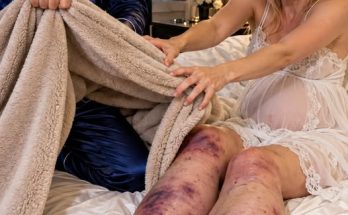
And an assault charge connected to the heated iron and documented injury.
Other investigations remained open.
Vance and Martin were being handled separately.
Sarah sat perfectly still.
“Is she being arrested?”
“She will be processed after medical clearance.”
The sentence I thought would bring triumph brought something else.
Silence.
Sarah’s eyes filled.
I asked, “Are you okay?”
“No.”
She laughed softly through tears.
“But I think maybe I’m safe enough to start finding out.”
I moved toward her.
Stopped.
She opened her arms.
Then I held her.
No victory speech.
No celebration.
Just two exhausted people in Monica’s kitchen while the machinery Eleanor had tried to manipulate finally began moving without her control.
Click here to continue reading: PART 15: Months Later, the Baby Arrived Safely, and the Final Consequences Forced Us to Decide What Family Would Mean After Eleanor
I Came Home Two Hours Early and Heard My Mother Use a Voice I Had Never Heard Before
Part 14 of 15