PART 1
By the time the church bells rang over Lancaster that Saturday morning, Everett “Rhett” Dawson had already taken off his best shirt and hung it back in the closet.
He stood in the narrow bedroom of his modest blue house, one hand resting on the open closet door, the other pressed against the pocket of a dark jacket he had not worn since his wife’s funeral. Outside the window, the fields were bright with late spring. The kind of morning Marianne would have called a mercy—soft sun, clean air, birds arguing in the maple tree as if the world had no cruelty in it.
On the bed lay a folded gray suit. Not expensive, but clean. Beside it sat a small wooden box containing a silver tie clip engraved with three words.
For my father.
Lillian had given it to him when she graduated college. She had cried that day, not because she was sad, but because happiness overwhelmed her in the same quiet way grief did. Everett had worn that tie clip to every important event since.
But not today.
Today, his daughter was getting married, and he had been asked not to attend.
He had not been asked with anger. That might have been easier. Anger gave a man something to push against. No, Clayton Vale had done it with a polished face and careful words, over coffee in a Philadelphia restaurant where the menu had no prices and the waiters moved like ghosts.
“Mr. Dawson,” Clayton had said, smoothing his napkin across his lap, “I respect you. I truly do. But my family is traditional. They have expectations. The ceremony will be very formal.”
Everett had waited.
Clayton’s eyes had drifted toward Everett’s worn hands, the old scar across his knuckle, the leather jacket folded beside him on the chair.
“There will be professional colleagues there,” Clayton continued. “Doctors. Attorneys. Donors. People connected to my father’s foundation. I don’t want anything to distract from Lillian.”
Everett remembered lowering his coffee cup slowly.
“Anything?” he had asked.
Clayton’s smile had flickered. “That’s not what I meant.”
But it was exactly what he meant.
Two months later, Everett stood alone in his bedroom, listening to those words echo in the silence.
Across town, Lillian was putting on her wedding dress.
Across town, people were arranging flowers, lighting candles, taking photographs.
Across town, a young man from a respectable family was preparing to marry the daughter of the man he had erased from the guest list.
Everett picked up the tie clip, ran his thumb across the engraving, and placed it back in the box.
Then he closed the lid.
He had promised Lillian he would not make a scene. He had promised because she had come to him with tears in her eyes, sitting at the same kitchen table where she had once done spelling homework and asked whether heaven had windows.
“Dad,” she had whispered that day, “I hate this. I hate all of it.”
Everett had reached across the table and held her trembling hand.
“Then don’t do it, Lil.”
She had looked at him then, and he saw a little girl inside a grown woman’s face—the same child who used to run to him after nightmares.
“It’s not that simple,” she said.
“It is if he’s ashamed of you.”
“He says he’s not ashamed of me.”
Everett had looked at her for a long time. “No. He’s ashamed of where you come from. That’s the same thing, only dressed nicer.”
She had cried harder then, not because he was cruel, but because he was right.
Still, love has a way of making intelligent people bargain with humiliation. Lillian loved Clayton. Or perhaps she loved the man Clayton had pretended to be before his family’s expectations entered the room. She believed he would soften after the wedding. She believed marriage would make him brave.
Everett, who had watched men reveal themselves under pressure for more than six decades, knew better.
But he did not say that.
A father can warn. He cannot live a daughter’s life for her.
So he promised her. He would not attend the ceremony. He would not bring the Iron Hollow Riders. He would not embarrass her.
He only made one request.
“After the vows,” he told her, “look across the street.”
She stared at him through her tears.
“Why?”
“Because I’ll be there.”
Lillian covered her mouth.
“Dad…”
“I won’t step inside. I won’t walk up the aisle. I won’t say a word to Clayton. But I raised you, Lillian Mae. I held you when you were six pounds and angry at the world. I taught you to ride a bike. I buried your mother with you holding my arm so tight I had bruises the next day. I’m not going to miss the sound of those bells.”
She leaned across the table and put her forehead against his hand.
“I don’t deserve you.”
Everett’s voice broke when he answered.
“Yes, you do.”
Now the hour had come.
He changed into dark jeans, polished boots, a white shirt, and the old leather vest he had worn for years. On the back were the words Iron Hollow Riders. On the front, over his heart, was a small patch that simply said Rhett.
Before leaving, he paused in the hallway.
There were photographs on the wall. Lillian at seven, missing her front teeth. Lillian at sixteen, holding a blue ribbon from the county fair. Lillian at twenty-two, standing between Everett and Marianne on graduation day, her cap crooked, her smile wide enough to make even sorrow step back.
At the end of the hallway hung the last photograph taken before Marianne died.
Everett touched the frame.
“I’m going to watch our girl get married,” he said softly. “I wish you were coming with me.”
Then he walked out, locked the door, and rode toward the church alone.
PART 2
St. Anselm’s Church stood at the corner of King Street and Maple, white stone and tall windows, the kind of place that looked as if it had been built for people who knew where they belonged.
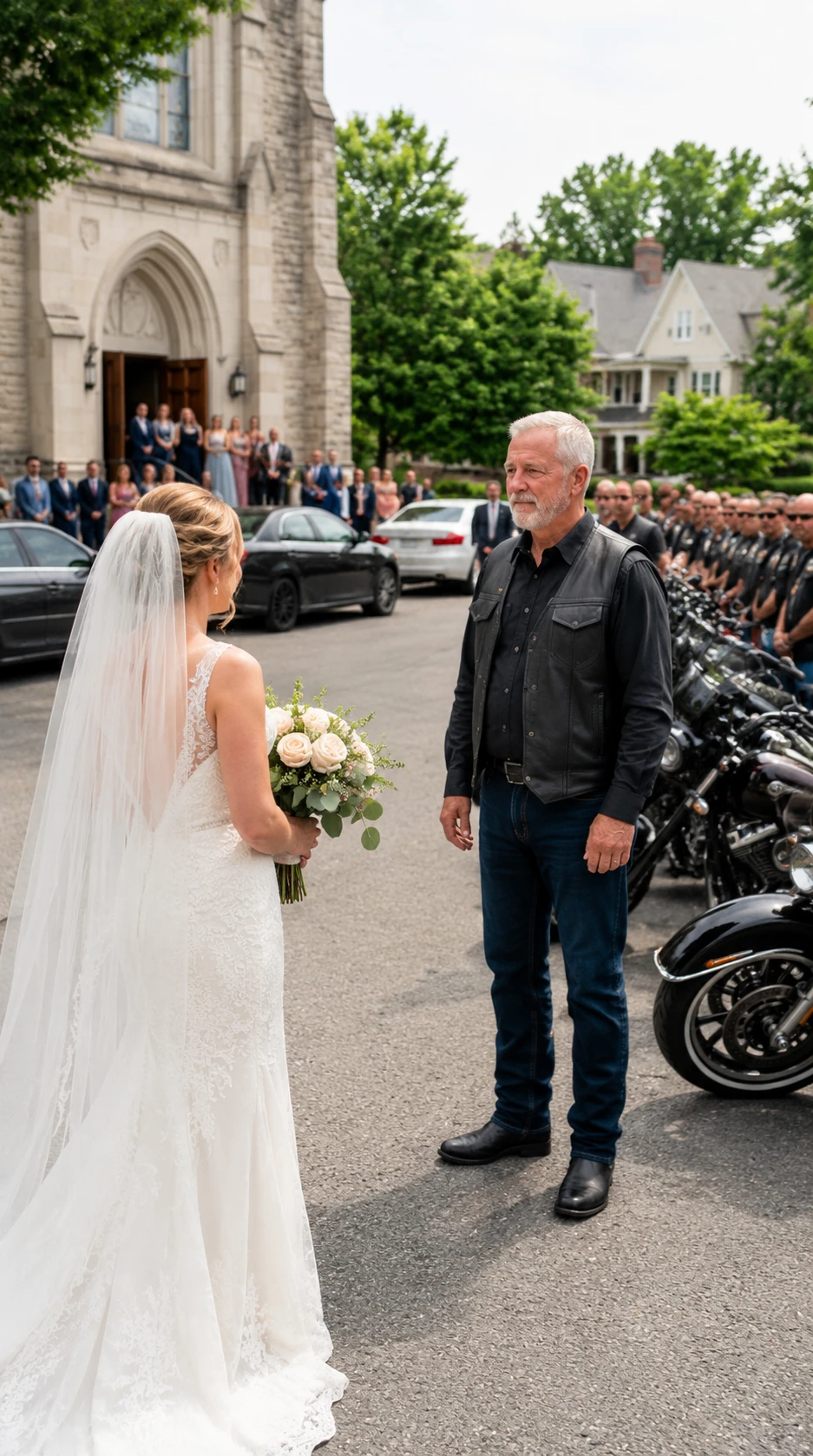
Everett parked his motorcycle across the street beneath an old sycamore tree. He arrived before most of the guests, because men who work with their hands learn early that being late is a form of disrespect. He removed his helmet, combed his fingers through his silver hair, and sat on the bench outside a closed bakery with his hands folded between his knees.
For a while, no one noticed him.
Then the cars began arriving.
Black sedans. Cream-colored SUVs. Women in pastel dresses and pearls. Men in navy suits who laughed with their mouths open but their eyes scanning for someone more important. Photographers moved along the sidewalk, catching moments of elegance and money.
Everett watched quietly.
He recognized Lillian’s school principal, a few teachers from Reading, and Mrs. Delaney from the grocery store, who had once brought soup after Marianne’s funeral. But most faces belonged to Clayton’s world—people with smooth hands, careful smiles, and the confident posture of those who had never had to wonder whether the heat bill could wait until Friday.
Then Clayton arrived.
He stepped from a long black car in a tailored suit, his hair perfect, his face calm. His father, Preston Vale, walked beside him—a tall man with white hair and the cold dignity of a bank lobby. Clayton’s mother, Celeste, wore a pale blue dress and diamonds that caught the morning light like small knives.
Clayton looked toward the church steps.
Then, as if pulled by a hook, his gaze shifted across the street.
He saw Everett.
For one second, Clayton’s expression cracked.
Not much. Just enough.
Everett did not wave. He did not stand. He only looked back.
Clayton said something to his father. Preston Vale turned. His eyes traveled over Everett’s vest, his boots, his motorcycle. A faint line formed at his mouth.
Celeste looked too, then quickly looked away as though Everett were something unpleasant on a clean tablecloth.
That was when Everett understood something important.
Clayton had not created this shame by himself. He had inherited it.
The church doors opened. Music drifted out.
Guests entered. The street quieted.
Everett stayed on the bench.
A few minutes later, a woman hurried across the street toward him. She was in her late fifties, wearing a lavender dress and worried eyes. It took Everett a moment to recognize her.
“Mr. Dawson?” she asked.
“Angela Price,” he said, standing. “You taught with Lillian her first year.”
The woman’s face softened. “You remember.”
“My daughter remembers everyone who was kind to her. That means I do too.”
Angela looked toward the church, then back at him. Her lips pressed together.
“She didn’t tell me,” she said quietly.
Everett knew what she meant.
“She didn’t want anyone uncomfortable.”
Angela’s eyes filled.
“That girl speaks of you like you hung the moon.”
Everett looked down the street. “I only held the ladder.”
Angela touched his arm. “Come inside. Sit with me. No one has to—”
“No,” he said gently. “I gave my word.”
“Sometimes promises made under pressure don’t deserve to be kept.”
Everett smiled sadly. “That’s true. But today, my daughter needs to know one person in this whole mess kept a promise.”
Angela stood with him for a moment longer. Then she did something that nearly broke him.
She kissed his cheek.
“I’ll tell her you were here.”
“She’ll know.”
Angela returned to the church. Everett sat again.
The bells rang once, then twice.
Through the open doors, he heard the music change.
He could not see Lillian walking down the aisle. But he imagined her. Marianne’s pearl comb in her hair. Her hands around a bouquet. That brave, frightened lift of her chin.
When she was little, she had hated walking into rooms alone. On the first day of kindergarten, she clung to his leg outside the classroom.
“What if nobody likes me?” she had whispered.
Everett had crouched before her. “Then you find the quietest kid in the room and like them first.”
That was Lillian’s whole life afterward. She found the lonely. The awkward. The forgotten. She liked them first.
And now she was marrying a man who had asked her to forget the person who loved her first.
Inside the church, the vows began.
Everett could not hear the words clearly. Just the rhythm of them. A man’s voice. Then Lillian’s.
Her voice carried farther than Clayton’s.
It always had when something mattered.
Everett bowed his head.
He did not pray often. Not formally. Marianne had done the praying for both of them, especially when money was tight or Lillian was sick. Everett’s prayers were usually short, rough things spoken into garages, hospital rooms, and empty kitchens.
That morning, he prayed only this:
Let her see the truth before it costs her too much.
The doors stayed closed for what felt like an hour.
Then the bells erupted.
The ceremony was over.
Guests spilled from the church, bright and laughing, applauding as Clayton and Lillian stepped onto the stone steps beneath a shower of white petals.
Everett stood.
For a moment, he forgot pain.
There she was.
His little girl.
Lillian’s gown was simple and beautiful, with lace sleeves and a skirt that moved like water. Marianne’s pearl comb gleamed in her dark hair. Her face was pale, but her eyes were searching.
Across the street, through the moving crowd, father and daughter found each other.
Everything stopped inside Everett.
Lillian looked at him.
He lifted one hand.
Not high. Just enough.
Her mouth trembled.
Then Clayton leaned close to her, smiling for the cameras, and murmured something.
Everett could not hear it.
But he saw Lillian’s expression change.
The trembling stopped.
Her face went still.
Not cold. Not angry.
Clear.
Clayton reached for her hand, likely to guide her toward the waiting car. But Lillian did not move with him.
She turned.
At first, the guests thought she was adjusting her dress. Then she stepped down from the church steps. The photographers shuffled, confused. Clayton laughed softly, as if trying to make it charming.
“Lillian,” he said. “Where are you going?”
She did not answer.
She lifted the front of her wedding dress with one hand and walked straight across the street.
The crowd quieted.
Everett felt every eye follow her.
Halfway across, Clayton called again, sharper now.
“Lillian.”
She kept walking.
A car slowed. Someone gasped. The photographer lowered his camera.
Lillian reached the opposite sidewalk and stopped in front of Everett.
For one heartbeat, she looked like the seven-year-old with skinned knees, the teenager trying not to cry after Marianne’s diagnosis, the young woman who had stood beside an open grave and squeezed his arm as if she might fall through the earth.
Then she turned around to face the church, the guests, the Vale family, and her new husband.
Her voice was not loud.
It did not need to be.
“If my father is not welcome at my wedding, then I am not staying at my wedding.”
The entire celebration fell into complete silence.
PART 3
Silence does not always arrive empty. Sometimes it comes full of all the things people should have said sooner.
On the church steps, Clayton’s smile froze. His mother’s hand flew to her necklace. His father stared as though Lillian had just broken a priceless vase in a room full of donors.
Everett could barely breathe.
“Lil,” he whispered.
She did not look back at him. Her eyes stayed fixed on Clayton.
Clayton stepped down one stair. “Lillian, don’t be dramatic.”
That word moved through her like a match catching dry paper.
“Dramatic?” she repeated.
The guests shifted. Someone coughed. A child asked too loudly, “Mommy, why is the bride across the street?”
Clayton glanced at the crowd, then lowered his voice. “We can talk about this privately.”
Lillian laughed once, but there was no humor in it.
“You wanted my father excluded publicly. You wanted your family comfortable publicly. You wanted perfect photographs publicly. So no, Clayton. We are not hiding the truth privately.”
Preston Vale moved forward. “Young lady, this is neither the time nor the place.”
Everett felt the old protective fire rise in him, but Lillian raised her hand slightly, stopping him without turning around.
She had always been gentle.
Gentle was not the same as weak.
“With respect, Mr. Vale,” she said, “you and your son chose the time and place when you decided my father was something to be managed.”
Celeste’s face tightened. “No one said that.”
Lillian looked directly at her. “You didn’t have to.”
Everett heard murmurs ripple through the crowd.
Angela Price stepped out from among the guests, her lavender dress bright against the church stone. She crossed her arms and stood very still, watching like a teacher waiting for a child to admit who broke the window.
Clayton came down another step. “Lillian, please. You’re upset.”
“I am awake,” she said.
Those three words landed harder than shouting would have.
Everett saw Clayton’s eyes change. The charm drained away, revealing something frightened and irritated underneath. It was the face of a man who had expected obedience from someone he mistook for quiet.
“You are my wife now,” Clayton said softly.
A sound moved through the guests. Not quite a gasp. Not quite anger. Recognition, perhaps.
Lillian took one step forward, still on Everett’s side of the street.
“No,” she said. “I stood in that church and said vows to a version of you I hoped was real. But the man standing there just told me who he is.”
Clayton’s jaw tightened. “This is absurd.”
“What did you whisper to me on the steps?” Lillian asked.
He looked away.
“Say it,” she demanded.
Clayton’s face reddened. “I said we would fix the photos later.”
“No,” Lillian said. “You said, ‘Smile now. We’ll cut him out later.’”
The silence deepened until even the birds seemed to stop.
Everett’s hand curled at his side.
Cut him out later.
Four words, polished smooth by habit. Four words that reduced a father to an inconvenience in a wedding album.
Lillian turned toward Everett then. Her eyes were full, but her voice did not break.
“I am so sorry,” she said.
Everett shook his head. “You don’t owe me sorry.”
“Yes,” she said. “I do. I almost let someone teach me to be ashamed of the only parent who never once made me earn love.”
Something inside Everett gave way.
He had prepared himself to be invisible that day. He had not prepared himself to be seen so fiercely.
Across the street, Clayton’s father spoke again, his tone cold enough to frost glass.
“Clayton, bring your wife back.”
Lillian turned slowly.
“No one brings me anywhere.”
That was when the first motorcycle appeared at the far end of Maple Street.
Then another.
Then another.
The sound was low at first, a distant thunder rolling between brick buildings. Heads turned. Dresses stirred in the breeze. A dozen motorcycles came into view, then two dozen, riding in slow formation—not loud, not wild, not threatening. Just steady.
The Iron Hollow Riders.
They parked along the curb behind Everett’s bike, one after another, engines quieting until the street held only the ticking of cooling metal.
Clayton looked horrified.
Preston Vale looked furious.
Everett looked confused.
At the front of the group, a broad-shouldered man with a gray beard removed his helmet. His name was Amos Reed, president of the Iron Hollow Riders, a retired firefighter with bad knees and a heart too soft for his own good.
He walked toward Everett with the solemn dignity of a man entering a funeral.
“Rhett,” Amos said.
Everett frowned. “What are you doing here?”
Amos glanced at Lillian. “Your daughter called.”
Everett turned to her.
Lillian swallowed. “Last night.”
“Why?”
She took a breath. “Because I knew I might not be brave enough alone.”
Amos nodded to her. “You were.”
Behind him stood men Everett had known for half his life. Some wore leather. Some wore suits beneath their vests. One leaned on a cane. Another held a bouquet of wildflowers. They looked nothing like the picture Clayton had painted. They looked like fathers, grandfathers, widowers, veterans, mechanics, small business owners, men who had buried friends and shown up anyway.
A woman in the guest crowd whispered, “Are they here to cause trouble?”
Angela Price turned sharply. “No. They’re here because family came when called.”
Lillian looked at the riders, then back at Clayton.
“You were afraid they would embarrass you,” she said. “But they showed up with more dignity than anyone who helped hide my father across the street.”
Clayton’s expression hardened.
“You planned this,” he said.
“No,” Lillian answered. “I prepared for it.”
Those words seemed to change the air.
Everett realized then that his daughter had not simply reached a breaking point. She had been walking toward this moment for weeks, gathering courage one painful step at a time.
Clayton looked at the guests, trying to find sympathy. “Everyone can see what this is. She is emotional. Her father has influenced her.”
That was the wrong thing to say.
Lillian’s eyes flashed.
“My father taught me to check the oil in my car. He taught me to balance a checkbook. He taught me that apologies mean nothing if behavior does not change. He taught me to sit beside dying people without running away. If that is influence, then yes, Clayton. I was influenced by a better man than you.”
A few people clapped before they could stop themselves.
Then more.
Not thunderous applause. Not yet. Just scattered, honest sound.
Preston Vale raised his voice. “Enough. This family has been generous. We paid for this wedding.”
Lillian looked at him.
“No,” she said. “Your family paid for a performance. I am ending it.”
She turned to Everett.
“Dad, will you walk with me?”
Everett could not answer immediately.
He had walked her into school. Into hospitals. Into funeral homes. Into college dorm rooms. He had thought the one walk he would never have was the walk down the aisle.
Now she stood before him, not asking him to give her away, but asking him to help her come back to herself.
He held out his arm.
“With all my heart.”
She took it.
Together, father and daughter began walking down Maple Street, away from the church, away from the flowers, away from the man who had mistaken a wedding for possession.
The Iron Hollow Riders fell in behind them.
And behind the riders, one by one, several guests began to follow.
PART 4
They ended up at Dawson’s Garage because that was where Everett had spent more of his life than anywhere except home.
The garage sat three blocks from the church, a brick building with faded red doors and a hand-painted sign Marianne had helped him letter thirty years earlier. Everett did not own it anymore in any official sense; he had sold most of his share when Marianne got sick. But the current owner, Frank Bell, had once been a boy Everett trained, and he still kept a key under the loose brick near the side entrance.
By noon, the garage yard was full of people in wedding clothes.
Women in heels stood beside tool benches. Men in suits leaned against pickup trucks. A flower girl ate a donut someone found in the office. The Iron Hollow Riders arranged folding chairs. Angela Price made coffee in an old machine that sounded like it might explode.
Lillian sat in the corner on a wooden crate, her wedding dress spread around her like spilled moonlight.
Everett brought her a paper cup of water.
She took it with both hands.
“You all right?” he asked.
“No.”
He nodded. “Good answer.”
That made her laugh, though tears slipped down her face at the same time.
“I ruined everything,” she whispered.
Everett sat beside her. His knees complained, but he ignored them.
“No, sweetheart. You stopped pretending it wasn’t already ruined.”
She stared at the cup.
“I kept thinking love meant patience. That if I gave Clayton time, he would choose me fully. But every compromise got smaller until I realized I was the one shrinking.”
Everett listened.
Outside, voices rose and fell. Someone had turned on an old radio. The smell of oil, coffee, and cut flowers mingled strangely in the air.
“I was embarrassed to tell you,” Lillian said. “Not because of you. Because I knew you would see it clearly. And I wanted to keep believing.”
“That’s what hope does sometimes,” Everett said. “It puts a soft light on sharp things.”
She looked at him. “Did Mom ever doubt marrying you?”
Everett smiled faintly. “Your mother doubted everything at least once. Including whether I was smart enough to own more than two forks.”
Lillian laughed again.
Then Everett’s smile faded into memory.
“But she never asked me to become smaller so she could love me. She made me better, not quieter.”
Lillian closed her eyes.
“I miss her.”
“Me too.”
For a while, they sat without speaking.
Then a black sedan pulled up outside the garage.
The yard quieted.
Clayton stepped out first. Behind him came Preston and Celeste Vale. Their wedding elegance looked strange against the old brick and grease-stained concrete.
Everett stood.
Lillian rose slowly.
Amos Reed moved closer, but Everett shook his head.
Clayton entered the garage as if stepping into a place where his shoes might catch something.
“Lillian,” he said, his voice controlled. “This has gone far enough.”
She looked exhausted now, but not uncertain.
“What do you want?”
“I want to talk sense into you.”
“Try apologizing first.”
Clayton flinched.
Celeste stepped forward. “Dear, emotions were high. Clayton misspoke.”
Lillian looked at her. “He did not misspeak. He revealed.”
Preston’s patience snapped. “You are humiliating my son.”
Everett’s voice came low. “She’s telling the truth. Humiliation is what happens when truth arrives after pride.”
Preston turned to him with open contempt. “This is between families.”
Everett stepped closer. “I am her family.”
Clayton inhaled sharply. “This is exactly what I was trying to avoid. This whole spectacle. The motorcycles. The garage. The shouting.”
“No one shouted until you arrived,” Angela Price called from near the coffee machine.
Several people murmured agreement.
Clayton ignored them.
He looked at Lillian. “Do you know what people are saying? Do you understand what this does to my reputation?”
There it was.
Not our marriage.
Not your heart.
My reputation.
Lillian nodded slowly, as if the final piece of something had settled into place.
“Thank you,” she said.
Clayton frowned. “For what?”
“For making this easier.”
His face darkened. “You don’t mean that.”
“I do.”
“You’re throwing away a marriage after twenty minutes.”
“No,” she said. “I’m refusing to spend twenty years explaining why I look sad in every photograph.”
Clayton stepped toward her. Everett moved instinctively, but Lillian lifted her hand again.
She did not need rescuing now.
“Lillian,” Clayton said, lowering his voice into something intimate and dangerous, “you are overwhelmed. Come with me. We’ll tell everyone you had a panic attack. People will understand. We can repair this.”
She stared at him.
“A panic attack?”
“It’s believable.”
The cruelty of that sentence was so casual that several guests recoiled.
Lillian’s voice turned soft. “You would rather tell people I was mentally unwell than admit you were ashamed of my father.”
Clayton said nothing.
The silence answered.
Then an old man stepped forward from the back of the garage.
He had been sitting unnoticed on a stack of tires, wearing a brown suit a size too large and holding a cane with both hands. Everett recognized him slowly.
“Judge Whitaker?” Everett said.
Clayton turned sharply.
The old man nodded. “Retired, thank God. But still capable of hearing a confession when a fool volunteers one.”
Preston Vale stiffened. “Walter, you need not involve yourself.”
Judge Walter Whitaker smiled thinly. “Preston, I have spent forty years watching men like you assume silence can be purchased with good tailoring.”
Clayton’s face drained of color.
Lillian looked between them. “You know each other?”
The judge stood with effort. “I knew your mother.”
Everett went still.
Marianne’s name entered the room without being spoken, and yet Everett felt it. He stared at the judge, his heart striking hard.
Judge Whitaker looked at him with deep sadness.
“Rhett,” he said, “there is something I should have told you years ago.”
Everett’s mouth went dry. “About Marianne?”
The room seemed to tighten.
Preston Vale stepped forward. “Walter, don’t.”
The judge looked at him. “You don’t get to command this room.”
Lillian took Everett’s hand.
Judge Whitaker turned to her. “Your mother came to me eight years ago. Before her illness became too severe. She was worried about you.”
Lillian whispered, “Me?”
“Yes. She had discovered something about the Vale family.”
Clayton’s eyes flashed. “This is insane.”
Judge Whitaker ignored him.
“Marianne worked part-time for a legal aid office years before you were born. She had a gift for numbers and records. Near the end of her life, she helped review old charitable trusts. One of them involved Preston Vale’s foundation.”
Preston’s face had gone gray.
Everett felt the floor tilt beneath him.
“What did she find?” he asked.
The judge’s voice lowered.
“That the Vale Foundation had been built, in part, using money diverted from a widows’ housing trust after a construction collapse in 1989.”
Everett stared.
The 1989 collapse.
He remembered it. Every construction man in Lancaster remembered it. Three workers died when a scaffold failed at the old textile mill renovation. One of them had been Everett’s closest friend, Miguel Alvarez. Miguel left behind a wife and two children.
A trust had been created for the widows.
Then it disappeared into legal fog.
Everett had never known why.
Lillian’s hand tightened around his.
Judge Whitaker continued. “Marianne found documents connecting Preston’s father and later Preston himself to the disappearance of those funds. She planned to bring it forward. Then she became ill.”
Celeste whispered, “Stop.”
The judge looked at her. “No.”
Everett could barely speak. “Why didn’t she tell me?”
“Because she knew you would storm the gates with a wrench in one hand and righteousness in the other,” the judge said gently. “She wanted proof first. She gave me copies. I kept them safe. After she passed, I hesitated. I regret that more than I can say.”
Clayton laughed suddenly, too loudly.
“This is ridiculous. Ancient history. What does any of this have to do with today?”
Lillian turned toward him slowly.
And then the true horror dawned on her face.
“You knew,” she said.
Clayton looked away.
“You knew who my mother was.”
Preston snapped, “Clayton.”
But Clayton had already betrayed himself.
Lillian stepped back as if struck.
“You didn’t just want my father hidden because he rode a motorcycle,” she whispered. “You wanted him hidden because someone might recognize him. Someone might connect him to the men your family robbed.”
Clayton’s mouth opened, then closed.
Everett felt the old grief of Miguel’s funeral rise in him—the widow holding two boys by the shoulders, the envelopes passed around job sites, the promises that help was coming.
Help had been stolen.
By the family whose son had tried to cut Everett out of his own daughter’s wedding.
PART 5
The garage became so quiet that the hum of the fluorescent lights sounded like insects.
Preston Vale recovered first, because men like him always mistake quickness for strength.
“This is slander,” he said. “I will bury every person in this room beneath lawsuits.”
Judge Whitaker reached into his coat pocket and removed a thick envelope.
“No, Preston. You buried widows. We are merely opening the ground.”
He handed the envelope to Lillian.
Her fingers trembled as she took it.
“What is this?” she asked.
“Copies,” the judge said. “Bank transfers. Trust amendments. Letters your mother saved. And one more thing.”
He looked at Everett.
“She left a statement.”
Everett felt his knees weaken.
“A statement?”
The judge nodded. “Video. Recorded in my office shortly before the final hospital stay. She asked that it be shown only if the Vale family ever tried to enter Lillian’s life.”
Lillian’s face crumpled. “Mom knew?”
“She suspected they might,” the judge said. “Not Clayton specifically. But she knew Preston had a son close to your age. She feared powerful families often returned to unfinished business wearing friendly faces.”
Clayton’s voice shook with anger. “That’s paranoid.”
“No,” Lillian said, looking at him with devastation. “That’s experience.”
Angela Price brought an old laptop from the garage office. Frank Bell found a cord. The screen flickered to life on a workbench between a box of spark plugs and a vase of wedding flowers someone had carried without realizing.
No one spoke as Judge Whitaker inserted a small drive.
Then Marianne appeared.
Seven years gone, but there she was.
Thin from illness. A scarf around her head. Her eyes tired but bright with the same warmth Lillian carried into every classroom.
Everett made a sound he could not stop.
Lillian covered her mouth with both hands.
On the screen, Marianne smiled gently.
“If you are watching this,” she said, “then my stubborn husband is probably standing somewhere pretending he is not about to cry.”
A broken laugh moved through the room.
Everett did cry then. Quietly. Without shame.
Marianne continued.
“Rhett, I am sorry. I kept this from you because I knew your heart, and your heart has always run faster than caution. I needed time to make sure I was right.”
She paused, breathing carefully.
“Lillian, my darling girl, listen to me. There are people in this world who will admire your kindness because they want to live inside it without ever protecting it. Do not marry anyone who asks you to cut away the parts of yourself that made you whole.”
Lillian sobbed.
Marianne’s eyes seemed to look through the screen directly into her daughter.
“And if the Vale name has come near you, ask why. Ask what they want softened, hidden, forgiven, or forgotten.”
Clayton stepped back.
Everett looked at him.
The young man’s face had changed completely now. Not shame. Fear.
Marianne’s voice grew firmer.
“Preston Vale’s family took money meant for the widows of dead workers. One of those workers was Miguel Alvarez. Another was Thomas Keene. Another was Robert Delling. Their wives deserved security. Their children deserved a future. That future was stolen and dressed up as philanthropy.”
Preston said, “Turn that off.”
No one moved.
Marianne continued.
“I do not want revenge. Revenge feeds the wound. I want restoration. I want the truth placed where polite people cannot step around it.”
Her smile softened.
“Rhett, if you are there, forgive me for carrying this alone. You carried everything else.”
Everett pressed his hand over his mouth.
“And Lillian,” Marianne said, “if you are in pain right now, come home to your father. There is no shame there. There never was.”
The video ended.
For several seconds, the screen remained black.
Then Lillian turned to Clayton.
“Did you know about this before you met me?”
Clayton’s lips parted.
Preston snapped, “Do not answer.”
But Clayton was no longer polished. He was a frightened man in a beautiful suit, standing in a garage full of truth.
“I knew there had been accusations,” he said.
Lillian’s voice was barely above a whisper. “Before you met me?”
He closed his eyes.
“Yes.”
The word landed like a door locking.
Lillian staggered, and Everett caught her.
“Why?” she asked.
Clayton looked at his father, then at her.
“My father wanted to know what your mother had left behind. He thought if I got close to you, maybe I could find out whether there were documents.”
A sound of disgust passed through the room.
Lillian stared at him as if he had become a stranger in the time it took to inhale.
“You courted me because of a file?”
“At first,” Clayton said quickly. “But then I loved you.”
“No,” she said. “You studied me.”
“I did love you.”
“You loved that I trusted you.”
Clayton reached toward her. “Please, Lillian. It became real.”
She stepped back.
“Real love does not begin as surveillance.”
Preston’s face hardened. “Clayton, enough.”
But Clayton turned on him suddenly.
“You told me it was harmless.”
Preston’s eyes went flat.
“I told you to protect this family.”
Clayton laughed bitterly. “No. You told me to find out what Marianne Dawson had left behind. You told me to marry Lillian if I had to because teachers are sentimental and lonely women trust patient men.”
Everett moved before thought could stop him.
Not to strike him. Everett had spent a lifetime learning that violence often gave cowards the excuse they wanted.
He simply stepped close enough that Clayton had to look at him.
“My daughter was never lonely,” Everett said. “She was loved. That is why you could not keep her fooled forever.”
Clayton’s face collapsed then. Perhaps in shame. Perhaps in self-pity. Everett no longer cared which.
Outside, sirens approached.
Angela Price looked through the window. “Police.”
Judge Whitaker nodded. “I called an old friend before the ceremony. I intended to speak quietly afterward. Events chose otherwise.”
Two police cars pulled into the yard. Behind them came a dark county vehicle.
A woman stepped out, tall, composed, wearing a badge clipped to her belt.
“Detective Morales,” Judge Whitaker said. “Thank you for coming.”
Preston Vale’s confidence finally cracked.
Detective Morales entered the garage and looked around at the bride, the bikers, the wedding guests, the old judge, and the billionaire philanthropist standing as if the concrete had turned to thin ice beneath him.
“I understand there are documents,” she said.
Lillian handed her the envelope.
Then she removed her wedding ring.
It was a simple motion. Quiet. Clean.
She placed the ring on the workbench beside the dead laptop.
Clayton stared at it.
“Lillian,” he whispered.
She looked at him one last time.
“I walked into that church thinking I was becoming your wife,” she said. “I walked out remembering I was Marianne Dawson’s daughter.”
Detective Morales began speaking with Preston. Another officer guided Clayton aside. Celeste Vale sat heavily in a folding chair, her diamonds dull now beneath the garage lights.
The wedding guests did not know what to do with themselves. Some slipped away, ashamed of their curiosity. Others stayed because they understood they had witnessed not gossip, but history pushing through a locked door.
By late afternoon, the sky had turned gold.
The police took Preston Vale for questioning. Clayton left in a separate car, without his jacket, without his bride, without the future he had tried to arrange like a business merger.
The flowers from the church ended up in coffee cans around the garage.
Someone brought sandwiches. Someone else found paper plates. The wedding cake arrived because the bakery had already been paid, and Frank Bell declared that no honest cake should suffer because of dishonest people.
So they ate it.
Lillian changed out of her wedding dress in the office with Angela helping her. When she came out, she wore jeans borrowed from Frank’s wife, sneakers from the trunk of a teacher’s car, and Everett’s old flannel shirt over her lace bodice.
She looked younger.
She looked older.
She looked free.
Near sunset, Everett found her outside beside his motorcycle.
“You ready to go home?” he asked.
She looked across the yard where the Iron Hollow Riders were laughing softly with schoolteachers and elderly guests, where the remains of a ruined wedding had become something strangely holy.
“Not yet,” she said.
Then she reached into the pocket of the flannel shirt and pulled out the wooden box.
Everett stared. “Where did you get that?”
“Your dresser,” she said.
“You went through my dresser?”
“I was a bride planning an escape. I needed supplies.”
He laughed, surprised by joy.
She opened the box and took out the silver tie clip.
For my father.
“I wanted you to wear this today,” she said.
“So did I.”
She stepped close and pinned it carefully to the edge of his leather vest, right above his heart.
“There,” she whispered. “Now the pictures will be right.”
Everett looked at her. “What pictures?”
She turned him gently toward the garage.
The photographer stood there, camera raised. Beside him were the riders, Angela, Judge Whitaker, Frank, teachers, neighbors, and half a wedding party that had decided truth was worth more than champagne.
Lillian took Everett’s arm.
“Dad,” she said, “will you walk me down the aisle?”
He blinked.
“What aisle?”
She smiled through tears.
“That one.”
The Iron Hollow Riders had formed two lines across the garage yard. Between them, flower petals from the church had been scattered over the concrete. At the far end stood not a groom, not a minister, not a family waiting to approve her.
At the far end stood a framed photograph of Marianne, placed on a tool chest beneath a string of work lights.
Everett understood then.
This was not a wedding.
It was a return.
He offered his arm.
Lillian took it.
Together, they walked between the motorcycles and the folding chairs, through the soft applause of people who had seen pride fall and love remain standing.
When they reached Marianne’s photograph, Lillian touched the frame.
“I came home, Mom,” she whispered.
Everett placed his hand over hers.
The photographer captured that moment.
Not the church. Not the staged flowers. Not the perfect kiss Clayton had planned for strangers to admire.
This photograph held grease-stained concrete, a bride in borrowed jeans, a biker father with a silver tie clip, and a dead woman’s truth glowing brighter than stained glass.
Months later, the story reached newspapers across Pennsylvania.
The Vale Foundation collapsed under investigation. Funds were traced, accounts frozen, names exposed. The widows’ families, some old now and some long scattered, received settlements that could never restore the years but finally acknowledged the theft. Miguel Alvarez’s sons, gray-haired themselves, came to Everett’s house one Sunday and stood in his kitchen crying over coffee.
Lillian annulled the marriage.
She returned to teaching.
Not right away. Healing took time. Betrayal does not leave the body simply because the betrayer is gone. Some mornings she woke angry. Some nights she dreamed of church bells and Clayton’s whisper.
But she also laughed again.
She planted flowers in Everett’s yard. She visited Marianne’s grave. She started a small scholarship in the names of the three workers whose widows had been robbed. The first recipients were children of tradesmen—welders, roofers, mechanics, masons—young people who knew the dignity of calloused hands.
As for Everett, he kept riding.
But something changed after that day.
For years, he had thought grief made a man smaller. He had believed Marianne’s death had carved out a room inside him that no one could enter.
He was wrong.
Grief had built a chapel there.
And on the day his daughter crossed the street in a wedding dress, she opened the doors.
One year later, on a bright Saturday morning, Everett and Lillian returned to St. Anselm’s Church. Not for a wedding. Not for revenge.
For the dedication of a memorial plaque honoring Miguel Alvarez, Thomas Keene, and Robert Delling.
This time, Everett did not stand across the street.
He walked through the front doors beside his daughter.
No one stopped him.
No one asked him to remove his vest.
And when the ceremony ended, Lillian stood before the congregation and said one sentence that made even the oldest men wipe their eyes.
“My father was never the shame in this story—he was the proof that love does not need permission to stand tall.”
Outside, the bells rang again.
This time, Everett heard them from the church steps, with Lillian’s hand tucked safely around his arm, and the whole town watching as the biker father who had once been asked to disappear stood exactly where he had always belonged.