PART 1: THE MILKSHAKE
The worst betrayals never shout at first; they sit across from you in a diner and ask you not to embarrass them while another man pours cold humiliation down your face.
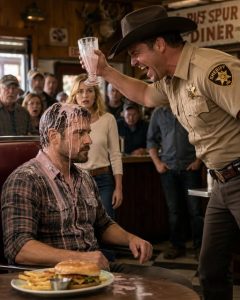
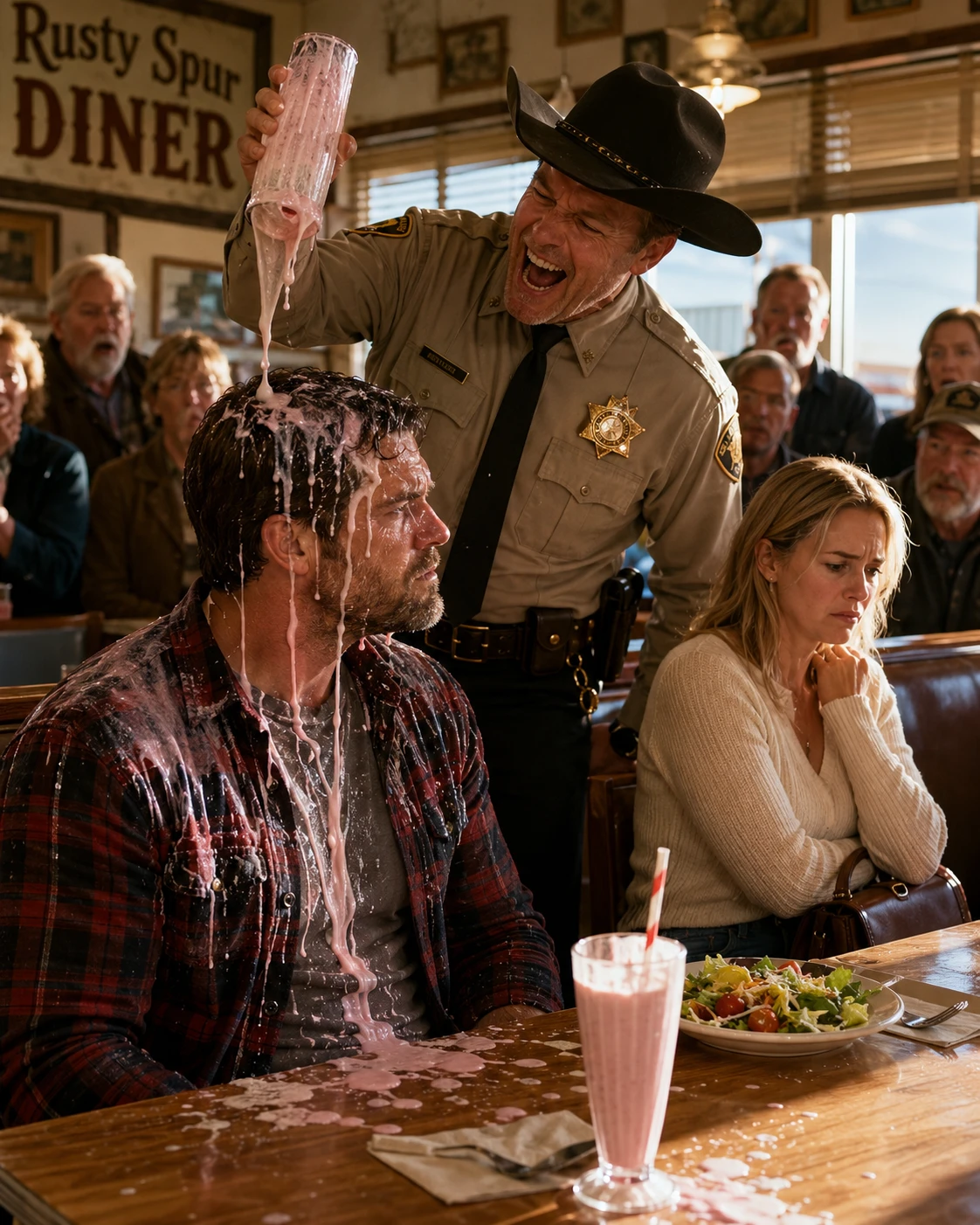
The strawberry milkshake hit Ethan Hayes like a bucket of January river water. It slid over his short gray hair, ran into the lines beside his eyes, soaked the collar of his flannel shirt, and dripped in pink drops onto the cracked black-and-white tile of the Rusty Spur Diner.
For one breath, nobody moved.
Forks paused halfway to mouths. A coffee pot stopped pouring at the counter. The jukebox in the corner kept playing an old Merle Haggard song, but the music seemed to come from another world, a softer world, one where men did not laugh while other men were shamed in public.
Then Sheriff Travis Cole laughed.
It was not the laugh of a man who had lost control. It was careful, cruel, rehearsed. The kind of laugh that told every person in the room what side they were expected to choose.
“Well,” Cole said, holding the empty milkshake glass upside down, “looks like the town ghost finally got himself cleaned up.”
A few people chuckled because fear has a way of teaching decent people to become smaller than they are.
Ethan did not move.
He did not wipe his face. He did not reach for the sheriff’s wrist. He did not rise from the booth, though every old instinct in his body knew exactly how quickly he could end the situation.
Instead, he looked across the table at his wife.
Rachel sat by the window, her purse clutched tightly in both hands. She wore the blue blouse he had bought her in Bozeman for their anniversary, back when they still tried to celebrate things. Her salad sat untouched in front of her. Her eyes were not full of concern.
They were full of embarrassment.
That hurt worse than the milkshake.
Ethan waited for her to say his name. He waited for the woman who had once held his hand through night terrors, who had once told him she did not care what wars had done to him, to stand up and say, “Enough.”
Instead, Rachel leaned toward him and whispered through tight lips, “Ethan, please don’t make a scene.”
Something inside him went very still.
Sheriff Cole bent down until his breath touched Ethan’s cheek. It smelled like cheap peppermint and morning whiskey.
“You got something to say, mechanic?”
Mechanic.
That was what Livingston County knew him as. Quiet Ethan Hayes, the man who fixed tractors, rebuilt old trucks, patched fences for widows, and bought coffee for strangers without asking for thanks. They knew his shop outside town with the peeling red doors. They knew the limp he got on cold mornings. They knew he kept to himself.
They did not know he had spent fourteen years in Naval Special Warfare.
They did not know that “Commander Hayes” was a name spoken softly in rooms with no windows.
They did not know the government still had sealed files with his handwriting on them, files that described places most people would never find on a map.
They did not know how many times he had chosen silence because silence was the only part of peace he understood.
Ethan’s hands rested under the table, relaxed and open.
He studied Cole automatically. Bad left knee. Right shoulder stiff from an old injury. Sidearm riding too high under the jacket. Weight forward. Ego forward. Mind behind.
Easy.
Too easy.
One movement and the sheriff would have been on the floor before the waitress finished gasping.
But Ethan had learned long ago that violence was often the laziest weapon. It felt clean in the moment and left mud everywhere afterward.
Patience, when used correctly, could bury a man deeper than fists ever could.
Ethan reached for a napkin and slowly wiped milkshake from his eyebrow.
“No,” he said quietly. “I’m done eating.”
Cole smiled, pleased with himself.
“That’s what I thought.”
Rachel stood so fast her knees bumped the table. “I’ll wait in the car,” she muttered. “Try not to embarrass me any more than you already have.”
She walked past the sheriff without looking at Ethan.
But Ethan saw what happened next.
It was tiny. Quick. Almost nothing.
Sheriff Cole gave Rachel a nod.
Not the nod of a public official to a citizen.
The nod of a man confirming a plan.
Rachel lowered her eyes like she had expected it.
The room returned to motion around Ethan, but his mind slowed to a perfect, terrible calm. The milkshake was not a drunken insult. It was theater. It had been done in front of witnesses for a reason.
They had wanted him to react.
They had needed him to react.
Ethan stood, placed enough cash on the table to cover the meal and the mess, and walked out into the pale Montana sunlight with strawberry cream dripping from his sleeve.
Rachel was already in the passenger seat of his old Ford, staring down at her phone.
She did not ask if he was all right.
For a long moment, Ethan stood beside the truck and watched his wife through the windshield. Behind her face, he saw the last six months arranging themselves into a pattern.
The late-night “county meetings.” The sudden private phone calls. The way she stopped touching his shoulder when she passed behind him in the kitchen. The new perfume. The sheriff’s truck once parked two blocks from their house at dawn. Her nervousness whenever Ethan walked into a room unexpectedly.
He had wanted not to see it.
A man can survive war and still be afraid of an ordinary truth.
Ethan climbed into the driver’s seat.
Rachel glanced at his ruined shirt and wrinkled her nose. “You should have just apologized.”
“For what?”
“For making him angry.”
Ethan looked at her then.
The question in his face frightened her, though he had not raised his voice.
He opened the center console and removed a secure satellite phone wrapped in an oilcloth. He had not touched it in over a year. Its weight in his palm felt like another life returning from the grave.
Rachel’s eyes widened.
“Who are you calling?”
Ethan turned the phone on.
“A lawyer.”
“You have a lawyer?”
He dialed from memory. “Not the kind you’re thinking of.”
The line connected on the second ring.
A woman’s voice answered, clipped and alert. “Hayes?”
“Commander Ethan Hayes,” he said calmly. “Retired. Authentication phrase: Blue Lantern, Seven, Winter.”
A pause.
Then the voice changed.
“Confirmed. What do you need, Commander?”
Ethan looked through the windshield at the diner, where Sheriff Cole was still laughing with men who did not know their world had just shifted beneath them.
“I need immediate legal intervention and federal oversight regarding a county sheriff involved in corruption, intimidation of veterans, possible misuse of military surplus, and conspiracy to provoke an assault under color of law.”
Rachel’s face drained of color.
The woman on the line said, “Are you in immediate danger?”
Ethan watched Cole step out of the diner and light a cigarette as if he owned the whole valley.
“No,” Ethan said. “But he is.”
PART 2: THE QUIET WAR
Ethan drove home without another word.
Rachel tried speaking twice. The first time, she said his name softly, as if softness could repair the sound of her betrayal. The second time, she said, “You’re overreacting.”
Ethan answered neither.
Their house sat six miles outside Livingston, where the prairie began to rise toward the Absaroka Range. It was not much to look at from the road: a low ranch house, a two-bay garage, a barn with sun-faded doors, and a line of cottonwoods that rattled in the wind.
But Ethan loved that place.
He loved the silence of it in the morning. He loved the smell of engine grease and cut hay. He loved the way the mountains turned purple at dusk. After years of sleeping lightly in foreign dust, he had believed Montana might teach him how to rest.
Rachel had loved it once, too.
In the early years, she filled the porch with clay pots of marigolds. She hung wind chimes from the eaves. She kept a notebook of recipes she wanted to try when they were old. On winter nights, she would sit near the woodstove and read aloud while Ethan worked a stubborn knot of tension from his hands.
But peace is not simple when one person wants stillness and the other mistakes stillness for emptiness.
At first, Rachel had admired his quiet. Later, she resented it.
“You never tell me anything,” she had said one night the previous autumn.
“I tell you what I can.”
“That’s not marriage, Ethan. That’s a locked door I’m supposed to decorate around.”
He had wanted to explain that some memories were not stories. They were rooms full of smoke. If opened carelessly, they could choke everyone inside.
But he had only said, “I’m trying.”
Rachel had cried then, not loudly, not dramatically, but with the exhaustion of someone tired of loving a man who kept part of himself buried.
Now, in the kitchen, she stood across from him while he changed out of the milkshake-soaked shirt.
“Who was that woman on the phone?” she demanded.
“Someone who answers when I call.”
“That’s not an answer.”
“It’s the only one you get today.”
Her mouth tightened. “You don’t scare me.”
“I’m not trying to.”
“You called someone about Travis because of a stupid diner scene. Do you understand how crazy that sounds?”
Ethan folded the ruined flannel and placed it in the sink.
“He wanted witnesses.”
“To what?”
“To my reaction.”
Rachel looked away too quickly.
There it was.
The silence between them changed shape.
Ethan leaned against the counter. His voice stayed even, but Rachel knew him well enough to know calm was more dangerous than anger.
“How long?”
She blinked. “How long what?”
“How long has Sheriff Cole been in our marriage?”
The color that had returned to her face vanished again.
“That is disgusting.”
“Yes,” Ethan said. “It is.”
“You don’t get to accuse me after shutting me out for years.”
“I asked a question.”
“You disappeared inside yourself, Ethan. You came here and turned into a ghost. I ate dinner alone while you sat in that garage until midnight. I went to church alone. To fundraisers alone. To everything alone.”
“And Travis made sure you weren’t alone.”
Her eyes flashed. “At least he noticed I was alive.”
The words landed hard, but Ethan did not flinch.
Part of him had expected something worse. Part of him, the part that still remembered her laughing barefoot in the kitchen, wanted to ask why she had not simply left. Why she had chosen cruelty instead of honesty.
But another part of him already knew.
People rarely betray for one reason. They build betrayal like a house, plank by plank, with resentment, loneliness, vanity, fear, and opportunity. By the time they move in, they have convinced themselves it was shelter.
“Rachel,” he said, “what did he promise you?”
She folded her arms. “I don’t know what you mean.”
“He didn’t pour that milkshake because he wanted a laugh. He wanted me to swing at him. You wanted it too.”
“No.”
“Then why tell me to sit there and take it?”
“Because I was trying to keep you from going to jail.”
“For assaulting the man you’re seeing?”
Her jaw trembled.
“I’m not seeing him.”
Ethan waited.
The kitchen clock ticked seven times.
Then Rachel’s face twisted, not with remorse exactly, but with fury at being trapped by truth.
“You have no idea what it feels like to be married to a man everyone pities,” she said. “Poor Rachel, living with the broken veteran. Poor Rachel, married to the quiet mechanic who barely speaks. Travis said you were unstable. He said if you ever lost control, there were ways to get you help.”
“Help,” Ethan repeated.
Her eyes darted toward the hallway.
In that instant, Ethan understood more than she had meant to reveal.
He moved past her and walked to their bedroom.
“Ethan, stop.”
He opened her nightstand.
Under an old magazine and a lavender sleep mask, he found a manila envelope.
Rachel began to cry behind him. “You had no right.”
Inside were photocopied forms. Statements. A draft petition. Phrases jumped out with legal ugliness.
Post-traumatic instability.
Potential threat to community safety.
Spousal fear.
Request for temporary protective intervention.
There were also property documents.
His property.
Or what Rachel believed was his property.
Ethan read in silence while she stood in the doorway breathing hard.
“You were going to have me committed,” he said.
“No. Travis said it was only temporary.”
“And while I was locked away?”
“He said I could sell the ranch. Start over. You would get treatment.”
“Treatment.”
“You don’t understand. I was drowning here.”
Ethan looked at the woman he had married. She was crying now, but the tears did not move him the way they once had. He saw sadness in them, yes, but also calculation. She was grieving the collapse of a plan, not the wound she had caused.
“You could have asked for a divorce,” he said.
“I knew you’d make it difficult.”
“No,” Ethan said softly. “You knew you wouldn’t get what you wanted.”
Her expression hardened because he had found the cleanest nerve.
Before she could answer, headlights turned into the driveway.
Two vehicles.
One was Sheriff Cole’s department SUV.
The other was a black pickup Ethan did not recognize.
Rachel’s lips parted. “You need to stay calm.”
Ethan almost smiled.
That phrase again. Calm, from the people poking the bear and praying it roared.
He walked to the mudroom and put on a dry jacket.
Rachel grabbed his arm. “Please don’t do anything stupid.”
Ethan looked down at her hand until she let go.
“I’m not the one who came to my house with a sheriff after dark.”
Cole knocked once and entered without waiting.
He filled the doorway with his tan uniform, his badge bright under the porch light. Behind him stood Deputy Marlow, a younger man with uneasy eyes and a hand hovering too close to his belt.
Cole smiled when he saw Ethan.
“Evening, partner. We got a call about a domestic disturbance.”
Rachel whispered, “Travis, I didn’t call.”
Cole ignored her.
Ethan stood in the center of the room. “No disturbance.”
Cole looked around the house as if inspecting merchandise.
“Well, Rachel here has expressed concern about your state of mind.”
Rachel’s face tightened.
Ethan saw the first small crack in her confidence. Perhaps she had thought betrayal could be managed politely. Perhaps she had not understood that men like Cole do not share power; they consume weakness.
Cole stepped closer.
“You humiliated yourself today, Ethan. Folks are worried.”
“Folks?”
“Your wife. Your neighbors. Me.”
“I’m touched.”
Cole’s smile faded. “You’re going to come with us tonight. Voluntarily would be best.”
Deputy Marlow shifted uncomfortably.
Ethan turned to him. “Deputy, are you detaining me?”
Marlow swallowed.
Cole snapped, “He doesn’t need a legal lecture.”
Ethan kept his eyes on the deputy. “Am I under arrest?”
Marlow looked at Cole.
Cole’s face reddened. “You think your big-city military nonsense matters out here?”
“No,” Ethan said. “I think the body camera on your deputy matters.”
Marlow’s hand twitched toward his chest.
Cole glanced down and realized the red light on Marlow’s camera was blinking.
Ethan continued, “I also think the federal attorney listening through my kitchen phone matters.”
No one moved.
From the counter, the house phone sat on speaker, connected to a silent line Ethan had opened the moment headlights entered the drive.
A woman’s voice came through.
“Sheriff Cole, this is Special Attorney Margaret Voss with the Department of Justice liaison office. Step away from Commander Hayes and leave the property unless you can state lawful cause for detention.”
Rachel put a hand over her mouth.
Cole’s eyes went flat and black.
For the first time, Ethan saw fear behind the arrogance.
Not much.
But enough.
PART 3: GHOST FILES
By morning, Livingston County was full of rumors.
At the feed store, men who had laughed in the diner suddenly remembered they had not laughed very loudly. At the Methodist church, women lowered their voices around Rachel Hayes’s name. At the Rusty Spur, waitress Darlene cleaned the same counter six times and told anyone who asked that she had seen the sheriff pour the milkshake “like he’d practiced it in a mirror.”
Ethan did not go into town.
He spent the morning in his garage, not because engines needed fixing, but because the place steadied him. The old Chevy on the lift smelled of oil and dust. Tools hung in perfect order along the wall. A woodstove clicked in the corner.
He had built that order one wrench at a time after leaving the teams.
War made a man fluent in chaos. Peace required learning smaller languages: the patience of rusted bolts, the mercy of a good dog sleeping by the door, the courage to sit still when no one was shooting.
At noon, a black government SUV came up the drive.
A woman in her early sixties stepped out wearing a gray coat and boots too practical to be from Washington. Her hair was silver, cut short, and her eyes had the calm severity of someone who had spent decades listening to men lie.
“Commander Hayes.”
“Margaret.”
Special Attorney Margaret Voss shook his hand, then looked toward the house. “Where is your wife?”
“Bedroom. Packing and unpacking. She can’t decide whether she’s leaving or performing leaving.”
Margaret’s mouth twitched. “I forgot how cheerful you are.”
“I’ve improved.”
“No, you haven’t.”
For the first time since the diner, Ethan almost laughed.
They walked into the garage office, where Ethan had already laid out the envelope from Rachel’s nightstand, photographs from his trail cameras, bank statements copied from a shared filing cabinet, and a notebook containing dates, times, and names.
Margaret studied the table.
“You suspected before yesterday.”
“I suspected the affair. Not the commitment petition.”
“And Cole?”
“I knew he was dirty. Didn’t know how dirty.”
Margaret picked up a photograph showing Cole’s SUV parked behind a closed county storage building at 2:13 a.m.
“You’ve been documenting him.”
“I’m retired, not blind.”
Margaret removed her glasses. “Ethan, I need to ask you something directly. Is this revenge?”
He looked toward the open garage door. Outside, the mountains stood under a hard blue sky.
“Yes,” he said.
Margaret watched him.
Then he added, “But I’m old enough now to know revenge is only worth having if justice can survive it.”
She nodded slowly.
“That answer will do.”
Over the next two days, men and women with quiet voices came to Livingston County. They did not arrive with flashing lights. They came in plain vehicles, wearing work coats and baseball caps, asking plain questions.
One went to the diner and collected video footage.
One visited the county impound lot, where vehicles seized from poor residents had been sold through a private auction company owned by Cole’s cousin.
One spoke to widows whose husbands had been veterans and whose land had been pressured away after unpaid tax notices that seemed to appear from nowhere.
One interviewed Deputy Marlow for four hours.
Marlow broke in the third.
He had joined the sheriff’s office at twenty-six because he believed in the badge. By thirty, he had learned that Sheriff Cole used fear the way ranchers used barbed wire. He knew which businesses paid “inspection fees.” He knew which DUI charges disappeared. He knew which evidence bags were light when they returned from the state lab.
But he had not known about Rachel Hayes until six weeks earlier.
“He wanted Commander Hayes unstable,” Marlow told Margaret, his voice shaking. “He said the old man was sitting on valuable land, that his wife wanted out, and that if Hayes put hands on him, even just a shove, we could take him in. Then the mental health petition would do the rest.”
“Why a public humiliation?” Margaret asked.
“Cole said men like Hayes can’t take disrespect.”
Ethan, listening from behind the one-way glass in the temporary federal office set up in Bozeman, closed his eyes.
Men like Hayes.
Cole had been counting on a stereotype. The broken veteran. The dangerous husband. The silent man everyone could fear because they had never bothered to understand him.
Marlow continued.
“Sheriff said Rachel would sign whatever we needed. He said she was tired of living with a ghost.”
Ethan opened his eyes.
Margaret glanced at him through the glass, but he gave no reaction.
That afternoon, Rachel agreed to speak with investigators.
She arrived wearing sunglasses though the sky was cloudy. Ethan watched from the hallway as she stepped into the interview room and sat with her hands clasped together. For the first time in years, she looked small to him. Not innocent. Not harmless. Just smaller than the damage she had helped create.
Margaret began gently.
“Mrs. Hayes, did Sheriff Cole encourage you to prepare documents alleging your husband was unstable?”
Rachel swallowed. “He said Ethan needed help.”
“Did you believe that?”
“I believed he was not well.”
“Had he ever threatened you?”
“No.”
“Hit you?”
“No.”
“Destroyed property?”
“No.”
“Then on what basis did you sign a statement saying you feared for your physical safety?”
Rachel’s lips trembled. “Travis wrote that part.”
“Why did you sign it?”
Rachel’s voice dropped to a whisper. “Because I wanted my life back.”
“What life?”
Rachel began crying then. This time the tears were real, but they were not clean.
“I was tired of being lonely. I was tired of living with medals in boxes and nightmares in the walls. Travis said Ethan had money hidden somewhere. He said the ranch was worth more than Ethan admitted. He said if I helped him, I’d be free.”
Margaret leaned forward. “Were you romantically involved with Sheriff Cole?”
Rachel covered her face.
“Yes.”
In the hallway, Ethan felt the answer pass through him like a cold wind through an abandoned house.
He had known.
Still, knowing a blade is coming does not make it painless.
Rachel kept speaking.
“But Travis changed. At first he listened. He made me feel seen. Then he started telling me what to do. What to wear. What to say. He said if I backed out, he’d make sure everyone knew I tried to have Ethan committed. He said Ethan would hate me anyway.”
Margaret asked, “Did you know Sheriff Cole was using county resources to target veterans?”
Rachel shook her head quickly. “No. I swear. I thought this was about the ranch.”
“What did he want with the ranch?”
Rachel hesitated.
Margaret said, “Mrs. Hayes, this is your last good chance to tell the truth before someone else tells it for you.”
Rachel looked toward the mirrored glass.
For one second, Ethan thought she knew he was behind it.
Then she said, “Travis said there was something buried there.”
The room went silent.
Margaret’s eyes sharpened.
“What exactly?”
“I don’t know. He called it an insurance policy. He said Ethan didn’t even know what he had.”
Behind the glass, Ethan went very still.
Because Rachel was wrong.
He knew.
PART 4: THE HEARING
The county courthouse had been built in 1911, back when people believed stone buildings could make justice permanent. Its steps were worn by generations of boots. Its flag snapped in the June wind. By eight in the morning, half the town had gathered outside.
They came for gossip, mostly.
Nothing pulls people from their kitchens faster than the fall of a powerful man.
Sheriff Travis Cole arrived in uniform, smiling like a candidate at a parade. He had not been arrested yet. That was deliberate. Margaret Voss believed men like Cole revealed more when they thought they were still controlling the room.
Rachel arrived separately, pale and unsmiling, escorted by her attorney.
Ethan came alone.
He wore a navy suit he had not taken from its garment bag since the funeral of a man named Luis Ortega, who had died laughing in a desert because he wanted his friends to hear courage instead of fear. On Ethan’s left lapel was a small silver pin few people recognized.
Three men waiting near the courthouse doors did recognize it.
They were old, broad-shouldered, and dressed in civilian clothes. One leaned on a cane. One had a scar from ear to jaw. The third wore a VFW cap and had eyes that filled when he saw Ethan.
Ethan stopped.
“Boone,” he said.
The man with the cane nodded. “Commander.”
“I didn’t ask you to come.”
“No,” Boone said. “That’s why we did.”
The other two stepped forward. Men who had once followed Ethan into darkness now stood beside him in daylight. Not as soldiers. As witnesses.
Inside, Judge Eleanor Pike called the hearing to order.
It was supposed to be simple: determine whether Sheriff Cole had abused his authority in attempting to detain Ethan Hayes without cause and whether a temporary federal injunction should remove him from operational command pending investigation.
But nothing about that morning remained simple for long.
Margaret Voss began with the diner footage.
The courtroom screen showed Ethan sitting quietly in the booth. It showed Cole approaching from behind. It showed Rachel looking at Cole before the milkshake was poured.
The town watched in silence as pink liquid ran down Ethan’s face.
In the back row, Darlene the waitress began to cry.
Margaret paused the video on Cole’s smile.
“Sheriff Cole, did you believe Commander Hayes posed an immediate threat at this moment?”
Cole shifted in the witness chair. “I believed he was unstable.”
“Because he was eating lunch?”
“Because of prior concerns.”
“Concerns raised by his wife, with whom you were having an affair?”
A murmur rushed through the courtroom.
Judge Pike struck the bench with her gavel. “Order.”
Cole’s jaw tightened. “That’s a private matter.”
Margaret smiled without warmth. “Not when you use it to manufacture probable cause.”
Cole leaned back. “You people don’t understand rural law enforcement. We don’t have the luxury of waiting until a veteran snaps.”
Ethan heard Boone inhale sharply behind him.
Margaret turned her head slightly. “Let the record reflect Sheriff Cole has referred to Commander Hayes’s military service as a basis for suspicion.”
Cole realized too late what he had done.
Rachel was called next.
She walked to the witness stand as if every step cost her something. Ethan did not look away. He had decided he owed himself the whole truth, no matter how ugly.
Margaret handed her the commitment petition.
“Mrs. Hayes, did you sign this document?”
“Yes.”
“Were the statements true?”
Rachel closed her eyes.
“No.”
The word moved through the courtroom like thunder far away.
Cole stared at her.
Rachel opened her eyes and looked at Ethan.
For the first time since the diner, she spoke to him instead of around him.
“I was angry,” she said, voice breaking. “I was lonely, and I let that become permission. Travis told me you were dangerous because it made what I was doing feel less wicked. But you were never dangerous to me, Ethan. Not once. You were just far away, and I punished you for not knowing how to come back.”
Ethan’s throat tightened.
He had wanted her confession. He had not expected it to sound like grief.
Her attorney whispered for her to stop, but Rachel kept going.
“I signed because I wanted the ranch. I wanted money. I wanted a door out that made me look like the victim. I am ashamed of that. I should be.”
Cole stood abruptly. “She’s lying to save herself.”
Judge Pike snapped, “Sit down, Sheriff.”
But Cole’s control was cracking.
“You think these federal people care about you?” he shouted at the room. “They’ll leave. I’m the one who stays. I’m the one who knows your sons, your debts, your secrets.”
That was the moment the town heard itself described as property.
Fear changed flavor in the room. It became anger.
Margaret let the silence ripen before she spoke.
“Your Honor, we have one more matter. It goes beyond the attempted unlawful detention of Commander Hayes.”
Judge Pike frowned. “Proceed carefully, Ms. Voss.”
Margaret nodded to the back doors.
Two federal agents entered carrying a sealed evidence box.
Cole’s face altered so quickly that most people missed it. Ethan did not. The sheriff had looked irritated, then worried, then truly afraid.
Margaret placed a photograph on the projector.
It showed a county storage bunker on Ethan’s ranch, half-hidden by sagebrush and timber. Its steel doors had been welded shut years earlier.
“This structure sits on land currently occupied by Commander Hayes,” Margaret said. “It was once a federal emergency communications relay during the Cold War, later decommissioned and forgotten by county records. Sheriff Cole believed something valuable was hidden inside.”
Judge Pike looked at Ethan. “Commander Hayes, did you know this structure existed?”
“Yes, Your Honor.”
Cole laughed harshly. “Of course he did. That old liar’s been sitting on government property.”
Margaret turned. “The bunker was legally transferred with the land. Commander Hayes reported its existence to federal authorities when he purchased the ranch. The contents were inventoried.”
Cole’s laugh died.
Margaret continued.
“But three months ago, someone cut the outer fence and attempted to breach the bunker. Commander Hayes installed cameras afterward. Those cameras captured Sheriff Cole entering the property on four separate nights.”
Images appeared on the screen.
Cole with bolt cutters.
Cole with two men unloading equipment.
Cole looking directly toward the hidden camera, unaware of the second one above him.
Judge Pike’s face darkened.
Cole said, “That’s fabricated.”
Margaret said, “No, Sheriff. It is not. But what you were looking for is the more interesting question.”
She reached into the evidence box and removed a smaller sealed envelope.
Ethan’s pulse slowed again.
This was the part even Rachel had not known.
Margaret said, “Years ago, Commander Hayes placed certain classified-adjacent personal records in federal custody. Among them was a file connected to an overseas operation in which American personnel were compromised by a civilian contractor using the alias Mason Vale.”
Cole’s hand moved slightly toward his belt.
Three agents moved faster.
“Hands visible,” one said.
The courtroom froze.
Margaret looked directly at Cole.
“Sheriff Travis Cole submitted fingerprints when he entered law enforcement. Those prints were never properly cross-checked against a sealed military contractor database because the database was restricted. Yesterday, after the diner incident and Commander Hayes’s formal complaint, that cross-check was authorized.”
Cole whispered, “No.”
Margaret’s voice was calm.
“Your fingerprints match Mason Vale.”
Boone’s cane struck the floor behind Ethan.
One of the old operators cursed under his breath.
Ethan did not move.
Rachel stared at Cole as if seeing a stranger emerge through his skin.
Margaret was not finished.
“Mason Vale was presumed dead after disappearing twelve years ago. Before that disappearance, he was suspected of selling convoy routes and operational details that led to the deaths of six American service members and two interpreters.”
The courtroom had gone so silent the wind outside could be heard against the windows.
Margaret turned to the judge.
“Your Honor, the man this county knows as Sheriff Travis Cole is not merely corrupt. He is a fugitive connected to the betrayal of American personnel overseas. We are requesting immediate remand to federal custody.”
Cole stood so violently his chair fell backward.
“I kept this town safe!” he shouted.
Ethan rose slowly.
Judge Pike said, “Commander Hayes, sit down.”
But Ethan was not moving toward Cole.
He simply stood, facing him across the courtroom.
Cole’s eyes locked onto his.
For the first time, the sheriff recognized the man he had poured a milkshake over.
Not a mechanic.
Not a ghost.
A survivor of the very operation Mason Vale had helped destroy.
Ethan spoke softly, but every person heard him.
“Luis Ortega had a daughter who was four years old when he died. Peter Lang’s wife was pregnant. Nasir, our interpreter, begged us to send his brother to school in America. You sold them for money.”
Cole’s face twisted.
“You don’t know what war makes men do.”
Ethan’s voice did not rise.
“I know exactly what war makes men do. That’s why I know you chose.”
PART 5: THE MAN BENEATH THE BADGE
Federal agents took Travis Cole out through the side door because Judge Pike did not trust the crowd on the courthouse steps.
By noon, the news had spread beyond Livingston County. By evening, every television in every bar within fifty miles carried some version of the headline.
Montana Sheriff Exposed as Fugitive Contractor in Federal Corruption Case.
But headlines never understand the center of a thing.
They mentioned the milkshake because humiliation makes good television. They mentioned the hidden bunker because mystery sells better than grief. They mentioned Commander Ethan Hayes, retired Navy SEAL, because America likes its heroes clean and simple.
Ethan was neither.
That night, he returned to the ranch alone.
Rachel had been released pending further proceedings. She faced charges, though Margaret believed cooperation would spare her prison if she told the truth fully. Ethan did not ask where she went. He assumed a hotel. Maybe her sister’s place in Billings. Maybe nowhere in particular.
He entered the house and found it too quiet.
Not peaceful.
Empty.
For the first time in years, he let himself look honestly at the marriage, not just Rachel’s betrayal but his own absences. He had provided a roof, loyalty, protection, steady money, and a kind of love so silent it became invisible. He had expected Rachel to understand wounds he had never shown her. He had mistaken endurance for intimacy.
None of that excused what she had done.
But truth, Ethan had learned, did not always come as a single blade. Sometimes it came as a handful of broken glass. You had to hold every piece carefully or bleed from the one you ignored.
Near midnight, headlights appeared again.
Ethan stood on the porch.
Rachel stepped from a borrowed sedan, wrapped in a sweater against the mountain wind. She looked older than she had that morning. Not because of years, but because consequences age people faster than time.
“I won’t come in,” she said.
“That’s best.”
She nodded, accepting the boundary.
For a while, neither spoke.
Coyotes called somewhere beyond the pasture.
Rachel looked toward the barn. “Was he really the man from your past?”
“Yes.”
“Did you know before yesterday?”
“I suspected after he tried to get into the bunker.”
“Why didn’t you tell me?”
Ethan gave a tired smile. “Would you have believed me?”
She flinched.
“No,” she whispered. “I suppose not.”
She pulled an envelope from her purse.
“My attorney said not to give you this.”
“That sounds like expensive advice.”
“I’m tired of taking advice from people who help me become worse.”
She held out the envelope.
Ethan did not take it at first.
“What is it?”
“Everything I have. Messages. Bank transfers. Names Travis mentioned. And a recording.”
Ethan’s eyes narrowed. “Of what?”
Rachel swallowed.
“The night he told me what he really wanted from the bunker.”
Ethan took the envelope.
Rachel’s hand shook as she released it.
“He said there was a list inside,” she continued. “Names of men from the operation. Survivors. Families. People he thought he could blackmail or silence before anyone connected him to Mason Vale.”
Ethan looked down at the envelope.
“That list isn’t in the bunker.”
“I know that now.”
“No,” Ethan said. “You don’t.”
Rachel looked up.
The porch light hummed above them.
Ethan said, “The bunker was bait.”
Her face went blank.
“What?”
“The federal inventory was real. The records were real. But after the break-in attempt, I moved anything sensitive. What remained in that bunker was an old radio rack, empty crates, and a tracking device inside a locked case marked with a code Mason Vale would recognize.”
Rachel’s mouth opened slightly.
Ethan continued, “I didn’t know Cole was Vale. Not for certain. But I knew whoever wanted that bunker was connected to him. I knew if the right rumor reached the right ears, the man who betrayed my team might come looking.”
Rachel stepped back as if the porch itself had shifted.
“You used the ranch to draw him out.”
“Yes.”
“And me?”
Ethan’s expression changed then, and she saw the pain beneath the discipline.
“No. I never used you. That was his work. And yours.”
Tears filled her eyes.
“I thought you were blind.”
“I was lonely too, Rachel. Don’t mistake mercy for blindness.”
That broke her.
She covered her mouth and sobbed in the cold. Not the defensive crying from the interview room. Not the frightened crying of a woman caught. This was lower, older, stripped of performance.
“I loved you once,” she said.
“I know.”
“I don’t know when I stopped being someone who deserved you.”
Ethan looked toward the dark mountains.
“That’s the trouble with deserving. By the time we start measuring it, we’re usually already lost.”
She wiped her face.
“Do you hate me?”
He took a long time to answer.
Part of him wanted to say yes. It would have been simple. Clean. The kind of word a betrayed man was allowed.
But Ethan had survived too many graves to lie for comfort.
“No,” he said at last. “But I’m done carrying you.”
Rachel nodded as if the sentence had struck exactly where it needed to.
“I’ll sign whatever divorce papers your lawyer sends.”
“Good.”
She turned to leave, then paused.
“Ethan?”
“Yes.”
“At the diner… when he did that… why didn’t you fight back?”
Ethan looked at the woman who had once been his home.
“Because every man who ever died beside me deserved better than for me to waste what they taught me on Travis Cole’s jaw.”
Rachel pressed a hand to her chest.
Then she got into the car and drove away.
The next morning, the final twist arrived in the form of Deputy Marlow.
He came to the ranch in his own truck, out of uniform, holding his hat in both hands. Ethan met him by the garage.
“Commander Hayes,” Marlow said, “I need to show you something.”
He handed Ethan a small evidence bag.
Inside was a tarnished silver coin.
Ethan’s breath stopped.
On one side was a trident. On the other was a date and six tiny engraved initials.
Ethan knew the coin. He had carried its twin in his pocket for twelve years.
“Where did you get this?”
Marlow’s voice was rough. “We found it in Cole’s private safe under the jail. There were passports too. Cash. Photos. But this was in a separate box.”
Ethan stared at the initials.
L.O. P.L. J.M. T.R. A.K. N.S.
The dead.
His dead.
Marlow continued, “There was a note with it. Federal agents took the original, but I asked them to copy it for you.”
He handed Ethan a folded page.
Ethan opened it.
The handwriting was neat, almost elegant.
To be delivered if I disappear:
Hayes is alive. He was never supposed to be.
The money was not the point.
The point was the witness list.
Find the woman. She knows where the original file went.
Ethan read the last line twice.
“What woman?” Marlow asked.
Ethan did not answer.
He walked into the garage office and unlocked the bottom drawer of his desk. From beneath old truck titles and insurance papers, he removed a photograph taken fifteen years earlier outside a field hospital.
In it, Ethan stood younger and harder-eyed beside his team. Near the edge of the frame was a nurse with dark hair, holding a clipboard and looking away from the camera.
Rachel.
Not Rachel Hayes as Montana knew her, with polished nails and careful smiles.
Rachel before Ethan.
Rachel in a place she had always claimed she had never been.
Ethan’s hand tightened around the photograph.
The room seemed to tilt.
Memory returned not as a picture but as a sensation: a field hospital light, a woman’s voice telling him to stay awake, fingers pressing a folded packet into his bloody hand, words whispered close to his ear.
“Don’t trust the contractor. If you live, hide this.”
He had woken three days later with no packet, no memory of her face, and a head injury that left parts of that week buried in fog.
Years afterward, he met Rachel at a veterans’ fundraiser in Virginia. She had said they had never met.
She had lied.
Ethan looked at the road where her car had disappeared the night before.
For the first time since the milkshake, his calm cracked.
Not because Rachel had betrayed him.
Because Rachel had not entered his life by accident.
The marriage, the ranch, the loneliness, the affair, the commitment papers—suddenly they were no longer pieces of one ugly domestic betrayal. They were pieces of something older.
Marlow watched his face. “Commander?”
Ethan folded the photograph and placed it in his coat.
Then the secure satellite phone rang inside the office.
Margaret Voss’s name appeared on the screen.
Ethan answered.
Her voice was tense. “Ethan, Rachel Hayes is gone.”
His eyes moved to the mountains.
“What do you mean gone?”
“She checked out of the motel at 4:12 this morning. Security footage shows her leaving with a gray-haired woman we haven’t identified.”
Ethan closed his eyes.
The nurse from the photograph had not been the only woman in that field hospital.
There had been another.
Older. Silver-haired. American. The intelligence handler everyone called Mother Pike.
A woman officially killed in a helicopter crash eleven years ago.
Margaret said, “Ethan, did Rachel ever tell you she worked military intelligence?”
The wind pushed dust across the garage floor.
Ethan thought of Rachel’s fear. Her lies. Her confession. Her envelope. The way she had asked why he didn’t fight back, not like a guilty wife, but like someone measuring whether the man she once saved still existed beneath the quiet.
He thought of the line in Cole’s note.
Find the woman.
Not kill the woman.
Find her.
Because Rachel had the original file.
Maybe she had always had it.
Maybe she had married him to watch him. Maybe she had fallen in love despite the mission. Maybe she had betrayed him with Cole to get close enough to learn what he knew. Maybe she had been coward, victim, spy, wife, and stranger all at once.
The truth was no longer behind him.
It was ahead.
Marlow whispered, “What happens now?”
Ethan looked at the old Chevy on the lift, the ranch, the mountains, the peaceful life he had tried so hard to build from broken things.
Then he reached for the keys to his truck.
“Now,” he said quietly, “I find my wife.”
Three days later, the Rusty Spur Diner reopened after the federal agents finished collecting evidence.
Darlene kept the booth by the window empty until noon. Then Ethan Hayes walked in wearing a clean flannel shirt and the same calm face the town had mistaken for weakness.
The room fell silent again.
This time, no one laughed.
An old rancher stood first.
Then Boone.
Then the waitress.
One by one, every person in the diner rose.
Ethan wished they wouldn’t, but he understood why they did. People rise for the fallen after they are gone. It takes more courage to rise for the living while they can still see your shame.
Darlene brought him black coffee and a slice of apple pie.
“On the house,” she said.
Ethan looked at the counter where Sheriff Cole had once leaned like a king.
“Thank you.”
Outside, his truck waited with a full tank of gas, a duffel bag behind the seat, and a photograph of Rachel in his coat pocket.
The town thought the story had ended with the sheriff in chains.
They were wrong.
The milkshake had exposed a corrupt man.
The hearing had unmasked a fugitive.
But the final betrayal, the one buried deepest, wore Rachel’s face and had been sleeping beside Ethan for years.
He finished his coffee, left money under the cup anyway, and walked back into the Montana sunlight.
He had spent three years pretending to be a mechanic.
Before that, he had spent fourteen years hunting ghosts.
Now, somewhere beyond the mountains, the woman who had been his wife was running with the truth that had killed his friends.
And Ethan Hayes, who had not thrown a single punch when the whole town expected him to break, finally understood the cruelest lesson of his life.
Sometimes the enemy does not hide in the dark.
Sometimes she makes your coffee in the morning, kisses your scars, and waits for you to remember who she really is.