“This hospital does not treat people without payment,” the guard said, blocking the glass doors with one hard arm.
Elena Carter stopped so fast her plastic medicine bag swung against her knee.
She was nine years old, barefoot inside shoes too large, and breathing like she had run through half of downtown Boston.
Behind the guard, the lobby of Whitmore Medical Center gleamed with white marble, polished chrome, and fresh orchids.
In front of him, Elena stood dusty, small, and shaking.
“Please,” she said, gripping the wrinkled pharmacy slip inside the bag. “My mother only needs one prescription.”
The guard did not move.
His name tag said K. Doyle, and his black uniform looked sharp enough for a courtroom.
He glanced at her torn beige dress, her tangled brown hair, and the faded scarf knotted around her neck.
Then his eyes dropped to the plastic bag.
“You need the public clinic three blocks over,” he said.
“I already went there,” Elena whispered.
“Then go back.”
“They said they cannot fill it today.”
“That is not our problem.”
A woman in a cream coat slowed near the entrance.
A man with a leather briefcase paused beside her.
Two nurses crossing the lobby turned their heads, then stopped behind the glass.
Elena saw them watching.
She also saw her reflection in the shining door.
She looked smaller there.
The hospital behind the glass looked like another world.
“I have money,” Elena said quickly.
She opened her palm.
Three damp dollar bills and a few coins trembled in her hand.
The guard stared at the money.
Someone behind Elena gave a quiet laugh.
“Kid,” Doyle said, lowering his voice. “That will not buy parking here.”
Elena’s ears burned.
She closed her fingers around the money.
“My mom cannot breathe right,” she said.
“Then call an ambulance.”
“She told me not to.”
“Why?”
Elena looked away.
That question had sat in her chest all morning.
Her mother had been curled on the couch, pale and sweating.
She had pushed the scarf into Elena’s hands, then tied it around her neck.
“If they will not listen,” her mother had whispered, “go to Whitmore.”
Elena had asked why.
Her mother had only said, “Show them this.”
Now Elena touched the scarf with one trembling hand.
It was old brown wool, soft from years of wear.
One corner had a tiny line of silver stitching.
Elena did not understand it.
She only knew her mother guarded it like a photograph.
“Move aside,” Doyle said. “You cannot stand in the entrance.”
Elena shook her head.
“I need to see a doctor.”
“This is a private hospital.”
“My mother is sick.”
“So are many people.”
“She said this place would help.”
Doyle’s face tightened.
“Who is your mother?”
“Olivia Carter.”
The name meant nothing to him.
His jaw flexed.
“And Olivia Carter has insurance?”
Elena swallowed.
“I do not know.”
“Does she have an appointment?”
“No.”
“Does she have a referral?”
“I do not know what that means.”
“Then you are done here.”
He stepped forward.
Elena stepped back, but only once.
The marble curb hit her heel.
Traffic hissed on the street behind her.
A black SUV rolled slowly past the entrance.
The driver glanced over, then looked away.
Elena tightened her grip on the medicine bag.
The pharmacy slip inside crackled.
Her mother’s handwriting sat on the back.
Please hurry.
Those two words felt louder than the guard.
“I am not leaving,” Elena said.
Her voice shook, but it did not break.
Doyle stared at her.
“You do not get to decide that.”
The glass doors chimed as someone exited.
A teenage girl stepped out first, laughing at something on her phone.
She wore a white designer dress under a pale pink jacket.
Her blond hair fell in perfect waves.
Two girls followed her, each holding iced coffees.
The first girl stopped when she saw Elena.
Her smile sharpened.
“Well, this is new,” she said.
One of her friends snorted.
Doyle turned slightly.
“Miss Whitmore, please go around.”
Elena heard the name.
Whitmore.
The same name written in silver above the hospital entrance.
The rich girl tilted her head.
“Is she blocking the door?”
“No, miss,” Doyle said. “I am handling it.”
The girl looked Elena up and down.
Her gaze lingered on the muddy shoes.
Then it landed on the scarf.
“What are you doing here?” she asked.
Elena held the bag against her chest.
“I need medicine for my mother.”
The girl laughed softly.
“From here?”
Elena said nothing.
The girl stepped closer.
She smelled like perfume and peppermint gum.
“What, does this little beggar think this is a charity hospital?”
Her friends laughed harder.
Elena’s eyes dropped to the marble.
She could feel people watching from every side.
The nurses behind the glass were not laughing.
Neither was the woman in the cream coat.
But nobody moved.
Doyle raised one hand.
“Chloe, let me take care of this.”
Chloe Whitmore smiled at him.
“She is making your entrance look bad.”
Elena took one small step toward the door.
“My mom said I should come here.”
Chloe’s smile vanished.
“She said that?”
“Yes.”
“People like your mom always say things.”
Elena’s fingers curled around the scarf.
“My mother does not lie.”
Chloe’s eyes narrowed.
Then she reached out.
Her manicured fingers caught the scarf.
Elena jerked back.
“Do not touch it.”
Chloe pulled harder.
The knot slipped loose.
The scarf tore away from Elena’s neck.
A small sound escaped Elena.
It was not a scream.
It was worse.
It was the sound of someone losing the last thing they had been told to protect.
Chloe held the scarf away from herself.
“Seriously?” she said. “This thing smells like a basement.”
“Give it back,” Elena said.
Chloe dropped it on the marble.
The brown wool landed near the wet edge of someone’s shoe print.
Elena fell to her knees and grabbed it.
Her medicine bag hit the ground.
The prescription slip slid halfway out.
Coins scattered across the curb.
One rolled beneath the guard’s polished shoe.
The laughter grew.
Elena pressed the scarf against her chest.
Her cheeks burned, but her eyes stayed dry.
Crying would waste time.
Her mother did not have time.
“Do not touch it,” Elena said. “My mother kept this her whole life.”
The lobby noise changed.
It did not stop.
It thinned.
Like someone had turned down the city.
Near the glass doors, an elderly man in a black suit had gone still.
He had been walking with two administrators and a woman carrying a tablet.
His silver hair was neatly combed.
His face was lined, calm, and practiced.
But now his eyes had locked on Elena’s scarf.
He stopped so suddenly the woman with the tablet almost bumped into him.
“Dr. Pierce?” she asked.
He did not answer.
The old hospital director stared through the glass.
Doyle noticed him.
So did Chloe.
The old man stepped outside.
His polished shoes touched the marble with slow, quiet weight.
Elena looked up.
She did not know him.
He looked important, but not kind.
At least not at first.
His eyes moved from her face to the scarf.
Then they narrowed.
Not with disgust.
With recognition.
The tiny silver stitching on the corner had caught the light.
Elena pressed the scarf tighter.
Doyle straightened.
“Dr. Pierce, I apologize,” he said. “I am removing her now.”
The director lifted one hand.
Doyle stopped mid-step.
Chloe’s smile flickered.
“Dr. Pierce,” she said brightly. “She was harassing people.”
The director did not look at her.
“What did you say your name was?” he asked Elena.
“Elena.”
“Elena what?”
“Elena Carter.”
The director’s face changed again.
It was not dramatic.
It was worse than dramatic.
Something old moved behind his eyes.
Doyle shifted uncomfortably.
The crowd at the entrance had grown thicker.
Visitors pretended not to watch while watching everything.
A valet stood frozen beside a silver Mercedes.
The director lowered himself slowly.
He did not kneel to Elena.
He bent close enough to see the scarf.
His voice was careful.
“May I look at the corner?”
Elena pulled back.
“No.”
The director nodded.
“That is fair.”
Chloe scoffed.
“Dr. Pierce, it is just a dirty scarf.”
He turned his head slightly.
“Do not speak.”
The words were quiet.
Chloe’s mouth opened.
Nothing came out.
Elena watched that silence like it was magic, though nothing magical happened.
It was only power changing direction.
The director looked back at her.
“Who gave you this scarf?”
“My mother.”
“What is her full name?”
“Olivia Grace Carter.”
His hand tightened against his knee.
“Where is she?”
“At home.”
“Is she alone?”
Elena hesitated.
“She told me to come here.”
“Is she alone?” he repeated, softer.
Elena nodded.
The director inhaled.
It was sharp and controlled.
Like someone had touched a bruise under his ribs.
“What did she tell you to say?”
Elena looked at Doyle.
Then at Chloe.
Then at the people behind the glass.
She wished the marble would open and hide her.
But her mother’s voice came back.
If they laugh, speak anyway.
“She said if nobody believed her, I should come here.”
The director closed his eyes.
Only for a second.
When he opened them, they were wet.
Doyle looked confused now.
Chloe looked annoyed.
“What does that mean?” Chloe asked.
The director ignored her.
The glass doors slid open behind him.
A hush moved through the hospital entrance before anyone spoke.
An elderly man appeared in the lobby.
He wore a dark tailored coat over a charcoal suit.
He was tall, though age had bent his shoulders slightly.
His white hair caught the daylight.
His face looked tired in a way money could not fix.
Two assistants followed him.
A younger doctor trailed behind with a folder.
Everyone near the entrance straightened.
Doyle’s posture snapped rigid.
Chloe turned, startled.
“Grandfather?” she said.
The elderly chairman did not answer.
He was staring at Elena.
No.
He was staring at the scarf.
His face emptied.
Then the folder slipped from the doctor’s hand behind him.
Papers scattered across the lobby floor.
No one picked them up.
The chairman stepped outside.
Each step seemed to cost him something.
“Elena,” Dr. Pierce said gently. “That man is Thomas Whitmore.”
Elena knew the name.
Everyone in Boston knew the name.
It was on hospitals, scholarship plaques, research centers, and charity billboards.
It was above her head in silver letters.
Whitmore Medical Center.
Thomas Whitmore stopped three feet from her.
His eyes moved across her face.
Messy hair.
Dusty cheeks.
The stubborn lift of her chin.
Then he looked at the scarf again.
He whispered one word.
“Grace.”
Elena flinched.
Grace was her mother’s middle name.
“My mother said that,” Elena whispered.
Thomas Whitmore’s lips trembled.
“She kept it.”
His voice barely held together.
Dr. Pierce stood slowly.
“Yes, sir.”
Chloe looked between them.
“Grandfather, what is going on?”
Thomas did not look at her.
Doyle swallowed hard.
The guard’s arm hung uselessly by his side now.
The entrance he had blocked suddenly felt like something he had no right to guard.
Elena slowly stood.
She kept the scarf pressed to her chest.
Her knees hurt from the marble.
Her coins still lay scattered near the curb.
Nobody laughed now.
Thomas looked at the medicine bag.
“Your mother needs medicine?”
Elena nodded.
“She cannot breathe right.”
“How long?”
“Since last night.”
“Why did she not call here herself?”
Elena looked down.
“She said she tried before.”
Thomas went still.
Dr. Pierce looked away.
That tiny movement did not escape Elena.
“What happened before?” she asked.
Nobody answered.
The chairman turned toward the lobby.
“Bring a crash team.”
A nurse gasped, then ran.
“Send an ambulance to her address now.”
Dr. Pierce already had his phone out.
“Elena,” he said. “Do you know your address?”
“Yes.”
“Tell me.”
Elena spoke it.
A tired apartment building in East Boston.
Second floor.
Unit 2C.
Dr. Pierce repeated it into his phone.
Thomas looked at Doyle.
“Why was this child stopped?”
Doyle’s face drained.
“Sir, I was following policy.”
Thomas’s eyes hardened.
“Policy did not tell you to humiliate her.”
Doyle opened his mouth.
No sound came out.
Chloe crossed her arms.
“She had no appointment.”
Thomas finally looked at her.
The disappointment in his face struck harder than anger.
“Chloe.”
Her confidence faltered.
“She was causing a scene.”
“No,” Thomas said. “She was asking for help.”
The words settled over the entrance.
Elena felt them in her chest.
Asking for help.
That was all she had done.
But all morning, every door had made it feel like a crime.
Thomas turned back to her.
“May I see the scarf?”
Elena did not move.
Her mother had said to show them.
She had not said to hand it over.
Thomas seemed to understand.
He lowered his voice.
“I will not take it from you.”
Elena studied him.
His hands were shaking.
Not from age alone.
She loosened the scarf slightly.
Thomas leaned closer.
His eyes found the silver stitching.
Three tiny letters sat in the corner.
G. W.
Beneath them was a date.
It was faded, but still there.
May 14.
Thomas covered his mouth.
Dr. Pierce stood beside him, silent.
The crowd held its breath.
Elena looked from one old man to the other.
“What is it?”
Thomas blinked hard.
“I gave that scarf to someone a very long time ago.”
“My mother?”
He swallowed.
“Yes.”
Elena frowned.
“She never said she knew you.”
Thomas’s face twisted.
“She had reasons.”
“What reasons?”
The ambulance siren began somewhere far away.
It was faint at first.
Then it grew louder.
Thomas looked toward the street.
“Because I failed her.”
Elena did not understand.
The siren turned the corner.
An ambulance with Whitmore Medical markings stopped hard at the curb.
Two paramedics jumped out.
A nurse ran from the lobby carrying a trauma bag.
Dr. Pierce pointed to the address on his phone.
“Bring the mother here immediately.”
The lead paramedic nodded.
“Elena Carter, right?”
Elena nodded.
“We are going to get her, sweetheart.”
The word sweetheart almost broke her.
She had heard it only from her mother that week.
“Can I go?” Elena asked.
Thomas nodded at once.
“Yes.”
Doyle stepped aside fully.
The entrance was open now.
The ambulance doors were open too.
For one strange second, Elena did not know which door she was allowed to enter.
Dr. Pierce crouched slightly.
“Elena, the paramedics will bring your mother here.”
“I want to go with them.”
“You can.”
Thomas looked at one assistant.
“Have a car follow.”
Then he looked at Dr. Pierce.
“Prepare a private room.”
Dr. Pierce nodded.
“Already done.”
Chloe stared at them.
“A private room?”
Thomas turned toward her again.
His voice lowered.
“You will go inside and wait in my office.”
“But Grandfather.”
“Now.”
Her friends stepped back from her.
For the first time, Chloe looked small.
Elena watched her face change.
It was not shame yet.
It was fear of consequences.
That was different.
Thomas seemed to know the difference too.
He did not soften.
“Dr. Pierce, have security preserve the camera footage.”
Doyle’s shoulders sank.
Chloe’s mouth parted.
“You cannot be serious.”
“I am very serious.”
Elena tightened her scarf.
“Is my mom going to be okay?”
Thomas turned back instantly.
The power in him faded into something raw.
“We will do everything we can.”
“That is what people say when they do not know.”
He flinched.
“You are right.”
Elena looked up at him.
“Then say what you know.”
Thomas breathed slowly.
“I know your mother sent you to the right place.”
Those words held her upright.
The paramedic guided Elena toward the ambulance.
She climbed in, still clutching the scarf and medicine bag.
Thomas stood at the open doors.
He looked like he wanted to climb in too.
He did not.
“Elena,” he said.
She turned.
“Do not lose that scarf.”
“I was not going to.”
His eyes dropped.
“No,” he said quietly. “I suppose you were not.”
The doors closed.
The siren rose.
Through the back window, Elena saw the hospital entrance shrink behind her.
She saw Doyle standing alone beside the glass.
She saw Chloe frozen near the marble steps.
She saw Thomas Whitmore lift one hand to the scarf of memory he no longer had.
Then the ambulance turned into traffic.
Elena held the medicine bag in her lap.
The paramedic sat across from her.
“I am Marcus,” he said. “What can you tell me about your mom?”
“Her name is Olivia Carter.”
“How old is she?”
“Thirty-four.”
“What symptoms?”
Elena repeated everything she had memorized.
Short breath.
Chest tightness.
Fever.
Blue lips for a little while.
The paramedic’s face grew more serious with each answer.
“Did she take anything?”
“She had an inhaler, but it stopped working.”
“Any allergies?”
“Penicillin.”
Marcus wrote it down.
“You are doing great.”
Elena looked at the scarf.
“I am scared.”
“I know.”
“Do grown-ups get scared?”
“All the time.”
“Then why do they act mean?”
Marcus looked toward the front of the ambulance.
“Some people confuse control with strength.”
Elena thought about Doyle’s arm.
She thought about Chloe’s fingers pulling the scarf.
She thought about Thomas Whitmore whispering Grace.
“My mom said rich people are not always bad,” Elena said.
“She sounds smart.”
“She is.”
Marcus nodded.
“What does she do?”
“She cleans rooms at a hotel.”
“Is she working today?”
“She tried to get up.”
“But she could not?”
Elena shook her head.
“She said missing a shift could get her fired.”
Marcus’s jaw tightened.
“Elena, did she send you alone?”
“Yes.”
“Did she have anyone else to call?”
Elena looked down.
“No.”
That answer made the ambulance feel smaller.
Marcus did not ask more.
He only said, “We are almost there.”
The apartment building looked worse when the ambulance stopped outside.
Peeling paint.
Bent railing.
A broken buzzer panel.
A grocery store bag twisted around the fence.
Elena jumped down before Marcus could help.
“Second floor,” she said.
The paramedics followed fast.
Neighbors cracked their doors as the team climbed the stairs.
One woman in a bathrobe stared.
Elena ignored everyone.
She reached Unit 2C and pushed inside.
“Mom!”
Olivia Carter lay on the couch, curled beneath a thin gray blanket.
Her dark hair stuck to her forehead.
Her lips were pale.
Her breathing sounded like paper tearing.
Elena ran to her.
“I came back.”
Olivia’s eyes opened halfway.
For one second, panic flashed there.
Then she saw Marcus.
She saw the uniforms.
She saw the Whitmore patch.
“No,” Olivia rasped.
“It is okay,” Elena said. “They believed me.”
Olivia’s eyes moved to the scarf.
Then tears gathered.
“They saw it?”
“Yes.”
Marcus knelt beside her.
“Ma’am, I need you to save your breath.”
Olivia tried to sit up.
“No Whitmore.”
Marcus paused.
Elena froze.
“What?”
Olivia looked at her daughter.
Her face was full of apology.
“Elena, I told you to go there only if you had no choice.”
“I had no choice.”
“I know.”
Marcus fitted an oxygen mask over Olivia’s face.
She fought weakly.
“Please,” Marcus said. “Let us help.”
Olivia’s eyes searched Elena’s.
Elena took her hand.
“Mom, please.”
That did it.
Olivia stopped fighting.
The paramedics moved quickly.
Oxygen.
Blood pressure.
Monitor leads.
Questions.
Elena answered what Olivia could not.
The apartment filled with beeps and clipped voices.
Elena stood by the couch, still wearing the scarf.
She noticed how little they owned.
One cracked lamp.
A small kitchen table.
Two mugs in the sink.
A framed photo of her mother laughing on a beach.
No pictures of grandparents.
No father.
No family except the two of them.
Marcus lifted Olivia onto the stretcher.
Olivia reached for Elena.
Elena grabbed her hand.
“I am here.”
Olivia squeezed weakly.
“I am sorry.”
“Do not talk.”
“I should have told you.”
“Told me what?”
Olivia’s eyes filled.
The oxygen mask fogged.
“Not now,” Marcus said gently.
Elena walked beside the stretcher.
Neighbors watched from their doorways.
The woman in the bathrobe whispered, “Is she okay?”
Elena did not answer.
Outside, Thomas Whitmore’s black car had arrived behind the ambulance.
He stood beside it, coat moving in the wind.
Olivia saw him.
Her whole body went rigid.
Thomas took one step forward.
Then he stopped.
His face collapsed with recognition.
“Olivia.”
She turned her face away.
Elena looked between them.
“You know him.”
Olivia closed her eyes.
Thomas’s voice shook.
“I looked for you.”
Olivia pulled the oxygen mask aside.
“Not hard enough.”
Marcus replaced it gently.
Thomas absorbed the words like a sentence he deserved.
He did not defend himself.
He did not ask for forgiveness.
He only stepped aside so the stretcher could pass.
“Elena rides with her,” Marcus said.
“Of course,” Thomas answered.
Olivia’s eyes snapped back to him.
“No favors.”
Thomas nodded.
“No favors.”
His voice barely carried.
“Medical care.”
Olivia stared at him.
Then her strength failed.
The paramedics loaded her into the ambulance.
Elena climbed in after her.
Thomas remained on the sidewalk.
The siren began again.
This time, Elena watched her mother’s hand.
She did not look out the window.
At Whitmore Medical Center, everything had changed.
The same entrance now swarmed with staff.
A doctor waited at the ambulance bay.
Two nurses held a gurney path clear.
A woman with a clipboard spoke into a headset.
Nobody asked for insurance.
Nobody asked for payment.
Nobody told Elena to move aside.
Olivia was rushed through automatic doors.
Elena tried to follow, but a nurse stopped her gently.
“Sweetheart, we need to take her into an exam room.”
“I am coming.”
“You can come to the family area.”
“I am her family.”
The nurse’s face softened.
“I know.”
Elena hated soft voices suddenly.
Soft voices meant doors closing.
Thomas appeared behind the nurse.
“Let her stay as close as policy allows.”
The nurse nodded.
“Yes, Mr. Whitmore.”
Elena looked at him.
“Policy again.”
Thomas heard the accusation.
“Yes,” he said. “This time, used correctly.”
The nurse led Elena down a hall.
The hospital smelled like lemon cleaner and antiseptic.
Monitors beeped behind curtains.
Shoes squeaked.
Doctors moved with the speed of people trained not to panic.
Elena sat in a small waiting room with blue chairs.
Thomas stood near the doorway.
Dr. Pierce entered moments later.
“Her oxygen levels are low,” he said. “We are treating her aggressively.”
“What does that mean?” Elena asked.
“It means we are helping her breathe.”
“Will she die?”
Dr. Pierce paused.
Thomas looked at him sharply.
Elena noticed.
She hated grown-ups speaking with their eyes.
“Tell me,” she said.
Dr. Pierce sat across from her.
“She is very sick, but she arrived in time.”
In time.
Elena held those words carefully.
They were not a promise.
But they were not goodbye.
Thomas slowly sat beside the opposite wall.
He kept distance from Elena.
Maybe he thought she would run if he came closer.
Maybe she would.
Dr. Pierce handed Elena a paper cup of water.
She drank because her throat hurt.
Her hands left dusty marks on the cup.
Thomas stared at those marks.
Then he looked away, ashamed.
A door opened down the hall.
Chloe entered with her father, a man in a navy suit.
Her father’s face was tense.
Chloe looked pale now.
Her friends were gone.
Doyle followed behind them with another security supervisor.
Elena stiffened.
Thomas rose.
“Not here,” he said.
Chloe’s father lowered his voice.
“Dad, we need to discuss this privately.”
“We will.”
“Chloe is upset.”
Thomas looked at Elena.
Then back at his son.
“A child was humiliated outside a hospital named for our family.”
Chloe’s father sighed.
“She is young.”
“So is Elena.”
Chloe’s eyes flicked toward Elena.
For a second, something like embarrassment crossed her face.
Then pride covered it.
“I did not know it mattered.”
Thomas stared at her.
“That sentence is the problem.”
The room went silent.
Doyle looked at the floor.
The security supervisor cleared his throat.
“Mr. Whitmore, we are reviewing the footage.”
Thomas nodded.
“Good.”
Doyle spoke quickly.
“Sir, I never touched her.”
Elena looked up.
“You blocked me.”
Doyle’s face tightened.
“I was doing my job.”
“You laughed at my money.”
The nurse at the desk stopped typing.
Doyle opened his mouth.
Elena continued.
“You said three dollars would not buy parking.”
The words sounded small.
But in the waiting room, they landed hard.
Thomas turned to Doyle.
“Is that accurate?”
Doyle swallowed.
“I may have said something like that.”
“You may have?”
“I did.”
Thomas nodded once.
“You are suspended pending review.”
Doyle’s face went red.
“Sir, please.”
“Leave the family area.”
Family area.
Elena heard it.
So did everyone else.
Chloe’s father noticed the word and frowned.
“Dad, maybe we should be careful with language.”
Thomas turned slowly.
“Careful language helped create this.”
His son stiffened.
“We do not know who they are.”
Dr. Pierce stepped forward.
“I do.”
Every head turned.
Elena’s grip tightened around the scarf.
Dr. Pierce’s voice lowered.
“I was here thirty-five years ago.”
Thomas closed his eyes.
“Andrew.”
“No,” Dr. Pierce said. “She deserves truth.”
Elena watched him.
Something in his face had changed from director to witness.
He looked older now.
Much older.
“Your mother came here before,” he said.
Elena’s heart thudded.
“When?”
“Before you were born.”
Thomas looked at the wall.
Chloe frowned.
Her father went very still.
Dr. Pierce continued.
“She was young. Frightened. Pregnant. Alone.”
Elena stopped breathing for a second.
“Pregnant with me?”
“Yes.”
Thomas’s son took a sharp breath.
Chloe whispered, “What?”
Thomas opened his eyes.
“Not here.”
Elena stood.
“Yes, here.”
Everyone looked at her.
Her knees still hurt.
Her dress was still torn.
Her hair still stuck to her cheek.
But her voice did not shake now.
“My mom is in there because people would not listen,” she said. “I want to hear.”
Thomas seemed to age in front of her.
Dr. Pierce looked at him.
Thomas gave the smallest nod.
Dr. Pierce turned back to Elena.
“Your mother came to see Mr. Whitmore.”
“Why?”
“She carried that scarf.”
Elena looked down at it.
“My mother said it was proof.”
“It was.”
“Proof of what?”
Thomas answered this time.
“Proof that I knew her mother.”
Elena frowned.
“My grandmother?”
“Yes.”
“What was her name?”
“Grace Walker.”
The letters on the scarf.
G. W.
May 14.
Elena touched the stitching.
Thomas’s voice became distant.
“I met Grace before this hospital existed.”
No one interrupted him.
The hallway noise seemed far away.
“She was a nurse at a free clinic in Roxbury,” Thomas said. “I was a young surgeon with more ambition than sense.”
Dr. Pierce stood silent beside him.
“Grace believed medicine belonged to people, not buildings,” Thomas said.
His eyes moved to the white walls around him.
“She hated places like this before I built one.”
Elena listened.
She did not understand all of it.
But she understood regret.
Regret had a sound.
It made adults speak slowly.
“Were you friends?” she asked.
Thomas swallowed.
“We were more than friends.”
Chloe’s father muttered, “Dad.”
Thomas did not stop.
“I loved her.”
Elena stared at him.
The scarf suddenly felt warmer.
“My grandmother?”
“Yes.”
“Then why does my mom not know you?”
“She did know me.”
His voice cracked.
“When she was little.”
Dr. Pierce looked down.
Thomas continued.
“Grace and I had a daughter.”
Elena’s chest tightened.
“Olivia.”
Thomas nodded.
Chloe grabbed the back of a chair.
Her father whispered, “That is impossible.”
Thomas looked at him.
“No, David. It is not.”
Elena’s mouth went dry.
“My mom is your daughter?”
Thomas covered his eyes for one second.
“Yes.”
The waiting room tilted.
Elena stepped back.
The blue chair hit her legs.
She sat down hard.
No one spoke.
Not even Chloe.
The scarf lay across Elena’s lap like a question that had waited years.
“My mom said she had no father,” Elena whispered.
Thomas flinched.
“She had one.”
“Then where were you?”
That question stripped the room bare.
Thomas stood motionless.
Dr. Pierce’s face tightened.
Chloe’s father looked away.
Thomas looked at Elena, and for once, he did not look powerful.
He looked like an old man holding wreckage.
“I believed she was taken from me,” he said.
Elena shook her head.
“That is not an answer.”
“No,” he said. “It is not enough.”
“Where were you?”
Thomas sat slowly.
“Grace left me after a fight.”
“What fight?”
“A fight about money, hospitals, and pride.”
His mouth twisted at the last word.
“I wanted investors. Expansion. A private wing. A name on a building.”
“And Grace did not?”
“She wanted the free clinic funded first.”
Elena looked toward the hallway.
Her mother cleaned hotel rooms.
Her mother counted coins.
Her mother could not fill a prescription.
The words free clinic hurt.
Thomas saw the thought on her face.
“She was right,” he said.
“Then why did you not listen?”
“Because I thought being successful meant never being questioned.”
Elena thought of Doyle.
She thought of Chloe.
She wondered if pride passed through families like eye color.
Thomas went on.
“Grace left that night with Olivia.”
“Why?”
“She said she would not raise our daughter inside my ambition.”
Chloe’s father stiffened.
Thomas ignored him.
“I went after them the next morning.”
“Did you find them?”
“No.”
“Why not?”
“Grace had gone to stay with family in Maine.”
Elena waited.
Thomas’s hands tightened.
“Then there was a car accident.”
The room chilled.
Dr. Pierce bowed his head.
“Grace died,” Thomas said.
Elena’s fingers closed around the scarf.
“My grandmother died?”
“Yes.”
“And my mom?”
“She survived.”
“Then why did you not take her?”
Thomas looked like the question struck his heart.
“I was told she had died too.”
“By who?”
Thomas looked at his son.
David Whitmore’s face had gone gray.
Chloe stared at her father.
“Dad?” she whispered.
David said nothing.
Elena looked between them.
Thomas’s voice was low.
“My father controlled the family then.”
Elena did not know what that meant.
Dr. Pierce explained gently.
“Thomas’s father did not approve of Grace.”
“Because she was a nurse?”
“Because she was poor,” Thomas said bitterly.
Elena looked at Chloe.
Chloe’s face changed.
For the first time, the rich girl looked truly ashamed.
Thomas continued.
“My father told me the accident killed them both.”
Elena’s voice sharpened.
“And you believed him?”
“Yes.”
The answer came with pain.
“I was broken. I wanted to believe nothing worse could happen.”
“What is worse than that?”
“Finding out years later that your child lived without you.”
Elena looked at David.
“Did you know?”
David’s jaw worked.
“Not everything.”
“That means yes.”
Chloe whispered, “Dad, what did you know?”
David rubbed his face.
“I knew there were letters.”
Thomas turned.
“What letters?”
David did not answer.
The hallway seemed to tighten.
Dr. Pierce’s eyes hardened.
“David.”
David looked trapped now.
Like a man watching a locked drawer open.
“My grandfather kept a file,” he said.
Thomas stood.
“What file?”
“After he died, I found correspondence.”
“From Olivia?”
David swallowed.
“Some from Grace’s relatives. Some from Olivia when she turned eighteen.”
Elena felt cold.
“My mom wrote?”
David nodded once.
“To this hospital?”
“To the foundation office.”
Thomas’s face lost color.
Dr. Pierce whispered, “My God.”
Elena gripped the scarf.
“What did she say?”
David looked at Thomas.
Thomas did not blink.
“What did my daughter say?”
David’s voice shrank.
“She said she believed you were her father.”
Chloe sat down slowly.
“She said she had the scarf,” David continued. “She asked for a meeting.”
Thomas stepped forward.
“And?”
“I thought it was a scam.”
Elena stood again.
Her whole body shook now.
“You thought my mom was a scam?”
David looked at her.
“I was protecting my father.”
“No,” Thomas said. “You were protecting yourself.”
David’s face tightened.
“That is not fair.”
Thomas’s voice rose for the first time.
“Not fair?”
Nurses looked in from the hall.
Thomas lowered his voice, but the anger remained.
“My daughter came here, and you buried her letter.”
David looked defensive now.
“You were recovering from heart surgery.”
“So you decided my child did not matter?”
“I decided not to bring chaos into the family.”
Elena heard the word family again.
It sounded different now.
Like a door locked from inside.
Dr. Pierce turned to Elena.
“I did not know about the letters.”
“I believe you,” Elena said.
She did.
His shock looked real.
Thomas stared at David.
“How many times?”
David’s silence answered first.
“How many?” Thomas repeated.
“Three letters.”
Elena’s throat hurt.
“She tried three times?”
David looked away.
“And a phone call.”
Thomas closed his eyes.
Chloe covered her mouth.
Elena thought of her mother saying she tried before.
She had said it without anger.
That seemed impossible now.
“How old was my mom?” Elena asked.
David did not answer.
“How old?”
“Eighteen the first time,” he said.
Elena imagined her mother young and scared.
Standing where Elena had stood.
Holding the same scarf.
Asking to be believed.
Maybe being turned away by cleaner hands and nicer words.
The unexpected shift hit Elena so hard she could barely stand.
The hospital had not simply failed her today.
It had failed her mother years before.
Thomas turned toward the hall.
“Find every record.”
David stepped forward.
“Dad, please think before you do this.”
Thomas looked at him.
“I have thought for thirty-four years.”
David’s face hardened.
“You will destroy the family.”
Thomas’s reply was quiet.
“No. I am discovering who already did.”
A monitor alarm beeped down the hallway.
Elena turned instantly.
A nurse hurried past the waiting room.
“Is that my mom?”
Dr. Pierce moved to the door.
“I will check.”
Elena tried to follow.
The nurse stopped her again, gently but firmly.
This time Elena did not fight.
She could not.
Her legs felt hollow.
Thomas stood beside her, not touching her.
“I am sorry,” he said.
She looked at him.
“You keep saying that with your face.”
He nodded.
“I do not know if I have the right to say it out loud.”
“My mom needed you.”
“I know.”
“I needed you today.”
“I know.”
“Do you?”
His eyes filled again.
“No,” he admitted. “Not fully.”
That honesty mattered more than a perfect answer.
Elena looked at Chloe.
Chloe sat stiffly, hands clasped in her lap.
The arrogant smile was gone.
Her white dress looked too bright in the blue waiting room.
“Why did you do that to my scarf?” Elena asked.
Chloe’s eyes lifted.
“I do not know.”
“That is not an answer.”
Chloe swallowed.
“I wanted you to leave.”
“Why?”
“Because you looked like you did not belong here.”
Elena waited.
Chloe’s eyes reddened.
“And I did not want to think about why that bothered me.”
Elena studied her.
It was not enough.
But it was the first true thing Chloe had said.
“My mother could have died because people thought that,” Elena said.
Chloe’s face crumpled.
“I am sorry.”
Elena looked down at the scarf.
Her voice stayed flat.
“Do not say it unless you will remember it.”
Chloe nodded.
“I will.”
David looked at his daughter.
Something like shame moved across his face.
Maybe he was seeing what his own words had taught her.
Maybe he was seeing what they had cost.
Dr. Pierce returned.
Elena stood so fast the chair scraped.
“She is stable,” he said.
The room exhaled.
Elena pressed both hands over her mouth.
Dr. Pierce continued.
“She has severe pneumonia with an asthma complication.”
“Can I see her?”
“In a few minutes.”
“She is not dying?”
“Not right now.”
Elena closed her eyes.
The words were strange.
Not right now was enough.
Thomas gripped the back of a chair.
His shoulders shook once.
Only once.
Then he gathered himself.
“What does she need?”
“Treatment, monitoring, rest,” Dr. Pierce said. “And time.”
“She has it.”
Dr. Pierce nodded.
“Yes.”
Olivia woke two hours later in a private room she did not ask for.
The room had a wide window overlooking Boston traffic and winter-bare trees.
A pale blanket covered her legs.
An oxygen tube rested beneath her nose.
Machines blinked beside her bed.
Elena sat in the chair nearest her.
She had refused food until Dr. Pierce brought crackers himself.
The scarf lay across her lap.
Thomas waited outside the room.
He had not entered.
Neither had David.
Chloe had gone home after writing an apology on paper Elena did not read.
Doyle had been removed from duty.
Everything had changed fast.
But Olivia still looked sick.
That kept the story from feeling finished.
Her eyes opened slowly.
“Elena.”
Elena leaned forward.
“I am here.”
Olivia’s hand moved weakly.
Elena took it.
“You came back.”
“With doctors.”
Olivia’s eyes filled.
“I told you not to trust them too much.”
“I did not.”
A tired smile touched Olivia’s mouth.
“That is my girl.”
Elena hesitated.
“He is outside.”
Olivia closed her eyes.
“I know.”
“He said you are his daughter.”
Olivia’s face tightened.
“He said that?”
“Yes.”
“What else did he say?”
“That he thought you died.”
A tear slid into Olivia’s hair.
Elena watched it disappear.
“Is that true?” Elena asked.
Olivia breathed shallowly.
“I do not know what he believed.”
“He said his father lied.”
Olivia opened her eyes.
“Maybe.”
“Did you write letters?”
“Yes.”
“How many?”
“Enough.”
“Why did you not tell me?”
Olivia looked at the ceiling.
“Because a closed door hurts less when your child does not know it exists.”
Elena did not understand that fully.
But she understood enough.
“I knew doors closed,” she said.
Olivia turned to her.
“They closed on you today?”
Elena nodded.
Olivia’s face changed with pain.
“Who hurt you?”
“It does not matter.”
“It matters to me.”
“The guard blocked me.”
Olivia’s eyes hardened.
“And?”
“A girl took the scarf.”
Olivia tried to sit up.
Elena pressed her hand gently down.
“I got it back.”
“Did it tear?”
“No.”
Olivia reached for it.
Elena placed the scarf in her hand.
Olivia touched the silver letters.
Her thumb moved over G. W.
“I hated this thing sometimes,” Olivia whispered.
“Why?”
“Because it was proof, and proof did not open anything.”
“It opened today.”
Olivia looked toward the door.
“Did it?”
Elena followed her gaze.
Thomas stood visible through the narrow window.
He looked older than he had at the entrance.
He held nothing.
No flowers.
No papers.
No check.
Only his hands clasped in front of him.
“Do you want him to come in?” Elena asked.
Olivia’s breathing changed.
“No.”
Elena nodded.
Then Olivia squeezed her fingers.
“Wait.”
Elena looked back.
Olivia stared at the ceiling again.
For a long moment, only the monitor spoke.
Beep.
Beep.
Beep.
Then Olivia whispered, “I do not know.”
That felt more honest than no.
Elena stood and walked to the door.
Thomas straightened at once.
“My mom does not know if she wants to see you.”
Thomas nodded.
“That is her right.”
“You can come in, but do not talk too much.”
His mouth trembled.
“I understand.”
“And do not say sorry first.”
He looked startled.
“Why?”
“She already knows that part.”
Thomas nodded again.
Elena opened the door.
He entered slowly, like the room belonged to someone else.
It did.
Olivia watched him.
Her face held thirty-four years of questions.
Thomas stopped near the foot of the bed.
He did not approach further.
“Olivia,” he said.
She stared at him.
“You got old.”
A broken laugh escaped him.
“Yes.”
“You look like the billboards.”
“I hate those billboards today.”
“Only today?”
He lowered his eyes.
“No. For longer than today.”
Olivia studied him.
Elena returned to her chair and held the scarf edge.
Thomas looked at Olivia’s oxygen tube.
His face tightened.
“Andrew says you arrived in time.”
“Andrew always liked careful sentences.”
“He did.”
“Still does.”
A faint smile moved between them.
It vanished quickly.
Thomas swallowed.
“I was told you died.”
Olivia’s eyes did not soften.
“I was told you did not want me.”
Thomas flinched.
“By who?”
“By your office.”
“My office was my father then.”
“And later?”
Thomas had no defense.
Olivia continued.
“I came here when I was eighteen.”
“I know now.”
“I wore that scarf.”
Thomas looked at it.
“I know.”
“A woman at the front desk took my name.”
His jaw tightened.
“She made a call.”
Olivia’s voice stayed weak, but every word cut.
“Then a man came down and said Mr. Whitmore had no daughter.”
Thomas closed his eyes.
Olivia watched him.
“I asked him to look at the scarf.”
“What did he say?”
“He said old women sell stories for money.”
Elena stared at the scarf.
The words sounded like Chloe’s words in older clothes.
Thomas gripped the bed rail.
“David knew.”
Olivia’s eyes sharpened.
“Your son?”
“Yes.”
“He was the man?”
“No. My father’s counsel was the man.”
“But David knew later.”
“Yes.”
Olivia looked toward the window.
Boston moved outside, indifferent and bright.
“I called again when Elena was born.”
Thomas bowed his head.
“I did not know.”
“I said I did not want money.”
Thomas looked up.
“I believe you.”
“I said I wanted medical history.”
His face changed.
Elena looked between them.
“Medical history?”
Olivia nodded.
“When you were little, doctors asked about family conditions.”
Elena remembered forms at clinics.
Unknown.
Unknown.
Unknown.
Olivia’s mouth tightened.
“I could not answer.”
Thomas whispered, “Heart disease.”
“Yes.”
“My mother had it. My father too.”
Olivia closed her eyes.
“No one told me.”
Thomas looked stricken.
Olivia opened her eyes again.
“Elena had breathing trouble when she was five.”
Thomas looked at Elena.
“I am sorry.”
Elena raised her eyebrows.
He stopped.
Olivia saw it.
A small tired smile flickered.
“She told you not to say it?”
“Yes.”
“Smart girl.”
“She is.”
That shared truth softened the air.
Only a little.
Olivia turned back to him.
“Why should I believe you now?”
Thomas did not answer quickly.
Good, Elena thought.
Fast answers were often fake.
Finally, he said, “You should not believe words.”
Olivia watched him.
“You should watch what I do next.”
“That sounds like something rich men say in movies.”
He nodded.
“It does.”
Elena looked at him.
“What will you do?”
Thomas turned toward her.
“First, your mother gets care with no bill.”
Olivia’s eyes hardened.
“No charity.”
“Not charity,” Thomas said. “Responsibility.”
Olivia said nothing.
“Second,” he continued, “the letters will be found.”
David appeared in the doorway then.
He had clearly been listening.
His tie was loosened.
His face looked drawn.
Olivia looked at him.
“So you are David.”
He swallowed.
“Yes.”
“The son who belonged.”
David closed his eyes briefly.
“That is fair.”
Thomas turned.
“You should not be here unless Olivia allows it.”
David looked at Olivia.
“I wanted to apologize.”
Olivia’s laugh was breathless and bitter.
“People keep wanting that after the damage is safe.”
David absorbed it.
“You are right.”
Elena watched him carefully.
He looked less arrogant than before.
But guilt could be another performance.
“My daughter copied me today,” David said.
Chloe’s name hovered unspoken.
“I taught her who mattered by deciding who did not.”
Olivia’s gaze stayed cold.
“That is a heavy thing to teach a child.”
“Yes.”
“And a heavier thing to unteach.”
“I know.”
Olivia closed her eyes.
“I am too tired for you.”
David nodded.
“I will leave.”
He looked at Elena.
“I am sorry for what happened outside.”
Elena did not answer.
David accepted that.
Then he left.
Thomas remained.
Olivia looked exhausted now.
Dr. Pierce stepped in.
“That is enough for now.”
Thomas nodded immediately.
“Elena can stay?” Olivia asked.
“Of course.”
Thomas turned to leave.
At the door, Olivia spoke.
“Thomas.”
He froze.
She had not called him Dad.
Not Father.
Just Thomas.
He turned.
Olivia held up the scarf slightly.
“Grace kept this in a drawer wrapped in tissue.”
His face softened painfully.
“She hated brown.”
Olivia blinked.
“What?”
Thomas’s voice warmed with memory.
“She said brown made everything look like wet cardboard.”
Despite herself, Olivia smiled.
“She told me it was practical.”
“She lied.”
Elena looked at her mother.
The smile on Olivia’s face was small, stunned, and young.
Thomas continued.
“She wore red whenever she wanted to win an argument.”
Olivia’s eyes filled.
“I never knew that.”
“She won many.”
“I believe that.”
The room changed again.
Not healed.
Not fixed.
But opened.
A locked drawer cracked.
Thomas took one careful breath.
“May I tell you about her sometime?”
Olivia stared at the scarf.
“Not today.”
“No.”
“Maybe.”
That word almost broke him.
He nodded and left before asking for more.
The next morning, the story had already reached the local news.
A child denied at Whitmore Medical Center.
Security review underway.
Founder confirms family matter.
The hospital tried to control the statement.
Thomas refused to hide behind polished language.
Elena saw the headline on a nurse’s phone.
She could not read every word, but she saw her own scarf in a blurred image.
Someone had recorded Chloe dropping it.
The video was everywhere.
Dr. Pierce looked furious about it.
Olivia looked tired.
Elena felt strange.
The world had seen her on her knees.
Now the world wanted to call her brave.
She did not feel brave.
She felt like a girl who had needed medicine.
Chloe came back that afternoon.
She wore jeans and a gray sweater, not the white dress.
Her hair was tied back.
She carried no friends with her.
A nurse stopped her outside Olivia’s room.
Chloe asked permission.
That mattered.
Elena stepped into the hall.
“What do you want?”
Chloe held a folded paper.
“To apologize again.”
“You did already.”
“I know.”
“Then why again?”
“Because the first one was about getting in trouble.”
Elena watched her.
“And this one?”
“This one is because I keep seeing your face when I dropped the scarf.”
Elena said nothing.
Chloe’s eyes watered.
“I thought being embarrassed was the worst thing that could happen to me.”
Elena looked through the room window at her mother.
“It is not.”
“I know that now.”
“You know it for one day.”
Chloe nodded.
“That is true.”
Elena liked that she did not argue.
Chloe held out the paper.
“I wrote what happened. All of it. I gave one copy to Dr. Pierce.”
Elena did not take it.
“Why give one to me?”
“Because people keep talking about you, and I thought you should have my words too.”
Elena looked at the paper.
Then she took it.
“I might not read it.”
“That is okay.”
“My mom might hate you.”
“That is okay too.”
Chloe nodded toward the room.
“Is she better?”
“A little.”
“I am glad.”
Elena did not say thank you.
Chloe turned to leave.
Then she stopped.
“I called you a beggar because I wanted everyone to know I was above you.”
Elena waited.
Chloe’s voice cracked.
“But you were trying to save someone, and I was trying to impress people.”
The hallway stayed quiet.
Elena looked at the folded paper.
“That sounds like something you should remember.”
Chloe nodded.
“I will.”
This time, Elena believed she might.
Not completely.
But enough for one step.
Thomas spent the next two days bringing documents to Olivia.
Not gifts.
Documents.
Copies of letters.
Hospital logs.
Old photographs.
A birth certificate with Grace Walker’s name.
A faded picture of Thomas, younger and thinner, standing beside a woman in a red sweater.
Grace had Elena’s chin.
Or Elena had hers.
Olivia stared at that photograph for a long time.
“She looks happy,” Olivia said.
“She was arguing with me five minutes before,” Thomas said.
“About what?”
“Whether doctors should wear expensive watches.”
Olivia glanced at his wrist.
He wore no watch now.
He noticed.
“She won that one late.”
Olivia almost smiled.
Elena sat between them on the bed, legs folded beneath her.
The room had become less frightening.
There were still machines.
There were still medicines.
There were still bills somewhere, though Thomas said none would reach them.
But there were also stories now.
Stories about Grace singing badly in the car.
Grace burning toast.
Grace refusing to let Thomas skip clinic shifts.
Grace writing G. W. into her scarf because Thomas kept losing things.
Olivia listened like someone drinking slowly after years of thirst.
Sometimes she turned away.
Sometimes she asked another question.
Sometimes she cried without sound.
Thomas never touched her without asking.
He never called her daughter unless she allowed it.
On the third day, Olivia asked, “Did you name this hospital after yourself or your father?”
Thomas looked ashamed.
“My father.”
Olivia nodded.
“Change something.”
He looked up.
“What?”
“Not the whole thing. I am not asking for theater.”
“What do you want?”
“The free clinic Grace wanted.”
Thomas did not breathe for a second.
Olivia continued.
“Not a press release. Not a ribbon cutting for rich donors.”
Elena watched Thomas carefully.
“A real clinic,” Olivia said. “Open late. No marble. No guard deciding who looks worthy.”
Thomas nodded slowly.
“Yes.”
Olivia’s eyes sharpened.
“Do not say yes because you feel guilty.”
“I am saying yes because Grace was right.”
“And because Elena was stopped.”
“Yes.”
“And because I was stopped.”
His voice broke.
“Yes.”
Olivia leaned back, exhausted.
“Then do it.”
Thomas looked at Elena.
“What should it be called?”
Elena touched the scarf.
Not Whitmore.
Not Thomas.
Not something shiny.
“Grace,” she said.
Olivia closed her eyes.
Thomas nodded.
“The Grace Walker Clinic.”
Olivia opened her eyes again.
“And it treats people before paperwork.”
Thomas looked at Dr. Pierce, who stood near the door.
Dr. Pierce smiled faintly.
“That can be arranged.”
“It better be,” Olivia said.
Her voice was weak, but there was steel inside it.
Elena had heard that steel all her life.
She had never known where it came from.
Now she did.
A week later, Olivia left the hospital.
She was not fully well.
Her breathing still tired her.
She had medicine, follow-up appointments, and strict instructions.
She also had a phone number that reached Dr. Pierce directly.
Olivia did not like that.
Elena did.
Thomas offered them a house.
Olivia refused before he finished the sentence.
He offered a hotel suite.
She refused that too.
He offered to pay their rent while she recovered.
Olivia stared at him for a long time.
“That is not a gift,” he said carefully. “It is a repair.”
“Repairs still make noise,” she said.
“Yes.”
She accepted three months.
Only three.
Thomas accepted her limit.
David came once more before they left.
He brought no excuses.
He gave Olivia a sealed folder.
“The letters,” he said.
She took it.
Her hand trembled.
“I do not forgive you.”
David nodded.
“I know.”
“I may never.”
“I know.”
“You stole years.”
His eyes reddened.
“Yes.”
Olivia looked at him.
“But your daughter came back and told the truth.”
David looked surprised.
Olivia continued.
“That means you have one thing left to do well.”
“What is that?”
“Do not let her become you.”
David lowered his head.
“I will try.”
“Trying is where people begin after failing.”
He nodded and stepped aside.
Chloe waited near the elevator.
She did not approach until Elena looked at her.
Then she lifted one hand.
Not a wave.
A question.
Elena lifted hers back.
Only a little.
Chloe smiled through tears.
It was not friendship.
Not yet.
It was something more fragile.
A first apology that might grow roots.
Outside the hospital, the same marble steps shone in bright daylight.
Doyle was gone.
A different guard opened the door without asking anything.
Elena noticed.
So did Olivia.
Thomas walked behind them, carrying Olivia’s small bag.
He had offered.
Olivia had allowed it.
That alone felt enormous.
At the curb, a black car waited.
Olivia paused.
“I am not riding in that.”
Thomas looked at the car.
Then at her.
“I can call a regular cab.”
Elena looked at her mother.
“Can we take the train?”
Olivia laughed, then coughed.
Dr. Pierce frowned from the doorway.
Olivia waved him off.
Thomas smiled softly.
“The train it is.”
So the billionaire founder of Whitmore Medical Center walked with them to the subway station.
His assistants followed at a confused distance.
Elena held her mother’s hand on one side.
Thomas walked on the other, careful not to crowd them.
Boston moved around them.
Cars honked.
A delivery bike shot past.
A man at a coffee cart shouted into his phone.
Nothing about the city changed.
Everything about Elena’s place inside it did.
At the station entrance, Olivia stopped.
She looked at Thomas.
“I am not ready to call you anything else.”
“I know.”
“I am still angry.”
“You should be.”
“I still do not trust easy endings.”
“Neither do I.”
Elena looked between them.
That sounded sad, but honest.
Thomas took a folded paper from his coat.
“What is that?” Olivia asked.
“A number.”
“I have your number.”
“This one reaches me even if everyone else says no.”
Olivia stared at the paper.
Then she took it.
“Do not make me regret that.”
“I will try not to.”
Olivia’s mouth tightened.
“Try harder than that.”
Thomas nodded.
“I will.”
Elena adjusted the old brown scarf around her neck.
Thomas watched the movement.
Olivia noticed.
For once, she did not pull away from the memory.
She reached out and fixed the knot herself.
“There,” Olivia said. “Your grandmother would say it still looks ugly.”
Thomas laughed quietly.
Then he wiped his eyes.
Elena touched the silver stitching.
G. W.
May 14.
Proof had not opened every door.
Not yet.
But it had opened one that mattered.
The train rumbled below them.
Olivia started down the stairs slowly.
Elena stayed beside her.
Halfway down, she looked back.
Thomas remained at the top, framed by winter light and city noise.
He looked powerful to everyone passing by.
To Elena, he looked like a man waiting to earn permission to follow.
She lifted her hand.
This time, it was a real wave.
Thomas pressed one hand to his chest.
He did not call after her.
He did not ruin the moment with promises.
Elena turned back to her mother.
Together, they descended into the noise of the city, carrying an old brown scarf and a future that still needed healing.
The Training Floor Remembered the Truth.
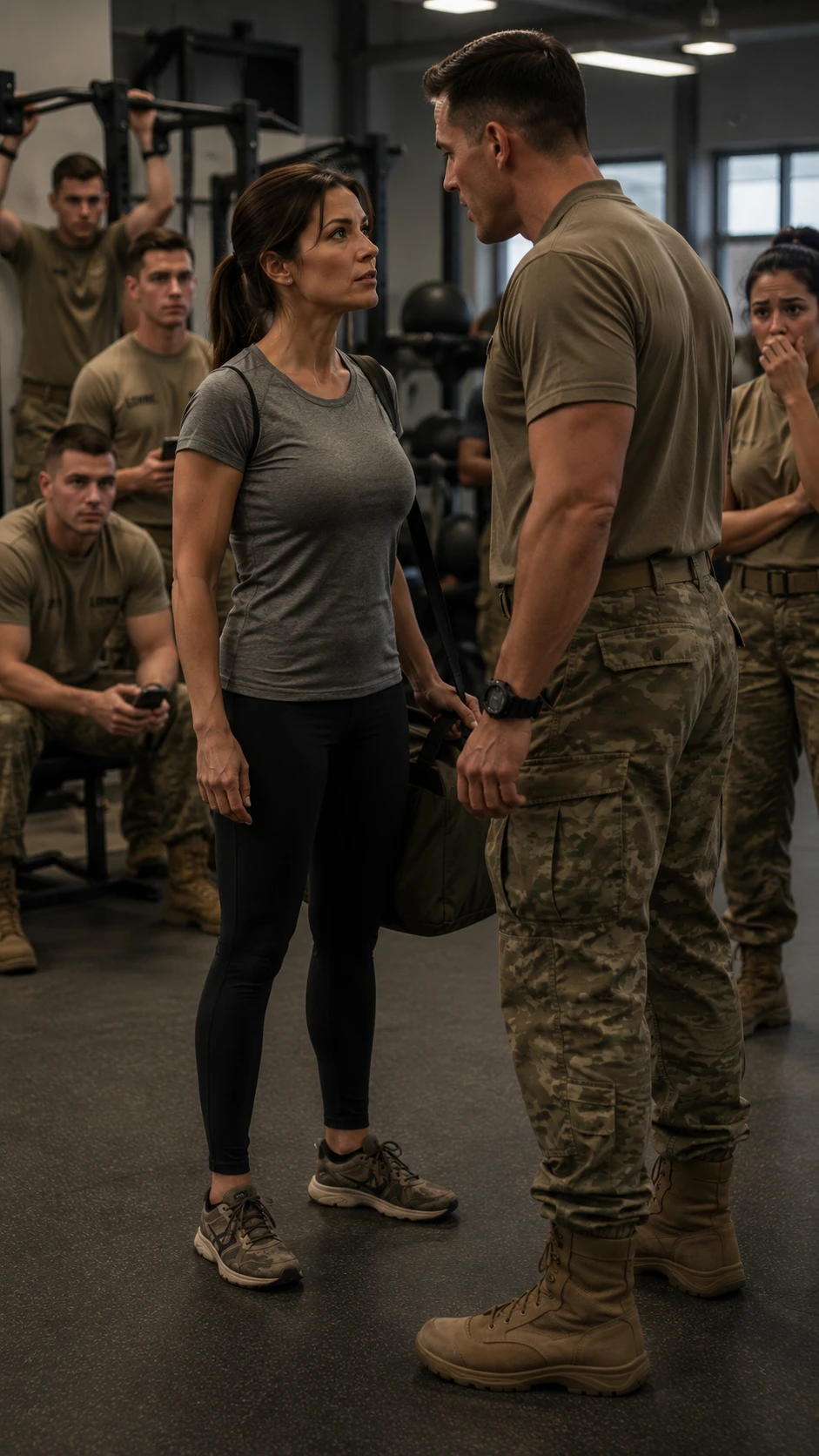
“Touch that binder again, Sergeant, and this room will learn who really owns it.”
“By who?”
“Ma’am, this is a military training facility, not a neighborhood workout class.”
The laughter arrived before the sentence had even ended.
Victoria Reed stood just inside the entrance of Fort Ashford’s readiness center.
She wore a gray training shirt, black leggings, and worn running shoes.
No rank.
No insignia.
No unit patch.
Only a small duffel bag rested on one shoulder.
Her calm expression somehow made the entire room feel smaller.
A young private near the pull-up bars smirked.
“Looks like somebody got lost.”
Several soldiers laughed louder than necessary.
Victoria remained still.
She slowly scanned the room once.
There was no trace of embarrassment.
It looked more like she was counting faces.
Staff Sergeant Ethan Cross stepped away from the equipment rack.
His jaw tightened.
Authority radiated from every movement.
“You hear me?” he asked.
“Walk into the wrong building?”
Victoria turned her gaze toward him.
Not frightened.
Not offended.
Simply assessing.
That irritated him more than any argument ever could.
“This area is restricted,” Cross said as he moved closer.
“Active personnel only.”
“I know,” Victoria replied.
The room grew slightly quieter.
Her voice was steady.
Low.
Almost indifferent.
Cross tilted his head.
“You know?”
“Yes.”
A soldier near the bench press chuckled quietly.
“Then why are you dressed like you’re heading to yoga?”
More laughter echoed across the room.
Victoria looked toward the speaker.
The soldier’s grin faded slightly.
She didn’t glare.
She didn’t challenge him.
She simply studied him long enough to show she noticed everything.
His posture.
His tone.
His confidence.
Even the glance he shot toward Cross for approval.
Then she looked away.
That unsettled him too.
Cross stopped three feet in front of her.
Broad-shouldered and clean-shaven, he carried himself like every room belonged to him.
The younger soldiers watched closely.
They waited for his next move.
He knew it.
He enjoyed it.
“Name,” he demanded.
Victoria didn’t answer immediately.
Behind Cross, a soldier whispered,
“She really thinks she belongs here.”
Another muttered,
“Recruiting must’ve sent her to the wrong side.”
The laughter returned.
Sharper this time.
Crueler.
Victoria finally spoke.
“Reed.”
Cross frowned.
“First name?”
“Victoria.”
“No rank?”
“Not today.”
Several soldiers reacted with disbelief.
Cross’s expression hardened.
“Not today,” he repeated.
“Is that supposed to be funny?”
“No.”
“Then explain yourself.”
Victoria glanced beyond him.
She noticed the formation lines marked across the floor.
The soldiers leaning against equipment instead of standing properly.
The open water bottles.
The loose straps.
The phones lying face-up on benches.
The casual smirks.
The effortless disrespect.
Then she met his eyes again.
“No need,” she said.
The room fell silent.
Cross let out a short, humorless laugh.
“You walk in dressed like that, refuse to identify yourself, and tell me there’s no need?”
Victoria said nothing.
The silence crawled beneath his skin.
He stepped closer.
“You’re about ten seconds away from being escorted out.”
She blinked once.
“By who?”
Cross stared at her.
For one second, nobody breathed.
The question had been quiet, almost casual, but it struck the floor harder than a shout.
“By who?” she had asked.
Not because she was daring him.
Not because she was reckless.
Because she already knew the answer.
Cross’s mouth tightened.
A few soldiers glanced between them, waiting for him to crush the moment with one sharp command.
He had done it before.
Everyone in that room knew how fast he could make a person regret speaking out of turn.
But Victoria did not look like someone who had misspoken.
She looked like someone who had placed a piece on a board.
Cross leaned in slightly.
“Private Lorne,” he said without looking away from her.
A young soldier near the wall snapped straighter.
“Yes, Sergeant?”
“Call the duty officer.”
Private Lorne reached for his phone.
Victoria’s eyes moved to him.
Not fast.
Not threatening.
Just enough.
Lorne froze with the phone halfway out of his pocket.
Something in her look stopped him.
It was not rank.
It was not fear.
It was recognition.
For the first time, uncertainty entered the room.
Cross noticed.
His eyes narrowed.
“Private,” he said.
Lorne swallowed.
“Yes, Sergeant.”
But he still did not dial.
Victoria turned back to Cross.
“You don’t need the duty officer.”
Cross let out a dry laugh.
“You don’t get to decide what I need.”
“No,” Victoria said. “But you already did.”
That landed strangely.
Cross blinked once.
“What is that supposed to mean?”
Victoria shifted the duffel bag off her shoulder and set it gently on the floor.
The sound was small.
Still, everyone heard it.
Inside the bag, something metallic clicked.
Several soldiers looked down.
Cross did too.
Victoria noticed.
“Relax,” she said. “It’s not a weapon.”
Cross’s face hardened again, because her calmness kept taking the room from him.
“You think this is funny?”
“No.”
“Then why are you smiling?”
Victoria touched the corner of her mouth, as though she hadn’t realized.
“I’m not smiling.”
But she almost was.
Not with amusement.
With sadness.
That confused him more than defiance would have.
He stepped back half a pace, enough to look her over again.
Gray shirt.
Black leggings.
Worn running shoes.
Small duffel.
No rank.
No patches.
No unit badge.
Nothing that made sense.
And yet she stood there as if every inch of that floor had once answered to her.
Cross looked toward the soldiers.
They were watching too closely now.
He could feel the shift.
His authority depended on certainty.
And certainty was leaking out of the room.
“Everyone back to stations,” he barked.
Nobody moved immediately.
His voice sharpened.
“Now.”
The soldiers scattered into motion.
But the movement was wrong.
Too slow.
Too curious.
They grabbed straps, water bottles, towels, phones.
A few pretended to adjust weights they had not touched for ten minutes.
Their eyes kept returning to Victoria.
Cross hated that.
He turned back to her.
“You have thirty seconds.”
Victoria looked at the taped formation lines again.
“Thirty seconds for what?”
“To explain why you walked into my training floor acting like you own it.”
A flicker crossed her face.
It was small, but Cross caught it.
Pain.
Not offense.
Not anger.
Pain.
Then it disappeared.
“This isn’t your floor,” she said.
Cross’s jaw flexed.
“The readiness center falls under my supervision during this block.”
“That wasn’t what I said.”
A soldier near the rowing machines muttered, “Oh, this is bad.”
Cross turned his head.
The soldier immediately looked down.
Victoria watched that too.
Every movement.
Every flinch.
Every silence.
Cross returned his glare to her.
“You have no authority here.”
Victoria’s eyes lifted.
“That’s what I came to find out.”
The words seemed to pull heat from the room.
Cross did not answer right away.
Because for the first time, her presence fit into a shape he did not like.
An inspection.
A test.
A trap.
His mind moved quickly.
Too quickly.
No rank.
No insignia.
No announcement.
No escort.
No clipboard.
No official vehicle outside, unless he had missed it.
But her eyes.
That was the problem.
She was not looking around like a visitor.
She was looking around like someone comparing reality to a memory.
Cross’s voice lowered.
“Who sent you?”
Victoria did not answer.
Instead, she crouched beside the duffel bag and unzipped it.
Cross’s hand moved instinctively toward his radio.
She paused.
“Don’t.”
The word was quiet.
It still stopped him.
That irritated him even more.
But he also noticed something else.
Private Lorne had gone pale.
Not frightened of Victoria.
Frightened of what she might reveal.
Victoria reached into the bag and pulled out a folded towel.
Then a pair of old fingerless training gloves.
Then a black binder, worn at the edges.
The binder looked cheap.
Plain.
Unimportant.
But Cross felt his stomach tighten.
Victoria stood with it in one hand.
“Do you know what this is?”
Cross gave a short laugh.
“A binder.”
“Yes.”
She opened it.
The first page had no title.
Only a printed grid.
Names.
Dates.
Times.
Scores.
Corrective notes.
Cross’s eyes flickered before he could stop them.
Victoria saw it.
So did Private Lorne.
So did the soldier near the bench press.
Victoria turned a page.
Then another.
“You’ve kept your numbers high,” she said.
Cross went still.
“Excuse me?”
“Your unit readiness numbers. Impressive on paper.”
The soldiers grew quieter.
Weights stopped clanking.
The treadmills hummed on without feet.
Victoria continued, “Fast progression. Consistent pass rates. Strong improvement across underperforming personnel.”
Cross’s face became unreadable.
“That information isn’t public.”
“No.”
“Then how did you get it?”
Victoria looked at him.
“You sent it.”
A murmur moved through the room.
Cross’s eyes sharpened.
“I did not send you anything.”
“No,” she said. “Not to me.”
She turned the binder around.
On one page, several names had been highlighted.
Next to them were notes written in different ink.
Injury risk.
Unreported fatigue.
Repeated intimidation.
Possible coercion.
Cross stared at the page.
A flush rose along his neck.
“That is internal documentation.”
“It is.”
“Who gave you that?”
Victoria looked past him.
Private Lorne lowered his eyes.
Cross saw it.
The room saw it.
And Private Lorne knew everyone had seen it.
Cross turned slowly.
“Lorne.”
The private looked like he might fold into himself.
“Sergeant, I—”
“Did you steal records?”
“No, Sergeant.”
“Did you give her those records?”
Lorne’s throat moved.
He did not answer.
Cross’s voice became dangerous.
“Private.”
Victoria closed the binder.
“Don’t punish him for doing what your chain of command refused to do.”
Cross snapped back toward her.
“You have no idea what you’re talking about.”
“I know exactly what I’m talking about.”
“No, you don’t.”
For the first time, his voice cracked.
Not loudly.
Not much.
But enough.
Victoria noticed.
Her expression changed.
Not softer.
More focused.
Cross stepped closer again, but now the room felt different around him.
Before, his size had filled the space.
Now it only seemed to mark how much distance he was trying to close.
“You walk in here with stolen records,” he said, “and expect me to stand here quietly?”
“I expect you to tell the truth.”
“The truth?”
His laugh came out harsher than before.
“The truth is, people here got stronger because I pushed them.”
“No,” Victoria said. “Some got stronger despite you.”
The sentence struck harder than any insult.
Several soldiers looked down.
A few looked away.
One young woman near the medicine balls pressed her lips together.
Cross saw too much in their faces.
Recognition.
Shame.
Relief.
That frightened him more than anger would have.
“You all have something to say?” he demanded.
Nobody spoke.
But silence had changed sides.
Victoria let it breathe.
Then she asked, “Where is Corporal Daniel Wexler?”
Cross’s face shut down.
The name moved through the room like a cold draft.
Private Lorne’s eyes closed.
Someone near the back whispered, “Don’t.”
Victoria heard it.
She turned slightly.
“Why not?”
No one answered.
Cross’s voice dropped.
“Wexler isn’t assigned to this block.”
“That wasn’t my question.”
“He’s on medical leave.”
“Why?”
Cross looked away for half a second.
Only half.
But Victoria caught it.
“He failed to disclose a prior condition.”
Lorne looked up sharply.
Victoria stayed still.
“A prior condition,” she repeated.
“Yes.”
“Documented?”
Cross’s stare hardened.
“You want medical records now?”
“I want the truth.”
“I told you the truth.”
“No,” Victoria said. “You told me the version that protects you.”
Cross moved so fast several soldiers flinched.
He grabbed the binder from her hand.
Or tried to.
Victoria moved before his fingers closed.
It was almost effortless.
One step back.
One turn of the wrist.
The binder remained in her hand.
Cross stopped.
His face went rigid.
The room went silent again.
Not because she had avoided him.
Because of how she had avoided him.
Clean.
Precise.
Trained.
A movement that belonged on a floor like this.
But not from someone dressed for yoga.
A few soldiers straightened unconsciously.
Victoria held his gaze.
“Don’t reach for things you’re not ready to carry.”
Cross’s breathing changed.
Private Lorne whispered, “Sergeant…”
Cross did not look at him.
He was staring at Victoria as if something old had just stepped out of a locked room.
“Who are you?” he asked.
Victoria did not answer at once.
Then she said, “Someone who should have come sooner.”
That was not the answer Cross expected.
It was not the answer anyone expected.
For the first time, guilt moved openly across her face.
It was brief.
But it was real.
Cross saw it.
And something in his own expression shifted.
Not sympathy.
Recognition.
The first crack in the wall.
Victoria walked past him.
Nobody stopped her.
She moved toward the center of the mat, where the taped lines crossed beneath the overhead lights.
The soldiers opened space without being ordered.
She stood at the center and turned slowly.
“Who here has been told an injury makes them weak?”
No one answered.
Cross barked, “Do not respond.”
Victoria looked at him.
“They already responded.”
He followed her gaze.
A hand had lifted.
Small.
Barely above waist level.
It belonged to the young woman near the medicine balls.
She looked terrified.
But she did not lower it.
Victoria nodded once.
“What’s your name?”
The soldier swallowed.
“Specialist Maya Ellison, ma’am.”
Cross’s eyes flashed.
“Ellison.”
Maya flinched.
Victoria’s voice cut through.
“Look at me, Specialist.”
Maya did.
Victoria held her gaze, steady and calm.
“Were you told that?”
Maya hesitated.
The room leaned toward her.
Cross said, “Specialist, choose carefully.”
Victoria did not look away from Maya.
“No,” Victoria said softly. “Choose honestly.”
Maya’s eyes filled.
“Yes, ma’am.”
The answer was barely audible.
But it changed everything.
Another hand rose.
Then another.
Then, slowly, five more.
Private Lorne raised his last.
Cross stared at them.
His face had drained of color.
Victoria did not look victorious.
She looked burdened.
As if each raised hand weighed something.
As if she had expected it and still hated seeing it.
She turned back to Cross.
“Daniel Wexler wrote three complaints.”
Cross’s voice was low.
“He was unstable.”
“He wrote them clearly.”
“He exaggerated.”
“He attached photos.”
Cross said nothing.
“He attached timestamps.”
Cross’s jaw worked.
“He attached the training schedule showing he had been assigned punishment drills after requesting medical evaluation.”
“That’s not what happened.”
“Then explain what happened.”
Cross looked around the room.
The soldiers watched him with fear, hope, resentment, and something worse.
Disappointment.
For a man like Cross, anger was survivable.
Disappointment was harder.
He looked back at Victoria.
“You don’t know this place.”
Victoria’s expression tightened.
“I know it better than you think.”
“No,” Cross said, suddenly bitter. “You know what people write after they fail.”
A ripple of surprise moved through the room.
Victoria’s eyes narrowed.
Cross continued, and now his voice carried something raw beneath the authority.
“You read reports. Complaints. Notes. You see bruises and assume cruelty. You see fear and assume abuse.”
Victoria listened.
He stepped closer again, but not aggressively now.
Almost desperately.
“You know what I see? I see kids who will freeze when it matters. I see soldiers who think discomfort is damage.”
Maya looked down.
Lorne stared at the floor.
Cross pointed toward the far wall.
“Two years ago, this unit lost people because training lied to them.”
The room went still.
Victoria did not interrupt.
Cross’s voice roughened.
“They passed on paper. Everyone looked good on paper. Clean numbers. Smiling inspections. Nobody pushed too hard.”
His eyes flicked toward the binder.
“Then the first real pressure came, and they broke.”
A silence followed.
Not forgiving.
But listening.
Cross swallowed hard.
“I brought discipline back.”
Victoria said quietly, “You brought fear.”
His face twisted.
“Fear keeps people alive.”
“No,” she said. “Training keeps people alive. Fear just makes them hide injuries until they become disasters.”
Cross flinched.
Just slightly.
But this time, it was not anger.
It was memory.
Victoria saw it.
“So you do know about Wexler.”
Cross looked away.
The room held its breath.
Private Lorne whispered, “Sergeant, please.”
Cross’s eyes closed briefly.
Then he opened them and looked at Victoria with exhaustion cutting through the hardness.
“You think I wanted that?”
Maya’s hand dropped to her side.
Victoria did not move.
“Tell them,” she said.
Cross’s face hardened again.
“No.”
“Tell them.”
“No.”
“Then I will.”
His head snapped up.
Victoria opened the binder again and pulled out a sealed envelope from the back pocket.
Cross saw it.
Everything changed in his face.
Shock.
Fear.
Grief.
Not guilt.
Grief.
That was the first true twist in the room.
Victoria saw the soldiers notice it.
Cross was not afraid of being exposed.
He was afraid of hearing what was inside.
She held up the envelope.
“This was addressed to me.”
Cross whispered, “Don’t.”
The word was so soft most people almost missed it.
Victoria did not.
Her expression changed again.
For the first time, she looked uncertain.
“You know what this is.”
Cross said nothing.
Private Lorne looked between them.
“Sergeant?”
Cross’s throat moved.
“Don’t read that here.”
Victoria’s fingers tightened around the envelope.
“Why?”
Cross’s eyes shone with something he refused to release.
“Because it wasn’t meant for them.”
Victoria looked down at the envelope.
Then back at him.
“It was meant for accountability.”
“No,” Cross said. “It was meant for you.”
The room seemed to tilt.
Victoria’s face went still.
“What did you say?”
Cross breathed in slowly.
Then he looked at the soldiers, one by one.
For once, they were not waiting for his command.
They were waiting for his truth.
He looked back at Victoria.
“Daniel Wexler was your nephew.”
The words landed like glass breaking.
Maya covered her mouth.
Lorne stared at Victoria.
Several soldiers shifted, shocked and suddenly ashamed of every laugh they had thrown at her.
Victoria did not move.
Her eyes stayed on Cross.
“Yes,” she said.
Her voice barely held.
“He was.”
Cross nodded once, as though confirming something painful.
“You didn’t come because of paperwork.”
“No.”
“You came because of him.”
Victoria’s face tightened.
“I came because the last voicemail he left me said he was scared of training.”
No one moved.
The overhead lights hummed.
Somewhere outside, a truck rolled past the building.
Inside, every soldier seemed trapped inside that sentence.
Cross lowered his head.
Victoria continued, her voice steady only because she forced it to be.
“Daniel did not scare easily. He didn’t complain. He didn’t ask for rescue.”
She looked around the room.
“He believed in earning things. He believed in this place.”
Her eyes returned to Cross.
“And he believed you hated him.”
Cross closed his eyes.
The words struck deeper than accusation.
When he opened them, the hardness was still there.
But it was cracked beyond repair.
“He was wrong,” Cross said.
Victoria stared at him.
“Then why did he think that?”
Cross breathed through his nose, fighting himself.
Lorne stepped forward.
“Because Sergeant Cross was covering for me.”
Cross turned sharply.
“Lorne.”
But Lorne did not stop.
His voice shook, but he kept going.
“That day. The day Corporal Wexler collapsed. It wasn’t supposed to be him on that rotation.”
Victoria slowly turned toward him.
Lorne’s face had gone pale.
“It was supposed to be me.”
Cross’s voice was low.
“Private, stand down.”
“No, Sergeant.”
The room froze again.
Lorne looked terrified of those words.
But once spoken, they seemed to give him strength.
“No,” he repeated.
Victoria watched him carefully.
Lorne swallowed.
“I falsified my recovery log.”
Maya whispered, “What?”
Lorne’s eyes filled, but he kept speaking.
“I was hurt. My knee was bad. I didn’t want to get recycled. I changed the entry.”
Cross stared at him with fury and helplessness.
“Lorne.”
“He found out,” Lorne said, nodding toward Cross. “Sergeant Cross found out.”
Victoria’s eyes moved back to Cross.
Lorne continued.
“He should’ve reported me. He should’ve ended my course.”
Cross’s jaw tightened.
“But he didn’t?” Victoria asked.
Lorne shook his head.
“He pulled me from the rotation quietly.”
Cross said, “Enough.”
Lorne’s voice broke.
“And Corporal Wexler volunteered to fill the slot.”
The room went silent in a different way.
Not fearful.
Sickened.
Victoria stared at Lorne.
“He volunteered?”
Lorne nodded, crying now without wiping his face.
“He said I had a kid coming. He said getting dropped would ruin my chance to stabilize my family.”
Cross looked away.
Lorne forced the words out.
“He said he could handle one more block.”
Victoria’s face changed.
Her nephew’s final days rearranged themselves behind her eyes.
Not completely.
Not cleanly.
But enough to hurt in a new direction.
Cross’s voice was rough.
“I told him no.”
Victoria looked at him.
Cross looked back, and this time he did not hide.
“I told him he was already overworked. He said he was fine.”
“You believed him?”
“No.”
“Then why was he out there?”
Cross flinched.
Lorne answered before he could.
“Because I begged.”
Cross turned.
Lorne shook his head.
“I begged him not to document my injury. I begged Daniel too.”
His breath hitched.
“I told them I couldn’t lose the assignment. I told them my wife was due. I told them I had no backup.”
Maya looked at Lorne with shock and pain.
Lorne stared at Victoria.
“Daniel said he’d help me for one day.”
Victoria’s eyes closed.
For a moment, the entire room seemed to vanish behind her grief.
When she opened them again, they were wet.
But her voice stayed controlled.
“And after he collapsed?”
Lorne lowered his head.
“I panicked.”
Cross spoke now.
“He panicked. I made the call.”
Victoria looked at him.
“What call?”
Cross swallowed.
“I changed the report.”
The confession fell heavily.
Maya whispered, “Sergeant…”
Cross did not look away from Victoria.
“I wrote that Daniel failed to disclose fatigue symptoms.”
Victoria stared at him.
“Why?”
Cross’s face twisted with shame.
“To protect Lorne.”
Lorne shook his head, crying harder.
“No, to protect me.”
Cross snapped, “To protect your family.”
“And you ruined Daniel’s name.”
The words came from Maya.
Not loud.
But devastating.
Cross turned toward her.
Maya was shaking.
“You let everyone think he was weak.”
Cross’s expression cracked.
“I know.”
The admission was so quiet that it hurt.
Victoria stepped closer.
“You let me bury him believing he died ashamed.”
Cross looked back at her.
His eyes finally broke.
“I know.”
No one spoke.
That was the second twist.
Cross had been cruel.
He had abused authority.
He had built fear into training.
But beneath that cruelty was not simple arrogance.
It was a buried lie.
A lie he had told himself was sacrifice.
A lie that had become a system.
Victoria understood it all at once.
The impossible readiness numbers.
The intimidation.
The refusal to let injuries speak.
The soldiers checking his face for approval.
Lorne’s fear.
Cross’s grief.
Daniel’s silence.
Cross had not only hidden the truth.
He had trained the whole unit to hide pain, because one hidden pain had destroyed everything.
Victoria’s hand tightened around the envelope.
“Who wrote this?” she asked.
Cross looked at it.
“Daniel.”
Her breath caught.
Lorne covered his face.
Cross continued.
“He gave it to me that morning.”
Victoria stared at him.
“That morning?”
Cross nodded.
“He said if anything happened, I should send it.”
Her voice became almost inaudible.
“And you didn’t.”
Cross shook his head.
“No.”
“Why?”
“Because I was a coward.”
The room absorbed it.
Cross looked at the floor.
“For months, I told myself I was waiting for the right process. Waiting for the inquiry. Waiting until Lorne’s family stabilized.”
He looked at Lorne.
“Then the longer I waited, the worse the truth became.”
He looked back at Victoria.
“And eventually, I wasn’t protecting anyone. I was protecting the version of myself that had survived it.”
Victoria’s eyes shone.
“You let me hate a dead boy for being silent.”
Cross flinched as if struck.
“He wasn’t silent.”
Victoria looked at the envelope.
Her hands trembled.
She hated that they trembled.
She had walked into that room prepared for arrogance, denial, maybe even a fight.
She had not prepared herself for Daniel’s handwriting.
Cross spoke carefully.
“He asked me to give it to you if he ever stopped making sense.”
Victoria looked up.
“What does that mean?”
Cross’s mouth tightened.
“He said you’d understand.”
Her face twisted.
Because she did.
Daniel had always joked like that when he was scared.
When his father died.
When he left home.
When he made light of things too heavy to hold.
If I ever stop making sense, Aunt Vic, read the instructions.
That memory almost dropped her to her knees.
But she stayed standing.
She opened the envelope.
Cross looked away.
Lorne bowed his head.
Maya wiped her eyes.
The paper inside was folded twice.
Victoria unfolded it slowly.
Her nephew’s handwriting stared back at her.
Uneven.
Hurried.
Alive.
She read silently at first.
Then her breath broke.
The soldiers stood motionless.
Cross’s face tightened with every second of silence.
Finally, Victoria spoke.
Her voice was fragile now.
Not weak.
Fragile.
“He knew.”
Cross did not move.
Victoria looked at him.
“He knew you were covering for Lorne.”
Cross’s eyes lifted.
She continued, reading from the letter, not word for word, but enough.
“He says you were wrong. He says you were stubborn. He says you needed to stop trying to save people by lying for them.”
Cross closed his eyes.
Victoria’s voice cracked.
“He says he volunteered because Lorne was scared, not because you forced him.”
Lorne began to sob.
Victoria kept going.
“He says if anything happened, I should not let grief make me cruel.”
The words changed the air.
Even Cross looked wounded by them.
Victoria swallowed.
“He says this place needs truth more than punishment.”
No one spoke.
The letter trembled in her hands.
Then she reached the final lines.
Her face collapsed for half a second before she caught it.
She looked at Cross.
“He asked me to come here.”
Cross looked up sharply.
The soldiers stared.
Victoria looked back down.
“He wrote, ‘If I don’t get to say it later, Aunt Vic, go see the floor yourself. Don’t wear rank. Don’t let them perform. People tell the truth when they think power isn’t watching.’”
The room went utterly still.
Every laugh from the beginning returned in silence.
The gray shirt.
The leggings.
The worn running shoes.
No rank.
No patches.
No unit badge.
Not carelessness.
Not disrespect.
A dead soldier’s final instruction.
Victoria folded the letter with reverence.
Her voice was quiet.
“That’s why I came dressed like this.”
The shame that moved through the room was almost physical.
The soldier who had joked about yoga lowered his head.
The one who mentioned recruiting sat down slowly, as if his legs had weakened.
Maya wiped her face.
Private Lorne whispered, “I’m sorry.”
Victoria looked at him.
He seemed to shrink under it.
“I am so sorry,” he said again. “I thought if I told the truth, my life was over.”
Victoria’s expression tightened with pain.
“And Daniel’s life was over.”
Lorne broke.
He dropped to one knee, not theatrically, but because he could no longer stand.
“I know.”
Cross moved toward him, then stopped.
He seemed to realize he no longer had the right to decide who deserved comfort.
Victoria looked from Lorne to Cross.
Anger still burned in her.
It had not vanished.
Truth did not erase consequences.
But the shape of that anger had changed.
It was no longer a blade searching for one throat.
It was a fire searching for air.
“What happened to the official inquiry?” she asked.
Cross looked exhausted.
“Closed.”
“On whose recommendation?”
Cross did not answer.
Victoria’s eyes narrowed.
“Sergeant.”
His face tightened.
“Captain Rusk.”
The name caused another shift.
Maya looked up fast.
Lorne’s expression changed.
Several soldiers exchanged glances.
Victoria noticed all of it.
“Captain Rusk closed it?”
Cross nodded.
“He said reopening the report would damage confidence in the program.”
Victoria’s voice went cold.
“And you accepted that?”
Cross’s eyes hardened with self-disgust.
“I obeyed it.”
“That is not the same thing.”
“No,” Cross said. “It isn’t.”
The office door at the far end of the center opened.
A man in a crisp uniform stepped out, drawn by the silence.
Captain Adrian Rusk had silver at his temples and a face trained for command photos.
His gaze moved across the room.
Victoria.
Cross.
Lorne on one knee.
The binder.
The letter.
His expression barely changed.
But his eyes did.
That was enough.
“Sergeant Cross,” Rusk said.
His voice was smooth.
Controlled.
“What is happening here?”
Cross stood straighter out of instinct.
Then he caught himself.
For the first time, he did not answer immediately.
Rusk noticed.
So did Victoria.
Rusk walked toward them.
“Who is this civilian?”
Victoria turned to face him.
“No one important,” she said.
Rusk gave her a thin smile.
“Then you won’t mind leaving.”
“No,” Victoria said.
His smile faded slightly.
“This is a restricted training area.”
“I know.”
Cross’s eyes flickered.
The echo was not lost on him.
Rusk looked at the binder.
“Is that government property?”
Victoria held it at her side.
“It contains copied records related to Corporal Daniel Wexler.”
Rusk’s face cooled.
“That matter is closed.”
Victoria studied him.
“Was it?”
“Yes.”
“By you?”
Rusk did not answer immediately.
The room watched.
Rusk smiled again, but now it looked thinner.
“Ma’am, grief can make people search for patterns where none exist.”
Victoria’s face went still.
Cross looked at Rusk sharply.
Maya’s jaw tightened.
Rusk continued, smooth and careful.
“Corporal Wexler’s loss was tragic. But tragedy does not always imply misconduct.”
Victoria nodded slowly.
“You sound practiced.”
His eyes hardened.
“Excuse me?”
“You’ve said that before.”
Rusk’s smile disappeared.
“I suggest you leave before this becomes a legal issue.”
Victoria tilted her head slightly.
“It already is.”
Rusk looked at Cross.
“Sergeant, remove her.”
Cross did not move.
The silence was enormous.
Rusk’s voice sharpened.
“That was an order.”
Cross stared at him.
For years, obedience had been his shelter.
It had protected him from responsibility, from shame, from the terrible freedom of choosing differently.
Now every soldier on that floor watched him stand at the edge of himself.
Victoria did not look at him.
She did not ask for help.
That made the choice worse.
Cross swallowed.
“No, sir.”
The words landed like thunder.
That was the first time the soldiers heard him disobey fear.
Rusk’s face went pale with anger.
“What did you say?”
Cross lifted his eyes.
“I said no, sir.”
Rusk stepped closer.
“You are refusing a direct order?”
“I am refusing to remove a witness.”
Victoria looked at him then.
Her expression did not soften completely.
But something in it shifted.
Rusk laughed once.
“A witness to what?”
Cross looked around the room.
His voice was rough, but steady.
“To what I helped hide.”
The soldiers stared.
Rusk’s jaw tightened.
“You should think very carefully.”
“I have,” Cross said.
“No,” Rusk replied quietly. “You haven’t.”
He turned to the room.
“All of you, return to training. Now.”
Nobody moved.
Rusk’s eyes swept over them.
“This is not a discussion.”
Maya stepped forward.
Her hands were shaking.
But she stepped forward.
“I was told to train through injury, sir.”
Rusk looked at her like she had disappointed him by existing.
“Specialist, this is not the time.”
“It never is,” she said.
The words surprised even her.
But once they were out, she stood taller.
Lorne rose slowly beside her.
“I falsified my recovery log, sir.”
Rusk’s face hardened.
“Private, I strongly advise silence.”
Lorne shook his head.
“I’ve been silent long enough.”
Another soldier stepped forward.
Then another.
Not all at once.
Not dramatically.
But steadily.
Like a room remembering its spine.
Victoria watched them with quiet pain.
This was what Daniel had wanted.
Not revenge.
Not humiliation.
Truth.
Rusk looked at Cross.
“You did this.”
Cross shook his head.
“No, sir. I delayed it.”
That answer struck Victoria deeply.
Because it was honest.
Not clean.
Not heroic.
But honest.
Rusk’s mask slipped.
Only for a moment.
His voice dropped.
“You think this ends well for anyone?”
Victoria answered.
“No.”
Rusk looked at her.
She held his gaze.
“It ends better than the lie.”
The captain stared at her.
Then he noticed something near the entrance.
Two people had entered without announcement.
One was an older woman in civilian clothes with a legal folder tucked beneath her arm.
The other wore the uniform of a full colonel.
Rusk’s face changed completely.
Colonel Miriam Vale walked forward slowly.
Her expression was calm in the way storms are calm before they break.
Rusk snapped to attention.
“Colonel.”
Vale did not return the greeting immediately.
Her eyes moved to Victoria.
Then to Cross.
Then to Lorne.
Finally, to the soldiers.
“I was told readiness training ran loudly in this room,” she said. “Interesting that truth is quieter.”
Rusk’s throat moved.
“Ma’am, there has been unauthorized entry—”
Vale lifted one hand.
He stopped.
The civilian woman beside her opened the legal folder.
Victoria stared at them.
She had not expected this.
Cross had not either.
Colonel Vale looked at Victoria.
“Ms. Reed, I apologize for arriving after the first contact phase. We needed to observe without influencing behavior.”
Rusk went rigid.
Victoria blinked.
“Observe?”
Vale nodded.
“Your nephew’s letter reached more than one destination.”
Victoria’s breath caught.
“What?”
The civilian woman stepped forward.
“My name is Elena Marrow. I represent Daniel Wexler’s estate.”
Victoria stared.
“I never hired an attorney.”
“No,” Marrow said gently. “Daniel did.”
The room seemed to disappear again.
Victoria looked down at the letter in her hand.
Marrow continued, “He prepared a conditional disclosure packet before his final training week.”
Cross stared at her.
“He what?”
Marrow looked at him.
“He knew something was wrong in the program. He did not know how far it went.”
Rusk’s face had lost all color.
Colonel Vale’s voice remained steady.
“Corporal Wexler sent copies to legal counsel, to his aunt, and to my predecessor’s office.”
Victoria whispered, “I never received mine.”
Marrow’s expression darkened.
“No. It was intercepted.”
Every eye turned to Rusk.
Rusk lifted his chin.
“That is a serious accusation.”
Vale looked at him.
“It is a documented one.”
Rusk said nothing.
Marrow opened the folder and removed a page.
“Mailroom logs. Security footage. Administrative routing slips.”
Her voice sharpened.
“Captain Rusk, you signed for the packet addressed to Ms. Reed.”
Victoria’s face went white.
Cross turned toward Rusk with open disbelief.
Rusk’s voice was controlled, but thinner.
“For chain-of-command review.”
Marrow’s eyes hardened.
“It was personal correspondence.”
Rusk looked at Vale.
“Ma’am, I was protecting the unit from unverified allegations during an active readiness cycle.”
Vale’s expression did not move.
“You were protecting metrics.”
That sentence cut through every excuse in the room.
Rusk’s eyes flashed.
“With respect, Colonel, readiness metrics keep funding stable, programs alive, and soldiers trained.”
“Soldiers,” Vale said quietly, “are not numbers arranged to protect careers.”
Rusk had no answer.
Victoria looked at Cross.
Cross looked devastated.
Because this final reveal had reframed him too.
He had been guilty.
But he had also been used.
His shame had made him useful to Rusk.
His silence had become someone else’s ladder.
Lorne looked like he might be sick.
Maya reached for his arm, then stopped, unsure if comfort was allowed yet.
Victoria saw the gesture.
Then she gave the smallest nod.
Maya placed her hand on Lorne’s sleeve.
He covered it with his own.
Colonel Vale stepped to the center of the floor.
“Captain Rusk, you are relieved of training oversight duties pending formal investigation.”
Rusk’s face hardened.
“Ma’am—”
“Effective immediately.”
The words were final.
Rusk looked around the room.
No one came to his defense.
That seemed to wound him more than the order.
Military command had taught him to expect obedience.
It had not prepared him for a room full of people choosing truth together.
He turned and walked out under the weight of every eye.
No one cheered.
No one smiled.
The door shut behind him.
The silence afterward felt less like victory and more like surgery.
Necessary.
Painful.
Incomplete.
Colonel Vale turned to Cross.
“Staff Sergeant Ethan Cross.”
Cross came to attention.
“Yes, ma’am.”
“You will submit a full written statement before end of day.”
“Yes, ma’am.”
“You will also be removed from direct training authority pending review.”
Cross closed his eyes briefly.
When he opened them, he looked relieved and destroyed.
“Yes, ma’am.”
Vale studied him.
“There will be consequences.”
“I understand.”
“No,” Vale said. “You probably don’t. But you will.”
Cross nodded.
Victoria watched him.
A part of her wanted him punished immediately.
Another part, the part Daniel’s letter had awakened, understood punishment alone would not repair what had happened.
Vale turned to the room.
“Every soldier with information related to coercive training practices, injury suppression, falsified reports, or retaliation will be interviewed.”
No one moved.
Her voice softened slightly.
“You will not be punished for telling the truth today.”
Maya began crying again.
Not loudly.
Just enough.
Vale looked at her.
“Specialist Ellison.”
Maya straightened through tears.
“Yes, ma’am.”
“You will report to medical after this.”
Maya nodded.
“Yes, ma’am.”
Vale looked at Lorne.
“Private Lorne.”
He stood straighter.
“Yes, ma’am.”
“You will also report. Your falsified log will be addressed.”
His face fell.
But Vale continued.
“So will the conditions that made you believe lying was your only option.”
Lorne’s eyes filled again.
“Yes, ma’am.”
Victoria folded Daniel’s letter and held it against her chest.
The room blurred.
For months, grief had been a locked room inside her.
She had thought coming here would open it with rage.
Instead, it had opened with voices.
Daniel’s.
Lorne’s.
Maya’s.
Even Cross’s, fractured and ashamed.
Colonel Vale approached her.
“I’m sorry,” she said.
Victoria looked at her.
The apology was simple.
No performance.
No official polish.
That almost broke her.
“He wanted truth,” Victoria whispered.
Vale nodded.
“Then we start there.”
Victoria looked around the readiness center.
The taped lines.
The equipment.
The phones now lying forgotten.
The open water bottles.
The soldiers no longer smirking.
Everything looked the same.
Nothing was the same.
Cross stood apart from the others.
For once, nobody clustered around him waiting for cues.
He looked smaller.
Not weak.
Human.
Victoria walked toward him.
The room watched, but she no longer cared.
Cross straightened as she approached.
He seemed prepared for anything.
Anger.
A slap.
A curse.
She gave him none of those.
Instead, she held out the letter.
His eyes widened.
“No.”
“Read the last line.”
Cross shook his head.
“I don’t deserve—”
“Read it.”
Her voice did not rise.
But it carried all the authority she had refused to wear.
Cross took the letter with trembling hands.
He looked down.
His eyes moved across Daniel’s handwriting.
Then he stopped.
His mouth tightened.
Victoria watched the moment hit him.
He read the final line aloud, barely.
“Don’t let Cross become the worst thing he did.”
The room went still.
Cross folded forward like something inside him had finally given way.
He did not sob loudly.
He just covered his mouth and turned away.
But everyone saw.
The man who had taught them to hide pain could no longer hide his own.
Victoria took the letter back gently.
“I don’t forgive you today,” she said.
Cross nodded, tears in his eyes.
“I know.”
“I may not forgive you tomorrow.”
“I know.”
“But he saw something in you worth saving.”
Cross looked at her, shattered.
Victoria’s voice trembled.
“So prove him right.”
Cross could not answer.
He only nodded.
Once.
Then again.
Like a vow he had no right to speak yet.
Three weeks later, the readiness center looked different.
Not dramatically.
Not perfectly.
No miracle had swept through Fort Ashford.
There were still investigations.
Statements.
Medical reviews.
Administrative hearings.
There were careers damaged and reputations cracked.
There were soldiers angry that the old system had fallen.
There were others angry it had survived so long.
Captain Rusk was gone from the training floor, though not yet gone from the Army.
Staff Sergeant Cross had been reassigned pending review.
Private Lorne faced disciplinary action for falsifying his log.
Specialist Ellison began physical therapy for an injury she had hidden for weeks.
Truth had not made the consequences disappear.
It had only made them honest.
But on a gray morning after rain, Victoria returned to the readiness center.
This time, she did not wear leggings.
She wore dark slacks, a plain jacket, and Daniel’s old training watch on her wrist.
Colonel Vale met her at the entrance.
“You sure you want to see it?”
Victoria looked through the glass doors.
Inside, soldiers were warming up.
Not lounging.
Not posturing.
Not pretending pain was discipline.
A medic stood near the far wall.
A whiteboard listed training objectives beside recovery protocols.
At the bottom, someone had written:
Report early. Train honestly. No hidden injuries.
Victoria swallowed.
“Yes.”
Vale opened the door.
The room quieted when Victoria entered.
This time, no one laughed.
No one smirked.
No one asked if she was lost.
Maya Ellison stood near the center mat with a brace under one sleeve.
She smiled nervously.
Private Lorne stood beside her, eyes red but steady.
And near the back wall, wearing plain training clothes instead of authority, stood Ethan Cross.
He was not leading the session.
He was observing.
Learning.
Listening.
When he saw Victoria, he straightened.
Not out of command.
Out of respect.
Victoria walked to the center of the mat.
Colonel Vale handed her a small framed photograph.
Daniel Wexler smiled from inside it, young and bright and impossibly alive.
Under the photograph was a simple plaque.
CORPORAL DANIEL WEXLER
TRAIN THE TRUTH
Victoria stared at it.
Her throat closed.
Maya stepped forward.
“We voted on the words,” she said softly.
Victoria looked at the soldiers.
Some nodded.
Some looked down.
All of them understood.
Victoria touched the frame.
For a moment, she saw Daniel as a boy again, running through her kitchen with untied shoes.
Then as a teenager, pretending not to be afraid before leaving home.
Then as a soldier, writing a letter he hoped would never need to be read.
She breathed in.
It hurt.
But for the first time, the pain had somewhere to go.
Cross stepped forward slowly.
He stopped several feet away.
“Ms. Reed.”
Victoria looked at him.
“I submitted everything,” he said. “All of it.”
She studied his face.
There were no excuses left there.
Only exhaustion.
And work.
“Good,” she said.
He nodded.
“I also requested to speak at the remedial leadership board.”
Victoria’s eyes narrowed slightly.
“To defend yourself?”
“No.”
He swallowed.
“To explain how easy it is to call fear discipline when people reward your results.”
Victoria looked at him for a long moment.
Then she nodded once.
Not forgiveness.
Not yet.
But acknowledgment.
That was enough for him to breathe.
Colonel Vale stepped back.
The soldiers formed a loose circle, not because they had been ordered, but because no one wanted to stand apart.
Victoria placed Daniel’s photograph on a small shelf near the whiteboard.
Her hand lingered on the frame.
The room stayed quiet.
Then Private Lorne stepped forward.
He was trembling.
“I wrote his parents,” he said.
Victoria turned.
Lorne’s voice broke, but he continued.
“I told them what I did. I told them what he did for me. I told them I was sorry.”
Victoria’s eyes filled.
“What did they say?”
Lorne wiped his face.
“They said Daniel always carried people who were too tired to admit they needed help.”
Victoria almost smiled.
Almost.
“That sounds like him.”
Lorne nodded.
“I’m naming my daughter Dani.”
The words hit softly.
Not as a grand gesture.
Not as repair.
Nothing could repair that much.
But as proof that Daniel’s kindness had not vanished into a report.
Victoria pressed her hand to her mouth.
Maya began crying again.
Cross looked down.
Colonel Vale turned away slightly, giving Victoria privacy she could not truly have.
Victoria stepped toward Lorne.
He looked terrified.
She reached out and placed one hand on his shoulder.
He broke instantly.
“I’m sorry,” he whispered.
“I know,” she said.
Her voice shook.
“Live better than this.”
He nodded through tears.
“I will.”
The morning light moved across the floor.
Soft.
Pale.
Ordinary.
Victoria looked back at Daniel’s photograph.
The boy in the frame seemed too young to have carried so much.
Too alive to belong to memory.
She took the old training gloves from her bag and placed them beneath the plaque.
Cross recognized them.
So did no one else.
Victoria saw his face.
“They were his?” he asked.
She nodded.
“He gave them to me after his first month here. Said they were lucky.”
Cross stared at them.
“He wore them during assessment week.”
“I know.”
Victoria touched the worn fabric.
“He said they helped him remember his hands were his own.”
No one spoke.
That sentence settled over the room like a final lesson.
Training could shape a soldier.
Command could guide one.
Fear could bend one.
But no system had the right to take ownership of a person’s pain.
Victoria stepped back.
Colonel Vale nodded to Maya.
Maya looked startled.
Then she faced the room.
“Warm-up begins in two minutes,” she said.
Her voice shook at first.
Then steadied.
“Report discomfort early. Pair checks after every circuit. No exceptions.”
A few soldiers answered, “Yes, Specialist.”
Victoria looked at Cross.
He had heard the order too.
Not as a threat.
As a correction.
As a future.
He met her eyes.
For once, he did not look away.
Outside, rainwater slid from the roof in slow drops.
Inside, soldiers began moving.
Carefully.
Honestly.
Together.
Victoria remained by the wall, beside Daniel’s photograph, until the first circuit began.
No one performed for her.
No one laughed.
No one hid.
And when the room filled with the sound of measured breathing, steady footsteps, and quiet check-ins, Victoria closed her eyes.
She imagined Daniel hearing it.
She imagined him laughing softly, embarrassed by the plaque, pretending it was too much.
Then she imagined him standing beside her, young and warm and whole.
For one impossible second, grief loosened its grip.
Not gone.
Never gone.
But no longer locked in darkness.
Victoria opened her eyes and touched the old training watch on her wrist.
The second hand moved forward.
Small.
Steady.
Alive.
And in the quiet rhythm of that room, Daniel’s truth kept time.