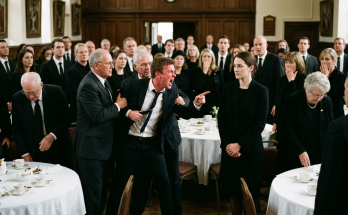
The blue savings book landed on my grandmother’s coffin with a soft, damp slap. For one strange second, that tiny sound seemed louder than the rain hammering the funeral canopy. My father stood at the edge of the open grave with one gloved hand still extended, as if he had just discarded a receipt instead of the last thing Eleanor Hayes had deliberately left to me. “There,” Richard said. “That’s about what it’s worth.”
Nobody moved.
Mud streaked the polished side of the coffin. The little book had fallen near the spray of white roses over Grandma’s chest, its faded cover darkening beneath the rain blowing sideways under the tent. I could make out the worn corners from where I stood. I had seen that book before, always tucked into the same kitchen drawer beneath rubber bands, expired coupons, and envelopes she insisted on saving.
My stepmother, Denise, gave a short laugh behind her black sunglasses. She had spent the entire service holding my father’s arm like they were attending a charity luncheon instead of burying the woman who had raised me. “Richard,” she murmured, though there was no warning in her voice. She sounded entertained.
My half-brother Tyler leaned close enough for his shoulder to brush mine. “Maybe Grandma left you twelve dollars and seventy-three cents,” he whispered. “If she did, lunch is on you.”
Two cousins heard him and snickered.
I kept looking at the passbook.
Thirty minutes earlier, in the funeral home’s small private room, Arthur Bennett had read Grandma’s will. He was an older attorney with silver hair, tired eyes, and the peculiar habit of pausing before sentences as though deciding whether the people listening deserved to hear them. My father had sat rigidly beside Denise while Arthur worked through the ordinary belongings first: dishes, photographs, a few pieces of furniture.
Then Arthur reached my name.
“To my granddaughter Claire Hayes,” he had said, “I leave my savings book and every legal right associated with it.”
That was all.
No house.
No jewelry.
No sentimental speech.
Just the savings book.
My father had actually laughed then. It began as a breath through his nose and grew into something openly contemptuous once Arthur confirmed that Richard himself had been left nothing. “She spent twenty years pretending she had some grand secret,” he had said. “And this is it?”
Arthur hadn’t answered.
I noticed that now.
He stood near the back of the funeral tent, rainwater collecting on the shoulders of his dark coat. Everyone else was watching me, waiting to see whether I would cry or argue. Arthur was watching my father.
That difference mattered, though I didn’t yet understand why.
The cemetery workers waited awkwardly beside the lowering mechanism. One of them looked toward the priest. The priest looked toward my father. Richard seemed pleased to have taken control of the moment.
He had always liked an audience.
When I was nine and spilled grape juice on his carpet, he made me stand in front of visiting relatives while he described every careless thing I had done that month. When I was twelve and cried after he told me my mother’s death had made me “clingy,” he announced that tears were another form of manipulation. By fourteen, I had learned that showing pain around my father only gave him something to work with.
Grandma had taught me something different.
Never confuse being quiet with surrender.
I could hear her saying it as clearly as if she were standing beside me.
Grandma had been the one who raised me after my mother, Madison, died in a car crash when I was five. Richard remained legally my father, but he existed around the edges of my childhood—appearing when he wanted obedience, disappearing whenever care required time or money. Eleanor handled school conferences, fevers, scraped knees, dental appointments, and the terrible nights when I woke calling for a mother who could no longer answer.
She never had much.
At least, that was what I believed.
Her refrigerator was full of carefully stacked leftovers in mismatched containers. She washed aluminum foil and used it again. Grocery advertisements arrived every Wednesday, and by Wednesday night she had circled the best prices in blue ink. When the heat climbed too high in summer, she opened windows before turning on the air conditioner.
Money, according to Grandma, deserved respect because it disappeared faster when people treated it casually.
My father mocked her for that too.
“She could squeeze a nickel until Jefferson screamed,” he once said.
Grandma had simply folded another coupon.
Now he had thrown her passbook into her grave.
I stepped forward.
Richard’s head turned immediately.
“Claire.”
I ignored him and reached the edge of the grave.
His hand closed around my upper arm.
The grip was familiar enough to send me backward twenty years without warning. I remembered being six, dragged away from Grandma’s bedroom because I had interrupted an argument. I remembered Richard’s fingers leaving pale marks above my elbow. I remembered Grandma coming downstairs afterward, kneeling in front of me, and placing a cold washcloth against my skin without saying one word about her own trembling hands.
“Don’t,” my father said quietly.
I looked down at his hand.
Then I looked at him.
“Take your hand off me.”
His smile tightened. “Don’t make yourself ridiculous at your grandmother’s funeral.”
“You already took care of that.”
Tyler’s grin vanished.
Even Denise stopped smiling.
Richard released me, but slowly, turning the gesture into something that looked voluntary. “You’re going to climb into a grave for an empty bankbook?”
“I’m going to collect what Grandma left me.”
“It’s garbage.”
“Then it shouldn’t bother you.”
Something flickered behind his eyes.
It lasted less than a second.
Anyone who hadn’t spent childhood studying his moods would have missed it.
I didn’t.
Fear.
Not anger. Not embarrassment.
Fear.
Rain slid down the back of my collar as I moved closer to the lowered coffin. The cemetery worker nearest me stepped forward and offered his arm. I thanked him, planted one shoe carefully against the wet edge, and leaned down far enough to reach the passbook.
My fingers closed around it.
The cover was gritty with soil.
I stood again with mud on my knees and Grandma’s last gift pressed between both palms.
Richard was pale now.
Denise noticed too. She touched his sleeve. “What?”
“Nothing.”
The answer came too quickly.
I wiped the cover with my thumb. Beneath the mud, embossed letters named a bank I recognized from downtown Chicago. Most of the ink inside had faded, but Grandma’s handwriting appeared beside several old entries. Numbers, dates, initials.
Nothing obviously remarkable.
Richard recovered himself.
“Your grandmother couldn’t keep that Oak Park house,” he said, pitching his voice loudly enough for everyone nearby to hear. “You remember that, don’t you? She lost everything and spent the rest of her life pretending she hadn’t. If you want to embarrass yourself chasing some fantasy she invented, go ahead.”
The house.
I remembered blue shutters, lilacs by the front path, and sunlight making squares on the kitchen floor.
I remembered leaving it at thirteen because Grandma told me we could no longer afford to stay.
I remembered Richard overseeing the sale.
He had told me Grandma had made bad financial decisions.
At the time, I believed him.
Arthur Bennett shifted near the back of the tent.
Our eyes met.
He gave the smallest shake of his head.
Not no.
More like not here.
A week before Grandma died, I had been sitting beside her hospital bed while evening light stretched across the blanket. Her body had become so small beneath the sheets that I could see the outline of her knees. Most of that afternoon she had been too tired to speak.
Then, without opening her eyes, she reached for my wrist.
“Claire.”
“I’m here.”
Her fingers tightened.
“When they laugh at you, don’t waste your strength answering them.”
I assumed medication had made her confused.
She opened her eyes.
They were sharp.
“Go to the bank.”
I stared at her.
“What bank?”
But she had already closed her eyes again.
Two days later she stopped speaking entirely.
Now I stood beside her grave holding the same passbook my father had tried to bury.
The memory no longer felt confused.
It felt like an instruction.
I opened my purse and slid the book inside.
Tyler stepped into my path. “Seriously? Where are you going?”
“Move.”
He raised his hands theatrically. “I’m asking.”
I looked past him toward the cemetery gates.
“To the bank.”
A cousin laughed again.
Denise muttered something about grief affecting judgment.
Then my father laughed loudest of all.
That sound followed me as I walked away from the grave, through wet grass and between rows of dark stones. Every part of me wanted to turn around and demand answers. Instead I remembered Grandma’s voice.
Don’t waste your strength answering them.
At the gate, I glanced back once.
The priest had resumed speaking.
Tyler was looking at his phone.
Denise had linked her arm through Richard’s.
But Arthur Bennett wasn’t watching the burial.
He was staring at me.
And the expression on his face made my stomach tighten.
He looked like a man who had spent years waiting for this exact moment—and was terrified that I had finally reached it.
Click here to continue reading: PART 2: Grandma’s Strange Hospital Warning Began Making Sense When One Forgotten Childhood Memory Made My Father’s Mockery Feel Like Something Else
My Father Threw Grandma’s Final Gift Into Her Grave, Certain Humiliation Would Keep Me From Discovering Why She Chose Me
Part 1 of 19