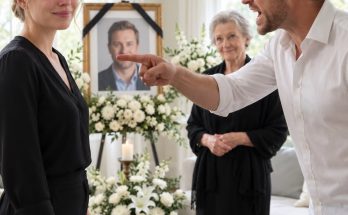
Richard Hayes never gave me the confession he believed I wanted.
He denied intending to kill my mother.
He admitted damaging the brake line only after prosecutors confronted him with the recordings recovered from the basement, the preserved brake assembly, Cross’s testimony, Frank Dorsey’s old photographs, Madison’s morning message to Jonathan Pell, and the garage images.
Even then, he insisted he had only meant to delay her.
As though sabotage became smaller if the person died by accident.
As though intention erased consequence.
Daniel Cross accepted a plea agreement that required full cooperation.
His testimony filled the remaining gaps.
Richard had learned that Madison planned to meet Jonathan Pell and Edward Vale on the morning of March fifteenth.
She intended to formally dispute the Harland financing and begin separation proceedings.
Richard feared the transaction would collapse.
He also believed that if Madison left him while the fraud was exposed, he would lose access to money, property, and perhaps custody leverage over me.
Cross brought tools to the garage.
Richard damaged the brake line.
Both men convinced themselves the failure would happen gradually.
Neither warned Madison after realizing how dangerous the act was.
She drove away the next morning.
She never reached Frank Dorsey’s shop.
That became the legal truth established through evidence and testimony.
The emotional truth remained harder.
My father had looked at a problem in his life and decided another person’s safety mattered less than his control.
Everything afterward followed from that first choice.
The forged transfer.
The salvaged brake assembly.
The fake death certificate.
The false power of attorney.
The break-in at Arthur’s office.
The archive theft.
The threats.
The fire.
He kept choosing concealment because every concealment made the original act harder to face.
By the time the criminal case reached court, more than a year had passed since Grandma’s funeral.
I attended only when necessary.
Tyler attended less.
Denise filed for divorce within weeks of Richard’s arrest.
She cooperated with investigators and surrendered financial records connected to Morrow Holdings.
Her civil liability took longer to resolve.
She had benefited from stolen assets.
She had also preserved evidence that helped recover them.
Both things were true.
I learned not to simplify people just because simplicity hurt less.
Edward Vale testified too.
He admitted helping approve transactions he knew rested on disputed ownership.
His age did not spare him consequences.
Neither did his eventual cooperation erase the years he stayed silent.
Before one hearing, he approached me in the courthouse hallway.
“I don’t expect forgiveness.”
“Good.”
He nodded.
“I wanted you to know Eleanor never forgave me either.”
That almost made me smile.
“Also good.”
He accepted that.
Some apologies should not be rewarded with comfort.
Arthur stayed beside me through everything.
His relationship with me changed after I learned how much he had withheld.
I trusted him differently.
Less blindly.
Probably more honestly.
One afternoon, months into the proceedings, he apologized without explaining himself.
“I believed Eleanor’s instructions protected you.”
“They did.”
He looked surprised.
“They also kept me ignorant.”
“Yes.”
“Both can be true.”
He nodded.
“Your grandmother would have hated that answer.”
“No. She would have argued with it for twenty minutes and then secretly agreed.”
That made him laugh.
The trust litigation moved separately.
Financial investigators reconstructed the Harland capitalization records using Edward’s originals, Rachel Kim’s backup scan, the burned trust amendment, Madison’s correspondence, and archived corporate filings.
The March 4 amendment was authenticated.
My mother’s ownership interest was confirmed.
Richard’s posthumous transfer documents were declared fraudulent.
The forged death certificate became central evidence demonstrating a continuing effort to eliminate my beneficiary rights.
Morrow Holdings was frozen.
Properties were sold or transferred under court supervision.
Accounts were traced.
Insurance proceeds that should have entered the trust were identified.
Not every dollar returned.
Some money had disappeared into failed investments, expenses, taxes, and transfers that could no longer be fully recovered.
Enough remained.
Far more than Grandma ever allowed herself to imagine spending.
When Arthur finally showed me the trust valuation, I stared at the number.
Then I closed the folder.
“That’s it?”
He blinked.
“That is not usually the reaction to this amount of money.”
“I mean that’s what Dad built everything around?”
Arthur understood.
“Yes.”
The number was large.
But not large enough to explain a dead woman.
No number could be.
That was the strange disappointment.
Money looked enormous from far away.
Up close, beside twenty-two lost years, it became paper.
Useful paper.
Consequential paper.
Still paper.
My first decision was about the Oak Park house.
The fire damaged it badly.
The basement was gutted.
Smoke ruined much of the first floor.
Insurance and structural engineers recommended either demolition or an expensive restoration.
Everyone assumed I would sell.
Tyler asked me what I wanted.
I said I didn’t know.
So I went there alone.
Not secretly.
Not dangerously.
Just alone.
For the first time since the night of the fire.
The side door had been replaced with temporary plywood.
Inside, the kitchen smelled of wet plaster and burned wood.
I could still see where Grandma’s table once stood.
The wall beside the pantry retained faint marks from Tyler’s visits as a child.
Upstairs, my old room had survived better than expected.
Someone had painted over the yellow walls years ago.
Under the window, I found a chip where the newer paint had peeled.
Yellow remained underneath.
I touched it.
And suddenly the house stopped being evidence.
It became home again.
Not a pure home.
Not a happy one in every memory.
But ours.
My mother’s.
Grandma’s.
Mine.
I restored it.
Not perfectly.
I refused to turn it into a museum.
The damaged basement wall remained partially exposed behind protective glass.
Three height marks survived the fire.
Ten.
Eleven.
Twelve.
I kept them.
The kitchen received new cabinets, but I copied Grandma’s old layout.
Arthur thought that was sentimental.
Tyler called it stubborn.
Both were right.
I gave Tyler something too.
Not stolen money.
Not compensation for choosing me.
I offered him the chance to buy into a legitimate investment property at the same terms I would give anyone else.
He stared at the proposal.
“You’re making me pay?”
“Yes.”
He laughed for almost a full minute.
“Grandma would approve.”
“She absolutely would.”
Tyler built his own career.
Slowly.
Without Richard’s approval.
The first Christmas after the trial began, he brought dessert to Oak Park and burned the pie crust.
Grandma would have mocked him for weeks.
Denise came once.
Only once.
She stood on the front porch holding a box of Grandma’s belongings recovered from Richard’s house.
Photographs.
Recipe cards.
A broken brooch.
Several letters.
“I thought these should be here.”
I took the box.
“Thank you.”
She looked past me into the kitchen.
“I’m sorry.”
I believed she meant it.
I did not tell her that made everything fine.
It didn’t.
“Take care of yourself,” I said.
She nodded and left.
Sometimes closure is not reconciliation.
Sometimes it is simply refusing to carry the argument farther.
Richard ultimately pleaded guilty to multiple financial crimes after pretrial rulings allowed much of the documentary evidence against him.
The homicide case proceeded separately until he entered a later plea to a serious offense connected to my mother’s death.
His lawyers avoided a trial that would have played the basement recording publicly.
I was allowed to give a statement before sentencing.
For weeks I tried to write something powerful.
I failed.
Every version sounded like a speech.
Grandma hated speeches.
So when I stood in court, I used plain words.
“You spent years telling me my mother’s death was an accident, my grandmother was bitter, and I was confused. The worst thing you stole was not money. It was my ability to trust my own memories.”
Richard looked at the table.
I continued.
“Grandma returned that to me.”
That was all.
I sat down.
He received a substantial prison sentence.
Daniel Cross received less because of cooperation, age, and the terms of his plea.
Mercer lost his license and faced criminal consequences for the archive theft and obstruction-related conduct.
Peter Lawson pleaded guilty to his role in stealing the file.
The hit-and-run investigation eventually tied the vehicle to a shell company connected to Richard.
Prosecutors alleged he arranged for Lawson to be frightened into silence after the handoff.
Lawson survived.
That mattered to me.
Not because he had been good.
Because another death would have made the story feel endless.
Grandma’s estate was much simpler.
Her personal savings were modest.
Furniture.
A small investment account.
Jewelry worth less than Denise once assumed.
The strange thing was that the old passbook really was nearly worthless as a bank instrument.
The original account associated with it had long since been closed and rolled into protected trust structures.
The balance printed inside meant almost nothing.
My father had been technically correct about one thing.
The passbook itself was not valuable.
Grandma had known that.
That was why it was perfect.
Richard valued money only when he understood the amount.
A faded blue savings book looked small enough to mock.
Small enough to throw away.
Small enough to bury.
Grandma counted on that.
The book was never the treasure.
It was a key he did not recognize.
A test he failed because contempt made him careless.
I keep it now in a drawer in the restored Oak Park kitchen.
Not in a vault.
Not behind a lock.
Just beneath a stack of rubber bands, grocery coupons, and envelopes.
Exactly where Grandma used to keep things she did not want anyone else to consider important.
The mud stain from her grave never completely came off.
I tried once.
Then stopped.
It belongs there.
So does the crease my father made when he threw it.
So does the faded notation with my name.
CLAIRE MADISON HAYES.
PERSONAL APPEARANCE REQUIRED.
Every few months I open it.
Not to remember Richard.
I have spent enough of my life doing that.
I open it because the handwriting around the old transactions belongs to Grandma.
Because my mother’s name is connected to mine.
Because objects can survive the stories people force onto them.
Tyler once found me holding it at the kitchen table.
“That thing caused a lot of trouble.”
“No.”
I closed the cover.
“People caused the trouble.”
He nodded.
“Fair.”
Outside, the lilacs had been replanted.
They took two seasons to bloom properly.
The first spring they did, I stood on the front walk longer than I intended.
Grandma had planted lilacs there decades ago.
My mother had stood beside them in photographs.
I used to think inheritance meant receiving whatever someone left when they died.
Money.
Property.
Jewelry.
A house.
Now I understood that inheritance could also be unfinished truth.
Evidence.
Memory.
The stubborn instinct to keep asking when everyone else wanted silence.
Grandma left me all of those things.
She also left me something gentler.
Permission to stop fighting once the truth no longer needed my help.
That took longer to accept.
For months after Richard’s sentencing, I still woke expecting another document.
Another secret.
Another hidden name.
Another room behind the room.
Eventually nothing came.
The quiet frightened me at first.
Then I learned what it was.
Life.
Not waiting for the next revelation.
Not preparing for somebody to tell me I remembered wrong.
Just life.
One Sunday morning, I made coffee in Grandma’s kitchen and opened the windows.
A baseball game played quietly from the radio.
Tyler was coming later with another pie he promised not to burn.
Arthur had sent me a letter I had not opened yet, probably containing something legal and unnecessarily formal.
On the counter sat Grandma’s blue passbook.
Sunlight reached across it.
For twenty-two years, my father believed the truth belonged to whoever controlled the documents.
Grandma understood something better.
Documents could be hidden.
Money could be stolen.
Records could be forged.
People could lie until lies became family history.
But the truth only needed one surviving path.
One photograph.
One recording.
One witness.
One stubborn old woman keeping copies where arrogant men never thought to look.
And one granddaughter willing to climb toward a coffin in the rain and pick up what everyone else had been told was worthless.
I touched the passbook once.
Then I put it back in the drawer.
And this time, I did not lock it.
The End
Read more original stories on Feel Every Story.
My Father Threw Grandma’s Final Gift Into Her Grave, Certain Humiliation Would Keep Me From Discovering Why She Chose Me
Part 19 of 19