“Did your parents send you here as a joke?” Dylan Pierce said, blocking the gate with one polished shoulder.
Lucas Hayes stopped so suddenly that his torn sneaker scraped the concrete.
The laughter came fast.
It rolled down from the grandstands, bounced off the steel railings, and spilled across the junior range.
Lucas stood beneath the white Nevada sun with his hands at his sides.
He was ten years old, small for his age, and dressed like he had borrowed clothes from a donation box.
His faded shirt hung loose around his shoulders.
His pants were worn white at the knees.
One shoelace was broken and tied into a knot.
Dylan Pierce looked him over like he was inspecting trash left near a VIP entrance.
The champion guest shooter wore a black-and-red competition jacket with his name stitched across the chest.
His gloves shone under the daylight.
His sunglasses reflected Lucas’s dusty face back at him.
Behind Dylan, the entrance to the junior shooting lane stood open.
Beyond that gate waited the clean white tables, electronic target rails, and bright scoreboards of the World Junior Shooting Invitational.
Lucas did not move.
He could feel hundreds of eyes pushing against him.
Parents in expensive sunglasses leaned forward.
Junior competitors in matching team jackets whispered behind their hands.
A camera operator near the media platform lifted his lens.
Dylan smiled wider when he noticed.
“Come on, kid,” he said, letting the microphone clipped to his collar catch every word.
The speakers crackled across the arena.
“This is a real invitational.”
More laughter broke out.
Lucas lowered his gaze, but not because he was ashamed.
He looked down because the silver eagle pendant had slipped outside his shirt.
It rested against his chest, dull from age, but clean at the edges.
He closed his fingers around it.
The pendant was cold.
For a moment, the noise around him thinned.
He remembered the weight of it in his palm before dawn.
He remembered standing beside an old motel sink in Henderson.
He remembered washing dust from his face with cold water while traffic hummed outside.
He remembered telling himself not to touch the pendant unless he had to.
Now his thumb pressed hard against the eagle’s wing.
Dylan noticed the movement.
His smile sharpened.
“What’s that?” Dylan asked.
Lucas said nothing.
Dylan leaned closer, lowering his voice like he wanted the insult to stay private.
The arena microphone betrayed him anyway.
“One shot,” Dylan said, “and you’ll run home crying.”
The words boomed from the speakers.
A few people gasped.
Most laughed again.
A teenage competitor near the barricade whispered, “He looks like he walked here.”
Another boy laughed under his breath.
Lucas heard it.
He heard all of it.
He heard the scratch of a chair leg.
He heard a mother tell her son not to stare.
He heard Dylan’s glove creak as the man crossed his arms.
Lucas did not answer.
He only tightened his grip on the pendant until the small metal eagle pressed into his skin.
Dylan straightened and turned toward the nearest referee assistant.
“You’re really letting him shoot?” Dylan asked.
The assistant looked uncomfortable.
“He has a registered slot,” she said.
Dylan chuckled.
“Registered by who?”
The assistant glanced at her tablet.
“Lucas Hayes,” she said.
Dylan tilted his head.
“That supposed to mean something?”
Lucas lifted his eyes.
For the first time, he looked directly at Dylan.
There was no anger in his face.
There was no fear either.
That bothered Dylan more than any insult could have.
The crowd began to quiet, not completely, but enough for the change to feel strange.
Dylan had expected tears.
He had expected a shaking lip.
He had expected the boy to retreat and turn the moment into another story about pressure breaking weak people.
Lucas simply stood there.
His small fingers remained around the silver pendant.
The old referee on the central platform watched from behind the scoring monitors.
Master Referee Daniel Ross had not spoken yet.
He sat beneath a shaded canopy, his gray hair swept back, his dark blazer buttoned despite the heat.
His official badge caught the sun whenever he turned.
Daniel had seen thousands of shooters step onto firing lines.
He had seen prodigies, showoffs, frauds, and broken men trying to prove they still had steady hands.
He had seen fear dressed as confidence.
He had seen arrogance disguised as skill.
Lucas Hayes did not fit any category.
That made Daniel lean forward.
Dylan raised one hand toward the stands.
“Relax, everybody,” he said loudly.
“I’ll make sure the little guy survives.”
The comment brought another round of laughter.
Lucas released the pendant.
He stepped around Dylan without touching him.
The movement was small, but the crowd felt it.
Dylan’s smile faded for half a second.
Lucas walked through the gate.
His sneakers made almost no sound on the rubberized floor.
The bright line of the junior competition lane stretched ahead of him.
A row of young shooters waited nearby, each with polished gear and careful posture.
Some stared openly.
Others looked away as if Lucas’s poverty might be embarrassing for them too.
Lucas passed them without looking left or right.
The smell of gun oil and hot electronics hung in the air.
Scoreboards glowed above each lane.
A giant central screen displayed names, ages, state flags, and rankings.
Lucas’s name appeared near the bottom.
LUCAS HAYES.
NEVADA.
AGE 10.
No team name followed.
No sponsor logo appeared.
No academy badge flashed beside his name.
Just empty space.
Dylan followed several steps behind him.
He was not supposed to be inside the junior lane during attempts.
But famous guests were often allowed to bend rules.
He knew that.
Everyone else knew that.
Daniel Ross watched the distance between Dylan and Lucas narrow.
His jaw tightened.
Lucas reached the firing table.
It was too high for him by half an inch.
He placed his palm flat against its edge and adjusted his stance.
A range assistant moved closer.
“Do you need the platform?” she asked softly.
Lucas shook his head.
“No, ma’am.”
His voice was quiet.
It carried only because the nearest microphone caught it.
The politeness surprised several people near the rail.
Dylan laughed once.
“Platform might help him see the target.”
No one laughed as loudly this time.
Lucas did not look back.
He studied the lane.
The target rail extended far downrange, silver and black beneath harsh daylight.
The competition target was not fixed.
It moved on a programmed path, crossing open spaces and narrow gaps between protective panels.
The final phase was notorious.
A target would change direction near the last slot.
Most young shooters fired early.
Many missed when the target slipped behind cover.
The event had already humbled half the finalists.
Lucas watched the empty track.
He watched it like he was listening to music no one else could hear.
Daniel Ross noticed.
He had seen that kind of stillness once before.
Not often.
Once.
His left hand moved toward the armrest of his chair.
Dylan moved beside the lane barrier.
“You sure you loaded enough courage?” he called.
A few boys snickered.
Lucas kept his hand on the table.
His breathing stayed even.
The range assistant placed the competition rifle in position.
It was standard issue for the junior event.
Every finalist used the same model.
No one could claim equipment gave Lucas an advantage.
The assistant checked the chamber.
She confirmed the safety procedure.
Then she stepped back.
Lucas reached for the rifle.
His hand was small, but it did not fumble.
He adjusted the stock with calm precision.
He placed his cheek against it without forcing his posture.
His finger stayed clear until he was ready.
Daniel’s eyes narrowed.
The old referee’s expression changed so slightly that only one nearby official saw it.
“What is it?” the official whispered.
Daniel did not answer.
Lucas looked downrange.
The stadium speaker clicked.
A younger referee raised his hand.
“Shooter ready?”
Lucas nodded.
The word did not come from Dylan now.
It came from the official lane referee.
“Begin.”
The buzzer sounded.
The target shot forward on the rail.
It appeared from behind the first panel, slid across open space, and vanished again.
The crowd leaned in.
Lucas tracked it without swinging wildly.
His movement was measured.
The target reappeared.
It crossed faster the second time.
Lucas did not fire.
Someone in the stands muttered, “Too slow.”
Dylan smiled again.
“There it is,” he said.
The target dipped along the rail.
It passed a narrow slot.
A shot there would have counted.
Lucas still did not fire.
Parents shifted in their seats.
The giant screen displayed the live feed from the target lane.
The red center circle appeared and vanished between metal dividers.
Lucas’s face filled a smaller screen.
He looked calm enough to be waiting for a bus.
Dylan’s voice cut through the silence.
“He froze.”
Lucas heard him.
His right hand did not tremble.
The target entered the final pattern.
The rail system whirred.
Then it made a sharp mechanical snap.
The target changed direction unexpectedly.
Several people in the stands reacted before Lucas moved.
The shift was legal.
It was also brutal.
Earlier finalists had missed that exact transition.
The target skimmed toward the last narrow gap.
For a fraction of a second, the red center aligned with open air.
Lucas exhaled.
“Now.”
The shot cracked across the arena.
It was one clean sound.
No panic.
No correction.
No second attempt.
The target continued sliding for less than a heartbeat.
Then the impact sensor flashed.
The screen went white.
A red dot appeared directly at center.
Dead center.
The scoreboard froze.
The arena seemed to forget how to breathe.
Lucas lowered the rifle safely.
The digital system processed the shot.
Then the central screen erupted in red.
NEW RECORD.
PERFECT CENTER HIT.
FINAL GAP STRIKE.
A warning tone rang across the range.
Not a danger warning.
A scoring alert.
The audience reacted in layers.
First came silence.
Then one gasp near the front rail.
Then a rising murmur.
Then chairs scraping.
Then a roar that did not know whether to cheer or question reality.
Dylan Pierce did not move.
His mouth opened slightly.
His sunglasses had slipped down his nose.
For the first time since Lucas arrived, Dylan looked young.
Not young in age.
Young in experience.
Young in the face of something he had never controlled.
Lucas stepped back from the table.
He kept his eyes on the floor.
He looked almost embarrassed by the noise.
Daniel Ross stood slowly from the referee platform.
The official beside him turned.
“Sir?”
Daniel ignored him.
His gaze was locked on Lucas’s chest.
During the shot, the boy’s pendant had swung forward.
The silver eagle had caught the sunlight.
Now it rested outside the faded shirt.
Daniel’s face changed.
The color drained from it.
His hand gripped the edge of the monitor table.
For a moment, the legendary referee was no longer inside the Nevada arena.
He was somewhere older.
Somewhere quieter.
Somewhere filled with desert wind, gun oil, and a promise that had never stopped hurting.
Daniel stepped down from the platform.
The crowd began to notice him moving.
That alone created another silence.
Daniel Ross did not cross lanes for ordinary scores.
He did not chase children for autographs.
He did not flatter sponsors.
He walked only when rules broke or history entered the room.
Lucas looked up when Daniel approached.
Dylan turned too.
The champion’s face twisted between disbelief and irritation.
“Check the system,” Dylan said.
His voice cracked.
The microphone caught that too.
Several people looked at him.
Dylan swallowed.
“I mean, verify it.”
Daniel stopped beside Lucas.
He did not look at the screen.
He looked at the pendant.
The silver eagle was old.
Its wings curved downward, not upward.
Its beak pointed to the left.
A tiny cut marked the lower edge, almost invisible unless someone knew where to look.
Daniel knew.
His lips parted.
The arena waited.
Lucas’s hand moved toward the pendant, but he did not cover it yet.
Daniel’s voice came out low.
“Impossible…”
The word traveled through the nearest microphone.
It reached the grandstands as a whisper with weight.
Dylan stared at Daniel.
Then he stared at Lucas.
The arrogance had drained from him.
The expensive jacket, the polished gloves, the champion posture, all looked suddenly thin.
He stepped closer.
“Who are you?”
Lucas’s fingers closed over the silver eagle.
He covered it against his chest.
Then he looked away.
The arena did not breathe.
Daniel remained frozen beside him.
The scoreboard still glowed red overhead.
Dylan waited for an answer.
Lucas gave none.
He held the pendant like it was not a trophy.
He held it like it was the last piece of someone.
The silence after Dylan’s question grew longer than any applause could have been.
A child near the front row asked his father, “What happened?”
The father did not answer.
He could not.
The screen still showed Lucas’s score.
The red center mark looked too perfect to argue with.
Officials hurried toward the scoring table.
One checked the sensor record.
Another replayed the shot path.
A third examined the timing gate.
Each small act made Dylan more restless.
“Run the replay,” Dylan demanded.
No one answered him.
The replay appeared on the giant screen.
The target moved.
The sudden directional change came.
Lucas waited.
His shot entered exactly as the center crossed the final gap.
The impact registered on the red circle’s central sensor.
The replay showed no flaw.
No early trigger.
No system delay.
No bounce.
No lucky graze.
It was a hit.
A perfect hit.
A clean hit.
The crowd saw it again.
This time, the gasp came before the red flash.
They knew what was coming.
That made it worse for Dylan.
Daniel did not turn toward the replay.
He kept looking at Lucas.
His face had softened, but not with joy.
It was something more painful.
Recognition can feel like a wound reopening.
Lucas looked small under the scoreboard’s red glow.
His hand remained over the pendant.
His dusty face showed no pride.
He looked like a boy trying not to be taken apart by attention.
Daniel lowered his voice.
“Where did you get that?”
Lucas’s shoulders tightened.
That question had weight.
It was not curiosity.
It was not a collector admiring jewelry.
It was a door opening somewhere Lucas did not want opened in public.
Dylan heard the question and stepped in.
“What pendant?” he said.
Daniel turned his head.
The old referee’s eyes hardened.
“Stand back.”
Dylan blinked.
The order was quiet, but it landed like a slap.
“I’m a guest shooter here,” Dylan said.
Daniel’s gaze did not move.
“You are blocking an active lane area.”
Dylan looked around.
People were watching him now.
The same crowd that had laughed with him was measuring him differently.
That shift made his neck flush.
Lucas noticed it.
He had seen adults change when the room stopped supporting them.
It happened at grocery counters.
It happened in school offices.
It happened outside motels when rent was late.
Power often lived in who the room believed.
For the first time that morning, the room was not believing Dylan.
Dylan tried to laugh.
It sounded wrong.
“I was just messing with him.”
No one laughed.
Daniel looked back at Lucas.
“Son,” he said gently, “I need to ask again.”
Lucas’s fingers tightened.
The pendant chain pressed into the back of his neck.
“My mom gave it to me,” Lucas said.
The answer was soft.
But the microphones carried it.
A murmur passed through the stands.
Daniel closed his eyes for one second.
When he opened them, he looked older.
“Your mother’s name?”
Lucas hesitated.
The lane assistant looked between them with concern.
Dylan frowned.
“What does his mom have to do with anything?”
Daniel did not respond.
Lucas watched the old referee’s face.
Something in it frightened him less than the crowd did.
Maybe it was the grief there.
Maybe it was the way Daniel had stopped looking like an official and started looking like a man remembering a promise.
Lucas swallowed.
“Rachel,” he said.
Daniel’s hand shook.
Only slightly.
But Dylan saw it.
So did the assistant.
The old referee took one step back.
The sound around them blurred again.
Daniel Ross had heard that name in hospital corridors.
He had heard it over bad phone connections.
He had heard it once from a man who carried medals in a shoebox and secrets in his lungs.
Rachel Hayes.
Rachel who hated crowds.
Rachel who never wanted her child near cameras.
Rachel who had once mailed Daniel a photograph of a newborn wrapped in a blue blanket.
Rachel who stopped writing six years later.
Rachel who vanished from every number Daniel had.
Rachel who had promised the boy would never shoot unless he asked to.
Daniel looked at Lucas’s grip.
“Rachel Hayes?” he asked.
Lucas’s eyes sharpened.
“You knew her?”
The word knew struck Daniel like a physical blow.
Not know.
Knew.
Past tense.
Daniel’s jaw worked.
Dylan shifted.
The crowd was too quiet now.
The story had moved beyond a score.
Everyone sensed it.
No one understood it.
Lucas looked suddenly trapped.
He had not come to Nevada for attention.
He had not come for applause.
He had not come to embarrass Dylan Pierce.
He had come because an envelope had arrived at the motel front desk two weeks earlier.
It had contained an invitation.
It had been addressed to Lucas Hayes.
Inside was a competitor badge, a waiver form, and one sentence written by hand.
If you ever want answers, come where your hands will be understood.
There was no signature.
His mother had been gone three months by then.
Lucas had read the sentence until the paper softened at the folds.
He had almost thrown it away.
Then he had opened the small metal box under his mother’s bed.
Inside was the silver eagle pendant and a photograph with one corner burned.
The photograph showed a younger Daniel Ross standing beside a man Lucas did not know.
The man wore no smile.
He wore the same silver eagle pendant.
Lucas had carried those things to Nevada with twelve dollars, two bus tickets, and a silence too heavy for a child.
Now Daniel Ross stood in front of him.
And Dylan Pierce stood nearby, waiting to reclaim control of a room he had lost.
Dylan pointed at the scoreboard.
“I want an equipment check,” he said.
That broke the spell.
Several officials looked offended.
Daniel turned slowly.
“You want what?”
Dylan lifted his chin.
“I want a check.”
He forced confidence back into his voice.
“A ten-year-old in street clothes just broke a record on a final-gap moving target.”
He pointed at Lucas.
“That’s suspicious.”
Lucas stared at the floor.
The insult landed differently this time.
Before the shot, Dylan had mocked his poverty.
After the shot, Dylan questioned his honesty.
The crowd murmured.
Some people nodded uncertainly.
Others looked uncomfortable.
Dylan sensed an opening.
He pushed harder.
“I’m saying what everyone’s thinking.”
A father near the front said, “Not everyone.”
Dylan ignored him.
“This event has standards.”
Daniel stepped closer to Dylan.
“So do I.”
The old referee’s voice was calm.
That made Dylan’s face tighten.
Daniel turned toward the officials.
“Full verification,” he said.
Dylan smiled faintly.
Daniel continued.
“Check the rifle, the target rail, the sensor logs, and the firing table.”
Dylan’s smile grew.
Then Daniel added, “And record that the request came from Dylan Pierce.”
The smile vanished.
A camera swung toward Dylan.
Daniel faced the crowd.
“We will verify the shot publicly.”
The arena responded with a low wave of anticipation.
Lucas looked up, worried.
Daniel noticed.
He leaned down slightly.
“You did nothing wrong,” Daniel said.
Lucas did not answer.
He wanted to believe him.
He had spent too much of his life learning that being right did not always protect a person.
Officials moved around the lane.
One lifted the rifle.
Another sealed the chamber record.
A technician opened the target system panel.
The giant screen switched to diagnostic mode.
Numbers, timing marks, and shot coordinates appeared.
Lucas stood beside the table while adults examined everything he had touched.
Dylan remained near the barrier, arms crossed.
His confidence had returned in pieces.
He looked at Lucas like a prosecutor waiting for the lie to crack.
“Still calm?” Dylan asked.
Daniel turned sharply.
Dylan raised his hands.
“What?”
Lucas spoke before Daniel could.
“Yes, sir.”
The reply was polite.
It made Dylan look smaller.
The crowd heard it.
A few people reacted with quiet approval.
Dylan’s jaw flexed.
“You always talk like that?”
Lucas looked at him.
“My mom said manners cost less than pride.”
A ripple passed through the front rows.
Someone laughed softly, not at Lucas.
Dylan’s face darkened.
Daniel looked away for a moment.
The sentence had Rachel in it.
He could hear her voice through the boy.
The technician at the target panel raised a thumb.
“Sensor is clean.”
Another official checked the rifle.
“Standard event rifle.”
A third studied the timing log.
“No fault.”
The head scoring officer looked at Daniel.
“Shot confirmed.”
The giant screen changed again.
The score returned.
NEW RECORD.
LUCAS HAYES.
The crowd erupted.
This time it was not confused.
It was loud and certain.
People stood.
Some clapped above their heads.
Junior competitors stared at Lucas with open awe.
The boy did not smile.
He took half a step back from the noise.
Dylan looked around as if betrayed by strangers.
Daniel raised a hand.
The applause lowered, not completely, but enough.
“Lucas Hayes,” Daniel said, “your score is official.”
Lucas nodded.
“Thank you, sir.”
Dylan scoffed.
“You’re all turning this into a fairy tale.”
Daniel’s head turned.
Dylan knew he should stop.
He did not.
“He got lucky.”
The words cut through the applause.
A few people booed.
Dylan continued anyway.
“One perfect shot doesn’t make him special.”
Lucas’s hand moved again to the pendant.
Daniel saw it.
The movement was defensive.
Small.
Practiced.
A child protecting the only private thing left.
Daniel’s patience thinned.
“No,” Daniel said.
“One perfect shot makes him the shooter of record.”
Dylan laughed bitterly.
“Come on, Daniel.”
The arena stiffened at the first-name use.
Dylan had crossed another line.
Daniel stepped closer.
“You are here as a guest,” he said.
“Act like one.”
Dylan’s nostrils flared.
“Or what?”
The crowd went quiet again.
That was Dylan’s mistake.
He thought the question challenged Daniel.
It actually revealed him.
Daniel looked at him for a long second.
“Or you leave the lane.”
Dylan stared back.
Then he glanced at the cameras.
He understood how this looked.
A grown champion arguing with an old referee after humiliating a hungry-looking boy who had just broken a record.
His pride fought his survival.
Survival almost won.
Then Lucas spoke.
“It’s okay.”
Everyone looked at him.
Lucas’s voice remained calm, but his fingers were white around the pendant.
“I can go now.”
Daniel’s face changed.
“No.”
Lucas blinked.
The answer came too fast.
Too firm.
Daniel softened his tone.
“No, son,” he said.
“You earned your place here.”
Lucas looked toward the exit.
The gate seemed farther away than before.
He had learned to leave before things got worse.
At school, when boys mocked his clothes, leaving helped.
At gas stations, when clerks watched him too closely, leaving helped.
At diners, when waitresses asked if his mother was coming, leaving helped.
Leaving was safety.
Standing still was risk.
But Daniel Ross was standing between him and the exit now.
Not blocking him.
Guarding him.
Lucas did not know what to do with that.
Dylan saw the emotional shift and attacked it.
“Don’t make him brave because he looks sad,” he said.
The crowd turned cold.
The sentence was ugly enough to land without help.
Daniel’s hand curled at his side.
Lucas looked down.
For the first time, shame touched his face.
Not shame for the shot.
Shame for being seen.
For being measured by torn shoes and dust.
For carrying grief in public where strangers could discuss it.
Daniel stepped closer to Dylan.
“You mocked a child at the gate,” he said.
Dylan looked away.
“You insulted his family.”
Dylan said nothing.
“You questioned his integrity after verification.”
Dylan’s mouth tightened.
“And now you are trying to make his pain part of your argument.”
Daniel’s voice did not rise.
That made each sentence heavier.
Dylan looked toward the sponsors’ platform.
No help came.
The event director stood with crossed arms.
Parents watched with hard faces.
The junior competitors looked at Dylan differently now.
They had admired him that morning.
Some had posters with his signature.
Now they looked like they were learning something painful about fame.
Lucas felt the room shift again.
The power that had carried Dylan into cruelty was draining away.
Not all at once.
But steadily.
Dylan tried one last time.
“Fine,” he said.
“Let him shoot another round.”
Daniel frowned.
“That is not required.”
Dylan pointed at Lucas.
“If he’s that good, he can repeat it.”
The challenge hung there.
It was unfair.
Everyone knew it.
Records did not require repeating.
A verified shot was enough.
But crowds love trials.
Even sympathetic crowds can become hungry again.
A murmur rose.
Lucas looked at the target lane.
Daniel shook his head.
“No.”
Lucas surprised him.
“I’ll do it.”
Daniel turned.
“You don’t have to.”
Lucas looked at Dylan, then at the crowd.
His voice was quiet, but steady.
“My mom used to say people believe what they see twice.”
Daniel’s throat tightened again.
Dylan smirked.
“There we go.”
Daniel leaned close to Lucas.
“You can decline,” he whispered.
Lucas met his eyes.
“I know.”
Daniel studied the boy.
He saw exhaustion.
He saw grief.
He saw a careful kind of courage, not loud enough to impress fools.
Then Daniel nodded.
“One exhibition attempt,” he said.
“No impact on the official record.”
Dylan stepped back with a satisfied look.
Lucas returned to the firing table.
The crowd settled into breathless silence.
This time the atmosphere had changed.
Before, Lucas had been entertainment.
Then he had become a question.
Now he was a test that no child should have to take.
The assistant reset the target sequence.
The rail system hummed.
The scoreboard cleared for exhibition mode.
Daniel stood near Lucas, closer than before.
Dylan watched from the barrier.
His confidence looked forced.
Lucas adjusted the rifle.
His pendant slipped again.
He paused.
The silver eagle rested against the old shirt.
He thought about tucking it away.
Then he left it visible.
Daniel saw that choice.
Dylan saw it too.
The arena speaker clicked.
The lane referee hesitated.
Daniel gave a small nod.
“Begin.”
The buzzer sounded.
The target moved.
This exhibition pattern was different.
A technician had selected a randomized rail sequence to avoid accusations.
The first crossing came low and fast.
Lucas followed it.
He did not shoot.
The second came behind a partial shield.
He did not shoot.
The crowd held itself still.
Even the children stopped whispering.
The target dipped, reversed, and vanished.
Dylan’s smile twitched.
“He missed his chance,” he muttered.
Lucas breathed in.
The target flashed through a midline gap.
Still no shot.
Daniel watched Lucas’s finger.
It remained disciplined.
No panic pressure.
No flinch.
No eagerness.
Only waiting.
The rail motor changed pitch.
Lucas heard it.
His head tilted a fraction.
Daniel noticed that too.
The boy was not reacting to the target.
He was reading the machine.
The final crossing came from an unexpected angle.
It was not identical to the record shot.
It was worse.
The target snapped upward through a narrow diagonal gap.
A few adults reacted with disbelief.
Lucas exhaled.
He fired.
The shot cracked.
The target vanished.
The sensor light blinked red.
The scoreboard processed.
For three seconds, nothing appeared.
Dylan leaned forward.
Then the screen flashed.
CENTER HIT.
EXHIBITION CONFIRMED.
The crowd exploded.
This time the sound hit like a wave.
People stood everywhere.
A junior competitor near the front shouted, “No way!”
Another clapped until his palms reddened.
A mother wiped her eyes without understanding why.
Dylan Pierce stepped backward.
His face had gone pale.
Lucas lowered the rifle safely again.
He did not celebrate.
He did not raise a fist.
He only looked relieved that the shot was over.
Daniel Ross stared at him.
The old referee’s eyes shone now.
Not from spectacle.
From recognition becoming certainty.
Dylan pulled off his sunglasses.
His voice shook when he spoke.
“That’s not normal.”
Daniel did not answer.
Dylan looked at Lucas.
The boy’s pendant hung in the open.
The eagle caught the sun again.
Dylan’s expression changed from anger to unease.
“What is that thing?”
Lucas covered it instantly.
The movement was too fast.
Daniel stepped between them.
“That is enough.”
Dylan’s breathing grew louder.
“No, seriously.”
He looked at Daniel.
“You know something.”
Daniel’s silence confirmed too much.
The crowd sensed another turn.
Phones lifted.
Cameras tightened.
Daniel looked at Lucas.
The boy’s face had closed.
The attention had become dangerous again.
Daniel understood.
Some truths should not be dragged into daylight because a cruel man demanded them.
He turned to the event director.
“Clear the lane,” he said.
The director nodded.
Security moved gently, not aggressively.
They guided Dylan away from the barrier.
Dylan resisted with words, not force.
“You can’t just shut this down.”
Daniel faced him.
“I can protect a minor competitor.”
The phrase landed officially.
Dylan looked toward the cameras again.
He lowered his voice.
“This isn’t over.”
Lucas heard it.
Daniel heard it too.
The old referee moved closer to Dylan.
“It is over for you today.”
Dylan stared at him.
Daniel continued.
“You will leave the competition floor.”
Dylan’s face twisted.
“And if I don’t?”
Daniel looked past him.
Two security officers stepped forward.
They were not dramatic.
They did not grab him.
They simply appeared where consequences stand.
Dylan looked around.
The crowd watched.
No one laughed with him now.
No one gave him the comfort of shared cruelty.
He pulled off his gloves one finger at a time.
“Fine,” he said.
But his voice had lost its edge.
He walked toward the exit.
The same gate where he had blocked Lucas now framed his retreat.
That was not lost on anyone.
A few people clapped when Dylan passed.
Not many.
Most simply watched in silence.
Silence can humiliate more than noise.
Dylan disappeared beyond the gate.
Lucas remained near the firing table.
The roar of applause had faded into murmurs.
The event director approached Daniel.
“Do you want to announce the award now?”
Daniel looked at Lucas.
“No.”
The director blinked.
Daniel lowered his voice.
“Give him space first.”
Lucas heard that.
It surprised him.
Adults usually gave him instructions.
Few gave him space.
Daniel crouched slightly, enough to meet Lucas without towering over him.
“Would you come with me for a minute?” he asked.
Lucas looked toward the stands.
People were still watching.
“Am I in trouble?”
The question hit Daniel harder than the record shot.
“No,” Daniel said.
“You are not in trouble.”
Lucas studied his face.
“Then why?”
Daniel looked at the pendant again.
“Because I think someone wanted you to find me.”
Lucas stopped breathing for a moment.
The arena noise faded.
He saw the envelope again.
He saw the handwriting.
He saw the sentence.
If you ever want answers, come where your hands will be understood.
Lucas slowly reached into his back pocket.
He unfolded a soft, creased piece of paper.
Daniel’s face went still when he saw it.
Lucas handed it to him.
Daniel read the sentence.
His thumb moved across the handwriting.
The old man’s lips pressed together.
“Who wrote it?” Lucas asked.
Daniel looked at him.
The question carried three months of grief.
It carried ten years of not knowing why his mother avoided certain names.
It carried nights in motel rooms and mornings pretending not to be hungry.
Daniel folded the paper carefully.
“I did.”
Lucas stared at him.
The crowd remained far away now, beyond the thin boundary of their conversation.
Daniel’s voice trembled.
“I sent it after I found Rachel’s last address.”
Lucas’s face tightened.
“You knew my mom was gone?”
Daniel nodded once.
“I found out late.”
Lucas looked down.
“She said people always find out late.”
Daniel closed his eyes briefly.
The sentence hurt because it sounded like Rachel forgiving him and accusing him at once.
“She was right,” Daniel said.
Lucas looked up.
That honesty seemed to confuse him.
Adults often defended themselves first.
Daniel did not.
The event director approached again, then stopped when Daniel lifted one hand.
Daniel looked toward a side corridor near the officials’ office.
“Come inside,” he said.
“No cameras.”
Lucas glanced toward the stands.
“What about the award?”
“It can wait.”
That answer reached him.
For a child who had waited for almost everything, hearing that an award could wait felt strange.
Lucas nodded.
Daniel led him away from the firing line.
They walked through the side corridor under the grandstand.
The sound changed immediately.
The crowd became muffled thunder overhead.
The concrete hallway smelled of dust, coffee, and old air conditioning.
Posters from past tournaments lined the walls.
Daniel’s younger face appeared in several of them.
In one photograph, he stood beside military shooters after a national exhibition.
Lucas slowed.
The same man from the burned-corner photograph stood beside Daniel in that poster.
He was taller than Daniel.
Quiet-faced.
Serious.
Around his neck hung the silver eagle pendant.
Lucas stopped walking.
Daniel noticed.
Lucas pointed.
“Who is that?”
Daniel looked at the poster.
For a moment, he did not answer.
The hallway felt colder.
“That was Marcus Hayes,” Daniel said.
Lucas’s hand went to his pendant.
“My dad?”
Daniel turned toward him.
“You know his name?”
Lucas nodded.
“My mom said his name once.”
His voice became smaller.
“She said he was brave, but brave people can still leave holes.”
Daniel absorbed that.
Rachel had always spoken like that.
Plain words with a blade underneath.
“Your father did not leave because he wanted to,” Daniel said.
Lucas looked guarded.
“That’s what people say.”
Daniel nodded.
“Yes.”
He did not rush.
He understood the danger of asking a child to trust a clean version of a painful story.
“Sometimes it is true,” Daniel said.
Lucas looked at the poster again.
“Is it true here?”
Daniel swallowed.
“Yes.”
They continued into a small officials’ room.
It held a metal table, stacked chairs, a coffee maker, and a window facing the empty practice lanes.
Daniel closed the door.
The crowd became distant.
Lucas stood near the table.
He did not sit until Daniel gestured.
Even then, he perched on the edge of the chair.
Daniel sat across from him.
For several seconds, neither spoke.
Lucas watched Daniel’s hands.
They were large, old, and marked with thin scars.
Daniel placed the folded paper on the table between them.
“I was your father’s coach,” he said.
Lucas did not blink.
“And his friend.”
Lucas’s face stayed still.
Daniel continued.
“He was the best moving-target shooter I ever saw.”
Lucas looked toward the window.
“Better than Dylan?”
Daniel almost smiled.
“Dylan would not have made Marcus look up from his coffee.”
A tiny movement touched Lucas’s mouth.
Not a smile.
Almost.
Daniel held onto it carefully.
“Marcus had that pendant made after his first national title.”
Daniel pointed gently.
“The eagle was for discipline.”
Lucas looked down at his hand.
“What’s the cut on the bottom?”
Daniel’s breath caught.
“You noticed?”
Lucas nodded.
“My mom said not to file it smooth.”
“She was right.”
Daniel leaned back.
“That mark came from the day your father saved my life.”
Lucas’s eyes lifted.
Daniel let the silence settle before continuing.
“We were at a training range outside Reno.”
“It was windy, crowded, and badly managed.”
“A target rig failed during a demonstration.”
“Everyone froze.”
“Marcus saw the problem before anyone else moved.”
Daniel touched his own wrist.
“He pulled me back by the arm.”
“The rig snapped where my head had been.”
Lucas looked at the pendant.
“It cut this?”
Daniel nodded.
“The chain caught the broken metal.”
“Marcus laughed after.”
“He said the eagle got wounded before we did.”
Lucas’s fingers softened around it.
The story did not fix anything.
But it placed warmth around the metal.
That mattered.
Daniel continued carefully.
“After that, Marcus gave me a matching pendant.”
Lucas looked at him quickly.
Daniel reached under his collar.
He pulled out a silver eagle.
It was older, darker, and marked by the same design.
Lucas stared.
The room seemed to tilt.
Daniel placed his pendant beside Lucas’s folded invitation.
“I stopped wearing it outside my shirt after your father died.”
Lucas looked at Daniel.
“How did he die?”
Daniel’s face tightened.
The question had waited years.
It deserved honesty with mercy.
“An accident,” Daniel said.
“During a private training evaluation.”
Lucas’s eyes narrowed.
“My mom said people called it an accident when they wanted to stop talking.”
Daniel’s chest tightened.
Rachel again.
Sharp and right.
“She was angry,” Daniel said.
“She had reason to be.”
Lucas waited.
Daniel chose every word carefully.
“Marcus reported safety problems before that evaluation.”
“People ignored him because sponsors wanted the event to happen.”
Lucas looked down.
“Then he died.”
“Yes.”
Daniel did not soften the word into something weaker.
Lucas’s shoulders rose and fell.
The room stayed quiet.
Outside, a distant cheer rolled through the arena.
It sounded like another world.
Daniel leaned forward.
“Rachel left because she did not trust the shooting world anymore.”
Lucas’s face changed.
“She never told me.”
“She wanted you safe.”
Lucas looked at the table.
“She hated guns.”
Daniel nodded.
“She hated what pride did around them.”
Lucas’s eyes flicked toward the door.
“Like Dylan.”
Daniel’s expression hardened.
“Yes.”
The word carried a promise.
Lucas pressed his thumb against the eagle.
“Then why did she teach me?”
Daniel stared.
“She taught you?”
Lucas nodded.
“Not with a rifle at first.”
He looked embarrassed.
“With bottle caps.”
Daniel leaned back.
Lucas continued quietly.
“She would roll them across the floor.”
“She made me wait for the space between chair legs.”
“She said patience matters more than aim.”
Daniel covered his mouth with one hand.
Not to hide shock.
To hold himself together.
That was Marcus’s exact training phrase.
Lucas kept speaking.
“Later, she let me use a pellet rifle behind a repair shop.”
“Only when no one was around.”
“She said I had his hands.”
Daniel’s eyes shone.
“She was right.”
Lucas shook his head.
“I don’t know if that’s good.”
Daniel let that sit.
The boy deserved more than easy reassurance.
“It depends what you do with them,” Daniel said.
Lucas looked at him.
“It depends who teaches you to respect them.”
Lucas nodded faintly.
The door opened after a soft knock.
The event director leaned in.
“Daniel, media is asking for a statement.”
Daniel’s eyes stayed on Lucas.
“Tell them the record is confirmed.”
The director glanced at Lucas.
“And Dylan?”
Daniel’s voice cooled.
“Tell them he left the floor after violating conduct standards.”
The director nodded.
“There’s more.”
Daniel looked up.
The director hesitated.
“Pierce’s sponsor team is threatening to pull their donation.”
Lucas’s face changed.
There it was.
The adult world again.
Money pushing against truth.
Daniel stood.
“Let them.”
The director blinked.
“Daniel.”
“Let them,” Daniel repeated.
His voice was calm and final.
Lucas stared at him.
The director exhaled.
“All right.”
He closed the door.
Lucas looked at Daniel with careful suspicion.
“You can do that?”
Daniel sat again.
“I should have done things like that sooner.”
Lucas heard the regret.
It was not theatrical.
It was old.
Daniel folded his hands.
“Your father trusted me.”
“I failed him after he died.”
Lucas looked at him.
“How?”
Daniel did not avoid it.
“I let sponsors shape the story.”
“I let officials call negligence bad luck.”
“I told myself I was protecting young shooters by staying inside the system.”
He looked toward the door.
“Maybe I was protecting my position too.”
Lucas said nothing.
Daniel’s honesty had weight.
It did not make him innocent.
It made him real.
“My mom said adults apologize when the truth is already too heavy to hide.”
Daniel nodded slowly.
“She knew me too well.”
Lucas’s eyes lowered.
“She cried when she thought I was asleep.”
Daniel closed his eyes.
The pain in the room became almost visible.
Lucas continued.
“She kept your letters in a box.”
Daniel opened his eyes.
“My letters?”
Lucas nodded.
“She never mailed hers back.”
Daniel looked toward the window.
“I wrote for years.”
“She never answered.”
“She read them.”
Lucas’s voice was soft.
“She just didn’t forgive you out loud.”
Daniel’s face broke a little.
He turned away for one breath.
When he looked back, he seemed less like a legend and more like a man standing before consequence.
“Did she suffer?” he asked.
Lucas looked at the table.
The question was too large for him.
“She worked double shifts.”
Daniel’s hand tightened.
“At a diner first.”
“Then a gas station near Boulder Highway.”
“Then she cleaned offices at night.”
Lucas swallowed.
“She said it was temporary.”
His voice thinned.
“Everything was temporary.”
Daniel looked at the boy’s torn shoes.
He had seen them earlier.
Now they accused him.
Lucas noticed.
He pulled his feet back under the chair.
Daniel’s voice dropped.
“I am sorry.”
Lucas looked away.
“I don’t need sorry.”
Daniel nodded.
“What do you need?”
Lucas’s answer came slowly.
“I don’t know.”
That was the most honest thing he had said.
Daniel accepted it.
A knock came again.
This time softer.
The lane assistant entered with a small paper cup of water and a wrapped sandwich.
“I thought he might want something,” she said.
Lucas stared at the food.
Daniel saw hunger move across his face before pride could cover it.
“Thank you,” Daniel said.
The assistant set it down and left.
Lucas did not touch it.
Daniel understood.
“You can eat,” he said.
Lucas kept his eyes on the sandwich.
“I have money.”
Daniel’s throat tightened.
“I know.”
Lucas looked up.
The old man did not smile.
He did not pity him.
He simply waited.
Lucas opened the wrapper.
He ate carefully, like taking too much might break a rule.
Daniel looked away to give him dignity.
Outside, the arena announcer began filling time.
The voice was muffled through the walls.
Lucas finished half the sandwich and wrapped the rest.
Daniel noticed.
“For later?” he asked.
Lucas nodded.
That small act was harder to witness than the insults.
Dylan’s cruelty had been loud.
Poverty’s habits were quiet.
Daniel stood and opened a cabinet.
He removed a clean event hoodie still inside plastic.
It was a junior medium.
He placed it on the table.
Lucas looked at it.
“I can’t pay for that.”
“You already did.”
Lucas frowned.
“With the record.”
Lucas touched the plastic.
Then he pulled his hand back.
Daniel did not push.
He sat again.
“I need to tell you something before we go back out.”
Lucas stiffened.
Daniel lowered his voice.
“Your father’s accident file was reopened last month.”
Lucas stared.
“Why?”
“Because Rachel sent me something before she died.”
Lucas stopped moving.
Daniel reached into his blazer pocket.
He removed a small envelope.
It was worn at the corners.
Lucas recognized his mother’s handwriting instantly.
His face changed.
Daniel placed it on the table.
“I did not know she was sick when she sent it.”
Lucas did not touch the envelope.
“What is it?”
Daniel looked at it.
“Records.”
“Names.”
“Proof your father warned them.”
Lucas’s breathing quickened.
Daniel continued.
“She asked me to protect you first.”
Lucas looked up.
“Protect me from what?”
Daniel’s jaw tightened.
“From people who would use your talent.”
“From people like Dylan.”
Lucas looked toward the door.
“Did Dylan know?”
“No.”
Daniel’s answer was firm.
“He knew nothing about you.”
Lucas absorbed that.
His humiliation had not been a conspiracy.
It had been ordinary cruelty.
Somehow that felt worse.
Daniel leaned forward.
“Your mother also asked me to give you a choice.”
Lucas’s eyes flicked back.
“What choice?”
“To walk away from this world forever.”
Daniel let the words breathe.
“Or train in it properly, safely, and on your terms.”
Lucas looked down at his hands.
They were small.
The same hands had just silenced an arena.
The same hands had opened ketchup packets for his mother after long shifts.
The same hands had held her blanket during her final week.
He did not know what those hands were supposed to become.
Daniel did not rush him.
The crowd outside started clapping again for another competitor.
Life had continued without permission.
Lucas looked at the silver eagle.
“My mom said the pendant was not proof I had to be like him.”
Daniel nodded.
“She was right.”
Lucas looked at him.
“What is it proof of?”
Daniel’s voice softened.
“That you were loved before you understood loss.”
Lucas looked away fast.
His eyes watered, and he hated that.
Daniel pretended not to notice.
The kindness was careful.
After a long silence, Lucas slid the event hoodie closer.
“Can I wear this outside?”
Daniel nodded.
“Only if you want.”
Lucas opened the plastic.
He pulled the hoodie over his faded shirt.
It was slightly too big.
The silver eagle pendant rested outside it.
Lucas noticed and tucked it in.
Then he stopped.
Slowly, he pulled it back out.
Daniel saw the decision.
He did not comment.
They stood.
Lucas tucked the half sandwich into his pocket.
Daniel opened the door.
The hallway noise returned.
A staff member waited outside.
“Daniel,” she said, “the awards platform is ready.”
Daniel looked at Lucas.
“Ready?”
Lucas shook his head.
Then he paused.
“No.”
Daniel nodded.
“We can wait.”
Lucas swallowed.
“But I’ll go.”
That was not the same as ready.
Daniel understood the difference.
They walked back toward the arena.
As they neared the tunnel, the crowd noise shifted.
People realized Lucas was returning.
The applause began before he appeared.
It grew when he stepped into the sunlight wearing the event hoodie.
The silver pendant glinted against the fabric.
Lucas froze at the edge of the lane.
Daniel stayed beside him.
Not in front.
Beside.
That mattered.
The announcer’s voice boomed overhead.
“Ladies and gentlemen, the junior moving-target record has been officially confirmed.”
The crowd erupted again.
Lucas flinched.
Daniel placed one hand lightly behind him, not touching unless needed.
Lucas took one step.
Then another.
The awards platform waited near the central screen.
A small medal rested on a tray.
Beside it stood the event director, the scoring officer, and two junior finalists.
Dylan Pierce was nowhere near the floor.
But his absence had shape.
Everyone could feel the empty space where his arrogance had been.
Lucas climbed the small steps.
The event director handed him the medal.
“Congratulations, Lucas.”
Lucas accepted it with both hands.
“Thank you, sir.”
The crowd reacted warmly.
The scoring officer leaned toward the microphone.
“Lucas Hayes set a new final-gap precision record with a verified center strike.”
The screen replayed the shot again.
People cheered when the target flashed red.
Lucas looked uncomfortable.
Daniel stepped toward the microphone.
The arena quieted almost instantly.
Daniel Ross rarely spoke during award moments.
When he did, people listened.
He looked across the stands.
“This morning,” Daniel said, “many of us saw a child judged before he touched the firing line.”
The crowd went still.
Lucas looked down.
Daniel continued.
“He was judged by his shoes.”
“By his clothes.”
“By the fact that he arrived without a team jacket.”
Several parents shifted uncomfortably.
Daniel’s voice remained steady.
“Then he did what this sport claims to respect.”
“He waited.”
“He controlled his breath.”
“He took one responsible shot.”
The crowd listened.
“He earned the score.”
Daniel turned slightly toward Lucas.
“And when challenged unfairly, he proved it again.”
A wave of applause rose.
Daniel lifted one hand, and it lowered.
“But this moment is not only about talent.”
Lucas glanced at him.
Daniel did not reveal the private story.
He kept the promise without being asked.
“It is about how adults behave around children with talent.”
The sentence landed hard.
Some eyes turned toward the sponsor area.
Daniel continued.
“We do not get to humiliate them first and praise them after they entertain us.”
The crowd went quiet enough to hear the target rails cooling.
“We do not get to mistake poverty for weakness.”
Lucas’s grip tightened on the medal.
“And we do not get to call cruelty pressure.”
Daniel’s eyes moved across the stands.
“Pressure is part of competition.”
“Humiliation is not.”
A few people began clapping.
Then more joined.
Daniel turned away from the microphone.
He did not make it a speech about himself.
He did not explain Marcus.
He did not name Rachel.
He did not expose Lucas’s grief to satisfy public curiosity.
The applause built anyway.
Lucas stood with the medal in his hands and the pendant on his chest.
For the first time all day, he lifted his head.
Not high.
Just enough.
A junior competitor stepped forward from the side.
He was older, maybe twelve, wearing a Nevada team jacket.
He looked nervous.
“Hey,” the boy said.
Lucas turned.
“That shot was insane.”
Lucas blinked.
“Thanks.”
The boy glanced at Lucas’s shoes, then quickly looked back at his face.
“I’m Caleb.”
Lucas nodded.
“Lucas.”
Caleb held out his fist.
Lucas hesitated.
Then he bumped it gently.
The tiny gesture drew another cheer from nearby kids.
Lucas almost smiled.
Almost.
Daniel saw it and looked away before the boy could feel watched.
The ceremony ended without confetti.
No perfect music swelled.
No lost family appeared from the crowd.
The day remained bright, hot, and complicated.
But something had changed.
Lucas stepped down from the platform.
The lane assistant returned with a small equipment bag.
“This is from the event,” she said.
Lucas looked at Daniel.
Daniel shrugged.
“You earned it.”
Lucas accepted the bag carefully.
“Thank you.”
The assistant smiled.
“You scared the whole arena.”
Lucas looked worried.
She laughed softly.
“In a good way.”
Lucas considered that.
“I didn’t mean to.”
“I know.”
That made the compliment safer.
A commotion rose near the media area.
Dylan Pierce stood behind the barrier, speaking sharply with his sponsor representative.
He was not on the floor, but Lucas saw him.
Their eyes met.
For a second, Dylan looked as if he might say something.
Then he looked at the crowd, the cameras, Daniel Ross, and the scoreboard still showing Lucas’s name.
He turned away.
That was the final shift in power.
Dylan still had money.
He still had fame.
He still had expensive gloves in one hand.
But inside that arena, his voice no longer ruled.
Lucas did not gloat.
He only watched him leave.
Daniel came beside him.
“You okay?”
Lucas thought about lying.
Then he shook his head.
“Not really.”
Daniel nodded.
“That is fair.”
Lucas looked at the medal.
“Does this mean people will come asking things?”
“Yes.”
Daniel did not pretend otherwise.
“Reporters.”
“Coaches.”
“Maybe sponsors.”
Lucas’s face tightened.
Daniel continued.
“You do not owe them an answer today.”
Lucas looked up.
“Can you say that for me?”
Daniel’s expression softened.
“Yes.”
Lucas looked relieved.
Then he looked suspicious again.
“Why are you helping me?”
Daniel took a long breath.
“Because Rachel asked me to.”
Lucas waited.
Daniel added, “And because I should have helped before she had to ask.”
That answer did not demand forgiveness.
Lucas respected it more because of that.
They walked toward the back corridor again.
This time the crowd’s eyes felt different.
Some people smiled.
Some looked ashamed.
Some whispered his name like they were trying to place him in a story already bigger than him.
Lucas did not want to be a story.
Not yet.
Maybe not ever.
Near the tunnel, a little girl wearing oversized ear protection waved at him.
Lucas gave a small wave back.
She grinned.
That tiny exchange loosened something in his chest.
Daniel noticed but did not speak.
Inside the corridor, the sound dropped again.
Lucas stopped near the poster of Marcus Hayes.
The man in the photograph looked serious, almost stern.
Lucas stood before him.
Daniel waited a few feet away.
Lucas touched his own pendant.
“He looks different than I imagined.”
“How did you imagine him?”
Lucas shrugged.
“Taller.”
Daniel looked at the poster.
“He was tall.”
“Meaner.”
Daniel smiled sadly.
“He could look mean when thinking.”
Lucas studied the image.
“Was he kind?”
Daniel answered without hesitation.
“Yes.”
Lucas swallowed.
“Was he scared?”
Daniel took that question seriously.
“Sometimes.”
Lucas nodded slowly.
“My mom said brave people get scared first.”
Daniel looked at him.
“She was right again.”
Lucas stared at the photograph.
The old story of his father had always been a shadow.
Now it had edges.
Not enough.
But more than before.
“Can I keep shooting?” Lucas asked.
Daniel’s heart seemed to pause.
“You can.”
Lucas looked at him.
“But safely?”
Daniel nodded.
“Safely.”
“And not with people like Dylan?”
Daniel’s jaw hardened.
“Never with people like Dylan in charge.”
Lucas looked back at the poster.
“Would my mom be mad?”
Daniel did not answer quickly.
That mattered.
“She would be scared,” he said.
Lucas looked down.
Daniel continued.
“She might be angry at me.”
Lucas almost smiled again.
“She probably would.”
Daniel accepted that.
“But if it was your choice,” he said, “and if you were protected, trained, and respected…”
He looked at Rachel’s son.
“I think she would stand close enough to complain.”
Lucas’s mouth moved.
This time it became a real smile.
Small.
Brief.
But real.
Daniel felt the room change because of it.
He did not mention it.
A staff member approached with a clipboard.
“Lucas, we need guardian contact for the official record.”
Lucas’s smile faded.
Daniel saw the problem immediately.
Lucas looked at the floor.
“I don’t have one here.”
The staff member froze.
Daniel stepped in.
“We will handle that privately.”
She nodded quickly.
“I’m sorry.”
Lucas said nothing.
The apology floated awkwardly.
Daniel turned to him after she left.
“Who is taking care of you right now?”
Lucas’s face closed again.
“A neighbor helped me get here.”
Daniel waited.
Lucas added, “Mostly me.”
The words were too calm.
Daniel felt anger rise, not at Lucas, but at every system that had allowed that sentence.
“Where are you staying?”
Lucas looked away.
“Motel.”
“Which one?”
Lucas hesitated.
Daniel did not push.
“I am not asking to take control,” Daniel said.
“I am asking because a ten-year-old should not be alone in a motel.”
Lucas’s eyes flashed.
“I’m not helpless.”
“No.”
Daniel’s voice stayed steady.
“You proved that.”
Lucas looked uncertain.
Daniel continued.
“But strong children still deserve adults.”
The sentence hit Lucas harder than expected.
He looked down at his torn shoes again.
Daniel gave him time.
“My mom paid through Friday,” Lucas said.
Today was Friday.
Daniel nodded slowly.
“Then we start with tonight.”
Lucas looked up.
“Start what?”
“Making sure you are safe.”
Lucas’s fingers tightened.
“Foster care?”
The fear came sharp.
Daniel chose honesty again.
“I do not know yet.”
Lucas’s face fell.
“But I know a lawyer who works with families after emergencies.”
Daniel lifted a hand before panic could rise.
“No one is taking you anywhere without explaining it.”
Lucas looked at him.
“No promises you can’t keep.”
Daniel absorbed the rule.
“All right.”
He changed his words.
“I will not disappear today.”
Lucas studied him.
“That one you can keep?”
Daniel nodded.
“Yes.”
Lucas held his gaze for a long moment.
Then he nodded once.
They returned to the officials’ room.
Daniel made calls with the door open.
Lucas sat at the table, eating the second half of the sandwich slowly.
The medal lay beside the folded invitation.
The equipment bag sat on the floor.
The silver eagle pendant rested against the event hoodie.
The old and the new touched without fighting.
Daniel spoke to a family attorney in Las Vegas.
He spoke to event security.
He spoke to the motel manager, who confirmed Lucas’s room and sounded nervous about it.
He spoke to a child services emergency liaison, carefully and firmly.
Lucas listened to every word.
Daniel did not hide behind hallway conversations.
That helped.
Not enough to create trust.
Enough to stop panic.
By late afternoon, the arena began emptying.
Sunlight shifted through high windows.
The bright white glare softened into gold.
The grandstands that had roared at Lucas now sat scattered with cups, programs, and forgotten signs.
The shooting lane looked ordinary again.
That felt strange.
How could a place look ordinary after changing a life?
Daniel walked Lucas out through a side exit to avoid reporters.
A black SUV waited near the service lane.
The driver was an event staff member, not a stranger from nowhere.
Daniel opened the rear door.
Lucas paused.
“Where are we going?”
“To your motel first.”
Lucas looked surprised.
“Why?”
“To get your things.”
Lucas’s face tightened.
“I don’t have much.”
Daniel did not say that was okay.
It was not okay.
He only nodded.
“Then it will not take long.”
Lucas climbed in.
Daniel sat beside him, not in front.
The SUV pulled away from the arena.
Nevada stretched around them, flat and bright beneath the late sun.
Billboards passed.
Gas stations stood at corners with flags snapping in dry wind.
Fast-food signs rose near freeway exits.
Lucas watched everything through the window like he might need to memorize the route.
Daniel noticed.
“You have the right to ask where we are at any time.”
Lucas nodded.
The ride stayed mostly quiet.
At a red light near a diner, Lucas looked at Daniel’s pendant.
“Do you always wear it?”
Daniel touched the silver eagle under his collar.
“I started again today.”
Lucas looked out the window.
“Because of me?”
Daniel answered carefully.
“Because I remembered who gave it to me.”
Lucas accepted that.
The motel stood behind a gas station, two stories of faded paint and humming air conditioners.
Lucas led Daniel to room 214.
The room smelled of detergent, dust, and old carpet.
A backpack sat beside the bed.
A grocery bag held folded clothes.
A small metal box rested under the nightstand.
Lucas picked it up first.
Daniel looked away, giving him privacy.
Lucas noticed.
He opened the box anyway.
Inside were the burned-corner photograph, his mother’s letters, two bus receipts, and a diner name tag.
RACHEL.
Lucas touched the name tag.
“She hated that uniform,” he said.
Daniel smiled sadly.
“She hated most uniforms.”
Lucas looked at him.
“But she kept yours?”
Daniel blinked.
Lucas lifted a folded photograph from under the letters.
It showed Daniel, Marcus, and Rachel standing outside a small diner years ago.
Rachel was laughing.
Daniel took the photograph with trembling hands.
“I forgot this existed.”
Lucas watched him.
“She didn’t.”
Daniel handed it back.
Lucas packed the box carefully.
He packed the clothes.
He took a toothbrush, a cracked paperback, and an envelope of cash from under the mattress.
Daniel pretended not to see the exact amount.
Lucas appreciated that too.
Before leaving, Lucas stood in the doorway and looked back.
The motel room had been temporary.
His mother had said that.
Temporary places can still hold permanent grief.
Daniel waited in the hall.
Lucas turned off the light.
They returned to the SUV.
The next stop was not Daniel’s house.
It was a small family legal office in Henderson.
Daniel had chosen neutral ground.
Lucas noticed.
Inside, a woman named Olivia Grant met them with calm eyes and no rushed smile.
She spoke directly to Lucas, not only to Daniel.
She explained emergency guardianship options.
She explained temporary placement.
She explained that Lucas had rights.
She explained that Daniel could not simply decide everything because he felt guilty.
Lucas liked her for saying that.
Daniel seemed to like her for saying it too.
By evening, the first safe step was arranged.
Lucas would stay that night in a licensed emergency family home connected to Olivia’s office.
Daniel would remain involved only with legal approval.
Child services would review Rachel’s documents.
Rachel’s last letter would be entered properly.
Nothing became magically solved.
No mansion appeared.
No instant adoption erased the past.
But Lucas would not sleep alone in room 214.
That was enough for one night.
Outside the office, the sky had turned purple over the parking lot.
The heat still rose from the pavement.
Daniel stood beside Lucas near the SUV.
“I will see you tomorrow morning,” Daniel said.
Lucas studied him.
“No promises you can’t keep.”
Daniel nodded.
“I will be at Olivia’s office at nine.”
Lucas looked at Olivia.
She confirmed it.
“Nine tomorrow.”
Lucas looked back at Daniel.
“What if reporters come?”
“I will handle them.”
“What if Dylan says I cheated?”
“Then he will answer to the verified record.”
Lucas looked down.
“What if I don’t want to shoot again?”
Daniel’s voice softened.
“Then you do not shoot again.”
Lucas looked up.
The answer mattered most.
Daniel continued.
“Your hands are yours.”
“Not your father’s.”
“Not mine.”
“Not the crowd’s.”
Lucas held the medal in one hand and the metal box in the other.
The pendant rested between them on his chest.
For a moment, he looked like a child carrying too many histories.
Then he nodded.
Olivia opened the car door.
Lucas climbed in, then paused.
He looked back at Daniel.
“Did my dad ever miss?”
Daniel smiled faintly.
“Yes.”
Lucas seemed surprised.
“He hated it.”
Daniel’s smile grew.
“Your mother said missing kept him human.”
Lucas looked down.
“She would say that.”
Daniel nodded.
“She did.”
Lucas sat back.
The door closed.
The car pulled away.
Daniel remained in the parking lot until the taillights turned onto the main road.
He stood under the neon glow of a nearby gas station sign.
Cars passed.
A truck rumbled by.
Somewhere far off, the arena lights still burned.
Daniel touched his silver eagle pendant.
For years, it had felt like evidence of failure.
Tonight, it felt like a promise renewed too late, but not too late for everything.
The next morning did not erase pain.
Lucas still woke in a strange room.
Daniel still carried guilt.
Rachel was still gone.
Marcus was still a photograph with unanswered spaces around him.
Dylan Pierce still had a public apology to make and consequences to face.
But at nine o’clock, Daniel Ross walked into Olivia Grant’s office.
Lucas was already there.
He sat at a table with his backpack beside him and the silver pendant outside his hoodie.
He looked tired.
He looked guarded.
He also looked up when Daniel entered.
“You came,” Lucas said.
Daniel stopped in the doorway.
“I said nine.”
Lucas nodded.
It was not forgiveness.
It was not trust.
Not yet.
But it was a beginning.
Daniel sat across from him.
Between them lay the medal, the folded invitation, and Rachel’s old diner name tag.
Lucas pushed the name tag slightly toward Daniel.
“She kept this,” he said.
Daniel touched it with two fingers.
Then Lucas pushed the medal beside it.
“I don’t know what to do with that.”
Daniel looked at the medal.
“You do not have to decide today.”
Lucas leaned back.
Outside the window, morning traffic moved through Henderson.
A school bus hissed at the curb.
A man filled his pickup at the gas station across the street.
America kept moving, ordinary and loud.
Inside the small office, a boy and an old referee sat with grief, proof, and one impossible shot between them.
Lucas touched the silver eagle at his chest.
This time, he did not cover it.
Daniel noticed.
He said nothing.
The quiet was enough.
The Room He Tried to Cancel
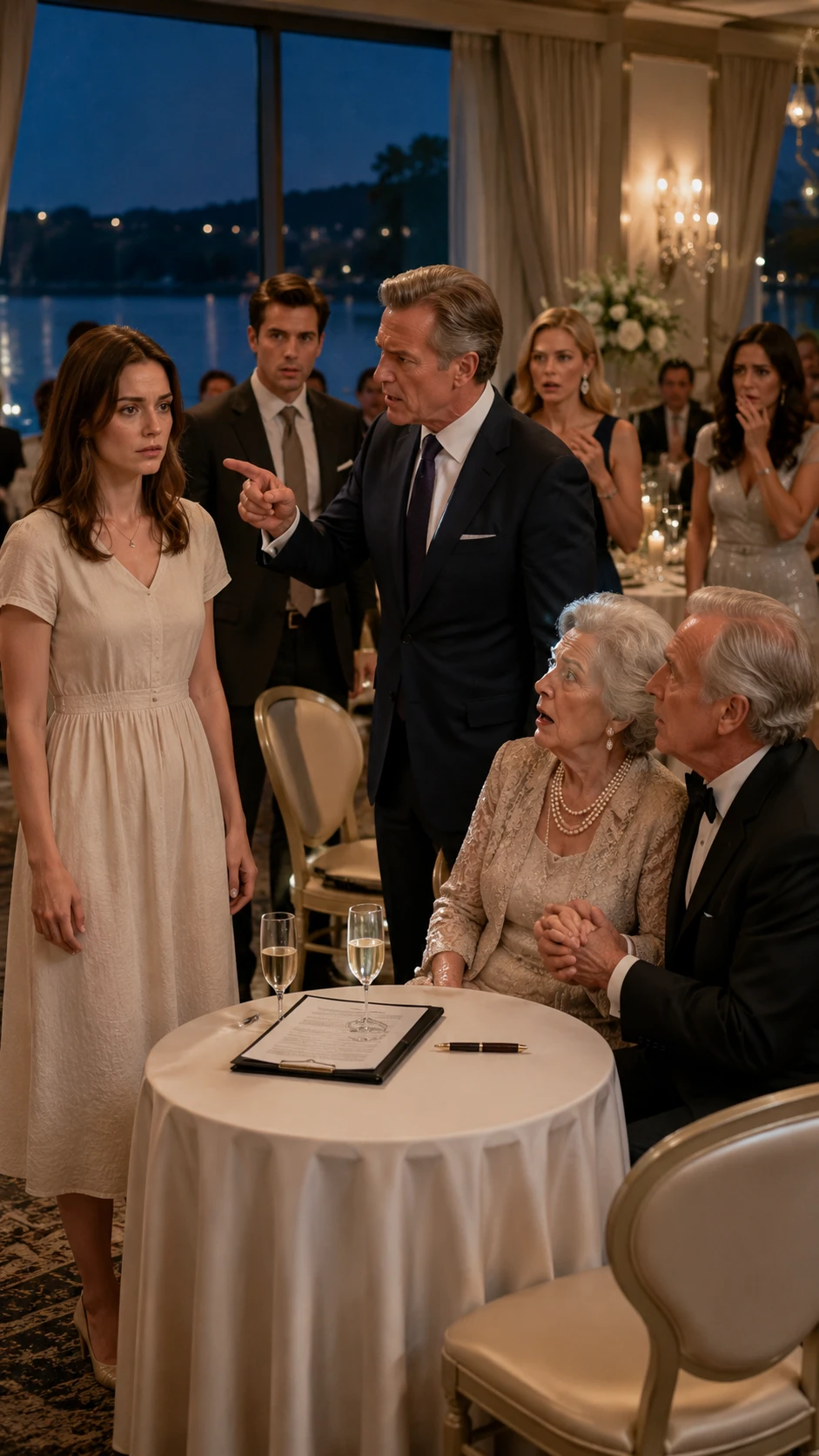
“Cancel her room,” my father demanded. “She does not belong here.”
By the time they realized what they had pushed away, it was already too late.
The first thing my brother Nolan said when I stepped out of my Subaru was, “You actually came?”
Not hello.
Not “Good to see you.”
Not even a fake hug for the guests watching near the entrance.
Just that.
The Grand View Resort and Spa in Lake Geneva looked exactly like its brochure.
White stone entrance.
Glass doors.
A valet stand polished to perfection.
Fresh flowers stood near the lobby.
Beyond the building, the lake glittered like a postcard.
My grandparents’ sixtieth anniversary reunion had been planned for nine months.
Three generations of Whitmores were supposed to gather there.
Golf.
Spa treatments.
A sunset cruise.
And one formal Saturday dinner.
Grandma would wear the pearls Grandpa had given her in 1964.
I had missed most of the family group chat.
Apparently, I had asked too many questions about the cost.
So I booked my own room.
Same hotel.
Different confirmation number.
Honestly, I preferred it that way.
Nolan stood near the entrance with his wife, Serena.
They were unloading matching designer luggage from their Range Rover.
He looked at my black rolling suitcase.
Then he looked at my cotton dress.
Then his eyes moved to my car.
“You know this place is five hundred a night, minimum, right?”
“I know.”
Serena lifted her sunglasses.
“Before resort fees.”
“I know.”
“And activities,” Nolan added.
“Dad planned a lot. Golf tournament, wine tasting, yacht cruise.”
“This isn’t exactly a budget weekend.”
I pulled up the handle of my suitcase.
“It’s Grandma and Grandpa’s anniversary.”
“That doesn’t explain how you’re paying for it.”
I looked straight at him.
“With money.”
Serena laughed softly under her breath.
It was the kind of laugh people pretend you were never meant to hear.
Then my sister Elise appeared from the lobby.
Her heels clicked across the polished floor behind her.
“Oh, Clara,” she said, already sounding worried.
“You came.”
There was that tone again.
Not joy.
Concern.
The kind people use after deciding your life is a problem to manage.
“Of course I came.”
Elise touched my arm.
“Did you talk to Dad?”
“Because he really didn’t think this was a good idea.”
“What wasn’t a good idea?”
“This,” Nolan said.
He gestured at me like I was luggage abandoned in the wrong lobby.
“You trying to keep up.”
My father walked out before I could answer.
He wore a crisp golf shirt, an expensive watch, and a stern expression.
My mother followed in a flowing resort dress.
Her face held that practiced sympathy she used when she wanted to hurt me gently.
“Clara,” Dad said.
“We need to be honest.”
I almost laughed.
My family loved honesty when it was aimed at me.
“You’re a preschool teacher,” he continued.
“There’s no shame in that.”
“But this is a luxury resort.”
“People spend what you make in a year on one week here.”
“I’m not asking anyone to pay for me.”
“That’s not the point,” Mom said.
“We don’t want you putting everything on credit cards.”
“Not just because you’re too proud to admit this is out of reach.”
Serena nodded.
“It would make everyone uncomfortable.”
“If we order wine or book spa services, we’ll all be thinking about you.”
“You’ll be sitting in your room, counting dollars.”
I stared at her.
“I promise you won’t need to think about me that much.”
Nolan’s mouth tightened.
“You’re making this difficult.”
Elise sighed.
“We love you.”
“We just don’t want you embarrassing yourself.”
Then Dad said the line that made the whole week clear.
“We don’t want you embarrassing us.”
The valet looked down.
A couple near the entrance slowed just enough to hear.
My mother whispered, “Martin.”
But she did not disagree.
I looked at each of them.
Nolan looked satisfied.
Serena looked bored.
Elise looked sad, but still left me standing alone.
Mom looked pleading.
Dad waited for obedience.
“Okay,” I said.
Everyone blinked.
“Okay?” Mom repeated.
“I’ll leave.”
Relief crossed their faces so quickly it almost made me dizzy.
“Oh, honey,” Mom said.
“That’s the mature choice.”
“Come back Saturday for dinner.”
“No pressure.”
“No stress.”
“Sure.”
I put my suitcase back into the Subaru.
Then I got behind the wheel and drove out of the circular driveway.
In the rearview mirror, they were already walking inside together.
They were laughing about something.
As if removing me had fixed the vacation.
I drove one mile down the road to a coffee shop in town.
I ordered a latte and sat beside the window.
Across the lake, the resort gleamed bright and polished on the shore.
Then I made a call.
“Good morning, Miss Whitmore,” Adrian Cole answered.
“How can I help you?”
Adrian was the regional director for Grand View Luxury Resorts.
All seven properties.
Including Lake Geneva.
“Pull up the Whitmore family reunion reservation,” I said.
“It should be under Martin Whitmore.”
A pause followed.
“Yes, I have it.”
“Party of twenty-three.”
“Presidential suite, four luxury suites, and six standard rooms.”
“Very nice booking.”
“I need you to flag it.”
“Flag it how?”
“Owner review,” I said.
“All charges.”
“All activities.”
“All privileges.”
“I want to be notified of every single thing they do this week.”
Adrian went quiet for half a second.
“Is there a problem?”
I looked back toward the resort.
“Let’s call it due diligence.”
Twenty minutes later, Adrian called back.
My father was in the lobby, trying to cancel my room.
For a moment, I only listened to the soft hiss of the espresso machine behind me.
The coffee shop smelled like cinnamon, steamed milk, and rain on old wood. People around me were reading books, checking phones, laughing quietly over brunch menus.
My father was less than a mile away, standing beneath crystal chandeliers, trying to erase me from a room I had paid for myself.
No.
Not erased.
Controlled.
That was always the difference with Martin Whitmore.
He rarely destroyed something outright if he could first make it obey.
“What exactly is he saying?” I asked.
Adrian’s voice remained calm, but I knew him well enough to hear the tension under it.
“He says you changed your mind. He says you asked him to handle the cancellation privately.”
I closed my eyes.
“Did he provide my confirmation number?”
“No.”
“Did he provide identification?”
“No.”
“Did he raise his voice?”
A pause.
“Moderately.”
I almost smiled, though nothing about it felt funny.
My father never believed he was shouting. He believed the room had failed to understand his authority.
“Don’t cancel anything,” I said.
“Of course not.”
“And don’t tell him who I am.”
Adrian went quiet again.
“Clara.”
“I mean it.”
“He is attempting to interfere with an owner-level reservation.”
“He is attempting to interfere with his daughter,” I said. “That matters more.”
Across the shop window, the lake glittered in cold blue pieces. The resort sat beyond it, bright and elegant, as if nothing ugly could happen behind that stone entrance.
But ugly things had always looked cleaner in my family.
They wore pressed shirts.
They used gentle voices.
They said cruel things slowly, so the cruelty sounded like wisdom.
Adrian exhaled.
“What would you like me to do?”
“Let the front desk follow policy. Nothing more.”
“Understood.”
“And Adrian?”
“Yes?”
“Send me everything he asks for. Every charge. Every note. Every request.”
His reply came lower this time.
“I already started.”
That was why I trusted him.
Not because he worked for me.
Because he knew when silence was protection, and when it became permission.
I ended the call and stared at my latte until the foam began to collapse.
The reasonable part of me wanted to drive home. I could return to my small apartment, put laundry in the machine, and spend Monday morning tying shoes for four-year-olds.
I could let them have their polished weekend.
I could let them eat expensive dinners, raise glasses over Grandma’s pearls, and tell themselves I had made the right choice by disappearing.
That was what I had done for years.
When Nolan joked about my paycheck at Christmas, I had smiled.
When Serena called my classroom “adorable charity work,” I had changed the subject.
When Elise stayed quiet after Dad corrected me at family dinners, I had told myself silence was not betrayal.
When Mom sent articles about “financial discipline” after I bought my Subaru, I had thanked her.
I had mistaken endurance for peace.
But my father trying to cancel my room changed something.
It was not embarrassment anymore.
It was proof.
My phone buzzed.
A message from Adrian appeared.
Front desk note: Guest Martin Whitmore requested cancellation of reservation under Clara Whitmore. Claimed guest was “emotionally overwhelmed” and “financially incapable of making responsible decisions.” Request denied.
I read it twice.
The words landed coldly.
Not because they surprised me.
Because they sounded practiced.
Financially incapable.
Emotionally overwhelmed.
My father had not improvised that phrase at the desk.
He had brought it with him.
Another message followed.
Additional request: Martin Whitmore asked whether Clara Whitmore could be removed from family activity manifests to “avoid confusion.”
I sat back slowly.
There it was.
He was not only trying to cancel the room.
He was trying to remove my name from the weekend.
A third message arrived.
Private dining update requested by Martin Whitmore: Saturday formal dinner to include document table, projector, and notary access.
The coffee shop noise blurred.
I stared at the screen.
Document table.
Projector.
Notary access.
For a moment, I saw Grandma’s hands instead of the phone.
Thin hands.
Warm hands.
Hands that had once fastened buttons on my coat when I was too small to reach them.
Hands that would wear pearls on Saturday night.
Hands my father wanted near a document table.
I called Adrian back.
He answered immediately.
“Tell me about the notary.”
“It was added three weeks ago,” he said. “Part of a private event request from Martin Whitmore.”
“Why wasn’t I notified?”
“It was listed as a ceremonial anniversary presentation. No legal language.”
“Who approved it?”
“Events department. Standard request.”
“What else?”
I heard keys tapping.
“Projector. Small signing table. Two leather chairs. Champagne service after remarks.”
My stomach tightened.
Champagne after remarks.
My father always planned celebration before consent.
“Did Grandma request any of this?”
“No. The request came from Martin.”
“Did Grandpa?”
“No.”
I leaned my elbow on the table and pressed my fingers against my brow.
All at once, the morning rearranged itself.
Dad had not wanted me gone because I might count pennies.
He had wanted me gone because I counted details.
Costs.
Names.
Documents.
Timing.
Questions.
The thing they hated most about me was not poverty.
It was attention.
“Is the attorney listed?” I asked.
“No attorney. Only a notary.”
“That’s worse.”
“Yes,” Adrian said quietly. “I thought so too.”
I looked at the resort again through the window.
It seemed farther away now.
Not in distance.
In memory.
“Prepare a duplicate of every event request,” I said. “Send copies to my secure folder.”
“Already uploading.”
“And have legal on standby.”
“Clara, do you want me to intervene now?”
I watched a family cross the street outside the coffee shop. A little girl jumped over puddles while her mother held her hand.
My voice came out softer than I expected.
“Not yet.”
“Are you sure?”
“No,” I said. “But I’m done reacting too early and being called dramatic.”
I hung up and paid for my latte, though I had barely touched it.
Outside, the air was crisp enough to sting.
I sat in my Subaru for several minutes with both hands on the steering wheel.
The dashboard still had a sticker from my classroom on it. One of my students had given it to me last spring after learning to write his name.
A gold star.
Crooked.
Peeling at one edge.
I looked at it and felt something inside me settle.
They thought the car proved I had nothing.
They never understood that I kept it because I liked things that did what they promised.
I started the engine and drove back toward the resort.
This time, I did not use the circular driveway.
I turned before the main entrance and followed a narrow service road lined with pines. It led to a discreet staff entrance near the conference wing.
A security guard stepped out as I approached.
Then he saw me and straightened.
“Miss Whitmore.”
“Hi, Luis.”
His eyes flicked toward my face.
Not curious.
Concerned.
Everyone at Grand View had been trained never to stare at an owner, a celebrity, or a crying guest.
But Luis had known me long before the ownership papers were signed. His daughter had been in my classroom two years ago, back when he worked nights and worried she was falling behind.
“She still drawing horses?” I asked.
His guarded expression softened.
“Every day. She says she’s going to own a ranch.”
“She will.”
He smiled and opened the gate.
The service road curved behind the resort, where the postcard vanished.
Here were loading docks, laundry carts, kitchen staff moving crates, and gardeners carrying trays of flowers toward the front.
This was the side of luxury guests never saw.
The part that worked.
I parked near administration and walked inside.
No one gasped.
No one bowed.
No one said, “You actually came?”
They only nodded with the careful warmth of people who knew exactly who I was and had promised not to make it strange.
That promise had been my first rule after the board vote eighteen months earlier.
No special greetings in public.
No owner suite unless operationally necessary.
No staff punished for failing to recognize me.
No family disclosures.
Especially that.
My family knew I taught preschool.
That was true.
They knew I wore cotton dresses and drove an old Subaru.
Also true.
They knew I asked too many questions about money.
Painfully true.
They did not know that Grandma and Grandpa had quietly placed their controlling shares of Grand View Luxury Resorts into a family stewardship trust.
They did not know they had named me managing trustee.
They did not know I had spent the last year learning payroll systems after school, reading contracts after midnight, and teaching toddlers by day because I refused to become the kind of person who forgot where gentleness came from.
And they absolutely did not know the first program I expanded across all seven properties was employee childcare.
That was the irony that would have amused me on another day.
My family had mocked me for being a preschool teacher while enjoying a resort whose staff loyalty had doubled because preschool teachers were finally paid properly.
I reached the administrative hallway.
Adrian was waiting outside the executive office with a tablet in one hand and a folder in the other.
He was in his early fifties, silver-haired, precise, and impossible to rattle.
Today, his jaw was tight.
“I’m sorry,” he said.
“For what?”
“For hearing it.”
I looked away first.
That was how I knew it hurt.
“I’ve heard worse.”
“That doesn’t make it acceptable.”
“No,” I said. “It doesn’t.”
He opened the folder.
“Your father failed to cancel the room. He then requested your key access be limited. Denied. He asked if security could be informed you were no longer a guest. Denied.”
My throat tightened despite myself.
“Did he use the same language?”
“Financially incapable. Emotionally unstable. Potential disruption.”
I let out a breath through my nose.
“Efficient.”
“There’s more.”
He handed me the folder.
Inside were printouts of the weekend itinerary. Golf. Spa. Wine tasting. Yacht cruise. Private dinner. Sunday brunch.
Each had notes attached.
Family charges to master account.
Do not disclose line-item totals to guests unless requested by Martin Whitmore.
If Clara Whitmore appears for activities, refer to Martin Whitmore before seating.
I looked up.
“Who added that?”
“Events coordinator. Per Martin’s phone instructions.”
“Did she know who Clara Whitmore was?”
“No.”
“Good.”
Adrian frowned.
“Good?”
“She followed the chain she was given. This is not on staff.”
His expression shifted slightly.
I had learned that from Grandma.
When something went wrong, find the person with power first.
Everyone else was usually surviving instructions.
I turned the page.
At the bottom of Saturday’s dinner schedule, one line was highlighted.
Legacy Presentation: Martin Whitmore, 8:10 p.m. Document signing to follow.
My skin went cold again.
“What document?” I asked.
“We don’t have it.”
“Find out.”
“I’m trying.”
Before he could say more, a soft knock came from the side door.
Adrian glanced over.
“Elise Whitmore is asking for you.”
My sister stood in the corridor with her arms wrapped tightly around herself.
Her resort clothes looked perfect.
Her face did not.
She had always been the beautiful one in the family photos. Soft brown hair, elegant hands, eyes that made people forgive her before she apologized.
But there was no elegance in her now.
Only fear.
“Elise,” I said.
Her eyes moved to Adrian, then back to me.
“You came back.”
“You sound disappointed.”
Her mouth trembled.
“I’m relieved.”
That stopped me.
For years, Elise had been sadness without action.
A sigh at the table.
A worried look in the hallway.
A text afterward saying, I’m sorry Dad was intense.
Never a challenge.
Never a refusal.
I had mistaken that for weakness.
Maybe it was.
But now she looked like someone who had been standing too close to a fire and finally smelled smoke on her own clothes.
“Why are you here?” I asked.
She swallowed.
“Because Dad just told everyone you went home.”
“I did leave.”
“He said you broke down.”
I almost laughed.
It came out sharp and ugly.
“Of course he did.”
“He said you admitted you couldn’t afford the weekend.”
Adrian’s face hardened behind me.
Elise saw it and went pale.
“Clara,” she whispered. “Why is the regional director standing with you?”
I held her gaze.
“Because he works here.”
Her eyes searched mine.
Something clicked behind them.
Not the whole truth.
Enough to frighten her.
“Oh,” she said.
Just that.
Then she covered her mouth.
Not with jealousy.
Not with calculation.
With horror.
“Oh my God.”
“What did Dad ask Grandma to sign?” I asked.
Elise froze.
There it was.
The question had gone exactly where it needed to go.
Her silence answered before she did.
“You know,” I said.
Her eyes filled.
“I didn’t know at first.”
“At first?”
She looked down at the folder in my hand.
“I thought it was just Dad being Dad. Controlling the weekend. Making everything look perfect.”
“That’s never just Dad being Dad.”
“I know that now.”
Her voice cracked.
“I know.”
Adrian stepped away without being asked, moving far enough to give us privacy while staying close enough to protect it.
Elise hugged herself tighter.
“Three months ago, Dad asked me to help organize family documents for the reunion. He said Grandma and Grandpa were getting older, and the trip would be a good time to discuss planning.”
My stomach sank.
“What kind of planning?”
“Power of attorney. Asset management. Voting rights. Medical decisions. Everything.”
The hallway seemed to narrow.
“Did Grandma ask for this?”
“No.”
“Grandpa?”
“No.”
“Then why didn’t you tell me?”
Her face twisted.
“Because he said you would make it emotional.”
I stared at her.
She flinched.
“I’m not defending it.”
“You are explaining why you obeyed him.”
“Yes,” she whispered. “And I hate it.”
I looked toward the frosted glass door at the end of the hall.
Beyond it, staff were arranging flowers for a family that believed beauty could hide a trap.
Elise spoke faster now, as if the words had waited too long.
“He said you were jealous. That you’d ruin the anniversary. That you’d make Grandma feel guilty for not paying for everyone equally.”
I blinked.
“What?”
She wiped her cheek.
“He told us Grandma and Grandpa only covered part of the weekend. He said he was paying most of it. He collected contributions from Nolan, Serena, Aunt Linda, everyone.”
My pulse slowed.
That dangerous calm returned.
“How much?”
“I don’t know all of it. Nolan paid eight thousand. Serena said it was worth it if the photos helped her brand deal. Aunt Linda paid five. Some cousins paid less.”
“And Grandma?”
Elise’s voice dropped.
“She thinks the entire weekend was prepaid from her anniversary account.”
“It was,” I said.
Elise stared at me.
“What?”
“It was prepaid seven months ago.”
“No.”
“Yes.”
“But Dad said—”
“I know what Dad said.”
Her shoulders sagged as if something heavy had finally landed.
Then she reached into her purse with shaking hands and pulled out a folded envelope.
“I copied what I could.”
She held it out.
“I was going to bring it to you Saturday before dinner.”
“Why Saturday?”
“Because I thought if I confronted him earlier, he’d move everything. Change the document. Blame me. Blame you.”
I did not take the envelope yet.
“Then why did you tell me to leave?”
The question came out quiet.
That made it worse.
Elise looked at me with more pain than I had ever seen on her face.
“Because I thought they were going to humiliate you in the lobby.”
“They did.”
“I know.”
“No, Elise. You stood there.”
She closed her eyes.
“I know.”
The silence between us filled with all the years she had almost spoken.
Almost defended.
Almost called.
Almost chosen me.
“I thought if you left calmly,” she said, “Dad would relax. I thought I could get Grandma alone and stop the signing.”
“That was your plan?”
“It was a coward’s plan,” she said.
The honesty landed harder than an excuse would have.
“I’m sorry.”
I looked at the envelope in her hand.
Then at my sister.
For the first time that day, I did not see polished concern.
I saw someone who had learned fear in the same house I had.
She had simply learned to survive it differently.
I took the envelope.
Inside were printed emails, screenshots, and one draft document.
The title made my stomach turn.
Whitmore Family Legacy Preservation Agreement.
I scanned the first page.
It gave Martin temporary authority to act on behalf of Walter and Rose Whitmore regarding “hospitality holdings, personal trusts, medical coordination, and future asset disposition.”
Temporary, in legal language, often meant until someone fought hard enough.
I turned to the signature page.
Grandma’s name.
Grandpa’s name.
Martin’s name.
A notary block.
And beneath it, a waiver.
All family members acknowledge Martin Whitmore as acting family representative for all matters regarding Grand View Luxury Resorts and related trust instruments.
My hand tightened around the paper.
There it was.
Not only money.
Authority.
He did not know the full structure, but he knew enough.
He knew Grand View mattered.
He knew Grandma and Grandpa had shares.
He knew I asked questions.
And he knew the easiest way to steal a voice was to first make everyone believe that voice was unstable.
My father had not tried to cancel my room because I was poor.
He had tried to cancel it because my name was the one name he could not afford in that room.
Elise watched my face.
“Clara?”
“Does Mom know?”
“I think she knows parts.”
“That means yes.”
Her chin trembled.
“She keeps saying Dad is under pressure.”
“Everyone is under pressure.”
“I know.”
“No,” I said. “You know now.”
She nodded once.
Tears slipped down her face.
“Can you stop him?”
I looked at the document again.
Then I thought of Grandma’s pearls.
The story everyone knew was simple. Grandpa had bought them in 1964 after saving for eight months.
The story almost no one knew was different.
Grandpa had bought them after Grandma sold her wedding bracelet to help him keep his first lakeside motel.
Years later, that motel became a partnership.
Then a regional hospitality group.
Then Grand View.
The pearls were never only jewelry.
They were proof that love sometimes looked like sacrifice before anyone called it wealth.
And my father wanted to turn that history into paperwork under a chandelier.
“Yes,” I said.
Elise’s knees seemed to weaken.
“But not by making a scene in the hallway.”
“What are you going to do?”
I looked toward the lobby.
“Let him finish setting the table.”
That afternoon passed like a storm gathering behind glass.
From the executive office, I watched the family through reports, alerts, and staff notes.
Nolan requested a suite upgrade because “the family was important to the property.”
Denied politely.
Serena asked whether the resort could arrange lakefront photos “in exchange for exposure.”
Quoted standard rates.
Dad tried again to confirm I was not on the dinner seating chart.
Events replied that all named guests remained listed unless the host changed the official contract.
He sent back one sentence.
Remove Clara Whitmore.
Adrian printed it.
He did not smile.
He only placed it in the folder.
At 4:20 p.m., another charge alert appeared.
Private wine tasting expanded.
Twelve additional premium bottles.
Master account.
At 5:05 p.m., spa services upgraded.
Couples treatments.
Master account.
At 5:40 p.m., yacht cruise extended.
Master account.
Beside every request, Martin’s name appeared like a fingerprint.
By evening, I knew the shape of it.
My father had collected money from half the family while letting Grandma believe her anniversary account covered everything.
He had inflated the weekend to impress people, then planned to use the “legacy agreement” to gain authority over assets large enough to hide what he had done.
It was not genius.
It was entitlement with stationery.
The next morning, I saw Grandma for the first time.
Not in person.
On a security feed from the lobby, which Adrian showed me only after asking twice if I truly wanted to see.
She entered beside Grandpa, small and elegant in a pale blue jacket.
Grandpa moved slower than last Christmas. His hand rested on her arm, though I knew she was probably the steadier one.
Mom walked beside them, smiling too brightly.
Dad stood ahead, directing bellmen as if the resort belonged to him.
The sight made something ache behind my ribs.
Grandma looked around the lobby.
Then she asked something.
I could not hear it, but I knew my grandmother’s mouth.
Where is Clara?
Mom answered.
Grandma’s smile faltered.
Dad touched her shoulder and guided her toward the elevators.
I looked away.
Adrian quietly closed the tablet.
“I can bring her to you,” he said.
“No.”
“She deserves to know you’re here.”
“I know.”
“Then why wait?”
Because if I went to Grandma now, my father would make it emotional.
He would say I had upset her.
He would say I had brought business into a family celebration.
He would use her love for me as evidence against me.
“I need him to reveal the document in front of witnesses,” I said.
Adrian nodded slowly.
“Legal agrees.”
“I hate that sentence.”
“So do I.”
By Saturday evening, the whole resort seemed to glow.
The lake reflected orange light from the sinking sun. Staff moved through the ballroom with candles, white roses, and linen napkins folded like sails.
From a private preparation room, I watched through a narrow glass panel as my family entered.
Nolan looked smug in a navy suit.
Serena wore emerald silk and checked her reflection in her phone.
Elise walked in last, pale but steady. When she passed the preparation room, she did not look over.
But her hand brushed her purse once.
The envelope was no longer there.
It was with legal.
Grandma entered on Grandpa’s arm.
She wore the pearls.
For one second, I was nine years old again, sitting on her bathroom counter while she dabbed perfume behind her ears.
Never wear something valuable to prove you are valuable, she had told me.
Wear it to remember what it cost someone to love you.
I pressed my fingers against my palm until the memory passed.
Dinner began beautifully.
That was the cruel part.
The food was perfect.
The music was soft.
People laughed.
Cousins posed for photographs.
Grandpa kissed Grandma’s hand when the anniversary cake arrived, and everyone clapped.
For a while, the evening almost became what it should have been.
A family honoring two people who had stayed.
Then my father stood.
His spoon touched his glass.
The room quieted.
“Before dessert,” he said, smiling with controlled emotion, “I want to say a few words about legacy.”
Elise lowered her eyes.
Mom folded her hands tightly in her lap.
Grandma looked up at Dad with polite confusion.
Grandpa did not smile.
That surprised me.
My father continued.
“This weekend has reminded me how important stewardship is. Mom and Dad built something extraordinary from very little.”
He turned toward the projector screen.
A photo appeared.
Grandma and Grandpa in front of the first lakeside motel.
Young.
Laughing.
Poorer than anyone at those tables wanted to imagine.
Dad’s voice warmed.
“As they enter this next chapter, it’s time for the family to help carry what they built.”
A few relatives nodded.
Nolan looked solemn.
Serena discreetly adjusted her phone angle to capture him.
Dad gestured toward the side of the room.
A resort employee wheeled out the small document table.
Two leather chairs.
A notary.
Champagne glasses waiting nearby.
Grandma’s smile vanished.
“Martin,” she said softly. “What is this?”
Dad gave her the tender look he used when cornering someone in public.
“Just a simple family agreement. We discussed planning, remember?”
“No,” Grandpa said.
The word cut cleanly through the room.
Dad’s smile flickered.
“Dad, we talked about making things easier.”
“We talked about dinner,” Grandpa said.
A murmur moved across the tables.
Dad recovered quickly.
“Of course. And this is part of protecting future dinners. Future reunions. Future stability.”
He lifted the document.
“I’ve carried most of the burden for this weekend already. I’m happy to do that. But we need clear authority going forward.”
There it was.
Burden.
The lie dressed as sacrifice.
Grandma slowly removed her napkin from her lap.
“Most of the burden?”
Dad’s eyes sharpened.
Financially, he had trained the entire family not to ask questions in front of outsiders.
But Grandma was not an outsider.
She was the beginning.
“Yes,” he said. “There were expenses. Contributions. It’s not important tonight.”
“It is important if you are asking me to sign something.”
His jaw tightened.
“Mom, please. This is exactly why we need structure. Conversations become confusing.”
Grandpa’s hand closed over Grandma’s.
“They are not confused.”
Dad looked around the room.
Now he needed allies.
“Nolan,” he said.
My brother stood halfway.
“Dad’s just trying to help. We all know things have been complicated.”
“Sit down,” Grandma said.
Nolan sat.
I had never loved her more.
Dad’s face hardened.
“This is precisely the problem. Emotion keeps getting in the way of responsibility.”
That was my cue.
I opened the preparation room door.
The ballroom turned toward the sound.
I stepped inside wearing the same cotton dress from the driveway.
No diamonds.
No dramatic gown.
No armor except the truth.
For a second, nobody moved.
Then Mom whispered, “Clara.”
Nolan’s mouth fell open.
Serena lowered her phone.
Dad went very still.
Grandma’s hand flew to her chest.
“Oh,” she breathed.
Not confusion.
Relief.
I walked between the tables slowly.
Every step sounded too loud.
Dad found his voice first.
“This is not the time.”
I stopped near the document table.
“It seems to be exactly the time.”
His eyes flashed.
“You were asked to leave.”
“Yes.”
“You chose to leave.”
“Yes.”
“You admitted—”
“I admitted nothing.”
The room was silent enough to hear the candles crackle.
I looked at Grandma.
“I’m sorry I waited.”
Her eyes shone.
“You came back.”
“I never left the property.”
Dad’s face changed.
Just slightly.
Enough.
He understood before anyone else.
Not everything.
But enough to fear the rest.
“What does that mean?” Nolan demanded.
“It means,” Adrian said from the ballroom entrance, “Miss Whitmore has been available all weekend.”
Every head turned.
Adrian walked in with the calm dignity of a man who had ended bigger men with smaller folders.
Behind him came a woman in a charcoal suit.
Marianne Vale.
Grand View’s general counsel.
Dad stared at her.
“Who are you?”
“The attorney you should have invited before asking elderly guests to sign asset documents,” she said.
A stunned sound moved through the room.
Serena whispered, “What is happening?”
I looked at her.
“Something without exposure.”
Her face reddened.
Dad lifted the document.
“This is a private family matter.”
Marianne smiled faintly.
“You scheduled it through a Grand View event order, requested a notary, used our ballroom, and referenced hospitality holdings governed by our trust agreements.”
She stepped closer.
“That makes it several matters.”
Dad’s voice dropped.
“Clara, stop this right now.”
It was the voice from childhood.
The one that ended arguments before I understood them.
The one that made apology feel safer than breathing.
My hands shook once.
Then steadied.
“No.”
The room absorbed the word.
Small.
Plain.
Unfamiliar.
Dad stared at me as if I had spoken another language.
I turned to the family.
“This weekend was prepaid seven months ago.”
Nobody spoke.
I looked at Aunt Linda first.
“Grandma and Grandpa paid for the rooms, the dinner, the cruise, and the planned activities.”
Aunt Linda’s expression collapsed.
“But Martin said we were contributing.”
“He collected contributions.”
Nolan stood again.
“Wait.”
Serena grabbed his sleeve.
“Don’t.”
But panic had already moved through him.
“I paid Dad eight thousand dollars.”
Several relatives began talking at once.
Dad raised his hands.
“Everyone calm down. There were additional costs.”
Adrian opened the folder.
“Additional costs were charged to the master account under Martin Whitmore’s authorization, not family necessity.”
He read the list without drama.
Premium wine.
Expanded spa services.
Extended yacht time.
Private photographer.
Media styling consultation.
Serena sank slowly into her chair.
Grandma looked at Dad as if seeing him from far away.
“Martin,” she said. “Why?”
For the first time that night, my father looked older.
Not repentant.
Exposed.
“There were expectations,” he said.
The answer was so small after so much damage.
“What expectations?” Grandpa asked.
Dad’s mouth worked.
“This family has an image.”
Grandma’s eyes hardened.
“No. You have an image.”
He flinched.
Mom began crying silently.
I wanted to feel satisfaction.
Instead, I felt grief.
Because there is a special sorrow in learning that someone did not become cruel.
They simply ran out of rooms where they could hide it.
Marianne placed another document on the table.
“This is the current stewardship record for Whitmore Family Hospitality Holdings.”
Dad’s eyes snapped toward her.
“You can’t disclose that.”
“To the beneficiaries and trustees present?” she asked. “Yes, I can.”
Nolan looked at me.
“Trustees?”
I took a breath.
This was the part I had never wanted.
Not because I was ashamed.
Because I had wanted one place in my life where love arrived before credentials.
“Grandma and Grandpa placed their controlling Grand View shares into a stewardship trust eighteen months ago.”
The room became airless.
“They named me managing trustee.”
Serena made a small sound.
Nolan stared as if I had struck him.
“You?”
I looked at him.
“Yes.”
“But you teach preschool.”
“I do.”
“You drive a Subaru.”
“I do.”
“You live in that little apartment.”
“I like my apartment.”
His face flushed darker with every answer.
Dad’s voice came low.
“You had no right to keep that from us.”
Grandpa laughed once.
Dry.
Sharp.
“She had every right. We asked her to.”
Everyone turned to him.
Grandpa sat straighter.
For the first time all weekend, he looked less fragile than furious.
“We wanted to see who would treat Clara with respect when they thought she had nothing to give.”
The room went painfully quiet.
Grandma touched her pearls.
“These were not bought with spare money,” she said. “I sold my bracelet so your grandfather could keep the first motel alive.”
Her voice trembled, but did not break.
“I learned early that people often respect money while insulting the sacrifices that made it.”
She looked at Dad.
“I did not want that disease in this family.”
Dad looked down.
But Grandma was not finished.
“We chose Clara because she was the only one who asked what the staff earned before asking what the suites cost.”
My eyes burned.
I had not known that part.
Grandpa turned toward me.
“You thought we chose you because you were careful.”
I swallowed.
“Yes.”
“We chose you because you noticed people.”
The words hit harder than the insult in the driveway.
I had spent years trying not to need my family’s approval.
Then my grandparents gave me something gentler.
Recognition.
Elise began crying openly now.
Nolan looked at the table.
Serena’s phone rested face down beside her plate.
Dad gripped the back of a chair.
“You set me up,” he said.
Grandma’s face changed.
Pain moved through it before anger returned.
“No, Martin. We gave you time.”
He shook his head.
“You hid ownership from your own son.”
“We protected it from him,” Grandpa said.
Dad recoiled.
The difference landed.
I saw it.
So did everyone else.
Marianne opened a second folder.
“There is also the matter of the collected family contributions.”
Aunt Linda’s voice shook.
“How much?”
Elise stood.
All eyes turned to her.
She held a flash drive in one hand.
“I have copies.”
Dad stared at her.
“Elise.”
She almost folded under his voice.
I saw it happen.
The old reflex.
The daughter wanting peace.
The child fearing the storm.
Then she looked at me.
And for once, she did not look away.
“No,” she said.
Her voice was trembling.
But it was there.
“I helped him hide things because I was scared. Then I kept copies because I was more scared of what would happen if nobody stopped him.”
Dad looked wounded, as if her fear were an insult.
“You don’t understand the pressure I was under.”
Elise wiped her face.
“I understand it better than you think.”
She turned to the room.
“Dad’s consulting business has been failing for over a year. He took money from the contribution account to cover a loan payment. He said he would replace it after getting authority over the trust distributions.”
Mom let out a broken sound.
Nolan sat down hard.
Grandma closed her eyes.
There was the second secret.
Not greed alone.
Desperation.
Pride.
Fear rotting into control.
Dad did not deny it.
That was almost worse.
He only whispered, “I was going to fix it.”
Grandpa’s voice came tired.
“With our signatures?”
Dad looked at him, and for one second, he was not a tyrant.
He was a frightened son who had confused asking for help with dying.
“I couldn’t lose everything,” he said.
Grandma’s face softened.
But only slightly.
“So you were willing to take it from us?”
His eyes filled.
“I was trying to keep the family together.”
“No,” I said gently.
He turned toward me.
“You were trying to keep yourself at the center of it.”
The words did not explode.
They landed.
He looked like he wanted to hate me for them.
Maybe he did.
But he did not argue.
Marianne moved the unsigned document away from Grandma’s seat.
“This agreement will not be signed.”
Dad laughed bitterly.
“Obviously.”
“That is not the only consequence,” she said.
He looked up.
“All collected contributions must be returned within thirty days. Any missing funds will be documented as misappropriation unless repayment terms are signed tonight.”
Mom covered her mouth.
Grandma stared at her son.
“Can you repay it?”
Dad did not answer.
That answer filled the room.
Grandpa leaned back, suddenly looking exhausted.
For a moment, nobody spoke.
The victory I had imagined in the coffee shop did not feel like victory at all.
It felt like standing in a beautiful ballroom while a wall came down and revealed mold behind it.
Then Grandma pushed back her chair.
I moved toward her instinctively, but she lifted one hand.
Not to stop me.
To steady herself.
She faced the family.
“This anniversary was supposed to celebrate sixty years of marriage,” she said. “But marriage is not the only thing that lasts because people tell the truth.”
Her eyes moved from table to table.
“Families last that way too. Or they do not last honestly at all.”
Nolan stared at his plate.
Serena was crying now, quietly, perhaps for herself, perhaps for the life she thought she had married into.
Grandma looked at Dad again.
“Martin, you will step down from all informal management of our affairs tonight.”
His face crumpled.
“Mom.”
“You will speak with Marianne and arrange repayment.”
“I’m your son.”
“Yes,” she said. “That is why I am not calling the police from this table.”
A shocked silence followed.
Her voice softened.
“But being my son does not make you safe for my signature.”
Dad lowered his head.
I had never seen him do that.
Not bow.
Not surrender.
Just fail to remain tall.
Grandpa reached for Grandma’s hand.
“And the rest of you,” he said, voice rough, “will stop measuring Clara by what you thought she lacked.”
His eyes found Nolan.
“That includes you.”
Nolan’s mouth opened.
No words came.
Grandpa looked at Serena.
“And you.”
She nodded quickly, tears slipping down her cheeks.
Then he looked at Elise.
Elise froze.
“You were late,” he said.
She flinched.
“But you came.”
She covered her face.
Grandma stepped toward her first.
Elise broke.
“I’m sorry,” she sobbed. “I’m so sorry.”
Grandma held her with one arm, but her eyes found me over Elise’s shoulder.
There was apology there too.
Not for what she had done.
For what she had hoped would not happen.
I understood then.
The final twist was not that Grandma and Grandpa had tested us.
It was that they had still hoped we would pass.
They had not wanted a scene.
They had not wanted humiliation.
They had wanted proof that their family could inherit something without becoming smaller than it.
Instead, the proof had hurt everyone.
Dinner did not continue normally after that.
How could it?
The cake remained half-cut.
The champagne stayed untouched.
Relatives moved in small, shaken clusters.
Some asked Adrian for copies of charges.
Some apologized to Grandma.
Some avoided looking at me.
Nolan approached once, stopped, then walked away.
Serena whispered something to him, and he shook his head.
For once, neither of them seemed to know how to perform.
Dad signed preliminary repayment paperwork in a side room with Marianne.
Mom sat outside the room alone, twisting a tissue until it tore.
I stood near the windows overlooking the lake.
The dark water reflected ballroom lights in broken gold lines.
Elise came to stand beside me.
Her mascara was ruined.
Her perfect hair had loosened around her face.
“I should have defended you outside,” she said.
“Yes.”
She nodded.
No excuses.
That mattered.
“I thought if I kept everyone calm, I could fix it quietly.”
“That’s what Mom always taught us.”
Elise gave a small, painful laugh.
“Keep things pretty.”
“Keep things quiet.”
“Keep Dad proud.”
We stood there, watching the lake.
“I don’t expect you to forgive me tonight,” she said.
“I don’t know what I’m doing tonight.”
“That’s fair.”
I glanced at her.
“But thank you for keeping copies.”
She cried again, silently this time.
“You looked so alone in the driveway,” she whispered. “And I hated myself because I was part of it.”
I thought of her hand on my arm.
Her worried voice.
You came.
All morning, I had heard condemnation in it.
Now I heard panic.
Not enough to erase the hurt.
Enough to complicate it.
“Next time,” I said, “don’t protect me by letting them hurt me.”
She nodded.
“There won’t be a next time.”
I wanted to believe her.
I did not know if I could.
But wanting was a beginning.
Across the room, Grandma removed her pearls.
The gesture was so small that almost no one noticed.
I did.
She walked toward me with Grandpa beside her.
For a second, the whole noisy, broken ballroom faded.
There were only the three of us near the windows.
Grandma held the pearls in both hands.
“I wore them because I thought tonight would be about memory,” she said.
Her voice was tired now.
Very tired.
“It was,” I said.
“Not the kind I wanted.”
“No.”
She looked down at the pearls.
“I should have told you we suspected your father.”
I shook my head.
“You were hoping you were wrong.”
Her eyes filled.
“That is a very expensive kind of hope.”
Grandpa put his hand on my shoulder.
Not heavy.
Just there.
“We also should have told you that the board vote was not the only reason we chose you.”
I looked at him.
“What do you mean?”
Grandma smiled through tears.
“Do you remember the first question you asked when we showed you the Lake Geneva reports?”
I thought back.
There had been spreadsheets, occupancy rates, renovation budgets, legal structures. I had been terrified they would discover I was pretending to understand faster than I did.
“I asked why turnover was so high in housekeeping.”
Grandma nodded.
“Everyone else asked about profit.”
Grandpa’s eyes warmed.
“You asked who was exhausted.”
My throat closed.
“That wasn’t strategy.”
“No,” Grandma said. “It was better.”
She lifted the pearls.
“I don’t want these to sit in a safe after me.”
“Grandma—”
“I’m not giving them to you because you are the trustee.”
Her fingers closed around mine.
“I’m giving them to you because you still know what things cost.”
The pearls were cool against my palm.
I could not speak.
Across the room, Dad stepped out of the side office.
He looked at us.
For once, he did not come over.
For once, he seemed to understand that not every family moment belonged to him.
That was not forgiveness.
It was distance.
And tonight, distance felt like mercy.
Grandma followed my gaze.
“He will have to live with what he did,” she said.
“So will we.”
“Yes.”
Her honesty settled between us.
Grounded.
Unpretty.
Real.
The formal dinner ended without speeches.
Guests left quietly.
Some hugged Grandma.
Some avoided Dad.
Nolan approached me near the door.
His face was pale.
“I didn’t know,” he said.
I looked at him.
“About the money?”
“About any of it.”
I waited.
He swallowed.
“I still said what I said.”
“Yes.”
His eyes lowered.
“I’m sorry.”
The apology was awkward and insufficient.
But it was the first thing he had offered me all weekend that was not wrapped in contempt.
“Return the money Dad took from you through legal,” I said. “Don’t make Grandma chase it.”
He nodded.
“I won’t.”
Serena stood behind him, arms folded tightly.
She looked smaller without performance.
“I deleted the videos,” she said.
I had not known there were videos.
That hurt in a fresh place.
“Good,” I said.
She winced.
No absolution came.
She did not deserve one yet.
Maybe someday she would earn a conversation.
Not tonight.
Near midnight, after legal papers were locked away and the family scattered into separate rooms, I walked outside.
The resort garden was quiet.
Lanterns glowed along the path to the lake.
The air smelled of damp stone and roses.
I sat on a bench near the water with Grandma’s pearls wrapped around my hand.
A few minutes later, Elise came out and sat beside me.
She did not speak.
That helped.
Then Grandma appeared on the path, leaning on Grandpa’s arm.
They moved slowly, carefully, like two people crossing not distance, but time.
I stood.
Grandma waved me down.
“No more standing for ceremony tonight.”
So I sat.
She lowered herself beside me with a soft sigh. Grandpa sat on her other side.
For a while, we listened to the water.
No one apologized again.
No one explained.
No one tried to turn pain into a lesson too quickly.
The resort glowed behind us, full of rooms, charges, secrets, and sleeping relatives who would wake tomorrow to consequences.
The lake moved gently in the dark.
Grandma reached for my hand.
I let her take it.
Her fingers rested over the pearls.
“When you were little,” she said, “you used to ask why they were not perfectly round.”
I remembered.
I had thought expensive things were supposed to be flawless.
Grandma had told me real pearls were shaped by irritation.
By something sharp entering a soft place.
By the long work of covering pain until it became luminous.
Tonight, I finally understood why she had smiled sadly when she said it.
I leaned my head against her shoulder.
Grandpa covered both our hands with his.
Behind us, the Grand View Resort shone across the grass.
Beautiful.
Imperfect.
Still standing.
And for the first time all weekend, nobody asked me to leave.