“Move away, kid,” the man in the gray suit snapped, stepping between the hungry boy and the glass office doors.
The little boy tried to stand, but his knees folded beneath him before anyone reached for him.
Helen Carter heard the hard sound of his palm scraping concrete before she saw his face.
She had been walking toward the alley behind the Lexington Avenue tower, holding her small lunch box against her chest.
Her cleaning shift had ended late that morning.
Her back hurt from polishing marble floors.
Her wrists still smelled faintly of bleach.
The July sun struck the sidewalk like a sheet of white fire.
Office workers moved around her in sharp streams, carrying salads, iced coffees, deli sandwiches, and brown paper bags.
Nobody slowed down for the boy.
Nobody wanted to look at him for more than a second.
He sat near the shallow concrete steps outside the tower, half-hidden beside a planter of dying summer flowers.
His oversized shirt clung to his thin shoulders.
Dust streaked his face.
His lips were dry and cracked.
His dark hair stuck to his forehead.
He looked at the food in people’s hands with a shame that seemed too old for his small face.
“Move,” the office worker repeated, louder this time.
The boy pressed one hand to the step and pushed himself up.
“I’m sorry,” he whispered.
His voice barely reached Helen through the noise.
A woman in heels shifted away from him and wrinkled her nose.
“Why do they let people sit here?” she muttered.
Her coworker laughed softly, but not kindly.
Helen stopped walking.
She looked down at the lunch box in her hands.
Inside were two slices of bread, a little rice, and the last piece of chicken from the night before.
She had packed it carefully at dawn.
She had counted every dollar before buying her weekly bus pass.
She had told herself lunch would help her finish the second cleaning job that evening.
Then the boy swayed.
His knees shook once.
His eyes rolled slightly, as if the bright sidewalk had suddenly tilted under him.
Helen moved before thinking.
“Hey,” she said, rushing forward.
The boy’s body dropped toward the edge of the step.
Helen caught his arm just before his temple hit the concrete.
Her lunch box slipped from her other hand and clattered beside them.
A few office workers stopped.
Others kept walking, irritated by the small interruption in their lunch hour.
The boy’s weight frightened her.
He felt almost weightless.
Helen lowered him back to the step and touched his shoulder gently.
“Baby, look at me,” she said.
His eyes fluttered open.
He seemed embarrassed that she had helped him.
“I’m okay,” he said, though his voice trembled.
“No,” Helen answered softly. “You’re not.”
A shadow fell across them.
Victor Lane stood above her in his black building-manager suit, his badge clipped perfectly to his jacket.
He had always walked like every inch of the building belonged to him.
His shoes were polished enough to catch the sun.
His expression held no surprise.
Only annoyance.
“Helen,” Victor said. “What are you doing?”
She looked up at him.
“He almost fell.”
Victor glanced at the boy as though he were trash blown against the building entrance.
“This area has to stay clear.”
“He’s a child,” Helen said.
“He’s blocking tenants.”
“He needs help.”
Victor’s mouth tightened.
“Then call someone else.”
The boy tried to pull his knees beneath himself.
“I can go,” he murmured.
Helen turned back to him.
“You don’t have to run.”
The boy’s eyes flicked toward Victor.
Fear moved across his face quickly, like a hand passing over a candle.
“I haven’t eaten,” he said.
The sentence broke something in Helen.
Not because she had never heard hunger before.
She knew hunger.
She knew how it sounded when someone tried to make it smaller than it was.
She knew how pride could whisper through an empty stomach.
She had skipped dinners.
She had stretched soup.
She had told herself coffee counted as breakfast.
But this boy was seven, maybe younger.
His bones showed through his wrists.
His voice had no demand in it.
Only apology.
Victor looked toward the front doors.
Two security guards stood inside the lobby, watching through the glass.
A group of employees from the legal firm on the twenty-eighth floor paused near the revolving doors.
Their eyes moved from the boy to Helen, then to Victor.
Victor hated scenes.
He especially hated scenes involving the cleaning staff.
“This is a business entrance,” Victor said.
His voice stayed low, but his anger sharpened each word.
“I understand,” Helen replied.
“No, you don’t.”
Victor bent and reached for the boy’s shoulder.
The boy flinched before the hand touched him.
Helen saw that flinch.
It was small, fast, practiced.
She stepped between them.
Victor froze.
A few people nearby became quiet.
Helen had never blocked him before.
She had nodded through schedule changes.
She had accepted extra floors.
She had worked sick.
She had apologized when other people spilled coffee on carpets.
But now she stood between Victor and a starving child.
“Helen,” he said warningly.
She picked up the lunch box from the ground.
The plastic lid had cracked slightly at one corner.
She held it like it mattered, because it did.
Victor stared at it.
“That food is for you,” he said.
The words came out almost as an accusation.
Helen looked at the boy.
He looked away, ashamed of needing anything.
The sun beat down on his neck.
People passed with lunch bags swinging from their wrists.
Some watched without stopping.
Some pretended they could not see.
Helen opened the lid.
The smell of chicken and rice rose faintly into the hot air.
The boy’s eyes moved toward it despite himself.
He swallowed.
His throat worked painfully.
Helen crouched in front of him.
“What’s your name?” she asked.
The boy hesitated.
“Noah,” he said.
“Noah what?”
“Noah Reed.”
His voice thinned at the last name, as if it belonged to someone he had lost.
Helen nodded.
“I’m Helen.”
“I’m sorry, Helen.”
“For what?”
“For sitting here.”
Helen blinked hard.
Behind her, Victor exhaled sharply.
“Enough,” he said. “Give him a dollar and send him down the block.”
Helen looked at the open lunch box.
Then she looked at the bottle of water tucked into the side pocket of her cleaning bag.
She had planned every bite of that meal.
She had planned drinking water slowly, because fountains in the basement tasted like metal.
She thought about the long evening ahead.
She thought about the bus ride home.
She thought about her rent envelope, thin and accusing in her kitchen drawer.
Then she placed the lunch box into Noah’s hands.
His fingers curled around it slowly, disbelieving.
“He needs it more than I do,” Helen said.
Victor’s face hardened.
“That’s not your responsibility.”
Helen unscrewed the water bottle.
“Maybe it should be someone’s.”
Noah stared at the food.
For a moment, he seemed afraid to eat.
Maybe he thought someone would snatch it away.
Maybe he thought kindness always came with a trick.
Helen broke the small plastic fork from its wrapper and put it in his hand.
“It’s okay,” she said.
Noah took one bite.
Then another.
He tried to eat slowly, but hunger pushed through his manners.
Tears slipped down his dusty cheeks and fell into the rice.
He wiped them quickly with his wrist.
Helen pretended not to notice.
Victor noticed.
So did the workers at the door.
Noah drank water with both hands around the bottle.
He stopped himself after several gulps, as if worried about taking too much.
Helen gently tilted the bottle back toward him.
“All of it,” she said.
Noah looked at her.
The sunlight made him squint.
His face was small, thin, and frightened.
But for the first time, he looked directly at someone.
“I’ll remember your face,” he whispered.
Helen felt a strange ache in her chest.
It was not sadness alone.
It was the terrible weight of being seen by someone who had nothing.
“You don’t have to remember anything,” she said.
“Yes, I do.”
Victor looked away, embarrassed by the emotion of it.
A man in a blue tie shook his head and walked inside.
The woman in heels whispered something about sanitation.
The revolving door kept turning.
New York kept moving.
Helen sat on the hot step beside Noah until he finished half the food.
She told him to save the rest.
He asked if she was sure.
She told him she was.
He asked if she had children.
She said no.
He asked why she was being nice.
Helen did not answer quickly.
Because some questions were bigger than seven-year-olds should have to ask.
Finally, she said, “Because nobody should be hungry in front of a building full of food.”
Noah lowered his eyes.
Victor checked his watch.
“Helen, your break is over.”
She looked up at him.
“My shift ended twenty minutes ago.”
“Then leave the property.”
Helen stood slowly.
Her knees hurt.
She brushed dust from her uniform.
Noah held the lunch box with both hands.
“Can I bring this back?” he asked.
“No,” Helen said. “Keep it.”
“It’s yours.”
“Not anymore.”
Victor stepped aside, but only enough for Helen to pass.
His eyes warned her that this would cost her later.
Helen knew it would.
People like Victor always found a way to charge kindness to someone’s account.
She lifted her cleaning bag and looked back once.
Noah was still sitting on the step.
His hands were around the cracked lunch box.
His gaze stayed on Helen’s face, as though he were trying to carve it into memory.
Then the crowd folded between them.
By evening, Helen’s stomach burned with emptiness.
She worked her second job at a small medical office in Queens.
She cleaned exam rooms, wiped counters, and emptied trash cans that smelled of antiseptic and paper gowns.
Her supervisor noticed she moved slower.
“You okay?” the woman asked.
Helen nodded.
“Just tired.”
She drank water from the break room sink.
She told herself hunger always passed.
Sometimes it did.
Sometimes it simply became part of the body.
That night, on the bus home, she looked at her reflection in the dark window.
Her face seemed older than thirty-eight.
Her uniform collar was stained with dust from the sidewalk.
She thought of Noah’s voice.
“I’ll remember your face.”
She almost smiled.
Then she wondered where he was sleeping.
The thought tightened around her throat.
The next morning, Victor called her into the service hallway near the freight elevators.
He did not use the office.
He never used proper rooms for conversations with people he considered beneath him.
“I received complaints yesterday,” he said.
Helen held her mop handle upright.
“About what?”
“About loitering at the entrance.”
“I wasn’t loitering.”
“You created a situation.”
“A child fainted.”
Victor stared at her.
“A child attracted attention from tenants.”
Helen swallowed.
The hallway smelled of floor wax and warm machinery.
Somewhere above them, an elevator bell chimed.
Victor lowered his voice.
“You are not paid to make moral decisions on company property.”
She looked at his badge.
Then at his face.
“I’m paid to clean the building.”
“Exactly.”
He stepped closer.
“So clean it. Don’t embarrass it.”
Helen said nothing.
She needed that job.
Her rent had gone up.
Her mother’s medical bills still arrived with red stamps.
Her savings could fit inside an envelope and still leave room.
Victor knew all this without knowing details.
Men like him recognized need from a distance.
It made people easier to control.
For the next few weeks, Helen looked for Noah every lunch break.
She checked the steps.
She checked the planter.
She walked around the block once when she could.
She never saw him again.
Sometimes that comforted her.
Maybe someone had helped him.
Maybe a shelter had found him.
Maybe a relative had come.
Other times, his absence scared her more.
New York could swallow children without leaving a sound.
Months passed.
The cracked lunch box became one more loss among many.
Helen bought another from a discount store.
It was smaller and cheaper.
She kept packing meals when she could.
Sometimes she brought extra bread.
Sometimes she left it near the back steps, wrapped in a napkin.
Victor caught her once.
He threw the bread in the trash.
“Pests come back when you feed them,” he said.
Helen stood very still.
“That was food.”
“That was a problem.”
She wanted to slap him.
She wanted to scream.
Instead, she went back downstairs and scrubbed the lobby floor until her hands ached.
Years began to layer themselves quietly.
The tower changed logos three times.
Companies moved in and out.
The lobby marble was replaced.
The revolving doors were polished.
The security desk was upgraded.
Victor stayed.
He rose through titles the way mold climbs a wall, slow and persistent.
Assistant facilities manager became senior property manager.
Senior property manager became director of building operations.
His suits improved.
His hair grayed.
His eyes did not soften.
Helen stayed too, for longer than she expected.
She moved from full-time cleaning to contract work.
Then the contract company changed.
Then another company underbid them.
Benefits disappeared first.
Then paid sick days.
Then steady hours.
At fifty-eight, Helen knew exactly how long a body could keep going after pride gave out.
Her knees clicked on stairs.
Her fingers stiffened in cold weather.
Her back tightened when rain came.
Still, she worked.
She cleaned offices after people left behind half-eaten lunches worth more than her dinner.
She emptied trash cans full of receipts from restaurants she would never enter.
She wiped conference tables where people discussed mergers, bonuses, and efficiency.
Nobody remembered the woman who made their glass walls shine.
Nobody remembered the boy on the steps.
At least Helen believed that.
Then spring came with bad news.
The cleaning company lost the contract.
A new vendor took over the tower.
Helen received the call while standing in her kitchen, wearing her winter coat indoors to save heat.
“We’re sorry,” the coordinator said.
“You’ve been reliable, Helen.”
Helen looked at the unpaid electric bill beside the sink.
“So where do I report Monday?”
There was a pause.
“That’s the issue.”
Her hand tightened around the phone.
“We don’t have a placement for you right now.”
“I can take nights.”
“We know.”
“I can take weekends.”
“I understand.”
“I’ve worked that building almost twenty years.”
The coordinator sighed.
“That building requested a younger crew.”
Helen closed her eyes.
The words were not official.
They were not legal.
They were not written anywhere.
But they were real enough to empty her calendar.
For three weeks, Helen applied everywhere.
Office cleaning.
Hotel laundry.
School cafeteria.
Hospital night shift.
She filled forms online at the public library because her old laptop had stopped working.
She sat beside teenagers doing homework and men searching for warehouse jobs.
Every application asked for experience.
She had experience.
Every application asked if she could lift thirty pounds.
She could, painfully.
Every application asked if she had reliable transportation.
She had buses, when she could afford them.
Her landlord taped a notice to her door.
It was polite and merciless.
Rent was overdue.
Late fees had been added.
Payment was required.
Helen read it twice.
Then she folded it carefully, because crumpling it would not make it disappear.
The next morning, she put on her gray coat.
She combed her hair back and tied it low.
More silver strands showed now.
She tried to smooth them with water.
She placed copies of her resume in a thin folder.
Then she rode the train into Manhattan.
The tower rose from Lexington Avenue like a polished blade.
Twenty years had changed its lobby.
The entrance had new glass.
The company name above the doors had changed again.
Large digital screens inside showed stock photos of smiling executives and green building awards.
But the steps were still there.
The planter was still there.
The sun still hit the concrete too hard at noon.
Helen stopped across the street.
For a moment, she saw a small boy sitting in the heat.
She blinked.
Only shadows remained.
A delivery cyclist shouted at a cab.
A man in a navy suit crossed against the light.
Two interns laughed over iced coffee.
Helen tightened her grip on the folder and crossed when the signal changed.
She reached the front doors just as a security guard opened them for a group of tenants.
Cool air rushed out.
It smelled like marble, coffee, and expensive perfume.
Helen stepped toward it.
“Can I help you?” the guard asked.
He was young.
He looked at her coat, her shoes, her folder.
Not unkindly, but cautiously.
“I’m here to ask about cleaning work,” Helen said.
“Do you have an appointment?”
“No.”
“Applications are online.”
“I filled them out.”
The guard shifted.
“You’ll need to contact the vendor.”
“I worked here for years.”
Before the guard could answer, a voice came from behind the security desk.
“Well,” Victor Lane said. “That explains the smell of bleach.”
Helen turned.
For half a second, she did not recognize him.
Then his mouth moved into the same flat line.
His hair had turned steel gray.
His suit had become expensive.
His badge now read Operations Director.
But his eyes were exactly as she remembered them.
Cold.
Measuring.
Unmoved.
“Victor,” Helen said.
He walked toward her slowly.
The lobby seemed to adjust around him.
Security guards straightened.
A receptionist looked down at her screen.
Two executives waiting near the elevators glanced over, curious.
Victor stopped a few feet from Helen.
He looked her up and down.
“Still carrying papers in person,” he said.
Helen kept her voice steady.
“I’m looking for work.”
“So I gathered.”
“I know this building.”
“You knew the old version.”
“I know the floors, loading dock, supply rooms, elevator schedules.”
Victor smiled without warmth.
“That is not the advantage you think it is.”
Helen swallowed.
“I can start tonight.”
He looked toward the guard, as if sharing a private joke.
“We don’t handle hiring at the front desk.”
“I was told the building requested changes.”
“Many changes were overdue.”
“I’ve never missed a shift without calling.”
“That may have been enough once.”
Helen’s fingers pressed into the folder.
The edges bent.
“I need this job.”
Victor’s expression sharpened with satisfaction.
There it was.
The sentence powerful people waited for.
Need made the ground uneven beneath a person.
Need lowered the voice.
Need turned old pride into something folded and held in both hands.
Victor stepped closer.
His cologne was heavy and clean.
“We don’t hire old cleaners anymore,” he said.
The lobby went quiet in that strange way public places do when cruelty becomes entertainment.
Nobody wanted to be part of it.
But everyone wanted to hear it.
Helen felt heat crawl up her neck.
For a second, she was back on the sidewalk twenty years earlier.
Only this time, she was the one everyone wanted removed.
The young security guard looked uncomfortable.
He opened his mouth, then closed it.
Victor noticed.
“Escort her out,” he said.
Helen’s chest tightened.
“I’m not causing trouble.”
“You’re blocking the entrance.”
The words landed with a cruel echo.
She remembered him saying the same about Noah.
The same sidewalk.
The same building.
The same polished indifference.
Helen looked past Victor toward the glass doors.
Outside, the noon sun poured over the steps.
She suddenly smelled chicken and rice, though there was none.
She heard a small voice whisper, “I’ll remember your face.”
Her eyes stung.
Victor misread it.
“Don’t make this dramatic,” he said.
“I’m not.”
“You people always think emotion changes policy.”
Helen looked at him.
“What people?”
Victor’s face tightened.
“Former staff.”
The receptionist looked away.
A man near the elevators pretended to check his phone.
Helen nodded slowly.
Former staff.
Old cleaner.
Problem at the entrance.
Words changed.
Power did not.
The guard stepped forward, embarrassed.
“Ma’am,” he said softly. “Maybe we can step outside.”
Helen looked at his face and saw he did not want to touch her.
That small mercy nearly broke her.
She adjusted the folder against her chest.
“I’ll go,” she said.
Victor gave a satisfied nod.
“Good decision.”
Then the sound came.
Low at first.
A set of engines rolling toward the curb.
Not one car.
Several.
The lobby’s glass front reflected black shapes pulling into place along Lexington Avenue.
A security guard near the door straightened.
The receptionist whispered, “They’re here.”
Victor turned sharply.
“Already?”
The guard at Helen’s side stepped back.
Outside, the first black sedan stopped.
Then another.
Then a third.
Their doors remained closed for one beat too long.
The lobby changed instantly.
People who had ignored Helen now moved with sudden purpose.
Two executives stepped away from the elevators.
A woman in a cream blazer hurried from a conference room.
A man with a tablet jogged across the lobby.
Victor adjusted his jacket.
His face rearranged itself into respect.
Helen stood near the entrance, still holding her folder.
No one looked at her now.
She had become invisible again.
That was almost a relief.
The front doors opened.
Heat rushed in.
A driver stepped out and opened the rear door of the central car.
A young man in a black tailored suit stepped onto the curb.
He was tall, composed, and calm.
His haircut was neat.
His posture had the stillness of someone used to rooms turning toward him.
Behind him, an older attorney emerged from another car.
Two assistants followed.
A building representative hurried forward with both hands extended.
“Mr. Reed,” Victor said, moving quickly. “Welcome to Lexington Tower.”
Helen heard the name.
Reed.
It touched something distant in her memory.
But Reed was not rare.
New York was full of names.
She lowered her eyes and stepped aside.
The young man crossed the sidewalk toward the entrance.
His gaze moved across the building, the doors, the polished lobby.
Then it stopped.
Not on Victor.
Not on the executives.
On Helen.
His step broke.
Everything around him seemed to continue for half a second before noticing he had stopped.
Victor’s extended hand remained hanging in the air.
“Mr. Reed?” he said.
The young man did not answer.
He stared at Helen’s face.
Helen looked back, confused.
There was something familiar in his eyes.
Not the color.
Not the shape.
The weight.
A seriousness she had once seen in a starving child who wanted to apologize for needing food.
The man took one step toward her.
Then another.
The executives fell silent.
Victor looked between them, irritation flickering beneath his professional smile.
“Sir,” Victor said carefully. “We can begin the tour inside.”
The young man ignored him.
Helen’s folder trembled in her hands.
The man stopped a few feet away.
His face had changed.
The calm power had cracked open.
Under it was something younger, rawer, almost frightened.
“Helen?” he asked.
Her breath caught.
Very few people in that building had ever said her name gently.
“I’m sorry,” she said. “Do I know you?”
The man swallowed.
His eyes shone, but he did not look away.
“Do you still skip lunch for hungry kids?”
The lobby became still.
The sentence moved through the air like a door opening.
Helen felt her knees weaken.
The folder slipped slightly from her hands.
For a moment, the twenty years between them vanished.
She saw the concrete step.
The burning sun.
The cracked lunch box.
The boy’s shaking hands.
“Noah?” she whispered.
The young man’s mouth trembled.
“Yes.”
Victor’s face lost color.
The receptionist stared openly now.
The young security guard stepped back as if witnessing something sacred.
Helen covered her mouth.
She did not know whether to laugh, cry, or apologize.
He was alive.
He was standing there.
He was not seven anymore.
He was not dusty, starving, or frightened.
But the boy was still inside his face.
Noah Reed looked at the folder in her hands.
Then he looked at Victor.
Something in his expression cooled.
Not cruelty.
Control.
The kind of control that made every person in the lobby understand the air had changed.
Victor cleared his throat.
“Sir,” he said. “You know this woman?”
Noah turned to him slowly.
Helen saw Victor shrink without moving.
“She gave me her only lunch,” Noah said.
His voice stayed quiet.
That made it worse for Victor.
“She gave it to me when I was dying under the sun outside this building.”
No one spoke.
Noah looked toward the steps beyond the glass.
“I was seven.”
Helen’s eyes filled.
“Noah, I didn’t know what happened to you.”
“I know.”
“I looked for you.”
“I know that too.”
Her lips parted.
“How?”
Noah reached into his jacket.
He pulled out a small object wrapped in a clean white cloth.
The attorney behind him looked down respectfully, as if he knew what it was.
Noah unfolded the cloth.
Inside was a cracked plastic lunch box lid.
The corner was broken.
The color had faded.
Helen made a small sound.
“You kept that?”
Noah looked at it.
“For a long time, it was the only proof I had that someone had seen me.”
Helen’s tears fell then.
She did not try to stop them.
Noah continued, his voice steady but strained.
“A shelter worker found me later that afternoon.”
He looked back at her.
“I was sitting on those steps, holding your lunch box.”
Helen pressed her hand to her chest.
“They asked where I got it,” Noah said.
“I told them a woman named Helen gave me food and water.”
Victor shifted slightly.
Noah’s eyes moved to him.
“And I told them a manager tried to drag me away first.”
Victor’s mouth opened.
“Sir, I’m sure there was a misunderstanding.”
Noah did not raise his voice.
“No.”
The single word cut through the lobby.
Victor stopped.
Noah folded the cloth over the lid and handed it to the attorney.
Then he faced Victor fully.
“What did you say to her before I walked in?”
Victor blinked.
“I don’t recall the exact wording.”
“I do,” the young security guard said.
Every head turned toward him.
He looked terrified, but he stood straighter.
Victor’s stare sharpened.
The guard swallowed.
“He said, ‘We don’t hire old cleaners anymore.’”
The words hung there again.
This time, they did not humiliate Helen.
They exposed Victor.
Noah’s expression did not change quickly.
But something behind his eyes hardened.
Helen stepped forward.
“Noah, please.”
He looked at her.
She shook her head slightly.
Not to protect Victor.
To protect the boy she still saw in him from becoming cruel in return.
Noah understood.
His shoulders eased by a fraction.
He turned back to Victor.
“Mr. Lane,” he said. “Today is my first day as owner of this property.”
Victor’s face drained completely.
The attorney opened a leather folder.
“The acquisition closed at 8:17 this morning,” the attorney said.
His voice was crisp.
“Mr. Reed now controls Lexington Tower and its operating entities.”
The executives behind Victor went very still.
Noah glanced toward the lobby, then at the marble floors.
“I spent years wanting to buy this building,” he said.
His voice lowered.
“Not because it was profitable.”
He looked at Helen.
“Because this was where I learned the difference between being ignored and being saved.”
Helen shook her head through tears.
“I only gave you lunch.”
“No,” Noah said. “You gave me time.”
She did not answer.
He stepped closer.
“You gave me enough strength to make it to the shelter.”
His voice caught.
“That shelter found my aunt in Buffalo.”
Helen pressed her hand to her mouth.
“She took me in,” Noah said. “She was strict, tired, and wonderful.”
A soft laugh moved through his tears.
“She made me finish school.”
Helen smiled weakly.
“She sounds strong.”
“She was.”
Noah looked down.
“She passed away three years ago.”
“I’m sorry.”
“She knew about you.”
Helen blinked.
Noah nodded.
“She used to say, ‘Find that woman before you thank the world for anything.’”
Helen cried harder at that.
The lobby remained silent.
Even the elevator bells seemed far away.
Victor stood with his hands at his sides, looking older than he had minutes before.
Noah turned back to him.
“You had twenty years to become a better man.”
Victor swallowed.
“Mr. Reed, I have served this building for decades.”
“No,” Noah said. “You served power.”
Victor flinched.
“You protected glass doors from hungry children.”
Noah’s voice remained controlled.
“You protected marble floors from people who cleaned them.”
Victor tried to recover.
“I maintained standards.”
Noah nodded slowly.
“Then we will discuss standards.”
He looked at the attorney.
“Effective immediately, Mr. Lane is suspended pending review.”
Victor’s mouth opened.
“Suspended?”
The attorney made a note.
Noah continued.
“His access to operational systems ends now.”
“Sir, that is not necessary.”
“It is.”
Victor looked around the lobby, searching for allies.
The same people who had laughed softly, watched quietly, or looked away now avoided his eyes.
Power had shifted.
Not loudly.
Not violently.
Completely.
Noah looked at the young security guard.
“What’s your name?”
“Marcus, sir.”
“Marcus, thank you for telling the truth.”
The guard nodded, stunned.
Noah looked at the building representatives.
“Find Helen Carter a chair.”
People moved at once.
Too fast.
Helen almost laughed through her tears.
For twenty years, she had cleaned around chairs other people sat in.
Now three executives seemed desperate to provide one.
“No,” Helen said softly. “I’m okay.”
Noah studied her face.
“You came here for work?”
She wiped her cheek.
“Yes.”
“Why?”
The question was gentle, but it exposed too much.
Helen looked down at the folder.
“I lost my cleaning position.”
Noah’s jaw tightened.
“From this building?”
“The vendor changed.”
“Because of age?”
She hesitated.
Victor stared at her with silent warning.
Noah saw it.
“Helen,” he said.
She looked at him.
“You don’t owe fear to anyone in this room.”
The words landed softly.
They undid something inside her.
She nodded.
“I was told the building wanted a younger crew.”
Noah closed his eyes for a beat.
When he opened them, the calm had returned.
“Then we start there.”
He looked at his attorney.
“I want every cleaning contract reviewed.”
“Yes, sir.”
“No age discrimination.”
“Yes, sir.”
“No retaliation.”
“Understood.”
“No worker disappears because a spreadsheet says younger is cheaper.”
The attorney nodded again.
Noah turned to Helen.
“I can offer you a job today.”
Helen looked startled.
“Noah, you don’t have to do that.”
“I know.”
“I didn’t come here to ask you for anything.”
“I know that too.”
She shook her head.
“I don’t want charity.”
Noah smiled faintly through the emotion.
“Good. I’m not offering charity.”
He looked around the lobby.
“I’m offering correction.”
Helen stared at him.
Noah pointed toward the elevators.
“This building has an operations director’s office.”
Victor’s head snapped up.
Noah did not look at him.
“It has a team that needs someone who understands the people who keep this place alive.”
Helen frowned slightly.
“Noah, I’m a cleaner.”
“You’re the only person here who proved she understood responsibility before she had power.”
The sentence struck the room harder than shouting would have.
Helen’s face crumpled.
“Noah.”
He stepped closer and lowered his voice.
“I’m not asking you to become someone else.”
He nodded toward the folder.
“I’m asking you to help me make sure nobody like that boy gets thrown away here again.”
Helen looked past him to the steps outside.
Sunlight still burned on the concrete.
Workers still passed with lunch bags.
The city had not softened.
Maybe it never would.
But one building could change.
One door could open differently.
One person could refuse to look away.
Victor spoke suddenly.
“This is absurd.”
Noah turned.
Victor’s desperation had sharpened into anger.
“You cannot hand executive authority to a former cleaner because of some childhood memory.”
Helen stiffened.
Noah’s face became still.
The attorney stepped forward, but Noah lifted one hand.
He wanted to answer himself.
“Mr. Lane,” Noah said. “You are mistaken.”
Victor breathed hard.
Noah continued.
“I am not giving her your office because of my memory.”
He stepped closer, and Victor stepped back.
“I am giving it to her because your conduct today proved you should never have had it.”
The lobby absorbed the words.
Victor looked at Helen.
For the first time, he seemed afraid of her.
Not because she had changed.
Because someone powerful had finally said she mattered.
Noah turned to Marcus.
“Please take Mr. Lane’s badge.”
Marcus looked shocked.
Then he moved.
Victor pulled back.
“You have no idea how this building runs.”
Noah’s gaze did not move.
“I know exactly how it ran.”
Marcus removed the badge from Victor’s lapel.
Victor stood frozen, stripped of the small rectangle that had given his cruelty a title.
Noah looked at Helen.
“Would you walk with me?”
Helen hesitated.
Her knees felt weak.
Her heart felt full and wounded.
Still, she nodded.
Noah offered his arm.
She looked at it, surprised.
Then she took it.
Together, they walked through the lobby.
People stepped aside.
Not because Victor ordered them.
Not because security moved them.
Because the room understood something had changed forever.
Helen looked down at the marble floor.
She remembered polishing it until her hands cramped.
She remembered eating nothing in the basement.
She remembered Victor’s voice echoing in service corridors.
Now her scuffed shoes crossed that same floor beside the building’s new owner.
At the elevators, Noah paused.
He looked back at the front doors.
“Can we stop outside first?” he asked.
Helen nodded.
They turned.
The executives looked confused, but followed at a distance.
Noah pushed through the glass doors into the noon heat.
The city noise rushed back around them.
Cabs honked.
A delivery truck beeped.
Somewhere, a vendor shouted about hot dogs and cold water.
Noah walked to the concrete step beside the planter.
The flowers were new now.
Bright red and yellow.
They looked too cheerful for the memory beneath them.
He stopped exactly where the boy had sat.
Helen stood beside him.
For a while, neither spoke.
Then Noah lowered himself onto the step.
His expensive suit touched the same concrete where his thin legs had trembled twenty years before.
Helen sat slowly beside him.
The executives remained near the door, uncertain.
Noah looked at the sidewalk.
“I used to think rich people never got hungry,” he said.
Helen gave a sad smile.
“They get hungry. They just have more places to hide it.”
He looked at her.
“You skipped lunch that day, didn’t you?”
She looked away.
“I was fine.”
“No, you weren’t.”
Helen sighed.
“No.”
Noah nodded.
“I knew.”
“You were seven.”
“I knew hunger.”
The words were quiet.
Helen turned toward him.
“I’m sorry life made you know that.”
He stared at his hands.
“For years, I thought about this step.”
His voice softened.
“I wondered if you remembered me.”
“I did.”
“Every day?”
“Not every day.”
He smiled faintly.
“That’s honest.”
“But often,” she said. “Especially when I saw children near the building.”
Noah looked at the doors.
“Victor threw away bread you left once.”
Helen’s eyes widened.
“You saw?”
“I was across the street.”
She turned fully toward him.
“You came back?”
“Twice.”
“Why didn’t you come to me?”
He swallowed.
“I was scared he would make you lose your job.”
Helen closed her eyes.
Noah’s voice grew rough.
“I thought if I stayed away, I was protecting you.”
“Oh, Noah.”
“I was a child.”
“I know.”
“I kept thinking, when I’m bigger, I’ll come back.”
He looked up at the tower.
“Then bigger took a long time.”
Helen followed his gaze.
The building reflected the sky without revealing anything inside.
“How did you get here?” she asked.
Noah took a breath.
“Scholarships. Mentors. Exhaustion.”
That made her laugh softly.
He smiled.
“My aunt made me apply to every program she found.”
“She sounds like someone I would have liked.”
“You would have loved her.”
His smile faded.
“She worked at a diner near Buffalo.”
“That’s hard work.”
“She said people show themselves by how they treat someone holding a coffee pot.”
Helen nodded.
“She was right.”
“She never let me forget you.”
Helen’s tears returned, quieter now.
Noah reached into his jacket again.
This time, he pulled out a small photograph.
It was worn at the edges.
Helen took it carefully.
In the picture, a teenage Noah stood beside an older woman in a red diner apron.
Both were smiling.
The woman’s hand rested firmly on his shoulder.
“She raised a good man,” Helen said.
“I hope so.”
“She did.”
Noah looked at her for a long moment.
“You helped.”
Helen shook her head.
“I was one person on one day.”
“Sometimes one day is the bridge.”
The words settled between them.
Behind them, the front doors opened.
The attorney stepped out.
“Mr. Reed,” he said gently. “The board is waiting upstairs.”
Noah nodded.
“In a minute.”
The attorney looked at Helen.
His expression softened.
“Ms. Carter, we can prepare formal employment documents today.”
Helen looked overwhelmed.
“I don’t know what title you think I can handle.”
Noah stood and offered his hand.
“We’ll choose one that respects what you already know.”
She let him help her up.
“I can’t run a whole building.”
“No,” Noah said. “But you can help run its conscience.”
Helen looked at him sharply.
“That sounds like a title you made up.”
“It probably is.”
For the first time that day, Helen laughed.
The sound surprised everyone nearby, including herself.
It was small and broken, but real.
Noah smiled.
Then he looked toward the street.
A boy stood near the corner, watching the building.
He was not Noah.
He was older, maybe ten.
He held an empty paper cup.
His eyes moved toward the revolving doors, then away.
Helen saw him.
So did Noah.
Neither needed to say anything.
Helen opened her folder and removed a blank sheet.
Noah looked confused.
She folded the paper around the remaining granola bar from her bag.
She always carried one now, even when she could not spare it.
Some habits came from pain.
Some came from hope.
She walked to the boy and crouched slightly, keeping enough distance not to scare him.
“Are you hungry?” she asked.
The boy stared.
Then he nodded once.
Helen gave him the bar.
Noah watched from the steps.
His face changed again.
Not with shock this time.
With recognition.
The boy took the food and whispered, “Thank you.”
Helen smiled.
“You’re welcome.”
She returned to Noah.
He wiped his eyes quickly before she reached him.
“You still do it,” he said.
Helen looked embarrassed.
“Do what?”
“Skip lunch for hungry kids.”
She glanced back at the boy.
“Not always.”
“But sometimes.”
She nodded.
“Sometimes.”
Noah looked up at the tower.
“Then this building needs a kitchen.”
Helen blinked.
“What?”
“A real one,” he said. “For staff. For emergency meals. For anyone at our door who needs help.”
The attorney, standing nearby, began typing on his phone.
Helen stared at Noah.
“You can’t feed all of New York.”
“No,” he said. “But we can stop stepping over people on our own sidewalk.”
Helen looked at the front doors.
For years, those doors had felt like a line drawn through the world.
Inside belonged to people with badges, salaries, shoes that shined, and reasons to hurry.
Outside belonged to everyone else.
Now Noah stood on that line and wanted to change what it meant.
The resolution was not perfect.
Victor’s cruelty had lasted decades.
Helen had lost years to exhaustion and fear.
Noah had survived hunger that no child should know.
A job offer could not erase any of that.
A building kitchen would not heal the city.
But something had turned.
Something real.
The boy on the steps had returned, not to punish the world blindly, but to make one corner of it answer.
Helen reached for Noah’s hand.
He took it immediately.
His hand was warm, steady, alive.
“I’m proud of you,” she said.
Noah’s face folded with emotion.
He bowed his head, not like an executive, but like a son receiving words he had waited twenty years to hear.
“Thank you,” he whispered.
Helen squeezed his hand.
Behind them, the glass doors opened again.
This time, they did not feel cold.
Noah and Helen walked inside together.
Victor stood near security, badge gone, his face pale and empty.
He watched them pass.
Helen did not look away from him.
She did not smile.
She did not gloat.
She simply walked forward.
That was enough.
At the elevator, Noah pressed the button for the top floor.
The doors opened with a soft chime.
Helen stepped in first.
Noah followed.
As the doors began to close, Helen looked through the narrowing gap.
She saw the lobby, the sidewalk, the bright step outside.
For one impossible second, she saw a little boy holding a cracked lunch box under the sun.
Then the doors closed.
The elevator rose.
Noah stood beside her in silence.
Helen looked down at her old shoes on the polished floor.
“Do I really get his office?” she asked quietly.
Noah looked at her, eyes still wet.
“Yes.”
She nodded, absorbing the strange weight of it.
Then she asked, “Does it have a window?”
Noah smiled.
“A big one.”
Helen looked straight ahead.
“Good,” she said softly. “I want to see the steps.”
The elevator climbed higher.
Neither of them spoke again.
They did not need to.
Outside, the noon sun kept burning against the city.
Inside, for the first time in twenty years, Helen Carter was not being escorted out.
She was being brought upstairs.
The Girl Who Saw the Dark Water
The Girl Who Saw the Dark Water
“Get back!” someone screamed as the yacht cracked beneath the morning sun.
“Don’t touch that gangway!”
“Sir, please, don’t step onto that yacht!”
The cry cut through the glittering marina like a warning from another world.
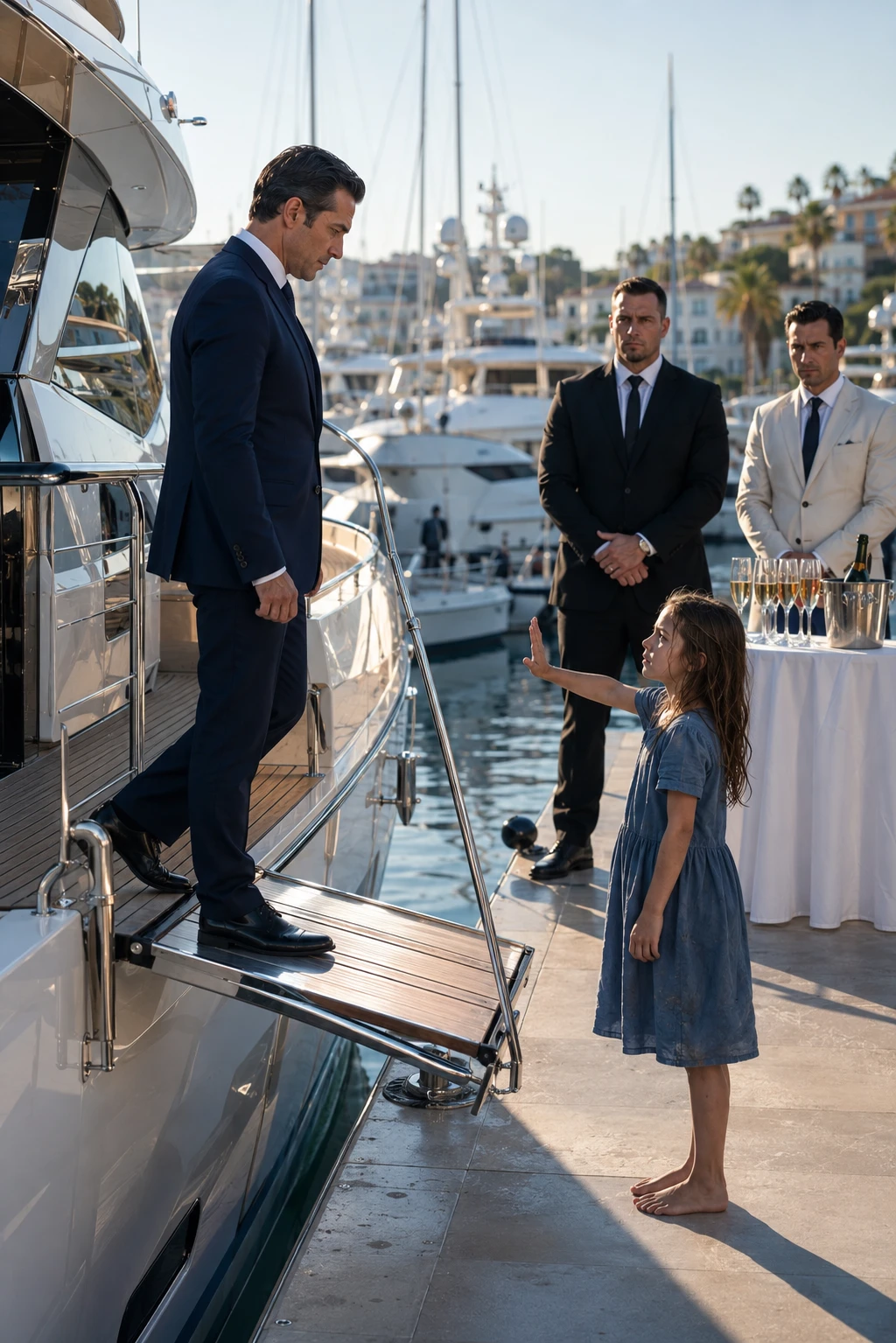
Adrian Whitmore froze, one polished shoe hovering inches above the gangway of his newly bought yacht.
Around him, Sapphire Bay Marina shimmered beneath the morning sun.
White sails rocked gently, silver railings flashed, champagne glasses chimed, and jealous eyes pretended not to stare.
But the voice that stopped him did not belong there.
It belonged to a barefoot little girl in a faded dress.
She stood between a millionaire and the most luxurious yacht in the harbor.
She looked fragile.
Far too fragile.
The sea breeze tangled her hair, and her tiny hands shook at her sides.
Security guards were already moving toward her, irritation carved across their faces.
They were ready to remove her from a place built for wealth, power, and people who never begged.
Adrian should have ignored her.
That was what men like him usually did.
He had woken that morning with victory burning in his chest.
After years of brutal negotiations, sleepless nights, calculated risks, and hidden sacrifices, he had secured the greatest deal of his career.
It was the kind of triumph that filled headlines and silenced rivals.
It justified every ruthless decision he had ever made.
So Adrian had chosen the perfect reward.
A day at sea.
His new yacht waited before him like a floating palace.
Sleek, white, enormous, and radiant beneath the sun, it looked carved from success itself.
It was the most extravagant vessel in Sapphire Bay Marina.
Everyone knew it.
Adrian felt their eyes on him.
Executives paused their conversations.
Wealthy couples turned subtly from their tables.
Dock workers watched from a distance.
Some admired him.
Some envied him.
Others wondered what it felt like to own something so breathtaking.
Adrian accepted it all with quiet satisfaction.
Then the little girl stepped directly into his path.
“Sir,” she whispered again, her voice trembling, “please don’t board that yacht.”
One guard reached for her arm.
“Move aside,” he ordered.
But she did not move.
Her eyes stayed locked on Adrian’s face, filled with a seriousness that chilled the air.
Adrian frowned.
“What did you just say?”
She swallowed hard.
“Please. You can’t go out there today.”
Soft laughter rippled through the nearby crowd.
Someone muttered about homeless children wandering where they did not belong.
Another guest shook his head, annoyed that the elegant morning had been interrupted.
Adrian tried to smile.
The expression felt wrong.
“Did someone send you to do this?” he asked.
The girl quickly shook her head.
“No.”
“Then why are you saying it?”
Her lips parted, but no sound came out.
Then she looked past him toward the yacht.
All color drained from her face.
“I saw it,” she whispered.
Adrian’s expression hardened.
“Saw what?”
“The water,” she said.
“Black water. Rising everywhere. People screaming. Something snapping.”
Her voice broke.
“And you… I saw your face.”
The marina seemed to fall silent around them.
Adrian gave a short laugh, the kind meant to bury nonsense before it became fear.
“A dream?”
The girl nodded, tears shining in her eyes.
“It wasn’t only a dream.”
The guard tightened his grip on her arm.
“That’s enough,” he snapped.
But Adrian raised one hand.
The guard stopped at once.
No one moved.
For reasons Adrian could not explain, he kept staring at the child.
There was no performance in her face.
No trick.
No hunger for attention.
Only fear.
Raw, desperate fear.
And beneath that fear was something stranger.
Certainty.
A cold weight settled behind Adrian’s ribs.
Slowly, he turned toward the yacht.
Sunlight danced along its polished railings.
The deck looked flawless.
Peaceful.
Secure.
His reward.
His victory.
His monument.
Then a metallic groan echoed from deep inside the vessel.
Long.
Low.
Wrong.
Every head on the dock turned toward the yacht.
The sound came again, sharper this time.
Then a violent crack thundered across the marina and sent ice through Adrian’s veins.
The little girl grabbed his sleeve.
“I told you,” she whispered.
And then someone screamed from the yacht.
“But the biggest secret had not been revealed yet. The next part changes everything. Comment “YES” below if you want the full story link. 👇”
The scream rose again, sharper now, tearing through the polished calm of Sapphire Bay Marina.
For one impossible second, no one moved.
Then the yacht shuddered.
Not visibly at first. Not enough to make the champagne spill or the polished deck tilt. But Adrian felt it through the soles of his shoes, a deep tremor rolling through the gangway like something alive had woken beneath the hull.
The little girl’s fingers tightened around his sleeve.
“Please,” she breathed. “You have to get them off.”
Adrian stared at her.
“Who?”
She pointed with a trembling hand.
“There are people inside.”
The words struck harder than the metallic crack.
Adrian turned toward the nearest guard. “Who’s aboard?”
The guard’s face went stiff.
“No one, sir. The crew is scheduled to arrive after inspection.”
“Then why is someone screaming?”
The guard’s jaw tightened. For half a heartbeat, his eyes flicked not to the yacht, but to a man standing near the champagne table.
Adrian noticed.
He had built an empire by noticing the things people hoped he would miss.
The man near the table was smiling too calmly. Dark suit. Silver tie. A marina badge clipped at his belt. Adrian recognized him as Nolan Pierce, the broker who had finalized the yacht purchase at dawn.
Nolan lifted his glass slightly, as if nothing unusual had happened.
Another scream erupted from below deck.
This time, it became words.
“Help! Somebody help us!”
The crowd broke.
People backed away from the gangway. A woman dropped her champagne flute, and glass shattered across the dock. Dock workers shouted. Phones appeared. The guards moved forward, but not toward the yacht.
They moved toward the little girl.
Adrian stepped in front of her.
“Touch her again,” he said quietly, “and you’re fired before your hand lands.”
The guard stopped.
His face flushed.
“Sir, she’s creating panic.”
“No,” Adrian said. “The yacht is creating panic.”
For the first time that morning, the marina no longer looked like a celebration of wealth. It looked like a stage built over something rotten.
A dockhand sprinted toward them from the far pier.
“Mr. Whitmore!” he shouted. “There’s water in the lower compartments!”
Adrian’s blood turned cold.
Nolan Pierce set down his glass.
“That’s impossible,” Nolan called, stepping forward with a polished smile. “The yacht passed every inspection. Likely just a pressure valve.”
Another metallic groan answered him.
Then the vessel listed slightly to port.
The movement was small, but everyone saw it.
The crowd gasped as one.
Adrian looked at the little girl. “What’s your name?”
She swallowed. “Mila.”
“Mila,” he said, forcing his voice to remain steady, “how many people did you see?”
Her eyes filled with terror. “Three. Maybe four. I heard a woman crying.”
Nolan laughed, but the sound came out too thin.
“A frightened child’s dream is not evidence, Adrian.”
Adrian did not look at him.
“Who said anything about evidence?”
Nolan’s smile faltered.
Adrian turned to the dockhand. “Can you open the lower access?”
“The crew hatch is sealed from inside,” the dockhand said. “Or jammed. We tried.”
“Get tools.”
“Already coming.”
Adrian stepped toward the gangway.
Mila grabbed him harder.
“No.”
“I’m not boarding for a pleasure ride.”
“You’ll die.”
Her voice was so certain that even the wind seemed to pause.
Adrian looked down at her small hand on his sleeve. Her knuckles were white. She was barefoot on sun-warmed wood, dressed in a faded blue dress with frayed seams. Everything about her looked breakable.
Everything except her eyes.
They held the dreadful steadiness of someone who had already survived what others refused to believe.
Adrian crouched slightly.
“You said you saw my face.”
Mila nodded.
“In the water?”
“Yes.”
“Was I alone?”
She hesitated.
That hesitation frightened him more than the scream.
“No,” she whispered. “You were holding someone.”
Another cry came from the yacht.
Adrian rose at once.
“Clear the dock!” he shouted. “Get emergency services here now! Bring flotation gear, cutting tools, and every pump this marina has!”
The command snapped through the chaos like a whip. People obeyed without thinking. Executives moved. Dock workers ran. Guards looked uncertain, then scattered under the force of Adrian’s voice.
Except one.
The same guard who had grabbed Mila remained beside the gangway, face pale, one hand hovering near his earpiece.
Adrian saw it.
“What’s your name?”
The guard stiffened. “Dane, sir.”
“Dane, get on that radio and call the harbor patrol.”
Dane did not move quickly enough.
Adrian’s eyes narrowed.
“Now.”
Dane turned away, murmuring into his earpiece.
Mila watched him with strange intensity.
Then she whispered, “He knows.”
Adrian looked down. “What?”
She stared at Dane. “He was there.”
Dane’s shoulders went rigid.
Slowly, Adrian turned.
“What did she say?”
Dane faced them with a forced scowl. “She’s scared. Children say things.”
Mila shrank behind Adrian, but she did not look away.
“You were with the man who came at night,” she said.
The dock seemed to tilt beneath Adrian.
Nolan Pierce’s voice cut in quickly.
“This is absurd. Adrian, we need to remove the child and let professionals handle this.”
Adrian looked from Dane to Nolan.
Two men.
Two reactions too sharp.
Two masks cracking at the same time.
The little girl had not only stopped him from boarding the yacht. She had stopped something from staying buried.
The first pump arrived with two dockhands dragging hoses. A mechanic followed with a crowbar and hydraulic cutter. Another scream came from inside the yacht, weaker now.
Adrian took off his jacket and threw it aside.
Nolan stepped in his path.
“Adrian, be reasonable. You are worth too much to risk yourself.”
Adrian’s smile was cold. “I’ve spent my life hearing that.”
“And it’s true.”
“No. It’s convenient.”
Nolan’s expression hardened for the first time.
Behind him, the yacht groaned again. The sound crawled through the marina, deep and wounded.
Adrian pushed past him.
“Dane,” he snapped, “with me.”
Dane did not move.
Adrian stopped.
The silence between them lasted only a second, but it was enough.
A second was enough for guilt to show.
Dane’s hand twitched toward his jacket.
A dock worker shouted, “He’s got something!”
Adrian reacted before thinking. He lunged, caught Dane’s wrist, and slammed it against the rail. A small black device clattered from the guard’s hand onto the dock.
It bounced once and slid near Mila’s bare foot.
She stared at it.
Her face went white.
“That,” she whispered. “That was in my dream.”
Nolan turned sharply.
Dane cursed and tried to pull free, but two dock workers tackled him from behind. The device skidded closer to Adrian. It was not a weapon.
It was a remote trigger.
Adrian looked at Nolan.
Nolan’s smile was gone.
“Explain,” Adrian said.
Nolan raised both hands.
“I have no idea what that is.”
Dane laughed from the dock, pinned under two workers.
The laugh was bitter and broken.
“Liar.”
Nolan’s face emptied.
Adrian knelt beside Dane, his voice low. “Who’s inside the yacht?”
Dane’s eyes flickered toward Mila.
For the first time, his expression changed.
Not anger.
Not irritation.
Shame.
“I didn’t know she’d come,” he said.
Mila took one step back.
Adrian felt the entire morning folding inward, every glittering surface hiding a blade beneath it.
“Who is she to you?” Adrian asked.
Dane closed his eyes.
“My niece.”
The crowd murmured.
Mila looked as if she had been slapped.
“No,” she whispered.
Dane opened his eyes. “Mila, I’m sorry.”
“You told them I was lying,” she said. Her voice cracked. “You said my father was crazy.”
Dane’s face twisted.
“I was trying to keep you alive.”
Nolan stepped backward.
Adrian saw it and pointed. “Stop him.”
Two dockhands moved, but Nolan was already turning, already calculating escape routes.
Then the yacht screamed.
Not a human scream.
A structural one.
The deck buckled near the stern with a brutal crack. Water surged from one side vent in a black gush, oily and foul. The crowd recoiled.
Mila sobbed once.
“Dark water,” she whispered.
Adrian’s mind sharpened.
Not prophecy.
Not madness.
Memory.
She had seen something real.
“Tools!” he shouted.
The mechanic shoved a cutter into his hands. Adrian crossed the gangway with three dock workers behind him.
Mila cried out.
“No!”
Adrian glanced back.
She stood at the edge of the dock, her face wet with tears, her hand still reaching after him.
“I’ll come back,” he said.
The words surprised him.
He had promised many things in his life. Contracts. acquisitions. impossible quarterly returns. He had promised shareholders the world and competitors ruin.
But he had almost never promised a child anything.
And he had never meant it more.
Inside the yacht, luxury died quickly.
The upper deck was all polished wood, cream leather, gleaming glass, and gold fixtures. But beneath the perfume of wealth lay the sour smell of flooding machinery. Alarms flashed silently, disabled or malfunctioning. Adrian followed the screams down a narrow stairwell, water already pooling across each step.
A dock worker behind him muttered, “This thing was meant to look perfect, not sail.”
The sentence lodged in Adrian’s mind.
Meant to look perfect.
That described too many things in his life.
At the lower corridor, they found the first trapped person.
A woman in a marina uniform was wedged behind a service door bent inward by pressure. Water swirled around her waist. Her lips were blue.
“Please,” she gasped. “My son is in there.”
Adrian’s chest tightened.
“Where?”
She pointed down the corridor with a shaking hand.
“Engine room. He was helping me clean before the launch. The man locked us in.”
The man.
Adrian did not need to ask which man yet.
They forced the door open and pulled her free. She clung to Adrian’s arm, coughing.
“There’s another,” she gasped. “An old man. He tried to stop them.”
Adrian’s pulse slammed.
The yacht shifted again.
Somewhere overhead, people screamed from the dock.
“Get her out!” Adrian ordered.
A dock worker lifted the woman and carried her toward the stairs.
Adrian pushed deeper.
Water rose to his knees.
Then his thighs.
The corridor lights flickered.
At the engine room door, the mechanic jammed the cutter into the lock. Metal screamed. Adrian braced his shoulder against the frame and pushed when the latch gave.
The door burst open.
A wave of black water struck him in the chest.
For a moment, he was back in Mila’s words.
Dark water. Rising everywhere. People screaming. Something breaking.
And you.
He grabbed the doorframe before the surge could sweep him backward.
Inside, a teenage boy clung to a pipe, trembling violently. Beside him, an old man floated half-conscious against a storage cabinet, one hand still wrapped around a wrench.
Adrian plunged forward.
The water was freezing.
It stole breath. It stole thought. It turned the yacht’s golden promise into a steel coffin.
He reached the boy first.
“Look at me!” Adrian shouted. “What’s your name?”
“Leo,” the boy sobbed.
“Leo, hold on to my neck.”
“I can’t swim.”
“You don’t have to. I can.”
It was not entirely true.
Adrian had not swum in years, not beyond private pools and staged charity events. But Leo believed him because he said it like an order.
That had always been Adrian’s most dangerous gift.
People believed him when he sounded certain.
He hauled Leo toward the door, where the mechanic caught him. Then Adrian turned back for the old man.
The yacht groaned again.
The ceiling panel split.
A rush of water slammed into the room.
“Mr. Whitmore!” the mechanic shouted. “Now!”
Adrian ignored him.
The old man’s eyes opened weakly.
For a moment, Adrian forgot the water.
He knew that face.
Older now. Gaunter. Weathered by grief and years. But he knew it from a photograph buried in a file he had signed six months ago.
Elias Voss.
Marine engineer.
Former contractor.
Whistleblower.
Officially dismissed as unstable.
Adrian felt the cold inside him deepen.
“Elias?” he shouted.
The old man’s eyes focused.
Something like recognition moved through them.
Then he whispered, “She came?”
Adrian grabbed him under the arms.
“Who?”
“My daughter.”
The yacht lurched.
Adrian pulled Elias free of the cabinet and dragged him toward the door. The mechanic helped haul him into the corridor. Together they fought through the rising water, half-walking, half-swimming, while the yacht trembled around them.
At the stairs, Adrian looked up and saw daylight.
Then another crack split the air.
The gangway shifted.
Someone above shouted, “Move! Move!”
Adrian pushed Leo upward first. Then the woman. Then Elias.
When it was his turn, the yacht dipped hard.
Water surged up the stairwell.
His foot slipped.
For one breathless instant, Adrian fell backward into the dark.
A small hand caught his wrist.
Impossible.
Mila.
She had stepped onto the lower landing, leaning over with both arms stretched toward him, tears streaming down her face.
Behind her, Dane held the rail with one cuffed hand, the other gripping the back of her dress to keep her from falling.
“Pull!” Dane shouted.
Adrian stared at him.
The hidden accomplice.
The lying uncle.
The man with the remote.
Now holding the child with all his strength while she held Adrian.
“Pull!” Dane roared again.
Adrian reached with his other hand. Dane grabbed his forearm, and together, with Mila screaming from the effort, they dragged him out of the black water.
The face Mila had seen in the dark water was real. But she had not seen Adrian dying alone. She had seen herself saving him.
They stumbled onto the dock seconds before the stern of the yacht dropped another foot into the harbor.
The marina erupted into chaos.
Emergency sirens wailed in the distance. Dock workers dragged hoses. Harbor patrol boats surged toward the pier. People shouted names, orders, prayers.
Adrian collapsed onto his knees, coughing black water from his lungs.
Mila fell beside Elias.
“Papa!”
The word tore through the noise.
Elias Voss opened his eyes.
For a moment, all the panic around them vanished from Mila’s face. She touched his cheek with both hands, as if afraid he would disappear beneath her fingers.
“You came,” he whispered.
“I saw it,” she sobbed. “I saw the water. I saw him. I saw everything.”
Elias’s eyes filled.
“No, sweetheart,” he said hoarsely. “You remembered.”
Mila froze.
Adrian, still coughing, lifted his head.
Elias tried to sit up, failed, and gripped his daughter’s hand.
“You were there that night,” he whispered. “You were half-asleep in the back of the van. I thought you didn’t hear.”
Mila shook her head slowly.
“The men?”
Elias nodded.
“The yacht?”
“Yes.”
Her lower lip trembled.
“I thought it was a dream.”
“I know.”
Adrian looked from father to daughter, then to Dane, who stood a few feet away with two dock workers holding him by the arms.
Dane’s face had collapsed into something unbearably human.
Guilt.
Fear.
Relief.
Adrian rose unsteadily.
“Talk,” he said.
Dane looked toward Nolan.
Only then did Adrian realize Nolan was gone.
“Where is Pierce?” he demanded.
A woman pointed toward the parking lot.
“He ran!”
Adrian turned to the nearest guard. “Seal every exit.”
The guard hesitated.
Adrian’s voice dropped. “Unless you’re also on his payroll.”
The man ran.
Dane swallowed.
“Nolan wanted the yacht sunk with you aboard,” he said.
A wave of horrified whispers spread across the dock.
Adrian went very still.
Dane continued, words spilling now that the lie had cracked.
“He bought the inspection team. He had the lower seals weakened and installed a controlled rupture system. The remote would accelerate the flooding once you were offshore.”
Adrian stared at him.
“Why?”
Dane gave a hollow laugh. “Because your biggest deal wasn’t supposed to close.”
Adrian’s mind moved with brutal speed.
The acquisition. The sleepless negotiations. The rival consortium. The sudden availability of the yacht. Nolan’s insistence that Adrian celebrate publicly before the press.
A floating palace.
A perfect reward.
A perfect coffin.
“Nolan represented the sellers,” Adrian said.
“He represented someone else,” Dane replied. “A shell company tied to Carroway Maritime.”
Adrian’s stomach tightened.
Carroway Maritime was the competitor he had crushed yesterday.
Not with force.
With paperwork.
With leverage.
With the kind of ruthless choices he had once considered clean because no one bled in front of him.
Dane looked down.
“They wanted it to look like arrogance killed you. Billionaire takes new yacht out too soon. Mechanical failure. Tragic accident.”
“And you helped.”
Dane flinched.
“Yes.”
Mila stared at him.
“Why?”
Her voice was small, but it broke him more than Adrian’s anger had.
Dane turned toward her.
“Because they had your father.”
Mila’s face crumpled.
Elias closed his eyes.
Dane’s voice shook.
“They told me if I didn’t cooperate, he’d disappear before anyone found him. They told me you’d be next if I went to the police. I thought if I stayed close, I could slow it down.”
“You grabbed her,” Adrian said.
“I was trying to get her away before Nolan noticed she knew too much.”
“You called her a liar.”
Dane’s eyes filled with tears he did not try to hide.
“I thought making everyone dismiss her would keep her safe.”
Mila took a step back from him.
Dane lowered his head.
“I know,” he whispered. “I know that doesn’t make it right.”
The second hidden truth settled over them: Dane had not been merely a villain, but fear had made him useful to one.
Adrian looked at Elias.
“And you?”
Elias’s breathing was ragged. Paramedics were pushing through the crowd now, but he waved them back long enough to speak.
“I tried to warn your office,” he said.
Adrian’s face hardened with shame before he even knew why.
“My office receives thousands of claims.”
“I know,” Elias said quietly. “Mine was marked unstable and closed.”
Adrian said nothing.
Elias held Mila’s hand.
“I inspected the yacht three weeks ago under a false maintenance order. I found the first alterations then. I kept digging. That was my mistake.”
“Nolan found out?”
Elias nodded.
“They took me last night. Locked me below with Mara and her boy because they saw too much during cleaning. They planned to leave us there until the yacht was offshore. When Dane realized Mila had followed him here, everything changed.”
Mila looked at Dane.
“I followed you because you burned Papa’s notebook.”
Dane’s face twisted.
“I didn’t burn it.”
Mila shook her head fiercely. “I saw you.”
Dane reached slowly into his soaked jacket.
The dock workers tightened their grip, but Adrian lifted a hand.
Dane pulled out a plastic-wrapped packet, damp but intact.
Inside was a small black notebook with scorched edges.
Mila stared.
“I burned the cover,” Dane said. “Nolan had cameras in my apartment. I made him think I destroyed it.”
Elias let out a broken breath.
“The notebook,” he whispered.
Dane held it toward Adrian.
“It has names. Payments. Diagrams. Everything Elias found. I was going to hand it to harbor patrol after you left the dock. But Mila stopped you before I could get you alone.”
Adrian took the notebook.
It felt heavier than it should have.
Not because of paper.
Because of all the lives nearly crushed beneath the weight of men protecting their fortunes.
Sirens arrived in full force. Paramedics lifted Elias onto a stretcher. Mara and Leo were wrapped in thermal blankets. Harbor patrol swarmed the damaged yacht while police officers moved through the crowd.
Then someone shouted from the parking lot.
“They got him!”
Nolan Pierce was dragged back between two officers, his silver tie loosened, his face slick with sweat. He tried to look offended rather than afraid.
“This is outrageous,” he snapped. “I demand my attorney.”
Adrian stepped toward him.
Nolan’s gaze flicked to the notebook in Adrian’s hand.
For one second, panic showed.
Adrian saw it.
So did the officers.
Nolan recovered quickly.
“You have no idea what you’re holding.”
Adrian’s voice was quiet. “I’m beginning to.”
Nolan leaned closer, lowering his tone.
“You think this makes you innocent? You built your empire the same way everyone does. You crushed companies. You buried warnings. You signed papers without reading the lives attached to them.”
The words landed because they were not entirely false.
Adrian felt them enter him like cold needles.
Nolan smiled faintly.
“You’re not the hero here.”
Adrian looked past him.
At Mila, kneeling beside her father.
At Mara holding Leo so tightly the boy could barely breathe.
At Dane standing cuffed, no longer resisting.
At the yacht, sinking slowly in the harbor, its flawless white body swallowing itself into black water.
“No,” Adrian said. “I’m not.”
Nolan’s smile widened.
Then Adrian lifted the notebook.
“But today I’m a witness.”
The smile vanished.
“And I’m rich enough,” Adrian continued, “to make sure everyone hears me.”
That was the turning point Adrian had never planned for. Not triumph. Not acquisition. Consequence.
The officers led Nolan away while he shouted threats that sounded smaller with each step.
Reporters arrived within minutes.
They always did when wealth cracked loudly enough.
Cameras gathered at the marina entrance. Phones recorded from every angle. The same crowd that had come to admire Adrian’s success now stared at him soaked in black water, shirt torn, shoes ruined, face pale and stripped of performance.
His public relations chief called nine times.
He ignored every call.
Instead, he sat on the dock beside Mila while paramedics checked her feet for splinters and cuts.
She refused to let go of Elias’s hand until the stretcher was ready to move.
When they lifted him, she panicked.
“No. I’m going with him.”
A paramedic crouched. “You can ride in the ambulance.”
Mila looked at Adrian, as if suddenly unsure whether adults kept promises.
Adrian nodded.
“Go with your father.”
She stared at him.
“You said you’d come back.”
“I did.”
“You almost didn’t.”
“I know.”
Her eyes lowered to his sleeve, still wrinkled from where she had grabbed him.
“I thought rich people didn’t listen.”
Adrian tried to answer.
Nothing clever came.
Nothing polished.
Nothing like the speeches he had given in boardrooms and ballrooms.
Finally, he said, “Most of the time, I didn’t.”
Mila studied him.
It was a child’s gaze, but not innocent. Not anymore.
“Will you listen now?”
Adrian looked at Elias being loaded into the ambulance. He looked at Dane, seated on the curb with wrists cuffed, speaking quietly to a detective. He looked at the ruined yacht, half-submerged.
Then he looked back at Mila.
“Yes,” he said. “But I think listening is the easy part.”
She frowned.
“What’s the hard part?”
“Changing after you hear the truth.”
Mila seemed to consider this.
Then she nodded once, solemnly.
The ambulance doors opened.
She ran to her father.
Before climbing in, she turned back.
“Adrian?”
It was the first time she used his name.
He stood.
“Yes?”
“In my dream, you looked scared.”
He gave a tired breath that was almost a laugh.
“I was.”
“No,” she said. “Before the water.”
Adrian’s expression changed.
Mila held his gaze.
“You looked scared when no one else could see it.”
Then she climbed into the ambulance.
The doors closed.
The siren wailed, and the vehicle pulled away from the marina.
Adrian remained standing long after it disappeared.
Because she was right.
He had been scared before the water.
Scared that victory meant nothing if there was no one left to prove wrong.
Scared that all his monuments were hollow.
Scared that the ruthless choices he had justified had not made him powerful, only alone.
The investigation unfolded with brutal speed.
By sunset, the notebook had become evidence. Elias Voss had documented every payment, every altered inspection report, every false maintenance order. Dane had recorded calls with Nolan, proving the threats against Elias and Mila. Mara, the cleaner, identified the men who had locked her and her son below deck.
And Adrian learned the part that nearly broke him.
Six months earlier, Elias had sent a warning to Whitmore Holdings.
Not to a general inbox.
Not to a random department.
To Adrian’s executive risk office.
The report had been flagged by an assistant as urgent, forwarded to legal, and buried under a standard defamation concern. Adrian had never seen it. But the final policy that allowed the report to be dismissed bore his signature.
A signature among hundreds.
A click in a digital folder.
One more ruthless efficiency.
That night, Adrian sat alone in his penthouse, still smelling faintly of harbor water despite three showers.
The city glittered beneath him.
He had once loved that view. It made him feel above everything.
Now it made him feel far away.
On the glass table lay three things.
Elias’s notebook.
A hospital visitor badge.
And the purchase certificate for the yacht.
Sapphire Monarch.
The name made him laugh once, bitterly.
A monarch for a man who had almost drowned inside his own reward.
His phone buzzed.
This time, he answered.
His PR chief did not wait.
“Adrian, we need to control the narrative immediately. You should make a statement emphasizing your bravery, your quick response, and your victim status.”
Adrian closed his eyes.
Victim status.
He thought of Mila’s bare feet.
He thought of Mara’s blue lips.
He thought of Elias whispering, “She came?”
“No,” Adrian said.
Silence.
“Excuse me?”
“No statement like that.”
“Adrian, the market will react. Carroway is implicated, but the story is messy. If we position you correctly—”
“I said no.”
His own voice sounded unfamiliar.
Not louder.
Just cleaner.
The PR chief lowered her tone. “Then what do you want to say?”
Adrian looked at the notebook.
“Tell the truth.”
“That is not a strategy.”
“It should be.”
The next morning, Adrian did something no one expected.
He held the press conference not at corporate headquarters, not before a polished logo wall, but at Sapphire Bay Marina, on the same dock where the yacht had gone down.
The vessel had been stabilized overnight, surrounded by floating barriers and investigative crews. Its white hull was stained and broken. It no longer looked like success.
It looked like evidence.
Reporters shouted as Adrian stepped forward.
He wore no tie.
No entourage stood behind him.
Only his attorney, two investigators, and Mara with Leo, who had agreed to appear after Adrian promised no one would ask them to speak.
Elias remained in the hospital.
Mila remained with him.
Adrian faced the cameras.
For once, he did not perform confidence.
“I was supposed to die here yesterday,” he said.
The reporters fell silent.
“Three other people were nearly killed because they knew the truth before I did. A child stopped me from stepping onto that yacht. Her name is Mila Voss. Her father, Elias Voss, tried to warn my company months ago.”
Camera shutters clicked.
Adrian swallowed.
“That warning was dismissed under a system I built. I did not read it. I did not know his name. But ignorance does not erase responsibility.”
His attorney shifted uneasily.
Adrian continued.
“I have spent years rewarding speed over care, silence over inconvenience, and profit over people who could not force their way into the room.”
A murmur moved through the reporters.
“Yesterday, a barefoot child did what my entire company failed to do. She told the truth loudly enough to interrupt a powerful man.”
His voice roughened.
“And I listened just in time.”
He looked toward the sunken yacht.
“Whitmore Holdings will fund the full recovery and medical care of every victim. We will create an independent maritime safety foundation led by outside engineers, not executives. Every buried complaint connected to our acquisitions will be reopened.”
His attorney whispered, “Adrian—”
Adrian ignored him.
“And effective immediately, I am stepping down from direct control of risk review until an independent board can determine what failed and who allowed it.”
The questions exploded.
He answered some.
He refused others.
But he did not retreat.
By noon, the headlines were everywhere.
Some called him brave.
Some called him guilty.
Some called it a calculated redemption.
Adrian read none of them.
He went to the hospital instead.
Elias was awake, propped against white pillows, one arm bandaged, his face thinner in fluorescent light. Mila sat beside him, eating a sandwich with the seriousness of someone guarding treasure.
She saw Adrian and stiffened.
Elias looked up.
“You came.”
Adrian stepped inside.
“I said I would.”
Mila’s eyes narrowed slightly.
“You say that a lot?”
“Not enough.”
Elias gave a faint smile, then winced.
Adrian placed a folder on the bedside table.
“This is for you.”
Elias did not touch it.
“What is it?”
“Full payment for the engineering work you were never paid for. Compensation for what happened. And an offer.”
Mila’s face tightened. “An offer like a trick?”
Adrian looked at her.
“No.”
Elias studied him. “What kind of offer?”
“The foundation needs someone honest enough to be inconvenient,” Adrian said. “Someone who understands what happens when warnings are ignored.”
Elias’s eyes darkened.
“You want me to help repair your image.”
“No,” Adrian said. “I want you to help repair what my image helped hide.”
The room went quiet.
Mila looked between them, still suspicious.
Elias tapped the folder but did not open it.
“I don’t forgive you,” he said.
Adrian nodded.
“I didn’t ask you to.”
“I don’t know if I ever will.”
“I know.”
Elias’s breathing was careful, pained.
“But if this foundation is real, I choose the engineers. I choose the cases. I answer to no corporate board.”
Adrian almost smiled.
“That was the idea.”
“And Dane?”
Mila looked down.
The name changed the room.
Adrian exhaled slowly.
“He’s cooperating. The charges will not vanish. But his recordings may reduce them.”
Mila’s fingers tightened around the sandwich wrapper.
“He lied to me.”
Elias touched her shoulder.
“Yes.”
“He was scared.”
“Yes.”
“That doesn’t fix it.”
“No,” Elias said softly. “It doesn’t.”
Adrian looked at her.
“Some people hurt others because they’re cruel. Some hurt others because they’re afraid. The damage can look the same.”
Mila stared at him.
“Which one were you?”
The question landed with devastating precision.
Elias closed his eyes briefly.
Adrian did not look away.
“Both,” he said.
Mila absorbed that.
Then she nodded, not forgiving him, but accepting the answer because it did not hide.
That was the third reveal, and the quietest one: the villain was not only the man who planned the sinking. It was also every silence that made the plan possible.
Weeks passed.
Nolan Pierce’s network unraveled faster than anyone expected. Carroway executives denied knowledge until Dane’s recordings proved otherwise. Inspection officials resigned. Two were arrested. The marina manager confessed to accepting payments to alter access logs.
Dane pleaded guilty to conspiracy, but his cooperation saved Elias’s case and exposed Nolan’s attempt to threaten Mila. He wrote Mila three letters.
She opened none of them at first.
Then one rainy afternoon, she opened the shortest.
It said only:
I thought fear could protect you if I wore it like armor. I was wrong. I am sorry for every second you believed no adult would stand beside you.
Mila folded it carefully and placed it inside Elias’s notebook.
She did not answer.
Not yet.
That mattered.
Because happy endings did not erase bruises.
They gave people room to heal without pretending nothing had hurt.
Adrian changed too, though not cleanly, not magically.
He still woke before dawn with numbers moving through his mind. He still felt the old hunger when competitors stumbled. He still knew how to become ruthless with terrifying ease.
But now, when an assistant said, “This complaint probably isn’t worth your time,” he heard Mila’s voice.
Please don’t board that yacht.
He began reading reports himself.
Not all.
He was still one man, not a saint reborn.
But enough.
Enough to know names.
Enough to ask who had been dismissed as unstable.
Enough to make powerful people deeply uncomfortable.
The foundation opened three months later in a modest building near the harbor, not in a glass tower. Elias insisted on that. The sign on the door read:
Voss Maritime Safety Initiative.
Adrian had suggested including Whitmore.
Elias had simply stared at him until he withdrew the suggestion.
Mila visited after school, carrying notebooks and sharpened pencils, pretending she was not fascinated by every diagram on every wall.
Mara worked there too, managing records with fierce precision. Leo came after classes and learned to repair small engines from Elias, though he still avoided deep water.
The first case they reopened involved a fishing crew whose complaints had been ignored by a shipping conglomerate Adrian once admired.
The second involved a ferry company that had hidden corrosion reports.
The third involved a luxury charter line selling elegance over safety.
Each case made enemies.
Each case saved someone before disaster arrived.
Adrian funded it all.
Elias challenged him constantly.
Mila watched both men with cautious approval.
One evening, nearly a year after the sinking, Adrian returned to Sapphire Bay Marina.
The dock had been repaired. The champagne tables were gone. The berth where the Sapphire Monarch had once gleamed now stood empty, marked only by new boards slightly paler than the old ones.
Mila was there, sitting cross-legged near the edge, sketching the water.
She was no longer barefoot. Adrian had bought her shoes once, expensive ones, and she had rejected them immediately. Elias later chose a simple pair of sturdy blue sneakers. Those she wore every day.
Adrian stopped a few feet away.
“Your father said I’d find you here.”
Mila did not look up.
“He says a lot of things.”
“He also said not to interrupt you when you’re drawing.”
“You’re interrupting.”
“Then I’m already failing.”
That earned the smallest smile.
Adrian sat beside her, leaving careful space.
For a while, they said nothing.
The harbor moved gently. Sails rocked. Railings gleamed. Somewhere far off, a gull cried. It looked almost like that morning.
Almost.
Mila shaded a dark patch beneath the outline of a boat.
“Do you still think I had a dream?” she asked.
Adrian looked at the water.
“I think you remembered what everyone else wanted forgotten.”
She nodded slowly.
“I still see it sometimes.”
“The water?”
“And your face.”
Adrian’s throat tightened.
“I’m sorry.”
“I know.”
The answer was simple, but not soft.
He accepted it.
Mila closed her sketchbook.
“Papa says the foundation saved twenty-six people this year.”
“It helped,” Adrian said. “Your father saved them.”
“You helped too.”
Adrian looked at her, surprised.
She shrugged.
“Not like a hero.”
He almost laughed.
“No?”
“No. Like a man cleaning up a mess he helped make.”
The words should have hurt.
They did.
But they also felt like mercy, because they were true.
“That sounds fair,” he said.
Mila watched the empty berth.
“Do you miss it?”
“The yacht?”
She nodded.
Adrian looked at the water where his monument had vanished.
Once, he would have missed it bitterly.
Not the yacht itself, but what it had told the world about him.
Now he thought of black water, a child’s hand, an engineer’s notebook, and a scream that saved him from becoming a headline written by his enemies and earned by his neglect.
“No,” he said. “I don’t.”
Mila leaned back on her hands.
“I’m glad it sank.”
Adrian looked at her.
She met his eyes.
“Not because people got hurt. Because if it hadn’t, nobody would have listened.”
The sentence settled between them.
Sad.
True.
Too heavy for a child, yet carried by one anyway.
Adrian’s voice was quiet.
“I wish we had listened before.”
Mila looked back at the harbor.
“Me too.”
The sun lowered, turning the water gold.
After a while, Mila reached into her pocket and pulled out something small. She placed it on the dock between them.
It was a polished screw, darkened by salt, recovered from the Sapphire Monarch’s damaged lower hatch.
“My father kept it,” she said. “He said broken things can still teach people.”
Adrian picked it up carefully.
The little piece of metal lay in his palm, plain and scarred.
Once, he had held contracts worth billions with less reverence.
“Why give it to me?”
“So you remember.”
He closed his fingers around it.
“I will.”
Mila studied him, deciding whether that was enough.
Then, quietly, she said, “Dane wrote again.”
Adrian did not push.
“What did he say?”
“He said he’s learning how to tell the truth before fear tells him not to.”
Adrian nodded.
“That sounds like something worth learning.”
Mila looked at him from the corner of her eye.
“You too?”
He smiled faintly.
“Me too.”
The marina lights began to glow one by one.
No crowd watched them.
No cameras flashed.
No champagne glasses chimed.
There was only the soft knock of water against the dock, the empty berth, and a child sitting beside a man she had once saved from the dark.
Mila opened her sketchbook again and tore out a page.
She handed it to Adrian.
The drawing showed the marina, the dock, and the place where the yacht had been.
But in the foreground, she had drawn three hands.
One small hand grabbing a sleeve.
One man’s hand reaching from the water.
And one scarred hand pulling them both back toward the light.
Adrian stared at it for a long time.
His eyes burned.
“Is this how you remember it?” he asked.
Mila shook her head.
“No,” she said softly. “It’s how I want to.”
Adrian folded the drawing with great care.
The harbor darkened around them, but neither moved.
And in the quiet where the scream had once been, Adrian finally understood that being saved was not the same as being forgiven.
It was only the beginning.
Beside him, Mila rested her chin on her knees and watched the water without fear.
For the first time, Adrian did too.