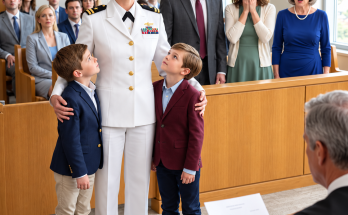
David made it three steps before Officer Davis reacted.
The movement was almost absurdly sudden.
One moment my brother stood beside his attorney with his hands loose at his sides. The next he shoved past a chair, cut toward the corridor leading to the rear exit and ran.
“David!”
Victor Hale’s shout followed him.
I did not.
Running after a suspect while emotionally involved was exactly how judgment failed.
Davis and another officer intercepted him near the hallway junction. David twisted away, slammed one shoulder into the wall and reached toward his jacket.
Every officer in sight tensed.
“Hands!”
David froze.
For one terrible second, I thought he might do something irreversible.
Then his arms lifted.
Davis pulled him backward, turned him toward the wall and secured his wrists.
My brother shouted my name.
Not for help.
As accusation.
“This is you!”
I stayed where I was.
“No,” I said. “This is you running.”
He struggled once against the cuffs.
Hale reached them and immediately ordered him to stop resisting.
“David, do not say another word.”
For once, my brother listened.
Ortiz searched the jacket pocket David had reached toward.
Inside was a phone.
Not the one he had already provided.
A second device.
Hale closed his eyes briefly.
That reaction told me he had not known about it.
Ortiz held the phone without touching the screen.
“Secure this.”
An evidence officer took it.
David looked at me.
His face had lost every trace of polish.
“You have no idea what you’re doing.”
I had heard that before.
This time, I believed he was afraid I might find out.
Prosecutors moved quickly after that.
Flight risk was no longer theoretical. Evidence of assault, financial fraud, witness manipulation and possible attempted destruction or concealment of records had accumulated.
Within the hour, David was formally arrested on an initial set of charges while investigators continued building the broader case.
The handcuffs did not make me feel better.
I had imagined, in abstract terms, what it might be like if my work ever crossed into family.
I had never imagined watching my brother’s fingerprints taken.
Dad was not there to see it.
For that, I was grateful.
Chloe learned about the arrest from her lawyer.
She cried.
I could not tell whether she cried for David, herself or the collapsing future she had expected to board a plane toward that night.
Maybe all three.
The second phone became the immediate priority.
Because David had tried to flee with it after learning investigators possessed damaging audio, everyone assumed it mattered.
The device was locked.
Forensic technicians did not guess passwords or improvise. They documented, isolated and processed it.
Meanwhile, Miller called from the storage unit.
“There’s a second ledger.”
“Financial?”
“Payments.”
“To whom?”
“Keller definitely. Pike possibly. Several names we haven’t identified.”
“Amounts?”
“Varies. Cash notation beside some.”
“Any initials?”
“Yes.”
“Read them.”
He did.
Most meant nothing to me.
Then one did.
“Repeat the fourth.”
“R.S.”
“When?”
“Multiple entries. Largest is fifty thousand.”
“What description?”
“‘Compliance.’ Another says ‘C letter.’”
I leaned against the hallway wall.
“Could be anyone.”
“Agreed.”
I hated myself for the thought that had already formed.
Rachel Stein.
The attorney I had called before flying in.
R.S.
No.
Initials were not evidence.
And Rachel was the one who had immediately begun protecting Dad’s legal authority.
Still, training required me to notice uncomfortable possibilities.
“Photograph and cross-reference. Do not assume identity.”
“Already doing it.”
“What about Pike?”
“Pike entries use H.P. and ‘admissions.’”
“That one is stronger.”
“Yes.”
“And Keller?”
“Full surname once. Initials elsewhere.”
“So R.S. might be unrelated.”
“Correct.”
I ended the call.
My phone immediately displayed a missed call from Rachel.
I stared at it.
Coincidence.
Probably.
I called back.
She answered quickly.
“I’ve been trying to reach you.”
“What happened?”
“Someone filed an emergency guardianship petition for your father.”
My spine stiffened.
“When?”
“Yesterday afternoon.”
Before the attack.
“Who filed it?”
“David, through counsel.”
“What counsel?”
“That’s what worries me.”
“Name.”
“A lawyer named Roland Shaw.”
R.S.
The hallway seemed to tilt.
“Spell that.”
She did.
Relief came first.
Then anger at myself for feeling it.
“Do you know him?”
“By reputation. Probate and elder-law work. Not someone I’d expect David to use.”
“Why?”
“Expensive. Discreet. Handles contested competency matters.”
“What did he file?”
“A petition alleging progressive dementia, financial mismanagement, violent behavior and medication refusal.”
“Supporting documents?”
“Keller affidavit. Statements from David and Chloe. Preliminary acceptance paperwork from Pine Ridge.”
The plan had been further along than we knew.
“Hearing date?”
“This afternoon.”
I closed my eyes.
“Today?”
“Yes. Emergency hearing. They were asking for temporary authority over medical decisions and financial management.”
“Without notice to me?”
“You weren’t listed as an interested party.”
“I’m his daughter.”
“I know.”
“Was I omitted accidentally?”
“No.”
Her certainty mattered.
“How do you know?”
“Because the petition states Arthur has one adult child available to manage his affairs.”
“One?”
“David.”
I felt something colder than anger.
They had legally erased me before trying to erase Dad.
“What are you doing?”
“I filed an emergency appearance, notified the court your father contests the petition, and disclosed the active criminal investigation to the extent appropriate.”
“Can the hearing be stopped?”
“Likely converted into a contested proceeding. The judge will not hand David control while he’s under arrest.”
“Good.”
“But Elena, somebody knew exactly how to structure this.”
“Roland Shaw.”
“Yes, but he may only know what David told him.”
“Did Shaw sign anything beyond the petition?”
“He certified information based on client representations and medical documents.”
“So we don’t assume he’s complicit.”
“Correct.”
I appreciated Rachel immediately drawing the line.
“Anything else?”
“Yes.”
“What?”
“The petition references a confidential neuropsychological evaluation.”
My skin prickled.
“Dad never had one.”
“That’s why I called.”
“Who performed it?”
“A Dr. Samuel Ross.”
Another R.S. possibility disappeared.
“Hospital affiliation?”
“None listed.”
“License?”
“I’m checking.”
“Send it to investigators.”
“I already sent the filing to the prosecutor contact you gave me.”
“Thank you.”
“Elena.”
“What?”
“Someone built a professional-looking paper trail around your father.”
“I know.”
“No. I mean better than a panicked family could improvise. Medical notes, residential placement, guardianship petition, evaluation. This was coordinated.”
I looked toward the room where David was being processed.
“Then there are more people.”
“That would be my concern.”
We ended the call.
The case had started with Chloe, David and Dad inside a house.
Now the circle was widening.
Keller.
Pike.
Shaw, possibly innocent.
A supposed neuropsychologist.
Unknown payment recipients.
A hidden phone.
I called Miller.
“New priority. Identify Samuel Ross, neuropsychologist listed in guardianship filing.”
“Send details.”
I forwarded them.
“Also attorney Roland Shaw drafted the petition. Treat him as a professional witness unless evidence says otherwise.”
“Understood.”
“Do not spook him unnecessarily.”
“Agreed.”
I went back to the hospital.
Dad was sitting upright now, eating dry toast with the concentration of a man performing a task imposed by medical bureaucracy.
“You arrested him.”
It was not a question.
“How do you know?”
“Rachel called.”
I sighed.
“She works fast.”
“She always did.”
I sat down.
Dad put the toast aside.
“What did he do?”
“He ran.”
His face tightened.
“From police?”
“Yes.”
“Idiot.”
The word held more sadness than contempt.
I told him about the emergency guardianship petition.
He listened without interrupting.
When I said the filing claimed he had only one available adult child, something broke across his face.
“They erased you.”
“On paper.”
“I’m sorry.”
“For what?”
“For bringing this into your life.”
“Dad, they brought it into mine when they used my absence as part of the plan.”
He stared at his hands.
“I should have told you when I first suspected the money.”
“Yes.”
He looked up, surprised by the blunt answer.
“You expected me to disagree?”
“A little.”
“You should have told me.”
“I was ashamed.”
“Of being robbed?”
“Of not seeing my own son.”
That I understood.
“But shame helped him.”
Dad winced.
“I know.”
I softened.
“I’m not saying that to hurt you.”
“I know that too.”
He picked at a corner of the toast.
“Did Chloe tell them?”
“She is cooperating.”
“She helped him.”
“Yes.”
“She also tried to help me sometimes.”
“Yes.”
He looked confused by the coexistence of those facts.
Victims often wanted people sorted cleanly into good and evil after chaos.
Reality rarely cooperated.
“She gave me water,” he said.
“I know.”
“How?”
“Video.”
His face changed.
“There were cameras?”
“Yes.”
He stared toward the wall.
“How much did they record?”
“We don’t know yet.”
Humiliation flooded his expression.
I understood immediately.
“Dad, listen to me. Those recordings are evidence of what was done to you. They are not evidence of weakness.”
He turned away.
I let him.
Then my phone rang.
Forensics.
The second phone had been accessed through a valid warrant and forensic process.
Agent Priya Shah spoke first.
“It’s mostly encrypted messaging.”
“With whom?”
“We’re mapping identifiers.”
“Anything immediate?”
“Yes. David tried to delete a conversation seconds before he ran.”
My pulse increased.
“Recovered?”
“Most of it.”
“With who?”
“Contact saved only as ‘M.’”
“What kind of conversation?”
“Financial and operational.”
“Operational how?”
“Instructions.”
“Give me examples.”
She paused.
“‘Keep Keller aligned.’ ‘Pike wants balance before intake.’ ‘Use recordings if court asks.’”
Someone coordinating.
“Does David take orders from M?”
“It reads that way.”
That changed everything.
I had assumed David designed the plot and recruited others.
Maybe he had not.
“What does M get?”
“Unknown.”
“Any identity clues?”
“One message references meeting at Lakeshore Club.”
Private club downtown.
“Dates?”
“Several.”
“Can we pull visitor logs?”
“Working on it.”
“What else?”
“M warns David not to access a specific account from home Wi-Fi.”
“Why?”
“Possibly concealment.”
“And tonight?”
Priya hesitated.
“There’s a message from 12:22 a.m.”
Before the confrontation.
“What does it say?”
“From David to M: ‘He still won’t give me the key. We may have to move tonight.’”
“What does M answer?”
“‘Then move. Do not let him speak to Elena first.’”
Every muscle in my body tightened.
This person knew me.
Not just that Dad had a daughter.
My name.
My role in the plan.
“Any response from David?”
“Yes.”
“What?”
“‘She won’t get involved unless he calls her.’”
I looked at Dad.
At 2:27, he had called.
One act.
One phone call.
That was what the plan had depended on preventing.
“Anything identifying M?”
“Not yet.”
“Keep going.”
“Already are.”
I ended the call.
Dad watched me carefully.
“What happened?”
“There may be someone else involved.”
“Who?”
“We don’t know yet.”
His eyes narrowed.
“Someone above David?”
“Possibly.”
Dad was quiet for several seconds.
Then he said, “There was a man.”
I leaned forward.
“What man?”
“I don’t know his name.”
“When?”
“Maybe three months ago.”
“Where?”
“At the house.”
“What did he look like?”
Dad frowned, reconstructing.
“Late fifties. Gray hair. Tall. Very good suit. David introduced him as a consultant.”
“What kind?”
“He didn’t say.”
“What did they discuss?”
“They went into the office.”
“Did you hear anything?”
“No.”
“See him again?”
“Once.”
“Where?”
Dad looked at me.
“At your mother’s grave.”
The room went silent.
“What was he doing there?”
“I don’t know.”
“Did he see you?”
“No. I was in the car.”
“Why didn’t you confront him?”
“I wanted to know what he was looking for.”
My heartbeat increased.
“The blue key.”
Dad nodded.
“He walked around the headstone for nearly ten minutes.”
“Did he find it?”
“No.”
“How do you know?”
“Because I moved the capsule afterward.”
I stared at him.
“Where?”
A faint trace of the old Arthur Vance appeared in his eyes.
“You think I’m telling you now?”
Despite everything, I almost smiled.
Then Priya sent me an image recovered from David’s hidden phone.
Security camera still.
A man entering the Lakeshore Club.
Late fifties.
Gray hair.
Tailored dark suit.
Underneath, facial-recognition software had offered a likely identity from public professional records.
I opened the profile.
The man was not a banker.
Not a doctor.
Not a lawyer.
He was a former federal investigator who now ran a private corporate intelligence firm.
And I knew him.
Martin Cross had supervised my first field assignment twelve years earlier.
Click here to continue reading: PART 9: The Man Behind My First FBI Assignment Had Found My Father’s Secret—and His Message Proved He Had Been Watching Me Too
My Father Never Called After Midnight, So When His Name Lit My Phone at 2:27, I Knew Something Was Terribly Wrong
Part 8 of 18