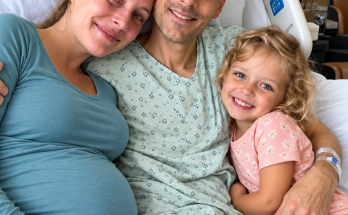
Three months later, Dad returned home.
Not alone.
He had argued about that point for almost the entire drive.
“I have lived in that house longer than you’ve been an agent.”
“That fact does not improve your security assessment.”
“I changed the locks.”
“So did professionals.”
“I changed the alarm.”
“Professionals did that too.”
He glanced at me from the passenger seat.
“You are extremely annoying.”
“You raised me.”
“That excuse is getting old.”
“So are you.”
He looked offended for half a second.
Then he laughed.
His ribs had healed enough that laughing no longer hurt.
That was one of the smaller victories.
The house looked ordinary from the outside.
That surprised me.
For months, I had pictured it through photographs from the search: evidence markers, open drawers, agents in protective gloves, the basement door hanging wide.
But houses do not advertise what happened inside them.
The front lawn had been cut.
A delivery package sat on a neighbor’s porch.
Someone’s dog barked behind a fence.
Dad stood at the bottom of his own steps longer than he expected.
I did not hurry him.
Finally he said, “I hate that I’m afraid of my front door.”
“Then hate it.”
He looked at me.
“You don’t have to turn everything into a lesson.”
“I wasn’t.”
That seemed to help.
He walked up.
Inside, the house smelled faintly of dust and fresh paint.
Dad had refused to sell.
Everyone suggested it.
Rachel.
His doctors.
Victim specialists.
Me, initially.
He refused.
“This is not their house,” he had said.
So the basement room was dismantled.
The deadbolt came off.
The pipe restraints were removed as evidence.
The damaged drywall was replaced.
Dad ordered a carpenter to install a wide interior doorway where the locked entrance had been, then turned the room into wine storage.
He did not drink much wine.
That was not the point.
He wanted the room incapable of imprisoning anyone again.
David had entered a guilty plea six weeks earlier after federal and state prosecutors coordinated the overlapping cases.
The charges were extensive: conspiracy, wire fraud, elder exploitation, evidence tampering, unlawful restraint and assault-related offenses, among others.
His plea did not erase what he had done.
It did something smaller.
It stopped him from forcing Dad through months of testimony about every moment in the basement.
That mattered.
At sentencing, which had not yet happened, prosecutors would present the full evidence.
Dad intended to speak.
He had rewritten his statement seven times.
Every version began with the same sentence.
“My son is responsible for what he did, and I am responsible for telling the truth about it.”
Chloe accepted a cooperation agreement without immunity.
Her information helped dismantle Vale’s network, identify storage locations and authenticate recordings.
She still faced prison.
She had drugged Dad at times.
She had participated in false reports.
She had swung the bat.
Helping him on other nights did not erase those choices.
The law did not require people to fit neatly into villain or victim.
Neither did we.
Keller surrendered his medical license before the state could revoke it.
He pleaded guilty to charges arising from fraudulent medical records and conspiracy.
Investigators ultimately concluded that the medications found in Dad’s system had been deliberately administered to impair him.
The supposed dementia diagnosis collapsed completely.
Independent neurologists found no evidence supporting it.
Dad celebrated by leaving his reading glasses in the refrigerator and asking whether that qualified him for damages.
I told him no.
He accused me of lacking imagination.
Pine Ridge fired Harold Pike.
Then prosecutors charged him.
Evidence showed he had agreed to accept Dad based on manufactured documentation in exchange for payments routed through intermediaries.
Roland Shaw, the guardianship attorney, was not charged.
Investigators found that David had lied to him and supplied falsified medical records and forged trust documents.
Shaw had been careless in not probing harder.
Carelessness was not the same as conspiracy.
That distinction mattered too.
Calvin Reed was charged for his role in falsifying documents and assisting Vale’s operational network.
He eventually admitted notarizing Dad’s forged trust certificate without Dad present.
He also admitted helping arrange surveillance at Mom’s cemetery.
Rachel filed civil actions that made him wish criminal court were his only problem.
Evan Rourke’s death turned out not to be murder.
The medical examiner concluded he suffered an accidental overdose involving alcohol and prescription medication.
That result frustrated people who had begun assuming Vale caused every death nearby.
Reality resisted tidy stories.
Rourke had betrayed federal systems for money.
He had also died because of his own private collapse.
Both could be true.
Gerald Mercer’s old death was reviewed as well.
No evidence emerged suggesting anything other than the heart attack originally documented.
Vale had exploited Mercer’s business conflict and records.
He had not killed him.
Again, facts were enough.
We did not need darker inventions.
Martin Cross pleaded guilty under a cooperation agreement that covered conduct far beyond my family.
His testimony helped prosecutors reconstruct years of corrupt intelligence work, illegal surveillance and financial manipulation.
Most important to me, investigators independently corroborated his admission concerning Marek.
Archived communications proved that Cross had disclosed restricted operational information to Vale’s network.
The official record of the Prague investigation was amended.
Not rewritten.
Amended.
My decisions were reviewed again.
The conclusion was uncomfortable and fair: I had communicated more optimism to Marek than operational reality justified, but I had not revealed his location, betrayed his status or violated the rules Cross violated.
For nine years, I had imagined absolution would feel like release.
It did not.
Marek remained dead.
I remained someone who wished she had chosen different words.
What changed was simpler.
I stopped carrying Cross’s crime as though it belonged to me.
Vale—Viktor Aleksy, Alekseyev, Adrian Cole and several other names—was denied bail.
The evidence against him expanded rapidly after his arrest.
The encrypted drives from his aircraft contained target profiles, financial structures, surveillance archives and communications connected to multiple elderly business owners.
Some cases were merely manipulative consulting.
Others appeared criminal.
Several families learned, in terrible ways, that arguments they thought were private had been cultivated by outsiders seeking control of assets.
Veritas Continuity Capital collapsed under asset freezes, litigation and investor withdrawals.
Meridian Stewardship Partners entered receivership.
The South Shore financing disappeared with it.
Dad lost the land options exactly as he had chosen.
Nineteen million dollars became twenty-three by the time penalties and sunk costs were counted.
He complained about every dollar.
He did not reverse the decision.
The board survived.
Margaret Chen remained.
Luis Alvarez resigned voluntarily after acknowledging he had failed to investigate the pressure around his son’s business deeply enough.
Dad accepted the resignation but refused to publicly destroy him.
“I’m tired of every mistake becoming a war,” he told me.
The company appointed two new independent directors and placed succession authority under a structure no single family member could control alone.
Dad also retired.
That shocked everyone.
Especially Dad.
His first week without the office, he drove there three times by accident.
By the fourth, the security guard stopped asking why.
He began consulting only two mornings a week.
Then one.
Eventually he admitted he enjoyed not knowing every answer.
I did not believe him.
But he was learning.
David wrote letters from detention.
Dad did not answer the first six.
He kept them in a drawer.
I knew because he told me, not because I searched.
That distinction mattered after everything.
The seventh letter contained no excuses.
No Vale.
No Chloe.
No resentment about me.
No claim that drugs, money or childhood made him hurt his father.
It said simply that he had wanted Dad to feel powerless because he had spent his own life feeling small beside him.
Dad read that sentence repeatedly.
Then he wrote back.
One page.
I never asked what it said.
David was still his son.
Love did not require access.
Forgiveness, if it ever came, did not require freedom from consequences.
Those were Dad’s decisions to make.
My own relationship with him changed too.
Not because Thomas Bell became my biological father.
That fact remained strange.
Rachel eventually found records about him.
He had been a civil engineer.
He played piano badly.
He volunteered with a neighborhood youth program.
Mom’s surviving letter described him as kind and restless and completely unprepared to become a parent.
I learned those things slowly.
Dad offered to help.
The first time he did, I nearly cried.
Not because I needed permission.
Because he understood curiosity was not betrayal.
I never stopped calling Arthur Vance my father.
There was no conversation where we formally decided that.
No dramatic declaration.
History had already settled it.
One Sunday afternoon, I found him in the garage trying to repair an old radio with parts spread across the workbench.
He looked up.
“Hand me the blue screwdriver.”
I froze.
He noticed.
“What?”
“Blue.”
Then he understood and started laughing.
The blue authentication key had eventually been recovered from the place where Dad moved it after seeing Cross at Mom’s grave.
Not another grave.
Not a safe.
Inside an old transistor radio in the garage.
“This one?” I asked.
“No. Other blue.”
“You have too many blue objects.”
“That was intentional.”
“Of course it was.”
The hardware token itself no longer mattered.
Banks had replaced every credential.
Accounts were restructured.
But the clue explained something about Dad that I had missed even while investigating him.
He had not been helpless during those months.
Terrified, yes.
Drugged.
Injured.
Sometimes trapped.
But he had resisted continuously.
He changed authorization structures.
He hid evidence.
He protected the key.
He refused the forged documents.
And at 2:27 in the morning, when Vale’s entire operation depended on him believing nobody would believe him, Dad found the one remaining action nobody could control.
He called me.
Later that afternoon, we drove to Mom’s grave.
Dad brought flowers.
I brought coffee.
The memorial plaque had been repaired after investigators processed it.
Dad stood quietly before the stone.
“Your mother would have hated all this attention.”
“I think she would have enjoyed being right about South Shore.”
He sighed.
“She would never let that go.”
“No.”
We stood there in comfortable silence.
Then Dad said, “I owe you an apology.”
“For which item? There’s a queue.”
He gave me a look.
“Thomas.”
The humor left.
“Yes.”
“I told myself I was protecting you.”
“I know.”
“I was also protecting myself.”
That honesty mattered more.
“From what?”
“The possibility that you’d decide biology mattered more than I did.”
I looked at him.
“You thought I might leave?”
“Yes.”
“You spent thirty-eight years being my father and still thought a name could undo it?”
“When you say it like that, I sound stupid.”
“You are occasionally stupid.”
“Inherited from Thomas, apparently.”
I laughed.
Then he became serious.
“I’m sorry.”
I nodded.
“I’m still angry.”
“You’re allowed.”
“I may be angry for a while.”
“You’re still coming Sunday?”
“Probably.”
“That seems manageable.”
It was not cinematic forgiveness.
It was better.
It was true.
Before leaving, Dad touched the top of Mom’s headstone.
Then he said, “I used to think family meant people who could never leave you.”
I waited.
“David taught me that isn’t true.”
His voice did not harden.
“Elena, you taught me something else.”
“What?”
“That someone can leave, build an entire life somewhere else, and still answer at two twenty-seven in the morning.”
I looked away because my eyes had filled.
“That is disgustingly sentimental.”
“I’m retired. I’m allowed.”
We walked back toward the car.
The sun was low enough to stretch our shadows across the cemetery road.
Dad moved more slowly than before.
Some injuries left marks even after they healed.
His forearm still carried small pale circles where the burns had been.
He no longer hid them beneath long sleeves.
He also no longer explained them when strangers looked.
They were evidence once.
Now they were scars.
At the car, my phone rang.
Dad looked suspicious.
“Work?”
“No.”
“Good.”
It was him calling accidentally from his pocket.
I held up my screen.
Arthur Vance.
Dad stared at his own phone.
Then at mine.
“I meant to do that.”
“Obviously.”
“You should answer.”
“You’re standing three feet away.”
“Procedure is procedure.”
I answered.
“Dad?”
He smiled.
“Honey.”
For one irrational instant, hearing that word pulled me back to the darkness of my bedroom, the glowing clock, his frightened voice from the police station.
But the memory did not own the moment.
Dad stood in afternoon sunlight, alive.
No police station.
No Chloe crying.
No David pretending.
No doctor telling him he was confused.
No locked room.
No forged papers.
No Vale deciding which version of reality everyone else would accept.
Just my father, holding a phone badly and smiling at me.
“You called?” I said.
“Yes.”
“What do you need?”
He glanced toward the car.
“Coffee.”
“You have coffee.”
“Better coffee.”
I shook my head.
“That might be the least urgent call you’ve ever made.”
Dad opened the passenger door.
“Good.”
He got in.
And for the first time since 2:27 that morning months earlier, neither of us needed the call to mean anything more than that.
The End
Read more original stories on Feel Every Story.
My Father Never Called After Midnight, So When His Name Lit My Phone at 2:27, I Knew Something Was Terribly Wrong
Part 18 of 18